
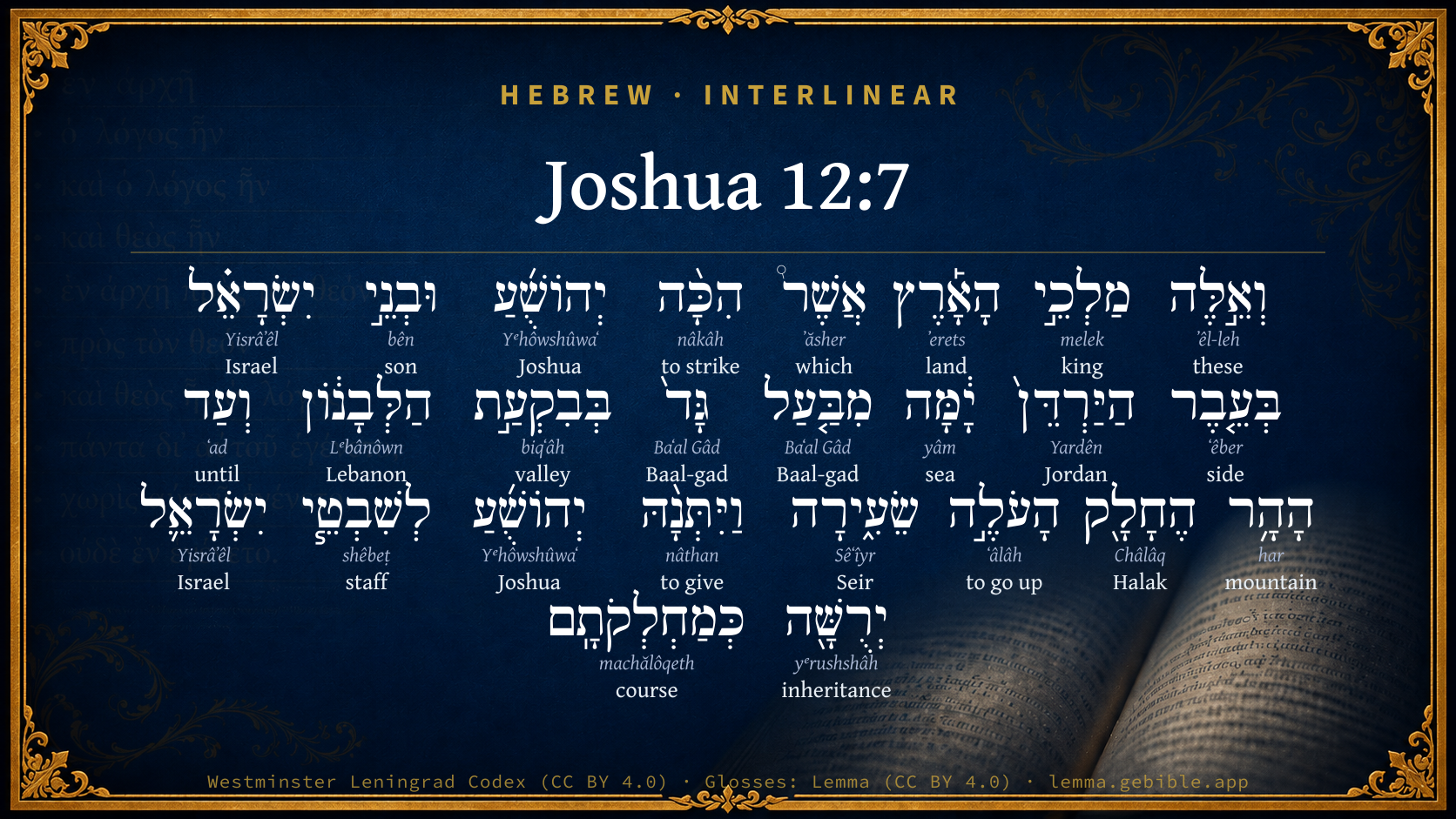
Joshua 12:7

Hebrew (Westminster Leningrad Codex) Joshua 12:7 appears in the Hebrew Old Testament. The text above is from the Westminster Leningrad Codex. Each word links to its Strong’s number, a concise gloss, and parsing drawn from the Open Scriptures Hebrew Bible morphology. Click any word for its full Brown-Driver-Briggs (BDB) entry.
Download image
Cite this verse

Joshua 12:7 (World English Bible). Public Domain. Lemma interlinear Bible study tool, https://lemma.gebible.app/v/joshua/12/7.

Show BibTeX & RIS
BibTeX
RIS
English Translation
These are the kings of the land whom Joshua and the children of Israel struck beyond the Jordan westward, from Baal Gad in the valley of Lebanon even to Mount Halak, that goes up to Seir; and Joshua gave it to the tribes of Israel for a possession according to their divisions;
World English Bible · Public Domain
Download a study sheet

One document with this verse’s original text, its word-by-word gloss line, the meaning frame, cross-references with their text, attributed commentary, and full source and license credits — printable, and it pastes into notes with its structure intact.

This verse Autodidact and up

Study sheet (.html) Plain text (.txt)

A passage Seminary Student

Up to 50 verses in one chapter. A passage sheet keeps up to 6 commentary sources and 12 cross-references per verse, in the order this page ranks them, and says so on the sheet whenever that leaves anything out. Ask for a single verse and you get the Autodidact verse sheet above.

Everything on this page stays free to read, with no account — the sheet is a download of what is already on screen, not access to it.

Want to remove ads? Support Godless Engineer
Compare translations 3

The same verse in 3 English versions, stacked beneath the original-language interlinear above. Click any original word for its lexicon entry.

Each is an independent rendering of the whole verse — the interlinear is not word-aligned to these translations.

Highlighted words mark where these versions differ — a whole-verse word diff, not a word-by-word alignment.

  • World English Bible Public Domain
    These are the kings of the land whom Joshua and the children of Israel struck beyond the Jordan westward, from Baal Gad in the valley of Lebanon even to Mount Halak, that goes up to Seir; and Joshua gave it to the tribes of Israel for a possession according to their divisions;
  • King James Version Public Domain
    And these are the kings of the country which Joshua and the children of Israel smote on this side Jordan on the west, from Baalgad in the valley of Lebanon even unto the mount Halak, that goeth up to Seir; which Joshua gave unto the tribes of Israel for a possession according to their divisions;
  • unfoldingWord Literal Text CC BY-SA 4.0
    Now these the kings of the land whom Joshua and the sons of Israel struck on the other side of the Jordan, toward the sea, from Baal Gad in the valley of the Lebanon and unto Mount Halak, the one ascending to Seir. And Joshua gave it to the tribes of Israel a possession according to their divisions,

unfoldingWord Literal Text — © unfoldingWord, licensed CC BY-SA 4.0. Word-aligned USFM3 via Door43 (git.door43.org/unfoldingWord/en_ult).

Versions to compare (up to 4)

3 of 4 selected

Show all 18 translations

Every available English version of this verse, each an independent rendering of the whole verse.

  • World English Bible Public Domain
    These are the kings of the land whom Joshua and the children of Israel struck beyond the Jordan westward, from Baal Gad in the valley of Lebanon even to Mount Halak, that goes up to Seir; and Joshua gave it to the tribes of Israel for a possession according to their divisions;
  • Berean Standard Bible Public Domain
    And these are the kings of the land that Joshua and the Israelites conquered beyond the Jordan to the west, from Baal-gad in the Valley of Lebanon to Mount Halak, which rises toward Seir (according to the allotments to the tribes of Israel, Joshua gave them as an inheritance
  • Majority Standard Bible Public Domain
    And these are the kings of the land that Joshua and the Israelites conquered beyond the Jordan to the west, from Baal-gad in the Valley of Lebanon to Mount Halak, which rises toward Seir (according to the allotments to the tribes of Israel, Joshua gave them as an inheritance
  • King James Version Public Domain
    And these are the kings of the country which Joshua and the children of Israel smote on this side Jordan on the west, from Baalgad in the valley of Lebanon even unto the mount Halak, that goeth up to Seir; which Joshua gave unto the tribes of Israel for a possession according to their divisions;
  • American Standard Version (1901) Public Domain
    And these are the kings of the land whom Joshua and the children of Israel smote beyond the Jordan westward, from Baal-gad in the valley of Lebanon even unto mount Halak, that goeth up to Seir; and Joshua gave it unto the tribes of Israel for a possession according to their divisions;
  • Revised Version (1885) Public Domain
    And these are the kings of the land whom Joshua and the children of Israel smote beyond Jordan westward, from Baal-gad in the valley of Lebanon even unto mount Halak, that goeth up to Seir; and Joshua gave it unto the tribes of Israel for a possession according to their divisions;
  • Geneva Bible (1599) Public Domain
    These also are the Kings of the countrey, which Ioshua and the children of Israel smote on this side Iorden, Westward, from Baal-gad in the valley of Lebanon, euen vnto the mount Halak that goeth vp to Seir, and Ioshua gaue it vnto the tribes of Israel for a possession, according to their portions:
  • Douay-Rheims (1899) Public Domain
    These are the kings of the land, whom Josue and the children of Israel slew beyond the Jordan on the west side from Baalgad in the held of Libanus, unto the mount, part of which goeth up into Seir: and Josue delivered it in possession to the tribes of Israel, to every one their divisions,
  • Young's Literal Translation Public Domain
    And these `are' kings of the land whom Joshua and the sons of Israel have smitten beyond the Jordan westward, from Baal-Gad, in the valley of Lebanon, and unto the mount of Halak, which is going up to Seir; and Joshua giveth it to the tribes of Israel -- a possession according to their divisions;
  • Literal Standard Version CC BY-SA 4.0
    And these [are] kings of the land whom Joshua and the sons of Israel have struck beyond the Jordan westward, from Ba‘al-Gad, in the Valley of Lebanon, and to the Mount of Halak, which is going up to Seir; and Joshua gives it to the tribes of Israel—a possession according to their divisions;
  • Unlocked Literal Bible CC BY-SA 4.0
    These are the kings of the land whom Joshua and the people of Israel defeated on the west side of the Jordan, from Baal Gad in the valley near Lebanon to Mount Halak near Edom. Joshua gave land to the tribes of Israel for them to possess.
  • unfoldingWord Literal Text CC BY-SA 4.0
    Now these the kings of the land whom Joshua and the sons of Israel struck on the other side of the Jordan, toward the sea, from Baal Gad in the valley of the Lebanon and unto Mount Halak, the one ascending to Seir. And Joshua gave it to the tribes of Israel a possession according to their divisions,
  • Darby Bible Public Domain
    And these are the kings of the land whom Joshua and the children of Israel smote on this side the Jordan on the west, from Baal-Gad in the valley of Lebanon as far as the smooth mountain, which rises toward Seir. And Joshua gave it to the tribes of Israel for a possession according to their divisions,
  • World Messianic Bible Public Domain
    These are the kings of the land whom Joshua and the children of Israel struck beyond the Jordan westward, from Baal Gad in the valley of Lebanon even to Mount Halak, that goes up to Seir. Joshua gave it to the tribes of Israel for a possession according to their divisions;
  • Webster's Bible Public Domain
    And these are the kings of the country whom Joshua and the children of Israel smote on this side of Jordan on the west, from Baal-gad in the valley of Lebanon, even to the mount Halak that goeth up to Seir; which Joshua gave to the tribes of Israel for a possession according to their divisions;
  • Free Bible Version CC BY-SA 4.0
    These are the kings of the land that Joshua and the Israelites defeated to the west of the Jordan, from Baal Gad in the valley of Lebanon to Mount Halak leading to Seir. Joshua gave it to the tribes of Israel to own as it was allotted to them.
  • Bible in Basic English Public Domain
    And these are the kings of the land whom Joshua and the children of Israel overcame on the west side of Jordan, from Baal-gad in the valley of Lebanon to Mount Halak, which goes up to Seir; and Joshua gave the land to the tribes of Israel for a heritage, in keeping with their divisions;
  • JPS Tanakh (1917) Public Domain
    And these are the kings of the land whom Joshua and the children of Israel smote beyond the Jordan westward, from Baal-gad in the valley of Lebanon even unto the bare mountain, that goeth up to Seir; and Joshua gave it unto the tribes of Israel for a possession according to their divisions;

Literal Standard Version (2020), Covenant Press — licensed CC BY-SA 4.0. Text via the HelloAO Bible API (eBible.org). Unlocked Literal Bible (unfoldingWord) — licensed CC BY-SA 4.0. Text via the HelloAO Bible API (eBible.org). unfoldingWord Literal Text — © unfoldingWord, licensed CC BY-SA 4.0. Word-aligned USFM3 via Door43 (git.door43.org/unfoldingWord/en_ult). Free Bible Version, Dr. Jonathan Gallagher — licensed CC BY-SA 4.0. Text via the HelloAO Bible API (eBible.org).

Word by word

More ways to search: Search by grammar → Find every occurrence → Compare this word →

Practice this passage: Drill this verse → Learn its vocabulary →

הֶחָלָ֖ק
Châlâq
H2510
“the · Halak”
Particle, Definite Article + Noun, Proper
Part of Speech
Particle + Noun
Type
Proper
Full BDB Definition

Origin: the same as H2509

TWOT: None

Halak = "smooth" - a mountain in southern Judah which is the southern limit of Joshua's conquest; site unknown
  1. וְאֵ֣לֶּה ʼêl-leh H428 “and · these” Conjunction + Pronoun, Demonstrative, Common, Plural
  2. מַלְכֵ֣י melek H4428 “kings of” Noun, Common, Masculine, Plural, Construct
  3. הָאָ֡רֶץ ʼerets H776 “the · land” Particle, Definite Article + Noun, Common, Both, Singular, Absolute
  4. אֲשֶׁר֩ ʼăsher H834 “which” Particle, Relative
  5. הִכָּ֨ה nâkâh H5221 “to strike” Verb, Hiphil, Perfect, 3rd Person, Masculine, Singular
  6. יְהוֹשֻׁ֜עַ Yᵉhôwshûwaʻ H3091 “Joshua” Noun, Proper
  7. וּבְנֵ֣י bên H1121 “and · sons of” Conjunction + Noun, Common, Masculine, Plural, Construct
  8. יִשְׂרָאֵ֗ל Yisrâʼêl H3478 “Israel” Noun, Proper
  9. בְּעֵ֤בֶר ʻêber H5676 “in/at · side of” Preposition + Noun, Common, Masculine, Singular, Construct
  10. הַיַּרְדֵּן֙ Yardên H3383 “the · Jordan” Particle, Definite Article + Noun, Proper
  11. יָ֔מָּה yâm H3220 “sea · toward” Noun, Common, Masculine, Singular, Absolute + Suffix, Demonstrative
  12. מִבַּ֤עַל Baʻal Gâd H1171 “from · Baal-gad” Preposition + Noun, Proper
  13. גָּד֙ Baʻal Gâd H1171 “Baal-gad” Noun, Proper
  14. בְּבִקְעַ֣ת biqʻâh H1237 “in/at · valley of” Preposition + Noun, Common, Feminine, Singular, Construct
  15. הַלְּבָנ֔וֹן Lᵉbânôwn H3844 “the · Lebanon” Particle, Definite Article + Noun, Proper
  16. וְעַד ʻad H5704 “and · until” Conjunction + Preposition
  17. הָהָ֥ר har H2022 “the · mountain” Particle, Definite Article + Noun, Common, Masculine, Singular, Absolute
  18. הָעֹלֶ֣ה ʻâlâh H5927 “the · going up” Particle, Definite Article + Verb, Qal, Participle Active, Masculine, Singular, Absolute
  19. שֵׂעִ֑ירָה Sêʻîyr H8165 “Seir · toward” Noun, Proper + Suffix, Demonstrative
  20. וַיִּתְּנָ֨הּ nâthan H5414 “and · to give · her” Conjunction + Verb, Qal, Sequential Imperfect, 3rd Person, Masculine, Singular + Suffix, Personal, 3rd Person, Feminine, Singular
  21. יְהוֹשֻׁ֜עַ Yᵉhôwshûwaʻ H3091 “Joshua” Noun, Proper
  22. לְשִׁבְטֵ֧י shêbeṭ H7626 “to/for · staffs of” Preposition + Noun, Common, Masculine, Plural, Construct
  23. יִשְׂרָאֵ֛ל Yisrâʼêl H3478 “Israel” Noun, Proper
  24. יְרֻשָּׁ֖ה yᵉrushshâh H3425 “inheritance” Noun, Common, Feminine, Singular, Absolute
  25. כְּמַחְלְקֹתָֽם machălôqeth H4256 “like/as · courses · their” Preposition + Noun, Common, Feminine, Plural, Construct + Suffix, Personal, 3rd Person, Masculine, Plural

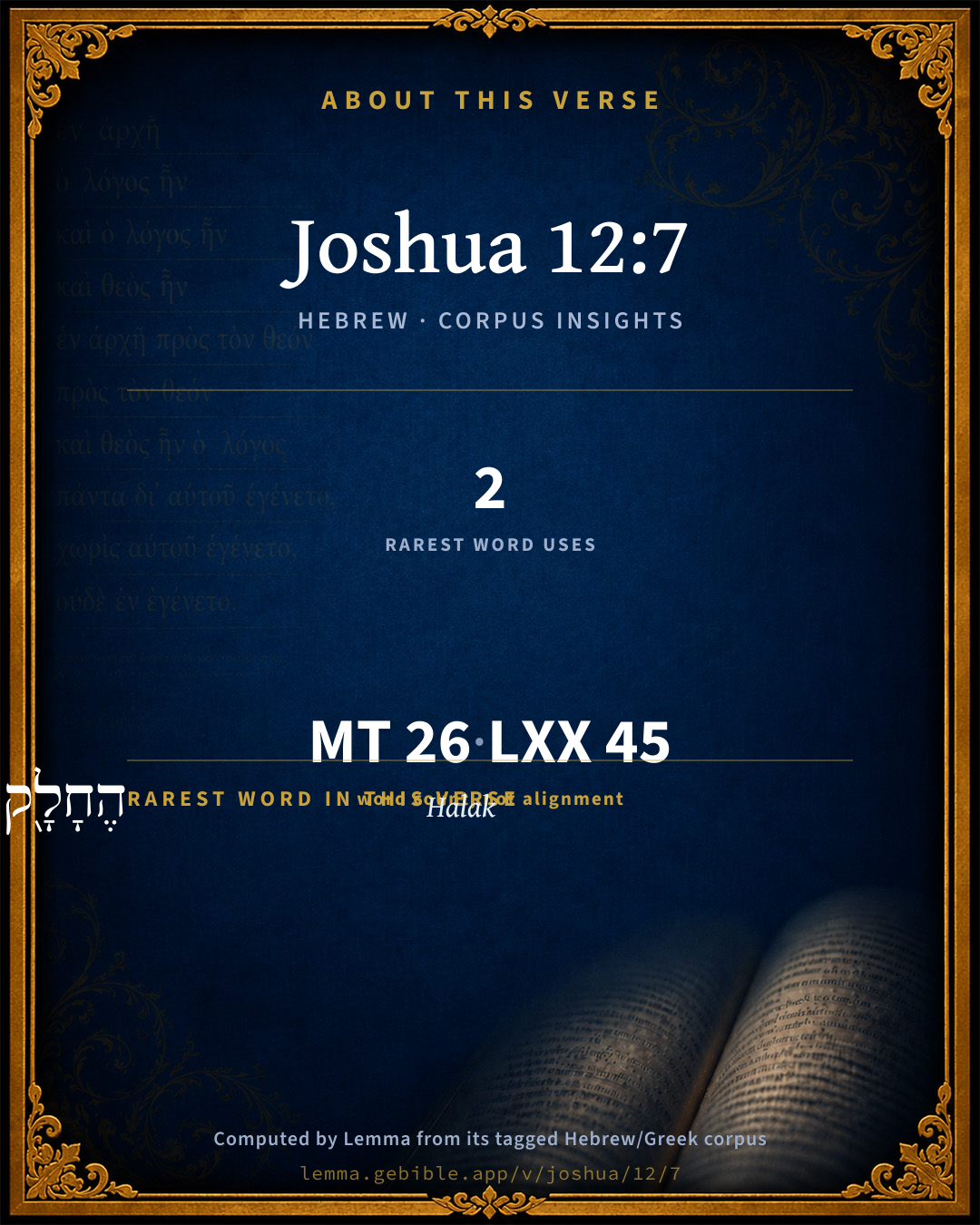
About this verse

These counts appear in no published source. They are computed here, from the morphology-tagged text and Lemma’s own curated glosses. What Lemma adds →

26
words
23
distinct lemmas
Historical
section

Notable vocabulary

The rarest word here is הֶחָלָ֖ק Halak H2510 — appearing just 2 times in the whole Hebrew Bible.

Shared distinctive vocabulary

הֶחָלָ֖ק Halak H2510 occurs in 2 verses of the Hebrew Bible. Also found in:

Grammatical profile

  • 3 verbs
  • 20 nouns
  • 1 pronoun
  • 1 preposition
  • 1 particle

Verb forms

  • הִכָּ֨ה Hiphil · Perfect
  • הָעֹלֶ֣ה Qal · Participle Active
  • וַיִּתְּנָ֨הּ Qal · Sequential Imperfect

Repetition

Words recur within this verse — often emphatic in Hebrew:

  • יְהוֹשֻׁ֜עַ Joshua H3091 ×2
  • יִשְׂרָאֵ֗ל Israel H3478 ×2
  • מִבַּ֤עַל Baal-gad H1171 ×2

Hebrew & Septuagint length

In English translation the verse runs 52 words from the Hebrew and 57 from the Septuagint (LXX English) — closely comparable.

A rough comparison of the two English renderings, which tokenize alike — not a word-level alignment.

Word counts can differ between the Hebrew and the Greek without any difference in meaning — e.g. the Hebrew direct-object marker אֵת has no separate Greek word, and Greek often adds the article ὁ.

In the original languages it is 26 Hebrew tokens and 45 Greek tokens — but the two are counted differently (Hebrew bundles its prefixes and suffixes into one token; the Greek is in lemma form), so that isn’t a like-for-like length.

Cross-references

14

Topical passages linked to Joshua 12:7 in the Treasury of Scripture Knowledge — connected by theme and wording, ordered by reader-vote popularity; previews shown in the World English Bible.

  • Joshua 11:17 from Mount Halak, that goes up to Seir, even to Baal Gad in the valley of Lebanon under Mount Hermon: and all their kings he took, and struck them, and put them to death.
  • Joshua 11:23–12:1 So Joshua took the whole land, according to all that Yahweh spoke to Moses; and Joshua gave it for an inheritance to Israel according to their divisions by their tribes. The land had rest from war.
  • Genesis 14:6 and the Horites in their Mount Seir, to Elparan, which is by the wilderness.
  • Genesis 32:3 Jacob sent messengers in front of him to Esau, his brother, to the land of Seir, the field of Edom.
  • Genesis 36:8 Esau lived in the hill country of Seir. Esau is Edom.
  • Genesis 36:20 These are the sons of Seir the Horite, the inhabitants of the land: Lotan, Shobal, Zibeon, Anah,
  • Genesis 36:30 chief Dishon, chief Ezer, and chief Dishan: these are the chiefs who came of the Horites, according to their chiefs in the land of Seir.
  • Deuteronomy 2:1 Then we turned, and took our journey into the wilderness by the way to the Red Sea, as Yahweh spoke to me; and we compassed Mount Seir many days.
  • Deuteronomy 2:4 Command you the people, saying, You are to pass through the border of your brothers the children of Esau, who dwell in Seir; and they will be afraid of you: take good heed to yourselves therefore;
  • Deuteronomy 11:23–24 then will Yahweh drive out all these nations from before you, and you shall dispossess nations greater and mightier than yourselves.
  • Joshua 1:3–4 Every place that the sole of your foot shall tread on, to you have I given it, as I spoke to Moses.
  • Joshua 3:17 The priests who bore the ark of the covenant of Yahweh stood firm on dry ground in the midst of the Jordan; and all Israel passed over on dry ground, until all the nation were passed clean over the Jordan.
  • Joshua 9:1 It happened, when all the kings who were beyond the Jordan, in the hill-country, and in the lowland, and on all the shore of the great sea in front of Lebanon, the Hittite, and the Amorite, the Canaanite, the Perizzite, the Hivite, and the Jebusite, heard of it;
  • Joshua 13:1–19 Now Joshua was old and well stricken in years; and Yahweh said to him, You are old and well stricken in years, and there remains yet very much land to be possessed.

Cross-references courtesy of OpenBible.info (CC BY 4.0).

Hebrew and Greek witnesses Masoretic Hebrew ↔ Greek Septuagint

The same verse in the two great witnesses to the Old Testament, shown verse-for-verse.

These are two independent witnesses, not word-aligned to each other, and the Septuagint is shown in lemma (dictionary) form.

Hebrew Joshua 12:7 Masoretic · Westminster Leningrad Codex

וְאֵ֣לֶּה מַלְכֵ֣י הָאָ֡רֶץ אֲשֶׁר֩ הִכָּ֨ה יְהוֹשֻׁ֜עַ וּבְנֵ֣י יִשְׂרָאֵ֗ל בְּעֵ֤בֶר הַיַּרְדֵּן֙ יָ֔מָּה מִבַּ֤עַל גָּד֙ בְּבִקְעַ֣ת הַלְּבָנ֔וֹן וְעַד הָהָ֥ר הֶחָלָ֖ק הָעֹלֶ֣ה שֵׂעִ֑ירָה וַיִּתְּנָ֨הּ יְהוֹשֻׁ֜עַ לְשִׁבְטֵ֧י יִשְׂרָאֵ֛ל יְרֻשָּׁ֖ה כְּמַחְלְקֹתָֽם

These are the kings of the land whom Joshua and the children of Israel struck beyond the Jordan westward, from Baal Gad in the valley of Lebanon even to Mount Halak, that goes up to Seir; and Joshua gave it to the tribes of Israel for a possession according to their divisions;

World English Bible · Public Domain

Greek LXX Joshua 12:7 Septuagint · lemma form

καί οὗτος ὁ βασιλεύς ὁ ἀμορραῖος ὅς ἀνααἱρέω ἰησοῦς καί ὁ υἱός ἰσραήλ ἐν ὁ πέραν ὁ ἰορδάνης παρά θάλασσα βααλγαδ ἐν ὁ πεδίον ὁ λίβανος καί ἕως ὁ ὄρος χελχα ἀναβαίνω εἰς σηιρ καί δίδωμι αὐτός ἰησοῦς ὁ φυλή ἰσραήλ κληρονομέω κατά κλῆρος αὐτός

And these are the kings of the Amorites, whom Joshua and the children of Israel killed beyond Jordan by the sea of Balagad in the plain of Libanus, and as far as the mountain of Chelcha, as men go up to Seir: and Joshua gave it to the tribes of Israel to inherit according to their portion;

LXX2012 (modern English Septuagint) · Public Domain

Hebrew: Westminster Leningrad Codex (CC BY 4.0). Greek: Septuagint (public domain); English from LXX2012 (modern English Septuagint) (Public Domain). How the Septuagint differs from the Hebrew →

Targum (Aramaic paraphrase)

1

The Targum is the ancient Jewish Aramaic paraphrase of the Hebrew Scriptures — an interpretive translation, not the Hebrew text itself. Onkelos (literal) and Pseudo-Jonathan (expansive) render the Torah, and Jonathan the Prophets. Coverage is partial: where no permissively-licensed English translation exists for a verse, only the Aramaic is shown. This is verse-level text, not a word-by-word alignment to the Hebrew.

  1. Targum Jonathan Prophets (Joshua–Malachi)
    וְאִלֵין מַלְכֵי אַרְעָא דִי מְחָא יְהוֹשֻׁעַ וּבְנֵי יִשְׂרָאֵל בְּעִבְרָא דְיַרְדְנָא מַעַרְבָא מִמֵישַׁר גָד בְּבִקְעַת לִבְנָן וְעַד טוּרָא פְלִיגָא דְסָלִיק לְשֵׂעִיר וְיַהֲבָהּ יְהוֹשֻׁעַ לְשִׁבְטָא יִשְׂרָאֵל יְרוּתָא כְּפַלְגוּתְהוֹן:

    (no public-domain English translation for this verse)

    Targum Jonathan — Aramaic: “Mikraot Gedolot” (public domain). English: “Sefaria Community Translation” (CC0 1.0 (public-domain dedication)); “London "Chaldee Paraphrase," 1871” (public domain). Text via Sefaria.

Commentary

Notes on Joshua 12:7 from classic Christian and Jewish commentators (each source and its license shown beneath its notes). The classic Christian expositions comment on the surrounding passage and are grouped to its opening verse, so a note may address several verses; the Jewish commentaries on the Tanakh (Rashi and others) are per-verse, so they appear only where the commentator wrote on this verse.

Lemma curates 59 commentaries, every one of them public domain or Creative Commons licensed, each selected and text-cleaned for this edition rather than reprinted as found. About our sources →

Jamieson, Fausset & Brown

Robert Jamieson, A. R. Fausset & David Brown

THE ONE AND THIRTY KINGS ON THE WEST SIDE OF JORDAN, WHICH JOSHUA SMOTE. (Jos. 12:7-24)

Baal-gad . . . even unto . . . Halak--(See on Jos 11:17). A list of thirty-one chief towns is here given; and, as the whole land contained a superficial extent of only fifteen miles in length by fifty in breadth, it is evident that these capital cities belonged to petty and insignificant kingdoms. With a few exceptions, they were not the scenes of any important events recorded in the sacred history, and therefore do not require a particular notice.

Next: Joshua Chapter 13

Jamieson, Fausset & Brown — Commentary Critical and Explanatory on the Whole Bible (1871) — public domain (CC PDM 1.0). Text via the HelloAO Bible API.

Trapp's Complete Commentary

John Trapp

Jos 12:7 And these [are] the kings of the country which Joshua and the children of Israel smote on this side Jordan on the west, from Baalgad in the valley of Lebanon even unto the mount Halak, that goeth up to Seir; which Joshua gave unto the tribes of Israel [for] a possession according to their divisions;

Ver. 7. Which Joshua gave unto the tribes of Israel.] A spacious and fruitful tract of ground, a country, which if God had fashioned the world like a ring, as he did like a globe, might have been the gem of it. But what was Canaan in its flourish in comparison of heaven, and of that city of pearl, the new Jerusalem, whither the Lord Christ will certainly bring all his people in despite of their enemies! they shall surely and safely sail, through Christ’s blood, into the bosom of the Father, and unto those mountains of spices. {Son 8:14}

John Trapp, A Commentary or Exposition upon All the Books of the Old and New Testament (1647–1656) — public domain. Text from a community e-Sword module.

Whedon's Commentary on the Bible

Daniel D. Whedon

LIST OF THE KINGS SUBDUED BY JOSHUA, Jos_12:7-24.

[This list is acknowledged by the most rationalistic critics to be a very ancient document. Ewald speaks of it as “a record of remarkable interest in many ways. Its distinctive antiquity would be sufficiently evident from its enumeration of cities which in those early days were great and powerful, but which afterwards sank into absolute insignificance, or were never heard of again.” It was not improbably composed by Joshua himself. A number of the kings here mentioned are not otherwise known, but so far as the previous history throws light on it this list follows mainly the order of the conquest. On the apparent exceptions see note on Jos_12:16.

From the fulness of this list as compared with the previous history we at once see that it was no object of the compiler of the Book of Joshua to record a complete history of all the wars and conquests of Joshua. He has given a detailed account of only the most important, but enough to show, together with this list, that under the administration of the great captain the whole land was subdued.]

7-13. For Baal-gad and Halak see Jos_11:17. For the Canaanitish tribes see Jos_3:10.

Jericho — See Jos_2:1.

Ai and Bethel — See Jos_7:2.

Jerusalem — See Jos_10:1.

Hebron, Jarmuth, Lachish, and Eglon — See Jos_10:3.

Gezer — See Jos_10:33.

Debir — See Jos_10:38. Geder is now unknown.

14. Hormah — The name of this city was originally Zephath, (Jdg_1:17,) and a trace of this latter name Dr. Robinson found in the rocky pass es-Sufah in the mountain barrier which completes the plateau of Southern Palestine; but the true identification is with Sebaita, some twenty-five miles south-west of Beer-sheba. See note on Jdg_1:17. The name Hormah commemorates the execution of the ban or curse of utter destruction which Moses pronounced on all the dependencies of Arad, (Num_21:2,) and which Judah and Simeon fulfilled. Jdg_1:17. Arad still exists in Tell Arad, twenty miles south of Hebron. Dr. Robinson describes it as “a barren-looking eminence rising above the country around.” Its king troubled Israel in their desert journey, Num_21:1.

Daniel D. Whedon (gen. ed.), Commentary on the Old and New Testaments (1874–1909) — public domain. Text from a community e-Sword module.

The Preacher's Complete Homiletical Commentary

Joseph S. Exell (gen. ed.)

CRITICAL NOTES.—

Jos_12:7. Baal gad.… Halak] Cf. on chap. Jos_11:17.

Jos_12:8. Mountains, etc.] Cf. on chapters Jos_9:1; Jos_10:40. Geographical notes on most of the places named in the following verses will be found under the Critical Notes of the preceding chapters, principally under chapters 10, 11.

Jos_12:13. King of Geder] Geder is thought to be the Gederah of chap. Jos_15:36, and was probably situated in the lowlands of Judah.

Jos_12:14. Hormah] = “destruction.” The place was thus devoted on two occasions (Num_21:3; Jdg_1:17). As the latter passage indicates, it was also called Zephath. The Israelites were defeated in this locality after the return of the spies (Num_14:45). The site is placed by Robinson near the pass es-Sufah, on the south of the Dead Sea. Arad] On the north of the wilderness of Judah (Jdg_1:16), i.e., the southern part of this wilderness. It is thought to have been about twenty miles directly south of Hebron.

Jos_12:15. Adullam] A city of great antiquity (Gen_38:1), situated in the Shephelah (Jos_15:33; Jos_15:35), not far from Gath. It was fortified by Rehoboam, reoccupied on the return from the captivity (Neh_11:30), and is mentioned under the name of Odollam in 2Ma_12:38.

Jos_12:17. Tappuah] Probably that mentioned in chap. Jos_15:33-34, as in the Shephelah, or it may be the Tappuah on the frontier between Ephraim and Manasseh (chaps. Jos_16:8; Jos_17:8). There was also a Beth-Tappuah in the mountains of Judah (chap. Jos_15:53). Hepher] = “a pit.” “In 1Ki_4:10 we find it mentioned as “all the land of Hepher,” being named together with Shochoh as placed under one of the twelve officers whom Solomon set over all Israel. It should therefore be looked for near to Shochoh, i.e., in the Shephelah, and not, as by Knobel, be identified with Haphraim (= “two pits”) in the plain of Jezreel, belonging to Issachar (chap. Jos_19:19). It is also to be distinguished from Gath-Hepher, or Gittah-Hepher, in the tribe of Zebulon (chap. Jos_19:13; 2Ki_14:25).

Jos_12:18. Aphek] = “strength.” It might be applied, says Dean Stanley, to any fort or fastness. “It is so common a name in Palestine, that its mention in 1Sa_29:1 is not of itself sufficient to identify it with the spot so called near Jerusalem, in 1Sa_4:1; and the scene of the first Philistine victory must therefore remain uncertain, since there is nothing in the details of the battle to fix it” (Sinai and Palestine). The Aphek here named is thought to be the same as Aphekah, in the mountains of Judah (chap Jos_15:53), while Keil holds it to be identical with the Aphek of 1Sa_4:1.

Jos_12:19. Lasharon] Cf. Margin. Mentioned only in this place, and not known.

Jos_12:21. Taanach … Megiddo] Two cities generally named together, situated on the boundary between Manasseh and Issachar, in the plain of Esdraelon by the river Kishon, into which the “waters of Megiddo” probably ran. The neighbourhood is famous as the scene of some of the most important battles in Hebrew history.

Jos_12:22. Kedesh] “A Levitical city of refuge on the mountains of Naphtali (chap. Jos_19:37; Jos_20:7; Jos_21:32), according to the Onomast., twenty Roman miles from Tyre. There are two other cities mentioned of the same name—one in Judah (chap. Jos_15:23), and the other in Issachar (1Ch_6:72)” [Keil.] Jokneam of Carmel] Belonging to Zebulon, and given to the Merarite Levites (chap. Jos_21:34). Robinson thinks it may be placed at the modern Tel Kaimon.

Jos_12:23. Nations of Gilgal] Lit.=“Goyim of Gilgal.” The Goyim are thought to have been certain tribes, as those named in Gen_14:1, called by this term as a proper name, and living in Gilgal, now Jiljilia, near Antipatris.

Jos_12:24. Tirzah] “Evidently near Shechem, and of proverbial beauty (Son_6:4); selected by the first sovereign, Jeroboam (1Ki_14:17), and then, during three short reigns, the habitual residence of the royal house (1Ki_15:21; 1Ki_16:8; 1Ki_16:17; 1Ki_16:23). [Stanley’s Sinai and Palestine.] Robinson identifies the city with Telluzah.

Jos_12:7-24. THE COUNTED AND UNCOUNTED DEAD.

In the brief chronicles of these few verses, dull and unimaginative as they look, there may be traced two or three features not without their pathos, and not devoid of significance to us who are the tenants of life and time now.

I. Some of the dead are counted, and some are not counted. Here is one man put down as slain, to represent a kingdom of dead. That is done in each of the thirty-one instances. The slain of the army and the slain of the home, the slain who were aged and the slain who were young, slain men and slain women: all these are merely counted in their slain king. Modern registration may be more thorough, but in the minds and thoughts of surviving men and women now, the count of the dead proceeds on much the same basis.

1. Men count the few, and not the many. Only here and there a name of the past survives in the present. The living are too weak, in more ways than one, to bear in mind more than a few of the dead. We, too, count our dead representatively.

2. Men count the great, and pass over the obscure. In the realms of statesmanship, eloquence, literature, art, science, and the like, men can do little more than put down the names of their kings.

3. Men count the deaths which are unusually sad, and keep little reckoning of such as are more ordinary. Irrespective of those who may be left, it seems more than a common calamity for a king to be slain, or die. To pass out of all the magnificence and power of an imposing past into a stillness and silence and helplessness which differ nothing from that of a dead peasant, seems peculiarly sad for the dying man himself. So, for a little season, over whatever realm the departed king may have reigned, his survivors will remember him. They put his death down in their chronicles.

4. Men count the rich and forget the poor. Great wealth? then much marble, or granite; little wealth? only a small monument; just enough during life for life’s necessities? the barest measure of plainest stone must suffice in death; very poor? then no stone whatever, and, it may be, not even a grave to oneself. Such is the testimony given by the graveyards and the cemeteries; and, taking society in its broader aspect, the witness without is a pretty faithful symbol and record of the mind within. What county, or town, or parish, remembers a dozen of its poor of the last generation? Without murmuring against the inevitable, it may be well sometimes to mark the fact.

5. God counts, and will count, every one. He forgets no single person in all the host of the dead. From the youngest infant to Methuselah, from the poorest person to the richest, He remembers all. “I saw the dead, small and great, stand before God.”

II. These dead Canaanites, counted and uncounted, were all overtaken by a common judgment. Kings, and leaders, and people, fell in a general slaughter. Heedless of condition or character, every one appeared to be dealt with alike.

1. In this life the guilty and innocent often seem to be judged in the same measure. (a) Some men are conspicuously guilty. They are leaders in wickedness. They use high positions and great influence to lead others astray. (b) Others are comparatively innocent. Like many of these Canaanites, who, it may be, held aloof from the wickedness around them, they take little active part in the open wickedness of their fellows. (c) The innocent and guilty seem to be dealt with alike. Children and adults, worshippers of idols and those who refused to worship, fell in the same way before the swords of the Israelites. Men look on life as, in its degree, it everywhere repeats this history; and they say, “The ways of the Lord are not equal.”

2. The judgments of life are far more equal than they seem. (a) The particular way in which we may be taken out of this life is a very small item in the account of eternity. We must all die. Who can say what time is the best? Who can say what manner is the best? God has the right to choose both the time and manner of our departure. It is best so. We are thankful it is so. What a mass of embodied pain and crime and wrinkled wickedness would still crawl the earth, if men chose the day of their own death! Ahab and Jezebel and Judas and Nero would be with us still. What perplexity would fill men if they had to decide on the manner of their departure! Men would stand before the various diseases, and other ways of exit, saying, “What I shall choose I wot not.” To have made us all choose our own way of dying would have been for God to have doubled the ordeal: most men would have suffered at least one death in anticipation, ere they came to the fact. It is probably only our shortsightedness, and our recoil from the horror that is visible, which leads us to throw so much emphasis as we mentally do on the slaughter of these more innocent Canaanites by the sword. Anyway, the manner and time of death are small items in the matter of eternity. (b) God’s real judgment of every man is within the man. Much of punishment is the recoil of our own guilt. The true Nemesis is not some one with a pair of scales and a whip, standing without us, but something standing within us, making us to do our own weighing and our own scourging.

“Fear not, then, thou child infirm:

There’s no god dare wrong a worm.

Laurel crowns cleave to deserts,

And power to him who power exerts;

Hast not thy share? on winged feet,

Lo! it rushes thee to meet;

And all that Nature made thy own,

Floating in air, or pent in stone,

Will rive the hills and swim the sea,

And, like thy shadow, follow thee.”

Emerson.

(c) This judgment of God within a man is continued after this life, and is always true and equal to the man’s deserts. Thus, the Saviour, for once during His ministry, draws aside the veil that shuts out perdition, and shews us Abraham standing afar off, and saying in language of terrible significance to Dives: “Son, remember.” Whatever may be the outward state of the wicked on the other side of this life, surely this “remembering” will be the judgment.

III. These dead are all overwritten by a common epitaph. The counted kings, and the uncounted people, were those “which Joshua and the children of Israel smote.” They were not merely killed in a war; they were “smitten” because of idolatry. God had said: “The iniquity of the Amorites is not yet full,” and, till it became full, God waited. Then the Israelites were bidden to smite. Thus the common epitaph of all these Canaanites is really this: “Slain because of idolatry.”

1. The state of unrepented sin generally leads to some conspicuous sin, great in the insult which it offers God and in the injury which it does to men.

2. The conspicuous sins of men, which stand immediately connected with judgment, are but the outcome of a life of sin.

3. The conspicuous sin of this dispensation, with which the judgment of men is specially connected, is the rejection of the Saviour. The great epitaph which stands written over all those who enter into “the second death” is a very brief one. Of His children God writes, “These all died in faith”; of the rest of mankind it may be said, “These all died in unbelief.”

The Preacher's Complete Homiletical Commentary (gen. ed. Joseph S. Exell; Funk & Wagnalls, c. 1892) — public domain (pre-1929). A full-Bible homiletical/sermon-outline anthology covering 65 of 66 books (2 John is absent from the source module). Text from a community e-Sword module.

Tyndale Open Study Notes

Tyndale Open Resources

12:7-24 Joshua and the Israelite armies faithfully carried out the tasks God gave them. This summary showcases their successes, providing proper recognition for their faithfulness. God gave the Israelites their promised inheritance while bringing about the long-delayed judgment of the Canaanites. This roster of defeated kings, identified by their city-states, provides evidence of God’s accomplished purposes. A solemn yet joyful recital for Israel, the list symbolizes God’s mighty acts for his people and exalts his own great name.

12:7 Baal-gad was at the western foot of Mount Hermon, the northern limit of Joshua’s conquests west of the Jordan. • The valley of Lebanon divided the coastal Lebanon range and the inland Anti-Lebanon range. • Mount Halak, which leads up to Seir (i.e., Edom), marked the southern limit of Joshua’s conquests.

Tyndale Open Study Notes — © Tyndale Open Resources, licensed CC BY-SA 4.0. Text via the HelloAO Bible API.

Geneva Bible (1599)

Geneva Bible translators

Read Josh. 11:17.

Geneva Bible (1599) marginal notes — public domain. Text via Bolls.life.

Matthew Henry's Commentary

We have here a breviate of Joshua's conquests.

I. The limits of the country he conquered. It lay between Jordan on the east and the Mediterranean Sea on the west, and extended from Baal-gad near Lebanon in the north to Halak, which lay upon the country of Edom in the south, v. 7. The boundaries are more largely described, Num 34:2, etc. But what is here said is enough to show that God had been as good as his word, and had given them possession of all he had promised them by Moses, if they would but have kept it.

II. The various kinds of land that were found in this country, which contributed both to its pleasantness and to its fruitfulness, Jos 12:8. There were mountains, not craggy, and rocky, and barren, which are frightful to the traveller and useless to the inhabitants, but fruitful hills, such as put forth precious things (Deu 33:15), which charmed the spectator's eye and filled the owner's hand. And valleys, not mossy and boggy, but covered with corn, Psa 65:13. There were plains, and springs to water them; and even in that rich land there were wildernesses too, or forests, which were not so thickly inhabited as other parts, yet had towns and houses in them, but served as foils to set off the more pleasant and fruitful countries.

III. The several nations that had been in possession of this country - Hittites, Amorites, Canaanites, etc., all of them descended from Canaan, the accursed son of Ham, Gen 10:15-18. Seven nations they are called (Deu 7:1), and so many are there reckoned up, but here six only are mentioned, the Girgashites being either lost or left out, though we find them, Gen 10:16 and Gen 15:21. Either they were incorporated with some other of these nations, or, as the tradition of the Jews is, upon the approach of Israel under Joshua they all withdrew and went into Africa, leaving their country to be possessed by Israel, with whom they saw it was to no purpose to contend, and therefore they are not named among the nations that Joshua subdued.

IV. A list of the kings that were conquered and subdued by the sword of Israel, some in the field, others in their own cities, thirty-one in all, and very particularly named and counted, it should seem, in the order in which they were conquered; for the catalogue begins with the kings of Jericho and Ai, then takes in the king of Jerusalem and the princes of the south that were in confederacy with him, and then proceeds to those of the northern association. Now, 1. This shows what a very fruitful country Canaan then was, which could support so many kingdoms, and in which so many kings chose to throng together rather than disperse themselves into other countries, which we may suppose not yet inhabited, but where, though they might find more room, they could not expect such plenty and pleasure: this was the land God spied out for Israel; and yet at this day it is one of the most barren, despicable, and unprofitable countries in the world: such is the effect of the curse it lies under, since its possessors rejected Christ and his gospel, as was foretold by Moses, Deu 29:23. 2. It shows what narrow limits men's ambition was then confined to. These kings contented themselves with the government, each of them, of one city and the towns and villages that pertained to it; and no one of them, for aught that appears, aimed to make himself master of the rest, but, when there was occasion, all united for the common safety. Yet it should seem that what was wanting in the extent of their territories was made up in the absoluteness of their power, their subjects being all their tenants and vassals, and entirely at their command. 3. It shows how good God was to Israel, in giving them victory over all these kings, and possession of all these kingdoms, and what obligations he hereby laid upon them to observe his statutes and to keep his laws, Psa 105:44, Psa 105:45. Here were thirty-one kingdoms, or seigniories, to be divided among nine tribes and a half of Israel. Of these there fell to the lot of Judah the kingdoms of Hebron, Jarmuth, Lachish, Eglon, Debir, Arad, Libnan, and Adullam, eight in all, besides part of the kingdom of Jerusalem and part of Geder. Benjamin had the kingdoms of Jericho, Ai, Jerusalem, Makkedah, Beth-el, and the nations of Gilgal, six in all. Simeon had the kingdom of Hormah and part of Geder. Ephraim had the kingdoms of Gezer and Tirzah. Manasseh (that half-tribe) had the kingdoms of Tappuah and Hepher, Taanach and Megiddo. Asher had the kingdoms of Aphek and Achshaph. Zebulun had the kingdoms of Lasharon, Shimron-meron, and Jokneam. Naphtali had the kingdoms of Madon, Hazor, and Kedesh. And Issachar had that of Dor. These were some of the great and famous kings that God smote, for his mercy endureth for ever; and gave their land for a heritage, even a heritage unto Israel his servant, for his mercy endureth for ever, Psa 136:17, etc.

Matthew Henry's Commentary on the Whole Bible (1708–1710) — public domain (CC PDM 1.0). Text via the HelloAO Bible API.

Adam Clarke's Commentary

Verse 7. From Baal-gad] A repetition of what is mentioned Jos 11:17.

Adam Clarke's Commentary on the Bible (1810–1826) — public domain. Text from a community e-Sword/MySword module.

The Cambridge Bible for Schools and Colleges

gen. ed. J. J. S. Perowne

7–24. Catalogue of the Kings vanquished on the West of the Jordan

7. And these are the kings] This and the following verse coincide with ch. Jos_11:16, and Jos_10:40-42. They introduce the following narrative.

The Cambridge Bible for Schools and Colleges (gen. ed. J. J. S. Perowne; Cambridge University Press, 1878–1918) — public domain. Text from a community e-Sword module.

John Gill's Exposition

And these are the kings of the country,.... After particularly named, Jos 12:9,

which Joshua and the children of Israel smote on this side Jordan on the west; that is, on the west of Jordan:

from Baalgad, in the valley of Lebanon, even unto the mount Halak,

that goeth up to Seir; of which see Jos 11:17,

which Joshua gave unto the tribes of Israel for a possession,

according to their divisions; as after related in this book.

John Gill's Exposition of the Whole Bible (1746–1763) — public domain (CC PDM 1.0). Text via the HelloAO Bible API.

Albert Barnes' Notes on the Bible

The names of the kings are given in the order of their actual encounter with Joshua. Those enumerated in Jos 12:10-18 either belonged to the league of the southern Canaanites (Jos 10:1 ff), the power of which was broken in the battle of Beth-horon, or were at any rate conquered in the campaign following that battle. Those mentioned in Jos 12:19-24 were in like manner connected with the northern confederates (Jos 11:1 ff), who were defeated at the Waters of Merom.

Jos 12:13-20

The identification of several of these places is still uncertain: the same name (e. g. Aphek, Jos 12:18) being applied to various places in various parts of Palestine. Geder, or Gedor Jos 15:58, a city in the mountain district in the south of the territory of Judah, is no doubt the modern “Jedur”.

Jos 12:21

Taanach - A Levitical town Jos 21:25 in the territory of Issachar, but assigned to the Manassites (Jos 17:11; Compare 1Ch 7:29), is identified with “Taanuk”. It was here that Barak encountered the host of Sisera Jdg 5:19. Megiddo was near it, and is thought to have been “el Lejjun” (the Roman Legion), (or Mujedd’a (Conder)).

Jos 12:22

Kedesh - i. e. Kedesh Naphtali, a city of refuge, a Levitical city, and the home of Barak Jdg 9:6.

Jokneam - A Levitical city in the territory of Zebulon Jos 19:11; perhaps the modern “Kaimon”. “Tell Kaimon” is a conspicuous and important position, commanding the main pass across the ridge of Carmel from Phoenicia to Egypt. This famous mountain range (about 15 miles long) no doubt received the name Carmel (the word means “a fruitful field” as opposed to “wilderness”) as descriptive of its character; and thus the name became an emblem of beauty and luxuriance (Isa 35:2; Son 7:5, etc.). Its highest part, about 4 miles from Tell Kaimon, is nearly 1,750 feet above the sea. Its modern name, “Jebel Mar Elias”, preserves still that association with the great deeds of Elijah, from which Carmel derives its chief Biblical interest. Mount Carmel was probably, like Lebanon, from very ancient Canaanite times, regarded as especially sacred; and since the altar of the Lord repaired by Elijah 1Ki 18:30 was an old one which had been broken down, Carmel was probably no less esteemed by the Israelites also. In later times the caves which abound toward the western bluffs of the range have been frequented by Christian, Jewish, and Mussulman anchorites. The order of Carmelite or barefooted friars took its rise from the convent founded by Louis, which still crowns the western headland.

Jos 12:23

The king of the nations - See Gen 14:1 and note. It means king of certain mixed and probably nomadic tribes, which regarded Gilgal Jos 9:19 as their center and capital.

Jos 12:24

Tirzah - This place, the capital of Jeroboam and his successors until the clays of Omri (1Ki 14:17; 1Ki 15:21, etc.), is identified by some with “Tulluzah”, a town 3 miles northeast of Nablous, (by others with Teiasir).

Albert Barnes' Notes on the Bible (1834–1885) — public domain. Text from a community e-Sword/MySword module.

Haydock's Catholic Bible Commentary

Seir. The same expression occurs, chap xi. 17. Hebrew, "from Baalgad, in the vale of Libanus, even unto Mount Halak, that goeth up to Seir." (Haydock) --- Halak means, "bald or naked." It is not know what mountain it denotes. Josue, (Calmet) or the Israelites, (Haydock) conquered "all the country beyond the Jordan, on the north from Baalgad, at the foot of Libanus, and from Hermon, where these mountains meet, as far as the mountains of separation," which divide the country of Chanaan from that of Seir, on the south of Judea. (Calmet) --- Baalgad was situated on the north western borders of this territory, not of the Jordan. (Haydock)

George Leo Haydock (1774–1849), Haydock's Catholic Family Bible and Commentary, 1859 edition — public domain. Excludes Psalms (Douay-Rheims chapter numbering differs from Protestant) and Deuterocanonical books (Catholic canon only).

The Pulpit Commentary

And these are the kings of the country. We now proceed to the enumeration of the kings whom Joshua had overcome on the western side of Jordan. And the first thing that strikes us is their immense number, as compared to the two potentates who alone occupied the large tract of country subdued on the other side of Jordan. Such a divided territory could hardly have maintained itself in the face of the powerful monarchs Sihon and Og to the eastward of Jordan. We are thus led to the conclusion that the smaller kings must have been tributary to some more powerful monarch who was the head of the confederacy. Such Bretwaldas, to borrow a term from our own history, the kings of Jerusalem and Hazor appear to have been, the one the head of the northern, the other of the southern tribes of Palestine, while possibly the five Philistine cities may have constituted another league, as they appear to have successfully defied the power of the Israelites from the first. That such confederacies existed at a much earlier time, we find from Gen_14:1-5, where the king of Elam, or Persia, appears as the head of such a one, though of a more extensive character. The resistance to his power organised by the kings in the neighbourhood of the Dead Sea is another case in point. Possibly in later times Persia and Babylon found their hands full in their conflict with one another, and with Egypt under Thothmes III, as afterwards under the all-conquering Rameses II, better known as Sesostris, and they had to leave the tribes of Palestine awhile to themselves. Or the rulers of the central power at Carchemish (see Introduction) may have exercised a kind of suzerainty over all. The next point to be observed is that, in the list of kings that follows, a good many are mentioned beside those enumerated in Jos 10. No doubt, as in the earlier history of this island, there were not only heads of leagues, and their tributary monarchs, but under kings also, who were actually subject to the reigning monarchs, and involved in their fall. Compare the other cities mentioned in connection with Gibeon, Jos_9:17. Baal-Gad, in the valley of Lebanon. See for this whole passage note on Jos_11:16, Jos_11:17.

HOMILIES BY R. GLOVER Vers. 7-24. The catalogue of the vanquished.

A melancholy document, meaning little more to us than a column in a directory, but meaning much to multitudes. Many of these kings would be lamented in elegies as sweet as David"s song over Saul and Jonathan. Some, doubtless, were noble, perhaps some devout, but implicated in a national fate to the deserving of which they had not contributed. Linger over these a little and observe

I ALL ARMIES WILL FIND THEIR PLACE IN ONE OF TWO CATALOGUES THAT OF VICTORS, OR THAT OF VANQUISHED. We lament that to place Israel God must displace others. That heroism conquering a home assumes also heroism fighting in vain to keep one. Life in its deepest action must always be a struggle, ending in victory or defeat. Every foolish life ends in failure, and in a consciousness like that of a beaten general, of plans unwisely formed and forces unhappily employed. Those who follow God"s guidance in all the affairs of life are fighters in a combat in which their success confers blessings on themselves and on society at large. All who refuse God"s guidance in their general affairs are fighters in a combat in which their success, if achieved, would damage others still more than their failure would hurt themselves. Those who choose wrongly thus find life a losing game, a disastrous battle. It would be well if all realised that not to win a victory with life is to suffer a terrible defeat, is to be left with loss of power, and with infinite damage. In one or other list we all shall be. Crowned as victors, humiliated and discredited as failures.

II MOST OF THOSE IN THAT LIST NEVER EXPECTED TO BE IN IT. Why should they? They had theories like ours today of the superiority of training in arms, of fortifications, of what they called their civilisation, to any rude force which nomadic hordes could bring. But they are beaten. Pride goeth before destruction. Many reliant in their strength of purpose are destroyed by temptations they despised. Youth dreams of only bright and golden issues to its life. Too often the only issues are deplorable. Do not assume your life is going to be a grand success. Victory is desert not drift, achievement not accident. Even to retain requires energy. These men could not transmit to others what had been transmitted to them.

III THEY WERE NOT SAVED BY PROFESSION OF SANCTITY. Some of the cities here had already had a long reputation for sanctity. "Jerusalem" had been Melchizedek"s seat; "Bethel," the old name of the locality (though the city was Luz), means "the house of God." "Kedesh" means "a holy place." These all seem to have been spots consecrated to the service of the true God. Consecrated peoples have God"s protection; consecrated places go without. "Judgment" does not spare, it "begins with the house of God." Later inhabitants of Jerusalem may say, "The temple of the Lord, the temple of the Lord axe these." But the sanctity of the site increases, it does not avert the punishment of those profaning it. There is something very solemn in this removal of the candlesticks which had served the Pre-Abrahamic Church. England is today a great Bethel, a sublime Kedesh. May we have grace to act worthily of, and so retain, our eminence.

IV THE INDIVIDUAL SHARES THE FATE OF THE COMMUNITY. Some of these kings and their people, doubtless, were worthy of a better fate. But implicated in the fortunes of the general community, leaguing with it for its defence, they come in for its fate. It is strange how the individual has to share the lot of the community. The accident of our birth may determine our calling, our fortune, even our creed, and our character. Advantages for which others have wrought, disabilities which others have transmitted, are inherited by us. "Other men have laboured, and we have entered into their labours." Sometimes other men have sinned, and we have entered into their penalty. There is, indeed, an inner realm whose fortunes depend only on ourselves. But we are members one of another, and must participate the general fortune. We should therefore cherish more patriotism, more religious interest in our country"s politics and action. The welfare of those yet unborn depends on the wisdom of the generation today existent. Let us not leave to our successors a "heritage of woe," such as was left to these kings of Canaan. Look on them with pity, with modest humility, asking of your soul, "Who maketh thee to differ?" It may be some Canaanitish bard lamented the dead at the waters of Merom, as the Scottish bard did those who fell at Flodden, and sang tenderly of" the flowers of the forest being a" wede away." Let us be thankful that in the past we have been spared such a doom, and careful in the future to avoid it. G

HOMILIES BY W.F. ADENEY Vers. 7, 8. Diversity of lots.

The diversity of situation and character in the several lots of the tribes of Israel is illustrative of the similar diversity which is seen in all human experience.

I DIVERSITY OF LOTS IS A NECESSITY. If we could attain uniformity we could not retain it.

(1) Diversity necessarily results from the inevitable differences in the arrangement of the physical world and the course of external events. The world is not large enough for all men to live on the most fertile soil and in the most genial climate.

(2) Diversity is also necessitated by the difference in human capacities. Since these sources of diversity are found in nature, they must be sanctioned by God. Therefore to complain of them is (a) futile, (b) distrustful.

II DIVERSITY OF LOTS IS LESS SEVERE THAN IT APPEARS TO BE.

(1) There is much compensation for inequality. We are inclined to notice only the hardships of our own lot and the favourable circumstances of our neighbour"s. There are cares peculiar to riches and blessings peculiar to poverty.

(2) Custom accommodates us to our lot. It softens the hardest lot and robs the pleasantest of its interest. The back becomes fitted to the daffy burden. The daffy luxury becomes insipid.

(3) Happiness depends more on the character of the inner life than on the circumstances of the external lot. A peaceful mind is better than all riches. The cheerful poor man is more favoured by Providence than the melancholy rich man. (Pro_15:17)

III DIVERSITY OF LOTS IS BENEFICIAL TO US INDIVIDUALLY, Justice is not equality, but fitness. It is not fit that we should all receive equal lots. For some the highlands are most fit, forsome the plains, for some the valleys.

(1) Fitness depends on our capacity. One can serve best in one lot, and another with different faculties in a totally different lot. The talents are given "to every man according to his several ability". (Mat_25:15)

(2) It depends on our disposition. We are not all capable of appreciating the blessings which are given to others. If we chose for ourselves we could not tell what would be most agreeable to us until we had experienced all kinds of lots. We often think we should enjoy things for which we have no capacity, as weak and timid people, delighting in stories of adventure, imagine they should like to be the heroes of them.

(3) It depends on our need. Our lots are apportioned to us for probation, discipline, and education. The lot which is most attractive may not be most beneficial. Various methods of training are needed according to our various characters. Some plants flourish best in the sunshine, others in the shade. Some souls are healthiest in prosperity, others in adversity.

IV DIVERSITY OF LOTS IS USEFUL FOR THE GENERAL WELFARE OF MANKIND. Dull uniformity would leave human life at a low level. Civilisation must become complex as it advances. Diversity of lots is necessary for division of labour. "The whole family" is most prosperous when the several members quietly accept their various lots. The mountain lot serves for the shepherd and his flock, the valley for the filler of the soil. Thus the common life of the whole nation is advanced. They who suffer most often have a special part to serve in the ministry of life for the good of their brethren. W.F.A.

The Pulpit Commentary (1880–1919), ed. H.D.M. Spence-Jones & Joseph S. Exell — public domain. Text from a community e-Sword module.

Keil & Delitzsch

C. F. Keil & F. Delitzsch

List of the thirty-one kings of Canaan whom Joshua smote on the western side of the Jordan, "from Baal-gad, in the valley of Lebanon, to the bald mountain that goeth up towards Seir" (see Jos 11:17). This land Joshua gave to the other tribes of Israel. (On the different parts of the land, see at Jos 9:1; Jos 10:40, and Jos 11:2.)

Keil & Delitzsch — Biblical Commentary on the Old Testament (1861–1891) — public domain (CC PDM 1.0). Text via the HelloAO Bible API. (Old Testament only.)

Kretzmann's Popular Commentary

Paul E. Kretzmann

The Conquered Kings West of Jordan

v. 7. And these are the kings of the country which Joshua and the children of Israel smote on this side Jordan on the west, from Baal-gad, in the Valley of Lebanon, in the north, even unto the Mount Halak, that goeth up to Seir, Jos 11:17; which Joshua gave unto the tribes of Israel for a possession according to their divisions;

v. 8. in the mountains, and in the valleys, and in the plains, and in the springs, and in the wilderness, and in the south country; the Hittites, the Amorites, and the Canaanites, the Perizzites, the Hivites, and the Jebusites, Cf Jos 10:40-42; Jos 11:16:

v. 9. the king of Jericho, one; the king of Ai, which is beside Bethel, one;

v. 10. the king of Jerusalem, one; the king of Hebron, one;

v. 11. the king of Jarmuth, one; the king of Lachish, one;

v. 12. the king of Eglon, one, the last five being those defeated at Gibeon, and executed at Makkedah, Joshua 10; the king of Gezer, one, Jos 10:33;

v. 13. the king of Debir, one; the king of Geder, in the lowlands of Judah, one;

v. 14. the king of Hormah, on the extreme southern boundary, one; the king of Arad, south of Hebron, one;

v. 15. the king of Libnah, one; the king of Adullam, one;

v. 16. the king of Makkedah, one; the king of Bethel, one, all those named till now being in the central and southern part of Canaan;

v. 17. the king of Tappuah, in the Plain of Jezreel, near the river Kishon, one; the king of Hepher, in the same region, one;

v. 18. the king of Aphek, one; the king of Lasharon, one;

v. 19. the king of Madon, one; the king of Hazor, one, he being the leader in the northern confederacy, Jos 11:10;

v. 20. the king of Shimronmeron, one; the king of Achshaph, one;

v. 21. the king of Taanach, one; the king of Megiddo, one, both these cities being situated in the Valley of Jezreel;

v. 22. the king of Kedesh, on the mountains of Naphtali, one; the king of Jokneam of Carmel, one;

v. 23. the king of Dor in the coast of Dor, Jos 11:2, one; the king of the nations of Gilgal, not far from Naphothdor, one;

v. 24. the king of Tirzah, north of Shechem, in Samaria, one: all the kings thirty and one. The enumeration of these conquered kings served as a reminder to the children of Israel never to forget the powerful and miraculous help of Jehovah, by which He gave them possession of the country promised to their fathers and them. It is only by always keeping the great deeds of God for our salvation before our eyes that we appreciate them with any degree of proper gratitude.

Paul E. Kretzmann, Popular Commentary of the Bible (1921–1924) — public domain. Text from a community e-Sword module.

unfoldingWord translationNotes

Door43 World Missions Community

Baal Gad ... Mount Halak ... Arabah

These are the names of places. (See: How to Translate Names)

translationWords

king

Joshua

Israel

Lebanon

Edom

Negev

Hittite

Amorite

Canaan

Perizzite

Hivite

Jebus

unfoldingWord translationNotes — © Distant Shores Media and the Door43 World Missions Community, licensed CC BY-SA 4.0. Source: git.door43.org/Door43/en_tn.

Lesson kit

Teaching starters — assembled from the data on this page, not authored interpretation. Every prompt links to the verse data it draws on. Edit before teaching.

Joshua, in the Historical, opens this verse with 26 words (23 distinct Hebrew lemmas). Its most distinctive word is Châlâq (“Halak”). A historical commentator’s framing appears above. Read the whole chapter for the surrounding context.

Discussion questions

  1. How does “Halak” (Châlâq) shape what this verse is saying?
  2. Joshua 11:17 shares the word «Halak» with this verse. How do the two illuminate each other?
  3. “Joshua” occurs 2× in this one verse. What is the effect of the repetition?
  4. The translations on this page render this verse differently — a whole-verse word diff, not a word-by-word alignment. What might account for the different wordings?
  5. The verb «הִכָּ֨ה» is Hiphil Perfect. How does its form color the action?
  6. Reading how Jamieson, Fausset & Brown and Trapp's Complete Commentary read this verse, where do the two commentators agree and where do they part?

Things to notice

Reading settings

Reading text

Shown beneath each verse's original-language words.

Old Testament
Old Testament edition

Read the OT as the Masoretic Hebrew (MT) or the Greek Septuagint (LXX).

English shown for the Greek Septuagint (in the Hebrew ↔ Greek comparison).

Comparing translations? Open the Compare panel on any verse page to stack up to four side by side.