Judges 11:16

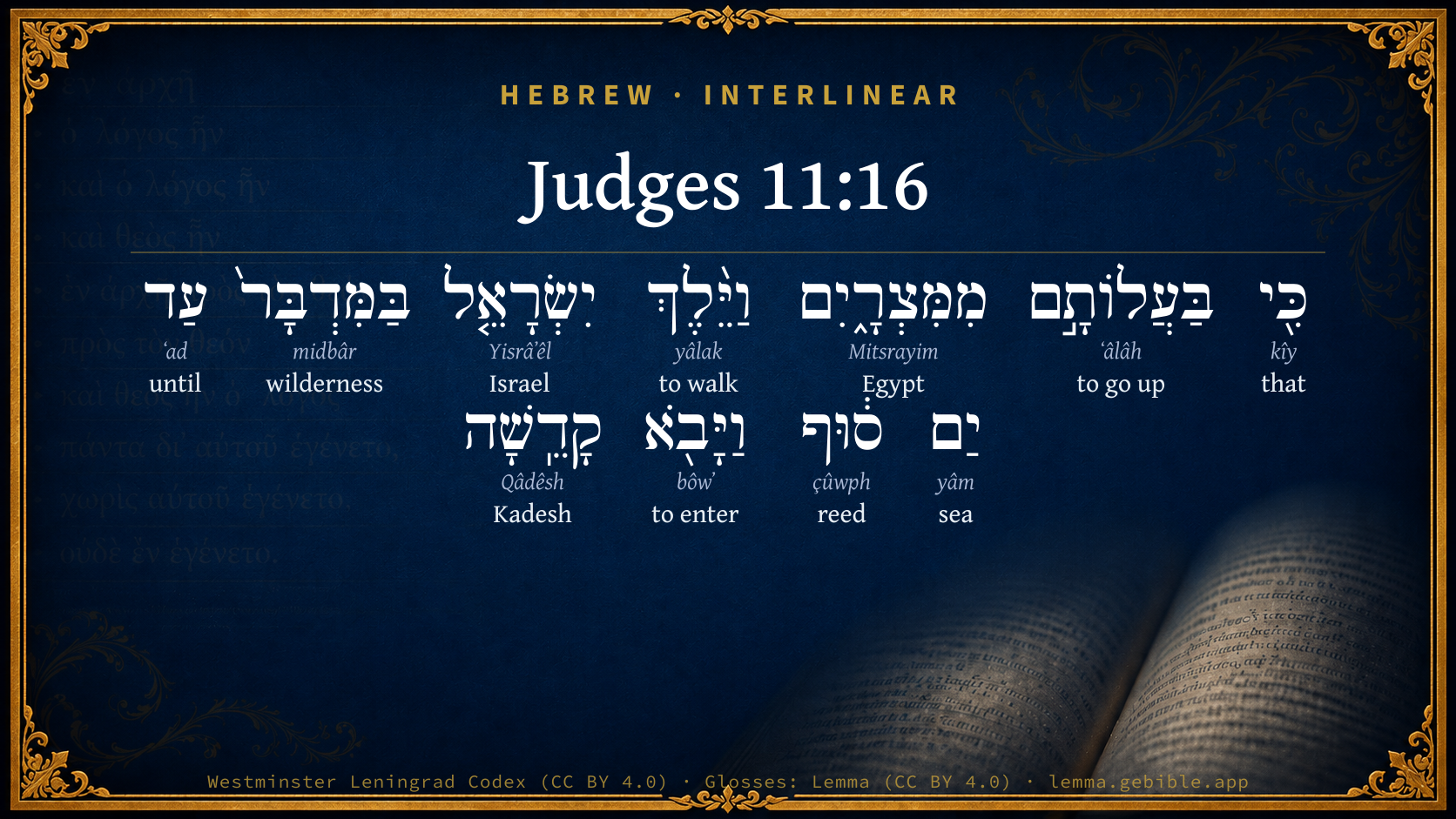
Hebrew (Westminster Leningrad Codex) Judges 11:16 appears in the Hebrew Old Testament. The text above is from the Westminster Leningrad Codex. Each word links to its Strong’s number, a concise gloss, and parsing drawn from the Open Scriptures Hebrew Bible morphology. Click any word for its full Brown-Driver-Briggs (BDB) entry.
Download image
Cite this verse

Judges 11:16 (World English Bible). Public Domain. Lemma interlinear Bible study tool, https://lemma.gebible.app/v/judges/11/16.

Show BibTeX & RIS
BibTeX
RIS
English Translation
but when they came up from Egypt, and Israel went through the wilderness to the Red Sea, and came to Kadesh;
World English Bible · Public Domain
Download a study sheet

One document with this verse’s original text, its word-by-word gloss line, the meaning frame, cross-references with their text, attributed commentary, and full source and license credits — printable, and it pastes into notes with its structure intact.

This verse Autodidact and up

Study sheet (.html) Plain text (.txt)

A passage Seminary Student

Up to 50 verses in one chapter. A passage sheet keeps up to 6 commentary sources and 12 cross-references per verse, in the order this page ranks them, and says so on the sheet whenever that leaves anything out. Ask for a single verse and you get the Autodidact verse sheet above.

Everything on this page stays free to read, with no account — the sheet is a download of what is already on screen, not access to it.

Want to remove ads? Support Godless Engineer
Compare translations 3

The same verse in 3 English versions, stacked beneath the original-language interlinear above. Click any original word for its lexicon entry.

Each is an independent rendering of the whole verse — the interlinear is not word-aligned to these translations.

Highlighted words mark where these versions differ — a whole-verse word diff, not a word-by-word alignment.

  • World English Bible Public Domain
    but when they came up from Egypt, and Israel went through the wilderness to the Red Sea, and came to Kadesh;
  • King James Version Public Domain
    But when Israel came up from Egypt, and walked through the wilderness unto the Red sea, and came to Kadesh;
  • unfoldingWord Literal Text CC BY-SA 4.0
    But in their coming up from Egypt, Israel went through the wilderness to the Sea of Reeds, and he came to Kadesh.

unfoldingWord Literal Text — © unfoldingWord, licensed CC BY-SA 4.0. Word-aligned USFM3 via Door43 (git.door43.org/unfoldingWord/en_ult).

Versions to compare (up to 4)

3 of 4 selected

Show all 18 translations

Every available English version of this verse, each an independent rendering of the whole verse.

  • World English Bible Public Domain
    but when they came up from Egypt, and Israel went through the wilderness to the Red Sea, and came to Kadesh;
  • Berean Standard Bible Public Domain
    But when Israel came up out of Egypt, they traveled through the wilderness to the Red Sea and came to Kadesh.
  • Majority Standard Bible Public Domain
    But when Israel came up out of Egypt, they traveled through the wilderness to the Red Sea and came to Kadesh.
  • King James Version Public Domain
    But when Israel came up from Egypt, and walked through the wilderness unto the Red sea, and came to Kadesh;
  • American Standard Version (1901) Public Domain
    but when they came up from Egypt, and Israel went through the wilderness unto the Red Sea, and came to Kadesh;
  • Revised Version (1885) Public Domain
    but when they came up from Egypt, and Israel walked through the wilderness unto the Red Sea, and came to Kadesh;
  • Geneva Bible (1599) Public Domain
    But when Israel came vp from Egypt, and walked through the wildernesse vnto the redde Sea, then they came to Kadesh.
  • Douay-Rheims (1899) Public Domain
    But when they came up out of Egypt, he walked through the desert to the Red Sea and came into Cades.
  • Young's Literal Translation Public Domain
    for in their coming up out of Egypt, Israel goeth in the wilderness unto the Red Sea, and cometh in to Kadesh,
  • Literal Standard Version CC BY-SA 4.0
    for in their coming up out of Egypt, Israel goes in the wilderness to the Red Sea, and comes to Kadesh,
  • Unlocked Literal Bible CC BY-SA 4.0
    but they came up from Egypt, and Israel went through the wilderness to the Sea of Reeds and on to Kadesh.
  • unfoldingWord Literal Text CC BY-SA 4.0
    But in their coming up from Egypt, Israel went through the wilderness to the Sea of Reeds, and he came to Kadesh.
  • Darby Bible Public Domain
    but when they came up from Egypt, Israel went through the wilderness to the Red Sea and came to Kadesh.
  • World Messianic Bible Public Domain
    but when they came up from Egypt, and Israel went through the wilderness to the Sea of Suf, and came to Kadesh,
  • Webster's Bible Public Domain
    But when Israel came up from Egypt, and walked through the wilderness to the Red sea, and came to Kadesh;
  • Free Bible Version CC BY-SA 4.0
    When they left Egypt, the Israelites went through the desert to the Red Sea and arrived at Kadesh.
  • Bible in Basic English Public Domain
    But when they came up from Egypt, Israel went through the waste land to the Red Sea and came to Kadesh;
  • JPS Tanakh (1917) Public Domain
    But when they came up from Egypt, and Israel walked through the wilderness unto the Red Sea, and came to Kadesh;

Literal Standard Version (2020), Covenant Press — licensed CC BY-SA 4.0. Text via the HelloAO Bible API (eBible.org). Unlocked Literal Bible (unfoldingWord) — licensed CC BY-SA 4.0. Text via the HelloAO Bible API (eBible.org). unfoldingWord Literal Text — © unfoldingWord, licensed CC BY-SA 4.0. Word-aligned USFM3 via Door43 (git.door43.org/unfoldingWord/en_ult). Free Bible Version, Dr. Jonathan Gallagher — licensed CC BY-SA 4.0. Text via the HelloAO Bible API (eBible.org).

Word by word

More ways to search: Search by grammar → Find every occurrence → Compare this word →

Practice this passage: Drill this verse → Learn its vocabulary →

קָדֵֽשָׁה
Qâdêsh
H6946
“Kadesh · toward”
Noun, Proper + Suffix, Demonstrative
Part of Speech
Noun
Type
Proper
Full BDB Definition

Origin: the same as H6945

TWOT: 1990e

Kadesh = "holy" - a city in the extreme south of Judah - same as 'Kedesh' and 'Kadesh-barnea'
  1. כִּ֖י kîy H3588 “that” Conjunction
  2. בַּעֲלוֹתָ֣ם ʻâlâh H5927 “in/at · to go up · them” Preposition + Verb, Qal, Infinitive Construct + Suffix, Personal, 3rd Person, Masculine, Plural
  3. מִמִּצְרָ֑יִם Mitsrayim H4714 “from · Egypt” Preposition + Noun, Proper
  4. וַיֵּ֨לֶךְ yâlak H3212 “and · to walk” Conjunction + Verb, Qal, Sequential Imperfect, 3rd Person, Masculine, Singular
  5. יִשְׂרָאֵ֤ל Yisrâʼêl H3478 “Israel” Noun, Proper
  6. בַּמִּדְבָּר֙ midbâr H4057 “in/at the · wilderness” Preposition, Determined + Noun, Common, Masculine, Singular, Absolute
  7. עַד ʻad H5704 “until” Preposition
  8. יַם yâm H3220 “sea of” Noun, Common, Masculine, Singular, Construct
  9. ס֔וּף çûwph H5488 “reed” Noun, Common, Masculine, Singular, Absolute
  10. וַיָּבֹ֖א bôwʼ H935 “and · to enter” Conjunction + Verb, Qal, Sequential Imperfect, 3rd Person, Masculine, Singular

About this verse

These counts appear in no published source. They are computed here, from the morphology-tagged text and Lemma’s own curated glosses. What Lemma adds →

11
words
11
distinct lemmas
Historical
section

Notable vocabulary

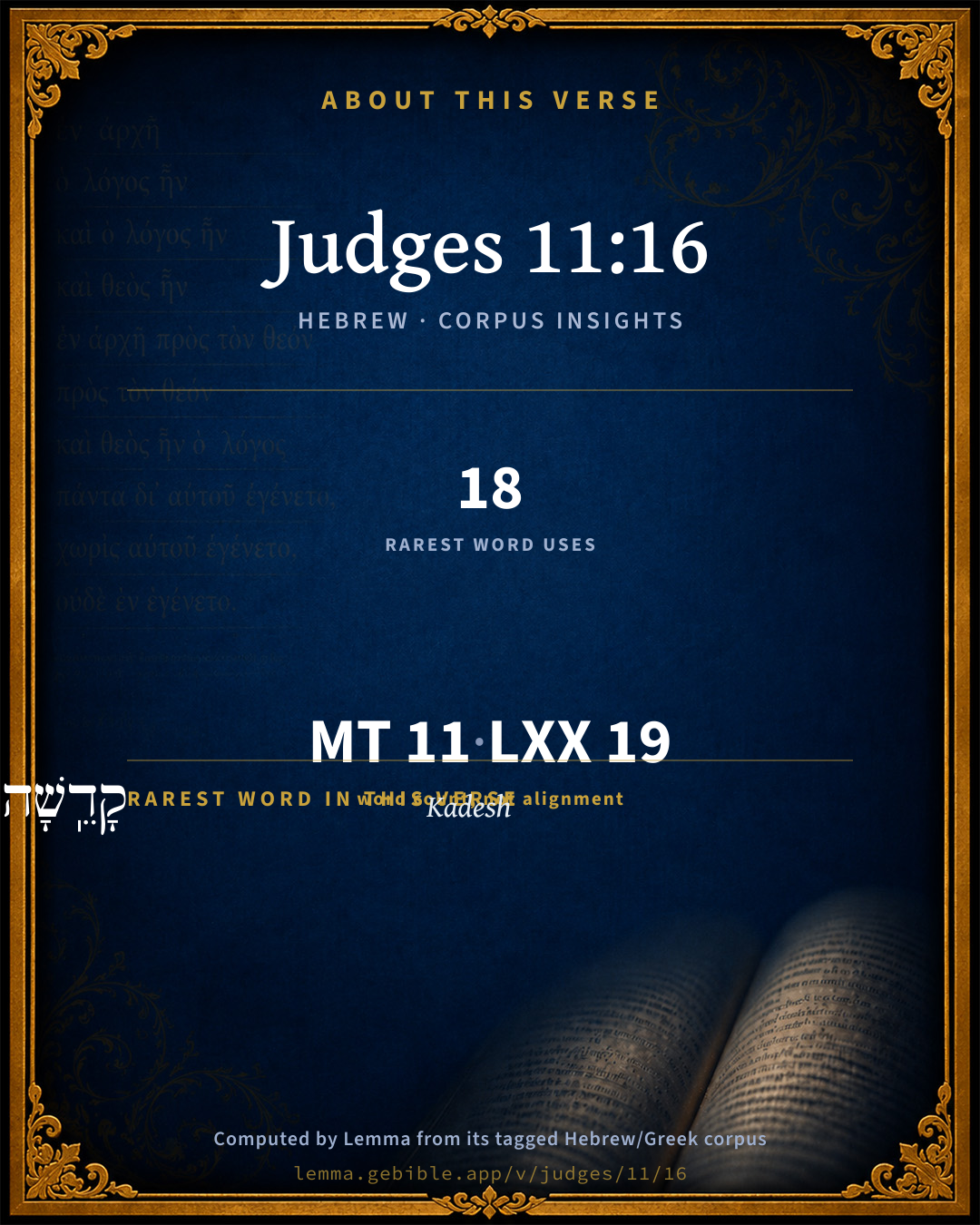
The rarest word here is קָדֵֽשָׁה Kadesh H6946 — appearing just 18 times in the whole Hebrew Bible.

Shared distinctive vocabulary

קָדֵֽשָׁה Kadesh H6946 occurs in 18 verses of the Hebrew Bible. Also found in:

Grammatical profile

  • 3 verbs
  • 6 nouns
  • 1 preposition
  • 1 conjunction

Verb forms

  • בַּעֲלוֹתָ֣ם Qal · Infinitive Construct
  • וַיֵּ֨לֶךְ Qal · Sequential Imperfect
  • וַיָּבֹ֖א Qal · Sequential Imperfect

Hebrew & Septuagint length

In English translation the verse runs 21 words from the Hebrew and 24 from the Septuagint (LXX English) — closely comparable.

A rough comparison of the two English renderings, which tokenize alike — not a word-level alignment.

Word counts can differ between the Hebrew and the Greek without any difference in meaning — e.g. the Hebrew direct-object marker אֵת has no separate Greek word, and Greek often adds the article ὁ.

In the original languages it is 11 Hebrew tokens and 19 Greek tokens — but the two are counted differently (Hebrew bundles its prefixes and suffixes into one token; the Greek is in lemma form), so that isn’t a like-for-like length.

Cross-references

7

Topical passages linked to Judges 11:16 in the Treasury of Scripture Knowledge — connected by theme and wording, ordered by reader-vote popularity; previews shown in the World English Bible.

  • Numbers 14:25 Now the Amalekite and the Canaanite dwell in the valley: tomorrow turn you, and get you into the wilderness by the way to the Red Sea.
  • Deuteronomy 1:40 But as for you, turn you, and take your journey into the wilderness by the way to the Red Sea.
  • Numbers 13:26 They went and came to Moses, and to Aaron, and to all the congregation of the children of Israel, to the wilderness of Paran, to Kadesh; and brought back word to them, and to all the congregation, and shown them the fruit of the land.
  • Numbers 20:1 The children of Israel, even the whole congregation, came into the wilderness of Zin in the first month: and the people abode in Kadesh; and Miriam died there, and was buried there.
  • Genesis 14:7 They returned, and came to En-mishpat (the same is Kadesh), and struck all the country of the Amalekites, and also the Amorites, that lived in Hazazon Tamar.
  • Deuteronomy 1:46 So you abode in Kadesh many days, according to the days that you abode [there].
  • Joshua 5:6 For the children of Israel walked forty years in the wilderness, until all the nation, even the men of war who came forth out of Egypt, were consumed, because they didn't listen to the voice of Yahweh: to whom Yahweh swore that he wouldn't let them see the land which Yahweh swore to their fathers that he would give us, a land flowing with milk and honey.

Cross-references courtesy of OpenBible.info (CC BY 4.0).

Hebrew and Greek witnesses Masoretic Hebrew ↔ Greek Septuagint

The same verse in the two great witnesses to the Old Testament, shown verse-for-verse.

These are two independent witnesses, not word-aligned to each other, and the Septuagint is shown in lemma (dictionary) form.

Hebrew Judges 11:16 Masoretic · Westminster Leningrad Codex

כִּ֖י בַּעֲלוֹתָ֣ם מִמִּצְרָ֑יִם וַיֵּ֨לֶךְ יִשְׂרָאֵ֤ל בַּמִּדְבָּר֙ עַד יַם ס֔וּף וַיָּבֹ֖א קָדֵֽשָׁה

but when they came up from Egypt, and Israel went through the wilderness to the Red Sea, and came to Kadesh;

World English Bible · Public Domain

Greek LXX Judges 11:16 Septuagint · lemma form

ὅτι ἐν ὁ ἀναβαίνω αὐτός ἐκ αἴγυπτος πορεύομαι ἰσραήλ ἐν ὁ ἔρημος ἕως θάλασσα σιφ καί ἔρχομαι εἰς καδης

for in their going up out of Egypt Israel went in the wilderness as far as the sea of Siph, and came to Cades.

LXX2012 (modern English Septuagint) · Public Domain

Hebrew: Westminster Leningrad Codex (CC BY 4.0). Greek: Septuagint (public domain); English from LXX2012 (modern English Septuagint) (Public Domain). How the Septuagint differs from the Hebrew →

Targum (Aramaic paraphrase)

1

The Targum is the ancient Jewish Aramaic paraphrase of the Hebrew Scriptures — an interpretive translation, not the Hebrew text itself. Onkelos (literal) and Pseudo-Jonathan (expansive) render the Torah, and Jonathan the Prophets. Coverage is partial: where no permissively-licensed English translation exists for a verse, only the Aramaic is shown. This is verse-level text, not a word-by-word alignment to the Hebrew.

  1. Targum Jonathan Prophets (Joshua–Malachi)
    אֲרֵי בְּמִסַקְהוֹן מִמִצְרָיִם וַאֲזַל יִשְׂרָאֵל בְּמַדְבְּרָא עַד יַמָא דְסוּף וַאֲתָא לִרְקָם:

    (no public-domain English translation for this verse)

    Targum Jonathan — Aramaic: “Mikraot Gedolot” (public domain). English: “Sefaria Community Translation” (CC0 1.0 (public-domain dedication)); “London "Chaldee Paraphrase," 1871” (public domain). Text via Sefaria.

Commentary

Notes on Judges 11:16 from classic Christian and Jewish commentators (each source and its license shown beneath its notes). The classic Christian expositions comment on the surrounding passage and are grouped to its opening verse, so a note may address several verses; the Jewish commentaries on the Tanakh (Rashi and others) are per-verse, so they appear only where the commentator wrote on this verse.

Lemma curates 59 commentaries, every one of them public domain or Creative Commons licensed, each selected and text-cleaned for this edition rather than reprinted as found. About our sources →

The Cambridge Bible for Schools and Colleges

gen. ed. J. J. S. Perowne

16. the wilderness … the Red Sea … Kadesh] The route is generalized, perhaps from reminiscences of Num_14:25; Num_20:14 (JE), as Moore suggests. It is now generally held that Kadesh is to be identified with ‘Ain Ḳadîs, 50 m. S. of Beer-sheba. Jdg_11:16-18 agree with JE’s narrative in Num., according to which the Israelites journeyed straight from Sinai to Kadesh, and abode in Kadesh (Jdg_11:17, Num_20:1 b) apparently till the fortieth year of the Exodus (Num_20:14; Num_20:16). D and P give divergent accounts; see Gray, Numbers, p. 260.

The Cambridge Bible for Schools and Colleges (gen. ed. J. J. S. Perowne; Cambridge University Press, 1878–1918) — public domain. Text from a community e-Sword module.

Trapp's Complete Commentary

John Trapp

Jdg 11:16 But when Israel came up from Egypt, and walked through the wilderness unto the Red sea, and came to Kadesh;

Ver. 16. But when Israel came up from Egypt.] It appeareth that Jephthah was a good historian. Public persons had need to be so: skilful in the sacred history especially, and in their own chronicles.

John Trapp, A Commentary or Exposition upon All the Books of the Old and New Testament (1647–1656) — public domain. Text from a community e-Sword module.

Joseph Benson's Commentary

Jdg 11:16-17. Unto the Red sea — Unto which they came three times; once, Exo 13:18; again, a little after their passage over it; and a third time, long after, when they came to Ezion-geber, which was upon the shore of the Red sea, from whence they went to Kadesh; of this time he speaks here. In the like manner they sent to the king of Moab — We do not read of such a message sent to the Moabites; but when the Israelites came from Ezion-geber into the wilderness of Moab, we find a command of God given to them not to distress the Moabites, nor contend with them in battle. This intimates there was some occasion for such a command, which was probably their refusing to grant them some common civility.

Joseph Benson's Commentary on the Old and New Testaments (1811–1818) — public domain. Text from a community e-Sword module.

Ellicott's Commentary for English Readers

(16) When Israel came up from Egypt.—Compare with this narrative Numbers 20, 21.

Walked through the wilderness.—In the second year of the wanderings (Deu_1:19).

Unto the Red sea.—Num_14:25. The name for this sea in the Old Testament is Yam sooph, “the sea of weeds.” They reached Kadesh Barnea from Ezion Geber (“the Giant’s backbone”), in the Gulf of Akaba (Num_33:36).

To Kadesh.—Num_20:1; Num_33:16.

A Bible Commentary for English Readers, edited by Charles John Ellicott (1878–1897) — public domain. Text from a community e-Sword module.

John Gill's Exposition

Then Israel sent messengers unto the king of Edom,.... The history of which may be read in Num 20:14, &c.

saying, let me, I pray thee, pass through thy land; the land of Edom, from the south to the north of it, according to Jarchi, which was the nearest and shortest way to the land of Canaan; so far were the Israelites from invading and seizing upon the properties of others, that they would not attempt to set their foot in another's country without leave; which they asked in an humble manner, promising to do no injury to any, but pay for whatever they ate and drank in their passage:

but the king of Edom would not hearken thereto; or grant their request, but refused them passage through his country:

and in like manner they sent unto the king of Moab, but he would not consent; that they should pass through his country, which lay, as Jarchi says, at the end of the land of Edom, to the west of it, and to the south of Canaan; and though we nowhere else read of their sending messengers to the king of Moab, and of the denial he made them, it is not at all to be doubted of, and the Jewish commentators observe, that it is clearly intimated by Moses, Deu 2:29.

as the children of Esau, who dwelt in Seir, and the Moabites which dwelt in Ar, did unto me; which they interpret thus, as the children of Esau would not suffer Israel to pass through their land, when desired of them, so neither would the Moabites, when the same request was made to them:

and Israel abode in Kadesh; quietly and peaceably, and did not attempt to force their way through either country, but continued in Kadesh some little time to consider what way they should take, and to wait for divine direction.

John Gill's Exposition of the Whole Bible (1746–1763) — public domain (CC PDM 1.0). Text via the HelloAO Bible API.

Haydock's Catholic Bible Commentary

Red Sea, as Asiongaber, many years after they left Egypt.

George Leo Haydock (1774–1849), Haydock's Catholic Family Bible and Commentary, 1859 edition — public domain. Excludes Psalms (Douay-Rheims chapter numbering differs from Protestant) and Deuterocanonical books (Catholic canon only).

Matthew Poole's English Annotations

Unto the Red Sea; unto which they came three times; once, Exo 13:18; again, a little after their passage over it, Exo 15:22; and a third time, long after, when they came to Ezion-gaber, Num 33:35; Deu 2:8, which was upon the shore of the Red Sea, 1Ki 9:26; 2Ch 8:17, from whence they went to Kadesh, Num 20; of this time he speaks here.

Matthew Poole's English Annotations on the Holy Bible (1683–1685) — public domain. Text from a community e-Sword/MySword module.

The Pulpit Commentary

When Israel came up, etc. In this and the following verses there is a distinct reference to the history in Numbers and Deuteronomy, and in some instances verbal quotations. Thus in this verse the words below which are put in italics are found in Num_13:26 Num_14:25: Israel... walked through the wilderness unto the Red Sea, and came to Kadesh.

The Pulpit Commentary (1880–1919), ed. H.D.M. Spence-Jones & Joseph S. Exell — public domain. Text from a community e-Sword module.

John Wesley's Explanatory Notes

The Red-sea - Unto which they came three times; once, Exod. xiii, 18, again, a little after their passage over it, and a third time, long after, when they came to Ezion Geber, which was upon the shore of the Red-Sea, from whence they went to Kadesh; of this time he speaks here.

John Wesley, Explanatory Notes Upon the Whole Bible (1754–1765) — public domain. Text via the GEBible commentary corpus.

Rashi

Rabbi Shlomo Yitzchaki (Rashi)

Until the Reed Sea. South of the land of Edom, while the land of Edom is south of the land of Canaan.

Rashi on the Tanakh — English translations: “The Judaica Press complete Tanach with Rashi, translated by A. J. Rosenberg” (CC BY 4.0); “Pentateuch with Rashi's commentary by M. Rosenbaum and A.M. Silbermann, 1929-1934” (public domain); “The Metsudah Tanach series, Lakewood, N.J” (CC BY 4.0); and “The Book of Joshua, Metsudah Publications, 1997” (CC BY 4.0). Text via Sefaria.

Lesson kit

Teaching starters — assembled from the data on this page, not authored interpretation. Every prompt links to the verse data it draws on. Edit before teaching.

Judges, in the Historical, opens this verse with 11 words (11 distinct Hebrew lemmas). Its most distinctive word is Qâdêsh (“Kadesh”). A historical commentator’s framing appears above. Read the whole chapter for the surrounding context.

Discussion questions

  1. How does “Kadesh” (Qâdêsh) shape what this verse is saying?
  2. How does Genesis 14:7, which shares the word «Kadesh», read alongside this verse?
  3. These translations render this verse differently; the difference is in the English rendering, not the original. What questions does that raise?
  4. «בַּעֲלוֹתָ֣ם» is a Qal Infinitive Construct verb. How does that grammatical form shape the action described?
  5. Compare how The Cambridge Bible for Schools and Colleges and Trapp's Complete Commentary read this verse. Where do they agree or differ?

Things to notice

Reading settings

Reading text

Shown beneath each verse's original-language words.

Old Testament
Old Testament edition

Read the OT as the Masoretic Hebrew (MT) or the Greek Septuagint (LXX).

English shown for the Greek Septuagint (in the Hebrew ↔ Greek comparison).

Comparing translations? Open the Compare panel on any verse page to stack up to four side by side.