
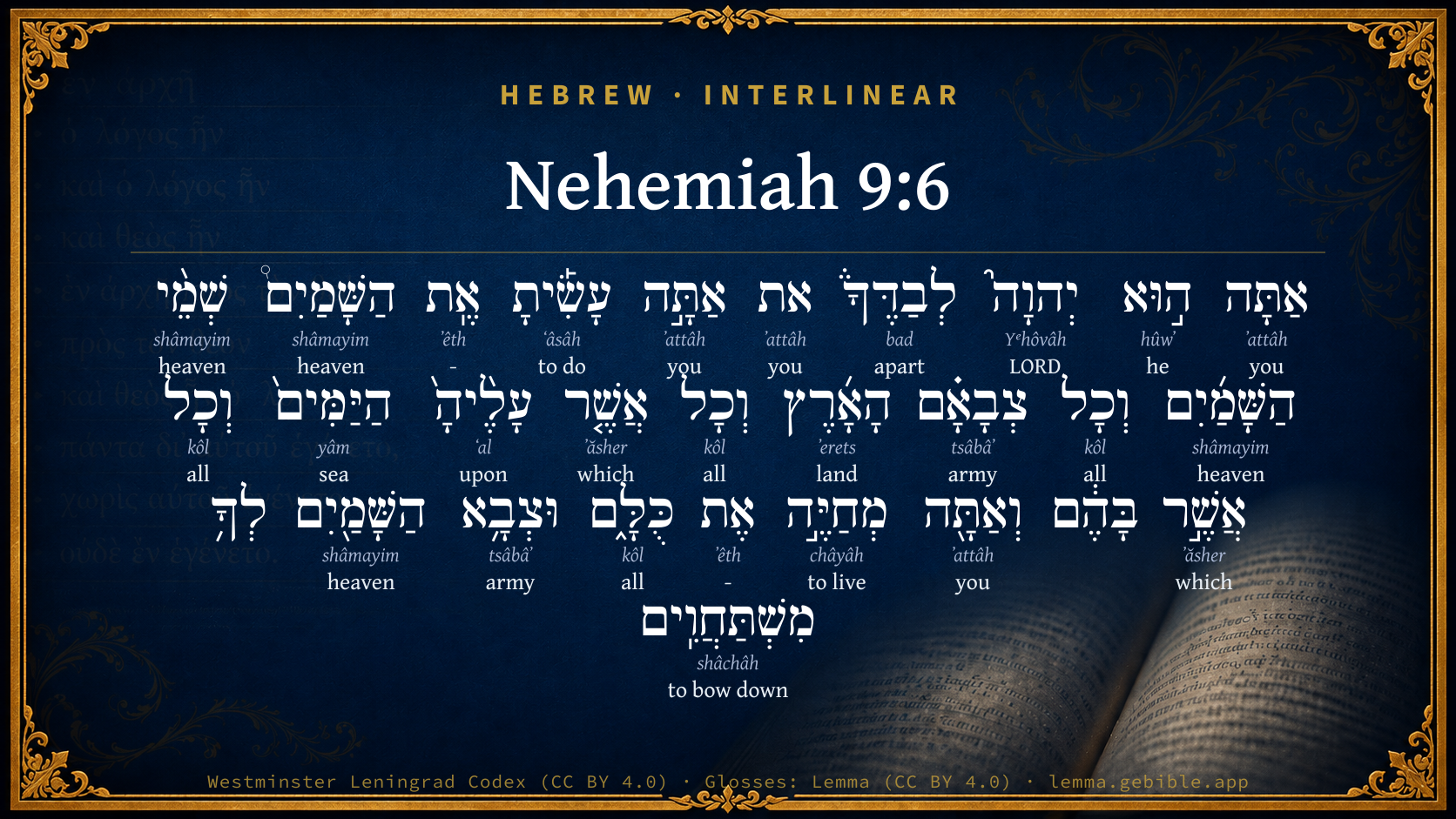
Nehemiah 9:6

Hebrew (Westminster Leningrad Codex) Nehemiah 9:6 appears in the Hebrew Old Testament. The text above is from the Westminster Leningrad Codex. Each word links to its Strong’s number, a concise gloss, and parsing drawn from the Open Scriptures Hebrew Bible morphology. Click any word for its full Brown-Driver-Briggs (BDB) entry.
Download image
Cite this verse

Nehemiah 9:6 (World English Bible). Public Domain. Lemma interlinear Bible study tool, https://lemma.gebible.app/v/nehemiah/9/6.

Show BibTeX & RIS
BibTeX
RIS
English Translation
You are Yahweh, even you alone; you have made heaven, the heaven of heavens, with all their host, the earth and all things that are thereon, the seas and all that is in them, and you preserve them all; and the host of heaven worships you.
World English Bible · Public Domain
Download a study sheet

One document with this verse’s original text, its word-by-word gloss line, the meaning frame, cross-references with their text, attributed commentary, and full source and license credits — printable, and it pastes into notes with its structure intact.

This verse Autodidact and up

Study sheet (.html) Plain text (.txt)

A passage Seminary Student

Up to 50 verses in one chapter. A passage sheet keeps up to 6 commentary sources and 12 cross-references per verse, in the order this page ranks them, and says so on the sheet whenever that leaves anything out. Ask for a single verse and you get the Autodidact verse sheet above.

Everything on this page stays free to read, with no account — the sheet is a download of what is already on screen, not access to it.

Want to remove ads? Support Godless Engineer
Compare translations 3

The same verse in 3 English versions, stacked beneath the original-language interlinear above. Click any original word for its lexicon entry.

Each is an independent rendering of the whole verse — the interlinear is not word-aligned to these translations.

Highlighted words mark where these versions differ — a whole-verse word diff, not a word-by-word alignment.

  • World English Bible Public Domain
    You are Yahweh, even you alone; you have made heaven, the heaven of heavens, with all their host, the earth and all things that are thereon, the seas and all that is in them, and you preserve them all; and the host of heaven worships you.
  • King James Version Public Domain
    Thou, even thou, art LORD alone; thou hast made heaven, the heaven of heavens, with all their host, the earth, and all things that are therein, the seas, and all that is therein, and thou preservest them all; and the host of heaven worshippeth thee.
  • unfoldingWord Literal Text CC BY-SA 4.0
    You alone are he, Yahweh: you yourself made the heavens, the heavens of the heavens and all their host, the earth and all that is on it, the seas and all that is in them; and you cause all of them to live; and the host of the heavens prostrates themselves to you.

unfoldingWord Literal Text — © unfoldingWord, licensed CC BY-SA 4.0. Word-aligned USFM3 via Door43 (git.door43.org/unfoldingWord/en_ult).

Versions to compare (up to 4)

3 of 4 selected

Show all 18 translations

Every available English version of this verse, each an independent rendering of the whole verse.

  • World English Bible Public Domain
    You are Yahweh, even you alone; you have made heaven, the heaven of heavens, with all their host, the earth and all things that are thereon, the seas and all that is in them, and you preserve them all; and the host of heaven worships you.
  • Berean Standard Bible Public Domain
    You alone are the LORD. You created the heavens, the highest heavens with all their host, the earth and all that is on it, the seas and all that is in them. You give life to all things, and the host of heaven worships You.
  • Majority Standard Bible Public Domain
    You alone are the LORD. You created the heavens, the highest heavens with all their host, the earth and all that is on it, the seas and all that is in them. You give life to all things, and the host of heaven worships You.
  • King James Version Public Domain
    Thou, even thou, art LORD alone; thou hast made heaven, the heaven of heavens, with all their host, the earth, and all things that are therein, the seas, and all that is therein, and thou preservest them all; and the host of heaven worshippeth thee.
  • American Standard Version (1901) Public Domain
    Thou art Jehovah, even thou alone; thou hast made heaven, the heaven of heavens, with all their host, the earth and all things that are thereon, the seas and all that is in them, and thou preservest them all; and the host of heaven worshippeth thee.
  • Revised Version (1885) Public Domain
    Thou art the LORD, even thou alone; thou hast made heaven, the heaven of heavens, with all their host, the earth and all things that are thereon, the seas and all that is in them, and thou preservest them all; and the host of heaven worshippeth thee.
  • Geneva Bible (1599) Public Domain
    Thou art Lord alone: thou hast made heauen, and the heauen of all heauens, with all their hoste, the earth, and all things that are therein, the seas, and al that are in them, and thou preseruest them all, and the host of the heauen worshippeth thee.
  • Douay-Rheims (1899) Public Domain
    Thou thyself, O Lord alone, thou hast made heaven, and the heaven of heavens, and all the host thereof: the earth and all things that are in it: the seas and all that are therein: and thou givest life to all these things, and the host of heaven adoreth thee.
  • Young's Literal Translation Public Domain
    Thou `art' He, O Jehovah, Thyself -- Thou hast made the heavens, the heavens of the heavens, and all their host, the earth and all that `are' on it, the seas and all that `are' in them, and Thou art keeping all of them alive, and the host of the heavens to Thee are bowing themselves.
  • Literal Standard Version CC BY-SA 4.0
    You [are] He, O YHWH, Yourself—You have made the heavens, || The heavens of the heavens, and all their host, || The earth and all that [are] on it, || The seas and all that [are] in them, || And You are keeping all of them alive, || And the host of the heavens are bowing themselves to You.
  • Unlocked Literal Bible CC BY-SA 4.0
    You are Yahweh. You alone. You have made heaven, the highest heavens, with all their host, and the earth and everything on it, and the seas and all that is in them. You give life to them all, and the host of heaven worship you.
  • unfoldingWord Literal Text CC BY-SA 4.0
    You alone are he, Yahweh: you yourself made the heavens, the heavens of the heavens and all their host, the earth and all that is on it, the seas and all that is in them; and you cause all of them to live; and the host of the heavens prostrates themselves to you.
  • Darby Bible Public Domain
    Thou art the Same, thou alone, Jehovah, who hast made the heaven of heavens, and all their host, the earth and all that is therein, the seas and all that is therein. And thou quickenest them all; and the host of heaven worshippeth thee.
  • World Messianic Bible Public Domain
    You are the LORD, even you alone. You have made heaven, the heaven of heavens, with all their army, the earth and all things that are on it, the seas and all that is in them, and you preserve them all. The army of heaven worships you.
  • Webster's Bible Public Domain
    Thou, even thou, art LORD alone; thou hast made heaven, the heaven of heavens, with all their host, the earth, and all things that are in it, the seas, and all that is in them, and thou preservest them all; and the host of heaven worshipeth thee.
  • Free Bible Version CC BY-SA 4.0
    They prayed, “Only you are the Lord. It was you who made the sky, the heavens with all their stars, the land and everything on it, the seas and everything in them. You give life to all of them, and all the heavenly beings worship you.
  • Bible in Basic English Public Domain
    You are the Lord, even you only; you have made heaven, the heaven of heavens with all their armies, the earth and all things in it, the seas and everything in them; and you keep them from destruction: and the armies of heaven are your worshippers.
  • JPS Tanakh (1917) Public Domain
    Thou art the LORD, even Thou alone; Thou hast made heaven, the heaven of heavens, with all their host, the earth and all things that are thereon, the seas and all that is in them, and Thou preservest them all; and the host of heaven worshippeth Thee.

Literal Standard Version (2020), Covenant Press — licensed CC BY-SA 4.0. Text via the HelloAO Bible API (eBible.org). Unlocked Literal Bible (unfoldingWord) — licensed CC BY-SA 4.0. Text via the HelloAO Bible API (eBible.org). unfoldingWord Literal Text — © unfoldingWord, licensed CC BY-SA 4.0. Word-aligned USFM3 via Door43 (git.door43.org/unfoldingWord/en_ult). Free Bible Version, Dr. Jonathan Gallagher — licensed CC BY-SA 4.0. Text via the HelloAO Bible API (eBible.org).

Word by word

More ways to search: Search by grammar → Find every occurrence → Compare this word →

Practice this passage: Drill this verse → Learn its vocabulary →

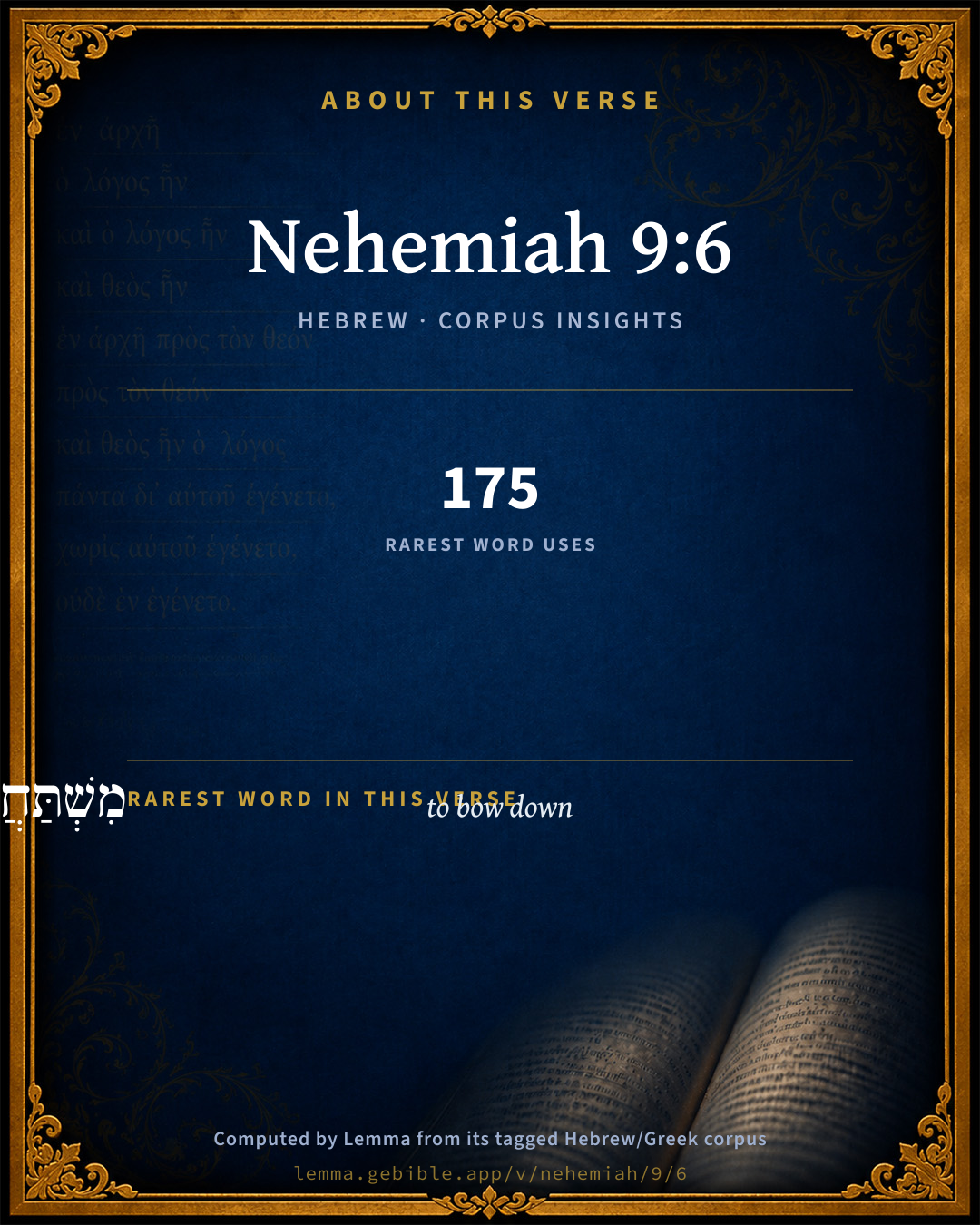
מִשְׁתַּחֲוִֽים
shâchâh
H7812
“bowing down”
Verb, Hishtaphel, Participle Active, Masculine, Plural, Absolute
Part of Speech
Verb
Stem
Hishtaphel
Form
Participle Active
Gender
Masculine
Number
Plural
State
Absolute
Full BDB Definition

Origin: a primitive root

TWOT: 2360

to bow down - (Qal) to bow down - (Hiphil) to depress (figuratively) - (Hithpael) - to bow down, prostrate oneself - before superior in homage - before God in worship - before false gods - before angel
  1. אַתָּה ʼattâh H859 “you” Pronoun, Personal, 2nd Person, Masculine, Singular
  2. ה֣וּא hûwʼ H1931 “he” Pronoun, Personal, 3rd Person, Masculine, Singular
  3. יְהוָה֮ Yᵉhôvâh H3068 “LORD” Noun, Proper
  4. לְבַדֶּךָ֒ bad H905 “to/for · apart · your” Preposition + Noun, Common, Masculine, Singular, Construct + Suffix, Personal, 2nd Person, Masculine, Singular
  5. את ʼattâh H859 “you” Pronoun, Personal, 2nd Person, Masculine, Singular
  6. אַתָּ֣ה ʼattâh H859 “you” Pronoun, Personal, 2nd Person, Masculine, Singular
  7. עָשִׂ֡יתָ ʻâsâh H6213 “to do” Verb, Qal, Perfect, 2nd Person, Masculine, Singular
  8. אֶֽת ʼêth H853 “-” Particle, Direct Object
  9. הַשָּׁמַיִם֩ shâmayim H8064 “the · heaven(s)” Particle, Definite Article + Noun, Common, Masculine, Plural, Absolute
  10. שְׁמֵ֨י shâmayim H8064 “heaven(s) of” Noun, Common, Masculine, Plural, Construct
  11. הַשָּׁמַ֜יִם shâmayim H8064 “the · heaven(s)” Particle, Definite Article + Noun, Common, Masculine, Plural, Absolute
  12. וְכָל kôl H3605 “and · all of” Conjunction + Noun, Common, Masculine, Singular, Construct
  13. צְבָאָ֗ם tsâbâʼ H6635 “army · their” Noun, Common, Both, Singular, Construct + Suffix, Personal, 3rd Person, Masculine, Plural
  14. הָאָ֜רֶץ ʼerets H776 “the · land” Particle, Definite Article + Noun, Common, Both, Singular, Absolute
  15. וְכָל kôl H3605 “and · all of” Conjunction + Noun, Common, Masculine, Singular, Construct
  16. אֲשֶׁ֤ר ʼăsher H834 “which” Particle, Relative
  17. עָלֶ֨יהָ֙ ʻal H5921 “upon · her” Preposition + Suffix, Personal, 3rd Person, Feminine, Singular
  18. הַיַּמִּים֙ yâm H3220 “the · seas” Particle, Definite Article + Noun, Common, Masculine, Plural, Absolute
  19. וְכָל kôl H3605 “and · all of” Conjunction + Noun, Common, Masculine, Singular, Construct
  20. אֲשֶׁ֣ר ʼăsher H834 “which” Particle, Relative
  21. וְאַתָּ֖ה ʼattâh H859 “and · you” Conjunction + Pronoun, Personal, 2nd Person, Masculine, Singular
  22. מְחַיֶּ֣ה châyâh H2421 “living” Verb, Piel, Participle Active, Masculine, Singular, Absolute
  23. אֶת ʼêth H853 “-” Particle, Direct Object
  24. כֻּלָּ֑ם kôl H3605 “all · their” Noun, Common, Masculine, Singular, Construct + Suffix, Personal, 3rd Person, Masculine, Plural
  25. וּצְבָ֥א tsâbâʼ H6635 “and · army of” Conjunction + Noun, Common, Both, Singular, Construct
  26. הַשָּׁמַ֖יִם shâmayim H8064 “the · heaven(s)” Particle, Definite Article + Noun, Common, Masculine, Plural, Absolute

About this verse

These counts appear in no published source. They are computed here, from the morphology-tagged text and Lemma’s own curated glosses. What Lemma adds →

29
words
15
distinct lemmas
Historical
section

Grammatical profile

  • 3 verbs
  • 14 nouns
  • 5 pronouns
  • 3 prepositions
  • 4 particles

Verb forms

  • עָשִׂ֡יתָ Qal · Perfect
  • מְחַיֶּ֣ה Piel · Participle Active
  • מִשְׁתַּחֲוִֽים Hishtaphel · Participle Active

Repetition

Words recur within this verse — often emphatic in Hebrew:

  • הַשָּׁמַיִם֩ heaven H8064 ×4
  • וְכָל all H3605 ×4
  • צְבָאָ֗ם army H6635 ×2
  • אַתָּה you H859 ×4
  • אֲשֶׁ֤ר which H834 ×2

Cross-references

31

Topical passages linked to Nehemiah 9:6 in the Treasury of Scripture Knowledge — connected by theme and wording, ordered by reader-vote popularity; previews shown in the World English Bible.

  • Isaiah 37:16 Yahweh of hosts, the God of Israel, who sits [above] the cherubim, you are the God, even you alone, of all the kingdoms of the earth; you have made heaven and earth.
  • Genesis 1:1 In the beginning God created the heavens and the earth.
  • Revelation 4:11 "Worthy are you, our Lord and God, the Holy One, to receive the glory, the honor, and the power, for you created all things, and because of your desire they existed, and were created!"
  • Deuteronomy 10:14 Behold, to Yahweh your God belongs heaven and the heaven of heavens, the earth, with all that is therein.
  • Deuteronomy 6:4 Hear, Israel: Yahweh is our God; Yahweh is one:
  • Genesis 2:1 The heavens and the earth were finished, and all the host of them.
  • 2 Kings 19:15 Hezekiah prayed before Yahweh, and said, Yahweh, the God of Israel, who sit [above] the cherubim, you are the God, even you alone, of all the kingdoms of the earth; you have made heaven and earth.
  • Isaiah 44:6 Thus says Yahweh, the King of Israel, and his Redeemer, Yahweh of Hosts: I am the first, and I am the last; and besides me there is no God.
  • Isaiah 44:8 Don't fear, neither be afraid: haven't I declared to you of old, and shown it? You are my witnesses. Is there a God besides me? Indeed, there is not. I don't know any Rock.
  • Jeremiah 10:11–12 Thus shall you say to them, The gods that have not made the heavens and the earth, these shall perish from the earth, and from under the heavens.
  • Isaiah 43:10 You are my witnesses, says Yahweh, and my servant whom I have chosen; that you may know and believe me, and understand that I am he: before me there was no God formed, neither shall there be after me.
  • Psalms 86:10 For you are great, and do wondrous things. You are God alone.
  • Revelation 5:11–13 I saw, and I heard something like a voice of many angels around the throne, the living creatures, and the elders; and the number of them was ten thousands of ten thousands, and thousands of thousands;
  • Revelation 14:7 He said with a loud voice, "Fear the Lord, and give him glory; for the hour of his judgment has come. Worship him who made the heaven, the earth, the sea, and the springs of waters!"
  • 1 Kings 8:27 But will God in very deed dwell on the earth? behold, heaven and the heaven of heavens can't contain you; how much less this house that I have built!
  • Psalms 36:6 Your righteousness is like the mountains of God. Your judgments are like a great deep. Yahweh, you preserve man and animal.
  • Colossians 1:15–17 who is the image of the invisible God, the firstborn of all creation.
  • Hebrews 1:3 His Son is the radiance of his glory, the very image of his substance, and upholding all things by the word of his power, when he had by himself made purification for our sins, sat down on the right hand of the Majesty on high;
  • 2 Kings 19:19 Now therefore, Yahweh our God, save you us, I beg you, out of his hand, that all the kingdoms of the earth may know that you Yahweh are God alone.
  • Psalms 148:2–4 Praise him, all his angels! Praise him, all his host!
  • Isaiah 6:2–3 Above him stood the seraphim. Each one had six wings. With two he covered his face. With two he covered his feet. With two he flew.
  • Isaiah 37:20 Now therefore, Yahweh our God, save us from his hand, that all the kingdoms of the earth may know that you are Yahweh, even you only.
  • Mark 12:29–30 Jesus answered, "The greatest is, 'Hear, Israel, the Lord our God, the Lord is one:
  • 1 Kings 22:19 [Micaiah] said, Therefore hear you the word of Yahweh: I saw Yahweh sitting on his throne, and all the host of heaven standing by him on his right hand and on his left.
  • Psalms 33:6 By Yahweh's word the heavens were made; All their host by the breath of his mouth.
  • Psalms 103:21 Praise Yahweh, all you hosts of his, You servants of his, who do his pleasure.
  • Psalms 136:5–9 To him who by understanding made the heavens; For his loving kindness endures forever:
  • Psalms 146:6 Who made heaven and earth, The sea, and all that is in them; Who keeps truth forever;
  • Ezekiel 20:11 I gave them my statutes, and shown them my ordinances, which if a man do, he shall live in them.
  • Hebrews 1:6 Again, when he brings in the firstborn into the world he says, "Let all the angels of God worship him."
  • John 10:30 I and the Father are one."

Cross-references courtesy of OpenBible.info (CC BY 4.0).

Hebrew and Greek witnesses Masoretic Hebrew ↔ Greek Septuagint

The same verse in the two great witnesses to the Old Testament, shown verse-for-verse.

These are two independent witnesses, not word-aligned to each other, and the Septuagint is shown in lemma (dictionary) form.

Hebrew Nehemiah 9:6 Masoretic · Westminster Leningrad Codex

אַתָּה ה֣וּא יְהוָה֮ לְבַדֶּךָ֒ את אַתָּ֣ה עָשִׂ֡יתָ אֶֽת הַשָּׁמַיִם֩ שְׁמֵ֨י הַשָּׁמַ֜יִם וְכָל צְבָאָ֗ם הָאָ֜רֶץ וְכָל אֲשֶׁ֤ר עָלֶ֨יהָ֙ הַיַּמִּים֙ וְכָל אֲשֶׁ֣ר בָּהֶ֔ם וְאַתָּ֖ה מְחַיֶּ֣ה אֶת כֻּלָּ֑ם וּצְבָ֥א הַשָּׁמַ֖יִם לְךָ֥ מִשְׁתַּחֲוִֽים

You are Yahweh, even you alone; you have made heaven, the heaven of heavens, with all their host, the earth and all things that are thereon, the seas and all that is in them, and you preserve them all; and the host of heaven worships you.

World English Bible · Public Domain

Greek LXX Structure differs

The Septuagint has no separate book of Nehemiah. Its Greek text is the second half of Esdras B (2 Esdras), chapters 11–23; Ezra is the first half (1–10).

A verse-for-verse comparison isn’t shown here because the chapters and verses don’t line up. Switch to the LXX edition with the MT / LXX toggle above to read the Greek directly.

On this verse, The Cambridge Bible for Schools and Colleges discusses the Septuagint’s reading. Read the note in Commentary ↓

Hebrew: Westminster Leningrad Codex (CC BY 4.0). Greek: Septuagint (public domain); English from a public-domain English Septuagint. How the Septuagint differs from the Hebrew →

Commentary

Notes on Nehemiah 9:6 from classic Christian and Jewish commentators (each source and its license shown beneath its notes). The classic Christian expositions comment on the surrounding passage and are grouped to its opening verse, so a note may address several verses; the Jewish commentaries on the Tanakh (Rashi and others) are per-verse, so they appear only where the commentator wrote on this verse.

Lemma curates 59 commentaries, every one of them public domain or Creative Commons licensed, each selected and text-cleaned for this edition rather than reprinted as found. About our sources →

Trapp's Complete Commentary

John Trapp

Neh 9:6 Thou, [even] thou, [art] LORD alone; thou hast made heaven, the heaven of heavens, with all their host, the earth, and all [things] that [are] therein, the seas, and all that [is] therein, and thou preservest them all; and the host of heaven worshippeth thee.

Ver. 6. Thou, even thou, art Lord alone] Jehovah is God’s incommunicable name; that holy and reverend name of his which Jews pronounce not, we too oft profane, at least by not considering the import of it; which is enough to answer all our doubts, and to fill us with strong consolation, had we but skill to spell all the letters in it.

Thou hast made heaven] With great skill and artifice thou hast made it, three stories high, 2Co 12:2 Heb 11:10.

The heaven of heavens] Called the highest, Luk 2:14, and the third heaven, 2Co 12:2. Of this heaven no natural knowledge can be had, nor any help by human arts, geometry, optics, &c.; for it is neither aspectable nor movable.

With all their host] i.e. Their furniture: angels, those heavenly courtiers, sun, moon, and stars, &c., which are all God’s servants, Psa 119:91, and do, in their way, worship him.

The earth, and all things that are therein] God may be read in the great book of nature, which hath three leaves, heaven, earth, and sea. Heaven is all that is above earth. Earth is an element of cold and dry nature, thick, solid, heavy, placed in the midst of the world as the foundation thereof, and therefore unmovable, though round (and in that respect naturally apt for motion), and though founded, not upon solid rocks, but fluid waters. This Aristotle himself wondered at, Lib. ii. de Caelo, cap. 13.

And all things that are thereon] Either therein, as metals and minerals; or thereon, as men, beasts, creeping things, &c.

The seas, and all that are therein] As, There is that leviathan, and creeping things innumerable. God’s handiwork all of them.

And thou preservest them all] Givest them ζωην και πνοην, Act 17:25, life and breath motion and maintenance; thou upholdest the whole creation by the word of thy power, and all things subsist by thy upholding, Heb 1:3. God doth not cast off the care of his works that he hath made (as doth the carpenter, or shipwright), but being perpetually present with them, ruleth, disposeth, and ordereth all by a certain counsel, to his own ends, and at length to his own glory.

And the host of heaven worshippeth thee] Angels and saints especially; who the more they know of God the more they love him and honour him; making their addresses to him with greatest self-abasement, considering their distance and disproportion. Thus angels: as for saints: "All thy works praise thee, O God," saith David, that is, they give matter and occasion; "but thy saints bless thee," Psa 145:10. How they do this, see Rev 5:11-12.

John Trapp, A Commentary or Exposition upon All the Books of the Old and New Testament (1647–1656) — public domain. Text from a community e-Sword module.

Joseph Benson's Commentary

Neh 9:6. Thou, even thou, art Lord alone — Jehovah, the self-existent and independent being; there is no God beside thee; thou hast made heaven, &c. — They acknowledged the God they worshipped to be the supreme Sovereign, the Lord over all, who had created all things whatsoever, who preserved them by his providence, and therefore had a sovereign dominion over all. And the host of heaven worshippeth thee — The angels, archangels, cherubim, and seraphim, and all the inhabitants of heaven, of whatever order, acknowledge thee as the universal King.

Joseph Benson's Commentary on the Old and New Testaments (1811–1818) — public domain. Text from a community e-Sword module.

Keil & Delitzsch

C. F. Keil & F. Delitzsch

In Neh 9:6 this praising of God begins with the acknowledgment that Jahve, the Creator of heaven and earth, chose Abram and made a covenant with him to give the land of Canaan to his seed, and had performed this word (Neh 9:6-8). These verses form the theme of that blessing the name of His glory, to which the Levites exhorted. This theme is then elucidated by facts from Israel's history, in four strophes. a. When God saw the affliction of His people in Egypt, He delivered them by great signs and wonders from the power of Pharaoh, gave them laws and judgments on Sinai, miraculously provided them with food and water in the wilderness, and commanded them to take possession of the promised land (Neh 9:9-15). b. Although their fathers rebelled against Him, even in the wilderness, God did not withdraw His mercy from them, but sustained them forty years, so that they lacked nothing; and subdued kings before them, so that they were able to conquer and possess the land (Neh 9:16-25). c. After they were settled in the land they rebelled again, and God delivered them into the hand of their oppressors; but as often as they cried unto Him, He helped them again, till at length, because of their continued opposition, He gave them into the power of the people of the lands, yet of His great mercy did not wholly cast them off (Neh 9:26-31). d. May He now too look upon the affliction of His people, as the God that keepeth covenant and mercy, although they have deserved by their sins the troubles they are suffering (Neh 9:32-37).

Neh 9:6

"Thou art Jahve alone; Thou hast made heaven, the heaven of heavens, and all their host, the earth and all that is thereon, the sea and all therein; and Thou givest life to them all, and the host of heaven worshippeth Thee. Neh 9:7 Thou art Jahve, the God who didst choose Abram, and broughtest him forth out of Ur of the Chaldees, and gavest him the name of Abraham: Neh 9:8 And foundest his heart faithful before Thee, and madest a covenant with him to give the land of the Canaanites, the Hittites, the Amorites, and the Perizzites, and the Jebusites, and the Girgashites, to give to his seed, and hast performed Thy word; for Thou art righteous." Jahve alone is God, the Creator of heaven and earth, and of all creatures in heaven and on earth. In order duly to exalt the almightiness of God, the notion of heaven is enhanced by the addition "heaven of heavens," as in Deu 10:14; Kg1 8:27; and that of earth by the addition "the sea and all therein;" comp. Psa 146:6. כּל־צבאם, Gen 2:1, here refers only to heaven. מחיּה, to cause to live = to give and preserve life. כּלּם relates to all creatures in heaven and earth. The host of heaven who worshipped God are the angels, as in Psa 148:2; Psa 103:21. This only God chose Abram; comp. Gen 12:1 with Gen 11:31 and Gen 15:7; Gen 17:5, where God bestowed upon the patriarch Abram the name of Abraham. The words, "Thou foundest his heart faithful," refer to בּיהוה האמין there mentioned. The making of a covenant alludes to Gen 17:5.; the enumeration of six Canaanitish nations to Deu 7:1; Exo 3:8; comp. with Gen 15:20. This His word God performed (fulfilled), for He is righteous. God is called צדּיק, inasmuch as with Him word and deed correspond with each other; comp. Deu 32:4.

Keil & Delitzsch — Biblical Commentary on the Old Testament (1861–1891) — public domain (CC PDM 1.0). Text via the HelloAO Bible API. (Old Testament only.)

Jamieson, Fausset & Brown

Robert Jamieson, A. R. Fausset & David Brown

Thou, even thou, art Lord alone, &c.--In this solemn and impressive prayer, in which they make public confession of their sins, and deprecate the judgments due to the transgressions of their fathers, they begin with a profound adoration of God, whose supreme majesty and omnipotence is acknowledged in the creation, preservation, and government of all. Then they proceed to enumerate His mercies and distinguished favors to them as a nation, from the period of the call of their great ancestor and the gracious promise intimated to him in the divinely bestowed name of Abraham, a promise which implied that he was to be the Father of the faithful, the ancestor of the Messiah, and the honored individual in whose seed all the families of the earth should be blessed. Tracing in full and minute detail the signal instances of divine interposition for their deliverance and their interest--in their deliverance from Egyptian bondage--their miraculous passage through the Red Sea--the promulgation of His law--the forbearance and long-suffering shown them amid their frequent rebellions--the signal triumphs given them over their enemies--their happy settlement in the promised land--and all the extraordinary blessings, both in the form of temporal prosperity and of religious privilege, with which His paternal goodness had favored them above all other people, they charge themselves with making a miserable requital. They confess their numerous and determined acts of disobedience. They read, in the loss of their national independence and their long captivity, the severe punishment of their sins. They acknowledge that, in all heavy and continued judgments upon their nation, God had done right, but they had done wickedly. And in throwing themselves on His mercy, they express their purpose of entering into a national covenant, by which they pledge themselves to dutiful obedience in future.

Jamieson, Fausset & Brown — Commentary Critical and Explanatory on the Whole Bible (1871) — public domain (CC PDM 1.0). Text via the HelloAO Bible API.

Adam Clarke's Commentary

Verse 6. Thou preservest them all] ואתה מחיה את כלם vettah mechaiyeh eth cullam, and thou givest life to them all: and the host of the heavens, לך משתחוים lecha mishtachavim, prostrate themselves unto thee. How near is this to the opinion of Kepler, that all the heavenly host are instinct with life, and navigate the great expanse on pinions adjusted to their situation in their respective orbits! But to preserve in life, or in being, is a very good meaning in the original, which does not necessarily imply vitality. We say a tree is alive when flourishing, a plant is dead when it withers, &c.

Adam Clarke's Commentary on the Bible (1810–1826) — public domain. Text from a community e-Sword/MySword module.

Ellicott's Commentary for English Readers

(6) Preservest them all.—In this comprehensiveness reproduced only in Heb_1:3.

The host of heaven.—First the stars, but here the angels (Psa_103:21).

A Bible Commentary for English Readers, edited by Charles John Ellicott (1878–1897) — public domain. Text from a community e-Sword module.

The Cambridge Bible for Schools and Colleges

gen. ed. J. J. S. Perowne

6. Thou, even thou, art Lord alone] R.V. Thou art the LORD, even thou alone. The confession opens with a declaration of the unity of the God of Israel. Jehovah alone is: He alone made the worlds and led Israel. Cf. Psa_83:18, ‘That they may know that thou alone, whose name is Jehovah (marg. thou whose name alone is Jehovah) art the Most High above all the earth,’ Isa_44:6.

made] ‘fecisti’ not ‘creasti,’ ‘âsah’ not ‘bara;’ no reference to Gen_1:1; Gen_2:1.

heaven, the heaven of heavens, with all their host] For ‘the heaven’ and ‘the heaven of heavens,’ cf. Deu_10:14; 1Ki_8:27; 2Ch_2:6; 2Ch_6:18; Psa_148:4. It denotes ‘the heavens’ in their plenitude, the clouds, and the wonders of the sky, the stars and the whole sidereal world.

therein] R.V. thereon.

therein] R.V. in them, giving emphasis to the use of the plural.

preservest] literally, ‘givest life to,’ ‘quickenest;’ LXX. ζωοποιεῖς. Vulg. ‘vivificas,’ an allusion to the continuity of Divine operation in relation to the Universe. Cf. Job_33:4; Joh_5:17.

the host of heaven] Does this refer to the stars and the powers of the sky, or to the angelic beings? The words, being separated from the phrase, ‘all their host’ and following upon the mention of the seas and the earth, most probably mean the created spirits, a distinct group of created things, 1Ki_22:19; Psa_103:21.

The Cambridge Bible for Schools and Colleges (gen. ed. J. J. S. Perowne; Cambridge University Press, 1878–1918) — public domain. Text from a community e-Sword module.

John Gill's Exposition

Thou, even thou art Lord alone,.... Whose name alone is Jehovah, the one only true and living God:

thou hast made heaven, the heaven of heavens, with all their host; the airy and starry heavens, and the sun, moon, and stars in them, and the third heaven, the seat of God, angels, and saints:

the earth, and all things that are therein; men, beasts, trees, metals, minerals, &c.

the seas, and all that is therein; fishes, sea plants, &c. see Act 4:24,

and thou preservest them all; they consist in thee, and are upheld in their being by thee, Heb 1:3

and the host of heaven worshipped thee; not the sun, moon, and stars, only in their way, Psa 148:2 but the angels chiefly, Heb 1:6.

John Gill's Exposition of the Whole Bible (1746–1763) — public domain (CC PDM 1.0). Text via the HelloAO Bible API.

Albert Barnes' Notes on the Bible

The host of heaven worshippeth thee - i. e the angels. See 1Ki 22:19; Psa 103:21.

Albert Barnes' Notes on the Bible (1834–1885) — public domain. Text from a community e-Sword/MySword module.

Haydock's Catholic Bible Commentary

Of heavens. The highest, (Calmet) and most glorious (Haydock) residence of the Eternal. --- Host. Stars (Calmet) and angels, (Menochius) which are like his guards. --- Life, or being. If the Levites had adopted the sentiments of the Persians, that the stars were animated, this does not prove the truth of that opinion, which has nevertheless been maintained by many, Genesis i. 18. (Calmet) --- The expression is used for preserving, (Psalm xl. 3.; Menochius) re-establishing, &c., chap. iv. 2. (Calmet)

George Leo Haydock (1774–1849), Haydock's Catholic Family Bible and Commentary, 1859 edition — public domain. Excludes Psalms (Douay-Rheims chapter numbering differs from Protestant) and Deuterocanonical books (Catholic canon only).

Matthew Poole's English Annotations

The host of heaven; either,

1. The stars, which after their manner worship and praise God, as all the creatures do after their manner, of which see Psa 148; or rather,

2. The angels, who are so called, as 1Ki 22:19; Luk 2:13, who do worship God truly and properly. And it is most usual and reasonable to understand all words properly, where there is no need of a figurative interpretation. And if this were understood of metaphorical and objective worshipping of God, there seems to be no reason to appropriate that to the host of heaven, to wit, the stars, seeing the hosts of sea and earth do in that sense worship God no less than the stars do, namely, in giving angels and men matter and occasion of worshipping and praising of God.

Matthew Poole's English Annotations on the Holy Bible (1683–1685) — public domain. Text from a community e-Sword/MySword module.

Whedon's Commentary on the Bible

Daniel D. Whedon

6. All their host — The glorious host of stars. Compare Gen_2:1.

Host of heaven worshippeth thee — Here the host of angels are intended. Compare Psa_103:21; Psa_148:2.

Daniel D. Whedon (gen. ed.), Commentary on the Old and New Testaments (1874–1909) — public domain. Text from a community e-Sword module.

The Pulpit Commentary

Thou art Lord alone. Compare Psa_86:10 and Isa_27:1-6. In the latter passage the phrase used is almost identical. The heaven of heavens. Compare Deu_10:14 1Ki_8:27 Psa_148:4. The expression has been explained as

1. The very highest heaven;

2. The heavens in all their infinity,

The latter sense best suits the various passages where the phrase occurs. With all their host. The "host of heaven" has been taken to mean

1. The angels;

2. The stars.

By the immediate context the stars would seem to be here intended; but the last clause of the verse is more properly applicable to the angels. Still, it must be remembered that, according to H.S., (Psa_148:3) even the stars "praise" God. Thou preservest them all. The preservation of all created things by him who called them into being is scarcely taught in the Old Testament elsewhere than in this passage. The Psalmist says in one place, "Thou preservest man and beast"; (Psa_36:6) but this acknowledgment falls very far short of the universality of the present passage. Man naturally, but foolishly, fancies that things once created are able to preserve themselves. Exact thought sees, that if all things have been produced from nothing, it requires precisely the same power to sustain as originally to produce them. Hence preservation" has been called "a continual creation.

Vers. 6-15, 19-25, 27-31. Adoration and thanksgiving.

At this great and solemn gathering, which followed the feast of tabernacles, Ezra and eight Levites led the whole assembly in a reverent address and appeal to God. It is thought by some that the record of it in this chapter (vers. 6-38) is the exact copy of it as then written down for the use of the Levites; or it may be the leading topics of it as afterwards recollected and recorded. We have seen that confession of sin is the groundwork and substance of it. But it includes adoration and thanksgiving, for the grateful recital of the excellences of God"s character and the graciousness of his dealings would be the very thing to deepen and to quicken penitence for their sin. A realisation of God"s holiness and a remembrance of his kindness are inseparably connected with the sense of our own guilt. This recital of the goodness of God, both general and particular, contains reference to

1. The essential greatness of God: as the one Lord; Creator and Preserver of men; Maker of heaven, "with all their host;"... whom "the host of heaven worshippeth" (ver. 6).

2. His distinguishing goodness to Israel: choosing Abraham (ver. 7), working great wonders on behalf of the race (vers. 10, 11), giving them a day of rest and a human leader (ver. 14), establishing and enriching them in the land of promise (vers. 22-25).

3. His miraculous and his abiding care for their wants: giving them "bread from heaven for their hunger," and bringing forth water for them out of the rock for their thirst (ver. 15); forty years sustaining them in the wilderness (ver. 21).

4. His faithfulness: "performing his words, for he is righteous" (ver. 8).

5. His pitifulness, and mercy, and patience: seeing their affliction and hearing their cry (ver. 9); "ready to pardon, slow to anger, and of great kindness" (ver. 17); "many times delivering them" in answer to their cry (ver. 28); "not utterly consuming nor forsaking them" (ver. 31).

6. His guidance and teaching: giving the cloudy pillar and the pillar of fire( ver. 12); speaking to them from heaven and giving them judgments and true laws, etc. (ver. 13), and his "good Spirit to instruct them" (ver. 20).

7. His chastening love (vers. 28-30). Let us consider

I THE ABUNDANT GROUND FOR GRATITUDE ON THE PART OF EVERY ONE OF US. We worship and bless God as

(1) our Creator: "it is he that hath made us, and not we ourselves;" it is he who breathed into us "the breath of life," and made us "living souls;" as

(2) our Divine Preserver and Sustainer, whose visitation has preserved our spirit; as

(3) One who has shown many peculiar and especial favours to us which he has not bestowed on others; as

(4) One who has been opening his band and satisfying our daily want loading us with benefits;" as

(5) One who has been faithful in all his dealings with us; who

(6) has borne much and long with our waywardness, our fruitlessness, our imperfection; as

(7) One who has been guiding us continually, "ordering our steps," leading us by a way we knew not, by a right and a wise way;

(8) teaching us his holy will, acting on us by his "good Spirit," and

(9) blessing us by that which we may have least appreciated, but which has been the truest instance of his love by chastening us, correcting us, "leading us into the wilderness, humbling us," weakening us, impoverishing us, taking from us the "light of our eyes," "breaking our schemes of earthly joy," that we might return unto him, to find our rest in his love, our portion in his service.

II GOOD REASONS WHY WE, AS ERRING BUT ENDEAVOURING SOULS, SHOULD RECALL AND RECOUNT IT. There are four very strong reasons why, in the presence of God and of one another, we should recall his past loving-kindness and his everlasting goodness.

1. It is in accordance with his will, and will give pleasure to him when we do so reverently and gratefully.

2. It will deepen our sense of sin; for we shall feel that it is against all this goodness and mercy we have rebelled.

3. It will give spirituality and intensity to the voice of our praise. Such recollections will constrain us to "make melody in our heart" when we make music with our voice.

4. It will give depth to our abiding gratitude that sense of unbounded indebtedness which we carry with us from the sanctuary, and hold in our hearts everywhere. C.

The Pulpit Commentary (1880–1919), ed. H.D.M. Spence-Jones & Joseph S. Exell — public domain. Text from a community e-Sword module.

Lesson kit

Teaching starters — assembled from the data on this page, not authored interpretation. Every prompt links to the verse data it draws on. Edit before teaching.

Nehemiah, in the Historical, opens this verse with 29 words (15 distinct Hebrew lemmas). Its most distinctive word is shâchâh (“to bow down”). A historical commentator’s framing appears above. Read the whole chapter for the surrounding context.

Discussion questions

  1. How does “to bow down” (shâchâh) shape what this verse is saying?
  2. Isaiah 37:16 shares this passage’s theme. How do the two illuminate each other?
  3. “heaven” occurs 4× in this one verse. What is the effect of the repetition?
  4. These translations render this verse differently. What is at stake in choosing one wording over another?
  5. The verb «עָשִׂ֡יתָ» is Qal Perfect. How does its form color the action?
  6. Reading how Trapp's Complete Commentary and Joseph Benson's Commentary read this verse, where do the two commentators agree and where do they part?

Things to notice

Reading settings

Reading text

Shown beneath each verse's original-language words.

Old Testament
Old Testament edition

Read the OT as the Masoretic Hebrew (MT) or the Greek Septuagint (LXX).

English shown for the Greek Septuagint (in the Hebrew ↔ Greek comparison).

Comparing translations? Open the Compare panel on any verse page to stack up to four side by side.