
Ezekiel 26:17

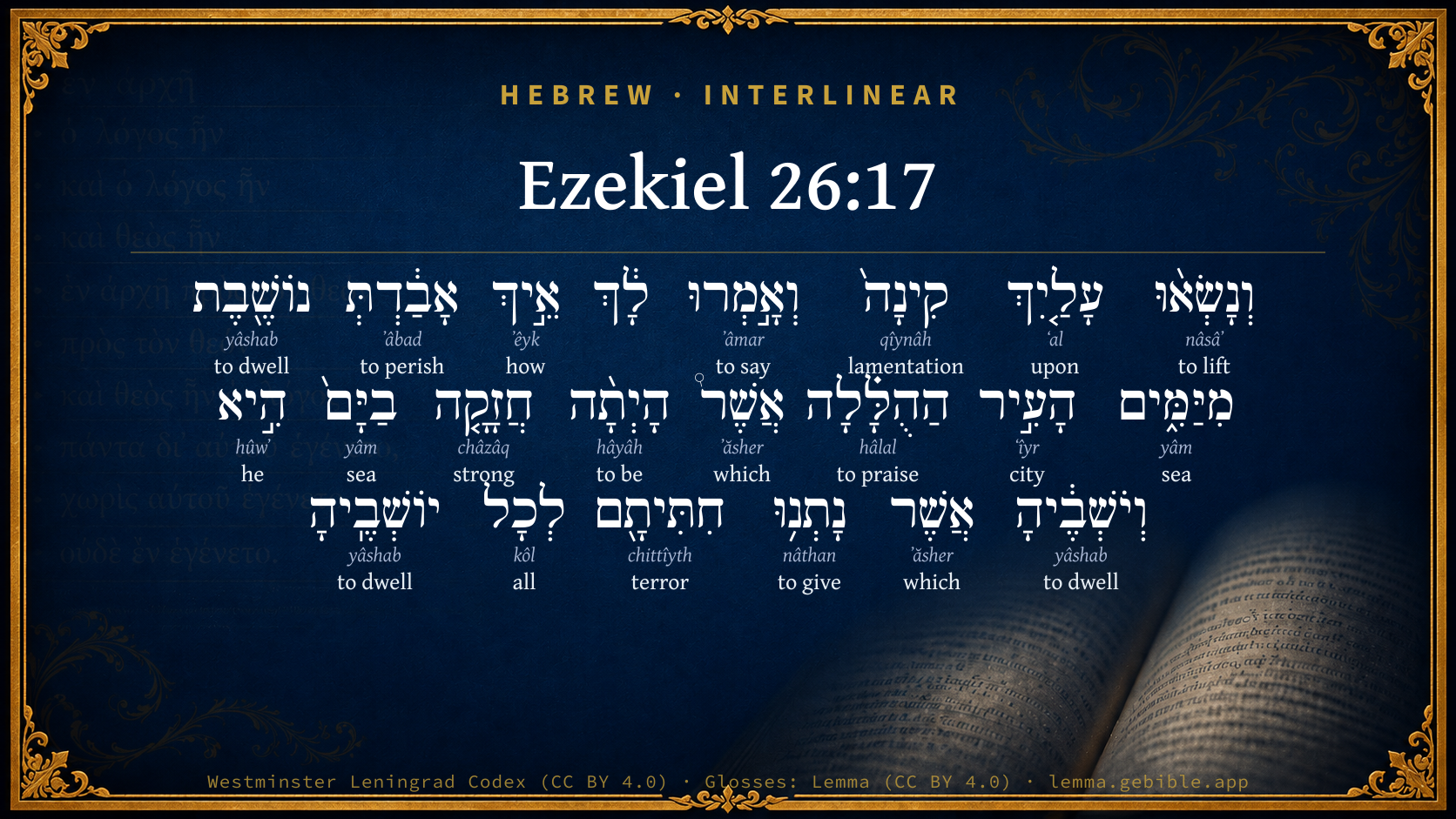
Hebrew (Westminster Leningrad Codex) Ezekiel 26:17 appears in the Hebrew Old Testament. The text above is from the Westminster Leningrad Codex. Each word links to its Strong’s number, a concise gloss, and parsing drawn from the Open Scriptures Hebrew Bible morphology. Click any word for its full Brown-Driver-Briggs (BDB) entry.
Download image
Cite this verse

Ezekiel 26:17 (World English Bible). Public Domain. Lemma interlinear Bible study tool, https://lemma.gebible.app/v/ezekiel/26/17.

Show BibTeX & RIS
BibTeX
RIS
English Translation
They shall take up a lamentation over you, and tell you, How are you destroyed, who were inhabited by seafaring men, the renowned city, who was strong in the sea, she and her inhabitants, who caused their terror to be on all who lived there!
World English Bible · Public Domain
Highlights
  • 1 first appearance in the Hebrew Bible
Full analysis ↓
Download a study sheet

One document with this verse’s original text, its word-by-word gloss line, the meaning frame, cross-references with their text, attributed commentary, and full source and license credits — printable, and it pastes into notes with its structure intact.

This verse Autodidact and up

Study sheet (.html) Plain text (.txt)

A passage Seminary Student

Up to 50 verses in one chapter. A passage sheet keeps up to 6 commentary sources and 12 cross-references per verse, in the order this page ranks them, and says so on the sheet whenever that leaves anything out. Ask for a single verse and you get the Autodidact verse sheet above.

Everything on this page stays free to read, with no account — the sheet is a download of what is already on screen, not access to it.

Want to remove ads? Support Godless Engineer
Compare translations 3

The same verse in 3 English versions, stacked beneath the original-language interlinear above. Click any original word for its lexicon entry.

Each is an independent rendering of the whole verse — the interlinear is not word-aligned to these translations.

Highlighted words mark where these versions differ — a whole-verse word diff, not a word-by-word alignment.

  • World English Bible Public Domain
    They shall take up a lamentation over you, and tell you, How are you destroyed, who were inhabited by seafaring men, the renowned city, who was strong in the sea, she and her inhabitants, who caused their terror to be on all who lived there!
  • King James Version Public Domain
    And they shall take up a lamentation for thee, and say to thee, How art thou destroyed, that wast inhabited of seafaring men, the renowned city, which wast strong in the sea, she and her inhabitants, which cause their terror to be on all that haunt it!
  • unfoldingWord Literal Text CC BY-SA 4.0
    They will lift up a lament for you and say to you, How you, who were inhabited by sailors, have been destroyed. The famous city that was so strong—it is now gone from the sea. The ones living in her once spread a terror about themselves upon everyone who lived near them.

unfoldingWord Literal Text — © unfoldingWord, licensed CC BY-SA 4.0. Word-aligned USFM3 via Door43 (git.door43.org/unfoldingWord/en_ult).

Versions to compare (up to 4)

3 of 4 selected

Show all 18 translations

Every available English version of this verse, each an independent rendering of the whole verse.

  • World English Bible Public Domain
    They shall take up a lamentation over you, and tell you, How are you destroyed, who were inhabited by seafaring men, the renowned city, who was strong in the sea, she and her inhabitants, who caused their terror to be on all who lived there!
  • Berean Standard Bible Public Domain
    Then they will lament for you, saying, “How you have perished, O city of renown inhabited by seafaring men—she who was powerful on the sea, along with her people, who imposed terror on all peoples!
  • Majority Standard Bible Public Domain
    Then they will lament for you, saying, “How you have perished, O city of renown inhabited by seafaring men—she who was powerful on the sea, along with her people, who imposed terror on all peoples!
  • King James Version Public Domain
    And they shall take up a lamentation for thee, and say to thee, How art thou destroyed, that wast inhabited of seafaring men, the renowned city, which wast strong in the sea, she and her inhabitants, which cause their terror to be on all that haunt it!
  • American Standard Version (1901) Public Domain
    And they shall take up a lamentation over thee, and say to thee, How art thou destroyed, that wast inhabited by seafaring men, the renowned city, that was strong in the sea, she and her inhabitants, that caused their terror to be on all that dwelt there!
  • Revised Version (1885) Public Domain
    And they shall take up a lamentation for thee, and say to thee, How art thou destroyed, that wast inhabited of seafaring men, the renowned city, which wast strong in the sea, she and her inhabitants, which caused their terror to be on all that haunt it!
  • Geneva Bible (1599) Public Domain
    And they shall take vp a lamentation for thee, and say to thee, Howe art thou destroyed, that wast inhabited of the sea men, the renoumed citie which was strong in the sea, both she and her inhabitants, which cause their feare to be on all that haunt therein!
  • Douay-Rheims (1899) Public Domain
    And taking up a lamentation over thee, they shall sag to thee: How art thou fallen, that dwellest in the sea, renowned city that wast strong in the sea, with thy inhabitants whom all did dread?
  • Young's Literal Translation Public Domain
    And have lifted up for thee a lamentation, And said to thee: How hast thou perished, That art inhabited from the seas, The praised city, that was strong in the sea, She and her inhabitants, Who put their terror on all her inhabitants!
  • Literal Standard Version CC BY-SA 4.0
    And have lifted up a lamentation for you, || And said to you: How you have perished, || That are inhabited from the seas, || The praised city, that was strong in the sea, || She and her inhabitants, || Who put their terror on all her inhabitants!
  • Unlocked Literal Bible CC BY-SA 4.0
    They will lift up a lament for you and say to you, How you, who were inhabited by sailors, have been destroyed. The famous city that was so strong—it is now gone from the sea. The ones living in her once spread a terror about themselves upon everyone who lived near them.
  • unfoldingWord Literal Text CC BY-SA 4.0
    They will lift up a lament for you and say to you, How you, who were inhabited by sailors, have been destroyed. The famous city that was so strong—it is now gone from the sea. The ones living in her once spread a terror about themselves upon everyone who lived near them.
  • Darby Bible Public Domain
    And they shall take up a lamentation for thee, and say to thee, How hast thou perished, that wast inhabited from the seas, O renowned city, which wast strong in the sea, -- she and her inhabitants, who caused their terror to be on all them that dwell therein!
  • World Messianic Bible Public Domain
    They will take up a lamentation over you, and tell you, “How you are destroyed, who were inhabited by seafaring men, the renowned city, who was strong in the sea, she and her inhabitants, who caused their terror to be on all who lived there!”
  • Webster's Bible Public Domain
    And they shall take up a lamentation for thee, and say to thee, How art thou destroyed, that wast inhabited by sea-faring men, the renowned city, which wast strong in the sea, she and her inhabitants, who cause their terror to be on all that haunt it!
  • Free Bible Version CC BY-SA 4.0
    Then they will sing a funeral song for you, saying, ‘You've been destroyed so completely, famous city! You once ruled the sea—you and your people terrified everyone else!
  • Bible in Basic English Public Domain
    And they will send up a song of grief for you, and say to you, What destruction has come on you, how are you cut off from the sea, the noted town, which was strong in the sea, she and her people, causing the fear of them to come on all the dry land!
  • JPS Tanakh (1917) Public Domain
    And they shall take up a lamentation for thee, and say to thee: how art thou destroyed, that wast peopled from the seas, the renowned city, that wast strong in the sea, thou and thy inhabitants, that caused your terror to be on all that inhabit the earth!

Literal Standard Version (2020), Covenant Press — licensed CC BY-SA 4.0. Text via the HelloAO Bible API (eBible.org). Unlocked Literal Bible (unfoldingWord) — licensed CC BY-SA 4.0. Text via the HelloAO Bible API (eBible.org). unfoldingWord Literal Text — © unfoldingWord, licensed CC BY-SA 4.0. Word-aligned USFM3 via Door43 (git.door43.org/unfoldingWord/en_ult). Free Bible Version, Dr. Jonathan Gallagher — licensed CC BY-SA 4.0. Text via the HelloAO Bible API (eBible.org).

Word by word

More ways to search: Search by grammar → Find every occurrence → Compare this word →

Practice this passage: Drill this verse → Learn its vocabulary →

חִתִּיתָ֖ם
chittîyth
H2851
“terror · their”
Noun, Common, Feminine, Singular, Construct + Suffix, Personal, 3rd Person, Masculine, Plural
Part of Speech
Noun
Type
Common
Gender
Feminine
Number
Singular
State
Construct
Full BDB Definition

Origin: from H2865

TWOT: 784f

terror
  1. וְנָשְׂא֨וּ nâsâʼ H5375 “and · to lift” Conjunction + Verb, Qal, Sequential Perfect, 3rd Person, Common, Plural
  2. עָלַ֤יִךְ ʻal H5921 “upon · you” Preposition + Suffix, Personal, 2nd Person, Feminine, Singular
  3. קִינָה֙ qîynâh H7015 “lamentation” Noun, Common, Feminine, Singular, Absolute
  4. וְאָ֣מְרוּ ʼâmar H559 “and · to say” Conjunction + Verb, Qal, Sequential Perfect, 3rd Person, Common, Plural
  5. אֵ֣יךְ ʼêyk H349 “how” Particle, Interrogative
  6. אָבַ֔דְתְּ ʼâbad H6 “to perish” Verb, Qal, Perfect, 2nd Person, Feminine, Singular
  7. נוֹשֶׁ֖בֶת yâshab H3427 “dwelled” Verb, Niphal, Participle Passive, Feminine, Singular, Absolute
  8. מִיַּמִּ֑ים yâm H3220 “from · seas” Preposition + Noun, Common, Masculine, Plural, Absolute
  9. הָעִ֣יר ʻîyr H5892 “the · city” Particle, Definite Article + Noun, Common, Feminine, Singular, Absolute
  10. הַהֻלָּ֗לָה hâlal H1984 “the · to praise” Particle, Definite Article + Verb, Pual, Perfect, 3rd Person, Feminine, Singular
  11. אֲשֶׁר֩ ʼăsher H834 “which” Particle, Relative
  12. הָיְתָ֨ה hâyâh H1961 “to be” Verb, Qal, Perfect, 3rd Person, Feminine, Singular
  13. חֲזָקָ֤ה châzâq H2389 “strong” Adjective, Adjective, Feminine, Singular, Absolute
  14. בַיָּם֙ yâm H3220 “in/at the · sea” Preposition, Determined + Noun, Common, Masculine, Singular, Absolute
  15. הִ֣יא hûwʼ H1931 “he” Pronoun, Personal, 3rd Person, Feminine, Singular
  16. וְיֹשְׁבֶ֔יהָ yâshab H3427 “and · dwelling · her” Conjunction + Verb, Qal, Participle Active, Masculine, Plural, Construct + Suffix, Personal, 3rd Person, Feminine, Singular
  17. אֲשֶׁר ʼăsher H834 “which” Particle, Relative
  18. נָתְנ֥וּ nâthan H5414 “to give” Verb, Qal, Perfect, 3rd Person, Common, Plural
  19. לְכָל kôl H3605 “to/for · all of” Preposition + Noun, Common, Masculine, Singular, Construct
  20. יוֹשְׁבֶֽיהָ yâshab H3427 “dwelling · her” Verb, Qal, Participle Active, Masculine, Plural, Construct + Suffix, Personal, 3rd Person, Feminine, Singular

About this verse

These counts appear in no published source. They are computed here, from the morphology-tagged text and Lemma’s own curated glosses. What Lemma adds →

22
words
17
distinct lemmas
Prophets
section

Notable vocabulary

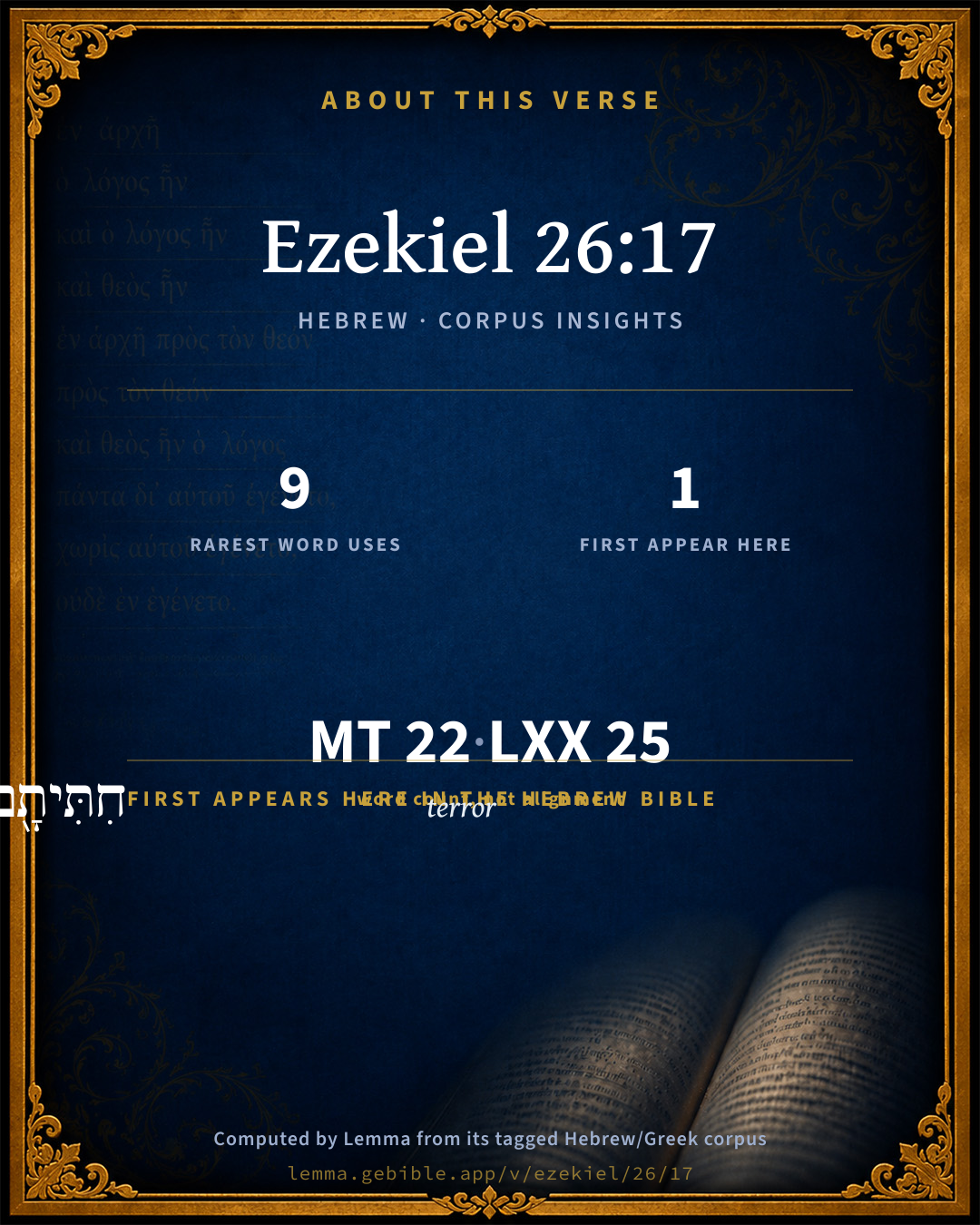
The rarest word here is חִתִּיתָ֖ם terror H2851 — appearing just 9 times in the whole Hebrew Bible.

First appearance in Scripture

This word makes its first canonical appearance in the Hebrew Bible here:

  • חִתִּיתָ֖ם terror H2851

Shared distinctive vocabulary

חִתִּיתָ֖ם terror H2851 occurs in 8 verses of the Hebrew Bible. Also found in:

Grammatical profile

  • 9 verbs
  • 6 nouns
  • 1 adjective
  • 1 pronoun
  • 2 prepositions
  • 3 particles

Verb forms

  • וְנָשְׂא֨וּ Qal · Sequential Perfect
  • וְאָ֣מְרוּ Qal · Sequential Perfect
  • אָבַ֔דְתְּ Qal · Perfect
  • נוֹשֶׁ֖בֶת Niphal · Participle Passive
  • הַהֻלָּ֗לָה Pual · Perfect
  • הָיְתָ֨ה Qal · Perfect
  • וְיֹשְׁבֶ֔יהָ Qal · Participle Active
  • נָתְנ֥וּ Qal · Perfect
  • יוֹשְׁבֶֽיהָ Qal · Participle Active

Repetition

Words recur within this verse — often emphatic in Hebrew:

  • נוֹשֶׁ֖בֶת to dwell H3427 ×3
  • מִיַּמִּ֑ים sea H3220 ×2
  • אֲשֶׁר֩ which H834 ×2

Hebrew & Septuagint length

In English translation the verse runs 45 words from the Hebrew and 34 from the Septuagint (LXX English) — closely comparable.

A rough comparison of the two English renderings, which tokenize alike — not a word-level alignment.

Word counts can differ between the Hebrew and the Greek without any difference in meaning — e.g. the Hebrew direct-object marker אֵת has no separate Greek word, and Greek often adds the article ὁ.

In the original languages it is 22 Hebrew tokens and 25 Greek tokens — but the two are counted differently (Hebrew bundles its prefixes and suffixes into one token; the Greek is in lemma form), so that isn’t a like-for-like length.

Cross-references

23

Topical passages linked to Ezekiel 26:17 in the Treasury of Scripture Knowledge — connected by theme and wording, ordered by reader-vote popularity; previews shown in the World English Bible.

  • Isaiah 14:12 How you are fallen from heaven, day-star, son of the morning! How you are cut down to the ground, who laid the nations low!
  • Ezekiel 19:1 Moreover, take up a lamentation for the princes of Israel,
  • 2 Samuel 1:25–27 How are the mighty fallen in the midst of the battle! Jonathan is slain on your high places.
  • Isaiah 23:4 Be ashamed, Sidon; for the sea has spoken, the stronghold of the sea, saying, I have not travailed, nor brought forth, neither have I nourished young men, nor brought up virgins.
  • Ezekiel 19:14 Fire is gone out of the rods of its branches, it has devoured its fruit, so that there is in it no strong rod to be a scepter to rule. This is a lamentation, and shall be for a lamentation.
  • Ezekiel 27:2–36 You, son of man, take up a lamentation over Tyre;
  • Ezekiel 32:2 Son of man, take up a lamentation over Pharaoh king of Egypt, and tell him, You were likened to a young lion of the nations: yet are you as a monster in the seas; and you did break forth with your rivers, and troubled the waters with your feet, and fouled their rivers.
  • Ezekiel 32:16 This is the lamentation with which they shall lament; the daughters of the nations shall lament therewith; over Egypt, and over all her multitude, shall they lament therewith, says the Lord Yahweh.
  • Revelation 18:9–10 The kings of the earth, who committed sexual immorality and lived wantonly with her, will weep and wail over her, when they look at the smoke of her burning,
  • Revelation 18:16–19 saying, 'Woe, woe, the great city, she who was dressed in fine linen, purple, and scarlet, and decked with gold and precious stones and pearls!
  • Joshua 19:29 and the border turned to Ramah, and to the fortified city of Tyre; and the border turned to Hosah; and the goings out of it were at the sea by the region of Achzib;
  • 2 Samuel 1:19 Your glory, Israel, is slain on your high places! How are the mighty fallen!
  • Isaiah 23:8 Who has purposed this against Tyre, the giver of crowns, whose merchants are princes, whose traffickers are the honorable of the earth?
  • Jeremiah 6:26 Daughter of my people, gird you with sackcloth, and wallow yourself in ashes: make you mourning, as for an only son, most bitter lamentation; for the destroyer shall suddenly come on us.
  • Jeremiah 7:29 Cut off your hair, [Jerusalem], and cast it away, and take up a lamentation on the bare heights; for Yahweh has rejected and forsaken the generation of his wrath.
  • Jeremiah 9:20 Yet hear the word of Yahweh, you women, and let your ear receive the word of his mouth; and teach your daughters wailing, and everyone her neighbor lamentation.
  • Lamentations 1:1 How does the city sit solitary, that was full of people! She has become as a widow, who was great among the nations! She who was a princess among the provinces is become tributary!
  • Ezekiel 28:2–10 Son of man, tell the prince of Tyre, Thus says the Lord Yahweh: Because your heart is lifted up, and you have said, I am a god, I sit in the seat of God, in the midst of the seas; yet you are man, and not God, though you did set your heart as the heart of God;-
  • Ezekiel 28:12–19 Son of man, take up a lamentation over the king of Tyre, and tell him, Thus says the Lord Yahweh: You seal up the sum, full of wisdom, and perfect in beauty.
  • Joel 1:18 How the animals groan! The herds of cattle are perplexed, because they have no pasture. Yes, the flocks of sheep are made desolate.
  • Obadiah 1:5 If thieves came to you, if robbers by night-- oh, what disaster awaits you--wouldn't they only steal until they had enough? If grape pickers came to you, wouldn't they leave some gleaning grapes?
  • Micah 2:4 In that day they will take up a parable against you, And lament with a doleful lamentation, saying, 'We are utterly ruined! My people's possession is divided up. Indeed he takes it from me and assigns our fields to traitors!'"
  • Zephaniah 2:15 This is the joyous city that lived carelessly, that said in her heart, "I am, and there is none besides me." How she has become a desolation, a place for animals to lie down in! Everyone who passes by her will hiss, and shake their fists.

Cross-references courtesy of OpenBible.info (CC BY 4.0).

Hebrew and Greek witnesses Masoretic Hebrew ↔ Greek Septuagint

The same verse in the two great witnesses to the Old Testament, shown verse-for-verse.

These are two independent witnesses, not word-aligned to each other, and the Septuagint is shown in lemma (dictionary) form.

Hebrew Ezekiel 26:17 Masoretic · Westminster Leningrad Codex

וְנָשְׂא֨וּ עָלַ֤יִךְ קִינָה֙ וְאָ֣מְרוּ לָ֔ךְ אֵ֣יךְ אָבַ֔דְתְּ נוֹשֶׁ֖בֶת מִיַּמִּ֑ים הָעִ֣יר הַהֻלָּ֗לָה אֲשֶׁר֩ הָיְתָ֨ה חֲזָקָ֤ה בַיָּם֙ הִ֣יא וְיֹשְׁבֶ֔יהָ אֲשֶׁר נָתְנ֥וּ חִתִּיתָ֖ם לְכָל יוֹשְׁבֶֽיהָ

They shall take up a lamentation over you, and tell you, How are you destroyed, who were inhabited by seafaring men, the renowned city, who was strong in the sea, she and her inhabitants, who caused their terror to be on all who lived there!

World English Bible · Public Domain

Greek LXX Ezekiel 26:17 Septuagint · lemma form

καί λαμβάνω ἐπί σύ θρῆνος καί εἶπον σύ πῶς καταλύω ἐκ θάλασσα ὁ πόλις ὁ ἐπαινεστός ὁ δίδωμι ὁ φόβος αὐτός πᾶς ὁ καταοἰκέω αὐτός

And they shall take up a lamentation for you, and shall say to you, How are you destroyed from out of the sea, the renowned city, that brought her terror upon all her inhabitants.

LXX2012 (modern English Septuagint) · Public Domain

Hebrew: Westminster Leningrad Codex (CC BY 4.0). Greek: Septuagint (public domain); English from LXX2012 (modern English Septuagint) (Public Domain). How the Septuagint differs from the Hebrew →

Targum (Aramaic paraphrase)

1

The Targum is the ancient Jewish Aramaic paraphrase of the Hebrew Scriptures — an interpretive translation, not the Hebrew text itself. Onkelos (literal) and Pseudo-Jonathan (expansive) render the Torah, and Jonathan the Prophets. Coverage is partial: where no permissively-licensed English translation exists for a verse, only the Aramaic is shown. This is verse-level text, not a word-by-word alignment to the Hebrew.

  1. Targum Jonathan Prophets (Joshua–Malachi)
    וְיִטְלוּן עֲלָךְ אִלְיָא וְיֵימְרוּן לָךְ אֵיכְדֵין אַבַדְתְּ דַהֲוֵית יָתְבָא בְּגוֹ יַמַיָא קַרְתָּא מִשֻׁבַּחְתָּא דַהֲוֵית יָתָבָא בִּתְקוֹף יַמָא הִיא וְיָתְבָהָא אִיכְדֵין אִתְמַסְרוּ לִתְבַר כָּל יָתְבָהָא:

    (no public-domain English translation for this verse)

    Targum Jonathan — Aramaic: “Mikraot Gedolot” (public domain). English: “Sefaria Community Translation” (CC0 1.0 (public-domain dedication)); “London "Chaldee Paraphrase," 1871” (public domain). Text via Sefaria.

Commentary

Notes on Ezekiel 26:17 from classic Christian and Jewish commentators (each source and its license shown beneath its notes). The classic Christian expositions comment on the surrounding passage and are grouped to its opening verse, so a note may address several verses; the Jewish commentaries on the Tanakh (Rashi and others) are per-verse, so they appear only where the commentator wrote on this verse.

Lemma curates 59 commentaries, every one of them public domain or Creative Commons licensed, each selected and text-cleaned for this edition rather than reprinted as found. About our sources →

Trapp's Complete Commentary

John Trapp

Eze 26:17 And they shall take up a lamentation for thee, and say to thee, How art thou destroyed, [that wast] inhabited of seafaring men, the renowned city, which wast strong in the sea, she and her inhabitants, which cause their terror [to be] on all that haunt it!

Ver. 17. And they shall take up a lamentation.] The like shall be done shortly at Rome. {Rev 18:9}

That wast inhabited of seafaring men.] Who are usually the worst of men, whence the proverb, Maritimi mores, &c.

On all that haunt it.] Haunt the sea, littorales qui sunt fere duri, horridi, immanes, latrociniis dediti, feri et inhospitales, tales olim Britanni.

John Trapp, A Commentary or Exposition upon All the Books of the Old and New Testament (1647–1656) — public domain. Text from a community e-Sword module.

Tyndale Open Study Notes

Tyndale Open Resources

26:17-18 The funeral song (see study note on 19:1-14) for Tyre would be taken up and repeated from place to place. • naval power . . . spread fear: Tyre’s trading practices were apparently based on conquest, subjugation, and exploitation (see 28:16, 18).

Tyndale Open Study Notes — © Tyndale Open Resources, licensed CC BY-SA 4.0. Text via the HelloAO Bible API.

Geneva Bible (1599)

Geneva Bible translators

Meaning, merchants which by their traffic did enrich her wonderfully and increase her power.

Geneva Bible (1599) marginal notes — public domain. Text via Bolls.life.

Jamieson, Fausset & Brown

Robert Jamieson, A. R. Fausset & David Brown

inhabited of seafaring men--that is, which was frequented by merchants of various sea-bordering lands [GROTIUS]. FAIRBAIRN translates with Peschito, "Thou inhabitant of the seas" (the Hebrew literal meaning). Tyre rose as it were out of the seas as if she got thence her inhabitants, being peopled so closely down to the waters. So Venice was called "the bride of the sea."

strong in the sea--through her insular position.

cause their terror to be on all that haunt it--namely, the sea. The Hebrew is rather, "they put their terror upon all her (the city's) inhabitants," that is, they make the name of every Tyrian to be feared [FAIRBAIRN].

Jamieson, Fausset & Brown — Commentary Critical and Explanatory on the Whole Bible (1871) — public domain (CC PDM 1.0). Text via the HelloAO Bible API.

Adam Clarke's Commentary

Verse 17. Wast strong in the sea] The strength of Tyre was so great, that Alexander despaired of being able to reduce it unless he could fill up that arm of the sea that ran between it and the main land. And this work cost his army seven months of labour.

Adam Clarke's Commentary on the Bible (1810–1826) — public domain. Text from a community e-Sword/MySword module.

Ellicott's Commentary for English Readers

(17) Inhabited of seafaring men.—Rather, in-habited from the sea. The word, which is very common, never bears the sense of men. The thought is that the rock of Tyre, built up with dwellings to the water’s edge was like a city rising from the sea.

Which cause their terror.—This clause has occasioned much difficulty. The literal translation is, she and her inhabitants, which gave their fear to all her inhabitants. “Fear” is here used in the sense of that which causes fear; and the meaning is, that the power of Tyre was so feared that every Tyrian was respected for her sake, just as at a later day every Roman bore about with him something of the majesty of Rome, or, as now, the citizen of a great Power is respected among foreigners for his country’s sake. (Comp. Eze_32:24; Eze_32:26.)

A Bible Commentary for English Readers, edited by Charles John Ellicott (1878–1897) — public domain. Text from a community e-Sword module.

The Cambridge Bible for Schools and Colleges

gen. ed. J. J. S. Perowne

17. of seafaring men] lit. inhabited from the seas.

cause their terror] Rather: caused. A.V. “all that haunt it” has taken the ref. to be to the sea, which is almost necessary, though the present text is literally all her inhabitants, referring to the city. The phrase “caused their terror to be” occurs several times in ch. Eze_32:17 seq. with a different construction (b for l), but the sense here can hardly be different, viz., made their terror felt. To say, however, that Tyre and her inhabitants made their terror felt by all her inhabitants is very unnatural. The pronoun must refer to the “seas.” The phrase “inhabited from the seas” is also peculiar; “inhabited” means having inhabitants, not, drawing inhabitants.

17. How art thou destroyed from the sea—the renowned city!

She that brought her terror—on all her inhabitants.

17, 18. Lament of the princes over Tyre.

The Cambridge Bible for Schools and Colleges (gen. ed. J. J. S. Perowne; Cambridge University Press, 1878–1918) — public domain. Text from a community e-Sword module.

John Gill's Exposition

And they shall take up a lamentation for thee, and say unto thee,.... The following mournful song:

how art thou destroyed that wast inhabited of seafaring men; or, "of the seas": by men who used the seas, and traded by sea to different parts of the world; and was frequented by persons that came by sea thither, by the great ocean, by the Red sea, the Mediterranean sea, and others; or, which was surrounded by the sea. So the Targum,

"that dwellest in the midst of the sea:''

"the renowned city, which wast strong in the sea"; fortified by the sea, and against it; strong in shipping and naval stores; so as to be formidable to others, and mistress of the sea. The Targum is,

"which dwell in the strength of the sea;''

and had the strength and riches of it brought unto it; and so was famous all the world over for its commerce, wealth, and power; but now ruined and undone:

she and her inhabitants, which cause their terror to be on all that haunt it! the sea; on all that used the seas; or on all the inhabitants of the islands of the sea; who all stood in fear of Tyre and her inhabitants, and were obliged to strike their sails to their ships.

John Gill's Exposition of the Whole Bible (1746–1763) — public domain (CC PDM 1.0). Text via the HelloAO Bible API.

Haydock's Catholic Bible Commentary

Dwellest in. Hebrew, "of the seas." Protestants, "seafaring men," (Haydock) being near the sea, or thence deriving thy riches.

George Leo Haydock (1774–1849), Haydock's Catholic Family Bible and Commentary, 1859 edition — public domain. Excludes Psalms (Douay-Rheims chapter numbering differs from Protestant) and Deuterocanonical books (Catholic canon only).

Matthew Poole's English Annotations

They; the princes of the sea, Eze 26:16.

Take up a lamentation for thee; solemnly, heartily, and for many days bewail thee.

Say to thee, by a prosopopceia, or fiction of persons, personate a dismal, sorrowful congress with fallen Tyre.

How art thou destroyed! Alas, is it so? Can it be true? How is it that thou art destroyed, who hadst so many friends, so much riches, &c.?

The renowned city; for thy strength, wealth, and wisdom.

Wast strong; strong indeed, and thought impregnable.

Cause their terror to be on all that haunt it: who durst set on thee, who overawedst all the bold adventurers at sea?

Matthew Poole's English Annotations on the Holy Bible (1683–1685) — public domain. Text from a community e-Sword/MySword module.

Whedon's Commentary on the Bible

Daniel D. Whedon

17. Of seafaring men — Literally, from the seas.

Cause [rather, caused] their terror — That is, the fear of “the seas.”

All that haunt it — Rather, all her inhabitants. (Compare Eze_25:4.) Her transient visitors and her miscellaneous population of various nationalities (Eze_27:8-11) were held in awe by a strong hand.

Daniel D. Whedon (gen. ed.), Commentary on the Old and New Testaments (1874–1909) — public domain. Text from a community e-Sword module.

The Pulpit Commentary

Inhabited of seafaring, etc.; Hebrew, from the seas. The sense is the same, but we lose the poetry of the original in the paraphrase. Possibly, however, the phrase may represent the position of Tyro as rising out of the sea or as deriving its wealth from it. Ewald adopts a conjectural reading, which gives "destroyed from the seas;" or, with another conjecture, "She that was settled from the days of the remote past."

The Pulpit Commentary (1880–1919), ed. H.D.M. Spence-Jones & Joseph S. Exell — public domain. Text from a community e-Sword module.

unfoldingWord translationNotes

Door43 World Missions Community

Connecting Statement:

Yahweh continues giving Ezekiel his message to Tyre.

General Information:

In these verses, "They" refers to the "princes of the sea" in the previous verse, and "you" refers to Tyre.

lift up

"sing"

How you, who were inhabited by sailors, have been destroyed

This can be stated in active form. AT: "How your enemies have destroyed you—you who were inhabited by sailors" (See: Active or Passive)

spread a terror about themselves upon everyone who lived near them

The abstract noun "terror" can be translated using the adjective "terrified." AT: "caused all the people around them to be terrified" (See: Abstract Nouns)

Now the coasts tremble on the day of your downfall. The islands in the sea are terrified, because you are no longer in your place

These two lines are similar in meaning and emphasize the response of the surrounding people to the destruction of Tyre. (See: Parallelism)

Now the coasts tremble

Here "the coasts" represents the people living there. AT: "Now the people of the coastlands tremble" (See: Metonymy)

The islands in the sea are terrified

Here "the islands in the sea" represents the people living there. AT: "The people of the islands are terrified" (See: Metonymy)

you are no longer in your place

The destruction of Tyre is spoken of as if it was a person who had died. AT: "you have departed" or "you exist no more" (See: Personification)

translationWords

lament

life

terror

unfoldingWord translationNotes — © Distant Shores Media and the Door43 World Missions Community, licensed CC BY-SA 4.0. Source: git.door43.org/Door43/en_tn.

Rashi

Rabbi Shlomo Yitzchaki (Rashi)

established from the seas [Heb. מִיָמִּים.] Some vocalize it without a “dagesh” (מִיָמִים) and interpret it to mean “settled from days of yore,” and others punctuate it with a “dagesh” (מִיַמִּים) and interpret it to mean “settled with strength through the seas surrounding her,” and so it is.

who cast terror around to all the inhabitants.

Heb. חִתִּיתָם, lur defre[n]emant in Old French, their terror.

Rashi on the Tanakh — English translations: “The Judaica Press complete Tanach with Rashi, translated by A. J. Rosenberg” (CC BY 4.0); “Pentateuch with Rashi's commentary by M. Rosenbaum and A.M. Silbermann, 1929-1934” (public domain); “The Metsudah Tanach series, Lakewood, N.J” (CC BY 4.0); and “The Book of Joshua, Metsudah Publications, 1997” (CC BY 4.0). Text via Sefaria.

Lesson kit

Teaching starters — assembled from the data on this page, not authored interpretation. Every prompt links to the verse data it draws on. Edit before teaching.

Ezekiel, in the Prophets, opens this verse with 22 words (17 distinct Hebrew lemmas). Its most distinctive word is chittîyth (“terror”). A historical commentator’s framing appears above. Read the whole chapter for the surrounding context.

Discussion questions

  1. How does “terror” (chittîyth) shape what this verse is saying?
  2. This is the first place “terror” appears in Scripture (first appears here). What does its debut here establish?
  3. How does Ezekiel 32:23, which shares the word «terror», read alongside this verse?
  4. What does the repetition of “to dwell” (3× in this one verse) do in this verse?
  5. The translations on this page render this verse differently — a whole-verse word diff, not a word-by-word alignment. What might account for the different wordings?
  6. «וְנָשְׂא֨וּ» is a Qal Sequential Perfect verb. How does that grammatical form shape the action described?
  7. Compare how Trapp's Complete Commentary and Tyndale Open Study Notes read this verse. Where do they agree or differ?

Things to notice

Reading settings

Reading text

Shown beneath each verse's original-language words.

Old Testament
Old Testament edition

Read the OT as the Masoretic Hebrew (MT) or the Greek Septuagint (LXX).

English shown for the Greek Septuagint (in the Hebrew ↔ Greek comparison).

Comparing translations? Open the Compare panel on any verse page to stack up to four side by side.