
1 Kings 7:23

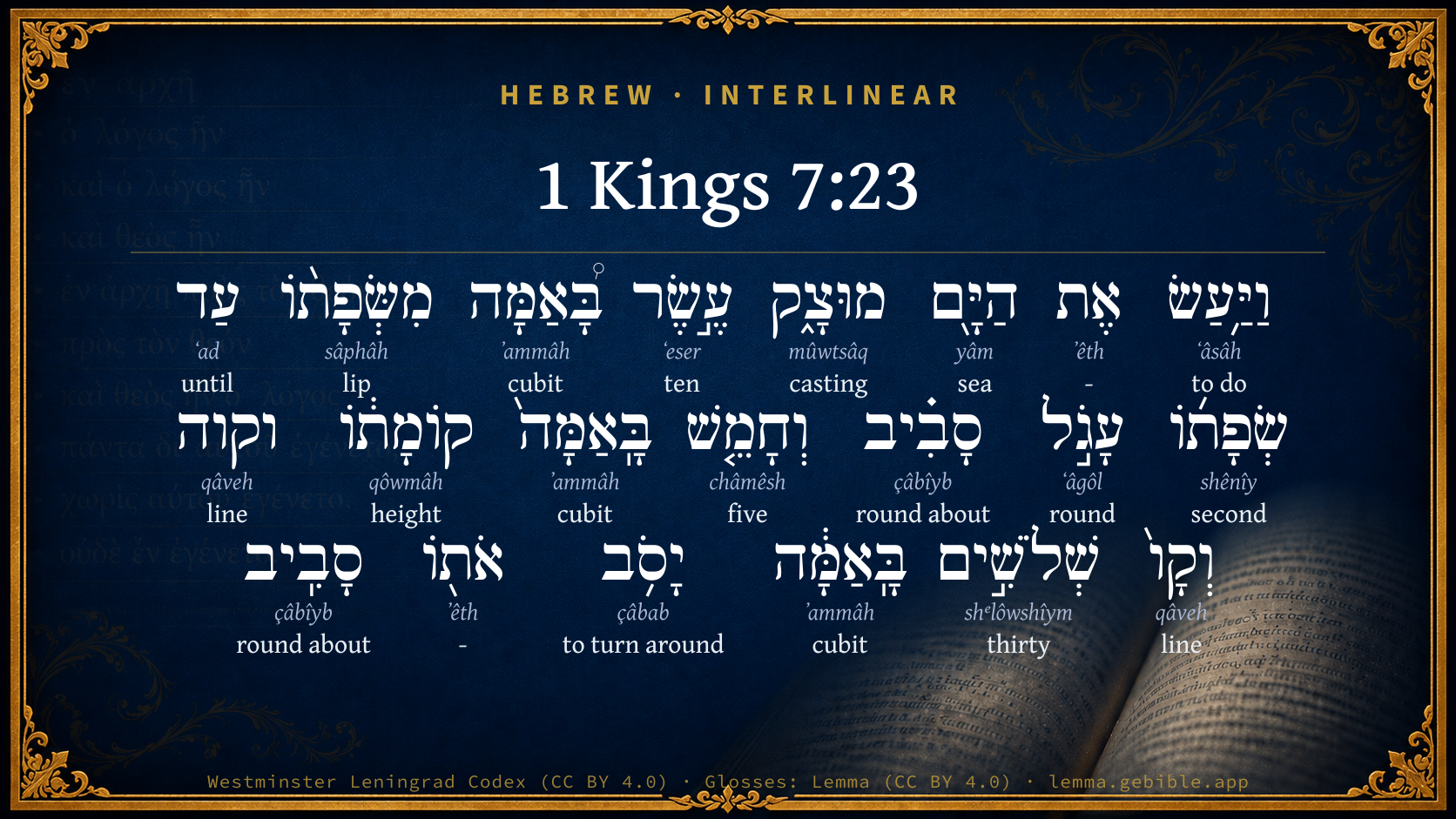
Hebrew (Westminster Leningrad Codex) 1 Kings 7:23 appears in the Hebrew Old Testament. The text above is from the Westminster Leningrad Codex. Each word links to its Strong’s number, a concise gloss, and parsing drawn from the Open Scriptures Hebrew Bible morphology. Click any word for its full Brown-Driver-Briggs (BDB) entry.
Download image
Cite this verse

1 Kings 7:23 (World English Bible). Public Domain. Lemma interlinear Bible study tool, https://lemma.gebible.app/v/1-kings/7/23.

Show BibTeX & RIS
BibTeX
RIS
English Translation
He made the molten sea of ten cubits from brim to brim, round in compass, and the height of it was five cubits; and a line of thirty cubits compassed it round about.
World English Bible · Public Domain
Highlights
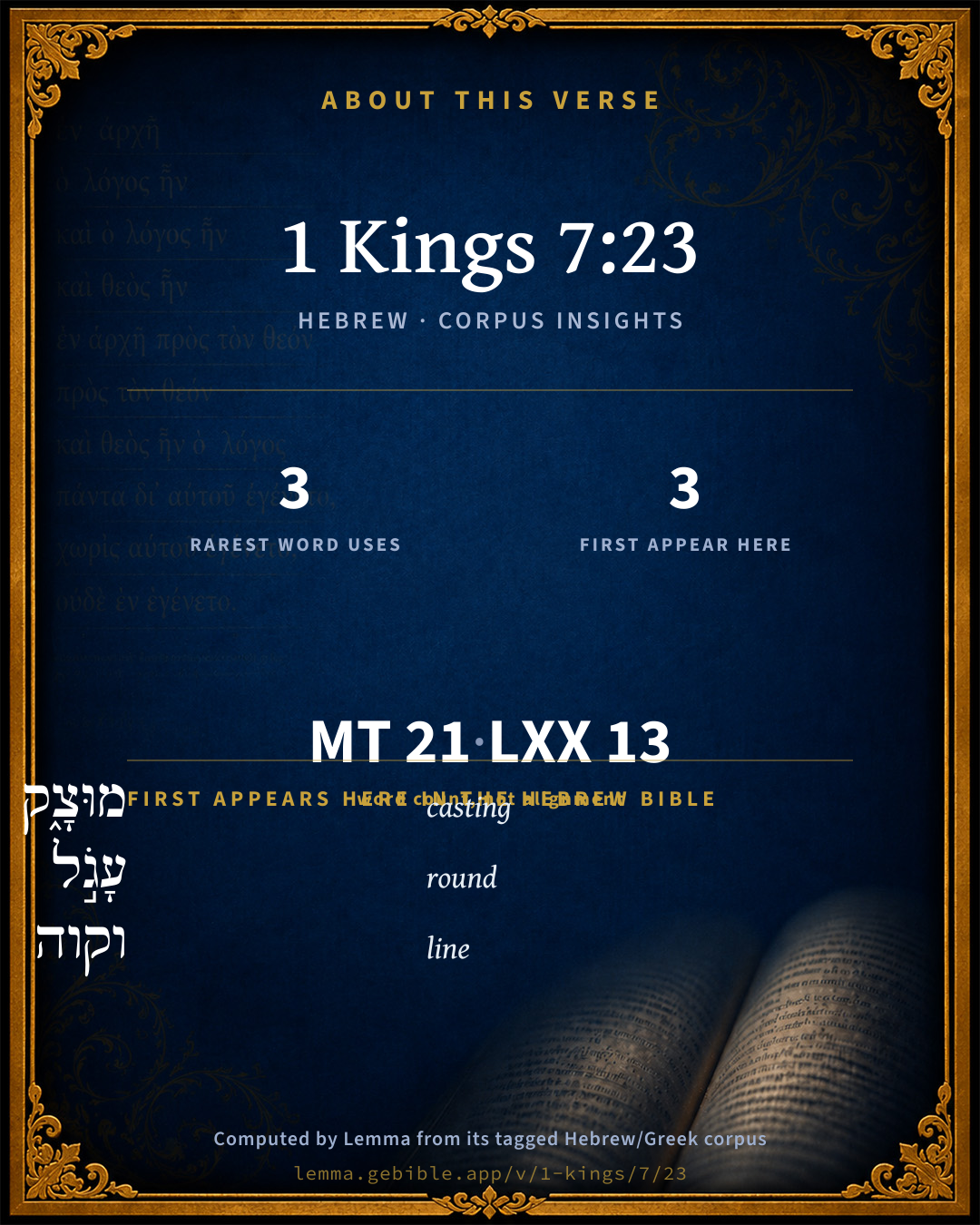
  • 3 first appearances in the Hebrew Bible
Full analysis ↓
Download a study sheet

One document with this verse’s original text, its word-by-word gloss line, the meaning frame, cross-references with their text, attributed commentary, and full source and license credits — printable, and it pastes into notes with its structure intact.

This verse Autodidact and up

Study sheet (.html) Plain text (.txt)

A passage Seminary Student

Up to 50 verses in one chapter. A passage sheet keeps up to 6 commentary sources and 12 cross-references per verse, in the order this page ranks them, and says so on the sheet whenever that leaves anything out. Ask for a single verse and you get the Autodidact verse sheet above.

Everything on this page stays free to read, with no account — the sheet is a download of what is already on screen, not access to it.

Want to remove ads? Support Godless Engineer
Compare translations 3

The same verse in 3 English versions, stacked beneath the original-language interlinear above. Click any original word for its lexicon entry.

Each is an independent rendering of the whole verse — the interlinear is not word-aligned to these translations.

Highlighted words mark where these versions differ — a whole-verse word diff, not a word-by-word alignment.

  • World English Bible Public Domain
    He made the molten sea of ten cubits from brim to brim, round in compass, and the height of it was five cubits; and a line of thirty cubits compassed it round about.
  • King James Version Public Domain
    And he made a molten sea, ten cubits from the one brim to the other: it was round all about, and his height was five cubits: and a line of thirty cubits did compass it round about.
  • unfoldingWord Literal Text CC BY-SA 4.0
    And he made a cast sea, ten by the cubit from its lip to its lip, circular all around. And five by the cubit was its height, and a cord of 30 cubits surrounded it all around.

unfoldingWord Literal Text — © unfoldingWord, licensed CC BY-SA 4.0. Word-aligned USFM3 via Door43 (git.door43.org/unfoldingWord/en_ult).

Versions to compare (up to 4)

3 of 4 selected

Show all 18 translations

Every available English version of this verse, each an independent rendering of the whole verse.

  • World English Bible Public Domain
    He made the molten sea of ten cubits from brim to brim, round in compass, and the height of it was five cubits; and a line of thirty cubits compassed it round about.
  • Berean Standard Bible Public Domain
    He also made the Sea of cast metal. It was circular in shape, measuring ten cubits from rim to rim, five cubits in height, and thirty cubits in circumference.
  • Majority Standard Bible Public Domain
    He also made the Sea of cast metal. It was circular in shape, measuring ten cubits from rim to rim, five cubits in height, and thirty cubits in circumference.
  • King James Version Public Domain
    And he made a molten sea, ten cubits from the one brim to the other: it was round all about, and his height was five cubits: and a line of thirty cubits did compass it round about.
  • American Standard Version (1901) Public Domain
    And he made the molten sea of ten cubits from brim to brim, round in compass, and the height thereof was five cubits; and a line of thirty cubits compassed it round about.
  • Revised Version (1885) Public Domain
    And he made the molten sea of ten cubits from brim to brim, round in compass, and the height thereof was five cubits: and a line of thirty cubits compassed it round about.
  • Geneva Bible (1599) Public Domain
    And he made a molten sea ten cubites wide from brim to brim, rounde in compasse, and fiue cubites hie, and a line of thirtie cubites did compasse it about.
  • Douay-Rheims (1899) Public Domain
    He made also a molten sea of ten cubits from brim to brim, round all about; the height of it was five cubits, and a line of thirty cubits compassed it round about.
  • Young's Literal Translation Public Domain
    And he maketh the molten sea, ten by the cubit from its edge unto its edge; `it is' round all about, and five by the cubit `is' its height, and a line of thirty by the cubit doth compass it round about;
  • Literal Standard Version CC BY-SA 4.0
    And he makes the molten sea, ten by the cubit from its edge to its edge; [it is] round all about, and its height [is] five by the cubit, and a line of thirty by the cubit surrounds it around;
  • Unlocked Literal Bible CC BY-SA 4.0
    Huram made the round sea of cast metal, ten cubits from brim to brim. Its height was five cubits, and the sea was thirty cubits in circumference.
  • unfoldingWord Literal Text CC BY-SA 4.0
    And he made a cast sea, ten by the cubit from its lip to its lip, circular all around. And five by the cubit was its height, and a cord of 30 cubits surrounded it all around.
  • Darby Bible Public Domain
    And he made the sea, molten, ten cubits from brim to brim, round all about; and its height was five cubits; and a line of thirty cubits encompassed it round about.
  • World Messianic Bible Public Domain
    He made the molten sea ten cubits from brim to brim, round in shape. Its height was five cubits; and a line of thirty cubits encircled it.
  • Webster's Bible Public Domain
    And he made a molten sea, ten cubits from the one brim to the other: it was entirely round, and its hight was five cubits: and a line of thirty cubits encompassed it.
  • Free Bible Version CC BY-SA 4.0
    Then he made the Sea of cast metal. Its shape was circular, and measured ten cubits from edge to edge, five cubits in height, and thirty cubits in circumference.
  • Bible in Basic English Public Domain
    And he made a great metal water-vessel ten cubits across from edge to edge, five cubits high and thirty cubits round.
  • JPS Tanakh (1917) Public Domain
    And he made the molten sea of ten cubits from brim to brim, round in compass, and the height thereof was five cubits; and a line of thirty cubits did compass it round about.

Literal Standard Version (2020), Covenant Press — licensed CC BY-SA 4.0. Text via the HelloAO Bible API (eBible.org). Unlocked Literal Bible (unfoldingWord) — licensed CC BY-SA 4.0. Text via the HelloAO Bible API (eBible.org). unfoldingWord Literal Text — © unfoldingWord, licensed CC BY-SA 4.0. Word-aligned USFM3 via Door43 (git.door43.org/unfoldingWord/en_ult). Free Bible Version, Dr. Jonathan Gallagher — licensed CC BY-SA 4.0. Text via the HelloAO Bible API (eBible.org).

Word by word

More ways to search: Search by grammar → Find every occurrence → Compare this word →

Practice this passage: Drill this verse → Learn its vocabulary →

מוּצָ֑ק
mûwtsâq
H4165
“casting”
Verb, Hophal, Participle Passive, Masculine, Singular, Absolute
Part of Speech
Verb
Stem
Hophal
Form
Participle Passive
Gender
Masculine
Number
Singular
State
Absolute
Full BDB Definition

Origin: from H5694

TWOT: 897b

a casting
  1. וַיַּ֥עַשׂ ʻâsâh H6213 “and · to do” Conjunction + Verb, Qal, Sequential Imperfect, 3rd Person, Masculine, Singular
  2. אֶת ʼêth H853 “-” Particle, Direct Object
  3. הַיָּ֖ם yâm H3220 “the · sea” Particle, Definite Article + Noun, Common, Masculine, Singular, Absolute
  4. עֶ֣שֶׂר ʻeser H6235 “ten” Adjective, Cardinal number, Feminine, Singular, Absolute
  5. בָּ֠אַמָּה ʼammâh H520 “in/at the · cubit” Preposition, Determined + Noun, Common, Feminine, Singular, Absolute
  6. מִשְּׂפָת֨וֹ sâphâh H8193 “from · lip · his” Preposition + Noun, Common, Feminine, Singular, Construct + Suffix, Personal, 3rd Person, Masculine, Singular
  7. עַד ʻad H5704 “until” Preposition
  8. שְׂפָת֜וֹ shênîy H8145 “second · his” Noun, Common, Both, Singular, Construct + Suffix, Personal, 3rd Person, Masculine, Singular
  9. עָגֹ֣ל ʻâgôl H5696 “round” Adjective, Adjective, Masculine, Singular, Absolute
  10. סָבִ֗יב çâbîyb H5439 “round about” Noun, Common, Both, Singular, Absolute
  11. וְחָמֵ֤שׁ châmêsh H2568 “and · five” Conjunction + Adjective, Cardinal number, Feminine, Singular, Absolute
  12. בָּֽאַמָּה֙ ʼammâh H520 “in/at the · cubit” Preposition, Determined + Noun, Common, Feminine, Singular, Absolute
  13. קוֹמָת֔וֹ qôwmâh H6967 “height · his” Noun, Common, Feminine, Singular, Construct + Suffix, Personal, 3rd Person, Masculine, Singular
  14. וקוה qâveh H6961 “and · line” Conjunction + Noun, Common, Masculine, Singular, Absolute
  15. וְקָו֙ qâveh H6961 “and · line of” Conjunction + Noun, Common, Masculine, Singular, Construct
  16. שְׁלֹשִׁ֣ים shᵉlôwshîym H7970 “thirty” Adjective, Cardinal number, Both, Plural, Absolute
  17. בָּֽאַמָּ֔ה ʼammâh H520 “in/at the · cubit” Preposition, Determined + Noun, Common, Feminine, Singular, Absolute
  18. יָסֹ֥ב çâbab H5437 “to turn around” Verb, Qal, Imperfect, 3rd Person, Masculine, Singular
  19. אֹת֖וֹ ʼêth H853 “- · him” Particle, Direct Object + Suffix, Personal, 3rd Person, Masculine, Singular
  20. סָבִֽיב çâbîyb H5439 “round about” Noun, Common, Both, Singular, Absolute

About this verse

These counts appear in no published source. They are computed here, from the morphology-tagged text and Lemma’s own curated glosses. What Lemma adds →

21
words
16
distinct lemmas
Historical
section

Notable vocabulary

The rarest word here is מוּצָ֑ק casting H4165 — appearing just 3 times in the whole Hebrew Bible.

First appearance in Scripture

These words make their first canonical appearance in the Hebrew Bible here:

Shared distinctive vocabulary

מוּצָ֑ק casting H4165 occurs in 3 verses of the Hebrew Bible. Also found in:

Grammatical profile

  • 3 verbs
  • 11 nouns
  • 4 adjectives
  • 1 preposition
  • 2 particles

Verb forms

  • וַיַּ֥עַשׂ Qal · Sequential Imperfect
  • מוּצָ֑ק Hophal · Participle Passive
  • יָסֹ֥ב Qal · Imperfect

Repetition

Words recur within this verse — often emphatic in Hebrew:

  • בָּ֠אַמָּה cubit H520 ×3
  • סָבִ֗יב round about H5439 ×2
  • וקוה line H6961 ×2

Hebrew & Septuagint length

In English translation the verse runs 33 words from the Hebrew and 30 from the Septuagint (LXX English) — closely comparable.

A rough comparison of the two English renderings, which tokenize alike — not a word-level alignment.

Word counts can differ between the Hebrew and the Greek without any difference in meaning — e.g. the Hebrew direct-object marker אֵת has no separate Greek word, and Greek often adds the article ὁ.

In the original languages it is 21 Hebrew tokens and 13 Greek tokens — but the two are counted differently (Hebrew bundles its prefixes and suffixes into one token; the Greek is in lemma form), so that isn’t a like-for-like length.

Cross-references

8

Topical passages linked to 1 Kings 7:23 in the Treasury of Scripture Knowledge — connected by theme and wording, ordered by reader-vote popularity; previews shown in the World English Bible.

  • 2 Kings 25:13 The pillars of brass that were in the house of Yahweh, and the bases and the brazen sea that were in the house of Yahweh, did the Chaldeans break in pieces, and carried the brass of them to Babylon.
  • 2 Chronicles 4:2 Also he made the molten sea of ten cubits from brim to brim, round in compass; and the height of it was five cubits; and a line of thirty cubits compassed it round about.
  • Jeremiah 52:17 The pillars of brass that were in the house of Yahweh, and the bases and the brazen sea that were in the house of Yahweh, did the Chaldeans break in pieces, and carried all the brass of them to Babylon.
  • Exodus 30:18–21 "You shall also make a basin of brass, and the base of it of brass, in which to wash. You shall put it between the tent of meeting and the altar, and you shall put water in it.
  • Exodus 38:8 He made the basin of brass, and its base of brass, out of the mirrors of the ministering women who ministered at the door of the tent of meeting.
  • 1 Chronicles 18:8 From Tibhath and from Cun, cities of Hadarezer, David took very much brass, with which Solomon made the brazen sea, and the pillars, and the vessels of brass.
  • Jeremiah 52:20 The two pillars, the one sea, and the twelve brazen bulls that were under the bases, which king Solomon had made for the house of Yahweh. The brass of all these vessels was without weight.
  • 2 Kings 16:17 King Ahaz cut off the panels of the bases, and removed the basin from off them, and took down the sea from off the brazen oxen that were under it, and put it on a pavement of stone.

Cross-references courtesy of OpenBible.info (CC BY 4.0).

Hebrew and Greek witnesses Masoretic Hebrew ↔ Greek Septuagint

The same verse in the two great witnesses to the Old Testament, shown verse-for-verse.

These are two independent witnesses, not word-aligned to each other, and the Septuagint is shown in lemma (dictionary) form.

Hebrew 1 Kings 7:23 Masoretic · Westminster Leningrad Codex

וַיַּ֥עַשׂ אֶת הַיָּ֖ם מוּצָ֑ק עֶ֣שֶׂר בָּ֠אַמָּה מִשְּׂפָת֨וֹ עַד שְׂפָת֜וֹ עָגֹ֣ל סָבִ֗יב וְחָמֵ֤שׁ בָּֽאַמָּה֙ קוֹמָת֔וֹ וקוה וְקָו֙ שְׁלֹשִׁ֣ים בָּֽאַמָּ֔ה יָסֹ֥ב אֹת֖וֹ סָבִֽיב

He made the molten sea of ten cubits from brim to brim, round in compass, and the height of it was five cubits; and a line of thirty cubits compassed it round about.

World English Bible · Public Domain

Greek LXX 1 Kings 7:23 Septuagint · lemma form

κατά αὐτός ποιέω πᾶς ὁ δέκα μεχωνωθ τάξις εἷς καί μέτρον εἷς πᾶς

And he made the sea, ten cubits from one rim to the other, the same was completely circular round about: its height was five cubits, and its circumference thirty-three cubits.

LXX2012 (modern English Septuagint) · Public Domain

On this verse, Keil & Delitzsch discusses the Septuagint’s reading. Read the note in Commentary ↓

Hebrew: Westminster Leningrad Codex (CC BY 4.0). Greek: Septuagint (public domain); English from LXX2012 (modern English Septuagint) (Public Domain). How the Septuagint differs from the Hebrew →

Targum (Aramaic paraphrase)

1

The Targum is the ancient Jewish Aramaic paraphrase of the Hebrew Scriptures — an interpretive translation, not the Hebrew text itself. Onkelos (literal) and Pseudo-Jonathan (expansive) render the Torah, and Jonathan the Prophets. Coverage is partial: where no permissively-licensed English translation exists for a verse, only the Aramaic is shown. This is verse-level text, not a word-by-word alignment to the Hebrew.

  1. Targum Jonathan Prophets (Joshua–Malachi)
    וַעֲבַד יַת יַמָא מַתַּךְ עֲסַר אַמִין מִסִפְתֵיהּ עַד סִפְתֵיהּ סְגַלְגַל סְחוֹר סְחוֹר וַחֲמֵשׁ אַמִין רוּמֵיהּ וְחוּט מְשַׁח תְּלָתִין אַמִין מַקַף לֵיהּ סְחוֹר סְחוֹר:

    (no public-domain English translation for this verse)

    Targum Jonathan — Aramaic: “Mikraot Gedolot” (public domain). English: “Sefaria Community Translation” (CC0 1.0 (public-domain dedication)); “London "Chaldee Paraphrase," 1871” (public domain). Text via Sefaria.

Commentary

Notes on 1 Kings 7:23 from classic Christian and Jewish commentators (each source and its license shown beneath its notes). The classic Christian expositions comment on the surrounding passage and are grouped to its opening verse, so a note may address several verses; the Jewish commentaries on the Tanakh (Rashi and others) are per-verse, so they appear only where the commentator wrote on this verse.

Lemma curates 59 commentaries, every one of them public domain or Creative Commons licensed, each selected and text-cleaned for this edition rather than reprinted as found. About our sources →

Trapp's Complete Commentary

John Trapp

1Ki 7:23 And he made a molten sea, ten cubits from the one brim to the other: [it was] round all about, and his height [was] five cubits: and a line of thirty cubits did compass it round about.

Ver. 23. And he made a molten sea.] As a large laver for the priests to wash in. {2Ch 4:6} the Hebrews used to call the gathering together of much water a sea. It signifieth both the exceeding filthiness of sin, requiring a sea for the cleansing of it, and the infinite virtue of Christ’s blood, &c.

John Trapp, A Commentary or Exposition upon All the Books of the Old and New Testament (1647–1656) — public domain. Text from a community e-Sword module.

Joseph Benson's Commentary

1Ki 7:23. He made a molten sea — He melted the brass, and cast it into the form of a great vessel, for its vastness called a sea, which name is given by the Hebrews to all great collections of waters. The use of it was for the priests to wash their hands and feet, or other things, as occasion required, with the water which they drew out of it. It was round all about — Of a circular form. Its height was five cubits — Besides the height of the oxen whereon it stood. A line of thirty cubits did compass it — For the diameter being ten cubits, thirty must be the circumference of it. This sea was filled with water by the Gibeonites, who were afterward called Nethinims.

Joseph Benson's Commentary on the Old and New Testaments (1811–1818) — public domain. Text from a community e-Sword module.

Tyndale Open Study Notes

Tyndale Open Resources

7:23-26 The giant bronze basin called the Sea replaced the smaller bronze washbasin used in the Tabernacle service (see Exod 30:17-21). The Sea was cast as one solid piece, excluding the twelve bronze oxen on which it sat. The oxen were placed so that three faced each direction, perhaps to remind priests that they served God on behalf of all twelve tribes of Israel. Ahaz later replaced the oxen with a stone base (2 Kgs 16:17). The priests used the Sea, like the bronze washbasin before it, for ceremonial washing (2 Chr 4:6) as they prepared to minister before God (see Exod 30:17-21). The apparent discrepancy in the volume of water it could hold (see 2 Chr 4:5) is probably due to standards of measurement that varied according to place and time.

Tyndale Open Study Notes — © Tyndale Open Resources, licensed CC BY-SA 4.0. Text via the HelloAO Bible API.

Geneva Bible (1599)

Geneva Bible translators

So called for the hugeness of the vessel.

Geneva Bible (1599) marginal notes — public domain. Text via Bolls.life.

Jamieson, Fausset & Brown

Robert Jamieson, A. R. Fausset & David Brown

he made a molten sea--In the tabernacle was no such vessel; the laver served the double purpose of washing the hands and feet of the priests as well as the parts of the sacrifices. But in the temple there were separate vessels provided for these offices. (See on Ch2 4:6). The molten sea was an immense semicircular vase, measuring seventeen and a half feet in diameter, and being eight and three-fourths feet in depth. This, at three and a half inches in thickness, could not weigh less than from twenty-five to thirty tons in one solid casting--and held from sixteen thousand to twenty thousand gallons of water. [See on Ch2 4:3.] The brim was all carved with lily work or flowers; and oxen were carved or cut on the outside all round, to the number of three hundred; and it stood on a pedestal of twelve oxen. These oxen must have been of considerable size, like the Assyrian bulls, so that their corresponding legs would give thickness or strength to support so great a weight for, when the vessel was filled with water, the whole weight would be about one hundred tons [NAPIER]. (See on Ch2 4:3).

Jamieson, Fausset & Brown — Commentary Critical and Explanatory on the Whole Bible (1871) — public domain (CC PDM 1.0). Text via the HelloAO Bible API.

Ellicott's Commentary for English Readers

(23-26) A molten sea—a gigantic laver for the ablution of the priests—corresponding to the laver of brass in the Tabernacle (Exo_30:18-21; Exo_38:8). It had a diameter of 15 feet, and a height of 7½ feet; but as it held 2,000 baths, that is, 17,000 gallons (or, as in 2Ch_4:3, 3,000 baths, that is, 25,500 gallons), it is clear that it could not have been a hemisphere, but must have bulged out in section. There must, however, have been first a bulging inwards, immediately under the rim: for the right translation of 1Ki_7:26 declares that the rim was in “the form of a lily flower,” that is, curving outwards. Under the rim ran a double row of “gourd ornaments,” like those carved in the cedar-panelling of the Temple. The sea stood on twelve oxen, corresponding perhaps to the twelve tribes of Israel—the ox being possibly the same emblem which was used in the form of the cherubim—till it was taken down and placed on the pavement by Ahaz (2Ki_16:17), and, like the great pillars, was broken up at last by the Chaldeans for the sake of the brass (2Ki_25:13).

A Bible Commentary for English Readers, edited by Charles John Ellicott (1878–1897) — public domain. Text from a community e-Sword module.

The Cambridge Bible for Schools and Colleges

gen. ed. J. J. S. Perowne

23–26. The Molten Sea which Hiram made (2Ch_4:2-5)

23. And he made a (R.V. the) molten sea] The definite article is expressed in the original, and the vessel itself was unique. It is called a ‘sea’ because of its great capacity (see Josephus Ant. viii. 3, 5). The Hebrew word is not confined in use to the ocean, but is applied to the Nile (Isa_18:2), and to the Euphrates (Isa_27:1). So lacus is used by Vergil (Georg. 4:173) for a blacksmith’s trough. See also 1Ki_18:32, note.

ten cubits from one brim to the other, &c.] The R.V. tries to be more literal, but with the same sense. Ten cubits from brim to brim, round in compass.

a line of thirty cubits] This would in round numbers be the size of the circumference, with ten cubits as diameter.

The Cambridge Bible for Schools and Colleges (gen. ed. J. J. S. Perowne; Cambridge University Press, 1878–1918) — public domain. Text from a community e-Sword module.

John Gill's Exposition

And under the brim of it round about there were knops compassing it,.... Of an oval form, and therefore the Targum calls them figures of eggs; in Ch2 4:3 they are said to have the similitude of oxen, being like the heads of oxen, and the other parts oval; or these were in the form of gourds, as sometimes the word is rendered, Kg2 4:39 which had on them the figures of the heads of oxen, and might serve as cocks to let out the water:

ten in a cubit, compassing the sea round about it; and as the circumference was thirty cubits, there must be three hundred of these in the circuit:

the knops were cast in two rows when it was cast; for these were cast together with the sea, and being in two rows, there must be in all six hundred of them.

John Gill's Exposition of the Whole Bible (1746–1763) — public domain (CC PDM 1.0). Text via the HelloAO Bible API.

Albert Barnes' Notes on the Bible

The “molten sea “of Solomon, so called from its great size, took the place of the laver of the tabernacle Exo 30:18-21, which was required for the ablutions of the priests. It was ten cubits, or fully fifteen feet, in diameter at top, and therefore forty-seven feet in circumference, with a depth of 5 cubits, or 7 12 feet. As a vessel of these dimensions, if hemispherical, would certainly not hold 2,000 1Ki 7:26, much less 3,000 2Ch 4:3 baths, the bath equaling 8 12 gallons, it is now generally supposed that the bowl bulged considerably below the brim, and further, that it had a “foot,” - or basin which received the water as it was drawn out by taps from the bowl. The “2,000 baths” may give the quantity of water ordinarily supplied to the “sea;” the “3,000 baths” the utmost that the laver could anyhow take. Bowls of a considerable size are represented in the Assyrian bas-reliefs; but none of such dimensions as Solomon’s. The largest mentioned by the Greeks held only 5,400 gallons, less than one-third of the contents of the “molten sea,” even according to the lowest estimate.

Albert Barnes' Notes on the Bible (1834–1885) — public domain. Text from a community e-Sword/MySword module.

Haydock's Catholic Bible Commentary

Brim, in diameter. The circumference was about 30 cubits; for it is not exactly three [but pi (3.14159...)] times as much as the diameter. (Calmet) --- The latter is [approximately] as 7 to 22, with respect to the circumference. But the Scripture takes no notice of trifles. (Menochius)

George Leo Haydock (1774–1849), Haydock's Catholic Family Bible and Commentary, 1859 edition — public domain. Excludes Psalms (Douay-Rheims chapter numbering differs from Protestant) and Deuterocanonical books (Catholic canon only).

Matthew Poole's English Annotations

He made a molten sea; he melted the brass, and cast it into the form of a great vessel, for its vastness called a sea, which name is given by the Hebrews to all great collections of waters. The use of it was for the priests to wash their hands and feet, or other things as occasion required, with the water which they drew out of it. See 2Ch 4:2. Compare Exo 30:19,20.

Matthew Poole's English Annotations on the Holy Bible (1683–1685) — public domain. Text from a community e-Sword/MySword module.

Whedon's Commentary on the Bible

Daniel D. Whedon

23. A molten sea — Called also brazen sea, from the material of which it was made. It was a vast bowl-shaped font, or laver, like that which Moses made for the tabernacle, (Exo_30:18,) and for the same purpose, but on account of its immense size it is called a sea. Its general appearance is shown in the annexed cut, which will serve to explain the sacred writer’s description better than would any verbal comment on his words.

Daniel D. Whedon (gen. ed.), Commentary on the Old and New Testaments (1874–1909) — public domain. Text from a community e-Sword module.

The Pulpit Commentary

The writer now passes on to describe the brazen vessels made by Hiram for the temple use. And he made a Heb. the molten sea so called on account of its unprecedented size and capacity. It was designed, like the laver of brass in the tabernacle, (Exo_30:18-20) to contain the water necessary for the ablutions of the priests. For its size and shape see below, ten cubits from the one brim to the other Heb. from his lip to his lip round all about i.e., circular, and his height was five cubits this was the depth of the vessel, exclusive of its foot or base: and a line of thirty cubits did compass It round about. The historian obviously uses round numbers when he speaks of the diameter as ten and the circumference as thirty cubits. If the diameter was exactly ten, the circumference would of course be about 31.5 cubits. But the sacred writers seldom aim at precision.

Vers. 23, 24.

The Molten Sea and the Brazen Layers.

If the two pillars teach the lesson of purity, of personal holiness, how much more the sea and bases! For observe

1. Sea and bases had the same end in view, viz., purification. The first was for the cleansing of the priests. The second for the cleansing of the sacrifices offered by the priests.

2. The extraordinary provision of water for the service of the temple. Underneath the temple area was a great reservoir (it is said to be some fifty feet deep), no doubt the same which exists at the present day, near the Mosque el Aksa (note on ver. 26). This was connected by an aqueduct (which can still be traced) with Solomon"s Pools at Etham, near Bethlehem. Whether these great works were purely for the use of the temple, or whether the city also shared in their benefits, may be doubtful, but that the temple occupied the first place in the scheme is beyond all question. From this subterranean sea whether by pipes or by the labours of the Nethinim, we cannot be certain both molten sea and brazen layers were filled. But here a distinction must be made. The priests were commanded to wash, under pain of death, (Exo_30:19 sqq.; Exo_29:4 Exo_40:30-32) but there was no such command with respect to the victims. No; the sacrifices would seem to have been washed because the Jewish mind instinctively felt that this was right and fitting. And that it was right and fitting is proved by the fact that the service was accepted, and here enjoys the Divine sanction. We should hardly have had twelve verses of Scripture devoted to the description of the layers and their bases, had not God Himself approved of the washing of "the work of the burnt offering" (2Ch_4:6, Hebrews)

Hence we may learn

I That Christian priests must be washed.

II That Christian sacrifices should be cleansed.

I CHRISTIAN PRIESTS MUST BE WASHED. Here two questions arise.

(1) Who are Christian PRIESTS?

(2) What is this WASHING?

1. By Christian priests we may understand here all Christians. For all Christians axe priests, precisely as all Jews were priests (cf. 1Pe_2:5, 1Pe_2:9, with. Exo_19:6) Of course, there is a priesthood among Christians, just as there was a priesthood among the Jews (see page 113). It is often said, and said truly, that the word iJereuv, sacerdos, is nowhere applied to the ministers of the New Testament; but the answer is that it could not have been so applied, so long as the Levitical priesthood existed, without risk of confusion. It is also true that the functions of the Christian presbyterate are very, very different from those of the Jewish priesthood; but all the same, if Christianity is filling up, and not the reversal or the negation of Judaism (Col_2:17; Mat_5:17) then, assuredly, it must not only have its altar,, (Heb_13:10) but its priesthood. But let us understand the word here of the body of believers: for clearly, if we can prove that all Christians must be washed, how much more those who minister in holy things, and bear the vessels of the Lord? (Isa_52:11)

2. By Christian washing we may understand, primarily, THE washing (kat ejxochn) of the New Testament, "the washing of regeneration". (Tit_3:5; cf. 1Co_6:11; Eph_5:26; Heb_10:22; cf. 6:2) For to all Christians is the command addressed, "Arise, and be baptized, and wash away thy sins" (Act_22:16; cf. 1Ki_2:38) Of all may our holy Lord be heard to say, "If I wash thee not, thou hast no part with me" (Joh_13:8; cf. 3:5; Mar_16:16)

But is this all? Are we only to find here a lesson as to Christian baptism? Certainly net. For observe,

(1) by baptism, the initial rite of our religion, men are made priests. (Rev_1:5, Rev_1:6)

(2) The washing of the priests was a washing of the hands and the feet; (Exo_30:19) and

(3) it was to be repeated as often as they "went into the tabernacle of the congregation or" came near unto the altar. (ver. 20; 1Ki 10:32) Clearly, then, the "one baptism" of Christianity cannot respond to this exclusively. No; that rather corresponds to the washing of the whole person, (Lev_16:4, Lev_16:24) which the Rabbins say was performed in the molten sea, or in its basin; but which may possibly have been performed in private. That there was such complete ablution on the part of the priests needs no proof; it is presupposed in the directions about the hands and feet. It would have been mockery to wash the extremities of the body, while the body itself remain unclean. But the priest who went to the temple pure might, perhaps, contract some defilement on the way; the exposed parts, the hands and the feet, might be stained and so become unfit for the service of the All-Holy. It was for this the molten sea was provided, and this, helps to illustrate our Lord"s words, "He that is washed needeth not save to wash his feet". (Joh_13:10) Even so we, though, as St. Paul says, we "were washed" (ajpelousasqe, aor.) "in the laver of regeneration," have sullied our baptismal robes in our passage through and contact with the, (Jam_3:2) and need, day by day, cleansing and forgiveness. (Mat_6:12) The text teaches, then, that we are unfit for the service of the Most Pure until we have washed our hands and feet; until, i.e., we are purged from the softs and stains of this wicked world, bier only must "our bodies be washed with pure water," our "hearts" must also be "sprinkled from an evil conscience," before we can draw near with acceptance to God. (Heb_10:22) "I cannot pray, but I sin; I cannot hear, or preach a sermon, but I sin; I cannot give an alms or receive the sacrament, but I sin; nay, I cannot so much as confess my sins, but my very confessions are still aggravations of them; my repentance needs to be repented of, my tears want washing, and the very washing of my tears needs still to be washed over again in the blood of my Redeemer" (Bp. Beveridge).

What, then, let us now ask, is the "sea," what the "laver " for the washing away of these daily sins and defilements? It is a fountain of blood ("Not by water only, but by water and blood,"; (1Jn_5:6) it is the other sacrament of our religion, the "blood of the new covenant shed for many for the remission of sins". (Mat_26:28) "The one baptism for the remission of sins" (Nicene Creed) cannot apply to the sins of later life. For this, other provision is needed, and in the mercy of God other provision is made in the sacrament of love and the ministry of reconciliation. (Cf. also Mat_16:19 Mat_18:18; Joh_20:28; Mat_28:20)

But here one word of caution may possibly be needful. It must not be supposed for a moment that there is any other source or ground of cleansing and forgiveness than the free, unmerited mercy of God in Christ; that there is any hope for the sinner except in the "full, perfect, and sufficient sacrifice, oblation, and satisfaction" once made by the one Saviour "for the sins of the whole world;" or that any rites or ordinances can have any virtue or efficacy apart from His meritorious death and His now victorious life. The sacraments are not, cannot be, the sources or the grounds of forgiveness, nor do they work like a charmex opere operato. But in the all-wise appointment of God, they are the means of grace, the channels through which His infinite mercy ordinarily flows (gratia non ligatur mediis) to the penitent and believing soul.

Nor must it be supposed that the generous provision made by God for the cleansing of all sin obviates the need for striving against sin. (Heb_12:4) We are to "cleanse ourselves from all filthiness of flesh and spirit". (2Co_7:1) We are to "purify ourselves, even as He is pure". 1Jn_3:3-7. The priests of the Holy God must "live a clean life" (Wyclif)

II CHRISTIAN SACRIFICES SHOULD BE CLEANSED. Here again two questions arise.

(1) What are Christian sacrifices?

(2) How can they be cleansed?

1. Christian sacrifices. Those which all Christian men are ordained to offer (1Pe_2:8) are these

(1) The living sacrifice of body and soul. (Rom_12:1)

(2) The sacrifice of praise and thanksgiving. (Heb_13:15)

(3) The sacrifice of alms and oblations (Heb_13:16; Php_4:18)

2. The Cleansing of these sacrifices is that which takes place in a "pure heart and good conscience." It is a matter of motive, of intention. The quality of the sacrifice depends on the spirit of the sacrificer. It is a sacrifice, howsoever offered there is such a thing as "the sacrifice of fools" (Ecc_5:1) but it may be, and often is, a maimed, or unclean, or unworthy sacrifice. If our praise, for example, be prompted by the love of music rather than the love of God; if our alms be offered for the praise of men (Mat_6:17) and not "for His name"s sake," then the sacrifice is unclean. The Christian priest, consequently, should "interrogate his heart"Interroge viscera tua (Augustine) before he enters on Divine service. It has been well said that we ought to wash our prayers and praises in our hearts before we put them into our lips. The customary "prayer before service" and the self examination before communion, (1Co_11:28) if made more real, would ensure the cleansing of the sacrifice. (Compare Jam_1:27)

The Pulpit Commentary (1880–1919), ed. H.D.M. Spence-Jones & Joseph S. Exell — public domain. Text from a community e-Sword module.

John Wesley's Explanatory Notes

A Sea - He melted the brass, and cast it into the form of a great vessel, for its vastness called a sea, which name is given by the Hebrew to all great collections of waters. The use of it was for the priests to wash their hands and feet, or other things as occasion required, with the water which they drew out of it.

John Wesley, Explanatory Notes Upon the Whole Bible (1754–1765) — public domain. Text via the GEBible commentary corpus.

Keil & Delitzsch

C. F. Keil & F. Delitzsch

The brazen sea (cf. Ch2 4:2-5). - "He made the molten sea - a water-basin called ים (mare) on account of its size - ten cubits from the one upper rim to the other," i.e., in diameter measured from the upper rim to the one opposite to it, "rounded all round, and five cubits its (external) height, and a line of thirty cubits encircled it round about," i.e., it was thirty cubits in circumference. The Chethib קוה is to be read קוה here and in Zac 1:16 and Jer 31:39, for which the Keri has קו in all these passages. קוה or קו means a line for measuring, which is expressed in Kg1 7:15 by חוּט. The relation of the diameter to the circumference is expressed in whole numbers which come very near to the mathematical proportions. The more exact proportions would be as 7 to 22, or 113 to 355.

Kg1 7:24

Any colocynths (gourds) ran round it under its brim, ten to the cubit, surrounding the sea in two rows; the colocynths "cast in its casting," i.e., cast at the same time as the vessel itself. Instead of פּקעים, gourds (see at Kg1 6:18), we find בּקרים דּמוּת, figures of oxen, in the corresponding text of the Chronicles, and in the last clause merely הבּקר, an evident error of the pen, בקרים being substituted by mistake for פקעים, and afterwards interpreted בקרים דמות. The assumption by which the early expositors removed the discrepancy, namely, that they were casts of bullocks' heads, is not to be thought of, for the simple reason that בקרים signifies oxen and not the heads of oxen. How far apart the two rows of gourd-like ornaments were, it is impossible to decide. Their size may be estimated, from the fact that there were ten within the space of a cubit, at a little over two inches in diameter.

Kg1 7:25

This vessel stood (rested) upon twelve brazen oxen, three turning to the north, three to the west, three to the south, and three to the east, "and the sea above upon them, and all their backs (turned) inwards;" i.e., they were so placed that three of their heads were directed towards each quarter of the heavens. The size of the oxen is not given; but we must assume that it was in proportion to the size and height of the sea, and therefore about five cubits in height up to the back. These figures stood, no doubt, upon a metal plate, which gave them a fixed and immoveable position (see the engraving in my bibl. Archol. Taf. iii. fig. 1).

Kg1 7:26

"And its thickness (i.e., the thickness of the metal) was a handbreadth" = four finger-breadths, as in the case of the brazen pillars (see at Kg1 7:15), "and its upper rim like work of a goblet (or of a goblet-rim, i.e., bent outwards), lily-blossom," i.e., ornamented with lily-flowers. It held 2000 baths; according to the Chronicles, 3000 baths. The latter statement has arisen from the confusion of ג (3) with ב (2); since, according to the calculation of Thenius, the capacity of the vessel, from the dimensions given, could not exceed 2000 baths. This vessel, which took the place of the laver in the tabernacle, was provided for the priests to wash themselves (Ch2 4:6), that is to say, that a supply of water might be kept in readiness to enable the priests to wash their hands and feet when they approached the altar to officiate, or were about to enter the Holy Place (Exo 30:18.). There were no doubt taps by which the water required for this purpose was drawn off from the sea.

(Note: For the different conjectures on this subject, see Lundius, jud. Heiligthmer, p. 356. Thenius supposes that there was also a provision for filling the vessel, since the height of it would have rendered it a work of great labour and time to fill it by hand, and that there was probably a pipe hidden behind the figures of the oxen, since, according to Aristeas, histor. lxx Interp., Oxon. 1692, p. 32 (also Eusebii praep. evang. ix. 38), there were openings concealed at the foot of the altar, out of which water was allowed to run at certain seasons for the requisite cleansing of the pavement of the court from the blood of the sacrifices; and there is still a fountain just in the neighbourhood of the spot on which, according to Kg1 7:39, the brazen sea must have stood (see Schultz's plan); and in the time of the Crusaders there was a large basin, covered by a dome supported by columns (see Robinson, Pal. i. 446). But even if the later temple was supplied with the water required by means of artificial water-pipes, the Solomonian origin of these arrangements or designs is by no means raised even to the rank of probability.)

- The artistic form of the vessel corresponded to its sacred purpose. The rim of the basin, which rose upwards in the form of a lily, was intended to point to the holiness and loveliness of that life which issued from the sanctuary. The twelve oxen, on which it rested, pointed to the twelve tribes of Israel as a priestly nation, which cleansed itself here in the persons of its priests, to appear clean and holy before the Lord. Just as the number twelve unquestionably suggests the allusion to the twelve tribes of the covenant nation, so, in the choice of oxen or bullocks as supporters of the basin, it is impossible to overlook the significance of this selection of the first and highest of the sacrificial animals to represent the priestly service, especially if we compare the position of the lions on Solomon's throne (Kg1 10:20).

Keil & Delitzsch — Biblical Commentary on the Old Testament (1861–1891) — public domain (CC PDM 1.0). Text via the HelloAO Bible API. (Old Testament only.)

unfoldingWord translationNotes

Door43 World Missions Community

Huram made

Huram would have commanded his workers to do this work. AT: "Huram also commanded them to make" (See: Metonymy)

the round sea

This refers to a bronze tank or basin that would hold water.

cast metal

Huram melted the bronze and formed it in a mold.

ten cubits ... five cubits ... thirty cubits

A cubit is 46 centimeters. AT: "4.6 meters ... 2.3 meters ... 13.8 meters" (See: Biblical Distance)

from brim to brim

"from one edge to the other"

in circumference

Circumference is the distance or measurement around a circular object or area.

encircling the sea were gourds

A gourd is a type of hard, round vegetable that grows on a vine on the ground.

when that basin was cast

This can be stated in active form. AT: "when Huram cast that basin" (See: Active or Passive)

unfoldingWord translationNotes — © Distant Shores Media and the Door43 World Missions Community, licensed CC BY-SA 4.0. Source: git.door43.org/Door43/en_tn.

Rashi

Rabbi Shlomo Yitzchaki (Rashi)

Ten amohs from rim to rim. Through the middle, because the diameter of every round object is through the middle.

And a line of thirty amohs [the circumference]. This is what was mentioned, “All that have three handbreadth in its circumference have one handbreadth in its diameter.” Its circumference was thirty [amohs] and its diameter ten [amohs], is a rounded off number. A diameter of ten amohs results in a circumference of approximately 31.4 amohs. and he measures from its midst. In [Maseches] Eruvin.

High. Its depth; and in Divrei Hayomim it states that he made it for the Kohanim to bathe and to immerse in.

Rashi on the Tanakh — English translations: “The Judaica Press complete Tanach with Rashi, translated by A. J. Rosenberg” (CC BY 4.0); “Pentateuch with Rashi's commentary by M. Rosenbaum and A.M. Silbermann, 1929-1934” (public domain); “The Metsudah Tanach series, Lakewood, N.J” (CC BY 4.0); and “The Book of Joshua, Metsudah Publications, 1997” (CC BY 4.0). Text via Sefaria.

Lesson kit

Teaching starters — assembled from the data on this page, not authored interpretation. Every prompt links to the verse data it draws on. Edit before teaching.

1 Kings, in the Historical, opens this verse with 21 words (16 distinct Hebrew lemmas). Its most distinctive word is mûwtsâq (“casting”). A historical commentator’s framing appears above. Read the whole chapter for the surrounding context.

Discussion questions

  1. How does “casting” (mûwtsâq) shape what this verse is saying?
  2. 3 words make their first appearance in Scripture here. What does this debut establish?
  3. How does 1 Kings 7:37, which shares the word «casting», read alongside this verse?
  4. What does the repetition of “cubit” (3× in this one verse) do in this verse?
  5. These translations render this verse differently. What is at stake in choosing one wording over another?
  6. «וַיַּ֥עַשׂ» is a Qal Sequential Imperfect verb. How does that grammatical form shape the action described?
  7. Compare how Trapp's Complete Commentary and Joseph Benson's Commentary read this verse. Where do they agree or differ?

Things to notice

Reading settings

Reading text

Shown beneath each verse's original-language words.

Old Testament
Old Testament edition

Read the OT as the Masoretic Hebrew (MT) or the Greek Septuagint (LXX).

English shown for the Greek Septuagint (in the Hebrew ↔ Greek comparison).

Comparing translations? Open the Compare panel on any verse page to stack up to four side by side.