
Ezra 3:7

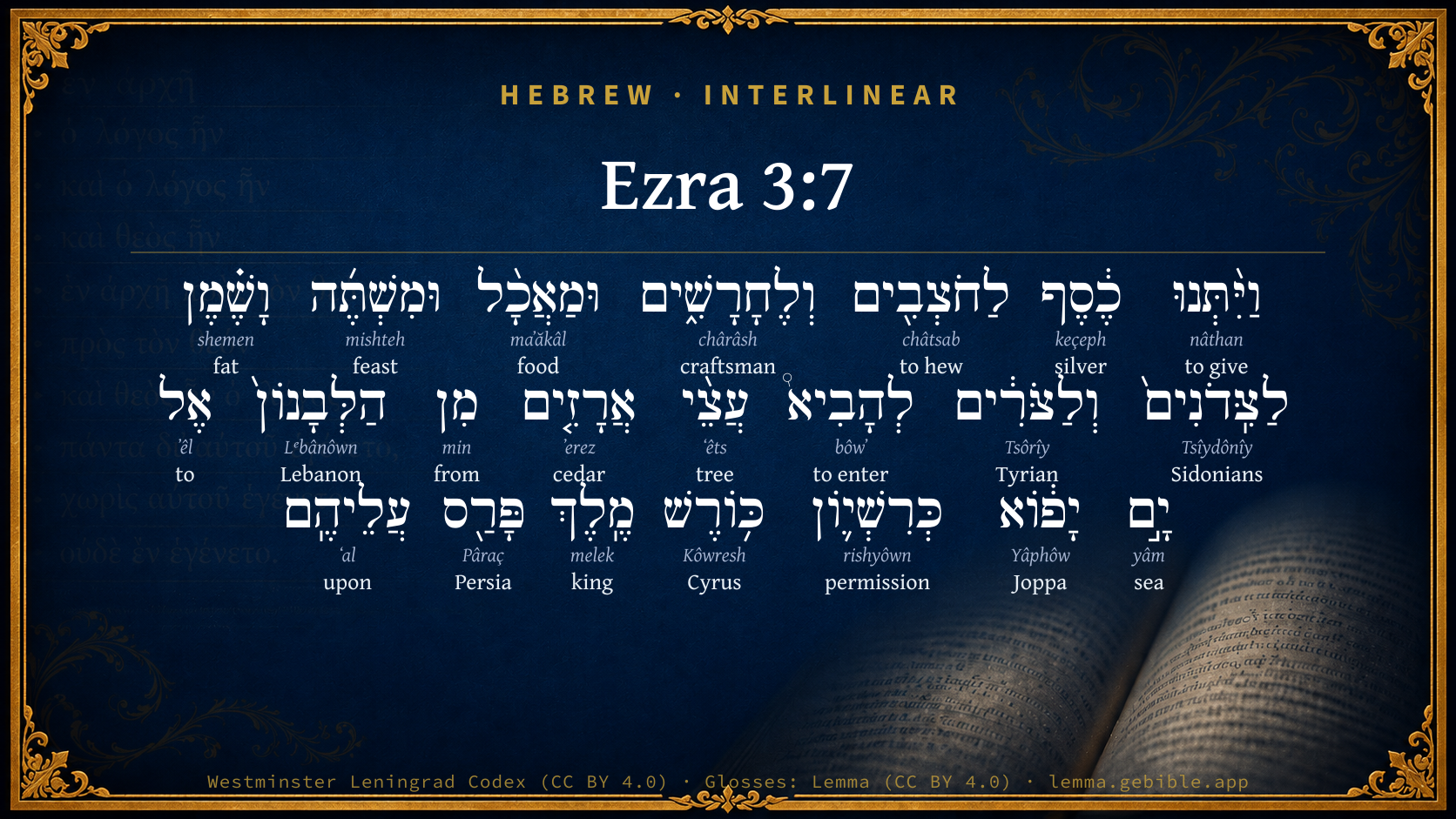
Hebrew (Westminster Leningrad Codex) Ezra 3:7 appears in the Hebrew Old Testament. The text above is from the Westminster Leningrad Codex. Each word links to its Strong’s number, a concise gloss, and parsing drawn from the Open Scriptures Hebrew Bible morphology. Click any word for its full Brown-Driver-Briggs (BDB) entry.
Download image
Cite this verse

Ezra 3:7 (World English Bible). Public Domain. Lemma interlinear Bible study tool, https://lemma.gebible.app/v/ezra/3/7.

Show BibTeX & RIS
BibTeX
RIS
English Translation
They gave money also to the masons, and to the carpenters; and food, and drink, and oil, to them of Sidon, and to them of Tyre, to bring cedar trees from Lebanon to the sea, to Joppa, according to the grant that they had of Cyrus king of Persia.
World English Bible · Public Domain
Highlights
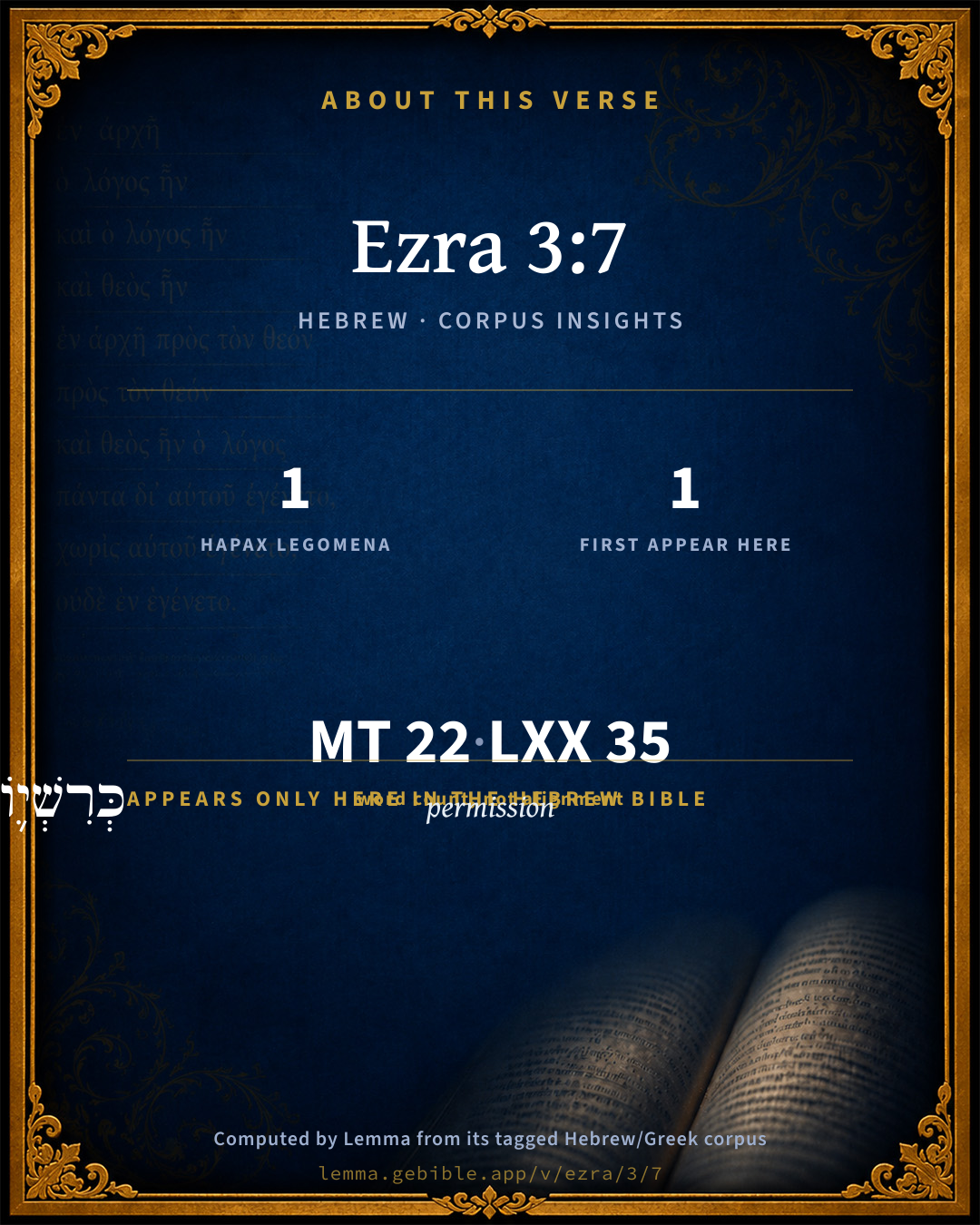
  • 1 hapax legomenon — only here in the Hebrew Bible
  • 1 first appearance in the Hebrew Bible
Full analysis ↓
Download a study sheet

One document with this verse’s original text, its word-by-word gloss line, the meaning frame, cross-references with their text, attributed commentary, and full source and license credits — printable, and it pastes into notes with its structure intact.

This verse Autodidact and up

Study sheet (.html) Plain text (.txt)

A passage Seminary Student

Up to 50 verses in one chapter. A passage sheet keeps up to 6 commentary sources and 12 cross-references per verse, in the order this page ranks them, and says so on the sheet whenever that leaves anything out. Ask for a single verse and you get the Autodidact verse sheet above.

Everything on this page stays free to read, with no account — the sheet is a download of what is already on screen, not access to it.

Want to remove ads? Support Godless Engineer
Compare translations 3

The same verse in 3 English versions, stacked beneath the original-language interlinear above. Click any original word for its lexicon entry.

Each is an independent rendering of the whole verse — the interlinear is not word-aligned to these translations.

Highlighted words mark where these versions differ — a whole-verse word diff, not a word-by-word alignment.

  • World English Bible Public Domain
    They gave money also to the masons, and to the carpenters; and food, and drink, and oil, to them of Sidon, and to them of Tyre, to bring cedar trees from Lebanon to the sea, to Joppa, according to the grant that they had of Cyrus king of Persia.
  • King James Version Public Domain
    They gave money also unto the masons, and to the carpenters; and meat, and drink, and oil, unto them of Zidon, and to them of Tyre, to bring cedar trees from Lebanon to the sea of Joppa, according to the grant that they had of Cyrus king of Persia.
  • unfoldingWord Literal Text CC BY-SA 4.0
    And they gave silver to the masons and to the carpenters, and food, and drink, and oil to the Sidonians and to the Tyrians, to bring trees of cedar from Lebanon to the sea of Joppa, according to the permission of Cyrus, the king of Persia, given to them.

unfoldingWord Literal Text — © unfoldingWord, licensed CC BY-SA 4.0. Word-aligned USFM3 via Door43 (git.door43.org/unfoldingWord/en_ult).

Versions to compare (up to 4)

3 of 4 selected

Show all 18 translations

Every available English version of this verse, each an independent rendering of the whole verse.

  • World English Bible Public Domain
    They gave money also to the masons, and to the carpenters; and food, and drink, and oil, to them of Sidon, and to them of Tyre, to bring cedar trees from Lebanon to the sea, to Joppa, according to the grant that they had of Cyrus king of Persia.
  • Berean Standard Bible Public Domain
    They gave money to the masons and carpenters, and food and drink and oil to the people of Sidon and Tyre to bring cedar logs from Lebanon to Joppa by sea, as authorized by Cyrus king of Persia.
  • Majority Standard Bible Public Domain
    They gave money to the masons and carpenters, and food and drink and oil to the people of Sidon and Tyre to bring cedar logs from Lebanon to Joppa by sea, as authorized by Cyrus king of Persia.
  • King James Version Public Domain
    They gave money also unto the masons, and to the carpenters; and meat, and drink, and oil, unto them of Zidon, and to them of Tyre, to bring cedar trees from Lebanon to the sea of Joppa, according to the grant that they had of Cyrus king of Persia.
  • American Standard Version (1901) Public Domain
    They gave money also unto the masons, and to the carpenters; and food, and drink, and oil, unto them of Sidon, and to them of Tyre, to bring cedar-trees from Lebanon to the sea, unto Joppa, according to the grant that they had of Cyrus king of Persia.
  • Revised Version (1885) Public Domain
    They gave money also unto the masons, and to the carpenters; and meat, and drink, and oil, unto them of Zidon, and to them of Tyre, to bring cedar trees from Lebanon to the sea, unto Joppa, according to the grant that they had of Cyrus king of Persia.
  • Geneva Bible (1599) Public Domain
    They gaue money also vnto the masons, and to the workemen, and meat and drinke, and oyle vnto them of Zidon and of Tyrus, to bring them cedar wood from Lebanon to the sea vnto Iapho, according to the graunt that they had of Cyrus King of Persia.
  • Douay-Rheims (1899) Public Domain
    And they gave money to hewers of stones and to masons: and meat and drink, and oil to the Sidonians and Tyrians, to bring cedar trees from Libanus to the sea of Joppe, according to the orders which Cyrus king of the Persians had given them.
  • Young's Literal Translation Public Domain
    and they give money to hewers and to artificers, and food, and drink, and oil to Zidonians and to Tyrians, to bring in cedar-trees from Lebanon unto the sea of Joppa, according to the permission of Cyrus king of Persia concerning them.
  • Literal Standard Version CC BY-SA 4.0
    and they give money to hewers and to craftsmen, and food, and drink, and oil to Zidonians and to Tyrians, to bring in cedar-trees from Lebanon to the Sea of Joppa, according to the permission of Cyrus king of Persia concerning them.
  • Unlocked Literal Bible CC BY-SA 4.0
    So they gave silver to the stoneworkers and craftsmen, and they gave food, drink, and oil to the people of Sidon and Tyre, so they would bring cedar trees by sea from Lebanon to Joppa, as authorized for them by Cyrus, king of Persia.
  • unfoldingWord Literal Text CC BY-SA 4.0
    And they gave silver to the masons and to the carpenters, and food, and drink, and oil to the Sidonians and to the Tyrians, to bring trees of cedar from Lebanon to the sea of Joppa, according to the permission of Cyrus, the king of Persia, given to them.
  • Darby Bible Public Domain
    And they gave money to the masons and to the carpenters; and meat and drink and oil to the Zidonians and to the Tyrians, to bring cedar-trees from Lebanon to the sea at Joppa, according to the grant that they had of Cyrus king of Persia.
  • World Messianic Bible Public Domain
    They also gave money to the masons and to the carpenters. They also gave food, drink, and oil to the people of Sidon and Tyre to bring cedar trees from Lebanon to the sea, to Joppa, according to the grant that they had from Cyrus King of Persia.
  • Webster's Bible Public Domain
    They gave money also to the masons, and to the carpenters; and provisions, and drink, and oil, to them of Zidon, and to them of Tyre, to bring cedar trees from Lebanon to the sea of Joppa, according to the grant that they had of Cyrus king of Persia.
  • Free Bible Version CC BY-SA 4.0
    They paid masons and carpenters, and provided food and drink and olive oil to the people of Sidon and Tyre for them to bring cedar logs from Lebanon to Joppa by sea, as King Cyrus of Persia had authorized.
  • Bible in Basic English Public Domain
    And they gave money to the stoneworkers and woodworkers; and meat and drink and oil to the people of Zidon and of Tyre, for the transport of cedar-trees from Lebanon to the sea, to Joppa, as Cyrus, king of Persia, had given them authority to do.
  • JPS Tanakh (1917) Public Domain
    They gave money also unto the hewers, and to the carpenters; and food, and drink, and oil, unto them of Zidon, and to them of Tyre, to bring cedar-trees from Lebanon to the sea, unto Joppa, according to the grant that they had of Cyrus king of Persia.

Literal Standard Version (2020), Covenant Press — licensed CC BY-SA 4.0. Text via the HelloAO Bible API (eBible.org). Unlocked Literal Bible (unfoldingWord) — licensed CC BY-SA 4.0. Text via the HelloAO Bible API (eBible.org). unfoldingWord Literal Text — © unfoldingWord, licensed CC BY-SA 4.0. Word-aligned USFM3 via Door43 (git.door43.org/unfoldingWord/en_ult). Free Bible Version, Dr. Jonathan Gallagher — licensed CC BY-SA 4.0. Text via the HelloAO Bible API (eBible.org).

Word by word

More ways to search: Search by grammar → Find every occurrence → Compare this word →

Practice this passage: Drill this verse → Learn its vocabulary →

כְּרִשְׁי֛וֹן
rishyôwn
H7558
“like/as · permission of”
Preposition + Noun, Common, Masculine, Singular, Construct
Part of Speech
Preposition + Noun
Type
Common
Gender
Masculine
Number
Singular
State
Construct
Full BDB Definition

Origin: from an unused root meaning to have leave

TWOT: 2220a

permission
  1. וַיִּ֨תְּנוּ nâthan H5414 “and · to give” Conjunction + Verb, Qal, Sequential Imperfect, 3rd Person, Masculine, Plural
  2. כֶ֔סֶף keçeph H3701 “silver” Noun, Common, Masculine, Singular, Absolute
  3. לַחֹצְבִ֖ים châtsab H2672 “to/for the · hewing” Preposition, Determined + Verb, Qal, Participle Active, Masculine, Plural, Absolute
  4. וְלֶחָרָשִׁ֑ים chârâsh H2796 “and · to/for the · craftsmen” Conjunction + Preposition, Determined + Noun, Common, Masculine, Plural, Absolute
  5. וּמַאֲכָ֨ל maʼăkâl H3978 “and · food” Conjunction + Noun, Common, Masculine, Singular, Absolute
  6. וּמִשְׁתֶּ֜ה mishteh H4960 “and · feast” Conjunction + Noun, Common, Masculine, Singular, Absolute
  7. וָשֶׁ֗מֶן shemen H8081 “and · fat” Conjunction + Noun, Common, Masculine, Singular, Absolute
  8. לַצִּֽדֹנִים֙ Tsîydônîy H6722 “to/for the · Sidonians” Preposition, Determined + Noun, Gentilic, Masculine, Plural, Absolute
  9. וְלַצֹּרִ֔ים Tsôrîy H6876 “and · to/for the · Tyrians” Conjunction + Preposition, Determined + Noun, Gentilic, Masculine, Plural, Absolute
  10. לְהָבִיא֩ bôwʼ H935 “to enter” Preposition + Verb, Hiphil, Infinitive Construct
  11. עֲצֵ֨י ʻêts H6086 “trees of” Noun, Common, Masculine, Plural, Construct
  12. אֲרָזִ֤ים ʼerez H730 “cedars” Noun, Common, Masculine, Plural, Absolute
  13. מִן min H4480 “from” Preposition
  14. הַלְּבָנוֹן֙ Lᵉbânôwn H3844 “the · Lebanon” Particle, Definite Article + Noun, Proper
  15. אֶל ʼêl H413 “to” Preposition
  16. יָ֣ם yâm H3220 “sea of” Noun, Common, Masculine, Singular, Construct
  17. יָפ֔וֹא Yâphôw H3305 “Joppa” Noun, Proper
  18. כּ֥וֹרֶשׁ Kôwresh H3566 “Cyrus” Noun, Proper
  19. מֶֽלֶךְ melek H4428 “king of” Noun, Common, Masculine, Singular, Construct
  20. פָּרַ֖ס Pâraç H6539 “Persia” Noun, Proper
  21. עֲלֵיהֶֽם ʻal H5921 “upon · them” Preposition + Suffix, Personal, 3rd Person, Masculine, Plural

About this verse

These counts appear in no published source. They are computed here, from the morphology-tagged text and Lemma’s own curated glosses. What Lemma adds →

22
words
22
distinct lemmas
Historical
section

Notable vocabulary

1 hapax legomenon — a word that appears only here in the entire Hebrew Bible:

  • כְּרִשְׁי֛וֹן permission H7558

First appearance in Scripture

This word makes its first canonical appearance in the Hebrew Bible here:

  • כְּרִשְׁי֛וֹן permission H7558

Shared distinctive vocabulary

יָפ֔וֹא Joppa H3305 occurs in 4 verses of the Hebrew Bible. Also found in:

Grammatical profile

  • 3 verbs
  • 16 nouns
  • 3 prepositions

Verb forms

  • וַיִּ֨תְּנוּ Qal · Sequential Imperfect
  • לַחֹצְבִ֖ים Qal · Participle Active
  • לְהָבִיא֩ Hiphil · Infinitive Construct

Hebrew & Septuagint length

In English translation the verse runs 49 words from the Hebrew and 43 from the Septuagint (LXX English) — closely comparable.

A rough comparison of the two English renderings, which tokenize alike — not a word-level alignment.

Word counts can differ between the Hebrew and the Greek without any difference in meaning — e.g. the Hebrew direct-object marker אֵת has no separate Greek word, and Greek often adds the article ὁ.

In the original languages it is 22 Hebrew tokens and 35 Greek tokens — but the two are counted differently (Hebrew bundles its prefixes and suffixes into one token; the Greek is in lemma form), so that isn’t a like-for-like length.

Cross-references

13

Topical passages linked to Ezra 3:7 in the Treasury of Scripture Knowledge — connected by theme and wording, ordered by reader-vote popularity; previews shown in the World English Bible.

  • 1 Kings 5:6 Now therefore command you that they cut me cedar trees out of Lebanon; and my servants shall be with your servants; and I will give you hire for your servants according to all that you shall say: for you know that there is not among us any who knows how to cut timber like the Sidonians.
  • Acts 9:36 Now there was at Joppa a certain disciple named Tabitha, which when translated, means Dorcas. This woman was full of good works and acts of mercy which she did.
  • Acts 12:20 Now Herod was very angry with the people of Tyre and Sidon. They came with one accord to him, and, having made Blastus, the king's chamberlain, their friend, they asked for peace, because their country depended on the king's country for food.
  • 1 Kings 5:9–11 My servants shall bring them down from Lebanon to the sea; and I will make them into rafts to go by sea to the place that you shall appoint me, and will cause them to be broken up there, and you shall receive them; and you shall accomplish my desire, in giving food for my household.
  • 2 Kings 12:11–12 They gave the money that was weighed out into the hands of those who did the work, who had the oversight of the house of Yahweh: and they paid it out to the carpenters and the builders, who worked on the house of Yahweh,
  • 2 Kings 22:5–6 and let them deliver it into the hand of the workmen who have the oversight of the house of Yahweh; and let them give it to the workmen who are in the house of Yahweh, to repair the breaches of the house,
  • 2 Chronicles 2:10–16 Behold, I will give to your servants, the cutters who cut timber, twenty thousand measures of beaten wheat, and twenty thousand measures of barley, and twenty thousand baths of wine, and twenty thousand baths of oil.
  • 2 Chronicles 24:12–13 The king and Jehoiada gave it to such as did the work of the service of the house of Yahweh; and they hired masons and carpenters to restore the house of Yahweh, and also such as worked iron and brass to repair the house of Yahweh.
  • Ezra 1:2–4 Thus says Cyrus king of Persia, All the kingdoms of the earth has Yahweh, the God of heaven, given me; and he has charged me to build him a house in Jerusalem, which is in Judah.
  • Ezra 6:3–5 In the first year of Cyrus the king, Cyrus the king made a decree: Concerning the house of God at Jerusalem, let the house be built, the place where they offer sacrifices, and let the foundations of it be strongly laid; the height of it sixty cubits, and the breadth of it sixty cubits;
  • Ezekiel 27:17 Judah, and the land of Israel, they were your traffickers: they traded for your merchandise wheat of Minnith, and confections, and honey, and oil, and balm.
  • Jonah 1:3 But Jonah rose up to flee to Tarshish from the presence of Yahweh. He went down to Joppa, and found a ship going to Tarshish; so he paid its fare, and went down into it, to go with them to Tarshish from the presence of Yahweh.
  • Acts 10:5–6 Now send men to Joppa, and get Simon, who is surnamed Peter.

Cross-references courtesy of OpenBible.info (CC BY 4.0).

Hebrew and Greek witnesses Masoretic Hebrew ↔ Greek Septuagint

The same verse in the two great witnesses to the Old Testament, shown verse-for-verse.

These are two independent witnesses, not word-aligned to each other, and the Septuagint is shown in lemma (dictionary) form.

Hebrew Ezra 3:7 Masoretic · Westminster Leningrad Codex

וַיִּ֨תְּנוּ כֶ֔סֶף לַחֹצְבִ֖ים וְלֶחָרָשִׁ֑ים וּמַאֲכָ֨ל וּמִשְׁתֶּ֜ה וָשֶׁ֗מֶן לַצִּֽדֹנִים֙ וְלַצֹּרִ֔ים לְהָבִיא֩ עֲצֵ֨י אֲרָזִ֤ים מִן הַלְּבָנוֹן֙ אֶל יָ֣ם יָפ֔וֹא כְּרִשְׁי֛וֹן כּ֥וֹרֶשׁ מֶֽלֶךְ פָּרַ֖ס עֲלֵיהֶֽם

They gave money also to the masons, and to the carpenters; and food, and drink, and oil, to them of Sidon, and to them of Tyre, to bring cedar trees from Lebanon to the sea, to Joppa, according to the grant that they had of Cyrus king of Persia.

World English Bible · Public Domain

Greek LXX Ezra 3:7 Septuagint · lemma form

καί δίδωμι ἀργύριον ὁ λατόμος καί ὁ τέκτων καί βρῶμα καί ποτός καί ἔλαιον ὁ σηδανιν καί ὁ σωριν φέρω ξύλον κέδρινος ἀπό ὁ λιβάνος πρός θάλασσα ιόππη κατά ἐπιχώρησις κῦρος βασιλεύς πέρσης ἐπί αὐτός

And they gave money to the stone-hewers and carpenters, and meat and drink, and oil, to the Sidonians, and Tyrians, to bring cedar trees from Libanus to the sea of Joppa, according to the grant of Cyrus king of the Persians to them.

LXX2012 (modern English Septuagint) · Public Domain

In the Septuagint this is one book — Esdras B (2 Esdras): Ezra is chapters 1–10, Nehemiah 11–23.

Hebrew: Westminster Leningrad Codex (CC BY 4.0). Greek: Septuagint (public domain); English from LXX2012 (modern English Septuagint) (Public Domain). How the Septuagint differs from the Hebrew →

Commentary

Notes on Ezra 3:7 from classic Christian and Jewish commentators (each source and its license shown beneath its notes). The classic Christian expositions comment on the surrounding passage and are grouped to its opening verse, so a note may address several verses; the Jewish commentaries on the Tanakh (Rashi and others) are per-verse, so they appear only where the commentator wrote on this verse.

Lemma curates 59 commentaries, every one of them public domain or Creative Commons licensed, each selected and text-cleaned for this edition rather than reprinted as found. About our sources →

Trapp's Complete Commentary

John Trapp

Ezr 3:7 They gave money also unto the masons, and to the carpenters; and meat, and drink, and oil, unto them of Zidon, and to them of Tyre, to bring cedar trees from Lebanon to the sea of Joppa, according to the grant that they had of Cyrus king of Persia.

Ver. 7. They gave money also unto the masons and carpenters] Who usually get it and eat it, laying up little; their life is called the life of their hands, because maintained by the labour of their hands, Isa 57:10; Isa 57:14; day wages they must have, or they cannot subsist; and these good Jews spared for no cost, but gave money out of the bag freely to these workmen. Idolaters care not what cost they cast away upon their dumb idols: Drum alienum dotant, so some read that text, Psa 16:4. The Turkish stately mosques, and Popish Basilicae, stuffed with vowed presents and memories, as they call them, are things known to all. When the famous artificer Phidias advised the Athenians to make the statue of Minerva rather of marble than of ivory, 1. Because more durable, this passed with allowance; 2. Because less chargeable, this they abhorred, and bade him say no more of such a matter.

And meat, and drink, and oil] More prized by the Tyrians and Sidonians than money, because their country was nourished by this country, Act 12:20, as being barren, and not bringing forth provision enough for themselves. Diogenes deeply taxed the folly of his Athenians, that prized money so much and bread grain so little; when as the life of man could be without that, but not without the other.

To bring cedar trees] Smooth and durable, and every way fit for fair buildings; and, therefore, made choice of by God himself, 2Sa 7:7, by Solomon for the first temple, 1Ki 5:6, and by these Jews for the second. The temple of Diana at Ephesus was likewise built of cedar; as the devil affecteth to be God’s ape.

To the sea of Joppa] This was a harbour, Jos 19:46 Act 9:43 Jon 1:3, and hath its name, a pulchritudine et elegantia, from its beauty and bravery, such as draweth love and liking. It might have been called The Fair Havens, as well as that place nigh unto the city of Lasea, Act 27:8, which retaineth the same name unto this day.

According to the grant] Or licence, which they took in the largest extent, as we also ought to do God’s gracious promises. Promissa sunt amplianda; and we must labour to see our own names written in them.

John Trapp, A Commentary or Exposition upon All the Books of the Old and New Testament (1647–1656) — public domain. Text from a community e-Sword module.

Joseph Benson's Commentary

Ezr 3:7. Meat, and drink, and oil, unto them of Zidon and Tyre — The inhabitants of those towns wanted provisions more than money, as appears by the history of Solomon’s building, 1Ki 5:10. To bring cedar- trees from Lebanon — Tyre and Zidon now, as of old, furnished them with workmen, and Lebanon with timber, orders for both which they had from Cyrus. What God calls us to we may depend upon his providence to furnish us with.

Joseph Benson's Commentary on the Old and New Testaments (1811–1818) — public domain. Text from a community e-Sword module.

Tyndale Open Study Notes

Tyndale Open Resources

3:7 Tyre and Sidon: Few tall and straight trees grew in the dry climate of Judah, and those that had grown in Israel had already been cut down. Therefore, skilled laborers were hired in countries that had tall trees (see also 1 Chr 22:1-5; 2 Chr 2:7-16).

Tyndale Open Study Notes — © Tyndale Open Resources, licensed CC BY-SA 4.0. Text via the HelloAO Bible API.

Geneva Bible (1599)

Geneva Bible translators

Or, Joppa.

Geneva Bible (1599) marginal notes — public domain. Text via Bolls.life.

Jamieson, Fausset & Brown

Robert Jamieson, A. R. Fausset & David Brown

They gave . . . meat . . . drink, and oil, unto them of Zidon--They opened negotiations with the Tyrians for workmen, as well as for timber, on the same terms and with the same views as Solomon had done (Kg1 5:11; Ch2 2:15-16).

Jamieson, Fausset & Brown — Commentary Critical and Explanatory on the Whole Bible (1871) — public domain (CC PDM 1.0). Text via the HelloAO Bible API.

Adam Clarke's Commentary

Verse 7. They gave money also] They copied the conduct of Solomon while he was building his temple; see 1Kg 5:11. He employed the Tyrians, gave them meat and drink, c. and this permission they now had from Cyrus.

Adam Clarke's Commentary on the Bible (1810–1826) — public domain. Text from a community e-Sword/MySword module.

Ellicott's Commentary for English Readers

(7) They gave money.—Their own workmen were paid in money; the Phoenicians, as in Solomon’s days (1 Kings 5; 2 Chronicles 2), were paid in kind. This illustrates and is illustrated by Act_12:20.

The sea of Joppa.—The Jewish port to which the cedar-trees were sent by sea, and thence thirty-five miles inland to Jerusalem.

The grant.—The authority of Cyrus over Phœnicia seems not to have been doubtful.

A Bible Commentary for English Readers, edited by Charles John Ellicott (1878–1897) — public domain. Text from a community e-Sword module.

The Cambridge Bible for Schools and Colleges

gen. ed. J. J. S. Perowne

7. First steps taken towards the Rebuilding of the Temple

the masons] The stone for the Temple was excavated from the hill on which Jerusalem stood.

It is possible that the word rendered ‘masons’ may include the rougher workmen for both stone and wood, i.e. quarrymen and wood cutters, while the word rendered ‘carpenters’ may mean the skilled artificers for working up the wood and stone.

meat] The old English expression for ‘something to eat’. Cf. Luk_24:41, ‘Have ye here any meat?’ (R.V. ‘anything to eat?’).

oil] One of the necessities of life for the inhabitants of a hot country, applied externally: classed here with meat and drink, and apparently also in Psa_23:5; Psa_104:15; Mic_6:15.

Solomon hired workmen from Tyre and Sidon and paid them in the same way, when the first Temple was erected. It is noteworthy that whereas 1Ki_5:11 states that Solomon gave Hiram’s household wheat and oil, we are told in 2Ch_2:10 that he promised to give Hiram’s servants ‘wheat and barley and wine and oil’. On this occasion similar payment in kind was given—a heavy tax upon the resources of the young community—to the Zidonians and Tyrians, engaged in felling trees on Lebanon and floating them to Joppa.

from Lebanon to the sea of Joppa] R.V. from Lebanon to the sea, unto Joppa. The mountain of Lebanon from which cedars were obtained and sent into every country far and near (e.g. 2Sa_5:11; 2Sa_7:2; 1Ki_5:6; 1Ch_14:1, &c.). Cf. Jer_22:23, ‘O inhabitant of Lebanon that makest thy nest in the cedars’.

The Tyrian workmen conveyed the trunks of cedar-trees from the hills to the nearest coast and then floated them in enormous rafts as far as Joppa, the nearest seaport to Jerusalem. Compare 2Ch_2:16, ‘And we will cut wood out of Lebanon, as much as thou shalt need: and we will bring it to thee in floats by sea to Joppa (marg. Heb. Japho); and thou shalt carry it to Jerusalem.’

‘To the sea of Joppa’, the A.V. rendering, preferred by some, is most unnatural.

Joppa—the modern Jaffa—was included in the tribe of Dan (Jos_19:46), but was never taken from the Philistines. Famous from the story of Jonah. In the Græco-Syrian period largely occupied by Jews, and included within Jewish territory by Jonathan and Simon, the brothers of Judas the Maccabee (see 1Ma_10:75). Peter at Joppa restored Tabitha (Act_9:36-43), and was summoned thence by Cornelius (Act_10:5). Now a small seaport, but of considerable importance. With certain improvements to the harbour it would become an important place. Distance 30 miles from Jerusalem.

according to the grant that they had &c.] The ‘grant’ or permit seems to be the probable rendering of the Hebrew word, which does not occur elsewhere in the Old Testament.

of Cyrus king of Persia] What is the grant referred to? It appears from Herodotus (iii. 34; see Rawlinson’s note on Herod. iii. 19) that Cyrus was not master of Phœnicia, and was not therefore in a position to give a grant to the Jews to obtain cedar from Lebanon. Nor is it probable that the ‘grant’ means royal permission to enter into treaty with the Tyrians and Zidonians.

We must understand the word quite generally. The action of the Jews in procuring wood and stone and hiring workmen was in accordance with the wish of Cyrus, under whose favour they had undertaken the task of rebuilding the Temple.

The Cambridge Bible for Schools and Colleges (gen. ed. J. J. S. Perowne; Cambridge University Press, 1878–1918) — public domain. Text from a community e-Sword module.

John Gill's Exposition

They gave money also to the masons, and to the carpenters,.... To buy stone and timber with for the building of the temple:

and meat and drink and oil unto them of Zidon, and to them of Tyre; which were more agreeable to them than money, because there was not plenty of such things in their country, as in the land of Israel:

to bring cedar trees from Lebanon to the sea of Joppa; as they did at the first building of the temple by Solomon; they cut down cedars at Lebanon, which belonged to them, and sent them by sea to Joppa, the nearest seaport to Jerusalem, about forty miles from it: see Ch2 2:16,

according to the grant that they had of Cyrus king of Persia; for Tyre and Zidon being under his dominion as well as Judea, he not only gave leave to the Jews to get cedar wood from Lebanon, but gave orders to the Zidonians and Tyrians to furnish them with it, paying a valuable consideration for it; and so some (a) render the word, "according to the commandment of Cyrus".

(a) "juxta praeceptum", Vatablus; "juxta quod praeceperat", V. L. So Ben Melech.

John Gill's Exposition of the Whole Bible (1746–1763) — public domain (CC PDM 1.0). Text via the HelloAO Bible API.

Albert Barnes' Notes on the Bible

According to the grant - i. e., in accordance with the permission granted them by Cyrus to rebuild their temple Ezr 1:1-4.

Albert Barnes' Notes on the Bible (1834–1885) — public domain. Text from a community e-Sword/MySword module.

Haydock's Catholic Bible Commentary

Meat, in imitation of Solomon, 3 Kings v. 11. --- Orders. Hebrew, "permission." (Calmet) --- Protestants, "grant." (Haydock)

George Leo Haydock (1774–1849), Haydock's Catholic Family Bible and Commentary, 1859 edition — public domain. Excludes Psalms (Douay-Rheims chapter numbering differs from Protestant) and Deuterocanonical books (Catholic canon only).

Whedon's Commentary on the Bible

Daniel D. Whedon

7. They gave money also — The feast of tabernacles was made also an occasion of contributing to the fund necessary to rebuild the temple.

Cedar trees from Lebanon — The same kind of wood, from the same place Solomon had used in the first temple. 1Ki_5:6; 1Ki_5:9.

To the sea of Joppa — Or, to the sea at Joppa. The transportation was to be done as in the time of Solomon. See note on 1Ki_5:9.

According to the grant… of Cyrus — All Syria and Phoenicia was subject to Cyrus, and this grant had doubtless been given to gratify the Jews in their desire to have the second temple built as nearly as possible after the manner of the first one.

Daniel D. Whedon (gen. ed.), Commentary on the Old and New Testaments (1874–1909) — public domain. Text from a community e-Sword module.

The Pulpit Commentary

PREPARATION OF MATERIALS FOR THE REBUILDING OF THE TEMPLE (ver. 7). When the restoration of religion had pro-greased thus far, the civil and ecclesiastical rulers turned their attention to that object which had been specially mentioned in the "decree of Cyrus", (Ezr_1:2, Ezr_1:3) the rebuilding of the temple. And, first of all, it was necessary to collect building materials, wood and stone, which were the chief materials of the first temple, and which Cyrus had particularized in a supplementary decree (Ezr_6:4) as those to be employed in the construction of the second.

They gave money also unto the masons. The exiles had no doubt been employed by the Babylonian monarchs to a large extent in building, as their ancestors had been during their sojourn in Egypt. (Exo_1:2) Consequently, among those who returned there were many masons and carpenters. These were now set to work by Zerubbabel, and received their wages in money. And meat, and drink, and oil, unto them of Zidon, and to them of Tyre. The Phoenicians, on the other hand, received their wages in kind. As Phoenicia was a narrow strip of country, and grew but little corn, it had always to depend mainly for its supplies of food on its neighbours, and generally drew the greater part from Palestine. (Act_12:20) Hiram had furnished materials to Solomon for the first temple on condition of receiving wheat, barley, wine, and oil. (2Ch_2:15) Zerubbabel made a similar arrangement at the present time with the Tyrians and Sidonians. To bring cedar trees from Lebanon to the sea of Joppa. Having cut the timber in the mountains, the Phoenicians conveyed it to the coast, perhaps sometimes letting it pass down the rivers, and, collecting it on the coast into large rafts or "flotes", (2Ch_2:16) took these by sea to the roadstead of Joppa (Jaffa). Hence it was conveyed by land a distance of thirty-five miles to Jerusalem. Lebanon cedar was in great request in the East, and appears to have been cut and carried off both by the Egyptians and the Assyrians. The forests must in the ancient times have been far more extensive than at present. According to the grant that they had of Cyrus. A special grant of Phoenician timber, made by Cyrus, seems to be intended. Though Cyrus had not conquered Phoenicia ("Herod.," 3:34), he might regard his conquest of Babylon as involving the submission of what had for some time been a Babylonian dependency.

HOMILIES BY W. CLARKSON. Vers. 7-13.

Thought, work, and feeling.

We have in this passage

I A TRUE THOUGHT (ver. 8). "Now in the second year of their coming," etc. We can easily imagine any orator among the company of the returned Jews making out a strong case for leaving the building of the temple till better days should dawn. The sufficiency of the altar already reared for the practical purposes of devotion; the readiness of God to accept any offering that came from the heart, however mean the outward circumstances might be; the insecurity of their present state; their incompetence to build a temple which would compare with that of Solomon; the imperative necessity that existed to spend all their strength in consolidating their new-gained liberty; the wisdom of waiting till they could do something worthy of the God they worshipped, etc. all this might have been made plausible enough, perhaps was so made. But if so, it was overruled by the true thought that to the God who had redeemed them from bondage, and given back to them their old liberties and their beloved land, they owed the very best they could offer, and that at the earliest moment. The first-fruits, they had long learnt, belonged to him who gave them everything. It was meet and fitting that as soon as ever they were established in their own old land they should build to him, the Source of all their blessings, the best house they could rear. This was a true thought of theirs, and should find a home in our minds now. Not anything that will do, but the very best that can possibly be done, for God. We should not be content that "the ark of the covenant of the Lord should remain under curtains" while we dwell in a "house of cedars". (1Ch_17:1) Whatever, in the affairs of his kingdom, is improvable should be improved. The slain lamb is to be "without blemish." The building should be without disproportion; the singing without discord; the service without mistakes. Let worthiness, excellency, beauty, grace be offered to him who has given us not only the necessary and indispensable, but the exquisite, the delightful, the glorious. Let nothing detain us from the immediate service of Christ.

II SYSTEMATIC WORK (vers. 8, 9). They set about accomplishing their design with great carefulness and method. They committed it to the Levites, who were most interested and best instructed to those of them who were of a suitable age (ver. 8); they sent to Tyre and Sidon and to Lebanon for the best workmen and the best materials that could be had for money (ver. 7); while, for love, the high priest and the priests overlooked and directed the work, and saw that all was according to the book of the law of the Lord. The work was quickly begun, but it was not hurriedly and slovenly dispatched. Each part was wrought by those who were specially adapted for it. No amount of zeal in the cause of God will make up for lack of intelligence and adaptation. We must build up the spiritual house of the Lord the Church of Christ not only inspired by consecration of spirit, but guided by a wise and intelligent adoption of the best means and appliances. Generous impulses must be sustained by sound methods, or the cause we have at heart will suffer, and instead of joy and exultation will come sorrow and shame.

III MINGLED FEELING (vers. 10-13). No more touching and pathetic picture can be found even in the Bible itself that book of tenderest pathos and truest poetry than the scene recorded in the closing verses of this chapter. The Jews, pure in heart and godly in spirit, have ever been capable of the most profound emotion. Here was an occasion to call forth the fullest joy and at the same time the tenderest grief. Once more, on the ruins of the ancient sanctuary, the new temple was about to rise. It was the hour from which a new era in their nation"s history should date. It was an act from which the devotion of a reverent people for many a long century should spring. Patriotism and piety lent their strong and hallowed influences to ennoble and consecrate the scene. Feeling touched its deepest and rose to its highest note. And when the aged fathers, the ancient men, remembering the perished glories of the temple.on which the eyes of their youth once rested with such pride and joy, wept as they looked on its ruins; and when their tears and lamentations mingled with the shouts of gladness, resounding far and wide, that came from all the younger men, who rejoiced with great joy at the sound of the sacred songs celebrating the goodness and mercy of Jehovah, there was such a scene as can never have been forgotten by any of that goodly throng while life and memory remained. Thus hand in hand go joy and sorrow, inseparable companions, along the path of life. Thus do they stand together round the same altar, under the same roof. Thus do they mingle their smiles and tears at the same hour and scene. "Shadow and shine is life, little Annie, flower and thorn," says the aged grandmother in one of our poems; and in another we read most truly that

There"s not a string attuned to mirth But has its chord in melancholy.

"We thank thee more that all our joy is touched with pain," sighs another tender spirit. That which forms so constantly recurring a strain in our poetry must be, and m, a prevalent and abiding feature of our life. Ill is it for those who have no other portion than the pleasures of the present, no other heritage than the satisfactions of earth and time. Well is it for those who thankfully accept earthly joy and the shaded brightness of the present time as flowers that spring at the touch of God"s finger along the path of duty and devotion, intended to help us onward in that goodly way, speaking to us of the fuller blessedness which the future holds in its folded hand for them that are faithful unto death. C.

HOMILIES BY J.A. MACDONALD

Vers. 7-13.

The founding of the temple.

The worship of Israel during the first year of the restoration from Babylon was such as could be conducted around an altar in the open. The people naturally felt how imperfectly they could fulfil the law of Moses without a temple, with its courts, its veil, and its sacred furniture. They did not let discouragement paralyse them, but taxed their energies and resources. These words bring under our notice

I THE PREPARATORY WORK.

1. What was required (see ver. 7)?

(1) Here we read of "masons." These suggest the quarrying and cutting of stones, and their transportation to the site. (comp. 1Ki_6:16-18)

(2) "Cedars of Lebanon" are mentioned. These suggest also other kinds of timber. The trees had to be felled, transferred to Tyre or Zidon, thence floated to Joppa, and conveyed across the country to Jerusalem. (comp. 1Ki_6:5-10) Other preparations suggested by these hints.

2. How did they meet the demand?

(1) Indirectly, by the gifts and sacrifices offered in connection with their worship at the altar. These were required for the support of that worship. But the" spirit of the worship thus encouraged animated them to further efforts. So it operates still under the gospel.

(2) Directly, in their additional subscriptions of cash and kind (ver. 7). These gifts rewarded the workmen of Tyre and Zidon. (comp. 2Ch_9:10) Also workmen of their own nation. (comp. 1Ki_6:13-15) How anticipative of the wide spirit of the gospel that Jews and Gentiles should be jointly concerned in this typical work!

(3) Do not these efforts shame those of Christian congregations? Here were under 50, 000 persons, all told, (see Ezr_2:64, Ezr_2:65) equal to about fifty out of the many thousands of our Christian congregations, undertaking this great work! What are we, each individual, doing towards the building of the spiritual temple?

II THE STONE-LAYING. The arrangements were

1. The appointment of officers for the building (vers. 8, 9).

(1) Zerubbabel had supreme command. (see Zec 4) This he had as of the seed royal, and representing David and Solomon.

(2) Jeshua the son of Josadak, as high priest, was associated with Zerubbabel.

(3) The priests of the courses were his seconds in command captains of the hosts of workmen.

(4) The Levites were made foremen over the workmen. "And appointed the Levites," etc. (vers. 8, 9). There should be order in everything connected with the work of God.

2. The presence of all things essential to the ceremony.

(1) The stone itself was there. This was a type of Christ, the Foundation of the living temple. (see Psa_118:22, Psa_118:23; comp. with Mat_21:42-44; Eph_2:20-22; Isa_28:16 Isa_8:14; comp. with 1Pe_2:6-8)

(2) Zerubbabel was there to lay the stone. In this he, too, typified Christ. (Zec_4:6-10) This language has unmistakable reference to the triumphs of the Messiah.

(3) Jeshua the son of Jozadak was there to witness it. (see Zec_3:9) In this he, too, was a type of Christ, our great High Priest. (see Zec 3, and Zec_6:9-15) Essentials in religion are those things which concern Christ. These should be held as fundamentals.

3. The provision for the celebration of praise.

(1) There were the trumpeters. These were the priests, distinguished by their apparel. (see Num_10:8, Num_10:10)

(2) The Levites, sons of Asaph, struck the cymbals. This was "after the ordinance of David". (see 1Ch_16:4 1Ch_16:6) The Levites also led the singing. This was responsive. The burden was "Praise and thanksgiving be unto the Lord;" the response, "Because he is good, and his mercy endureth for ever towards Israel." The leaders of praise in Christian congregations should be godly persons.

III THE EFFECT OF THE PROCEEDINGS. This was various.

1. There was the emotion of the people.

(1) Excitement was so strong that it vented itself in shouting.

(2) Ours should be intense as we realise the glorious things foreshadowed.

2. There was the emotion of the ancients.

(1) While "all" shouted "because the foundation of the house of the Lord was laid," yet on the part of many the shouting was mingled with wailing. These were the ancients who looked on the ruins of the temple of Solomon, which they remembered in its splendour. They saw a mere handful of people, the relics of a great nation as they remembered it. They looked upon their chief magistrate, a dependent upon the Persian king, in contrast with what they remembered of the earlier representatives of David and Solomon.

(2) The passion of the weepers was such that it rivalled that of the exulters. No interests are so vital as those of religion. None should move us so deeply.

3. The outsiders heard the sound.

(1) Those "afar off" were the Gentiles. (see 2Ki 27:6)

(2) The nations of the world should be made to hear the sounds of Christian exultation. J.A.M.

The Pulpit Commentary (1880–1919), ed. H.D.M. Spence-Jones & Joseph S. Exell — public domain. Text from a community e-Sword module.

Rashi

Rabbi Shlomo Yitzchaki (Rashi)

to the Zidonians and to the Tyrians the people of Tyre and Zidon, who were the artisans who built the Temple.

to the sea of Jaffa By way of the sea they would bring them.

according to the sanction of Heb. כְּרִשְׁיוֹן as the sanction of the king was upon them to build the Temple. כְּרִשְׁיוֹן is an expression of permission (רְשּׁוּת) derived from רשּׁה; since from אבה to want, he says [i.e., derives] אֶבְיוֹן, a needy person; and from צבה, to desire, צִבְיוֹן, desire; and from חזה to see, חִזָיוֹן, a vision; and from רעה, רַעְיוֹן, thought; from חבה, חֶבְיוֹן, hiding; and from רשּׁה, he says רְשּׁוּת, permission; like from, ענה, עֱנוּת, affliction; and from שּׁבה, שְּׁבוּת,captivity; and from ראה, רְאוּת, a sight; and from זנה, זְנוּת, harlotry. The result is that רְשּׁוּת and רִשְׁיוֹן are derived from the same root according to the gauge of grammar, and they are the same expression. Menahem, (p. 34) however, associated it with (Ps. 21:3): “and the speech of his lips (וַַַַַאֲרֶשֶּׁת),” but he was not exact with its root. Nevertheless, these two manners [of defining words] are close to each other in their meanings.

Rashi on the Tanakh — English translations: “The Judaica Press complete Tanach with Rashi, translated by A. J. Rosenberg” (CC BY 4.0); “Pentateuch with Rashi's commentary by M. Rosenbaum and A.M. Silbermann, 1929-1934” (public domain); “The Metsudah Tanach series, Lakewood, N.J” (CC BY 4.0); and “The Book of Joshua, Metsudah Publications, 1997” (CC BY 4.0). Text via Sefaria.

Lesson kit

Teaching starters — assembled from the data on this page, not authored interpretation. Every prompt links to the verse data it draws on. Edit before teaching.

Ezra, in the Historical, opens this verse with 22 words (22 distinct Hebrew lemmas). Its most distinctive word is rishyôwn (“permission”). A historical commentator’s framing appears above. Read the whole chapter for the surrounding context.

Discussion questions

  1. What does “permission” (rishyôwn) contribute to the verse as a whole?
  2. This verse holds 1 word here found nowhere else in the Hebrew Bible. What might the rare word draw attention to?
  3. The word “permission” first appears here in Scripture. What is being introduced at this debut?
  4. Joshua 19:46 shares the word «Joppa» with this verse. How do the two illuminate each other?
  5. The translations on this page render this verse differently — a whole-verse word diff, not a word-by-word alignment. What might account for the different wordings?
  6. The verb «וַיִּ֨תְּנוּ» is Qal Sequential Imperfect. How does its form color the action?
  7. Reading how Trapp's Complete Commentary and Joseph Benson's Commentary read this verse, where do the two commentators agree and where do they part?

Things to notice

Reading settings

Reading text

Shown beneath each verse's original-language words.

Old Testament
Old Testament edition

Read the OT as the Masoretic Hebrew (MT) or the Greek Septuagint (LXX).

English shown for the Greek Septuagint (in the Hebrew ↔ Greek comparison).

Comparing translations? Open the Compare panel on any verse page to stack up to four side by side.