
Numbers 34:11

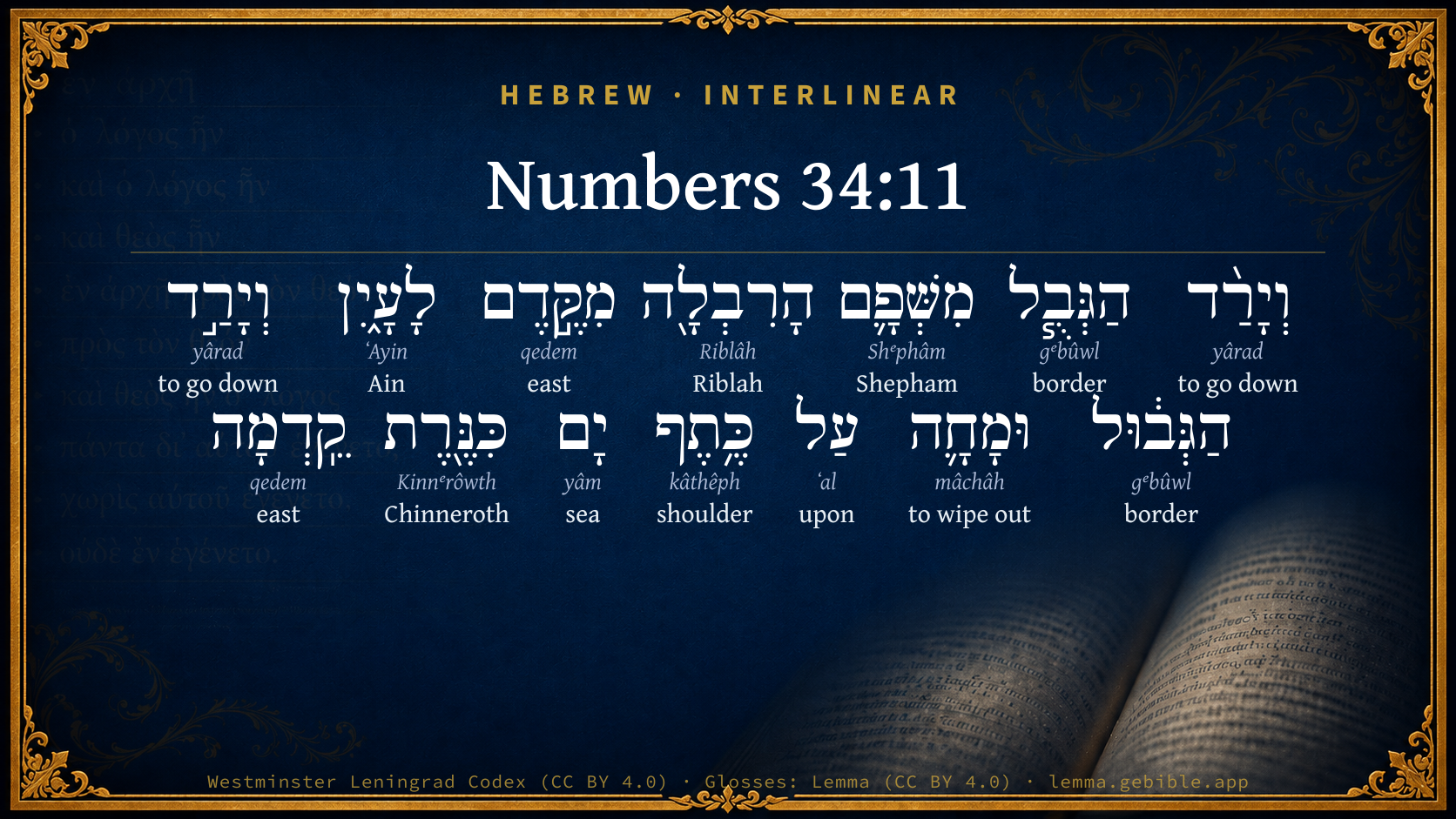
Hebrew (Westminster Leningrad Codex) Numbers 34:11 appears in the Hebrew Old Testament. The text above is from the Westminster Leningrad Codex. Each word links to its Strong’s number, a concise gloss, and parsing drawn from the Open Scriptures Hebrew Bible morphology. Click any word for its full Brown-Driver-Briggs (BDB) entry.
Download image
Cite this verse

Numbers 34:11 (World English Bible). Public Domain. Lemma interlinear Bible study tool, https://lemma.gebible.app/v/numbers/34/11.

Show BibTeX & RIS
BibTeX
RIS
English Translation
and the border shall go down from Shepham to Riblah, on the east side of Ain; and the border shall go down, and shall reach to the side of the sea of Chinnereth eastward;
World English Bible · Public Domain
Highlights
  • 3 first appearances in the Hebrew Bible
Full analysis ↓
Download a study sheet

One document with this verse’s original text, its word-by-word gloss line, the meaning frame, cross-references with their text, attributed commentary, and full source and license credits — printable, and it pastes into notes with its structure intact.

This verse Autodidact and up

Study sheet (.html) Plain text (.txt)

A passage Seminary Student

Up to 50 verses in one chapter. A passage sheet keeps up to 6 commentary sources and 12 cross-references per verse, in the order this page ranks them, and says so on the sheet whenever that leaves anything out. Ask for a single verse and you get the Autodidact verse sheet above.

Everything on this page stays free to read, with no account — the sheet is a download of what is already on screen, not access to it.

Want to remove ads? Support Godless Engineer
Compare translations 3

The same verse in 3 English versions, stacked beneath the original-language interlinear above. Click any original word for its lexicon entry.

Each is an independent rendering of the whole verse — the interlinear is not word-aligned to these translations.

Highlighted words mark where these versions differ — a whole-verse word diff, not a word-by-word alignment.

  • World English Bible Public Domain
    and the border shall go down from Shepham to Riblah, on the east side of Ain; and the border shall go down, and shall reach to the side of the sea of Chinnereth eastward;
  • King James Version Public Domain
    And the coast shall go down from Shepham to Riblah, on the east side of Ain; and the border shall descend, and shall reach unto the side of the sea of Chinnereth eastward:
  • unfoldingWord Literal Text CC BY-SA 4.0
    And the border will go down from Shepham to Riblah, from east of Ain. And the border will go down and strike on the shoulder of the Sea of Chinnereth eastward.

unfoldingWord Literal Text — © unfoldingWord, licensed CC BY-SA 4.0. Word-aligned USFM3 via Door43 (git.door43.org/unfoldingWord/en_ult).

Versions to compare (up to 4)

3 of 4 selected

Show all 18 translations

Every available English version of this verse, each an independent rendering of the whole verse.

  • World English Bible Public Domain
    and the border shall go down from Shepham to Riblah, on the east side of Ain; and the border shall go down, and shall reach to the side of the sea of Chinnereth eastward;
  • Berean Standard Bible Public Domain
    then go down from Shepham to Riblah on the east side of Ain and continue along the slopes east of the Sea of Chinnereth.
  • Majority Standard Bible Public Domain
    then go down from Shepham to Riblah on the east side of Ain and continue along the slopes east of the Sea of Chinnereth.
  • King James Version Public Domain
    And the coast shall go down from Shepham to Riblah, on the east side of Ain; and the border shall descend, and shall reach unto the side of the sea of Chinnereth eastward:
  • American Standard Version (1901) Public Domain
    and the border shall go down from Shepham to Riblah, on the east side of Ain; and the border shall go down, and shall reach unto the side of the sea of Chinnereth eastward;
  • Revised Version (1885) Public Domain
    and the border shall go down from Shepham to Riblah, on the east side of Ain; and the border shall go down, and shall reach unto the side of the sea of Chinnereth eastward:
  • Geneva Bible (1599) Public Domain
    And the coast shall goe downe from Shepham to Riblah, and from the Eastside of Ain: and the same border shall descend and goe out at the side of the sea of Chinneereth Eastward.
  • Douay-Rheims (1899) Public Domain
    And from Sephama the bounds shall go down to Rebla over against the fountain of Daphnis: from thence they shall come eastward to the sea of Cenereth,
  • Young's Literal Translation Public Domain
    and the border hath gone down from Shepham to Riblah, on the east of Ain, and the border hath gone down, and hath smitten against the shoulder of the sea of Chinnereth eastward;
  • Literal Standard Version CC BY-SA 4.0
    and the border has gone down from Shepham to Riblah, on the east of Ain, and the border has gone down, and has struck against the shoulder of the Sea of Chinnereth eastward;
  • Unlocked Literal Bible CC BY-SA 4.0
    Then the eastern border will go down from Shepham to Riblah, on the east side of Ain. The border will continue along the east side of the Sea of Kinnereth.
  • unfoldingWord Literal Text CC BY-SA 4.0
    And the border will go down from Shepham to Riblah, from east of Ain. And the border will go down and strike on the shoulder of the Sea of Chinnereth eastward.
  • Darby Bible Public Domain
    and the border shall go down from Shepham to Riblah, on the east side of Ain; and the border shall descend, and shall strike upon the extremity of the sea of Chinnereth eastward;
  • World Messianic Bible Public Domain
    The border shall go down from Shepham to Riblah, on the east side of Ain. The border shall go down, and shall reach to the side of the sea of Chinnereth eastward.
  • Webster's Bible Public Domain
    And the limit shall go down from Shepham to Riblah, on the east side of Ain; and the border shall descend, and shall reach to the side of the sea of Chinnereth eastward:
  • Free Bible Version CC BY-SA 4.0
    Then the boundary will go down from Shepham to Riblah on the east side of Ain. It will pass down along the slopes east of the Sea of Galilee.
  • Bible in Basic English Public Domain
    Going down from Shepham to Riblah on the east side of Ain, and on as far as the east side of the sea of Chinnereth:
  • JPS Tanakh (1917) Public Domain
    and the border shall go down from Shepham to Riblah, on the east side of Ain; and the border shall go down, and shall strike upon the slope of the sea of Chinnereth eastward;

Literal Standard Version (2020), Covenant Press — licensed CC BY-SA 4.0. Text via the HelloAO Bible API (eBible.org). Unlocked Literal Bible (unfoldingWord) — licensed CC BY-SA 4.0. Text via the HelloAO Bible API (eBible.org). unfoldingWord Literal Text — © unfoldingWord, licensed CC BY-SA 4.0. Word-aligned USFM3 via Door43 (git.door43.org/unfoldingWord/en_ult). Free Bible Version, Dr. Jonathan Gallagher — licensed CC BY-SA 4.0. Text via the HelloAO Bible API (eBible.org).

Word by word

More ways to search: Search by grammar → Find every occurrence → Compare this word →

Practice this passage: Drill this verse → Learn its vocabulary →

מִשְּׁפָ֛ם
Shᵉphâm
H8221
“from · Shepham”
Preposition + Noun, Proper
Part of Speech
Preposition + Noun
Type
Proper
Full BDB Definition

Origin: probably from H8192

TWOT: None

Shepham = "bald" - a place or region in northeastern Canaan on the eastern border
  1. וְיָרַ֨ד yârad H3381 “and · to go down” Conjunction + Verb, Qal, Sequential Perfect, 3rd Person, Masculine, Singular
  2. הַגְּבֻ֧ל gᵉbûwl H1366 “the · border” Particle, Definite Article + Noun, Common, Masculine, Singular, Absolute
  3. הָרִבְלָ֖ה Riblâh H7247 “the · Riblah” Particle, Definite Article + Noun, Proper
  4. מִקֶּ֣דֶם qedem H6924 “from · east” Preposition + Noun, Common, Masculine, Singular, Absolute
  5. לָעָ֑יִן ʻAyin H5871 “to/for · Ain” Preposition + Noun, Proper
  6. וְיָרַ֣ד yârad H3381 “and · to go down” Conjunction + Verb, Qal, Sequential Perfect, 3rd Person, Masculine, Singular
  7. הַגְּב֔וּל gᵉbûwl H1366 “the · border” Particle, Definite Article + Noun, Common, Masculine, Singular, Absolute
  8. וּמָחָ֛ה mâchâh H4229 “and · to wipe out” Conjunction + Verb, Qal, Sequential Perfect, 3rd Person, Masculine, Singular
  9. עַל ʻal H5921 “upon” Preposition
  10. כֶּ֥תֶף kâthêph H3802 “shoulder of” Noun, Common, Feminine, Singular, Construct
  11. יָם yâm H3220 “sea of” Noun, Common, Masculine, Singular, Construct
  12. כִּנֶּ֖רֶת Kinnᵉrôwth H3672 “Chinneroth” Noun, Proper
  13. קֵֽדְמָה qedem H6924 “east · toward” Noun, Common, Masculine, Singular, Absolute + Suffix, Demonstrative

About this verse

These counts appear in no published source. They are computed here, from the morphology-tagged text and Lemma’s own curated glosses. What Lemma adds →

14
words
11
distinct lemmas
Pentateuch
section

Notable vocabulary

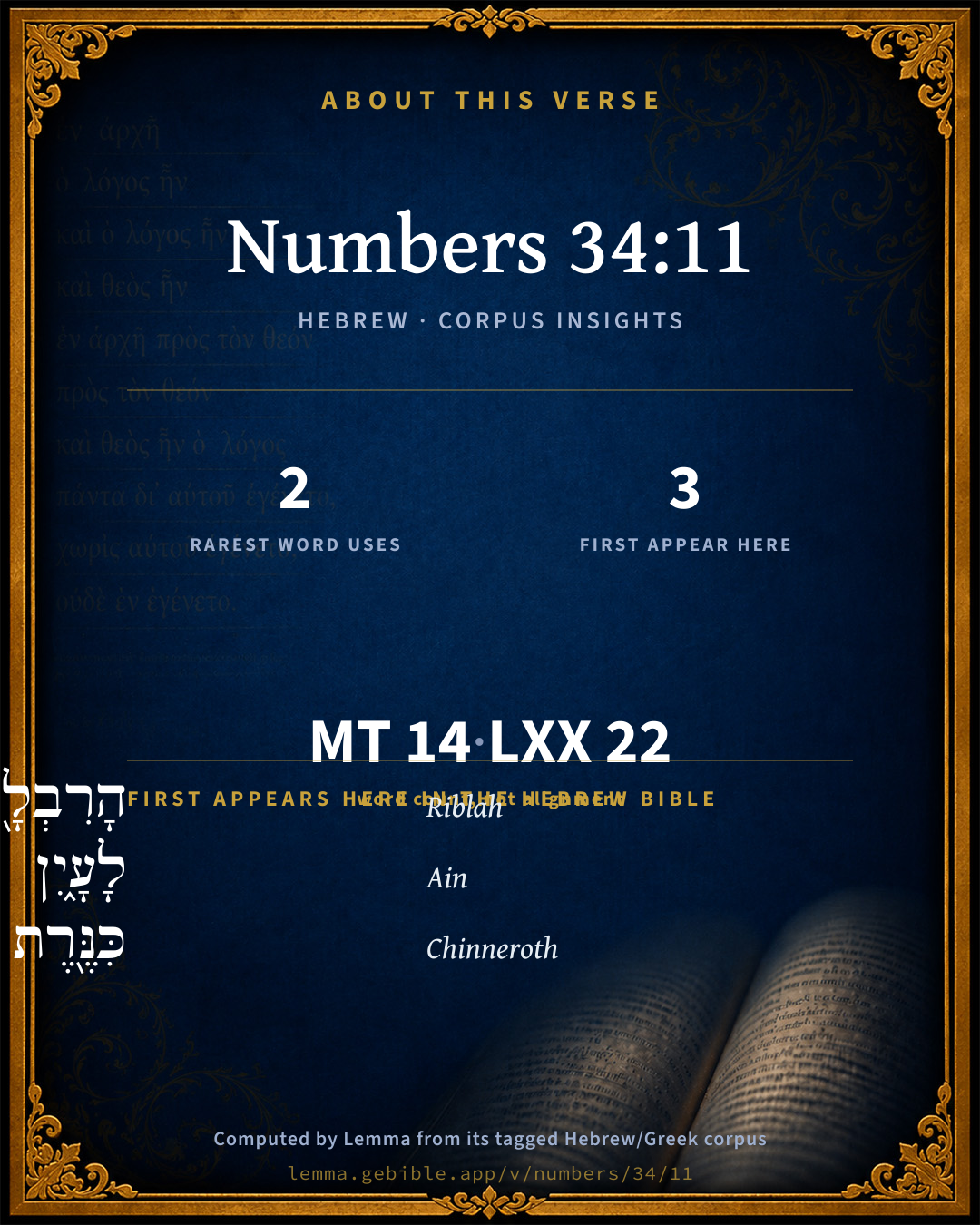
The rarest word here is מִשְּׁפָ֛ם Shepham H8221 — appearing just 2 times in the whole Hebrew Bible.

First appearance in Scripture

These words make their first canonical appearance in the Hebrew Bible here:

  • הָרִבְלָ֖ה Riblah H7247
  • לָעָ֑יִן Ain H5871
  • כִּנֶּ֖רֶת Chinneroth H3672

Shared distinctive vocabulary

מִשְּׁפָ֛ם Shepham H8221 occurs in 2 verses of the Hebrew Bible. Also found in:

Grammatical profile

  • 3 verbs
  • 10 nouns
  • 1 preposition

Verb forms

  • וְיָרַ֨ד Qal · Sequential Perfect
  • וְיָרַ֣ד Qal · Sequential Perfect
  • וּמָחָ֛ה Qal · Sequential Perfect

Repetition

Words recur within this verse — often emphatic in Hebrew:

  • וְיָרַ֨ד to go down H3381 ×2
  • הַגְּבֻ֧ל border H1366 ×2
  • מִקֶּ֣דֶם east H6924 ×2

Hebrew & Septuagint length

In English translation the verse runs 34 words from the Hebrew and 27 from the Septuagint (LXX English) — closely comparable.

A rough comparison of the two English renderings, which tokenize alike — not a word-level alignment.

Word counts can differ between the Hebrew and the Greek without any difference in meaning — e.g. the Hebrew direct-object marker אֵת has no separate Greek word, and Greek often adds the article ὁ.

In the original languages it is 14 Hebrew tokens and 22 Greek tokens — but the two are counted differently (Hebrew bundles its prefixes and suffixes into one token; the Greek is in lemma form), so that isn’t a like-for-like length.

Cross-references

12

Topical passages linked to Numbers 34:11 in the Treasury of Scripture Knowledge — connected by theme and wording, ordered by reader-vote popularity; previews shown in the World English Bible.

  • Deuteronomy 3:17 the Arabah also, and the Jordan and the border [of it], from Chinnereth even to the sea of the Arabah, the Salt Sea, under the slopes of Pisgah eastward.
  • 2 Kings 23:33 Pharaoh Necoh put him in bonds at Riblah in the land of Hamath, that he might not reign in Jerusalem; and put the land to a tribute of one hundred talents of silver, and a talent of gold.
  • Joshua 11:2 and to the kings who were on the north, in the hill-country, and in the Arabah south of Chinneroth, and in the lowland, and in the heights of Dor on the west,
  • Joshua 19:35 The fortified cities were Ziddim, Zer, and Hammath, Rakkath, and Chinnereth,
  • Luke 5:1 Now it happened, while the multitude pressed on him and heard the word of God, that he was standing by the lake of Gennesaret.
  • Joshua 13:27 and in the valley, Beth Haram, and Beth Nimrah, and Succoth, and Zaphon, the rest of the kingdom of Sihon king of Heshbon, the Jordan and the border [of it], to the uttermost part of the sea of Chinnereth beyond the Jordan eastward.
  • 2 Kings 25:6 Then they took the king, and carried him up to the king of Babylon to Riblah; and they gave judgment on him.
  • Jeremiah 39:5–6 But the army of the Chaldeans pursued after them, and overtook Zedekiah in the plains of Jericho: and when they had taken him, they brought him up to Nebuchadrezzar king of Babylon to Riblah in the land of Hamath; and he gave judgment on him.
  • Jeremiah 52:10 The king of Babylon killed the sons of Zedekiah before his eyes: he killed also all the princes of Judah in Riblah.
  • Jeremiah 52:26–27 Nebuzaradan the captain of the guard took them, and brought them to the king of Babylon to Riblah.
  • Matthew 14:34 When they had crossed over, they came to the land of Gennesaret.
  • John 6:1 After these things, Jesus went away to the other side of the sea of Galilee, which is also called the Sea of Tiberias.

Cross-references courtesy of OpenBible.info (CC BY 4.0).

Hebrew and Greek witnesses Masoretic Hebrew ↔ Greek Septuagint

The same verse in the two great witnesses to the Old Testament, shown verse-for-verse.

These are two independent witnesses, not word-aligned to each other, and the Septuagint is shown in lemma (dictionary) form.

Hebrew Numbers 34:11 Masoretic · Westminster Leningrad Codex

וְיָרַ֨ד הַגְּבֻ֧ל מִשְּׁפָ֛ם הָרִבְלָ֖ה מִקֶּ֣דֶם לָעָ֑יִן וְיָרַ֣ד הַגְּב֔וּל וּמָחָ֛ה עַל כֶּ֥תֶף יָם כִּנֶּ֖רֶת קֵֽדְמָה

and the border shall go down from Shepham to Riblah, on the east side of Ain; and the border shall go down, and shall reach to the side of the sea of Chinnereth eastward;

World English Bible · Public Domain

Greek LXX Numbers 34:11 Septuagint · lemma form

καί καταβαίνω ὁ ὅριον ἀπό σεπφαμ αρβηλα ἀπό ἀνατολή ἐπί πηγή καί καταβαίνω ὁ ὅριον βηλα ἐπί νῶτον θάλασσα χεναρα ἀπό ἀνατολή

And the border shall go down from Sepphamar to Bela eastward to the fountains, and the border shall go down from Bela behind the sea Chenereth eastward.

LXX2012 (modern English Septuagint) · Public Domain

On this verse, Haydock's Catholic Bible Commentary discusses the Septuagint’s reading. Read the note in Commentary ↓

Hebrew: Westminster Leningrad Codex (CC BY 4.0). Greek: Septuagint (public domain); English from LXX2012 (modern English Septuagint) (Public Domain). How the Septuagint differs from the Hebrew →

Targum (Aramaic paraphrase)

2

The Targum is the ancient Jewish Aramaic paraphrase of the Hebrew Scriptures — an interpretive translation, not the Hebrew text itself. Onkelos (literal) and Pseudo-Jonathan (expansive) render the Torah, and Jonathan the Prophets. Coverage is partial: where no permissively-licensed English translation exists for a verse, only the Aramaic is shown. This is verse-level text, not a word-by-word alignment to the Hebrew.

  1. Targum Onkelos Torah (Genesis–Deuteronomy)
    וְיֵחוֹת תְּחוּמָא מִשְׁפָם לְרִבְלָה מִמַדְנַח לָעָיִן וְיֵחוֹת תְּחוּמָא וְיִמְטֵי עַל כֵּיף יַם גִנוֹסַר קִדוּמָא

    (no public-domain English translation for this verse)

    Targum Onkelos — Aramaic: “Onkelos Genesis” (public domain); “Onkelos Exodus” (public domain); “Onkelos Leviticus” (public domain); “Onkelos Numbers” (public domain); “Onkelos Deuteronomy” (public domain). English: “Sefaria Community Translation” (CC0 1.0 (public-domain dedication)); “J.W. Etheridge. The Targums of Onkelos and Jonathan Ben Uzziel on the Pentateuch. London: Longmans, Green, 1862” (public domain). Text via Sefaria.

  2. Targum Pseudo-Jonathan Torah (Genesis–Deuteronomy)
    וְיֵיחוֹת תְּחוּמָא מִן אַפְמִיאָה לִדְפַנֵי מִן מַדְנַח לְעֵינְוָותָא וְיֵיחוֹת תְּחוּמָא לִמְעָרַת סַנִיאָס וּמִמְעָרַת סַנִיאָס יֵיחוֹת תְּחוּמָא לְטַוָר תַּלְגָא וּמִטַוָר תַּלְגָא יֵיחוֹת תְּחוּמָא לְעֵינָן וּמֵעֵינָן יֵיחוֹת תְּחוּמָא וְיִסַב מֵישְׁרַיָא מֵישַׁר נַחֲלֵי אַרְנוֹנָא וְיֵיתֵי לְמַדְבְּרָא וְצִינֵי טַוָר פַּרְזְלָא מֵי מַצוּתָא אַבְּלוּ וּדְמוּכָא סְמִיךְ לִגְנִיסַת כְּרַךְ מַלְכוּתְהוֹן דֶאֱדוֹמָאֵי אַחֲסָנוּת שֵׁיבַט רְאוּבֵן וְגָד וּפַלְגוּת שֵׁיבַט מְנַשֶׁה וְיֵיחוֹת תְּחוּמָא וְיַקִיף לִתְחוּם יַמָא דִגְנֵיסַר מִמַדִינְחָא

    and the border shall descend from Apamea to Dophne, eastward of Hinvetha; thence the border shall go down to the cavern of Panias, and from the cavern of Panias to the mountain of snow, and from the mountain of snow to Henan, and from Henan the border shall go down and encompass the plain of the river of Arnon, and arrive at the wilderness and the palms of the mountain of iron, take in the Waters of Contention, and rest at Ginesar, a city of the kings of the Edomites, the inheritance of the tribes of Reuben and Gad, and the half tribe of Menasheh; and the border shall descend and encompass the Sea of Genesar on the east.

    Targum Pseudo-Jonathan — Aramaic: “Targum Jonathan on Genesis” (public domain); “Targum Jonathan on Exodus” (public domain); “Targum Jonathan on Leviticus” (public domain); “Targum Jonathan on Numbers” (public domain); “Targum Jonathan on Deuteronomy” (public domain). English: “The Targum of Jonathan ben Uzziel, trans. J. W. Etheridge, London, 1862” (public domain). Text via Sefaria.

Commentary

Notes on Numbers 34:11 from classic Christian and Jewish commentators (each source and its license shown beneath its notes). The classic Christian expositions comment on the surrounding passage and are grouped to its opening verse, so a note may address several verses; the Jewish commentaries on the Tanakh (Rashi and others) are per-verse, so they appear only where the commentator wrote on this verse.

Lemma curates 59 commentaries, every one of them public domain or Creative Commons licensed, each selected and text-cleaned for this edition rather than reprinted as found. About our sources →

Tyndale Open Study Notes

Tyndale Open Resources

34:11 Sea of Galilee: Its eastern edge (literally shoulder) is the ridge that rises rather abruptly from its eastern shoreline.

Tyndale Open Study Notes — © Tyndale Open Resources, licensed CC BY-SA 4.0. Text via the HelloAO Bible API.

Geneva Bible (1599)

Geneva Bible translators

Which in the Gospel is called the lake of Gennesaret.

Geneva Bible (1599) marginal notes — public domain. Text via Bolls.life.

Adam Clarke's Commentary

Verse 11. The sea of Chinnereth] The same as the sea of Galilee, sea of Tiberias, and sea of Gennesareth.

Adam Clarke's Commentary on the Bible (1810–1826) — public domain. Text from a community e-Sword/MySword module.

Ellicott's Commentary for English Readers

(11) Riblah, on the east side of Ain.—Ain (Heb., a fountain) is supposed to be the great fountain of Neba Anjar at the foot of Antilibanus, in which case Riblah must be distinguished from the Riblah in the land of Hamath, which is mentioned in 2Ki_23:33 and in Jer_39:9. From this point the boundary went further southward by the side (Heb., shoulder) of the lake of Chinnereth, or Sea of Galilee, from whence the eastern boundary was the Jordan down to the Dead Sea. This was to be the land of the Israelites, according to its borders on every side.

The sea of Chinnereth.—Chinnereth, or Cinnereth, appears to have been the name of a district, and also of a town. The name is supposed to be derived from kinnor, a “harp.” In later times the city was called Genusar, whence the name Gennesareth, as we find it in the Gospels.

A Bible Commentary for English Readers, edited by Charles John Ellicott (1878–1897) — public domain. Text from a community e-Sword module.

The Cambridge Bible for Schools and Colleges

gen. ed. J. J. S. Perowne

11. the side of the sea] lit. ‘the shoulder of the sea.’ The word is a descriptive term referring to the mountain slopes on the N.E. of the lake; cf. Jos_15:10. The sea or lake is that known in N.T. times as the Sea, or Lake, of Galilee.

The Cambridge Bible for Schools and Colleges (gen. ed. J. J. S. Perowne; Cambridge University Press, 1878–1918) — public domain. Text from a community e-Sword module.

John Gill's Exposition

And the coast shall go down from Shepham to Riblah,.... Said to be in the land of Hemath, Jer 52:9, which, according to Jerom (x), was Antioch of Syria; and both the Targums of Jonathan and Jerusalem understand by it Daphne, which was in the suburbs of Antioch; but this seems to be carrying the limits of the land too far: Jarchi remarks, that when the border goes from the north towards the south, it is said to go down:

on the east side of Ain; a city in the tribe of Judah; according to Jerom (y) now a village that goes by the name of Bethennim, two miles from the turpentine tree, that is, from the tent of Abraham or oak of Mamre, and four from Hebron:

and the border shall descend, and shall reach unto the side of the sea of Chinnereth eastward; the same with the sea of Tiberius, and the sea of Gennesaret, frequently made mention of in the New Testament, and in Eze 47:18, called the east sea.

(x) Comment. ut supra. (cf. ver. 15.) (y) De loc. Heb. fol. 88. F.

John Gill's Exposition of the Whole Bible (1746–1763) — public domain (CC PDM 1.0). Text via the HelloAO Bible API.

Haydock's Catholic Bible Commentary

Sephama, or Apamea. (Targum) --- Rebla. Septuagint, "Bela, or Asbela." (Haydock) --- St. Jerome understands Antioch, near which was the fountain of Daphnis, or Daphne, a word which is inserted in the Targum, though it be not found in Hebrew. But Antioch did not lie on the eastern borders, and this fountain may be the same place as Enan, ver. 9. --- Against. Hebrew, "on the east side of Ain, or the fountain." (Calmet) --- Cenereth. This is the sea of Galilee, illustrated by the miracles of our Lord. (Challoner) --- The line was not drawn to this lake of Genesareth, or of Tiberias, as it was likewise called, but comprised a large territory lying to the east of it, (Calmet) and given to the tribes of Manasses, Gad, and Ruben, which inhabited the country east of the Jordan and of the Salt Sea. (Haydock) --- Eastward: the Septuagint insinuate, "to the south, leaving the sea of Cenereth on the east." --- The fountain of Daphnis may probably be that near the Semechonite lake, through which the Jordan runs. (Josephus, Jewish Wars iv. 1.) It may have received the title of Daphnis, from the laurels with which it is adorned, like the suburbs of Antioch. (Bonfrere) (Menochius) --- It appears that Moses has only in view, the nine tribes for which a provision was not yet made; and their eastern limits extend from Emath, down the Jordan to the Dead Sea, so as to comprise no part to the east of that river, which was already given to their brethren; (see ver. 13, 15, 29;) and thus the observation of Calmet, respecting the countries east of Cenereth, will be rather inaccurate, as the line must run through that sea, following the course of the Jordan. These were properly the eastern limits of Chanaan, which country comprised all between Egypt and Idumea, as far as Sidon and Mount Libanus, being bounded by the Jordan on the east. The other three tribes were hemmed in on the north and east by the mountains of Hermon, Basan, Galaad, and Arnon; beyond which, the nations about Damascus, and the descendants of Ammon, Ismael, and Moab dwelt, in Syria and the desert of Arabia, so that the latter country was the eastern boundary of the promised land, taken in its utmost extent. (Haydock) --- The respective limits must naturally vary, when we speak of the whole or a part only. (Du Hamel) (Tirinus)

George Leo Haydock (1774–1849), Haydock's Catholic Family Bible and Commentary, 1859 edition — public domain. Excludes Psalms (Douay-Rheims chapter numbering differs from Protestant) and Deuterocanonical books (Catholic canon only).

Matthew Poole's English Annotations

Chinnereth; of this name we have a city, Jos 19:35, and a country, Jos 11:2; 1Ki 15:20 and a sea or lake, here an Jos 12:3; 13:27 which in the New Testament is called the sea of Gennesaret, Luk 5:1 and of Galilee, and of Tiberas Joh 6:1.

Matthew Poole's English Annotations on the Holy Bible (1683–1685) — public domain. Text from a community e-Sword/MySword module.

Whedon's Commentary on the Bible

Daniel D. Whedon

11, 12. Riblah cannot be identified with “Riblah in the land of Hamath,” seeing that four landmarks occur between them.

The east side of Ain — Since Ain is a common noun signifying a fountain, and since there are many fountains in northern Palestine, we get no clew from it to the eastern borderline. Robinson identifies this spring with the great fountain of Neba or Birket Anjar, at the foot of Antilibanus.

Sea of Chinnereth — Sea of Tiberias or Galilee. Jos_11:2; Mat_4:13, notes.

Down to Jordan — The boundary shall go along the Jordan (downward) and its termination shall be the salt sea, or the Dead Sea. Gen_14:3, note.

Coasts — Boundaries. Thus eastern Palestine, the land beyond the Jordan, is not included in the Holy Land.

Daniel D. Whedon (gen. ed.), Commentary on the Old and New Testaments (1874–1909) — public domain. Text from a community e-Sword module.

The Pulpit Commentary

Shepham is unknown. Riblah cannot possibly be the Riblah in the land of Hamath, (Jer_39:5) now apparently Ribleh on the Orontes. This one example will serve to show how delusive are these identifications with modern places. Even if Ribleh represents an ancient Riblah, it is not the Riblah which is mentioned here. On the east side of Ain, i.e., of the fountain. The Targums here imply that this Ain was the source of Jordan below Mount Hermon, and that would agree extremely well with what follows. The Septuagint has epi phgav , and there is in fact more than one fountain from which this head-water of Jordan takes its rise. Immediately before the Septuagint has Bhla where we read Riblah. It has been supposed that the word was originally Arbhla , a transliteration of "Har-bel," the mountain of Bel or Baal, identical with the Harbaal-Hermon (our Mount Hermon) of Jud_1:3:3. The Hebrew hlbrih being differently pointed, and the final h taken as the suffix of direction, we get lbeArh; but this is extremely precarious. Shall reach unto the side of the sea of Chinnereth eastward. Literally, "shall strike (hjm) the shoulder of the sea," &c. The line does not seem to have descended the stream from its source, but to have kept to the east, and so to have struck the lake of Galilee at its north-eastern corner. From this point it simply followed the water-way down to the Salt Sea. The lands beyond Jordan were not reckoned as within the sacred limits. ;

The Pulpit Commentary (1880–1919), ed. H.D.M. Spence-Jones & Joseph S. Exell — public domain. Text from a community e-Sword module.

Rashi

Rabbi Shlomo Yitzchaki (Rashi)

מקדם לעין ON THE EAST SIDE OF AIN — עין is the name of a place. The boundary went to the east of it, and consequently Ain is within the boundary and was part of the land of Israel.

וירד הגבול AND THE BOUNDARY SHALL GO DOWN — The more the boundary goes from north to south it goes down more and more.

ומחה על כתף ים כנרת קדמה AND SHALL SMITE UPON THE SLOPE OF THE SEA OF CHINNERETH EASTWARD, so that the sea of Chinnereth is within the border to the west, and the boundary is on the east (קדמה) of the sea of Chinnereth. From there it went down to the Jordan. The Jordan extends from the north to the south in a slanting direction, inclining towards the east, but comes nearer the land of Canaan opposite the sea of Chinnereth, and extends further along the eastern side of the land of Israel [opposite the sea of Chinnereth] until it falls into the Salt Sea. There the boundary ends through its goings forth into the Salt Sea from which, too, is the beginning of the boundary at the south-east comer. — Here, then, you have a description of what bounds it (the land) round about on its four sides.

Rashi on the Tanakh — English translations: “The Judaica Press complete Tanach with Rashi, translated by A. J. Rosenberg” (CC BY 4.0); “Pentateuch with Rashi's commentary by M. Rosenbaum and A.M. Silbermann, 1929-1934” (public domain); “The Metsudah Tanach series, Lakewood, N.J” (CC BY 4.0); and “The Book of Joshua, Metsudah Publications, 1997” (CC BY 4.0). Text via Sefaria.

Lesson kit

Teaching starters — assembled from the data on this page, not authored interpretation. Every prompt links to the verse data it draws on. Edit before teaching.

Numbers, in the Pentateuch, opens this verse with 14 words (11 distinct Hebrew lemmas). Its most distinctive word is Shᵉphâm (“Shepham”). A historical commentator’s framing appears above. Read the whole chapter for the surrounding context.

Discussion questions

  1. How does “Shepham” (Shᵉphâm) shape what this verse is saying?
  2. 3 words make their first appearance in Scripture here. What does this debut establish?
  3. How does Numbers 34:10, which shares the word «Shepham», read alongside this verse?
  4. What does the repetition of “to go down” (2× in this one verse) do in this verse?
  5. These translations render this verse differently. What is at stake in choosing one wording over another?
  6. «וְיָרַ֨ד» is a Qal Sequential Perfect verb. How does that grammatical form shape the action described?
  7. Compare how Tyndale Open Study Notes and Geneva Bible (1599) read this verse. Where do they agree or differ?

Things to notice

Reading settings

Reading text

Shown beneath each verse's original-language words.

Old Testament
Old Testament edition

Read the OT as the Masoretic Hebrew (MT) or the Greek Septuagint (LXX).

English shown for the Greek Septuagint (in the Hebrew ↔ Greek comparison).

Comparing translations? Open the Compare panel on any verse page to stack up to four side by side.