
Job 36:30

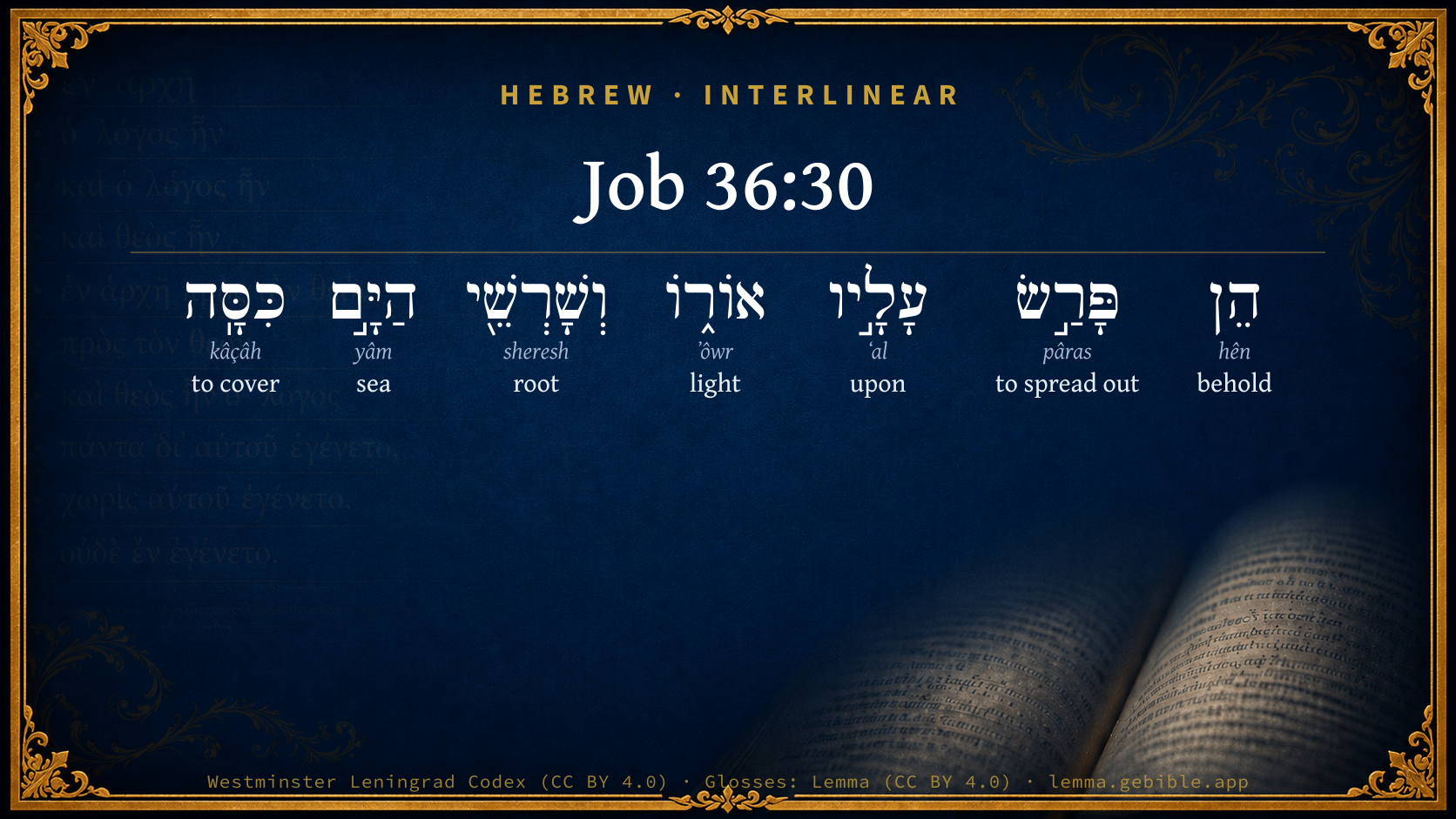
Hebrew (Westminster Leningrad Codex) Job 36:30 appears in the Hebrew Old Testament. The text above is from the Westminster Leningrad Codex. Each word links to its Strong’s number, a concise gloss, and parsing drawn from the Open Scriptures Hebrew Bible morphology. Click any word for its full Brown-Driver-Briggs (BDB) entry.
Download image
Cite this verse

Job 36:30 (World English Bible). Public Domain. Lemma interlinear Bible study tool, https://lemma.gebible.app/v/job/36/30.

Show BibTeX & RIS
BibTeX
RIS
English Translation
Behold, he spreads his light around him. He covers the bottom of the sea.
World English Bible · Public Domain
Download a study sheet

One document with this verse’s original text, its word-by-word gloss line, the meaning frame, cross-references with their text, attributed commentary, and full source and license credits — printable, and it pastes into notes with its structure intact.

This verse Autodidact and up

Study sheet (.html) Plain text (.txt)

A passage Seminary Student

Up to 50 verses in one chapter. A passage sheet keeps up to 6 commentary sources and 12 cross-references per verse, in the order this page ranks them, and says so on the sheet whenever that leaves anything out. Ask for a single verse and you get the Autodidact verse sheet above.

Everything on this page stays free to read, with no account — the sheet is a download of what is already on screen, not access to it.

Want to remove ads? Support Godless Engineer
Compare translations 3

The same verse in 3 English versions, stacked beneath the original-language interlinear above. Click any original word for its lexicon entry.

Each is an independent rendering of the whole verse — the interlinear is not word-aligned to these translations.

Highlighted words mark where these versions differ — a whole-verse word diff, not a word-by-word alignment.

  • World English Bible Public Domain
    Behold, he spreads his light around him. He covers the bottom of the sea.
  • King James Version Public Domain
    Behold, he spreadeth his light upon it, and covereth the bottom of the sea.
  • unfoldingWord Literal Text CC BY-SA 4.0
    Behold, he spreads his lightning upon it, and he covers the roots of the sea.

unfoldingWord Literal Text — © unfoldingWord, licensed CC BY-SA 4.0. Word-aligned USFM3 via Door43 (git.door43.org/unfoldingWord/en_ult).

Versions to compare (up to 4)

3 of 4 selected

Show all 18 translations

Every available English version of this verse, each an independent rendering of the whole verse.

  • World English Bible Public Domain
    Behold, he spreads his light around him. He covers the bottom of the sea.
  • Berean Standard Bible Public Domain
    See how He scatters His lightning around Him and covers the depths of the sea.
  • Majority Standard Bible Public Domain
    See how He scatters His lightning around Him and covers the depths of the sea.
  • King James Version Public Domain
    Behold, he spreadeth his light upon it, and covereth the bottom of the sea.
  • American Standard Version (1901) Public Domain
    Behold, he spreadeth his light around him; And he covereth the bottom of the sea.
  • Revised Version (1885) Public Domain
    Behold, he spreadeth his light around him; and he covereth the bottom of the sea.
  • Geneva Bible (1599) Public Domain
    Beholde, he spreadeth his light vpon it, and couereth the bottome of the sea.
  • Douay-Rheims (1899) Public Domain
    And lighten with his light from above, he shall cover also the ends of the sea.
  • Young's Literal Translation Public Domain
    Lo, He hath spread over it His light, And the roots of the sea He hath covered,
  • Literal Standard Version CC BY-SA 4.0
    Behold, He has spread His light over it, || And He has covered the roots of the sea,
  • Unlocked Literal Bible CC BY-SA 4.0
    See, he spreads his lightning around him and covers the roots of the sea.
  • unfoldingWord Literal Text CC BY-SA 4.0
    Behold, he spreads his lightning upon it, and he covers the roots of the sea.
  • Darby Bible Public Domain
    Lo, he spreadeth his light around him, and covereth the bottom of the sea.
  • World Messianic Bible Public Domain
    Behold, he spreads his light around him. He covers the bottom of the sea.
  • Webster's Bible Public Domain
    Behold, he spreadeth his light upon it, and covereth the bottom of the sea.
  • Free Bible Version CC BY-SA 4.0
    See how he scatters lightning around him, and covers the depths of the sea in darkness.
  • Bible in Basic English Public Domain
    See, he is stretching out his mist, covering the tops of the mountains with it.
  • JPS Tanakh (1917) Public Domain
    Behold, He spreadeth His light upon it; and He covereth the depths of the sea.

Literal Standard Version (2020), Covenant Press — licensed CC BY-SA 4.0. Text via the HelloAO Bible API (eBible.org). Unlocked Literal Bible (unfoldingWord) — licensed CC BY-SA 4.0. Text via the HelloAO Bible API (eBible.org). unfoldingWord Literal Text — © unfoldingWord, licensed CC BY-SA 4.0. Word-aligned USFM3 via Door43 (git.door43.org/unfoldingWord/en_ult). Free Bible Version, Dr. Jonathan Gallagher — licensed CC BY-SA 4.0. Text via the HelloAO Bible API (eBible.org).

Word by word

More ways to search: Search by grammar → Find every occurrence → Compare this word →

Practice this passage: Drill this verse → Learn its vocabulary →

About this verse

These counts appear in no published source. They are computed here, from the morphology-tagged text and Lemma’s own curated glosses. What Lemma adds →

7
words
7
distinct lemmas
Wisdom
section

Shared distinctive vocabulary

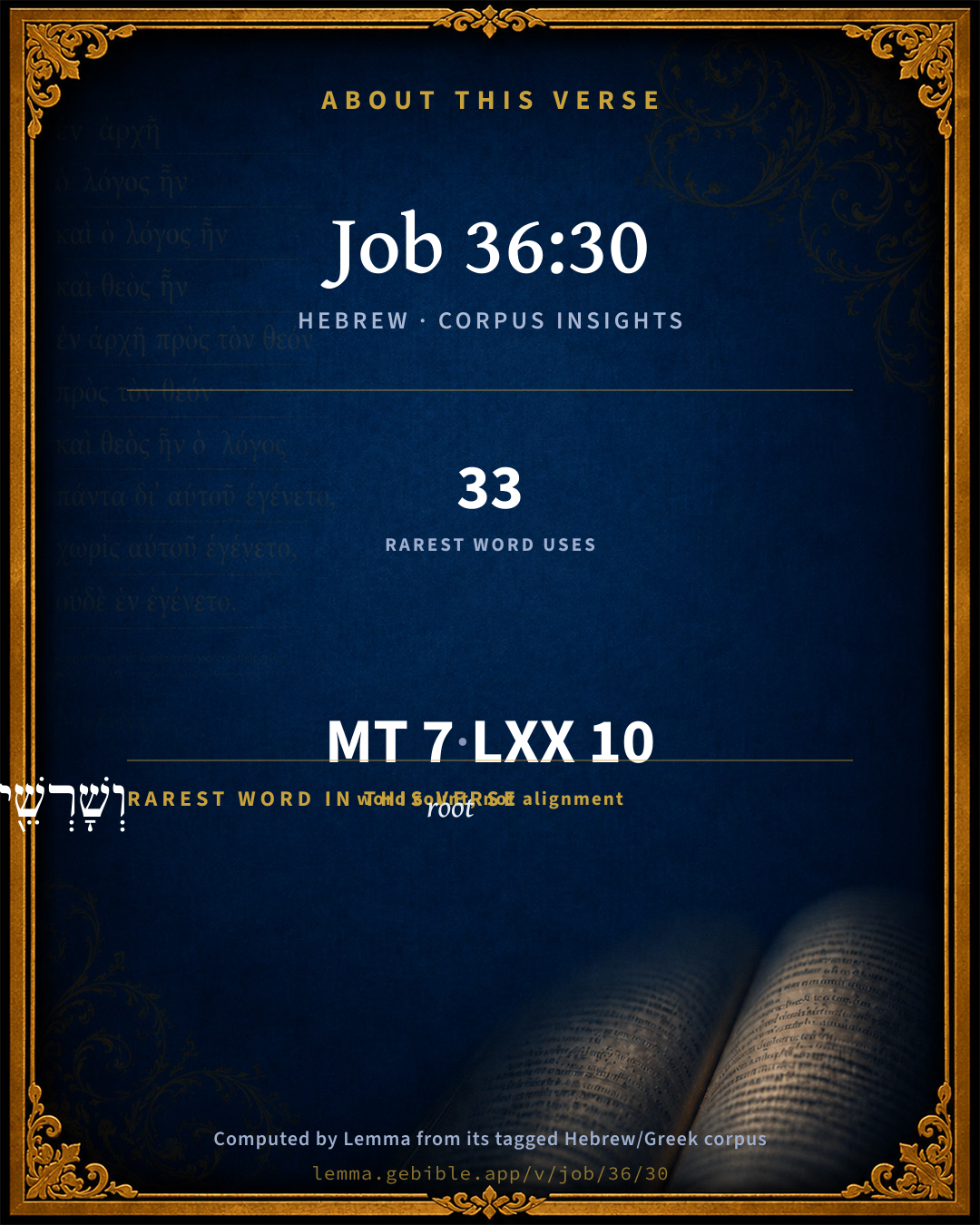
וְשָׁרְשֵׁ֖י root H8328 occurs in 32 verses of the Hebrew Bible. Also found in:

Grammatical profile

  • 2 verbs
  • 3 nouns
  • 1 preposition
  • 1 particle

Verb forms

  • פָּרַ֣שׂ Qal · Perfect
  • כִּסָּֽה Piel · Perfect

Hebrew & Septuagint length

In English translation the verse runs 14 words from the Hebrew and 16 from the Septuagint (LXX English) — closely comparable.

A rough comparison of the two English renderings, which tokenize alike — not a word-level alignment.

Word counts can differ between the Hebrew and the Greek without any difference in meaning — e.g. the Hebrew direct-object marker אֵת has no separate Greek word, and Greek often adds the article ὁ.

In the original languages it is 7 Hebrew tokens and 10 Greek tokens — but the two are counted differently (Hebrew bundles its prefixes and suffixes into one token; the Greek is in lemma form), so that isn’t a like-for-like length.

Cross-references

10

Topical passages linked to Job 36:30 in the Treasury of Scripture Knowledge — connected by theme and wording, ordered by reader-vote popularity; previews shown in the World English Bible.

  • Genesis 1:9 God said, "Let the waters under the sky be gathered together to one place, and let the dry land appear," and it was so.
  • Exodus 14:22 The children of Israel went into the midst of the sea on the dry ground, and the waters were a wall to them on their right hand, and on their left.
  • Exodus 14:28 The waters returned, and covered the chariots and the horsemen, even all Pharaoh's army that went in after them into the sea. There remained not so much as one of them.
  • Exodus 15:4–5 Pharaoh's chariots and his host has he cast into the sea; His chosen captains are sunk in the Red Sea.
  • Job 38:8–11 "Or who shut up the sea with doors, When it broke forth from the womb,
  • Job 38:25 Who has cut a channel for the flood water, Or the path for the thunderstorm;
  • Job 38:34–35 "Can you lift up your voice to the clouds, That abundance of waters may cover you?
  • Psalms 18:11–16 He made darkness his hiding-place, his pavilion around him, Darkness of waters, thick clouds of the skies.
  • Psalms 104:5–9 He laid the foundations of the earth, That it should not be moved forever.
  • Luke 17:24 for as the lightning, when it flashes out of the one part under the sky, shines to the other part under the sky; so will the Son of Man be in his day.

Cross-references courtesy of OpenBible.info (CC BY 4.0).

Hebrew and Greek witnesses Masoretic Hebrew ↔ Greek Septuagint

The same verse in the two great witnesses to the Old Testament, shown verse-for-verse.

These are two independent witnesses, not word-aligned to each other, and the Septuagint is shown in lemma (dictionary) form.

Hebrew Job 36:30 Masoretic · Westminster Leningrad Codex

הֵן פָּרַ֣שׂ עָלָ֣יו אוֹר֑וֹ וְשָׁרְשֵׁ֖י הַיָּ֣ם כִּסָּֽה

Behold, he spreads his light around him. He covers the bottom of the sea.

World English Bible · Public Domain

Greek LXX Job 36:30 Septuagint · lemma form

ἰδού ἐκτείνω ἐπί αὐτός ηδω καί ῥίζωμα ὁ θάλασσα καλύπτω

behold he will stretch his bow against him, and he covers the bottom of the sea.

LXX2012 (modern English Septuagint) · Public Domain

On this verse, Keil & Delitzsch discusses the Septuagint’s reading. Read the note in Commentary ↓

Hebrew: Westminster Leningrad Codex (CC BY 4.0). Greek: Septuagint (public domain); English from LXX2012 (modern English Septuagint) (Public Domain). How the Septuagint differs from the Hebrew →

Commentary

Notes on Job 36:30 from classic Christian and Jewish commentators (each source and its license shown beneath its notes). The classic Christian expositions comment on the surrounding passage and are grouped to its opening verse, so a note may address several verses; the Jewish commentaries on the Tanakh (Rashi and others) are per-verse, so they appear only where the commentator wrote on this verse.

Lemma curates 59 commentaries, every one of them public domain or Creative Commons licensed, each selected and text-cleaned for this edition rather than reprinted as found. About our sources →

Trapp's Complete Commentary

John Trapp

Job 36:30 Behold, he spreadeth his light upon it, and covereth the bottom of the sea.

Ver. 30. Behold, he spreadeth his light upon it] That is, his fair weather, clearing up the cloudy sky, as some expound it; or, as others, his lightning shot forth every way, Psa 18:13; Psa 18:15; Psa 144:6. Or the sunbeams spread upon the sea, and drawing up vapours; unde mare hoc loco nubium radix dicitur, saith Brentius, whence the sea is here called the root of the clouds; or the surface of the sea is called the root of it, in regard to the wandering waves which are cut in asunder, after the manner of roots; so saith Vatablus. Those that by light here understand lightnings, say, that God maketh them dart so abundantly through the waters of the sea, that they do, as it were, cover all the bottom of it.

John Trapp, A Commentary or Exposition upon All the Books of the Old and New Testament (1647–1656) — public domain. Text from a community e-Sword module.

Keil & Delitzsch

C. F. Keil & F. Delitzsch

30 Behold, He spreadeth His light over Himself,

And the roots of the sea He covereth.

31 For thereby He judgeth peoples,

He giveth food in abundance.

32 Both hands He covereth over with light,

And directeth it as one who hitteth the mark.

33 His noise announceth Him,

The cattle even that He is approaching.

A few expositors (Hirz., Hahn, Schlottm.) understand the celestial ocean, or the sea of the upper waters, by ים, Job 36:30; but it is more than questionable (vid., on Job 9:8) whether ים is used anywhere in this sense. Others as (Umbr., Ew.) the masses of water drawn up to the sky out of the depths of the sea, on which a Persian passage cited by Stick. (who, however, regards the Waw of ושׁרשׁי as Waw adaequationis) from Schebisteri may be compared: "an exhalation rises up out of the sea, and comes down at God's command upon the deserts." In both cases כּסּה would be equivalent to כסה עליו, obtegit se, which in and of itself is possible. But he who has once witnessed a storm in the neighbourhood of the sea, will decide in favour of one of the three following explanations: (1.) He covereth the uprooted ground of the sea (comp. Psa 18:15.) with the subsiding waves (Blumenf.); but then Job 36:30 would require to be understood of the light of the brightening sky following the darkness of the storm, which is improbable in respect of Job 36:32. (2.) While the sky is brilliantly lighted up by the lightning, the abysses of the ocean are veiled in a so much deeper darkness; the observation is correct, but not less so another, that the lightning by a thunder-storm, especially when occurring at night, descends into the depths of the sea like snares that are cast down (פּחים, Psa 11:6), and the water is momentarily changed as it were into a sea of flame; accordingly it may be explained, (3.) Behold, He spreadeth over Himself His light (viz., the light which incessantly illumines the world), and the roots of the sea, i.e., the sea down to its depths, He covers with it, since He makes it light through and through (Stuhlm. Wolfs.). Thus, as it appears, Jerome also interprets: Et (si voluerit) fulgurare lumine suo desuper, cardines quoque maris operiet.

(Note: The Targ. translates אור, Job 36:30, Job 36:32, by מטרא, pluvia, according to the erroneous opinion of R. Jochanan: כל אורה שׁנאמר באליהוא אינו אלא בירידת גשׁמים. Aben-Ezra and Kimchi explain even עלי־אור, Isa 18:4, according to this passage. The lxx translates Job 36:30: ἰδοὺ ἐκτενεῖ ἐπ ̓ αὐτὸν ἠδώ (Cod. Alex. επ αυτον το τοξον; Cod. Sinait. επ αυτην ηωδη (with the corrections ηδω and τοξον), probably according to the reading אידו for אורו. But what connection have ἠδώ and rainbow?)

This, that He makes the light of the lightning His manifestation (פּרשׂ עליו), and that He covers the earth down to the roots of the sea beneath with this light, is established in Job 36:31 from the design, partly judicial, partly beneficial, which exists in connection with it. בּם refers as neuter (like בּהם, Job 22:21) to the phenomena of the storm; מכבּיר (with the adverbial ל like לרב, Job 26:3), what makes great = a making great, abundance (only here), is n. hiphil. after the form משׁהית, perdens = perditio. In Job 36:32 God is represented under a military figure as a slinger of lightnings: He covers light over both hands, i.e., arms both completely with light (comp. סכסך and Arab. škk, totum se operire armis), and directs it (עליה referring to אור as fem. like Jer 13:16, and sometimes in the Talmud). But what is the meaning of בּמפגּיע? Hahn takes מפגיע as n. hiphil. like מכביר: an object of attack; but what then becomes of the original Hiphil signification? It ought to be בּמפגּע (Job 7:20), as Olsh. wishes to read it. Ew., Hirz., and others, after the example of Theod. (lxx), Syr., Jer., translate: against the adversary; מפגיע ;yrasre signifies indeed the opposite in Isa 49:16 : intercessor (properly, one who assails with prayers); however, it would be possible for this word, just as פגע c. acc. (which signifies usually a hostile meeting, Exo 5:3 and freq., but sometimes also a friendly, Isa 47:3; Isa 64:4), to be an ἐναντιόσημον. We prefer to abide by the usage of the language as we have it, according to which הפגיע signifies facere ut quid incurset s. petat, Isa 53:6; מפגיע therefore is one who hits, in opposition to one who misses the mark. The Beth is the Beth essentiae (vid., on Job 23:13), used here like Exo 6:3; Psa 55:19; Isa 40:10. With both hands He seizes the substance of the lightning, fills them with it so that they are completely covered by it, and gives it the command (appoints it its goal), a sure aimer!

Job 36:33

Targ., Syr., Symm., Theod. (from which Job 36:32 is supplied in the lxx),

(Note: Vid., Bickel, De indole ac ratione versionis Alex. in interpretando l. Iobi, p. 50. Cod. Sinait. has, like Cod. Vat.: αναγγελει περι αυτου φιλον (corr. φιλος) αυτου κς κτησις και περι αδικαις.)

Jer., Luther, and others destroy the idea, since they translate רעו = רעהוּ, "his friend (companion)." Among moderns, only Umbr. and Schlottm. adopt this signification; Bttch. and Welte, after the example of Cocceius, Tingstad, and others, attempt it with the signification "thought = determination;" but most expositors, from Ew. to Hahn, decide in favour of the rendering as simple as it is consistent with the usage of the language and the connection: His noise (רעו as Exo 32:17) gives tidings concerning Him (announces Him). In Job 36:33 Theod. (lxx), Syr., and Jer. point מקנה like our text, but translate possessio, with which we can do nothing. It seems that in the three attempts of the Targ. to translate Job 36:33, the translators had קנאה and קנּא before their mind, according to which Hahn translates: the arousing of anger (announces) the comer, which assumes מקנה instead of מקנה; and Schlottm.: fierce wrath (goes forth) over evil (according to Symm. ζῆλον περὶ ἀδικίας), which assumes the reading עולה (עולה), ἀδικία, adopted also by Syr., Theod. (lxx). Schultens even renders similarly: rubedinem flammantem nasi contra elatum, and Tingstad: zelum irae in iniquitatem. But it is not probable that the language was acquainted with a subst. מקנה, exciting, although in Eze 8:3 המּקנה is equivalent to המּקניא, so that one might more readily be tempted (vid., Hitz. in loc.) to read מקנה אף, "one who excites anger against evil," it one is not willing to decide with Berg, and recently Bleek, in favour of (מקנּה) מקנּא אף בּעולה, excandescens (zelans) ira= contra iniquitatem. But does the text as it stands really not give an appropriate idea? Aben-Ezra and Duran have understood it of the foreboding of an approaching thunder-storm which is manifested by cattle, מקנה. Accordingly Ew. translates: His thunder announces Him, the cattle even, that He is approaching; and peculiarly new (understanding יגיד not of a foreboding but of a thankful lowing) is Ebrard's rendering; also the cattle at fresh sprouting grass. But such a change of the position of אף is without precedent. Hirz. and Ges.: His rumble (rumble of thunder) announces Him to the herds, Him, and indeed as Him who rises up (approaches). But this new interpunction destroys the division of the verse and the syntax. Better Rosenm. like Duran: pecus non tantum pluviam proximam, sed et antequam nubes in sublime adscenderint adscensuras praesagit, according to Virgil, Georg. i. 374f.:

illum (imbrem) surgentem vallibus imis

Aeriae fugere grues.

But עליו refers to God, and therefore על־עולה also, viz., Him who leads forth the storm-clouds (Jer 10:13; Jer 51:16; Psa 135:7), and Himself rising up in them; or, what עלה frequently signifies, coming on as to battle. It is to be interpreted: His thunder-clap announces Him (who is about to reveal Himself as a merciful judge), the cattle even (announce) Him at His first rising up, since at the approach of a storm they herd together affrighted and seek shelter. The speakers are Arabian, and the scene is laid in the country: Elihu also refers to the animal world in Job 35:11; this feature of the picture, therefore, cannot be surprising.

Keil & Delitzsch — Biblical Commentary on the Old Testament (1861–1891) — public domain (CC PDM 1.0). Text via the HelloAO Bible API. (Old Testament only.)

Geneva Bible (1599)

Geneva Bible translators

That men cannot come to the knowledge of the springs thereof.

Upon the cloud.

Geneva Bible (1599) marginal notes — public domain. Text via Bolls.life.

Jamieson, Fausset & Brown

Robert Jamieson, A. R. Fausset & David Brown

light--lightning.

it--His tabernacle (Job 36:29). The light, in an instant spread over the vast mass of dark clouds, forms a striking picture.

spread--is repeated from Job 36:29 to form an antithesis. "He spreads not only clouds, but light."

covereth the bottom--roots.

of the sea--namely, with the light. In the storm the depths of ocean are laid bare; and the light "covers" them, at the same moment that it "spreads" across the dark sky. So in Psa 18:14-15, the discovering of "the channels of waters" follows the "lightnings." UMBREIT translates: "He spreadeth His light upon Himself, and covereth Himself with the roots of the sea" (Psa 104:2). God's garment is woven of celestial light and of the watery depths, raised to the sky to form His cloudy canopy. The phrase, "cover Himself with the roots of the sea," is harsh; but the image is grand.

Jamieson, Fausset & Brown — Commentary Critical and Explanatory on the Whole Bible (1871) — public domain (CC PDM 1.0). Text via the HelloAO Bible API.

Adam Clarke's Commentary

Verse 30. He spreadeth his light upon it] Or, as Mr. Good translates, "He throweth forth from it his flash." These two verses may both have an allusion to the sudden rarefaction of that part of the atmosphere whence the thunder proceeds, by the agency of the electric fluid; the rushing in of the air on each side to restore the equilibrium, which the passage of the fire had before destroyed. The noise produced by this sudden rushing in of the air, as well as that occasioned by the ignition of the hydrogen gas, which is one of the constituents of water, is the thunder of his tabernacle, viz., the atmosphere, where God appears, in such cases, to be manifesting his presence and his power.

Elihu says that God spreadeth his light upon it. This is spoken in reference to the flashes and coruscations of lightning in the time of thunder storms, when, even in a dark night, a sudden flash illuminates for a moment the surface of the earth under that place.

And covereth the bottom of the sea.] He doth whatsoever it pleaseth him in the heavens above, in the earth beneath, in the sea, and in all deep places. Yea, the depths of the sea are as much under his control and influence as the atmosphere, and its whole collection of vapours, meteors, and galvanic and electric fluids.

Adam Clarke's Commentary on the Bible (1810–1826) — public domain. Text from a community e-Sword/MySword module.

Ellicott's Commentary for English Readers

(30) His light appears to mean here the lightning which flashes forth from the cloud.

And covereth the bottom of the sea.—Literally, it hath covered the roots of the sea: i.e., it, the lightning, or He, God, hath covered those clouds which are composed of the roots of the sea, that is, the drops of water which are exhaled from the sea.

A Bible Commentary for English Readers, edited by Charles John Ellicott (1878–1897) — public domain. Text from a community e-Sword module.

The Cambridge Bible for Schools and Colleges

gen. ed. J. J. S. Perowne

30. Though God is enveloped in the dark cloud, He is there encircled with His light, which, though the masses of waters cover Him, manifests itself to men’s eyes in the lightning that shoots from the cloud and illumines it.

the bottom of the sea] lit. the roots of the sea, a singular figure, which must mean the deeps or recesses of the sea. The reference is no doubt to the masses of water in the thunder clouds which enshroud the Almighty, but the precise idea of the poet is uncertain. Either he must call the heavenly waters the “sea” (cf. Psa_29:3), and mean by its “roots” its densest recesses; or if he refer to the sea on earth, his idea must be that it has been, as it were, drawn up from its bottom in cloud and vapour to form the pavilion of the Lord. This second idea has a certain extravagance which makes it less probable.

The Cambridge Bible for Schools and Colleges (gen. ed. J. J. S. Perowne; Cambridge University Press, 1878–1918) — public domain. Text from a community e-Sword module.

John Gill's Exposition

Behold, he spreadeth his light upon it,.... Upon his tabernacle; that is, upon the clouds, which are his tabernacle; either the light of the sun, whereby the clouds are dispersed and blotted out; an emblem of the blotting out of sin, or the forgiveness of it, Isa 44:22, which is like a clear shining after rain, Sa2 23:4, or on a thin cloud, whereby the rainbow is formed, an emblem of peace and reconciliation by Christ; or lightning, which bursting out of the dark cloud is spread over it, when it seems to be all in flames. Cocceius renders it, "he spreads the light about himself"; God spreads it about himself, clothing himself with light as with a garment, and dwelling in light inaccessible to men: or he "spreads it upon him", upon man; causing his sun to shine on the just and unjust; or on it, the earth; so it was spread when first commanded to shine out of darkness, with which the earth in its primeval state was covered; and so it is spread every morning upon the earth; as soon as day breaks, the morning is spread upon the mountains, and in a short time it overspreads the whole hemisphere; an emblem this of the spread of the light of grace over the dark hearts of men, in conversion, which are like the earth in its chaotic state, or as in the night season covered with darkness; out of which they are called and brought by the grace of God, having the true light sprung and placed in their souls; which at first is but glimmering, and at best imperfect in the present state, yet is spreading and increasing, Pro 4:18; and of the spread of the great and glorious light of the Gospel in the world, in the times of the apostles, and as it will be in the latter day glory;

and covereth the bottom of the sea, or "the roots of the sea" (n); though one would think they should be rather covered with water and with darkness, as they are; see Job 38:8. This is to be understood either of the light of the sun, and the rays of it, which are so piercing and penetrating as to reach to the bottom of the sea, and cover it and exhale waters out of it; or of lightning, which is equally as piercing and penetrating, or more, and strikes to the very roots of the sea, and covers them, or rather discovers them, so that the channels of waters are seen, and the foundations of the world are discovered, Psa 18:14; the Targum of this verse is,

"he spreads upon it rain, and covers the rocks or foundations of the sea;''

and the rain is called light according to Ramban, because by the descent of it the day is enlightened, and the darkness of the clouds removed; and by this means the bottom of the sea is covered, so that it passes its bounds and covers the rocks, that is, the borders of it, as others explain it (o).

(n) "radices maris", Pagninus, Montanus, &c. (o) In Bar Tzemach in loc.

John Gill's Exposition of the Whole Bible (1746–1763) — public domain (CC PDM 1.0). Text via the HelloAO Bible API.

Albert Barnes' Notes on the Bible

Behold, he spreadeth his light upon it - That is, upon his tabernacle or dwelling-place - the clouds. The allusion is to lightning, which flashes in a moment over the whole heavens. The image is exceedingly beautiful and graphic. The idea of “spreading out” the light in an instant over the whole of the darkened heavens, is that which Elihu had in his mind, and which impressed him so forcibly. On the difficulty in regard to the translation of the Septuagint here, see Schleusner on the word ἡδὼ hēdō.

And covereth the bottom of the sea - Margin, “roots.” The word roots is used to denote the bottom, as being the lowest part of a thing - as the roots of a tree. The meaning is that he covers the lowest part of the sea with floods of waters; and the object of Elihu is to give an exalted conception of the greatness of God, from the fact that his agency is seen in the higlest and the lowest objects. He spreads out the clouds, thunders in his tabernacle, diffuses a brilliant light over the heavens, and at the same time is occupied in covering the bottom of the sea with the floods. He is Lord over all, and his agency is seen every where. The highest and the lowest objects are under his control, and his agency is seen above and below. On the one hand, he covers the thick and dense clouds with light; and on the other, he envelopes the depth of the ocean in impenetrable darkness.

Albert Barnes' Notes on the Bible (1834–1885) — public domain. Text from a community e-Sword/MySword module.

Haydock's Catholic Bible Commentary

Ends. Literally, "the hinges," or poles, cardines. (Haydock) --- Hebrew, "roots;" Aristotle (Meteor. ii. 1.) and Hesoid (Theog. 727,) use the same term, (Calmet) to denote the fountains which supply the sea. (Haydock) --- Who ever discovered these deep recesses? Eliu describes a thunder-storm, when the sea is covered with darkness. He intimates that the pavilion of God, though hidden from us by the clouds, is not destitute of light. (Calmet) --- God inhabits light inaccessible. (Haydock)

George Leo Haydock (1774–1849), Haydock's Catholic Family Bible and Commentary, 1859 edition — public domain. Excludes Psalms (Douay-Rheims chapter numbering differs from Protestant) and Deuterocanonical books (Catholic canon only).

Matthew Poole's English Annotations

His light, i.e. the lightning; of which the whole context speaks, which is fitly called God’s light, as it is called God’s lightning, Psa 144:6, because God only can light it.

Upon it, i.e. upon the cloud, which is in a manner the candlestick in which God sets up this light.

Covereth the bottom of the sea; the lightning spreads far and wide over all the parts of the sea, and pierceth deep, reaching even to the bottom of it, and spreading itself upon it, and so covering it like a gay and glorious garment, suddenly cast over and covering the body of a man or woman; or as God is said to cover himself with light as with a garment, Psa 104:2.

Matthew Poole's English Annotations on the Holy Bible (1683–1685) — public domain. Text from a community e-Sword/MySword module.

Whedon's Commentary on the Bible

Daniel D. Whedon

30. Light upon it — More properly, light around himself.

Covereth the bottom of the sea — Covereth (himself) with the roots of the sea. Others read as in the text of Authorized Version. Job had spoken also of the roots of the mountains, (Job_28:9,) and even of the roots of the human foot, (Job_13:27.) The sublime thought of the text weaves together celestial light and ocean depth to form fit garment for the Almighty. An old Orphic hymn has a like expression: —

Thou who holdest the roots of the sea,

Thy dark-gleaming throne.

Daniel D. Whedon (gen. ed.), Commentary on the Old and New Testaments (1874–1909) — public domain. Text from a community e-Sword module.

The Pulpit Commentary

Behold, he spreadeth his light upon it. God flashes the weird brilliance of his lightning over the heaven not over himself, as some translate (Rosenmuller, Cook). He lights up the whole sky at once with the electric splendour, and even covereth with it the bottom (literally, the roots) of the see. This is, of course, hyperbole; but it seems to be Elihu"s meaning.

The Pulpit Commentary (1880–1919), ed. H.D.M. Spence-Jones & Joseph S. Exell — public domain. Text from a community e-Sword module.

John Wesley's Explanatory Notes

Light - The lightning; fitly God's light, because God only can light it. It - Upon the cloud, which is in a manner the candlestick in which God sets up this light. The sea - The lightning spreads far and wide over all the parts of the sea, and pierceth deep, reaching even to the bottom of it.

John Wesley, Explanatory Notes Upon the Whole Bible (1754–1765) — public domain. Text via the GEBible commentary corpus.

unfoldingWord translationNotes

Door43 World Missions Community

See, he spreads

"Look carefully and see how he spreads"

and covers the roots of the sea

Elihu speaks of the deep parts of the sea as if the sea were a plant and its depths were its roots. Possible meanings are 1) although the lightning causes light in the sky, the deep parts of the sea remain dark. AT: "but the depths of the sea remain dark" or 2) the lightning in the sky cause even the depths of the sea to have light. AT: "and lights up the depths of the sea" (See: Metaphor)

translationWords

people group

unfoldingWord translationNotes — © Distant Shores Media and the Door43 World Missions Community, licensed CC BY-SA 4.0. Source: git.door43.org/Door43/en_tn.

Rashi

Rabbi Shlomo Yitzchaki (Rashi)

Behold He spread (on the cloud His rain) and covered the roots of the sea therewith.

Rashi on the Tanakh — English translations: “The Judaica Press complete Tanach with Rashi, translated by A. J. Rosenberg” (CC BY 4.0); “Pentateuch with Rashi's commentary by M. Rosenbaum and A.M. Silbermann, 1929-1934” (public domain); “The Metsudah Tanach series, Lakewood, N.J” (CC BY 4.0); and “The Book of Joshua, Metsudah Publications, 1997” (CC BY 4.0). Text via Sefaria.

Lesson kit

Teaching starters — assembled from the data on this page, not authored interpretation. Every prompt links to the verse data it draws on. Edit before teaching.

Job, in the Wisdom, opens this verse with 7 words (7 distinct Hebrew lemmas). Its most distinctive word is sheresh (“root”). A historical commentator’s framing appears above. Read the whole chapter for the surrounding context.

Discussion questions

  1. How does “root” (sheresh) shape what this verse is saying?
  2. How does Deuteronomy 29:18, which shares the word «root», read alongside this verse?
  3. The translations on this page render this verse differently — a whole-verse word diff, not a word-by-word alignment. What might account for the different wordings?
  4. «פָּרַ֣שׂ» is a Qal Perfect verb. How does that grammatical form shape the action described?
  5. Compare how Trapp's Complete Commentary and Keil & Delitzsch read this verse. Where do they agree or differ?

Things to notice

Reading settings

Reading text

Shown beneath each verse's original-language words.

Old Testament
Old Testament edition

Read the OT as the Masoretic Hebrew (MT) or the Greek Septuagint (LXX).

English shown for the Greek Septuagint (in the Hebrew ↔ Greek comparison).

Comparing translations? Open the Compare panel on any verse page to stack up to four side by side.