
Joshua 13:27

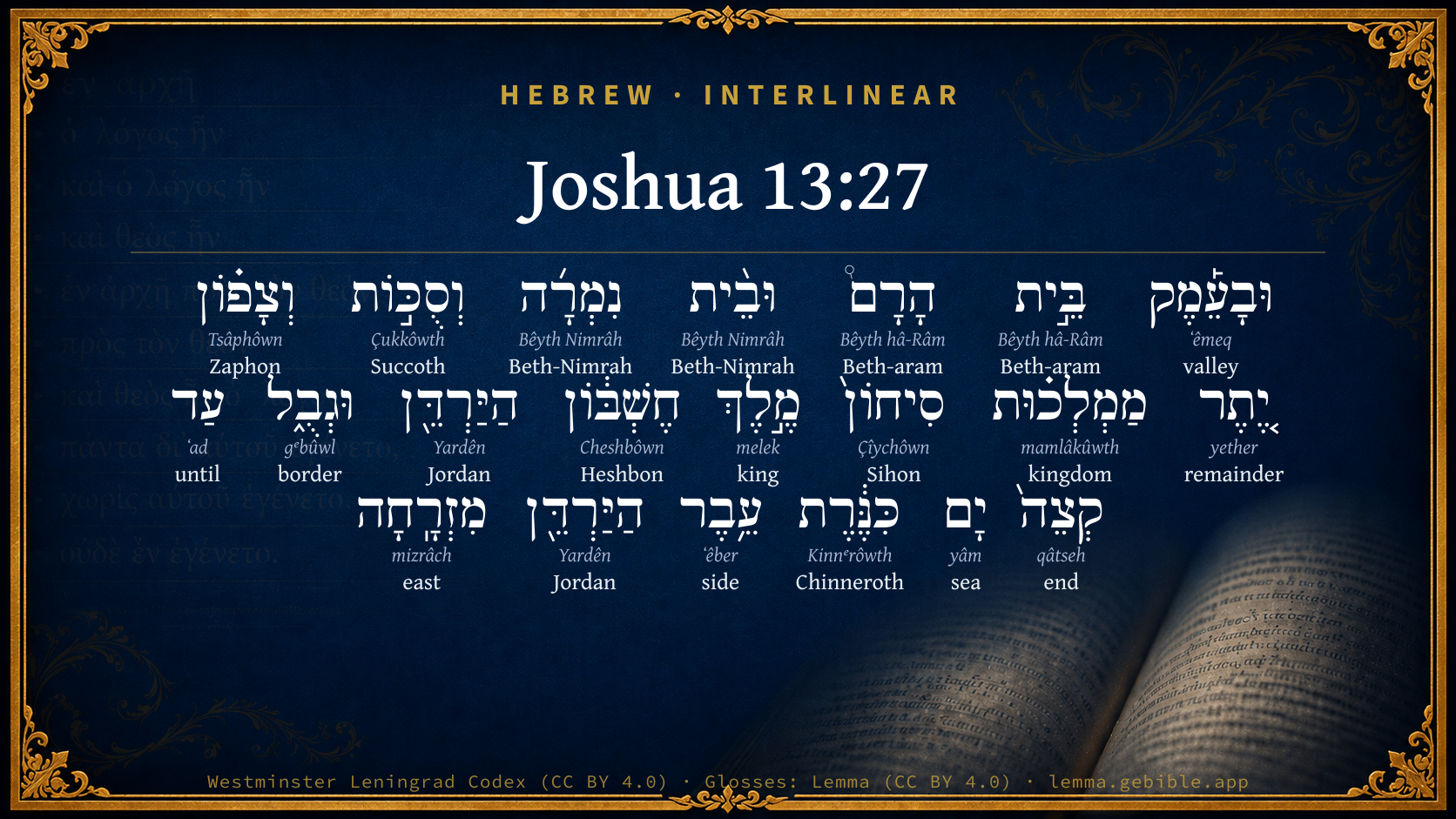
Hebrew (Westminster Leningrad Codex) Joshua 13:27 appears in the Hebrew Old Testament. The text above is from the Westminster Leningrad Codex. Each word links to its Strong’s number, a concise gloss, and parsing drawn from the Open Scriptures Hebrew Bible morphology. Click any word for its full Brown-Driver-Briggs (BDB) entry.
Download image
Cite this verse

Joshua 13:27 (World English Bible). Public Domain. Lemma interlinear Bible study tool, https://lemma.gebible.app/v/joshua/13/27.

Show BibTeX & RIS
BibTeX
RIS
English Translation
and in the valley, Beth Haram, and Beth Nimrah, and Succoth, and Zaphon, the rest of the kingdom of Sihon king of Heshbon, the Jordan and the border [of it], to the uttermost part of the sea of Chinnereth beyond the Jordan eastward.
World English Bible · Public Domain
Highlights
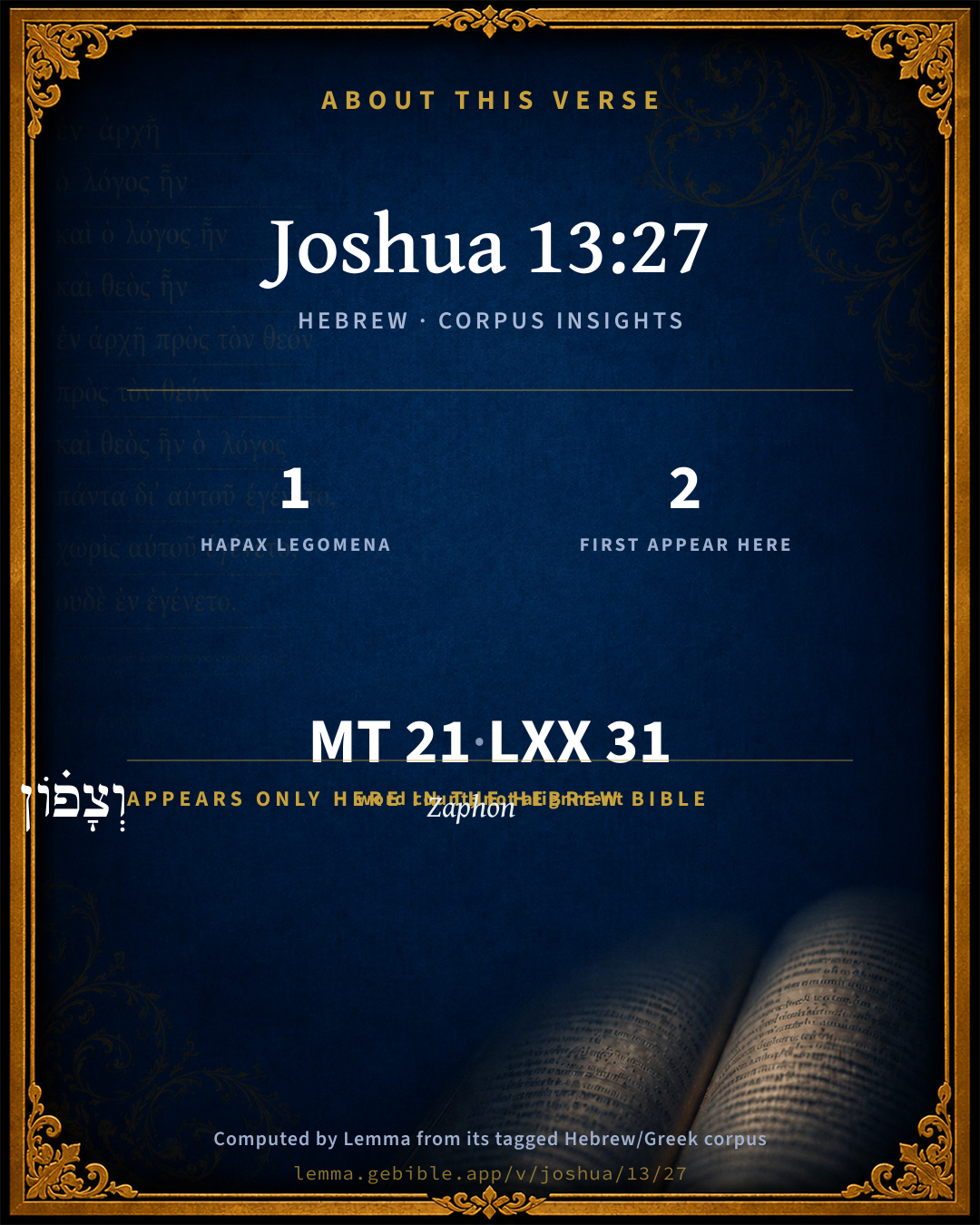
  • 1 hapax legomenon — only here in the Hebrew Bible
  • 2 first appearances in the Hebrew Bible
Full analysis ↓
Download a study sheet

One document with this verse’s original text, its word-by-word gloss line, the meaning frame, cross-references with their text, attributed commentary, and full source and license credits — printable, and it pastes into notes with its structure intact.

This verse Autodidact and up

Study sheet (.html) Plain text (.txt)

A passage Seminary Student

Up to 50 verses in one chapter. A passage sheet keeps up to 6 commentary sources and 12 cross-references per verse, in the order this page ranks them, and says so on the sheet whenever that leaves anything out. Ask for a single verse and you get the Autodidact verse sheet above.

Everything on this page stays free to read, with no account — the sheet is a download of what is already on screen, not access to it.

Want to remove ads? Support Godless Engineer
Compare translations 3

The same verse in 3 English versions, stacked beneath the original-language interlinear above. Click any original word for its lexicon entry.

Each is an independent rendering of the whole verse — the interlinear is not word-aligned to these translations.

Highlighted words mark where these versions differ — a whole-verse word diff, not a word-by-word alignment.

  • World English Bible Public Domain
    and in the valley, Beth Haram, and Beth Nimrah, and Succoth, and Zaphon, the rest of the kingdom of Sihon king of Heshbon, the Jordan and the border [of it], to the uttermost part of the sea of Chinnereth beyond the Jordan eastward.
  • King James Version Public Domain
    And in the valley, Betharam, and Bethnimrah, and Succoth, and Zaphon, the rest of the kingdom of Sihon king of Heshbon, Jordan and his border, even unto the edge of the sea of Chinnereth on the other side Jordan eastward.
  • unfoldingWord Literal Text CC BY-SA 4.0
    and in the valley, Beth Haram and Beth Nimrah and Succoth and Zaphon, the rest of the kingdom of Sihon, the king of Heshbon, the Jordan and the border, unto the end of the Sea of Chinnereth, beyond the Jordan from the sunrise.

unfoldingWord Literal Text — © unfoldingWord, licensed CC BY-SA 4.0. Word-aligned USFM3 via Door43 (git.door43.org/unfoldingWord/en_ult).

Versions to compare (up to 4)

3 of 4 selected

Show all 18 translations

Every available English version of this verse, each an independent rendering of the whole verse.

  • World English Bible Public Domain
    and in the valley, Beth Haram, and Beth Nimrah, and Succoth, and Zaphon, the rest of the kingdom of Sihon king of Heshbon, the Jordan and the border [of it], to the uttermost part of the sea of Chinnereth beyond the Jordan eastward.
  • Berean Standard Bible Public Domain
    and in the valley, Beth-haram, Beth-nimrah, Succoth, and Zaphon, with the rest of the kingdom of Sihon king of Heshbon (the territory on the east side of the Jordan up to the edge of the Sea of Chinnereth).
  • Majority Standard Bible Public Domain
    and in the valley, Beth-haram, Beth-nimrah, Succoth, and Zaphon, with the rest of the kingdom of Sihon king of Heshbon (the territory on the east side of the Jordan up to the edge of the Sea of Chinnereth).
  • King James Version Public Domain
    And in the valley, Betharam, and Bethnimrah, and Succoth, and Zaphon, the rest of the kingdom of Sihon king of Heshbon, Jordan and his border, even unto the edge of the sea of Chinnereth on the other side Jordan eastward.
  • American Standard Version (1901) Public Domain
    and in the valley, Beth-haram, and Beth-nimrah, and Succoth, and Zaphon, the rest of the kingdom of Sihon king of Heshbon, the Jordan and the border `thereof', unto the uttermost part of the sea of Chinnereth beyond the Jordan eastward.
  • Revised Version (1885) Public Domain
    and in the valley, Beth-haram, and Beth-nimrah, and Succoth, and Zaphon, the rest of the kingdom of Sihon king of Heshbon, Jordan and the border thereof, unto the uttermost part of the sea of Chinnereth beyond Jordan eastward.
  • Geneva Bible (1599) Public Domain
    And in the valley Beth-aram, and Bethnimrah, and Succoth, and Zaphon, the rest of the kingdome of Sihon King of Heshbon, vnto Iorden and the borders euen vnto the Sea coast of Cinneereth, beyond Iorden Eastward.
  • Douay-Rheims (1899) Public Domain
    And in the valley Betharan and Bethnemra, and Socoth, and Saphon the other part of the kingdom of Sehon king of Hesebon: the limit of this also is the Jordan, as far as the uttermost part of the sea of Cenereth beyond the Jordan on the east side.
  • Young's Literal Translation Public Domain
    and in the valley, Beth-Aram, and Beth-Nimrah, and Succoth, and Zaphon, the rest of the kingdom of Sihon king of Heshbon, the Jordan and `its' border, unto the extremity of the sea of Chinnereth, beyond the Jordan, eastward.
  • Literal Standard Version CC BY-SA 4.0
    and in the valley, Beth-Aram, and Beth-Nimrah, and Succoth, and Zaphon, the rest of the kingdom of Sihon king of Heshbon, the Jordan and [its] border, to the extremity of the Sea of Chinnereth, beyond the Jordan eastward.
  • Unlocked Literal Bible CC BY-SA 4.0
    In the valley, Moses gave them Beth Haram, Beth Nimrah, Succoth, and Zaphon, the rest of the kingdom of Sihon king of Heshbon, with the Jordan as a border, to the lower end of the Sea of Kinnereth, eastward beyond the Jordan.
  • unfoldingWord Literal Text CC BY-SA 4.0
    and in the valley, Beth Haram and Beth Nimrah and Succoth and Zaphon, the rest of the kingdom of Sihon, the king of Heshbon, the Jordan and the border, unto the end of the Sea of Chinnereth, beyond the Jordan from the sunrise.
  • Darby Bible Public Domain
    and in the valley, Beth-haram, and Beth-Nimrah, and Succoth, and Zaphon, the rest of the kingdom of Sihon the king of Heshbon, the Jordan and [its] border, as far as the edge of the sea of Chinnereth beyond the Jordan eastward.
  • World Messianic Bible Public Domain
    and in the valley, Beth Haram, Beth Nimrah, Succoth, and Zaphon, the rest of the kingdom of Sihon king of Heshbon, the Jordan’s bank, to the uttermost part of the sea of Chinnereth beyond the Jordan eastward.
  • Webster's Bible Public Domain
    And in the valley, Beth-aram, and Beth-nimrah, and Succoth, and Zaphon, the rest of the kingdom of Sihon king of Heshbon, Jordan and its border, even to the edge of the sea of Cinneroth, on the other side of Jordan eastward.
  • Free Bible Version CC BY-SA 4.0
    In the Jordan valley lay Beth-haram, Beth-nimrah, Succoth, and Zaphon, the rest of the kingdom of Sihon, king of Heshbon. The boundary ran along the Jordan up to the bottom end of the sea of Kinnereth and then ran east.
  • Bible in Basic English Public Domain
    And in the valley, Beth-haram, and Beth-nimrah, and Succoth, and Zaphon, the rest of the kingdom of Sihon, king of Heshbon, having Jordan for its limit, to the end of the sea of Chinnereth on the east side of Jordan.
  • JPS Tanakh (1917) Public Domain
    and in the valley, Beth-haram, and Beth-nimrah, and Succoth, and Zaphon, the rest of the kingdom of Sihon king of Heshbon, the Jordan being the border thereof, unto the uttermost part of the sea of Chinnereth beyond the Jordan eastward.

Literal Standard Version (2020), Covenant Press — licensed CC BY-SA 4.0. Text via the HelloAO Bible API (eBible.org). Unlocked Literal Bible (unfoldingWord) — licensed CC BY-SA 4.0. Text via the HelloAO Bible API (eBible.org). unfoldingWord Literal Text — © unfoldingWord, licensed CC BY-SA 4.0. Word-aligned USFM3 via Door43 (git.door43.org/unfoldingWord/en_ult). Free Bible Version, Dr. Jonathan Gallagher — licensed CC BY-SA 4.0. Text via the HelloAO Bible API (eBible.org).

Word by word

More ways to search: Search by grammar → Find every occurrence → Compare this word →

Practice this passage: Drill this verse → Learn its vocabulary →

וְצָפ֗וֹן
Tsâphôwn
H6829
“and · Zaphon”
Conjunction + Noun, Proper
Part of Speech
Conjunction + Noun
Type
Proper
Full BDB Definition

Origin: the same as H6828

TWOT: None

Zaphon = "north" - a city in Gad east of the Sea of Galilee on the east bank of the Jordan
  1. וּבָעֵ֡מֶק ʻêmeq H6010 “and · in/at the · valley” Conjunction + Preposition, Determined + Noun, Common, Masculine, Singular, Absolute
  2. בֵּ֣ית Bêyth hâ-Râm H1027 “Beth-aram” Noun, Proper
  3. הָרָם֩ Bêyth hâ-Râm H1027 “Beth-aram” Noun, Proper
  4. וּבֵ֨ית Bêyth Nimrâh H1039 “and · Beth-Nimrah” Conjunction + Noun, Proper
  5. נִמְרָ֜ה Bêyth Nimrâh H1039 “Beth-Nimrah” Noun, Proper
  6. וְסֻכּ֣וֹת Çukkôwth H5523 “and · Succoth” Conjunction + Noun, Proper
  7. יֶ֚תֶר yether H3499 “remainder of” Noun, Common, Masculine, Singular, Construct
  8. מַמְלְכ֗וּת mamlâkûwth H4468 “kingdom of” Noun, Common, Feminine, Singular, Construct
  9. סִיחוֹן֙ Çîychôwn H5511 “Sihon” Noun, Proper
  10. מֶ֣לֶךְ melek H4428 “king of” Noun, Common, Masculine, Singular, Construct
  11. חֶשְׁבּ֔וֹן Cheshbôwn H2809 “Heshbon” Noun, Proper
  12. הַיַּרְדֵּ֖ן Yardên H3383 “the · Jordan” Particle, Definite Article + Noun, Proper
  13. וּגְבֻ֑ל gᵉbûwl H1366 “and · border” Conjunction + Noun, Common, Masculine, Singular, Absolute
  14. עַד ʻad H5704 “until” Preposition
  15. קְצֵה֙ qâtseh H7097 “end of” Noun, Common, Both, Singular, Construct
  16. יָם yâm H3220 “sea of” Noun, Common, Masculine, Singular, Construct
  17. כִּנֶּ֔רֶת Kinnᵉrôwth H3672 “Chinneroth” Noun, Proper
  18. עֵ֥בֶר ʻêber H5676 “side of” Noun, Common, Masculine, Singular, Construct
  19. הַיַּרְדֵּ֖ן Yardên H3383 “the · Jordan” Particle, Definite Article + Noun, Proper
  20. מִזְרָֽחָה mizrâch H4217 “east · toward” Noun, Common, Masculine, Singular, Absolute + Suffix, Demonstrative

About this verse

These counts appear in no published source. They are computed here, from the morphology-tagged text and Lemma’s own curated glosses. What Lemma adds →

21
words
18
distinct lemmas
Historical
section

Notable vocabulary

1 hapax legomenon — a word that appears only here in the entire Hebrew Bible:

  • וְצָפ֗וֹן Zaphon H6829

First appearance in Scripture

These words make their first canonical appearance in the Hebrew Bible here:

  • בֵּ֣ית Beth-aram H1027
  • וְצָפ֗וֹן Zaphon H6829

Grammatical profile

  • 20 nouns
  • 1 preposition

Repetition

Words recur within this verse — often emphatic in Hebrew:

  • בֵּ֣ית Beth-aram H1027 ×2
  • וּבֵ֨ית Beth-Nimrah H1039 ×2
  • הַיַּרְדֵּ֖ן Jordan H3383 ×2

Hebrew & Septuagint length

In English translation the verse runs 43 words from the Hebrew and 39 from the Septuagint (LXX English) — closely comparable.

A rough comparison of the two English renderings, which tokenize alike — not a word-level alignment.

Word counts can differ between the Hebrew and the Greek without any difference in meaning — e.g. the Hebrew direct-object marker אֵת has no separate Greek word, and Greek often adds the article ὁ.

In the original languages it is 21 Hebrew tokens and 31 Greek tokens — but the two are counted differently (Hebrew bundles its prefixes and suffixes into one token; the Greek is in lemma form), so that isn’t a like-for-like length.

Cross-references

11

Topical passages linked to Joshua 13:27 in the Treasury of Scripture Knowledge — connected by theme and wording, ordered by reader-vote popularity; previews shown in the World English Bible.

  • Genesis 33:17 Jacob traveled to Succoth, built himself a house, and made shelters for his cattle. Therefore the name of the place is called Succoth.
  • Numbers 32:36 and Beth Nimrah, and Beth Haran: fortified cities, and folds for sheep.
  • Numbers 34:11 and the border shall go down from Shepham to Riblah, on the east side of Ain; and the border shall go down, and shall reach to the side of the sea of Chinnereth eastward;
  • Deuteronomy 3:17 the Arabah also, and the Jordan and the border [of it], from Chinnereth even to the sea of the Arabah, the Salt Sea, under the slopes of Pisgah eastward.
  • Joshua 11:2 and to the kings who were on the north, in the hill-country, and in the Arabah south of Chinneroth, and in the lowland, and in the heights of Dor on the west,
  • Numbers 32:3 Ataroth, and Dibon, and Jazer, and Nimrah, and Heshbon, and Elealeh, and Sebam, and Nebo, and Beon,
  • Joshua 12:3 and the Arabah to the sea of Chinneroth, eastward, and to the sea of the Arabah, even the Salt Sea, eastward, the way to Beth-jeshimoth; and on the south, under the slopes of Pisgah:
  • Judges 8:5–6 He said to the men of Succoth, Please give loaves of bread to the people who follow me; for they are faint, and I am pursuing after Zebah and Zalmunna, the kings of Midian.
  • Judges 8:14–16 He caught a young man of the men of Succoth, and inquired of him: and he described for him the princes of Succoth, and the elders of it, seventy-seven men.
  • 1 Kings 7:46 In the plain of the Jordan did the king cast them, in the clay ground between Succoth and Zarethan.
  • Luke 5:1 Now it happened, while the multitude pressed on him and heard the word of God, that he was standing by the lake of Gennesaret.

Cross-references courtesy of OpenBible.info (CC BY 4.0).

Hebrew and Greek witnesses Masoretic Hebrew ↔ Greek Septuagint

The same verse in the two great witnesses to the Old Testament, shown verse-for-verse.

These are two independent witnesses, not word-aligned to each other, and the Septuagint is shown in lemma (dictionary) form.

Hebrew Joshua 13:27 Masoretic · Westminster Leningrad Codex

וּבָעֵ֡מֶק בֵּ֣ית הָרָם֩ וּבֵ֨ית נִמְרָ֜ה וְסֻכּ֣וֹת וְצָפ֗וֹן יֶ֚תֶר מַמְלְכ֗וּת סִיחוֹן֙ מֶ֣לֶךְ חֶשְׁבּ֔וֹן הַיַּרְדֵּ֖ן וּגְבֻ֑ל עַד קְצֵה֙ יָם כִּנֶּ֔רֶת עֵ֥בֶר הַיַּרְדֵּ֖ן מִזְרָֽחָה

and in the valley, Beth Haram, and Beth Nimrah, and Succoth, and Zaphon, the rest of the kingdom of Sihon king of Heshbon, the Jordan and the border [of it], to the uttermost part of the sea of Chinnereth beyond the Jordan eastward.

World English Bible · Public Domain

Greek LXX Joshua 13:27 Septuagint · lemma form

καί ἐν εμεκ βαιθαραμ καί βαιθαναβρα καί σοκχωθα καί σαφαν καί ὁ λοιπός βασιλεία σηων βασιλεύς εσεβων καί ὁ ἰορδάνης ὁρίζω ἕως μέρος ὁ θάλασσα χενερεθ πέραν ὁ ἰορδάνης ἀπό ἀνατολή

and Enadom, and Othargai, and Baenthanabra, and Soccotha, and Saphan, and the rest of the kingdom of Sean king of Esebon: and Jordan shall be the boundary as far as part of the sea of Chenereth beyond Jordan eastward.

LXX2012 (modern English Septuagint) · Public Domain

On this verse, Whedon's Commentary on the Bible discusses the Septuagint’s reading. Read the note in Commentary ↓

Hebrew: Westminster Leningrad Codex (CC BY 4.0). Greek: Septuagint (public domain); English from LXX2012 (modern English Septuagint) (Public Domain). How the Septuagint differs from the Hebrew →

Targum (Aramaic paraphrase)

1

The Targum is the ancient Jewish Aramaic paraphrase of the Hebrew Scriptures — an interpretive translation, not the Hebrew text itself. Onkelos (literal) and Pseudo-Jonathan (expansive) render the Torah, and Jonathan the Prophets. Coverage is partial: where no permissively-licensed English translation exists for a verse, only the Aramaic is shown. This is verse-level text, not a word-by-word alignment to the Hebrew.

  1. Targum Jonathan Prophets (Joshua–Malachi)
    וּבְמֵישְׁרָא בֵּית הָרָם וּבֵית נִמְרָה וְסֻכּוֹת וְצִפוּנָא שְׁאָר מַלְכוּת סִיחוֹן מַלְכָּא דְחֶשְׁבּוֹן יַרְדְנָא וּתְחוּמֵיהּ עַד סְיָפֵי יַם גִינוֹסַר עַבְרָא דְיַרְדְנָא מַדִינְחָא:

    (no public-domain English translation for this verse)

    Targum Jonathan — Aramaic: “Mikraot Gedolot” (public domain). English: “Sefaria Community Translation” (CC0 1.0 (public-domain dedication)); “London "Chaldee Paraphrase," 1871” (public domain). Text via Sefaria.

Commentary

Notes on Joshua 13:27 from classic Christian and Jewish commentators (each source and its license shown beneath its notes). The classic Christian expositions comment on the surrounding passage and are grouped to its opening verse, so a note may address several verses; the Jewish commentaries on the Tanakh (Rashi and others) are per-verse, so they appear only where the commentator wrote on this verse.

Lemma curates 59 commentaries, every one of them public domain or Creative Commons licensed, each selected and text-cleaned for this edition rather than reprinted as found. About our sources →

John Gill's Exposition

This is the inheritance of the children of Gad, after their families,.... As described in Jos 13:27,

the cities and their villages; the cities given them, some of which are mentioned by name, and the villages adjacent and belonging to them were included in them.

John Gill's Exposition of the Whole Bible (1746–1763) — public domain (CC PDM 1.0). Text via the HelloAO Bible API.

Trapp's Complete Commentary

John Trapp

Jos 13:27 And in the valley, Betharam, and Bethnimrah, and Succoth, and Zaphon, the rest of the kingdom of Sihon king of Heshbon, Jordan and [his] border, [even] unto the edge of the sea of Chinnereth on the other side Jordan eastward.

Ver. 27. {See Trapp on "Jos 13:18"}

John Trapp, A Commentary or Exposition upon All the Books of the Old and New Testament (1647–1656) — public domain. Text from a community e-Sword module.

Geneva Bible (1599)

Geneva Bible translators

That is, in the land of Moab.

Geneva Bible (1599) marginal notes — public domain. Text via Bolls.life.

Adam Clarke's Commentary

Verse 27. Beth-aram] This city was rebuilt by Herod, and called Livias, in honour of Livia, the wife of Augustus. Josephus calls it Julias, Julia being the name which the Greeks commonly give to Livia. - Calmet.

Succoth] A place between Jabbok and Jordan where Jacob pitched his tents, from which circumstance it obtained its name, see Ge 33:17.

Adam Clarke's Commentary on the Bible (1810–1826) — public domain. Text from a community e-Sword/MySword module.

The Cambridge Bible for Schools and Colleges

gen. ed. J. J. S. Perowne

27. and in the valley] i. e. the valley of the Jordan. The possessions of the Gadites are now described in this valley as far north as the Sea of Galilee.

Beth-aram] or Beth-haran, the modern Beit-haran (Num_32:36). In later times it was known as Bethramphtha, and was called Julias or Livias by Herod Antipas in honour of the Emperor Augustus.

Beth-nimrah] or Nimrah (Num_32:3), which name still survives in the Nahr Nimrîn, close to one of the fords of Jordan just above Jericho.

and Succoth] (“Booths”), in the Jordan valley, between Peniel, near the ford of the torrent Jabbok, and Shechem (Gen_32:30; Gen_33:18). It is famous (a) in the history of Jacob’s return from Padan-aram; of (b) Gideon’s pursuit of Zebah and Zalmunna (Jdg_8:5-17); (c) as the spot at which the brass foundries were placed for casting the metal-work of the Temple (1Ki_7:46; 2Ch_4:17). Its position has not been exactly ascertained, and no place resembling Zaphon also has yet been discovered.

Jordan and his border] See above, Jos_13:23. For the Sea of Chinnereth = the “sea of Galilee,” see above, Jos_12:3.

The Cambridge Bible for Schools and Colleges (gen. ed. J. J. S. Perowne; Cambridge University Press, 1878–1918) — public domain. Text from a community e-Sword module.

Haydock's Catholic Bible Commentary

Betharan, which was enlarged by Herod, and called Livias, or Julias, as the Greeks called Livia, the wife of Augustus, Julia. (Josephus) --- Saphon, or "the northern part of," &c.

George Leo Haydock (1774–1849), Haydock's Catholic Family Bible and Commentary, 1859 edition — public domain. Excludes Psalms (Douay-Rheims chapter numbering differs from Protestant) and Deuterocanonical books (Catholic canon only).

Matthew Poole's English Annotations

Rest of the kingdom of Sihon; the northern part of his kingdom.

Matthew Poole's English Annotations on the Holy Bible (1683–1685) — public domain. Text from a community e-Sword/MySword module.

Whedon's Commentary on the Bible

Daniel D. Whedon

27. The valley — The Jordan valley from the border of Reuben northward to the sea of Chinnereth. Beth-aram is doubtless the same as Beth-haran in Num_32:36. In Eusebius, Jerome, and the Talmud it is called Bethramtha. It has not been accurately identified, but very probably will be found at the ruins called er-Ram just north of the Wady Heshban. The site of Beth-nimrah is still preserved in Nimrin, located, according to Robinson’s map, near the mouth of the Wady Shoaib, and about twelve miles north of er-Ram. In Num_32:3, it is called simply Nimrah. From its abundance of water and likeness of name in the Septuagint it seems to meet the requirements of the Bethabara of the New Testament. See note on Joh_1:28.

Succoth — An important place east of the Jordan, where Jacob built a house and made booths for his cattle after his meeting with Esau. Gen_33:17. Its exact location is unknown. Zaphon is mentioned again only at Jdg_12:1, where see note. No modern trace of it has been discovered.

The rest of the kingdom of Sihon — That is, the portion of it that was left after allotting the southern part to the tribe of Reuben. See note on Jos_13:21.

Sea of Chinnereth — See note on Jos_11:2. The subsequent fate of the children of Gad was very like that of the tribe of Reuben. See note on Jos_13:23.

Daniel D. Whedon (gen. ed.), Commentary on the Old and New Testaments (1874–1909) — public domain. Text from a community e-Sword module.

The Pulpit Commentary

The valley. The Emek. (see Jos_8:13) Beth-Nimrah. (Num_32:36) Afterwards Nimrim. (Isa_15:6 Jer_48:34) Now Nimrin. Succoth . i.e. , booths. Here Jacob rested after his meeting with Esau. (Gen_33:17) Here Gideon "taught the men of Succoth," who had declined to provide food for his army. (see Jud_1:8:5, 7, 16) It is mentioned in connection with Zarthan, or Zaretan (cf. Jos_3:16) as being in the tract or rKki of the Jordan, where the metal work of the temple was cast. (1Ki_7:46 2Ch_4:17) Zaphon. Perhaps, and the North; what remained of the kingdom of Sihon, i.e., as is implied above, the part which was not assigned to Reuben. Jordan and his border. Literally, Jordan and a border (see note on ver. 23). The edge. Rather, the end (see note on ver. 24).

The Pulpit Commentary (1880–1919), ed. H.D.M. Spence-Jones & Joseph S. Exell — public domain. Text from a community e-Sword module.

John Wesley's Explanatory Notes

The rest of the kingdom - The northern part of his kingdom.

John Wesley, Explanatory Notes Upon the Whole Bible (1754–1765) — public domain. Text via the GEBible commentary corpus.

Keil & Delitzsch

C. F. Keil & F. Delitzsch

On the north, the territory of Gad seems to have extended to the Jabbok, and only to have stretched beyond the Jabbok at Mahanaim, which formed the boundary of half-Manasseh, according to Jos 13:30. In the valley of the Jordan, on the other hand, the boundary reached to the Sea of Galilee. "The valley" is the valley of the Jordan, or the Arabah from Wady Hesbn above the Dead Sea up to the Sea of Galilee, along the east side of the Jordan, which belonged to the kingdom of Sihon (Jos 12:3; Deu 3:17). The northern boundary of the tribe of Reuben must have touched the Jordan in the neighbourhood of the Wady Hesbn. In the Jordan valley were Beth-haram, the future Libias, and present er Rameh (see at Num 32:36); Beth-nimra, according to the Onom. five Roman miles to the north, the present ruin of Nimrein (see at Num 32:36); Succoth, according to the Onom. trans Jordanem in parte Scythopoleos (see at Gen 33:17); Zaphon (i.e., north), probably not far from the southern extremity of the Sea of Galilee. "The rest of the kingdom of Sihon," the other part having been given to the Reubenites (Jos 13:21).

Keil & Delitzsch — Biblical Commentary on the Old Testament (1861–1891) — public domain (CC PDM 1.0). Text via the HelloAO Bible API. (Old Testament only.)

unfoldingWord translationNotes

Door43 World Missions Community

Beth Haram ... Beth Nimrah ... Zaphon ... Heshbon

These are the names of places. (See: How to Translate Names)

This is the inheritance of the tribe of Gad

The land that Moses assigned to the tribe of Gad is spoken of as if it were an inheritance that the tribe of Gad received as a permanent possession. (See: Metaphor)

translationWords

Succoth

kingdom

king

unfoldingWord translationNotes — © Distant Shores Media and the Door43 World Missions Community, licensed CC BY-SA 4.0. Source: git.door43.org/Door43/en_tn.

Rashi

Rabbi Shlomo Yitzchaki (Rashi)

The Jordan and its border. The Jordan and its boundary, [including] the cities which are on its bank.

Rashi on the Tanakh — English translations: “The Judaica Press complete Tanach with Rashi, translated by A. J. Rosenberg” (CC BY 4.0); “Pentateuch with Rashi's commentary by M. Rosenbaum and A.M. Silbermann, 1929-1934” (public domain); “The Metsudah Tanach series, Lakewood, N.J” (CC BY 4.0); and “The Book of Joshua, Metsudah Publications, 1997” (CC BY 4.0). Text via Sefaria.

Lesson kit

Teaching starters — assembled from the data on this page, not authored interpretation. Every prompt links to the verse data it draws on. Edit before teaching.

Joshua, in the Historical, opens this verse with 21 words (18 distinct Hebrew lemmas). Its most distinctive word is Tsâphôwn (“Zaphon”). A historical commentator’s framing appears above. Read the whole chapter for the surrounding context.

Discussion questions

  1. The word Tsâphôwn carries the sense “Zaphon.” How does it shape the verse?
  2. 1 word here appears nowhere else in the Hebrew Bible. Why might the author reach for such rare wording?
  3. 2 words make their first appearance in Scripture here. What does this debut establish?
  4. How does Genesis 33:17, which shares this passage’s theme, read alongside this verse?
  5. What does the repetition of “Beth-aram” (2× in this one verse) do in this verse?
  6. The translations on this page render this verse differently — a whole-verse word diff, not a word-by-word alignment. What might account for the different wordings?
  7. Compare how John Gill's Exposition and Trapp's Complete Commentary read this verse. Where do they agree or differ?

Things to notice

  • 1 word in this verse appears nowhere else in the Hebrew Bible.
  • 2 words make their first canonical appearance in Scripture here.
  • This verse counts 21 Hebrew ↔ 31 Greek words.
  • These translations choose different wording for 15 words in this verse.
  • “Beth-aram” occurs 2× in this single verse.

Reading settings

Reading text

Shown beneath each verse's original-language words.

Old Testament
Old Testament edition

Read the OT as the Masoretic Hebrew (MT) or the Greek Septuagint (LXX).

English shown for the Greek Septuagint (in the Hebrew ↔ Greek comparison).

Comparing translations? Open the Compare panel on any verse page to stack up to four side by side.