
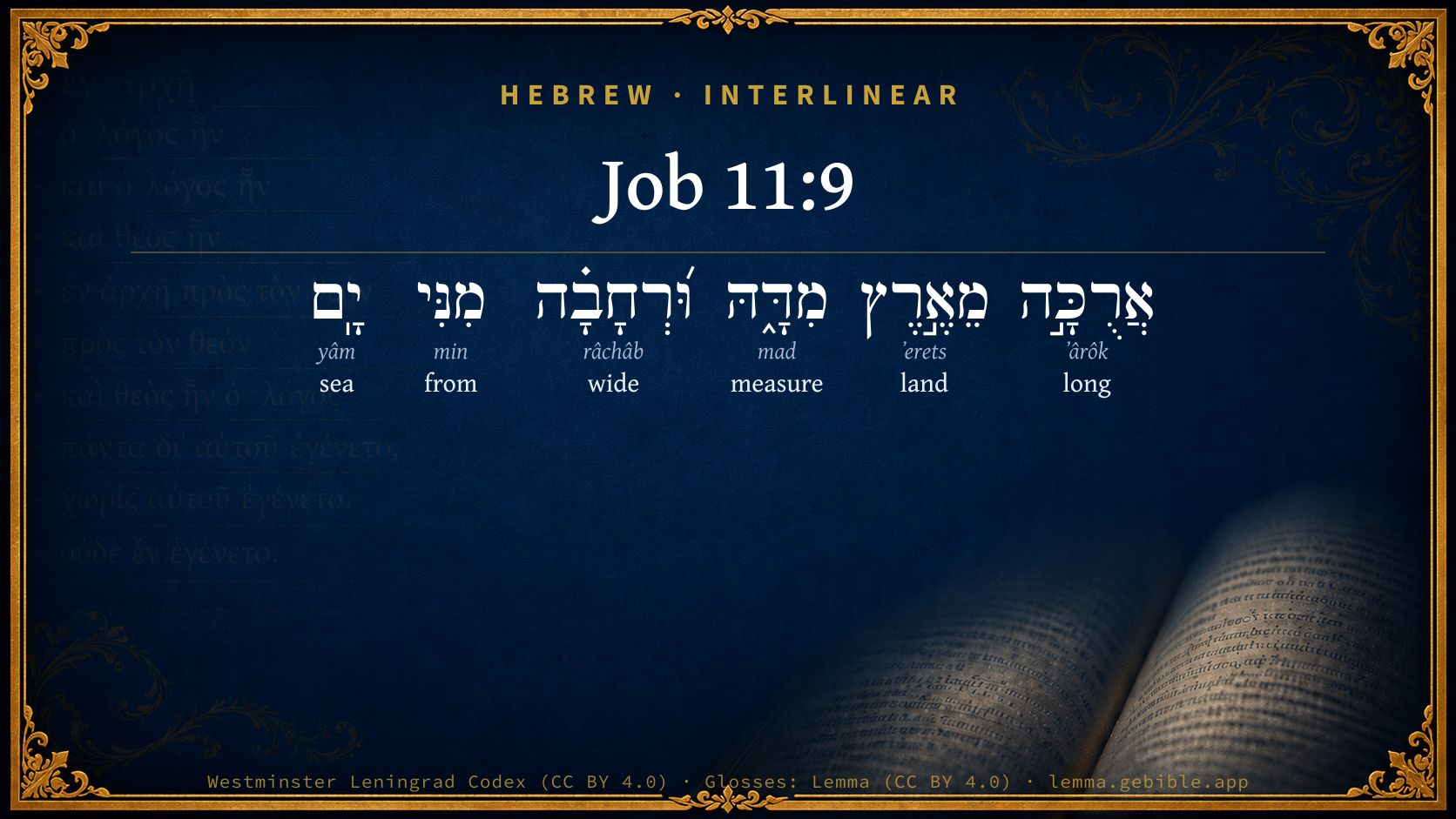
Job 11:9

Hebrew (Westminster Leningrad Codex) Job 11:9 appears in the Hebrew Old Testament. The text above is from the Westminster Leningrad Codex. Each word links to its Strong’s number, a concise gloss, and parsing drawn from the Open Scriptures Hebrew Bible morphology. Click any word for its full Brown-Driver-Briggs (BDB) entry.
Download image
Cite this verse

Job 11:9 (World English Bible). Public Domain. Lemma interlinear Bible study tool, https://lemma.gebible.app/v/job/11/9.

Show BibTeX & RIS
BibTeX
RIS
English Translation
The measure of it is longer than the earth, And broader than the sea.
World English Bible · Public Domain
Download a study sheet

One document with this verse’s original text, its word-by-word gloss line, the meaning frame, cross-references with their text, attributed commentary, and full source and license credits — printable, and it pastes into notes with its structure intact.

This verse Autodidact and up

Study sheet (.html) Plain text (.txt)

A passage Seminary Student

Up to 50 verses in one chapter. A passage sheet keeps up to 6 commentary sources and 12 cross-references per verse, in the order this page ranks them, and says so on the sheet whenever that leaves anything out. Ask for a single verse and you get the Autodidact verse sheet above.

Everything on this page stays free to read, with no account — the sheet is a download of what is already on screen, not access to it.

Want to remove ads? Support Godless Engineer
Compare translations 3

The same verse in 3 English versions, stacked beneath the original-language interlinear above. Click any original word for its lexicon entry.

Each is an independent rendering of the whole verse — the interlinear is not word-aligned to these translations.

Highlighted words mark where these versions differ — a whole-verse word diff, not a word-by-word alignment.

  • World English Bible Public Domain
    The measure of it is longer than the earth, And broader than the sea.
  • King James Version Public Domain
    The measure thereof is longer than the earth, and broader than the sea.
  • unfoldingWord Literal Text CC BY-SA 4.0
    Its measure longer than the earth and wider than the sea.

unfoldingWord Literal Text — © unfoldingWord, licensed CC BY-SA 4.0. Word-aligned USFM3 via Door43 (git.door43.org/unfoldingWord/en_ult).

Versions to compare (up to 4)

3 of 4 selected

Show all 18 translations

Every available English version of this verse, each an independent rendering of the whole verse.

  • World English Bible Public Domain
    The measure of it is longer than the earth, And broader than the sea.
  • Berean Standard Bible Public Domain
    Their measure is longer than the earth and wider than the sea.
  • Majority Standard Bible Public Domain
    Their measure is longer than the earth and wider than the sea.
  • King James Version Public Domain
    The measure thereof is longer than the earth, and broader than the sea.
  • American Standard Version (1901) Public Domain
    The measure thereof is longer than the earth, And broader than the sea.
  • Revised Version (1885) Public Domain
    The measure thereof is longer than the earth, and broader than the sea.
  • Geneva Bible (1599) Public Domain
    The measure thereof is longer then the earth, and it is broader then the sea.
  • Douay-Rheims (1899) Public Domain
    The measure of him is longer than the earth, and broader than the sea.
  • Young's Literal Translation Public Domain
    Longer than earth `is' its measure, And broader than the sea.
  • Literal Standard Version CC BY-SA 4.0
    Its measure [is] longer than earth, and broader than the sea.
  • Unlocked Literal Bible CC BY-SA 4.0
    Its measure is longer than the earth, and wider than the sea.
  • unfoldingWord Literal Text CC BY-SA 4.0
    Its measure longer than the earth and wider than the sea.
  • Darby Bible Public Domain
    The measure thereof is longer than the earth, and broader than the sea.
  • World Messianic Bible Public Domain
    Its measure is longer than the earth, and broader than the sea.
  • Webster's Bible Public Domain
    The measure of it is longer than the earth, and broader than the sea.
  • Free Bible Version CC BY-SA 4.0
    It extends farther than the earth, and wider than the sea.
  • Bible in Basic English Public Domain
    Longer in measure than the earth, and wider than the sea.
  • JPS Tanakh (1917) Public Domain
    The measure thereof is longer than the earth, and broader than the sea.

Literal Standard Version (2020), Covenant Press — licensed CC BY-SA 4.0. Text via the HelloAO Bible API (eBible.org). Unlocked Literal Bible (unfoldingWord) — licensed CC BY-SA 4.0. Text via the HelloAO Bible API (eBible.org). unfoldingWord Literal Text — © unfoldingWord, licensed CC BY-SA 4.0. Word-aligned USFM3 via Door43 (git.door43.org/unfoldingWord/en_ult). Free Bible Version, Dr. Jonathan Gallagher — licensed CC BY-SA 4.0. Text via the HelloAO Bible API (eBible.org).

Word by word

More ways to search: Search by grammar → Find every occurrence → Compare this word →

Practice this passage: Drill this verse → Learn its vocabulary →

About this verse

These counts appear in no published source. They are computed here, from the morphology-tagged text and Lemma’s own curated glosses. What Lemma adds →

6
words
6
distinct lemmas
Wisdom
section

Notable vocabulary

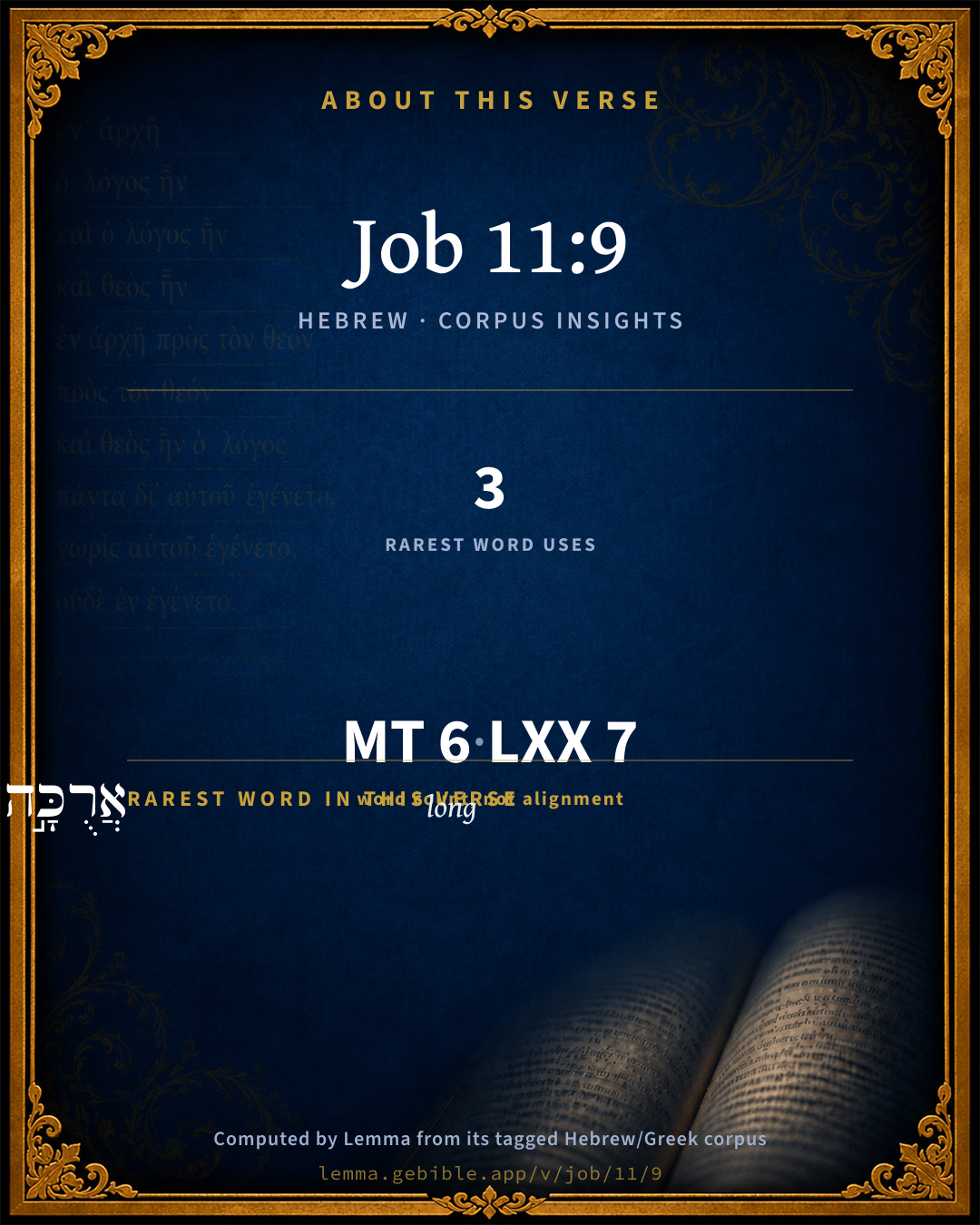
The rarest word here is אֲרֻכָּ֣ה long H752 — appearing just 3 times in the whole Hebrew Bible.

Shared distinctive vocabulary

אֲרֻכָּ֣ה long H752 occurs in 3 verses of the Hebrew Bible. Also found in:

Grammatical profile

  • 3 nouns
  • 2 adjectives
  • 1 preposition

Hebrew & Septuagint length

In English translation the verse runs 14 words from the Hebrew and 14 from the Septuagint (LXX English) — the same length.

A rough comparison of the two English renderings, which tokenize alike — not a word-level alignment.

Word counts can differ between the Hebrew and the Greek without any difference in meaning — e.g. the Hebrew direct-object marker אֵת has no separate Greek word, and Greek often adds the article ὁ.

In the original languages it is 6 Hebrew tokens and 7 Greek tokens — but the two are counted differently (Hebrew bundles its prefixes and suffixes into one token; the Greek is in lemma form), so that isn’t a like-for-like length.

Cross-references

3

Topical passages linked to Job 11:9 in the Treasury of Scripture Knowledge — connected by theme and wording, ordered by reader-vote popularity; previews shown in the World English Bible.

  • Psalms 139:9–10 If I take the wings of the dawn, And settle in the uttermost parts of the sea;
  • Job 28:24–25 For he looks to the ends of the earth, And sees under the whole sky.
  • Psalms 65:5–8 By awesome deeds of righteousness, you answer us, God of our salvation. You who are the hope of all the ends of the earth, Of those who are far away on the sea;

Cross-references courtesy of OpenBible.info (CC BY 4.0).

Hebrew and Greek witnesses Masoretic Hebrew ↔ Greek Septuagint

The same verse in the two great witnesses to the Old Testament, shown verse-for-verse.

These are two independent witnesses, not word-aligned to each other, and the Septuagint is shown in lemma (dictionary) form.

Hebrew Job 11:9 Masoretic · Westminster Leningrad Codex

אֲרֻכָּ֣ה מֵאֶ֣רֶץ מִדָּ֑הּ וּ֝רְחָבָ֗ה מִנִּי יָֽם

The measure of it is longer than the earth, And broader than the sea.

World English Bible · Public Domain

Greek LXX Job 11:9 Septuagint · lemma form

ἤ μακρός μέτρον γῆ ἤ εὖρος θάλασσα

Or longer than the measure of the earth, or the breadth of the sea.

LXX2012 (modern English Septuagint) · Public Domain

Hebrew: Westminster Leningrad Codex (CC BY 4.0). Greek: Septuagint (public domain); English from LXX2012 (modern English Septuagint) (Public Domain). How the Septuagint differs from the Hebrew →

Commentary

Notes on Job 11:9 from classic Christian and Jewish commentators (each source and its license shown beneath its notes). The classic Christian expositions comment on the surrounding passage and are grouped to its opening verse, so a note may address several verses; the Jewish commentaries on the Tanakh (Rashi and others) are per-verse, so they appear only where the commentator wrote on this verse.

Lemma curates 59 commentaries, every one of them public domain or Creative Commons licensed, each selected and text-cleaned for this edition rather than reprinted as found. About our sources →

Trapp's Complete Commentary

John Trapp

Job 11:9 The measure thereof [is] longer than the earth, and broader than the sea.

Ver. 9. The measure thereof is longer than the earth] Wherein some kingdoms are of a very great length, as those of the Turks and of the Tartars at this day. How long, then, is the earth itself? Some have undertaken to tell in how many days a nimble footman might measure it, but that is but a conjecture. It must be remembered that these things are spoken after the manner of men; for the wisdom of God can neither be measured nor numbered: of his understanding there is no number, saith the prophet, Psa 147:5. Archimedes, the mathematician, vaunted that he, by his skill in arithmetic, could number up all the sand or dust that is in the whole world, habitable and inhabitable. But who can cast up the extent of the Divine wisdom?

And broader than the sea] Which yet David calleth the "great and wide sea," Psa 104:25. Breadth is ascribed to the sea, because of its huge extension: mariners for many days together, while they sail upon the main, see no land, but only sky and water. God’s wisdom goes beyond all these; neither must we think to lade this ocean with our cockle shell. We may sooner drain the sea with a spoon than the perfections of God with our largest understandings.

John Trapp, A Commentary or Exposition upon All the Books of the Old and New Testament (1647–1656) — public domain. Text from a community e-Sword module.

Joseph Benson's Commentary

Job 11:9. The measure thereof is longer than the earth — From one end to the other. And broader than the sea — Called the great and wide sea, Psa 104:25. It infinitely exceeds the limits of the whole creation. Examine the earth in its utmost dimensions: consider all the beauties and excellences belonging to it. Having done this, compare it with the vast, unbounded wisdom of God, and thou wilt soon be sensible how small and inconsiderable the one will be in proportion to the other. The sea, how wide and broad soever it may seem to be; though, at first view, it may appear to be immeasurable; yet, should you examine it in the scale with the divine perfections, the whole ocean, in its utmost extent, would be only as the drop of a bucket, and the waters thereof such as he could measure in the hollow of his hand.

Joseph Benson's Commentary on the Old and New Testaments (1811–1818) — public domain. Text from a community e-Sword module.

John Gill's Exposition

The measure thereof is longer than the earth, and broader than the sea. Length is generally ascribed to the earth, and width to the sea; the ends of the earth are used for a great distance, and the sea is called the great and wide sea; see (k) Psa 72:1; but God and his perfections, particularly his wisdom and understanding, are infinite, Psa 147:5; and will admit of no dimensions; as his love, so his wisdom, has an height which cannot be reached, a depth that cannot be fathomed, and a length and breadth immeasurable; see Eph 3:18; from hence it appears that God is omniscient, omnipresent, and incomprehensible; and since he is to be found in Christ, and in him only, it is in vain for us to seek for him elsewhere: next the sovereignty of God is discoursed of.

(k) "Quid oceano longius inveriri potest", Cicero. Orat. 36.

John Gill's Exposition of the Whole Bible (1746–1763) — public domain (CC PDM 1.0). Text via the HelloAO Bible API.

Albert Barnes' Notes on the Bible

The measure thereof is longer than the earth - The measure of the knowledge of God. The extent of the earth would be one of the longest measures known to the ancients. Yet it is now impossible to ascertain what ideas were attached, in the time of Job, to the extent of the earth - and it is not necessary to know this in order to understand this expression. It is morally certain that the prevailing ideas were very limited, and that a small part of the earth was then known. The general belief seems to have been, that it was a vast plain, surrounded by water - but how supported, and what were its limits, were evidently matters to them unknown. The earliest knowledge which we have of geography, as understood by the Arabs, represents the earth as wholly encompassed by an ocean, like a zone. This was usually characterized as a “Sea of Darkness;” an appellation usually given to the Atlantic; while to the Northern Sea was given the name of “The Sea of Pitchy Darkness.” Edrisi imagined the land to be floating in the sea, and only part appearing above, like an egg in a basin of water. If these views prevailed so late as the tenth and eleventh centuries of the Christian era, it is reasonable to conclude that the views of the figure and size of the earth must have been extremely limited in the time of Job. On the ancient views of geography, see the notes at Job 26:7-10, and the maps there, also Murray’s Encyclopaedia of Geography, Book I, and Eschenberg’s Manual of Classical Literature, by Prof. Fiske, Part I.

And broader than the sea - What was the idea of the breadth of the sea, which was supposed to surround the earth, it is now wholly impossible to determine. Probably there were no ideas on the subject that could be regarded as settled and definite. The ancients had no means of ascertaining this, and they perhaps supposed that the ocean extended to an unlimited extent - or, perhaps, to the far distant place where the sky and the water appeared to meet. At all events it was an illustration then, as it is now, of a vast distance, and is not inappropriately used here to denote the impossibility of fully understanding God. This illustration would be far more striking then than now. We have crossed the ocean; and we do not deem it an impracticable thing to explore the remotest seas. But not so the ancients. They kept close to the shore. They seldom ventured out of sight of land. The enterprise of exploring and crossing the vast ocean, which they supposed encompassed the globe, was regarded by them as wholly impracticable - and equally so they correctly supposed it was to find out God.

Albert Barnes' Notes on the Bible (1834–1885) — public domain. Text from a community e-Sword/MySword module.

Matthew Poole's English Annotations

Longer than the earth, from one end to the other.

Broader than the sea; which is called the great and wide sea, Psa 104:25.

Matthew Poole's English Annotations on the Holy Bible (1683–1685) — public domain. Text from a community e-Sword/MySword module.

Whedon's Commentary on the Bible

Daniel D. Whedon

9. Longer than the earth — Firdusi, Persia’s epic poet, exclaims: “The height and the depth of the whole world have their centre in thee, O my God! I do not know thee, what thou art; but I know that thou art what thou alone canst be.”

Daniel D. Whedon (gen. ed.), Commentary on the Old and New Testaments (1874–1909) — public domain. Text from a community e-Sword module.

The Pulpit Commentary

The measure thereof is longer than the earth, and broader than the sea. Zophar"s metaphors are drawn from the objects which, to his mind, exceed in extent all others. "The earth" and "the sea" represent to him the illimitable.

The Pulpit Commentary (1880–1919), ed. H.D.M. Spence-Jones & Joseph S. Exell — public domain. Text from a community e-Sword module.

Rashi

Rabbi Shlomo Yitzchaki (Rashi)

its measure Heb. מדה, its measure, but here he mentions measure with a masculine noun (since he did not say, מדתה).

Rashi on the Tanakh — English translations: “The Judaica Press complete Tanach with Rashi, translated by A. J. Rosenberg” (CC BY 4.0); “Pentateuch with Rashi's commentary by M. Rosenbaum and A.M. Silbermann, 1929-1934” (public domain); “The Metsudah Tanach series, Lakewood, N.J” (CC BY 4.0); and “The Book of Joshua, Metsudah Publications, 1997” (CC BY 4.0). Text via Sefaria.

Lesson kit

Teaching starters — assembled from the data on this page, not authored interpretation. Every prompt links to the verse data it draws on. Edit before teaching.

Job, in the Wisdom, opens this verse with 6 words (6 distinct Hebrew lemmas). Its most distinctive word is ʼârôk (“long”). A historical commentator’s framing appears above. Read the whole chapter for the surrounding context.

Discussion questions

  1. The word ʼârôk carries the sense “long.” How does it shape the verse?
  2. 2 Samuel 3:1 shares the word «long» with this verse. How do the two illuminate each other?
  3. These translations render this verse differently; the difference is in the English rendering, not the original. What questions does that raise?
  4. Reading how Trapp's Complete Commentary and Joseph Benson's Commentary read this verse, where do the two commentators agree and where do they part?

Things to notice

Reading settings

Reading text

Shown beneath each verse's original-language words.

Old Testament
Old Testament edition

Read the OT as the Masoretic Hebrew (MT) or the Greek Septuagint (LXX).

English shown for the Greek Septuagint (in the Hebrew ↔ Greek comparison).

Comparing translations? Open the Compare panel on any verse page to stack up to four side by side.