
Joshua 15:10

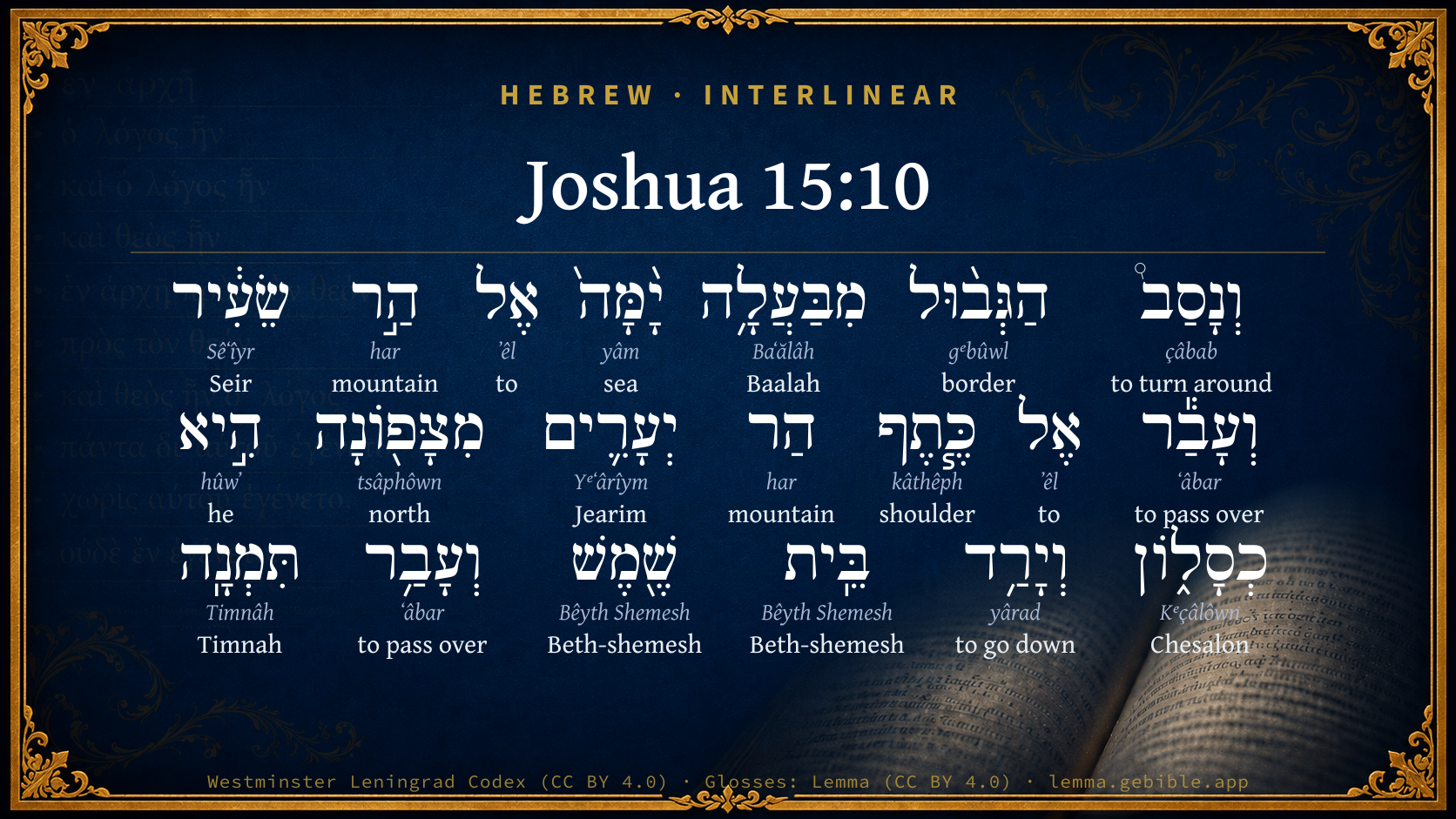
Hebrew (Westminster Leningrad Codex) Joshua 15:10 appears in the Hebrew Old Testament. The text above is from the Westminster Leningrad Codex. Each word links to its Strong’s number, a concise gloss, and parsing drawn from the Open Scriptures Hebrew Bible morphology. Click any word for its full Brown-Driver-Briggs (BDB) entry.
Download image
Cite this verse

Joshua 15:10 (World English Bible). Public Domain. Lemma interlinear Bible study tool, https://lemma.gebible.app/v/joshua/15/10.

Show BibTeX & RIS
BibTeX
RIS
English Translation
and the border turned about from Baalah westward to Mount Seir, and passed along to the side of Mount Jearim on the north (the same is Chesalon), and went down to Beth-shemesh, and passed along by Timnah;
World English Bible · Public Domain
Highlights
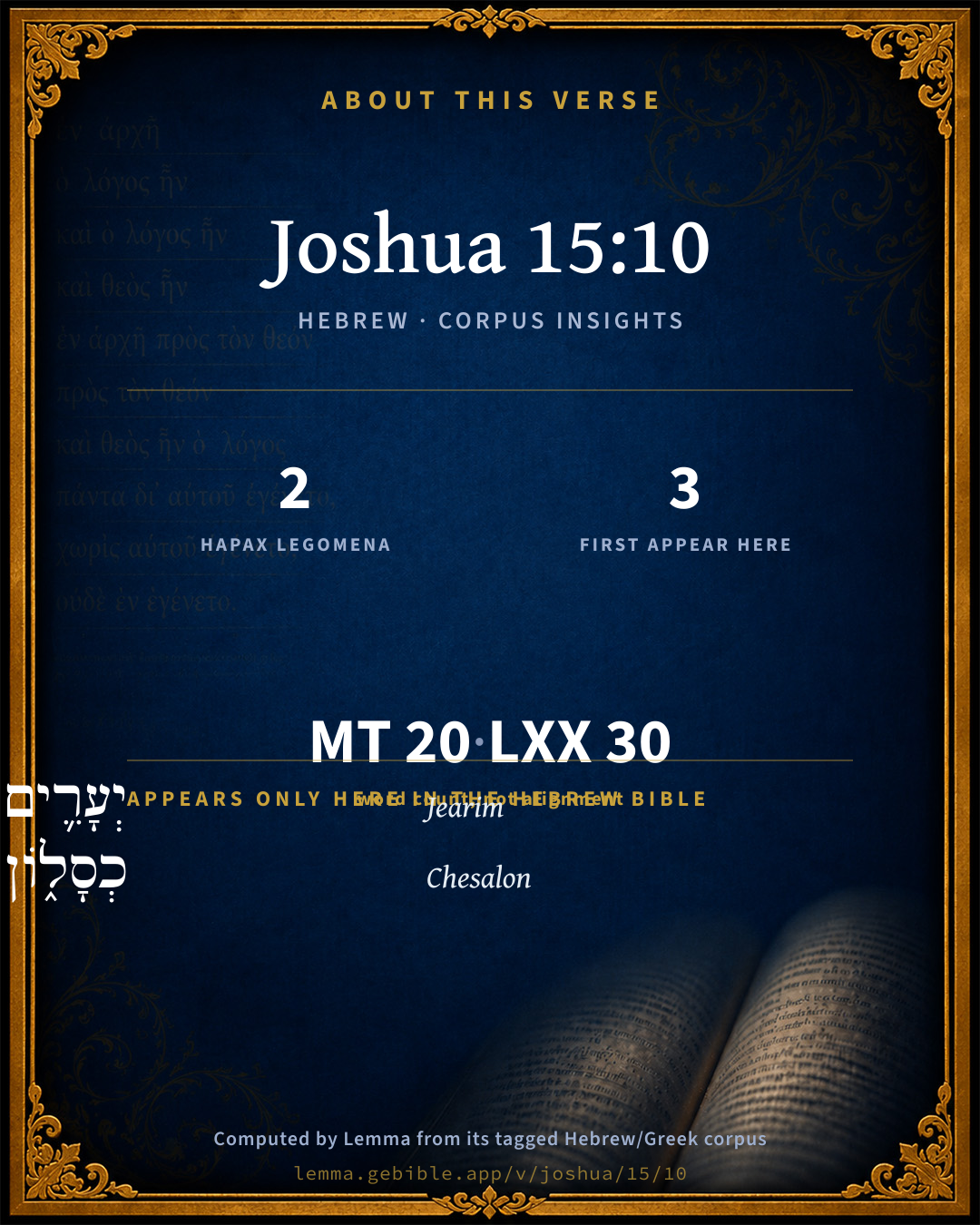
  • 2 hapax legomena — only here in the Hebrew Bible
  • 3 first appearances in the Hebrew Bible
Full analysis ↓
Download a study sheet

One document with this verse’s original text, its word-by-word gloss line, the meaning frame, cross-references with their text, attributed commentary, and full source and license credits — printable, and it pastes into notes with its structure intact.

This verse Autodidact and up

Study sheet (.html) Plain text (.txt)

A passage Seminary Student

Up to 50 verses in one chapter. A passage sheet keeps up to 6 commentary sources and 12 cross-references per verse, in the order this page ranks them, and says so on the sheet whenever that leaves anything out. Ask for a single verse and you get the Autodidact verse sheet above.

Everything on this page stays free to read, with no account — the sheet is a download of what is already on screen, not access to it.

Want to remove ads? Support Godless Engineer
Compare translations 3

The same verse in 3 English versions, stacked beneath the original-language interlinear above. Click any original word for its lexicon entry.

Each is an independent rendering of the whole verse — the interlinear is not word-aligned to these translations.

Highlighted words mark where these versions differ — a whole-verse word diff, not a word-by-word alignment.

  • World English Bible Public Domain
    and the border turned about from Baalah westward to Mount Seir, and passed along to the side of Mount Jearim on the north (the same is Chesalon), and went down to Beth-shemesh, and passed along by Timnah;
  • King James Version Public Domain
    And the border compassed from Baalah westward unto mount Seir, and passed along unto the side of mount Jearim, which is Chesalon, on the north side, and went down to Bethshemesh, and passed on to Timnah:
  • unfoldingWord Literal Text CC BY-SA 4.0
    And the border curved around from Baalah seaward to Mount Seir and passed over to the shoulder of Mount Jearim from the north (it is Chesalon). Then it went down to Beth Shemesh and passed over to Timnah.

unfoldingWord Literal Text — © unfoldingWord, licensed CC BY-SA 4.0. Word-aligned USFM3 via Door43 (git.door43.org/unfoldingWord/en_ult).

Versions to compare (up to 4)

3 of 4 selected

Show all 18 translations

Every available English version of this verse, each an independent rendering of the whole verse.

  • World English Bible Public Domain
    and the border turned about from Baalah westward to Mount Seir, and passed along to the side of Mount Jearim on the north (the same is Chesalon), and went down to Beth-shemesh, and passed along by Timnah;
  • Berean Standard Bible Public Domain
    The border curled westward from Baalah to Mount Seir, ran along the northern slope of Mount Jearim (that is, Chesalon), went down to Beth-shemesh, and crossed to Timnah.
  • Majority Standard Bible Public Domain
    The border curled westward from Baalah to Mount Seir, ran along the northern slope of Mount Jearim (that is, Chesalon), went down to Beth-shemesh, and crossed to Timnah.
  • King James Version Public Domain
    And the border compassed from Baalah westward unto mount Seir, and passed along unto the side of mount Jearim, which is Chesalon, on the north side, and went down to Bethshemesh, and passed on to Timnah:
  • American Standard Version (1901) Public Domain
    and the border turned about from Baalah westward unto mount Seir, and passed along unto the side of mount Jearim on the north (the same is Chesalon), and went down to Beth-shemesh, and passed along by Timnah;
  • Revised Version (1885) Public Domain
    and the border turned about from Baalah westward unto mount Seir, and passed along unto the side of mount Jearim on the north (the same is Chesalon), and went down to Beth-shemesh, and passed along by Timnah:
  • Geneva Bible (1599) Public Domain
    Then this border compasseth from Baalah Westward vnto mount Seir, and goeth along vnto the side of mount Iearim, which is Chesalon on the Northside: so it commeth downe to Bethshemesh, and goeth to Timnah.
  • Douay-Rheims (1899) Public Domain
    And it compasseth from Baala westward unto mount Seir: and passeth by the side of mount Jarim to the north into Cheslon: and goeth down into Bethsames, and passeth into Thamna.
  • Young's Literal Translation Public Domain
    and the border hath gone round from Baalah westward, unto mount Seir, and passed over unto the side of mount Jearim (it `is' Chesalon), on the north, and gone down `to' Beth-Shemesh, and passed over to Timnah;
  • Literal Standard Version CC BY-SA 4.0
    and the border has gone around from Ba‘alah westward, to Mount Seir, and passed over to the side of Mount Jearim (it [is] Chesalon), on the north, and gone down [to] Beth-Shemesh, and passed over to Timnah;
  • Unlocked Literal Bible CC BY-SA 4.0
    Then the border circled around west of Baalah to Mount Seir, and passed along to the side of Mount Jearim on the north (the same as Kesalon), went down to Beth Shemesh, and crossed over to Timnah.
  • unfoldingWord Literal Text CC BY-SA 4.0
    And the border curved around from Baalah seaward to Mount Seir and passed over to the shoulder of Mount Jearim from the north (it is Chesalon). Then it went down to Beth Shemesh and passed over to Timnah.
  • Darby Bible Public Domain
    and the border turned from Baalah westwards toward mount Seir, and passed toward the side of Har-jearim, that is, Chesalon, northwards, and went down to Beth-shemesh, and passed Timnah.
  • World Messianic Bible Public Domain
    and the border turned about from Baalah westward to Mount Seir, and passed along to the side of Mount Jearim (also called Chesalon) on the north, and went down to Beth Shemesh, and passed along by Timnah;
  • Webster's Bible Public Domain
    And the border compassed from Baalah westward to mount Seir, and passed along to the side of mount Jearim (which is Chesalon) on the north side, and went down to Beth-shemesh, and passed on to Timnah:
  • Free Bible Version CC BY-SA 4.0
    Then the boundary moved around to the west of Baalah to Mount Seir and passed along the northern slope of Mount Jearim to the town of Kesalon, down to Beth Shemesh and on to Timnah.
  • Bible in Basic English Public Domain
    Then turning west, the line goes from Baalah to Mount Seir, and on to the side of Mount Jearim (which is Chesalon) on the north, then down to Beth-shemesh, and on past Timnah:
  • JPS Tanakh (1917) Public Domain
    And the border turned about from Baalah westward unto mount Seir, and passed along unto the side of mount Jearim on the north — the same is Chesalon — and went down to Beth-shemesh, and passed along by Timnah.

Literal Standard Version (2020), Covenant Press — licensed CC BY-SA 4.0. Text via the HelloAO Bible API (eBible.org). Unlocked Literal Bible (unfoldingWord) — licensed CC BY-SA 4.0. Text via the HelloAO Bible API (eBible.org). unfoldingWord Literal Text — © unfoldingWord, licensed CC BY-SA 4.0. Word-aligned USFM3 via Door43 (git.door43.org/unfoldingWord/en_ult). Free Bible Version, Dr. Jonathan Gallagher — licensed CC BY-SA 4.0. Text via the HelloAO Bible API (eBible.org).

Word by word

More ways to search: Search by grammar → Find every occurrence → Compare this word →

Practice this passage: Drill this verse → Learn its vocabulary →

יְעָרִ֛ים
Yᵉʻârîym
H3297
“Jearim”
Noun, Proper
Part of Speech
Noun
Type
Proper
Full BDB Definition

Origin: pl. of H3293

TWOT: None

Jearim = "forests" - a hill on the northern boundary of Judah
  1. וְנָסַב֩ çâbab H5437 “and · to turn around” Conjunction + Verb, Niphal, Perfect, 3rd Person, Masculine, Singular
  2. הַגְּב֨וּל gᵉbûwl H1366 “the · border” Particle, Definite Article + Noun, Common, Masculine, Singular, Absolute
  3. מִבַּעֲלָ֥ה Baʻălâh H1173 “from · Baalah” Preposition + Noun, Proper
  4. יָ֨מָּה֙ yâm H3220 “sea · toward” Noun, Common, Masculine, Singular, Absolute + Suffix, Demonstrative
  5. אֶל ʼêl H413 “to” Preposition
  6. הַ֣ר har H2022 “mountain of” Noun, Common, Masculine, Singular, Construct
  7. שֵׂעִ֔יר Sêʻîyr H8165 “Seir” Noun, Proper
  8. וְעָבַ֕ר ʻâbar H5674 “and · to pass over” Conjunction + Verb, Qal, Perfect, 3rd Person, Masculine, Singular
  9. אֶל ʼêl H413 “to” Preposition
  10. כֶּ֧תֶף kâthêph H3802 “shoulder of” Noun, Common, Feminine, Singular, Construct
  11. הַר har H2022 “mountain of” Noun, Common, Masculine, Singular, Construct
  12. מִצָּפ֖וֹנָה tsâphôwn H6828 “from · north · toward” Preposition + Noun, Common, Feminine, Singular, Absolute + Suffix, Demonstrative
  13. הִ֣יא hûwʼ H1931 “he” Pronoun, Personal, 3rd Person, Feminine, Singular
  14. כְסָל֑וֹן Kᵉçâlôwn H3693 “Chesalon” Noun, Proper
  15. וְיָרַ֥ד yârad H3381 “and · to go down” Conjunction + Verb, Qal, Perfect, 3rd Person, Masculine, Singular
  16. בֵּֽית Bêyth Shemesh H1053 “Beth-shemesh” Noun, Proper
  17. שֶׁ֖מֶשׁ Bêyth Shemesh H1053 “Beth-shemesh” Noun, Proper
  18. וְעָבַ֥ר ʻâbar H5674 “and · to pass over” Conjunction + Verb, Qal, Perfect, 3rd Person, Masculine, Singular
  19. תִּמְנָֽה Timnâh H8553 “Timnah” Noun, Proper

About this verse

These counts appear in no published source. They are computed here, from the morphology-tagged text and Lemma’s own curated glosses. What Lemma adds →

20
words
16
distinct lemmas
Historical
section

Notable vocabulary

2 hapax legomena — words that appear only here in the entire Hebrew Bible:

  • יְעָרִ֛ים Jearim H3297
  • כְסָל֑וֹן Chesalon H3693

First appearance in Scripture

These words make their first canonical appearance in the Hebrew Bible here:

  • יְעָרִ֛ים Jearim H3297
  • כְסָל֑וֹן Chesalon H3693
  • בֵּֽית Beth-shemesh H1053

Shared distinctive vocabulary

מִבַּעֲלָ֥ה Baalah H1173 occurs in 5 verses of the Hebrew Bible. Also found in:

Grammatical profile

  • 4 verbs
  • 13 nouns
  • 1 pronoun
  • 2 prepositions

Verb forms

  • וְנָסַב֩ Niphal · Perfect
  • וְעָבַ֕ר Qal · Perfect
  • וְיָרַ֥ד Qal · Perfect
  • וְעָבַ֥ר Qal · Perfect

Repetition

Words recur within this verse — often emphatic in Hebrew:

  • הַ֣ר mountain H2022 ×2
  • וְעָבַ֕ר to pass over H5674 ×2
  • בֵּֽית Beth-shemesh H1053 ×2
  • אֶל to H413 ×2

Hebrew & Septuagint length

In English translation the verse runs 37 words from the Hebrew and 46 from the Septuagint (LXX English) — closely comparable.

A rough comparison of the two English renderings, which tokenize alike — not a word-level alignment.

Word counts can differ between the Hebrew and the Greek without any difference in meaning — e.g. the Hebrew direct-object marker אֵת has no separate Greek word, and Greek often adds the article ὁ.

In the original languages it is 20 Hebrew tokens and 30 Greek tokens — but the two are counted differently (Hebrew bundles its prefixes and suffixes into one token; the Greek is in lemma form), so that isn’t a like-for-like length.

Cross-references

5

Topical passages linked to Joshua 15:10 in the Treasury of Scripture Knowledge — connected by theme and wording, ordered by reader-vote popularity; previews shown in the World English Bible.

  • Judges 14:1 Samson went down to Timnah, and saw a woman in Timnah of the daughters of the Philistines.
  • Genesis 38:12–13 After many days, Shua's daughter, the wife of Judah, died. Judah was comforted, and went up to his sheep-shearers to Timnah, he and his friend Hirah, the Adullamite.
  • Joshua 15:57 Kain, Gibeah, and Timnah; ten cities with their villages.
  • Judges 14:5 Then went Samson down, and his father and his mother, to Timnah, and came to the vineyards of Timnah: and, behold, a young lion roared against him.
  • 1 Samuel 6:12–21 The cattle took the straight way by the way to Beth-shemesh; they went along the highway, lowing as they went, and didn't turn aside to the right hand or to the left; and the lords of the Philistines went after them to the border of Beth-shemesh.

Cross-references courtesy of OpenBible.info (CC BY 4.0).

Hebrew and Greek witnesses Masoretic Hebrew ↔ Greek Septuagint

The same verse in the two great witnesses to the Old Testament, shown verse-for-verse.

These are two independent witnesses, not word-aligned to each other, and the Septuagint is shown in lemma (dictionary) form.

Hebrew Joshua 15:10 Masoretic · Westminster Leningrad Codex

וְנָסַב֩ הַגְּב֨וּל מִבַּעֲלָ֥ה יָ֨מָּה֙ אֶל הַ֣ר שֵׂעִ֔יר וְעָבַ֕ר אֶל כֶּ֧תֶף הַר יְעָרִ֛ים מִצָּפ֖וֹנָה הִ֣יא כְסָל֑וֹן וְיָרַ֥ד בֵּֽית שֶׁ֖מֶשׁ וְעָבַ֥ר תִּמְנָֽה

and the border turned about from Baalah westward to Mount Seir, and passed along to the side of Mount Jearim on the north (the same is Chesalon), and went down to Beth-shemesh, and passed along by Timnah;

World English Bible · Public Domain

Greek LXX Joshua 15:10 Septuagint · lemma form

καί περιἔρχομαι ὅριον ἀπό βααλ ἐπί θάλασσα καί παραἔρχομαι εἰς ὄρος ασσαρες ἐπί νῶτον πόλις ιαριμ ἀπό βορέας οὗτος εἰμί χασλων καί καταβαίνω ἐπί πόλις ἥλιος καί παραἔρχομαι ἐπί λίψ

And the border will go round from Baal to the sea, and will go on to the mount of Assar behind the city of Jarin northwards; this is Chaslon: and it will come down to the city of Sun, and will go on to the south.

LXX2012 (modern English Septuagint) · Public Domain

Hebrew: Westminster Leningrad Codex (CC BY 4.0). Greek: Septuagint (public domain); English from LXX2012 (modern English Septuagint) (Public Domain). How the Septuagint differs from the Hebrew →

Targum (Aramaic paraphrase)

1

The Targum is the ancient Jewish Aramaic paraphrase of the Hebrew Scriptures — an interpretive translation, not the Hebrew text itself. Onkelos (literal) and Pseudo-Jonathan (expansive) render the Torah, and Jonathan the Prophets. Coverage is partial: where no permissively-licensed English translation exists for a verse, only the Aramaic is shown. This is verse-level text, not a word-by-word alignment to the Hebrew.

  1. Targum Jonathan Prophets (Joshua–Malachi)
    וּמִסְתַּחַר תְּחוּמָא מִבַּעֲלָה לְיַמָא לְטוּרָא דְשֵׂעִיר וַעֲבַר לְעִיבַּר טוּר יְעָרִים מִצִפּוּנָא הִיא כְסָלוֹן וְנָחִית לְבֵית שֶׁמֶשׁ וַעֲבַר לְתִמְנָא:

    (no public-domain English translation for this verse)

    Targum Jonathan — Aramaic: “Mikraot Gedolot” (public domain). English: “Sefaria Community Translation” (CC0 1.0 (public-domain dedication)); “London "Chaldee Paraphrase," 1871” (public domain). Text via Sefaria.

Commentary

Notes on Joshua 15:10 from classic Christian and Jewish commentators (each source and its license shown beneath its notes). The classic Christian expositions comment on the surrounding passage and are grouped to its opening verse, so a note may address several verses; the Jewish commentaries on the Tanakh (Rashi and others) are per-verse, so they appear only where the commentator wrote on this verse.

Lemma curates 59 commentaries, every one of them public domain or Creative Commons licensed, each selected and text-cleaned for this edition rather than reprinted as found. About our sources →

Trapp's Complete Commentary

John Trapp

Jos 15:10 And the border compassed from Baalah westward unto mount Seir, and passed along unto the side of mount Jearim, which [is] Chesalon, on the north side, and went down to Bethshemesh, and passed on to Timnah:

Ver. 10. Unto mount Seir.] Not that of the Idumeans, but another of that name, from its roughness.

John Trapp, A Commentary or Exposition upon All the Books of the Old and New Testament (1647–1656) — public domain. Text from a community e-Sword module.

Adam Clarke's Commentary

Verse 10. Beth-shemesh] The house or temple of the sun. It is evident that the sun was an object of adoration among the Canaanites; and hence fountains, hills, c., were dedicated to him. Beth-shemesh is remarkable for the slaughter of its inhabitants, in consequence of their prying curiously, if not impiously, into the ark of the Lord, when sent back by the Philistines. See 1Sa 6:19.

Adam Clarke's Commentary on the Bible (1810–1826) — public domain. Text from a community e-Sword/MySword module.

Ellicott's Commentary for English Readers

(10) Mount Seir.—Of course, entirely distinct from the place in Edom, but not precisely identified.

Chesalon is identified with Kesla, two and a quarter miles due north of Khurbet ’Erma, on sheet 17 Timnah is Tibneh (on sheet 16).

A Bible Commentary for English Readers, edited by Charles John Ellicott (1878–1897) — public domain. Text from a community e-Sword module.

The Cambridge Bible for Schools and Colleges

gen. ed. J. J. S. Perowne

10. and the border compassed] = it “beat round,” “took a circuit;” and see above, Jos_15:3.

unto mount Seir] not the Edomite range (Gen_32:3; Num_24:18), but the range, which lies between the Wady Aly and the Wady Ghurab. It may have derived its name either (a) from some peculiarity in the form or appearance of the spot, or (b) from some incursion of the Edomites, which has escaped record.

and passed along unto the side of mount Jearim] or, unto the shoulder of mount Jearim,” which is Chesalon. Chesalon, probably now Kesla (see Robinson’s Later Bibl. Res. p. 154), was also called Har-jearim = “mountain of forests,” as Baalah was called Kirjath-jearim = “city of forests” or “forest town.” The region appears in early times to have been thickly covered with woods.

and went down to Beth-shemesh, and passed on to Timnah] (a) Beth-shemesh = “house of the sun,” or Ir-shemesh (ch. Jos_19:22), now ’Ain-Shems, about two miles from the great Philistine plain, and seven miles from Ekron. It (a) was allotted to the priests (Jos_21:16); was (b) the place whither “the kine took the straight way” from Ekron with the Ark of the Covenant (1Sa_6:9); where (c) the people looked into the Ark and caused the severe judgment that followed (1Sa_6:19); and where (d) Solomon had one of his commissariat districts (1Ki_4:9). “Here,” at ’Ain-Shems, “are the vestiges of a former extensive city, consisting of many foundations, and the remains of ancient walls of hewn stone. Both the name and the position of this spot seem to indicate the site of the ancient Beth-shemesh of the Old Testament.” Robinson, Later Bibl. Res. p. 153. (β) Timnah, or Timnath, or Thimnathah (Jos_19:43), now Tibnah, a village about two miles west of ’Ain-Shems, from which Samson fetched his wife (Jdg_14:1; Jdg_14:5), and in the vineyards of which, without anything in his hand, he killed the lion (Jdg_14:5-6).

The Cambridge Bible for Schools and Colleges (gen. ed. J. J. S. Perowne; Cambridge University Press, 1878–1918) — public domain. Text from a community e-Sword module.

John Gill's Exposition

And the border compassed from Baalah westward unto Mount Seir,.... Not that in Idumea, so famous for its being the seat of Esau, which lay remote from hence, but a third of that name near Kirjathjearim; and which Adrichomius (t) places on the borders of Azotus and Ashkelon: this compass is fetched from the north to the west:

and passed along unto the side of the mount Jearim, which is Chesalon, on the north side; that is, on the north side of the mount, which went by both those names; and which Jerom (u) places on the borders of Aelia or Jerusalem; but it seems to be at a distance from thence, and near to Kirjathjearim, and had its name, as that, from the multitude of trees that grow on it:

and went down to Bethshemesh; there were several cities of this name; but this, according to Jerom (w), was a Levite's city in the tribe of Benjamin, and in his day was shown as you go from Eleutherepolis to Nicopolis or Emmaus, ten miles to the east; according to Burchard (x), it was five miles from Kirjathjearim to the south; and Bunting (y) places it four miles from Jerusalem westward, taking it for a city in the tribe of Judah, Jos 21:16,

and passed on to Timnah; which, in Jerom's time, was a large village on the borders of Lydda, as you go to Jerusalem, in the tribe of Judah, or Dan (z); his placed in the tribe of Judah, Jos 15:57; though thought to be afterwards given to Dan; here Judah sheared his sheep; see Gill on Gen 38:12.

(t) Theatrum Terrae Sanct. p. 24. (u) De loc. Heb. fol. 90. F. (w) Ib. fol. 89. H. (x) Apud Masium in loc. (y) Travels, p. 124. (z) De loc. Heb. fol. 95. C.

John Gill's Exposition of the Whole Bible (1746–1763) — public domain (CC PDM 1.0). Text via the HelloAO Bible API.

Albert Barnes' Notes on the Bible

Mount Seir is not the well-known range of Edom. The name ( “shaggy mountain”) is applicable to any rugged or well-wooded hill. Here it probably denotes the range which runs southwestward from Kirjath-jearim to the Wady Surar. Mount Jearim, i. e. “woody mountain,” is through its other name, Chesalon, identified with the modern “Kesla”.

Beth-shemesh - i. e. “house of the sun,” called “Ir-shemesh” or “city of the sun” (Jos 19:41; Compare 1Ki 4:9), a place assigned to Dan, and one of the cities which fell by lot to the Levites Jos 21:16. Beth-shemesh was the first place at which the ark rested after its return from the hands of the Philistines 1Sa 6:12. It was the residence of one of Solomon’s purveyors 1Ki 4:9, and was the spot where at a later date Amaziah was defeated and slain by Jehoash (2Ki 14:11 ff). It is no doubt the modern “Ain Shems”.

Timnah, called also Timnath, and Timnathah, belonged likewise to Dan, and is to be distinguished from other places of like name Gen 38:12; Jos 24:30. Timnah ( “portion”) was evidently, like Gilgal, Ramah, Kirjath, and several other towns, of frequent use in Canaanite topography.

Albert Barnes' Notes on the Bible (1834–1885) — public domain. Text from a community e-Sword/MySword module.

Haydock's Catholic Bible Commentary

Bethsames, "the house of the sun," was at the same distance, westward. Here the sight of the ark proved so fatal to 50,070 of the inhabitants, 1 Kings vi. 19. (Calmet)

George Leo Haydock (1774–1849), Haydock's Catholic Family Bible and Commentary, 1859 edition — public domain. Excludes Psalms (Douay-Rheims chapter numbering differs from Protestant) and Deuterocanonical books (Catholic canon only).

Matthew Poole's English Annotations

Mount Seir; not that of Edom, but another so called from some resemblance it had with that in quality.

Bethshemesh: there were divers cities of this name; this in Judah here, and Jos 21:16; 2Ki 14:11, another in Issachar, and a third in Naphtali, Jos 19:22,38.

Matthew Poole's English Annotations on the Holy Bible (1683–1685) — public domain. Text from a community e-Sword/MySword module.

Whedon's Commentary on the Bible

Daniel D. Whedon

10. Compassed — That is, encompassed; described a curve. Mount Seir must not be confounded with that of Idumea. It is a range running southwest from Kirjath-jearim, between the Wady Aly and the Wady Ghurab. The name still continues in the place called Sairah. Chesalon is the modern Kesla, seen by Dr. Robinson on a high point of the lofty ridge south of the Wady Ghurab. [He also recognized Beth-shemesh in the modern Ain-shems, just south of the great Wady Surar. The ruins, which consist of many foundations and remains of ancient walls of hewn stone, are “upon and around the plateau of a low swell or mound between the Surar on the north and a smaller wady on the south.” To this place the Ark was brought after its capture by the Philistines. 1Sa_6:9.] Timnah, from which Samson fetched his wife, is the modern Tibneh, about two miles west of Beth-shemesh. This Timnah must be distinguished from another place of the same name on the mountains, mentioned at Jos_15:57.

11. Unto the side of Ekron northward — That is, on the north side of Ekron. This was the most northerly of the five great Philistine cities. Compare Jos_13:3. It was the last place to which the captured Ark was taken, (1Sa_5:10,) and thence it was transported on the new cart to Beth-shemesh. Its site is found in the modern Akir, in a northwesterly direction from Beth-shemesh, and about half way between the latter city and the sea. The site of Shicron is unknown. Mount Baalah is also uncertain, but probably was the name of a range of hills seen from Ekron on the east of Wady Rubin. Jabneel is doubtless the same as Jabneh, which Uzziah took from the Philistines. 2Ch_26:6. The name and site are still found in Yebna, a village situated on an eminence in the midst of a rich plain, two miles from the sea and three from Ekron.

The goings out… at the sea — That is, the northern boundary terminated at the Mediterranean Sea.

Daniel D. Whedon (gen. ed.), Commentary on the Old and New Testaments (1874–1909) — public domain. Text from a community e-Sword module.

The Pulpit Commentary

Compassed. Or, deflected (see ver. 4). This is in accordance with the view taken above. The border line which had run northwest from Jerusalem now bent backwards in a southwesterly direction, and followed the ridge towards Chesalon (see note on Chesalon). Mount Seir. Not the dwelling place of Esau, afterwards the country of the Edomites, (Gen_32:3 Gen_36:8) but a range running southwestward from Kirjathjearim, part of which is still known as Sairah, or Saris, "auf welchem Saris und Mihsir liegen" (Kuobel). Since Kirjath-jearim means the "city of the forests," and Seir means "hairy," we may conjecture that the name was given to the ridge on account of its wooded character. This also is implied by "Mount Jearim." The side of Mount Jearim. Literally, the shoulder (see above, ver. 8). Which is Chesalon. This is identified with Kesia, a point on the summit of the ridge stretching southwest from Kirjath-jearim. The fact that the border passed northward of Chesalon is a confirmation of the view taken above. We learn from Jos_19:41 (cf. ver. 33 of thischapter), that the border passed by Zorah and Eshtaol in the Shephelah, through a neighbourhood described in Conder"s Handbook as "an open corn country." Beth-shemesh. The "house of the sun," identified with the modern Ain (or fountain of) Shems. It is called Irshemesh in Jos_19:41. It was close to the border of the Philistines, and was the scene of the transactions recorded in 1Sa 6. The propinquity to the Philistines appears to have affected the principles of its inhabitants, and their conduct contrasts most unfavourably with that of the inhabitants of Kirjath-jearim. This was the more disgraceful, in that Beth-shemesh (Jos_21:16) was a priestly city, and being inhabited by those whose "lips should keep knowledge," might have been expected to set a better example. It was required to furnish Solomon"s household with provisions, (1Ki_4:9) it witnessed the defeat and capture of Amaziah (2Ki_14:11-13 2Ch_25:21) by Joash, king of Israel. It fell into the hands of the Philistines at the time of the decay of the Jewish power under Ahaz. (2Ch_28:18) The name, like Baal-Gad and Ashtaroth-Karnaim, is worthy of remark, as pointing to the character of the early Phoenician worship. Timnah. Sometimes called Timnath in Scripture, (see Jud 14:1-6) and Timnatha in Jos_19:43.

The Pulpit Commentary (1880–1919), ed. H.D.M. Spence-Jones & Joseph S. Exell — public domain. Text from a community e-Sword module.

John Wesley's Explanatory Notes

Mount Seir - Not that of Edom, but another so called from some resemblance it had to it.

John Wesley, Explanatory Notes Upon the Whole Bible (1754–1765) — public domain. Text via the GEBible commentary corpus.

Rashi

Rabbi Shlomo Yitzchaki (Rashi)

The boundary turned from Baaloh westward. Now he reverts to his previous description [of the cities] from the east to the west.

To the side of Mount Yearim to the north. The borderline was to the north of Mount Yearim. Thus Mount Yearim was within the boundary of Yehudah, within the borderline.

Rashi on the Tanakh — English translations: “The Judaica Press complete Tanach with Rashi, translated by A. J. Rosenberg” (CC BY 4.0); “Pentateuch with Rashi's commentary by M. Rosenbaum and A.M. Silbermann, 1929-1934” (public domain); “The Metsudah Tanach series, Lakewood, N.J” (CC BY 4.0); and “The Book of Joshua, Metsudah Publications, 1997” (CC BY 4.0). Text via Sefaria.

Lesson kit

Teaching starters — assembled from the data on this page, not authored interpretation. Every prompt links to the verse data it draws on. Edit before teaching.

Joshua, in the Historical, opens this verse with 20 words (16 distinct Hebrew lemmas). Its most distinctive word is Yᵉʻârîym (“Jearim”). A historical commentator’s framing appears above. Read the whole chapter for the surrounding context.

Discussion questions

  1. What does “Jearim” (Yᵉʻârîym) contribute to the verse as a whole?
  2. 2 words here appear nowhere else in the Hebrew Bible. Why might the author reach for such rare wording?
  3. 3 words make their first appearance in Scripture here. What does this debut establish?
  4. How does Joshua 15:9, which shares the word «Baalah», read alongside this verse?
  5. What does the repetition of “mountain” (2× in this one verse) do in this verse?
  6. These translations render this verse differently. What is at stake in choosing one wording over another?
  7. «וְנָסַב֩» is a Niphal Perfect verb. How does that grammatical form shape the action described?
  8. Compare how Trapp's Complete Commentary and Adam Clarke's Commentary read this verse. Where do they agree or differ?

Things to notice

  • 2 words in this verse appear nowhere else in the Hebrew Bible.
  • 3 words make their first canonical appearance in Scripture here.
  • This verse counts 20 Hebrew ↔ 30 Greek words.
  • These translations choose different wording for 17 words in this verse.
  • “mountain” occurs 2× in this single verse.

Reading settings

Reading text

Shown beneath each verse's original-language words.

Old Testament
Old Testament edition

Read the OT as the Masoretic Hebrew (MT) or the Greek Septuagint (LXX).

English shown for the Greek Septuagint (in the Hebrew ↔ Greek comparison).

Comparing translations? Open the Compare panel on any verse page to stack up to four side by side.