
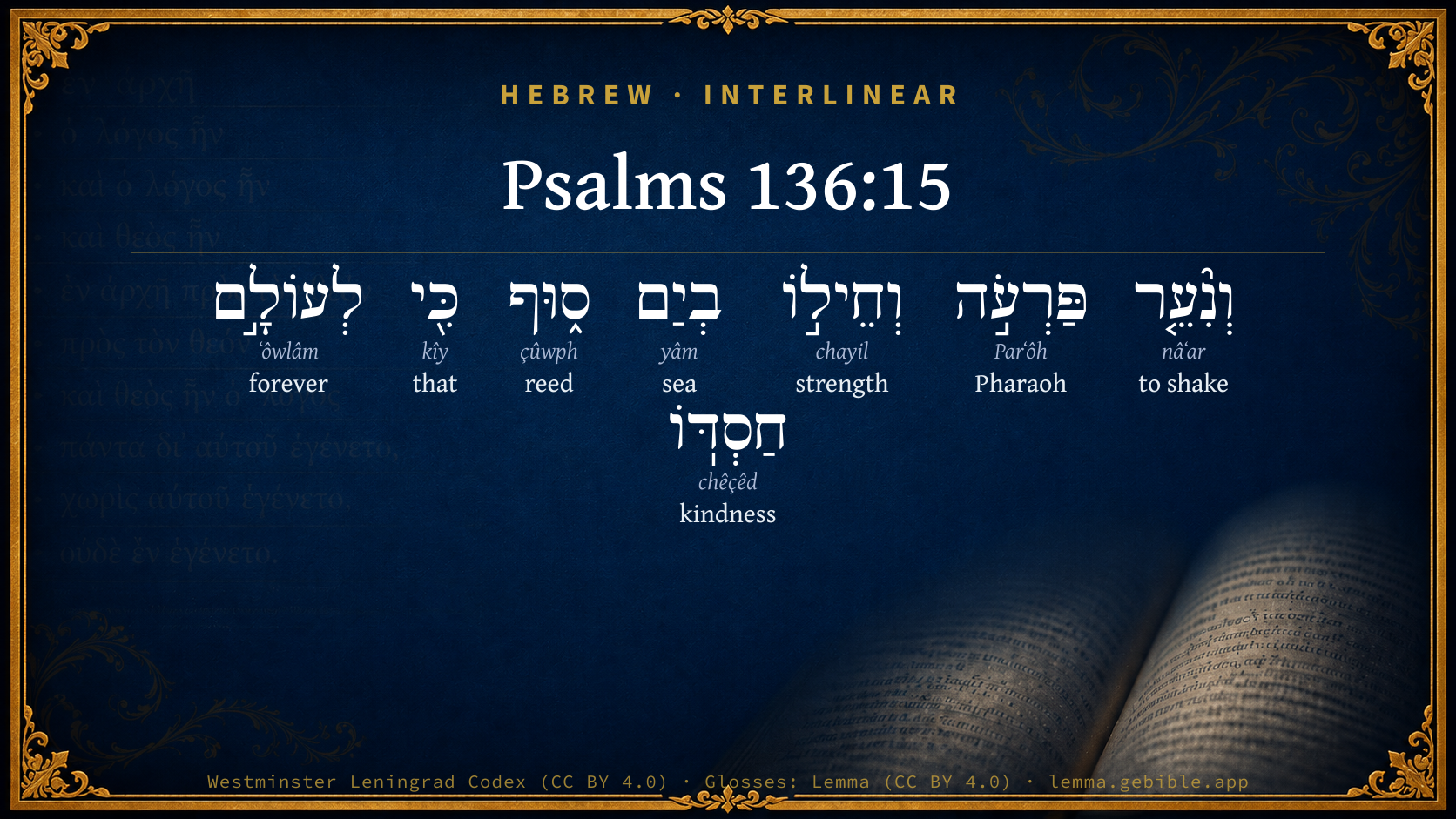
Psalms 136:15

Hebrew (Westminster Leningrad Codex) Psalms 136:15 appears in the Hebrew Old Testament. The text above is from the Westminster Leningrad Codex. Each word links to its Strong’s number, a concise gloss, and parsing drawn from the Open Scriptures Hebrew Bible morphology. Click any word for its full Brown-Driver-Briggs (BDB) entry.
Download image
Cite this verse

Psalms 136:15 (World English Bible). Public Domain. Lemma interlinear Bible study tool, https://lemma.gebible.app/v/psalms/136/15.

Show BibTeX & RIS
BibTeX
RIS
English Translation
But overthrew Pharaoh and his host in the Red Sea; For his loving kindness endures forever:
World English Bible · Public Domain
Download a study sheet

One document with this verse’s original text, its word-by-word gloss line, the meaning frame, cross-references with their text, attributed commentary, and full source and license credits — printable, and it pastes into notes with its structure intact.

This verse Autodidact and up

Study sheet (.html) Plain text (.txt)

A passage Seminary Student

Up to 50 verses in one chapter. A passage sheet keeps up to 6 commentary sources and 12 cross-references per verse, in the order this page ranks them, and says so on the sheet whenever that leaves anything out. Ask for a single verse and you get the Autodidact verse sheet above.

Everything on this page stays free to read, with no account — the sheet is a download of what is already on screen, not access to it.

Want to remove ads? Support Godless Engineer
Compare translations 3

The same verse in 3 English versions, stacked beneath the original-language interlinear above. Click any original word for its lexicon entry.

Each is an independent rendering of the whole verse — the interlinear is not word-aligned to these translations.

Highlighted words mark where these versions differ — a whole-verse word diff, not a word-by-word alignment.

  • World English Bible Public Domain
    But overthrew Pharaoh and his host in the Red Sea; For his loving kindness endures forever:
  • King James Version Public Domain
    But overthrew Pharaoh and his host in the Red sea: for his mercy endureth for ever.
  • unfoldingWord Literal Text CC BY-SA 4.0
    And he tossed Pharaoh and his army into the Sea of Reeds, for his covenant faithfulness to forever.

unfoldingWord Literal Text — © unfoldingWord, licensed CC BY-SA 4.0. Word-aligned USFM3 via Door43 (git.door43.org/unfoldingWord/en_ult).

Versions to compare (up to 4)

3 of 4 selected

Show all 18 translations

Every available English version of this verse, each an independent rendering of the whole verse.

  • World English Bible Public Domain
    But overthrew Pharaoh and his host in the Red Sea; For his loving kindness endures forever:
  • Berean Standard Bible Public Domain
    but swept Pharaoh and his army into the Red Sea. His loving devotion endures forever.
  • Majority Standard Bible Public Domain
    but swept Pharaoh and his army into the Red Sea. His loving devotion endures forever.
  • King James Version Public Domain
    But overthrew Pharaoh and his host in the Red sea: for his mercy endureth for ever.
  • American Standard Version (1901) Public Domain
    But overthrew Pharaoh and his host in the Red Sea; For his lovingkindness `endureth' for ever:
  • Revised Version (1885) Public Domain
    But overthrew Pharaoh and his host in the Red Sea: for his mercy endureth for ever.
  • Geneva Bible (1599) Public Domain
    And ouerthrewe Pharaoh and his hoste in the red Sea: for his mercie endureth for euer:
  • Douay-Rheims (1899) Public Domain
    The idols of the Gentiles are silver and gold, the works of men's hands.
  • Young's Literal Translation Public Domain
    And shook out Pharaoh and his force in the sea of Suph, For to the age `is' His kindness.
  • Literal Standard Version CC BY-SA 4.0
    And shook out Pharaoh and his force in the Sea of Suph, || For His kindness [is] for all time.
  • Unlocked Literal Bible CC BY-SA 4.0
    but overthrew Pharaoh and his army in the Sea of Reeds, for his covenant faithfulness endures forever.
  • unfoldingWord Literal Text CC BY-SA 4.0
    And he tossed Pharaoh and his army into the Sea of Reeds, for his covenant faithfulness to forever.
  • Darby Bible Public Domain
    And overturned Pharaoh and his host in the Red sea, for his loving-kindness [endureth] for ever;
  • World Messianic Bible Public Domain
    but overthrew Pharaoh and his army in the Sea of Suf, for his loving kindness endures forever;
  • Webster's Bible Public Domain
    But overthrew Pharaoh and his army in the Red sea: for his mercy endureth for ever.
  • Free Bible Version CC BY-SA 4.0
    But threw Pharaoh and his army into the Red Sea. For his trustworthy love lasts forever.
  • Bible in Basic English Public Domain
    By him Pharaoh and his army were overturned in the Red Sea: for his mercy is unchanging for ever.
  • JPS Tanakh (1917) Public Domain
    But overthrew Pharaoh and his host in the Red Sea, for His mercy endureth for ever.

Literal Standard Version (2020), Covenant Press — licensed CC BY-SA 4.0. Text via the HelloAO Bible API (eBible.org). Unlocked Literal Bible (unfoldingWord) — licensed CC BY-SA 4.0. Text via the HelloAO Bible API (eBible.org). unfoldingWord Literal Text — © unfoldingWord, licensed CC BY-SA 4.0. Word-aligned USFM3 via Door43 (git.door43.org/unfoldingWord/en_ult). Free Bible Version, Dr. Jonathan Gallagher — licensed CC BY-SA 4.0. Text via the HelloAO Bible API (eBible.org).

Word by word

More ways to search: Search by grammar → Find every occurrence → Compare this word →

Practice this passage: Drill this verse → Learn its vocabulary →

וְנִ֘עֵ֤ר
nâʻar
H5287
“and · to shake”
Conjunction + Verb, Piel, Perfect, 3rd Person, Masculine, Singular
Part of Speech
Conjunction + Verb
Stem
Piel
Form
Perfect
Person
3rd Person
Gender
Masculine
Number
Singular
Full BDB Definition

Origin: a primitive root [probably identical with H5286 , through the idea of the rustling of mane, which usually accompanies the lion's roar]

TWOT: 1388

to shake, shake out or off - (Qal) to shake out, show emptiness - (Niphal) - to be shaken - to shake oneself - (Piel) to shake off or out - (Hithpael) to shake oneself
  1. פַּרְעֹ֣ה Parʻôh H6547 “Pharaoh” Noun, Proper
  2. וְחֵיל֣וֹ chayil H2428 “and · strength · his” Conjunction + Noun, Common, Masculine, Singular, Construct + Suffix, Personal, 3rd Person, Masculine, Singular
  3. בְיַם yâm H3220 “in/at · sea of” Preposition + Noun, Common, Masculine, Singular, Construct
  4. ס֑וּף çûwph H5488 “reed” Noun, Common, Masculine, Singular, Absolute
  5. כִּ֖י kîy H3588 “that” Conjunction
  6. לְעוֹלָ֣ם ʻôwlâm H5769 “to/for · forever” Preposition + Noun, Common, Masculine, Singular, Absolute
  7. חַסְדּֽוֹ chêçêd H2617 “kindness · his” Noun, Common, Masculine, Singular, Construct + Suffix, Personal, 3rd Person, Masculine, Singular

About this verse

These counts appear in no published source. They are computed here, from the morphology-tagged text and Lemma’s own curated glosses. What Lemma adds →

8
words
8
distinct lemmas
Wisdom
section

Notable vocabulary

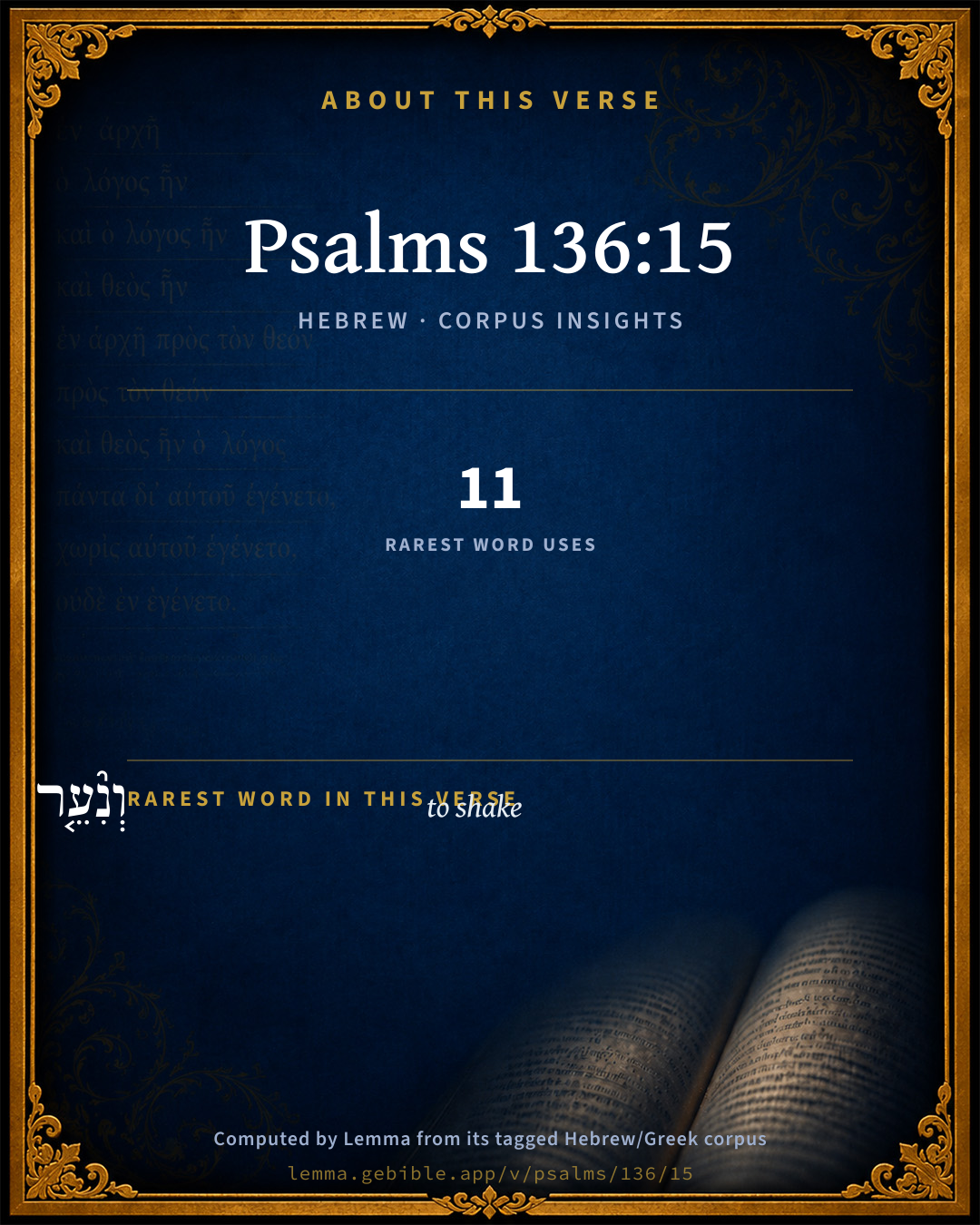
The rarest word here is וְנִ֘עֵ֤ר to shake H5287 — appearing just 11 times in the whole Hebrew Bible.

Shared distinctive vocabulary

וְנִ֘עֵ֤ר to shake H5287 occurs in 9 verses of the Hebrew Bible. Also found in:

Grammatical profile

  • 1 verb
  • 6 nouns
  • 1 conjunction

Verb forms

  • וְנִ֘עֵ֤ר Piel · Perfect

Hebrew & Septuagint length

In English translation the verse runs 16 words from the Hebrew and 16 from the Septuagint (LXX English) — the same length.

A rough comparison of the two English renderings, which tokenize alike — not a word-level alignment.

Word counts can differ between the Hebrew and the Greek without any difference in meaning — e.g. the Hebrew direct-object marker אֵת has no separate Greek word, and Greek often adds the article ὁ.

Cross-references

10

Topical passages linked to Psalms 136:15 in the Treasury of Scripture Knowledge — connected by theme and wording, ordered by reader-vote popularity; previews shown in the World English Bible.

  • Psalms 78:53 He led them safely, so that they weren't afraid, But the sea overwhelmed their enemies.
  • Nehemiah 9:10–11 and shown signs and wonders on Pharaoh, and on all his servants, and on all the people of his land; for you knew that they dealt proudly against them, and did get you a name, as it is this day.
  • Psalms 135:9 Who sent signs and wonders into the midst of you, Egypt, On Pharaoh, and on all his servants;
  • Exodus 14:27–28 Moses stretched out his hand over the sea, and the sea returned to its strength when the morning appeared; and the Egyptians fled against it. Yahweh overthrew the Egyptians in the midst of the sea.
  • Exodus 15:4–5 Pharaoh's chariots and his host has he cast into the sea; His chosen captains are sunk in the Red Sea.
  • Exodus 15:10–13 You blew with your wind. The sea covered them. They sank like lead in the mighty waters.
  • Psalms 65:5 By awesome deeds of righteousness, you answer us, God of our salvation. You who are the hope of all the ends of the earth, Of those who are far away on the sea;
  • Psalms 79:6–9 Pour out your wrath on the nations that don't know you; On the kingdoms that don't call on your name;
  • Psalms 143:12 In your loving kindness, cut off my enemies, And destroy all those who afflict my soul, For I am your servant.
  • Luke 1:71–74 Salvation from our enemies, and from the hand of all who hate us;

Cross-references courtesy of OpenBible.info (CC BY 4.0).

Hebrew and Greek witnesses Masoretic Hebrew ↔ Greek Septuagint

The same verse in the two great witnesses to the Old Testament, shown verse-for-verse.

You’re reading Greek Psalm 135 (Hebrew Psalm 136). The Septuagint counts the superscription, so verse numbers can differ from the Hebrew — chapter-level alignment, not verse-by-verse. Numbering follows Rahlfs.

These are two independent witnesses, not word-aligned to each other, and the Septuagint is shown in lemma (dictionary) form.

Hebrew Psalms 136:15 Masoretic · Westminster Leningrad Codex

וְנִ֘עֵ֤ר פַּרְעֹ֣ה וְחֵיל֣וֹ בְיַם ס֑וּף כִּ֖י לְעוֹלָ֣ם חַסְדּֽוֹ

But overthrew Pharaoh and his host in the Red Sea; For his loving kindness endures forever:

World English Bible · Public Domain

Greek LXX Greek Psalm 135:15 Septuagint · lemma form

καί ἐκτινάσσω φαραώ καί ὁ δύναμις αὐτός εἰς θάλασσα ἐρυθρός ὅτι εἰς ὁ αἰών ὁ ἔλεος αὐτός

and overthrew Pharao and his host in the Red Sea: for his mercy endures for ever.

LXX2012 (modern English Septuagint) · Public Domain

Hebrew: Westminster Leningrad Codex (CC BY 4.0). Greek: Septuagint (public domain); English from LXX2012 (modern English Septuagint) (Public Domain). How the Septuagint differs from the Hebrew →

Commentary

Notes on Psalms 136:15 from classic Christian and Jewish commentators (each source and its license shown beneath its notes). The classic Christian expositions comment on the surrounding passage and are grouped to its opening verse, so a note may address several verses; the Jewish commentaries on the Tanakh (Rashi and others) are per-verse, so they appear only where the commentator wrote on this verse.

Lemma curates 59 commentaries, every one of them public domain or Creative Commons licensed, each selected and text-cleaned for this edition rather than reprinted as found. About our sources →

Trapp's Complete Commentary

John Trapp

Psa 136:15 But overthrew Pharaoh and his host in the Red sea: for his mercy [endureth] for ever.

Ver. 15. But overthrew Pharaoh] Praecipitavit, pitched him in headlong; having before paved a way for him. Subito tollitur qui diu toleratur.

John Trapp, A Commentary or Exposition upon All the Books of the Old and New Testament (1647–1656) — public domain. Text from a community e-Sword module.

J. A. Alexander on Psalms

Joseph Addison Alexander

15. (Psa 136:15) And cast Pharaoh and his host into the Bed Sea--for unto eternity (is) his mercy. The first verb strictly means knocked off or shook off, and is borrowed from Exo 14:27. A passive form of it occurs above, Psa 109:23.

Joseph Addison Alexander, The Psalms Translated and Explained (1850) — public domain. Text from a community e-Sword module.

The Cambridge Bible for Schools and Colleges

gen. ed. J. J. S. Perowne

15. And he hath lifted up a horn for his people, a praise for all his beloved, even the children of Israel, a people near unto him. Hallelujah, (Psa_148:14).

If this hymn was composed by Ben Sira, it proves that he was familiar with Psalms, some of which have been regarded as among the latest in the Psalter, and it affords a strong presumption that the Psalter was complete before b.c. 180. The hymn, it is true, is not found in the Versions, but Dr Schechter thinks that its authenticity is established, and that its omission is accounted for, by the prominence which it gives to the house of Zadok. It was natural for Ben Sira, who knew that family in its best representative, Simon the Just, to give thanks for its election to the priesthood: it was equally natural for his grandson the translator to omit such a thanksgiving, when the high-priests of the house of Zadok had disgraced their calling, and the house of Zadok had been superseded by the Maccabaean line. See Schechter and Taylor’s Wisdom of Ben Sira (1899), p. 35.

15. overthrew] Lit. shook off, as Exo_14:27.

The Cambridge Bible for Schools and Colleges (gen. ed. J. J. S. Perowne; Cambridge University Press, 1878–1918) — public domain. Text from a community e-Sword module.

John Gill's Exposition

But overthrew Pharaoh and his host in the Red sea,.... In the same sea which was parted for the Israelites, and through which they passed safely as on dry land; into which Pharaoh and his army entering in pursuit of them in their chariots, the Lord "shook" (u) him and them out of them, as the word signifies; and causing the waters to return and cover them; they were drowned in them, Exo 14:28. This was an emblem of the destruction of Satan, and of his principalities and powers, by Christ, who thereby has saved his spiritual Israel out of their hands; and of the casting of the sins of God's people into the depths of the sea, never to be seen more, or to appear any more against them to their condemnation; and of the everlasting ruin and perdition of ungodly men;

for his mercy endureth for ever; it was in mercy to Israel that Pharaoh and his host were destroyed, who threatened them with ruin; and therefore they sung of judgment and of mercy, and gave thanks to God for this instance of his vengeance on their enemies, and of goodness to them, Exo 15:1.

(u) "excussit", V. L. Pagninus, Montanus, Junius & Tremellius, Piscator, &c.

John Gill's Exposition of the Whole Bible (1746–1763) — public domain (CC PDM 1.0). Text via the HelloAO Bible API.

Albert Barnes' Notes on the Bible

But overthrew Pharaoh and his host in the Red sea - Margin, as in Hebrew, shaked off. The word is applicable to a tree shaking off its foliage. Isa 33:9. The same word is used in Exo 14:27 : “And the Lord overthrew (Margin, shook off) the Egyptians in the midst of the sea,” He shook them off as if he would no longer protect them. He left them to perish.

For his mercy ... - Their destruction was done in mercy to his people and to the world, for it was the means of deliverance to Israel. The death of a wicked man is a benefit to the world, and the act of removing him may be really an act of the highest benevolence to mankind. No wrong is done to such people, for they deserve to die; and the only service which can be rendered to the world through them is by their removal from the earth.

Albert Barnes' Notes on the Bible (1834–1885) — public domain. Text from a community e-Sword/MySword module.

The Treasury of David

Charles H. Spurgeon

Ver. 15. But overthrew Pharaoh and his host in the Red sea. Here comes the thunder clap. Though we hear them sounding peal upon peal, yet the judgments of the Lord were only loud mouthed mercies speaking confusion to the foe, that the chosen might tremble before him no longer. The chariots were thrown over, the horses were overthrown. The King and his warriors were alike overwhelmed; they were hurled from their chariots as locusts are tossed to and fro in the wind. Broken was the power and conquered was the pride of Egypt. Jehovah had vanquished the enemy. "Art thou not it which cut Rahab and wounded crocodile?" None are too great for the Lord to subdue, none too high for Lord to abase. The enemy in his fury drove after Israel into the sea, but his wrath found a terrible recompense beneath the waves.

For his mercy endureth for ever. Yes, mercy continued to protect its children, and therefore called in the aid of justice to fulfil the capital sentence on their foes. Taken red handed, in the very act of rebellion against their sovereign Lord, the adversaries met the fate which they had themselves invited. He that goes into the midst of the sea asks to be drowned. Sin is self damnation. The sinner goes downward of his own choice, and if he finds out too late that he return, is not his blood upon his own head? The finally impenitent, terrible their doom, will not be witnesses against mercy; but rather this shall aggravate their misery, that they went on in defiance of mercy, and would yield themselves to him whose mercy endureth for ever. To the Israelites as they sung this song their one thought would be of the rescue of their fathers from fierce oppressor. Taken like a lamb from between the teeth of the lion, justly praises her Deliverer and chants aloud:

Evermore his love shall reign;

Pharaoh and his host are slain.

Ver. 15. But overthrew Pharaoh, etc. Thus fell Sethos the Second. It was his terrible destiny to leave to after times the strongest exemplification of daring wickedness and mad impiety in his life, and of the vengeance of God in his death, that ever was enacted on the earth. Never had such a judgment befallen any nation, as his reign in Egypt. Accordingly the memory of this fearful event has never departed from among men. The gulf in which he perished is named Bahr Kolzoum, "the sea of destruction", to this day.

The memory and name of Sethos the Second were infamous in Egypt. His tomb was desecrated, and his sarcophagus publicly and judicially broken. The vault seems to have been used as a burying place for slaves. The distinctive title of his name, Sethos, has been mutilated on all the monuments of Egypt. In Lower Egypt the mutilation has even been extended to the same title in the rings of his great grandfather (Sethos the First), such was the deep abhorrence in which the name had fallen, after it had been borne by this wicked king. His is the only one in the whole range of the kings of Egypt which has suffered this mark of public infamy. William Osburn.

Ver. 15. But overthrew Pharaoh, etc. Margin, as in Hebrew, shaked off. The word is applicable to a tree shaking off its foliage, Isa 33:9. The same word is used in Ex 14:27: "And the Lord overthrew (Margin, shook off) the Egyptians in the midst of the sea." He shook them off as if he would no longer protect them. He left them to perish. Albert Barnes.

Ver. 15. But shook off Pharaoh. This translation gives an image of locusts. They fell into the sea like a swarm of locusts. Zachary Mudge, 1769.

Ver. 15. But overthrew Pharaoh, etc. I know that the Gospel is a book of mercy; I know likewise that in the prophets there are many expressions of mercy; I know likewise that in the ten commandments, which are the ministration of death, there is made express mention of mercy, "I will have mercy on thousands": yet, notwithstanding all this, if every leaf, and every line, and every word in the Bible were nothing but mercy, it would nothing avail the presumptuous sinner. Our God is not an impotent God with one arm; but as he is slow to anger, so is he great in power. And therefore though in this Psalm there is nothing but his mercy endureth for ever, which is twenty-six times in twenty-six verses: yet mark what a rattling thunder clap is here in this verse. In our addresses therefore unto God, let us so look upon him as a just God, as well as a merciful; and not either despair of or presume upon his mercy. Abraham Wright.

Ver. 15. Final victory.

1. Battalions of evil annihilated.

2. Love unharmed mounting immortal above the wave: "for his mercy endureth for ever."

3. Heaven resonant with the song of Moses and the Lamb, to him give thanks. W.B.H.

Psalms 136:16*

Charles H. Spurgeon's The Treasury of David (1869–1885) — public domain. Psalms only. Text from a community e-Sword/MySword module.

The Pulpit Commentary

But overthrew Pharaoh and his host in the Red Sea. (see Exo_14:27, 28 15:1-10) That the Pharaoh"s death in the Red Sea is not necessarily implied has been shown in the comment on Exodus. For his mercy, etc. Severity to their adversaries was "mercy" to Israel, who could not otherwise have been delivered.

The Pulpit Commentary (1880–1919), ed. H.D.M. Spence-Jones & Joseph S. Exell — public domain. Text from a community e-Sword module.

Lesson kit

Teaching starters — assembled from the data on this page, not authored interpretation. Every prompt links to the verse data it draws on. Edit before teaching.

Psalms, in the Wisdom, opens this verse with 8 words (8 distinct Hebrew lemmas). Its most distinctive word is nâʻar (“to shake”). A historical commentator’s framing appears above. Read the whole chapter for the surrounding context.

Discussion questions

  1. What does “to shake” (nâʻar) contribute to the verse as a whole?
  2. Exodus 14:27 shares the word «to shake» with this verse. How do the two illuminate each other?
  3. These translations render this verse differently; the difference is in the English rendering, not the original. What questions does that raise?
  4. The verb «וְנִ֘עֵ֤ר» is Piel Perfect. How does its form color the action?
  5. Reading how Trapp's Complete Commentary and J. A. Alexander on Psalms read this verse, where do the two commentators agree and where do they part?

Things to notice

Reading settings

Reading text

Shown beneath each verse's original-language words.

Old Testament
Old Testament edition

Read the OT as the Masoretic Hebrew (MT) or the Greek Septuagint (LXX).

English shown for the Greek Septuagint (in the Hebrew ↔ Greek comparison).

Comparing translations? Open the Compare panel on any verse page to stack up to four side by side.