Exodus 27:12

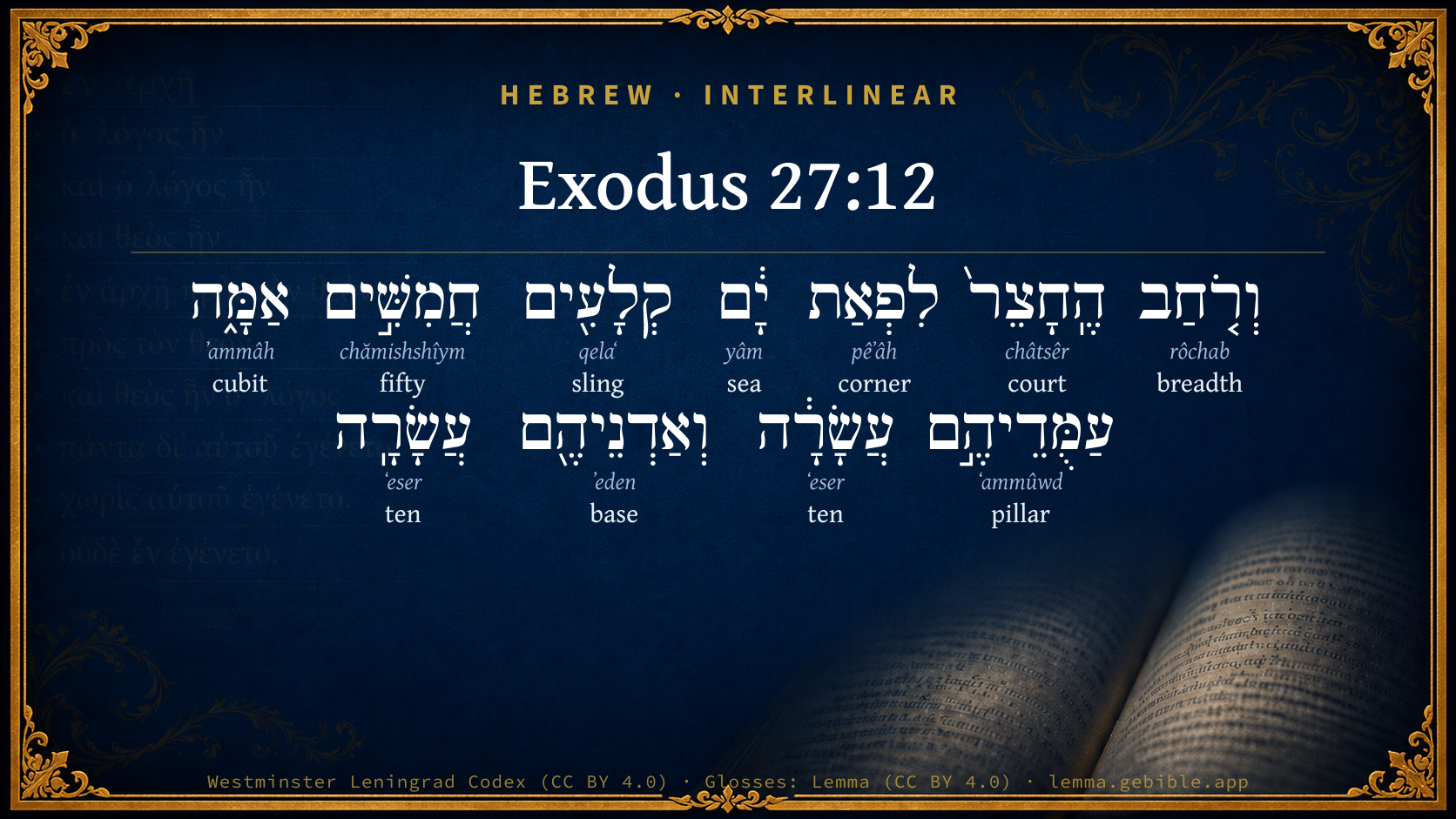
Hebrew (Westminster Leningrad Codex) Exodus 27:12 appears in the Hebrew Old Testament. The text above is from the Westminster Leningrad Codex. Each word links to its Strong’s number, a concise gloss, and parsing drawn from the Open Scriptures Hebrew Bible morphology. Click any word for its full Brown-Driver-Briggs (BDB) entry.
Download image
Cite this verse

Exodus 27:12 (World English Bible). Public Domain. Lemma interlinear Bible study tool, https://lemma.gebible.app/v/exodus/27/12.

Show BibTeX & RIS
BibTeX
RIS
English Translation
For the breadth of the court on the west side shall be hangings of fifty cubits; their pillars ten, and their sockets ten.
World English Bible · Public Domain
Download a study sheet

One document with this verse’s original text, its word-by-word gloss line, the meaning frame, cross-references with their text, attributed commentary, and full source and license credits — printable, and it pastes into notes with its structure intact.

This verse Autodidact and up

Study sheet (.html) Plain text (.txt)

A passage Seminary Student

Up to 50 verses in one chapter. A passage sheet keeps up to 6 commentary sources and 12 cross-references per verse, in the order this page ranks them, and says so on the sheet whenever that leaves anything out. Ask for a single verse and you get the Autodidact verse sheet above.

Everything on this page stays free to read, with no account — the sheet is a download of what is already on screen, not access to it.

Want to remove ads? Support Godless Engineer
Compare translations 3

The same verse in 3 English versions, stacked beneath the original-language interlinear above. Click any original word for its lexicon entry.

Each is an independent rendering of the whole verse — the interlinear is not word-aligned to these translations.

Highlighted words mark where these versions differ — a whole-verse word diff, not a word-by-word alignment.

  • World English Bible Public Domain
    For the breadth of the court on the west side shall be hangings of fifty cubits; their pillars ten, and their sockets ten.
  • King James Version Public Domain
    And for the breadth of the court on the west side shall be hangings of fifty cubits: their pillars ten, and their sockets ten.
  • unfoldingWord Literal Text CC BY-SA 4.0
    And the width of the courtyard, on the west side, shall have a curtain 50 cubits long with its ten pillars and ten bases.

unfoldingWord Literal Text — © unfoldingWord, licensed CC BY-SA 4.0. Word-aligned USFM3 via Door43 (git.door43.org/unfoldingWord/en_ult).

Versions to compare (up to 4)

3 of 4 selected

Show all 18 translations

Every available English version of this verse, each an independent rendering of the whole verse.

  • World English Bible Public Domain
    For the breadth of the court on the west side shall be hangings of fifty cubits; their pillars ten, and their sockets ten.
  • Berean Standard Bible Public Domain
    The curtains on the west side of the courtyard shall be fifty cubits wide, with ten posts and ten bases.
  • Majority Standard Bible Public Domain
    The curtains on the west side of the courtyard shall be fifty cubits wide, with ten posts and ten bases.
  • King James Version Public Domain
    And for the breadth of the court on the west side shall be hangings of fifty cubits: their pillars ten, and their sockets ten.
  • American Standard Version (1901) Public Domain
    And for the breadth of the court on the west side shall be hangings of fifty cubits; their pillars ten, and their sockets ten.
  • Revised Version (1885) Public Domain
    And for the breadth of the court on the west side shall be hangings of fifty cubits: their pillars ten, and their sockets ten.
  • Geneva Bible (1599) Public Domain
    And the breadth of the court on the Westside shall haue curtaines of fiftie cubites, with their ten pillars and their ten sockets.
  • Douay-Rheims (1899) Public Domain
    But in the breadth of the court, that looketh to the west, there shall be hangings of fifty cubits, and ten pillars, and as many sockets.
  • Young's Literal Translation Public Domain
    `And `for' the breadth of the court at the west side `are' hangings of fifty cubits, their pillars ten, and their sockets ten.
  • Literal Standard Version CC BY-SA 4.0
    And [for] the breadth of the court at the west side [are] hangings of fifty cubits, their pillars ten, and their sockets ten.
  • Unlocked Literal Bible CC BY-SA 4.0
    Along the courtyard on the west side there must be a curtain fifty cubits long. There must be ten posts and ten bases.
  • unfoldingWord Literal Text CC BY-SA 4.0
    And the width of the courtyard, on the west side, shall have a curtain 50 cubits long with its ten pillars and ten bases.
  • Darby Bible Public Domain
    -- And the breadth of the court on the west side, hangings of fifty cubits; their pillars ten, and their bases ten.
  • World Messianic Bible Public Domain
    For the width of the court on the west side shall be hangings of fifty cubits; their pillars ten, and their sockets ten.
  • Webster's Bible Public Domain
    And for the breadth of the court on the west side shall be hangings of fifty cubits: their pillars ten, and their sockets ten.
  • Free Bible Version CC BY-SA 4.0
    The curtains for the west side of the courtyard are to be fifty cubits wide, with ten posts and ten stands.
  • Bible in Basic English Public Domain
    And for the open space on the west side, the hangings are to be fifty cubits wide, with ten pillars and ten bases;
  • JPS Tanakh (1917) Public Domain
    And for the breadth of the court on the west side shall be hangings of fifty cubits: their pillars ten, and their sockets ten.

Literal Standard Version (2020), Covenant Press — licensed CC BY-SA 4.0. Text via the HelloAO Bible API (eBible.org). Unlocked Literal Bible (unfoldingWord) — licensed CC BY-SA 4.0. Text via the HelloAO Bible API (eBible.org). unfoldingWord Literal Text — © unfoldingWord, licensed CC BY-SA 4.0. Word-aligned USFM3 via Door43 (git.door43.org/unfoldingWord/en_ult). Free Bible Version, Dr. Jonathan Gallagher — licensed CC BY-SA 4.0. Text via the HelloAO Bible API (eBible.org).

Word by word

More ways to search: Search by grammar → Find every occurrence → Compare this word →

Practice this passage: Drill this verse → Learn its vocabulary →

קְלָעִ֖ים
qelaʻ
H7050
“slings”
Noun, Common, Masculine, Plural, Absolute
Part of Speech
Noun
Type
Common
Gender
Masculine
Number
Plural
State
Absolute
Full BDB Definition

Origin: from H7049

TWOT: 2030a , 2030c

sling, slingstones - curtain, drape, hanging
  1. וְרֹ֤חַב rôchab H7341 “and · breadth of” Conjunction + Noun, Common, Masculine, Singular, Construct
  2. הֶֽחָצֵר֙ châtsêr H2691 “the · court” Particle, Definite Article + Noun, Common, Both, Singular, Absolute
  3. לִפְאַת pêʼâh H6285 “to/for · corner of” Preposition + Noun, Common, Feminine, Singular, Construct
  4. יָ֔ם yâm H3220 “sea” Noun, Common, Masculine, Singular, Absolute
  5. חֲמִשִּׁ֣ים chămishshîym H2572 “fifty” Adjective, Cardinal number, Both, Plural, Absolute
  6. אַמָּ֑ה ʼammâh H520 “cubit” Noun, Common, Feminine, Singular, Absolute
  7. עַמֻּדֵיהֶ֣ם ʻammûwd H5982 “pillars · their” Noun, Common, Masculine, Plural, Construct + Suffix, Personal, 3rd Person, Masculine, Plural
  8. עֲשָׂרָ֔ה ʻeser H6235 “ten” Adjective, Cardinal number, Masculine, Singular, Absolute
  9. וְאַדְנֵיהֶ֖ם ʼeden H134 “and · bases · their” Conjunction + Noun, Common, Masculine, Plural, Construct + Suffix, Personal, 3rd Person, Masculine, Plural
  10. עֲשָׂרָֽה ʻeser H6235 “ten” Adjective, Cardinal number, Masculine, Singular, Absolute

About this verse

These counts appear in no published source. They are computed here, from the morphology-tagged text and Lemma’s own curated glosses. What Lemma adds →

11
words
10
distinct lemmas
Pentateuch
section

Notable vocabulary

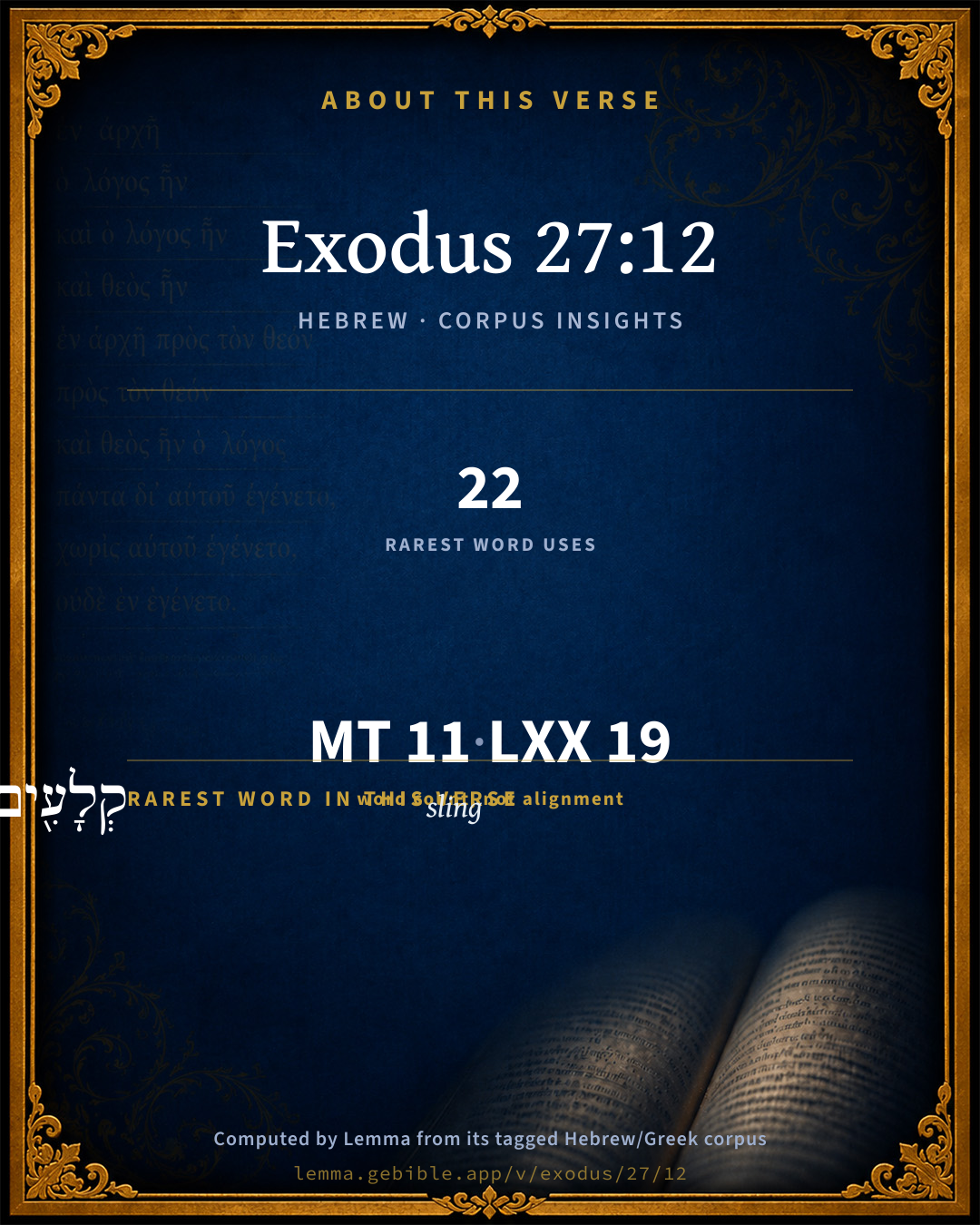
The rarest word here is קְלָעִ֖ים sling H7050 — appearing just 22 times in the whole Hebrew Bible.

Shared distinctive vocabulary

קְלָעִ֖ים sling H7050 occurs in 22 verses of the Hebrew Bible. Also found in:

Grammatical profile

  • 8 nouns
  • 3 adjectives

Repetition

A word recurs within this verse — often emphatic in Hebrew:

  • עֲשָׂרָ֔ה ten H6235 ×2

Hebrew & Septuagint length

In English translation the verse runs 23 words from the Hebrew and 21 from the Septuagint (LXX English) — closely comparable.

A rough comparison of the two English renderings, which tokenize alike — not a word-level alignment.

Word counts can differ between the Hebrew and the Greek without any difference in meaning — e.g. the Hebrew direct-object marker אֵת has no separate Greek word, and Greek often adds the article ὁ.

In the original languages it is 11 Hebrew tokens and 19 Greek tokens — but the two are counted differently (Hebrew bundles its prefixes and suffixes into one token; the Greek is in lemma form), so that isn’t a like-for-like length.

Hebrew and Greek witnesses Masoretic Hebrew ↔ Greek Septuagint

The same verse in the two great witnesses to the Old Testament, shown verse-for-verse.

These are two independent witnesses, not word-aligned to each other, and the Septuagint is shown in lemma (dictionary) form.

Hebrew Exodus 27:12 Masoretic · Westminster Leningrad Codex

וְרֹ֤חַב הֶֽחָצֵר֙ לִפְאַת יָ֔ם קְלָעִ֖ים חֲמִשִּׁ֣ים אַמָּ֑ה עַמֻּדֵיהֶ֣ם עֲשָׂרָ֔ה וְאַדְנֵיהֶ֖ם עֲשָׂרָֽה

For the breadth of the court on the west side shall be hangings of fifty cubits; their pillars ten, and their sockets ten.

World English Bible · Public Domain

Greek LXX Exodus 27:12 Septuagint · lemma form

ὁ δέ εὖρος ὁ αὐλή ὁ κατά θάλασσα ἱστίον πεντήκοντα πῆχυς στῦλος αὐτός δέκα καί ὁ βάσις αὐτός δέκα

And in the breadth of the tabernacle toward the west curtains of fifty cubits, their pillars ten and their sockets ten.

LXX2012 (modern English Septuagint) · Public Domain

Hebrew: Westminster Leningrad Codex (CC BY 4.0). Greek: Septuagint (public domain); English from LXX2012 (modern English Septuagint) (Public Domain). How the Septuagint differs from the Hebrew →

Targum (Aramaic paraphrase)

2

The Targum is the ancient Jewish Aramaic paraphrase of the Hebrew Scriptures — an interpretive translation, not the Hebrew text itself. Onkelos (literal) and Pseudo-Jonathan (expansive) render the Torah, and Jonathan the Prophets. Coverage is partial: where no permissively-licensed English translation exists for a verse, only the Aramaic is shown. This is verse-level text, not a word-by-word alignment to the Hebrew.

  1. Targum Onkelos Torah (Genesis–Deuteronomy)
    וּפוּתְיָא דְדַרְתָּא לְרוּחַ מַעַרְבָא סְרָדִין חַמְשִׁין אַמִין עַמוּדֵיהוֹן עַשְׂרָא וְסַמְכֵיהוֹן עַשְׂרָא:

    (no public-domain English translation for this verse)

    Targum Onkelos — Aramaic: “Onkelos Genesis” (public domain); “Onkelos Exodus” (public domain); “Onkelos Leviticus” (public domain); “Onkelos Numbers” (public domain); “Onkelos Deuteronomy” (public domain). English: “Sefaria Community Translation” (CC0 1.0 (public-domain dedication)); “J.W. Etheridge. The Targums of Onkelos and Jonathan Ben Uzziel on the Pentateuch. London: Longmans, Green, 1862” (public domain). Text via Sefaria.

  2. Targum Pseudo-Jonathan Torah (Genesis–Deuteronomy)
    וּפוּתְיָא דְדַרְתָּא לְרוּחַ מַעַרְבָא וִילַוָון חַמְשִׁין אַמִּין עַמּוּדֵיהוֹן עַשְרָא וְחוּמְרֵיהוֹן עַשְרָא

    And for the breadth of the court on the western side, the hangings shall be fifty cubits; their columns ten and their foundations ten.

    Targum Pseudo-Jonathan — Aramaic: “Targum Jonathan on Genesis” (public domain); “Targum Jonathan on Exodus” (public domain); “Targum Jonathan on Leviticus” (public domain); “Targum Jonathan on Numbers” (public domain); “Targum Jonathan on Deuteronomy” (public domain). English: “The Targum of Jonathan ben Uzziel, trans. J. W. Etheridge, London, 1862” (public domain). Text via Sefaria.

Commentary

Notes on Exodus 27:12 from classic Christian and Jewish commentators (each source and its license shown beneath its notes). The classic Christian expositions comment on the surrounding passage and are grouped to its opening verse, so a note may address several verses; the Jewish commentaries on the Tanakh (Rashi and others) are per-verse, so they appear only where the commentator wrote on this verse.

Lemma curates 59 commentaries, every one of them public domain or Creative Commons licensed, each selected and text-cleaned for this edition rather than reprinted as found. About our sources →

John Gill's Exposition

And for the breadth of the court, on the west side,.... On the west end, the upper end of the court, near to which reached the holy of holies:

shall be hangings of fifty cubits: or twenty five yards and more, so that the court was but half as broad as it was long:

their pillars ten, and their sockets ten; which was a number proportionate to the hangings, and stood at an equal distance from each other, as the pillars for the sides, at five cubits, or two yards and a half, as commonly computed.

John Gill's Exposition of the Whole Bible (1746–1763) — public domain (CC PDM 1.0). Text via the HelloAO Bible API.

Whedon's Commentary on the Bible

Daniel D. Whedon

12-18. Breadth of the court — The court was one hundred cubits long and fifty broad, (150 x 75 feet,) and its linen fence five cubits high. The gate of the court was twenty cubits wide, and the hangings of this part differed from the rest by being embroidered like that of the door of the tent. Exo_25:36. An outline of the court and the tabernacle, with the altar and laver, is shown in the annexed cut.

Daniel D. Whedon (gen. ed.), Commentary on the Old and New Testaments (1874–1909) — public domain. Text from a community e-Sword module.

The Pulpit Commentary

The west side is also to be similar, except that it is to be half the length, fifty cubits and, therefore, requires only half the number of pillars and sockets.

The Pulpit Commentary (1880–1919), ed. H.D.M. Spence-Jones & Joseph S. Exell — public domain. Text from a community e-Sword module.

Keil & Delitzsch

C. F. Keil & F. Delitzsch

"As for the breadth of the court on the west side, (there shall be) curtains fifty cubits; their pillars twenty; and the breadth of the court towards the front, on the east side, fifty cubits." The front is divided in Exo 27:14-16 into two כּתף, lit., shoulders, i.e., sides or side-pieces, each consisting of 15 cubits of hangings and three pillars with their sockets, and a doorway (שׁער), naturally in the middle, which was covered by a curtain (מסך) formed of the same material as the covering at the entrance to the dwelling, of 20 cubits in length, with four pillars and the same number of sockets. The pillars were therefore equidistant from one another, viz., 5 cubits apart. Their total number was 60 (not 56), which was the number required, at the distance mentioned, to surround a quadrangular space of 100 cubits long and 50 cubits broad.

(Note: Although any one may easily convince himself of the correctness of these numbers by drawing a figure, Knobel has revived Philo's erroneous statement about 56 pillars and the double reckoning of the pillars in the corner. And the statement in Exo 27:14-16, that three pillars were to be made in front to carry the hangings on either side of the door, and four to carry the curtain which covered the entrance, may be easily shown to be correct, notwithstanding the fact that, as every drawing shows, four pillars would be required, and not three only, to carry 15 cubits of hangings, and five (not four) to carry a curtain 20 cubits broad, if the pillars were to be placed 5 cubits apart; for the corner pillars, as belonging to both sides, and the pillars which stood between the hangings and the curtain on either side, could only be reckoned as halves in connection with each side or each post; and in reckoning the number of pillars according to the method adopted in every other case, the pillar from which you start would not be reckoned at all. Now, if you count the pillars of the eastern side upon this principle (starting from a corner pillar, which is not reckoned, because it is the starting-point and is the last pillar of the side wall), you have 1, 2, 3, then 1, 2, 3, 4, and then again 1, 2, 3; that is to say, 3 pillars for each wing and 4 for the curtain, although the hangings of each wing would really be supported by 4 pillars, and the curtain in the middle by 5.)

Keil & Delitzsch — Biblical Commentary on the Old Testament (1861–1891) — public domain (CC PDM 1.0). Text via the HelloAO Bible API. (Old Testament only.)

Lesson kit

Teaching starters — assembled from the data on this page, not authored interpretation. Every prompt links to the verse data it draws on. Edit before teaching.

Exodus, in the Pentateuch, opens this verse with 11 words (10 distinct Hebrew lemmas). Its most distinctive word is qelaʻ (“sling”). A historical commentator’s framing appears above. Read the whole chapter for the surrounding context.

Discussion questions

  1. The word qelaʻ carries the sense “sling.” How does it shape the verse?
  2. Exodus 27:9 shares the word «sling» with this verse. How do the two illuminate each other?
  3. “ten” occurs 2× in this one verse. What is the effect of the repetition?
  4. These translations render this verse differently; the difference is in the English rendering, not the original. What questions does that raise?
  5. Reading how John Gill's Exposition and Whedon's Commentary on the Bible read this verse, where do the two commentators agree and where do they part?

Things to notice

Reading settings

Reading text

Shown beneath each verse's original-language words.

Old Testament
Old Testament edition

Read the OT as the Masoretic Hebrew (MT) or the Greek Septuagint (LXX).

English shown for the Greek Septuagint (in the Hebrew ↔ Greek comparison).

Comparing translations? Open the Compare panel on any verse page to stack up to four side by side.