
1 Kings 18:44

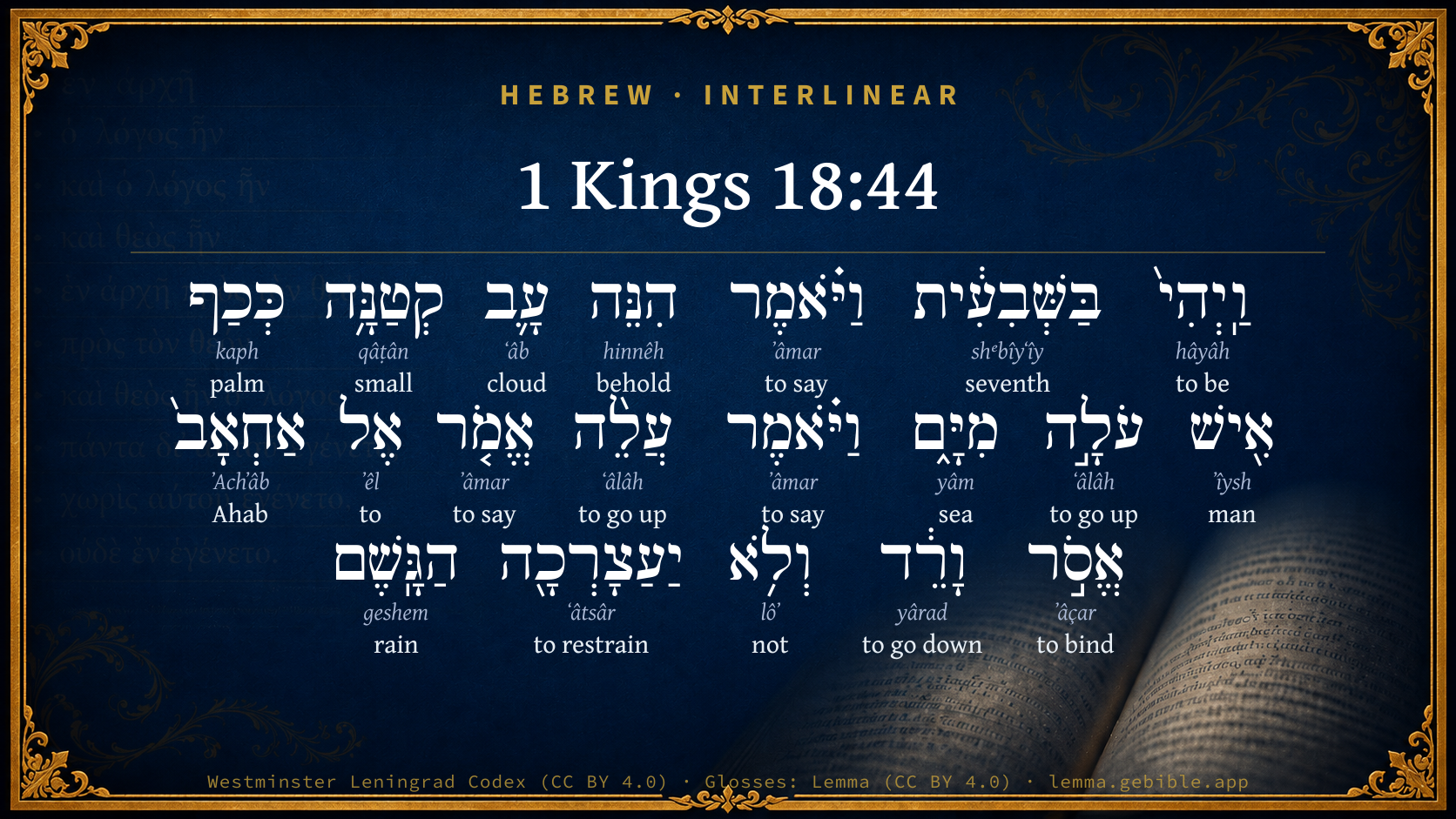
Hebrew (Westminster Leningrad Codex) 1 Kings 18:44 appears in the Hebrew Old Testament. The text above is from the Westminster Leningrad Codex. Each word links to its Strong’s number, a concise gloss, and parsing drawn from the Open Scriptures Hebrew Bible morphology. Click any word for its full Brown-Driver-Briggs (BDB) entry.
Download image
Cite this verse

1 Kings 18:44 (World English Bible). Public Domain. Lemma interlinear Bible study tool, https://lemma.gebible.app/v/1-kings/18/44.

Show BibTeX & RIS
BibTeX
RIS
English Translation
It happened at the seventh time, that he said, "Behold, a small cloud, like a man's hand, is rising out of the sea." He said, Go up, tell Ahab, Make ready [your chariot], and get you down, that the rain not stop you.
World English Bible · Public Domain
Download a study sheet

One document with this verse’s original text, its word-by-word gloss line, the meaning frame, cross-references with their text, attributed commentary, and full source and license credits — printable, and it pastes into notes with its structure intact.

This verse Autodidact and up

Study sheet (.html) Plain text (.txt)

A passage Seminary Student

Up to 50 verses in one chapter. A passage sheet keeps up to 6 commentary sources and 12 cross-references per verse, in the order this page ranks them, and says so on the sheet whenever that leaves anything out. Ask for a single verse and you get the Autodidact verse sheet above.

Everything on this page stays free to read, with no account — the sheet is a download of what is already on screen, not access to it.

Want to remove ads? Support Godless Engineer
Compare translations 3

The same verse in 3 English versions, stacked beneath the original-language interlinear above. Click any original word for its lexicon entry.

Each is an independent rendering of the whole verse — the interlinear is not word-aligned to these translations.

Highlighted words mark where these versions differ — a whole-verse word diff, not a word-by-word alignment.

  • World English Bible Public Domain
    It happened at the seventh time, that he said, "Behold, a small cloud, like a man's hand, is rising out of the sea." He said, Go up, tell Ahab, Make ready [your chariot], and get you down, that the rain not stop you.
  • King James Version Public Domain
    And it came to pass at the seventh time, that he said, Behold, there ariseth a little cloud out of the sea, like a man's hand. And he said, Go up, say unto Ahab, Prepare thy chariot, and get thee down that the rain stop thee not.
  • unfoldingWord Literal Text CC BY-SA 4.0
    And it happened on the seventh time that he said, “Behold, a small cloud like the palm of a man is coming up from the sea.” And he said, “Go up, say to Ahab, ‘Harness and go down so the rain does not stop you.’”

unfoldingWord Literal Text — © unfoldingWord, licensed CC BY-SA 4.0. Word-aligned USFM3 via Door43 (git.door43.org/unfoldingWord/en_ult).

Versions to compare (up to 4)

3 of 4 selected

Show all 18 translations

Every available English version of this verse, each an independent rendering of the whole verse.

  • World English Bible Public Domain
    It happened at the seventh time, that he said, "Behold, a small cloud, like a man's hand, is rising out of the sea." He said, Go up, tell Ahab, Make ready [your chariot], and get you down, that the rain not stop you.
  • Berean Standard Bible Public Domain
    On the seventh time the servant reported, “There is a cloud as small as a man’s hand rising from the sea.” And Elijah replied, “Go and tell Ahab, ‘Prepare your chariot and go down before the rain stops you.’”
  • Majority Standard Bible Public Domain
    On the seventh time the servant reported, “There is a cloud as small as a man’s hand rising from the sea.” And Elijah replied, “Go and tell Ahab, ‘Prepare your chariot and go down before the rain stops you.’”
  • King James Version Public Domain
    And it came to pass at the seventh time, that he said, Behold, there ariseth a little cloud out of the sea, like a man's hand. And he said, Go up, say unto Ahab, Prepare thy chariot, and get thee down that the rain stop thee not.
  • American Standard Version (1901) Public Domain
    And it came to pass at the seventh time, that he said, Behold, there ariseth a cloud out of the sea, as small as a man's hand. And he said, Go up, say unto Ahab, Make ready `thy chariot', and get thee down, that the rain stop thee not.
  • Revised Version (1885) Public Domain
    And it came to pass at the seventh time, that he said, Behold, there ariseth a cloud out of the sea, as small as a man’s hand. And he said, Go up, say unto Ahab, Make ready thy chariot, and get thee down, that the rain stop thee not.
  • Geneva Bible (1599) Public Domain
    And at the seuenth time he sayd, Behold, there ariseth a litle cloude out of the sea like a mans hand. Then he sayd, Vp, and say vnto Ahab, Make readie thy charet, and get thee downe, that the raine stay thee not.
  • Douay-Rheims (1899) Public Domain
    And at the seventh time, behold, a little cloud arose out of the sea like a man's foot. And he said: Go up and say to Achab: Prepare thy chariot and go down, lest the rain prevent thee.
  • Young's Literal Translation Public Domain
    And it cometh to pass, at the seventh, that he saith, `Lo, a little thickness as the palm of a man is coming up out of the sea.' And he saith, `Go up, say unto Ahab, `Bind -- and go down, and the shower doth not restrain thee.'
  • Literal Standard Version CC BY-SA 4.0
    And it comes to pass, at the seventh, that he says, “Behold, a little thickness as the palm of a man is coming up out of the sea.” And he says, “Go up, say to Ahab, Bind and go down, and the shower does not restrain you.”
  • Unlocked Literal Bible CC BY-SA 4.0
    At the seventh time the servant said, “Look, there is a cloud going up from the sea, as small as a man's hand.” Elijah replied, “Go up and say to Ahab, 'Make ready your chariot and go down before the rain stops you.'”
  • unfoldingWord Literal Text CC BY-SA 4.0
    And it happened on the seventh time that he said, “Behold, a small cloud like the palm of a man is coming up from the sea.” And he said, “Go up, say to Ahab, ‘Harness and go down so the rain does not stop you.’”
  • Darby Bible Public Domain
    And it came to pass at the seventh time that he said, Behold there is a cloud, small as a man's hand, arising out of the sea. And he said, Go up, say to Ahab, Harness and go down, that the pour of rain stop thee not.
  • World Messianic Bible Public Domain
    On the seventh time, he said, “Behold, a small cloud, like a man’s hand, is rising out of the sea.” He said, “Go up, tell Ahab, ‘Get ready and go down, so that the rain doesn’t stop you.’”
  • Webster's Bible Public Domain
    And it came to pass at the seventh time, that he said, Behold, there ariseth a little cloud out of the sea, like a man's hand. And he said, Go up, say to Ahab, Prepare thy chariot, and go down, that the rain may not hinder thee.
  • Free Bible Version CC BY-SA 4.0
    The seventh time the servant came back and said, “I saw a small cloud the size of a man's hand coming up from the sea.” So Elijah said, “Run to Ahab and tell him, ‘Get your chariot ready and go down before the rain stops you.’”
  • Bible in Basic English Public Domain
    And the seventh time he said, I see a cloud coming up out of the sea, as small as a man's hand. Then he said, Go up and say to Ahab, Get your carriage ready and go down or the rain will keep you back.
  • JPS Tanakh (1917) Public Domain
    And it came to pass at the seventh time, that he said: 'Behold, there ariseth a cloud out of the sea, as small as a man's hand.' And he said: 'Go up, say unto Ahab: Make ready thy chariot, and get thee down, that the rain stop thee not.'

Literal Standard Version (2020), Covenant Press — licensed CC BY-SA 4.0. Text via the HelloAO Bible API (eBible.org). Unlocked Literal Bible (unfoldingWord) — licensed CC BY-SA 4.0. Text via the HelloAO Bible API (eBible.org). unfoldingWord Literal Text — © unfoldingWord, licensed CC BY-SA 4.0. Word-aligned USFM3 via Door43 (git.door43.org/unfoldingWord/en_ult). Free Bible Version, Dr. Jonathan Gallagher — licensed CC BY-SA 4.0. Text via the HelloAO Bible API (eBible.org).

Word by word

More ways to search: Search by grammar → Find every occurrence → Compare this word →

Practice this passage: Drill this verse → Learn its vocabulary →

עָ֛ב
ʻâb
H5645
“cloud”
Noun, Common, Both, Singular, Absolute
Part of Speech
Noun
Type
Common
Gender
Both
Number
Singular
State
Absolute
Full BDB Definition

Origin: from H5743

TWOT: 1574a

darkness, cloud, thicket - dark cloud - cloud mass - thicket (as refuge)
  1. וַֽיְהִי֙ hâyâh H1961 “and · to be” Conjunction + Verb, Qal, Sequential Imperfect, 3rd Person, Masculine, Singular
  2. בַּשְּׁבִעִ֔ית shᵉbîyʻîy H7637 “in/at the · seventh” Preposition, Determined + Adjective, Ordinal number, Feminine, Singular, Absolute
  3. וַיֹּ֗אמֶר ʼâmar H559 “and · to say” Conjunction + Verb, Qal, Sequential Imperfect, 3rd Person, Masculine, Singular
  4. הִנֵּה hinnêh H2009 “behold” Particle, Demonstrative
  5. קְטַנָּ֥ה qâṭân H6996 “small” Adjective, Adjective, Feminine, Singular, Absolute
  6. כְּכַף kaph H3709 “like/as · palm of” Preposition + Noun, Common, Feminine, Singular, Construct
  7. אִ֖ישׁ ʼîysh H376 “man” Noun, Common, Masculine, Singular, Absolute
  8. עֹלָ֣ה ʻâlâh H5927 “going up” Verb, Qal, Participle Active, Feminine, Singular, Absolute
  9. מִיָּ֑ם yâm H3220 “from · sea” Preposition + Noun, Common, Masculine, Singular, Absolute
  10. וַיֹּ֗אמֶר ʼâmar H559 “and · to say” Conjunction + Verb, Qal, Sequential Imperfect, 3rd Person, Masculine, Singular
  11. עֲלֵ֨ה ʻâlâh H5927 “go up” Verb, Qal, Imperative, 2nd Person, Masculine, Singular
  12. אֱמֹ֤ר ʼâmar H559 “say” Verb, Qal, Imperative, 2nd Person, Masculine, Singular
  13. אֶל ʼêl H413 “to” Preposition
  14. אַחְאָב֙ ʼAchʼâb H256 “Ahab” Noun, Proper
  15. אֱסֹ֣ר ʼâçar H631 “bind” Verb, Qal, Imperative, 2nd Person, Masculine, Singular
  16. וָרֵ֔ד yârad H3381 “and · go down” Conjunction + Verb, Qal, Imperative, 2nd Person, Masculine, Singular
  17. וְלֹ֥א lôʼ H3808 “and · not” Conjunction + Particle, Negative
  18. יַעַצָרְכָ֖ה ʻâtsâr H6113 “to restrain · you” Verb, Qal, Imperfect, 3rd Person, Masculine, Singular + Suffix, Personal, 2nd Person, Masculine, Singular
  19. הַגָּֽשֶׁם geshem H1653 “the · rain” Particle, Definite Article + Noun, Common, Masculine, Singular, Absolute

About this verse

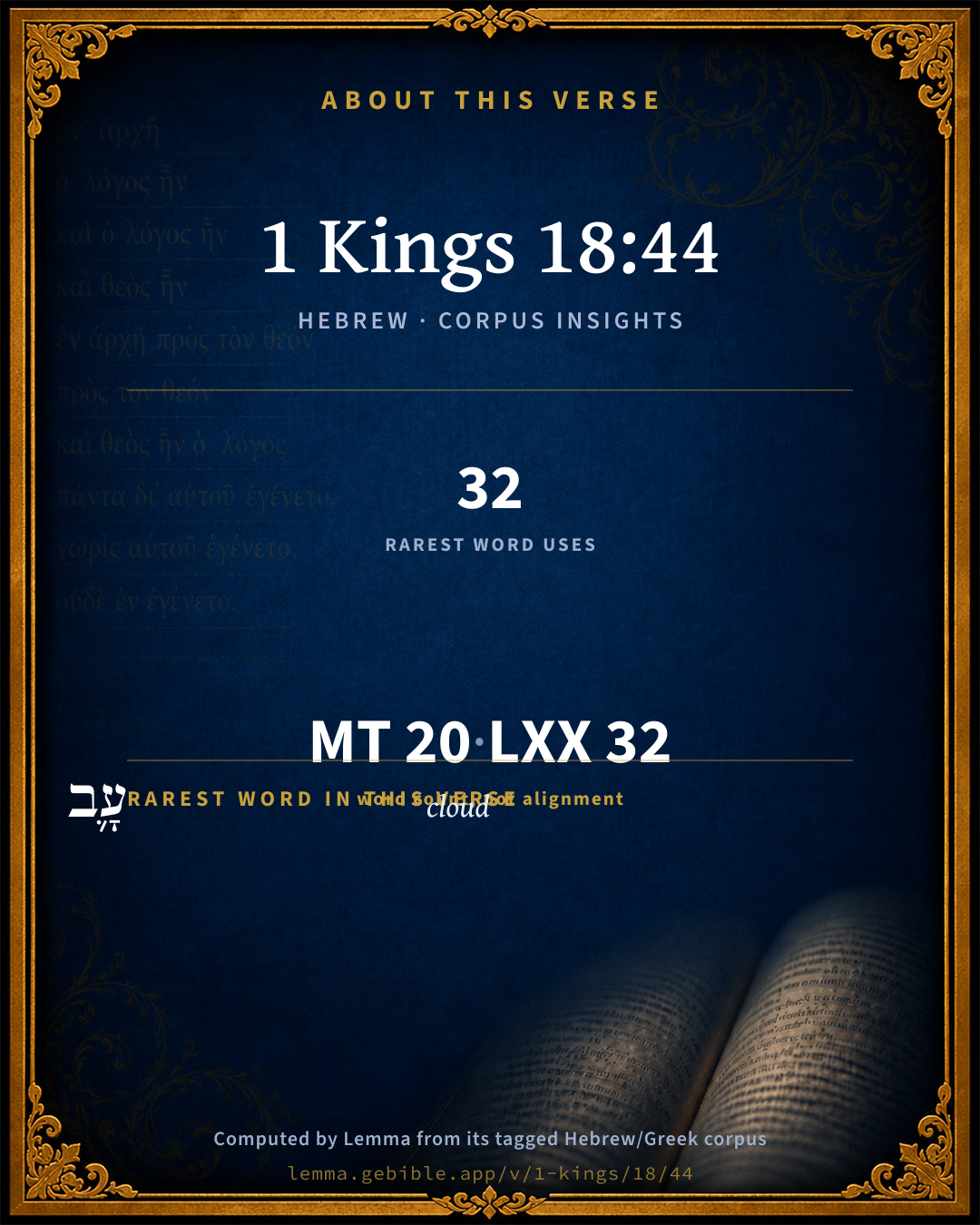
These counts appear in no published source. They are computed here, from the morphology-tagged text and Lemma’s own curated glosses. What Lemma adds →

20
words
17
distinct lemmas
Historical
section

Shared distinctive vocabulary

עָ֛ב cloud H5645 occurs in 32 verses of the Hebrew Bible. Also found in:

Grammatical profile

  • 9 verbs
  • 6 nouns
  • 2 adjectives
  • 1 preposition
  • 2 particles

Verb forms

  • וַֽיְהִי֙ Qal · Sequential Imperfect
  • וַיֹּ֗אמֶר Qal · Sequential Imperfect
  • עֹלָ֣ה Qal · Participle Active
  • וַיֹּ֗אמֶר Qal · Sequential Imperfect
  • עֲלֵ֨ה Qal · Imperative
  • אֱמֹ֤ר Qal · Imperative
  • אֱסֹ֣ר Qal · Imperative
  • וָרֵ֔ד Qal · Imperative
  • יַעַצָרְכָ֖ה Qal · Imperfect

Repetition

Words recur within this verse — often emphatic in Hebrew:

  • וַיֹּ֗אמֶר to say H559 ×3
  • עֹלָ֣ה to go up H5927 ×2

Hebrew & Septuagint length

In English translation the verse runs 43 words from the Hebrew and 51 from the Septuagint (LXX English) — closely comparable.

A rough comparison of the two English renderings, which tokenize alike — not a word-level alignment.

Word counts can differ between the Hebrew and the Greek without any difference in meaning — e.g. the Hebrew direct-object marker אֵת has no separate Greek word, and Greek often adds the article ὁ.

In the original languages it is 20 Hebrew tokens and 32 Greek tokens — but the two are counted differently (Hebrew bundles its prefixes and suffixes into one token; the Greek is in lemma form), so that isn’t a like-for-like length.

Cross-references

6

Topical passages linked to 1 Kings 18:44 in the Treasury of Scripture Knowledge — connected by theme and wording, ordered by reader-vote popularity; previews shown in the World English Bible.

  • Luke 12:54 He said to the multitudes also, "When you see a cloud rising from the west, immediately you say, 'A shower is coming,' and so it happens.
  • Job 8:7 Though your beginning was small, Yet your latter end would greatly increase.
  • Micah 1:13 Harness the chariot to the swift steed, inhabitant of Lachish. She was the beginning of sin to the daughter of Zion; For the transgressions of Israel were found in you.
  • Zechariah 4:10 Indeed, who despises the day of small things? For these seven shall rejoice, and shall see the plumb line in the hand of Zerubbabel. These are the eyes of Yahweh, which run back and forth through the whole earth."
  • 1 Samuel 6:10 The men did so, and took two milk cattle, and tied them to the cart, and shut up their calves at home;
  • 1 Samuel 6:7 Now therefore take and prepare yourselves a new cart, and two milk cattle, on which there has come no yoke; and tie the cattle to the cart, and bring their calves home from them;

Cross-references courtesy of OpenBible.info (CC BY 4.0).

Hebrew and Greek witnesses Masoretic Hebrew ↔ Greek Septuagint

The same verse in the two great witnesses to the Old Testament, shown verse-for-verse.

These are two independent witnesses, not word-aligned to each other, and the Septuagint is shown in lemma (dictionary) form.

Hebrew 1 Kings 18:44 Masoretic · Westminster Leningrad Codex

וַֽיְהִי֙ בַּשְּׁבִעִ֔ית וַיֹּ֗אמֶר הִנֵּה עָ֛ב קְטַנָּ֥ה כְּכַף אִ֖ישׁ עֹלָ֣ה מִיָּ֑ם וַיֹּ֗אמֶר עֲלֵ֨ה אֱמֹ֤ר אֶל אַחְאָב֙ אֱסֹ֣ר וָרֵ֔ד וְלֹ֥א יַעַצָרְכָ֖ה הַגָּֽשֶׁם

It happened at the seventh time, that he said, "Behold, a small cloud, like a man's hand, is rising out of the sea." He said, Go up, tell Ahab, Make ready [your chariot], and get you down, that the rain not stop you.

World English Bible · Public Domain

Greek LXX 1 Kings 18:44 Septuagint · lemma form

καί γίγνομαι ἐν ὁ ἕβδομος καί ἰδού νεφέλη μικρός ὡς ἴχνος ἀνήρ ἀναἄγω ὕδωρ καί εἶπον ἀναβαίνω καί εἶπον ὁ αχααβ ζευγνύω ὁ ἅρμα σύ καί καταβαίνω μή καταλαμβάνω σύ ὁ ὑετός

And the servant went again seven times: and it came to pass at the seventh time, that, behold, a little cloud like the sole of a man's foot brought water; and he said, Go up, and say to Achaab, make ready your chariot, and go down, lest the rain overtake you.

LXX2012 (modern English Septuagint) · Public Domain

Hebrew: Westminster Leningrad Codex (CC BY 4.0). Greek: Septuagint (public domain); English from LXX2012 (modern English Septuagint) (Public Domain). How the Septuagint differs from the Hebrew →

Targum (Aramaic paraphrase)

1

The Targum is the ancient Jewish Aramaic paraphrase of the Hebrew Scriptures — an interpretive translation, not the Hebrew text itself. Onkelos (literal) and Pseudo-Jonathan (expansive) render the Torah, and Jonathan the Prophets. Coverage is partial: where no permissively-licensed English translation exists for a verse, only the Aramaic is shown. This is verse-level text, not a word-by-word alignment to the Hebrew.

  1. Targum Jonathan Prophets (Joshua–Malachi)
    וַהֲוָה בְּזִמְנָא שְׁבִיעֵיתָא וַאֲמַר הָא עֲנָנָא סְלִיק זְעֵירָא כְּפִיסַת יַד גְבַר סָלֵיק מִמְעַרְבָא וַאֲמַר סַק אֱמַר לְאַחְאָב אִזְדָרַז וְחוּת וְלָא יְעַכְּבִינָךְ מַטְרָא:

    (no public-domain English translation for this verse)

    Targum Jonathan — Aramaic: “Mikraot Gedolot” (public domain). English: “Sefaria Community Translation” (CC0 1.0 (public-domain dedication)); “London "Chaldee Paraphrase," 1871” (public domain). Text via Sefaria.

Commentary

Notes on 1 Kings 18:44 from classic Christian and Jewish commentators (each source and its license shown beneath its notes). The classic Christian expositions comment on the surrounding passage and are grouped to its opening verse, so a note may address several verses; the Jewish commentaries on the Tanakh (Rashi and others) are per-verse, so they appear only where the commentator wrote on this verse.

Lemma curates 59 commentaries, every one of them public domain or Creative Commons licensed, each selected and text-cleaned for this edition rather than reprinted as found. About our sources →

Trapp's Complete Commentary

John Trapp

1Ki 18:44 And it came to pass at the seventh time, that he said, Behold, there ariseth a little cloud out of the sea, like a man’s hand. And he said, Go up, say unto Ahab, Prepare [thy chariot], and get thee down, that the rain stop thee not.

Ver. 44. Behold, there ariseth a little cloud.] This little cloud shall ere long overmask the whole heaven. Every former mercy is a pledge and forerunner of a future and greater, if it be well improved; only we must pray on, and not faint. {Luk 18:1} Gregorius Turonensis relateth {a} the like to have fallen out once at Orleans, upon the prayer of Anianus, bishop there; at what time that city was almost taken by Attilus, king of Hunns, but seasonably rescued, and the siege raised by Aetius and Theodoricus, helped by abundance of rain at that time falling, after the sight of a little cloud, arising out of the earth.

{a} Lib. ii. cap. 7.

John Trapp, A Commentary or Exposition upon All the Books of the Old and New Testament (1647–1656) — public domain. Text from a community e-Sword module.

Joseph Benson's Commentary

1Ki 18:44. There ariseth a little cloud like a man’s hand — Which presently overspread the heavens, and watered the earth. Great blessings often rise from small beginnings, and showers of plenty from a cloud of a span long: let us therefore never despise the day of small things, but hope and wait for greater things from it.

Joseph Benson's Commentary on the Old and New Testaments (1811–1818) — public domain. Text from a community e-Sword module.

Jamieson, Fausset & Brown

Robert Jamieson, A. R. Fausset & David Brown

Behold, there ariseth a little cloud out of the sea, like a man's hand--The clearness of the sky renders the smallest speck distinctly visible; and this is in Palestine the uniform precursor of rain. It rises higher and higher, and becomes larger and larger with astonishing celerity, till the whole heaven is black, and the cloud bursts in a deluge of rain.

Prepare thy chariot, and get thee down, that the rain stop thee not--either by the river Kishon being suddenly so swollen as to be impassable, or from the deep layer of dust in the arid plain being turned into thick mud, so as to impede the wheels.

Jamieson, Fausset & Brown — Commentary Critical and Explanatory on the Whole Bible (1871) — public domain (CC PDM 1.0). Text via the HelloAO Bible API.

Adam Clarke's Commentary

Verse 44. There ariseth a little cloud out of the sea, like a man's hand.] איש ככף kechaph ish, like the hollow of a man's hand. In the form of the hand bent, the concave side downmost. I have witnessed a resemblance of this kind at sea previously to a violent storm, a little cloud the size of a man's hand first appearing, and this increasing in size and density every moment, till at last it covered the whole heavens, and then burst forth with incredible fury.

Mr. Bruce mentions a similar appearance in Abyssinia: - "Every morning, in Abyssinia, is clear, and the sun shines. About nine a small cloud, not above four hundred feet broad, appears in the east, whirling violently round, as if upon an axis; but arrived near the zenith, it first abates its motion, then loses its form, and extends itself greatly, and seems to call up vapours from all opposite quarters. These clouds, having attained nearly the same height, rush against each other with great violence, and put me always in mind of Elijah foretelling rain on Mount Carmel." - Travels, vol. v., page 336, edit. 1806.

Adam Clarke's Commentary on the Bible (1810–1826) — public domain. Text from a community e-Sword/MySword module.

The Cambridge Bible for Schools and Colleges

gen. ed. J. J. S. Perowne

44. there ariseth a little cloud out of the sea, like a man’s hand] R.V. a cloud out of the sea as small as a man’s hand. This is more in accordance with the Hebrew construction. The statement was not meant to describe the shape of the cloud, but the size of it. The servant returns as soon as there appears the smallest token of a rain-cloud. The Hebrew word here employed, כף, is sometimes used for the ‘sole of the foot’ (see Jos_1:3). Josephus therefore gives here οὐ πλέον ἴχνους ἀνθρωπίνου ‘not bigger than the sole of a man’s foot.’

Prepare [R.V. make ready thy chariot] The change is introduced from 2Ki_9:21, where the word for ‘chariot,’ which is here understood, stands in the text.

The Cambridge Bible for Schools and Colleges (gen. ed. J. J. S. Perowne; Cambridge University Press, 1878–1918) — public domain. Text from a community e-Sword module.

John Gill's Exposition

And the hand of the Lord was on Elijah,.... Giving him more than common strength of body, as well as courage and fortitude of mind; so the Targum, the spirit of strength from the Lord was with him:

and he girded up his loins; gathered up his long loose garment, and girt it about him, that he might be more fit for travelling:

and ran before Ahab to the entrance of Jezreel; reckoned about sixteen miles from Carmel (l); this showed his humility, that he was not elated with the wonderful things God had done by him, and that he bore no ill will to Ahab, but was ready to show him all honour and respect due to him as a king; and that it were his sins, and not his person, he had an aversion to; and that he was not afraid of Jezebel, and her prophets, but entered into the city where she was, to instruct the people, and warn them against her idolatries; though some think he went no further than the gate of the city, prudently avoiding falling into her hands.

(l) Bunting's Travels, &c. p. 204.

Next: 1 Kings Chapter 19

John Gill's Exposition of the Whole Bible (1746–1763) — public domain (CC PDM 1.0). Text via the HelloAO Bible API.

Albert Barnes' Notes on the Bible

A little cloud ... - Sailors know full well that such a cloud on the far horizon is often the forerunner of a violent storm.

Albert Barnes' Notes on the Bible (1834–1885) — public domain. Text from a community e-Sword/MySword module.

Haydock's Catholic Bible Commentary

Sea, the Mediterranean, which could be seen from Carmel. (Haydock) --- Hence the rain commonly came in that country, Luke xii. 54.

George Leo Haydock (1774–1849), Haydock's Catholic Family Bible and Commentary, 1859 edition — public domain. Excludes Psalms (Douay-Rheims chapter numbering differs from Protestant) and Deuterocanonical books (Catholic canon only).

Whedon's Commentary on the Bible

Daniel D. Whedon

44. Go up, say unto Ahab — The king was yet on the lofty summit; the prophet still remained in his nook of prayer.

That the rain stop thee not — By causing the streams to rise so suddenly, and to such a degree, as to prevent all crossing.

Daniel D. Whedon (gen. ed.), Commentary on the Old and New Testaments (1874–1909) — public domain. Text from a community e-Sword module.

The Pulpit Commentary

And it came to pus at the seventh time, that he said, Behold, there ariseth a little cloud out of the sea, like a man"s hand. pK lit., palm, hollow of hand. Cf. Luk_12:54, "When ye see the cloud (Gr. thlhn) arise out of the west, straightway ye say, There cometh a shower; and so it is." "Still in autumn the Utile cloud comes up like a man"s hand and swells till huge thunder pillars are piled black and high above the mountains" (Condor). But it is not in Palestine alone that a little cloud on the horizon is frequently the harbinger of rain. And he said, Go up see note on ver. 42, say unto Ahab, Prepare thy chariot Heb. bind, and get thee down Keil, Stanley, and others assume that Ahab"s chariot was waiting at the foot of the mountain. But it is to be noticed that the command to harness the horses precedes that to "go down." The writer rode down from El Murahkah to the plain, and it is quite conceivable that the royal chariot may have conveyed Ahab to the plateau of sacrifice and have waited for him there, that the rain stop thee not, After heavy rain ( the Kishon, which "collects the whole drainage of this large basin" (Conder), the Great Plain, soon becomes an impassable Swamp.(Jdg_5:21), "I can tell you from experience that in wet seasons it (the Wady) is extremely muddy, and then the Kishon causes great tribulation to the muleteers. Rarely indeed do they get over it without some of their animals sticking fast in its oozy bottom" (Thomson, L. and B. 2. p. 218).

Elijah"s Prayer for Rain.

The wonders which accompanied the ministry of Elijah were not meaningless prodigies. Those who question the wisdom of miracles should remember that the condition of those for whom they were intended rendered them necessary. Sensuous men must learn through their senses, and worshippers of material force must be met by physical displays of power. We do not try to instruct a child by an essay, or to convince a savage by a syllogism. God could speak directly to the devout patriarchs; but when the worshippers of Baal were to know that there was a living God, they saw the fire from heaven, and heard the bursting of a storm after years of drought. Idolatry had just been swept away by a whirlwind of popular execration. The time had therefore come for the curse to be removed. Elijah with a premonition of the distant rain bade king and people eat of the sacrificial feast, while he went up the mountain to pray. Six times his servant ascended the loftiest peak of Carmel, and came back to say that there was no sign of change; but the seventh time, gazing over the blue expanse of the Mediterranean, he saw a cloud tiny as a man"s hand, which was the pledge of answered prayer, for soon the heavens were "black with clouds," and over the thirsty land there was "a great rain." In dealing with events of Old Testament history, we must guard ourselves against giving a fanciful interpretation which cannot be reasonably justified; but we must not forget, on the other hand, that such incidents reveal great principles which run through the whole economy of God, in the moral as well as in the physical world.

I THE SPIRITUAL SIGNIFICANCE OF THE BLESSING SOUGHT. The New Testament justifies us in regarding the rain which Elijah prayed for as a type of the Holy Spirit, without whom our hearts are barren, and the moral world is dead. See, for instance, how boldly the writer of the Epistle to the Hebrews evolves from the tabernacle what those who constructed it little imagined. Take as another example the allusion which Paul makes to the rock in the wilderness, in which he says emphatically, "That rock was Christ." Recall passages in which the descent of the Spirit is likened to the failing of rain and the distilling of dew. Points of analogy: the grounds on which the heavenly blessing is withheld; the misery that follows its absence; the preparation and prayer for its coming; the subsequent fertility of the barren land, etc. The sins of our age are not unlike those of Elijah"s time, though they are less gross in form. The enervating luxuries of civilization, the indifference of many to the decline of religion, the deification of force and of lust, are examples. There has been a forsaking of the Lord on the part of His people, and hence this barrenness of good, in spite of all our toil; because there is a withholding of the gracious influences of the Divine Spirit. May He "come down as rain upon the mown grass, and as showers that water the earth.

II THE SPIRITUAL PREPARATION FOR THE BLESSING PROMISED.

1. Self forgetfulness. Elijah was personally provided for, and would lack nothing. His heart bled, however, for the suffering people. For them he prayed. We want more of such soul burdening on the part of parents and pastors.

2. Reformation. By the execution of the false prophets, Elijah had done all that in him lay to put away evil. Sins are obstacles in the way of descending blessings. We cannot win the Holy Spirit by good conduct, but we may hinder His work by our sin. Sin is a bar across the sluice gates of benediction, and must be removed or broken before the dry channel can be flooded.

3. Prayer. It is in the Epistle of James that we are told that Elijah"s prayersbrought both the drought and the rainfall. The fact that the prophet heard the sound of abundance of rain stimulated his supplication, and did not prevent it. He did not argue that God would send the storm whether he prayed or not, but believed that the reception of blessing was inseparably connected with the offering of prayer. Similarly the Holy Spirit was promised to the disciples, but they met to pray till He came. "Ask, and you shall receive.

4. Watchfulness. Elijah was so sure of God"s fidelity and goodness that he sent his servant seven times to look for the faintest sign of rain. We need watchfulness for the following reasons:

(1) The answer to prayer does not always come when and how we expect it. E.g., we ask for holiness, and God sends an illness, in which our murmuring closes our heart against the very blessing that is then nearing us. Or we pray for spirituality, and have the possibility of it presented to us in some unexpected joy, which too often makes us more worldly than grateful. Or we entreat God for the salvation of our child; and because we do not watch, we fail to recognize the sign and pledge of the Holy Spirit"s work in the child"s eager questioning and simple prayer.

(2) The answer to prayer may be long delayed. Elijah was not discouraged even by the sixth repetition of the despairing phrase, "There is nothing." Yet on that very day his one earnest cry had instantaneously brought down fire from heaven. How often like the Psalmist we say," Hath God forgotten to be gracious?.... Wait on the Lord, wait patiently for him.

(3) The answer to prayer may begin in what seems trifling. A cloud the size of a man"s hand, hardly describable on the horizon, was enough to transfer Elijah"s prayer into praise. Little in itself, it was the beginning of a glorious blessing. The baptism of the Holy Spirit will not suddenly fill the world with worshippers; but it will be seen, perhaps, in the turning to God of one lad, who shall prove the Elijah of his age; or in the new light given to one who has long been under the shadow of doubt; or in some holy resolve, some noble thought that shall presage blessing to the world. Slight and insignificant as it may seem, gratefully welcome it, and still hope, and wait, and pray, till He "come and rain righteousness upon us. A.R.

The Pulpit Commentary (1880–1919), ed. H.D.M. Spence-Jones & Joseph S. Exell — public domain. Text from a community e-Sword module.

John Wesley's Explanatory Notes

Like a man's hand - Great blessings often rise from small beginnings, and showers of plenty from a cloud of a span long. Let us therefore never despise the day of small things, but hope and wait for greater things from it.

John Wesley, Explanatory Notes Upon the Whole Bible (1754–1765) — public domain. Text via the GEBible commentary corpus.

Rashi

Rabbi Shlomo Yitzchaki (Rashi)

Harness your [horses to the carriage] and go down. Harness your [horses to] your chariots and go down quickly from Mount Carmel, to return to your house, otherwise the rain will press you on the way.

Rashi on the Tanakh — English translations: “The Judaica Press complete Tanach with Rashi, translated by A. J. Rosenberg” (CC BY 4.0); “Pentateuch with Rashi's commentary by M. Rosenbaum and A.M. Silbermann, 1929-1934” (public domain); “The Metsudah Tanach series, Lakewood, N.J” (CC BY 4.0); and “The Book of Joshua, Metsudah Publications, 1997” (CC BY 4.0). Text via Sefaria.

Lesson kit

Teaching starters — assembled from the data on this page, not authored interpretation. Every prompt links to the verse data it draws on. Edit before teaching.

1 Kings, in the Historical, opens this verse with 20 words (17 distinct Hebrew lemmas). Its most distinctive word is ʻâb (“cloud”). A historical commentator’s framing appears above. Read the whole chapter for the surrounding context.

Discussion questions

  1. The word ʻâb carries the sense “cloud.” How does it shape the verse?
  2. Exodus 19:9 shares the word «cloud» with this verse. How do the two illuminate each other?
  3. “to say” occurs 3× in this one verse. What is the effect of the repetition?
  4. These translations render this verse differently. What is at stake in choosing one wording over another?
  5. The verb «וַֽיְהִי֙» is Qal Sequential Imperfect. How does its form color the action?
  6. Reading how Trapp's Complete Commentary and Joseph Benson's Commentary read this verse, where do the two commentators agree and where do they part?

Things to notice

Reading settings

Reading text

Shown beneath each verse's original-language words.

Old Testament
Old Testament edition

Read the OT as the Masoretic Hebrew (MT) or the Greek Septuagint (LXX).

English shown for the Greek Septuagint (in the Hebrew ↔ Greek comparison).

Comparing translations? Open the Compare panel on any verse page to stack up to four side by side.