
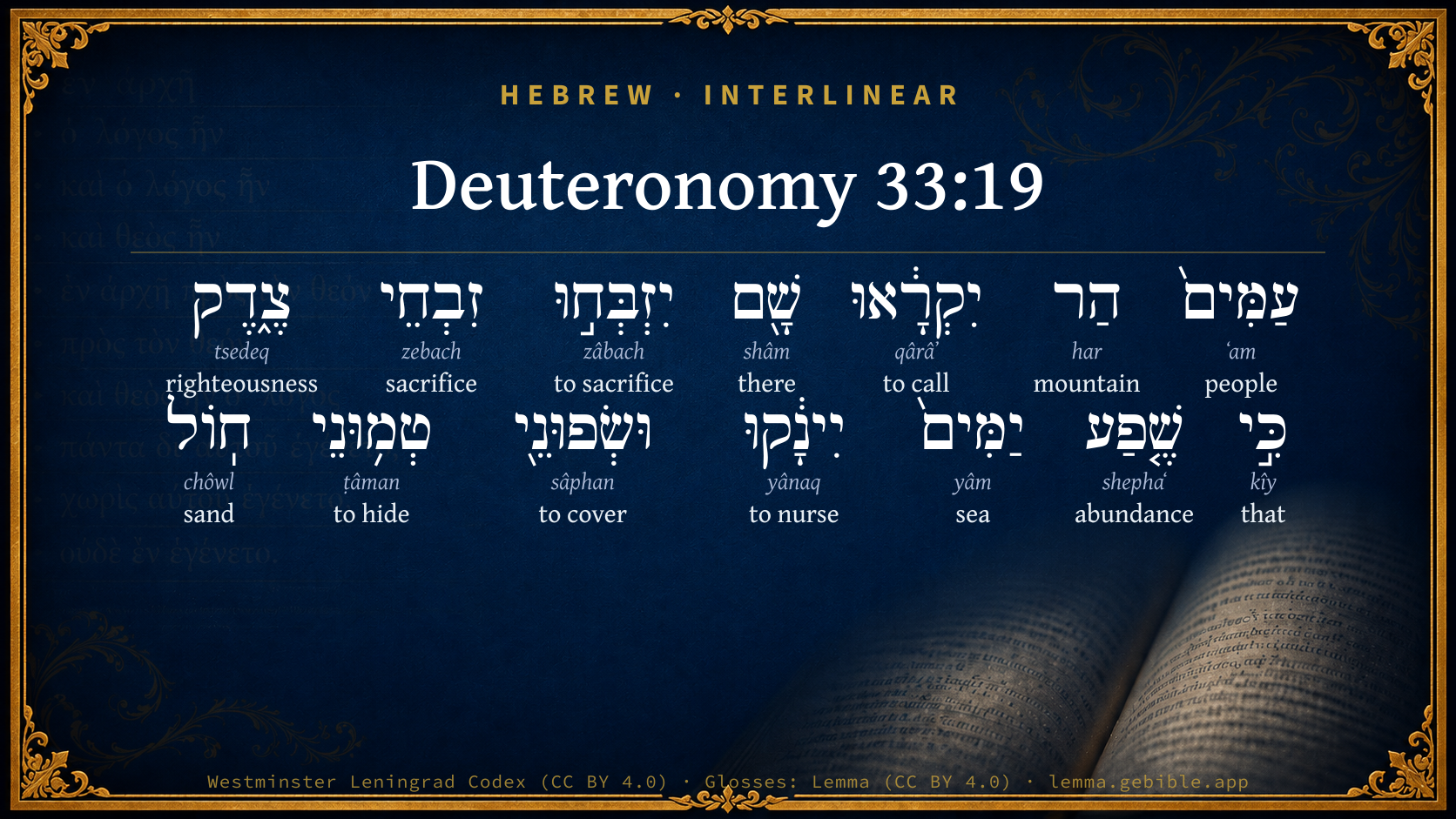
Deuteronomy 33:19

Hebrew (Westminster Leningrad Codex) Deuteronomy 33:19 appears in the Hebrew Old Testament. The text above is from the Westminster Leningrad Codex. Each word links to its Strong’s number, a concise gloss, and parsing drawn from the Open Scriptures Hebrew Bible morphology. Click any word for its full Brown-Driver-Briggs (BDB) entry.
Download image
Cite this verse

Deuteronomy 33:19 (World English Bible). Public Domain. Lemma interlinear Bible study tool, https://lemma.gebible.app/v/deuteronomy/33/19.

Show BibTeX & RIS
BibTeX
RIS
English Translation
They shall call the peoples to the mountain; There shall they offer sacrifices of righteousness: For they shall suck the abundance of the seas, The hidden treasures of the sand.
World English Bible · Public Domain
Highlights
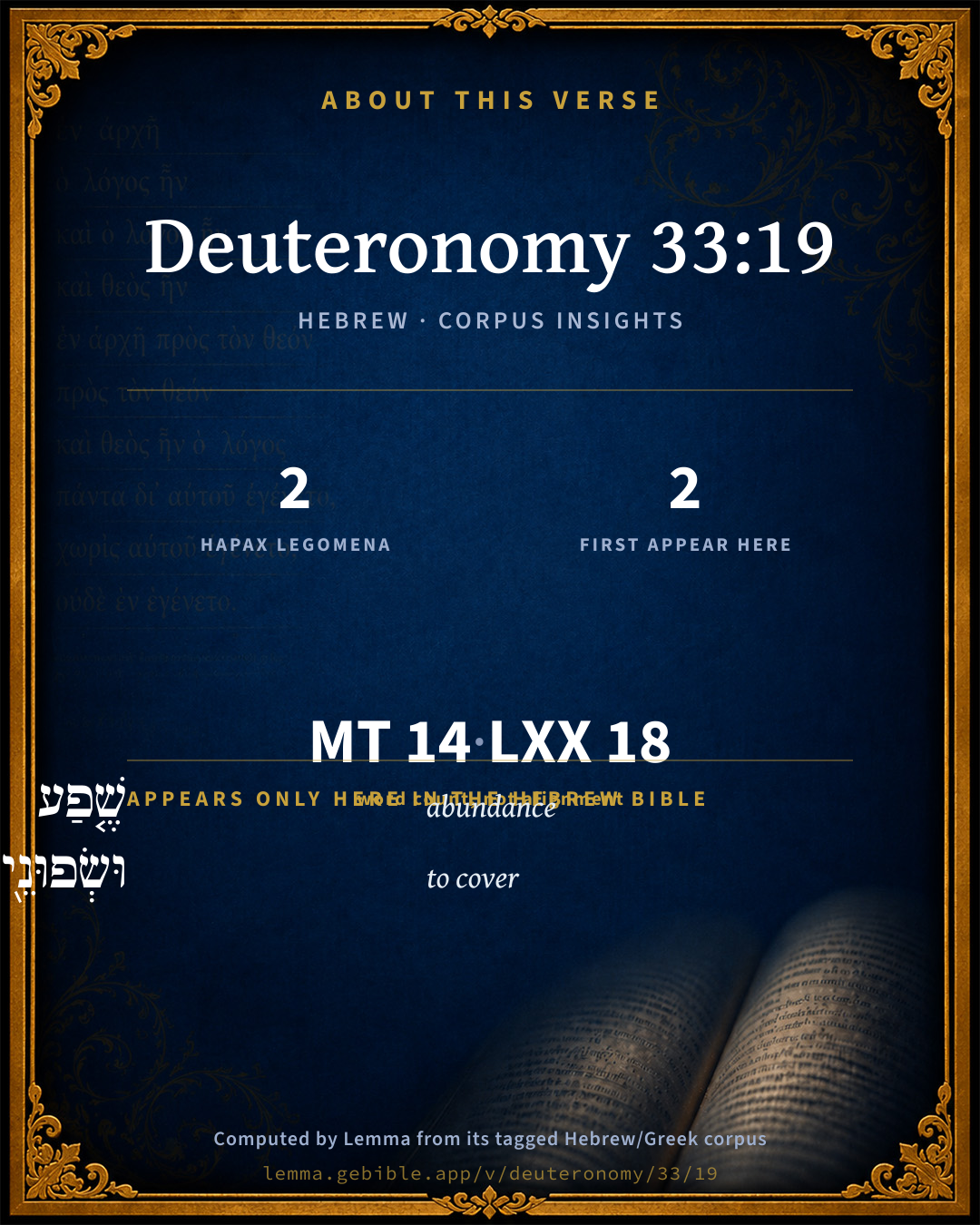
  • 2 hapax legomena — only here in the Hebrew Bible
  • 2 first appearances in the Hebrew Bible
Full analysis ↓
Download a study sheet

One document with this verse’s original text, its word-by-word gloss line, the meaning frame, cross-references with their text, attributed commentary, and full source and license credits — printable, and it pastes into notes with its structure intact.

This verse Autodidact and up

Study sheet (.html) Plain text (.txt)

A passage Seminary Student

Up to 50 verses in one chapter. A passage sheet keeps up to 6 commentary sources and 12 cross-references per verse, in the order this page ranks them, and says so on the sheet whenever that leaves anything out. Ask for a single verse and you get the Autodidact verse sheet above.

Everything on this page stays free to read, with no account — the sheet is a download of what is already on screen, not access to it.

Want to remove ads? Support Godless Engineer
Compare translations 3

The same verse in 3 English versions, stacked beneath the original-language interlinear above. Click any original word for its lexicon entry.

Each is an independent rendering of the whole verse — the interlinear is not word-aligned to these translations.

Highlighted words mark where these versions differ — a whole-verse word diff, not a word-by-word alignment.

  • World English Bible Public Domain
    They shall call the peoples to the mountain; There shall they offer sacrifices of righteousness: For they shall suck the abundance of the seas, The hidden treasures of the sand.
  • King James Version Public Domain
    They shall call the people unto the mountain; there they shall offer sacrifices of righteousness: for they shall suck of the abundance of the seas, and of treasures hid in the sand.
  • unfoldingWord Literal Text CC BY-SA 4.0
    Peoples they will call the mountain. There they will sacrifice sacrifices of righteousness. For the abundance of the seas they suckle, and treasures hidden sand.”

unfoldingWord Literal Text — © unfoldingWord, licensed CC BY-SA 4.0. Word-aligned USFM3 via Door43 (git.door43.org/unfoldingWord/en_ult).

Versions to compare (up to 4)

3 of 4 selected

Show all 18 translations

Every available English version of this verse, each an independent rendering of the whole verse.

  • World English Bible Public Domain
    They shall call the peoples to the mountain; There shall they offer sacrifices of righteousness: For they shall suck the abundance of the seas, The hidden treasures of the sand.
  • Berean Standard Bible Public Domain
    They will call the peoples to a mountain; there they will offer sacrifices of righteousness. For they will feast on the abundance of the seas and the hidden treasures of the sand.”
  • Majority Standard Bible Public Domain
    They will call the peoples to a mountain; there they will offer sacrifices of righteousness. For they will feast on the abundance of the seas and the hidden treasures of the sand.”
  • King James Version Public Domain
    They shall call the people unto the mountain; there they shall offer sacrifices of righteousness: for they shall suck of the abundance of the seas, and of treasures hid in the sand.
  • American Standard Version (1901) Public Domain
    They shall call the peoples unto the mountain; There shall they offer sacrifices of righteousness: For they shall suck the abundance of the seas, And the hidden treasures of the sand.
  • Revised Version (1885) Public Domain
    They shall call the peoples unto the mountain; There shall they offer sacrifices of righteousness: For they shall suck the abundance of the seas, And the hidden treasures of the sand.
  • Geneva Bible (1599) Public Domain
    They shall call ye people vnto the mountaine: there they shall offer the sacrifices of righteousnesse: for they shall sucke of the abundance of the sea, and of the treasures hid in the sand.
  • Douay-Rheims (1899) Public Domain
    They shall call the people to the mountain: there shall they sacrifice the victims of justice. Who shall suck as milk the abundance of the sea, and the hidden treasures of the sands.
  • Young's Literal Translation Public Domain
    Peoples `to' the mountain they call, There they sacrifice righteous sacrifices; For the abundance of the seas they suck, And hidden things hidden in the sand.
  • Literal Standard Version CC BY-SA 4.0
    They call peoples [to] the mountain, || There they sacrifice righteous sacrifices; For they suck up the abundance of the seas, || And hidden things hidden in the sand.
  • Unlocked Literal Bible CC BY-SA 4.0
    They will call the peoples to the mountains. There will they offer sacrifices of righteousness. For they will suck the abundance of the seas, and from the sand on the seashore.
  • unfoldingWord Literal Text CC BY-SA 4.0
    Peoples they will call the mountain. There they will sacrifice sacrifices of righteousness. For the abundance of the seas they suckle, and treasures hidden sand.”
  • Darby Bible Public Domain
    They shall invite [the] peoples to the mountain; There they shall offer sacrifices of righteousness; For they will suck the abundance of the seas, And the hidden treasures of the sand.
  • World Messianic Bible Public Domain
    They will call the peoples to the mountain. There they will offer sacrifices of righteousness, for they will draw out the abundance of the seas, the hidden treasures of the sand.”
  • Webster's Bible Public Domain
    They shall call the people to the mountain; there they shall offer sacrifices of righteousness: for they shall suck of the abundance of the seas, and of treasures hid in the sand.
  • Free Bible Version CC BY-SA 4.0
    They will summon the peoples to a mountain; will offer the appropriate sacrifices there. They will enjoy the rich produce of the seas and from trading on the seashores.”
  • Bible in Basic English Public Domain
    They will send out the word for the people to come to the mountain, taking there the offerings of righteousness: for the store of the seas will be theirs, and the secret wealth of the sand.
  • JPS Tanakh (1917) Public Domain
    They shall call peoples unto the mountain; there shall they offer sacrifices of righteousness; for they shall suck the abundance of the seas, and the hidden treasures of the sand.

Literal Standard Version (2020), Covenant Press — licensed CC BY-SA 4.0. Text via the HelloAO Bible API (eBible.org). Unlocked Literal Bible (unfoldingWord) — licensed CC BY-SA 4.0. Text via the HelloAO Bible API (eBible.org). unfoldingWord Literal Text — © unfoldingWord, licensed CC BY-SA 4.0. Word-aligned USFM3 via Door43 (git.door43.org/unfoldingWord/en_ult). Free Bible Version, Dr. Jonathan Gallagher — licensed CC BY-SA 4.0. Text via the HelloAO Bible API (eBible.org).

Word by word

More ways to search: Search by grammar → Find every occurrence → Compare this word →

Practice this passage: Drill this verse → Learn its vocabulary →

שֶׁ֤פַע
shephaʻ
H8228
“abundance of”
Noun, Common, Masculine, Singular, Construct
Part of Speech
Noun
Type
Common
Gender
Masculine
Number
Singular
State
Construct
Full BDB Definition

Origin: from an unused root meaning to abound

TWOT: 2447a

abundance
  1. עַמִּים֙ ʻam H5971 “peoples” Noun, Common, Masculine, Plural, Absolute
  2. הַר har H2022 “mountain” Noun, Common, Masculine, Singular, Absolute
  3. יִקְרָ֔אוּ qârâʼ H7121 “to call” Verb, Qal, Imperfect, 3rd Person, Masculine, Plural
  4. שָׁ֖ם shâm H8033 “there” Adverb
  5. יִזְבְּח֣וּ zâbach H2076 “to sacrifice” Verb, Qal, Imperfect, 3rd Person, Masculine, Plural
  6. זִבְחֵי zebach H2077 “sacrifices of” Noun, Common, Masculine, Plural, Construct
  7. צֶ֑דֶק tsedeq H6664 “righteousness” Noun, Common, Masculine, Singular, Absolute
  8. כִּ֣י kîy H3588 “that” Conjunction
  9. יַמִּים֙ yâm H3220 “seas” Noun, Common, Masculine, Plural, Absolute
  10. יִינָ֔קוּ yânaq H3243 “to nurse” Verb, Qal, Imperfect, 3rd Person, Masculine, Plural
  11. וּשְׂפוּנֵ֖י sâphan H8226 “and · covered” Conjunction + Verb, Qal, Participle Passive, Masculine, Plural, Construct
  12. טְמ֥וּנֵי ṭâman H2934 “hidden” Verb, Qal, Participle Passive, Masculine, Plural, Construct
  13. חֽוֹל chôwl H2344 “sand” Noun, Common, Masculine, Singular, Absolute

About this verse

These counts appear in no published source. They are computed here, from the morphology-tagged text and Lemma’s own curated glosses. What Lemma adds →

14
words
14
distinct lemmas
Pentateuch
section

Notable vocabulary

2 hapax legomena — words that appear only here in the entire Hebrew Bible:

  • שֶׁ֤פַע abundance H8228
  • וּשְׂפוּנֵ֖י to cover H8226

First appearance in Scripture

These words make their first canonical appearance in the Hebrew Bible here:

  • שֶׁ֤פַע abundance H8228
  • וּשְׂפוּנֵ֖י to cover H8226

Shared distinctive vocabulary

חֽוֹל sand H2344 occurs in 23 verses of the Hebrew Bible. Also found in:

Grammatical profile

  • 5 verbs
  • 7 nouns
  • 1 conjunction
  • 1 adverb

Verb forms

  • יִקְרָ֔אוּ Qal · Imperfect
  • יִזְבְּח֣וּ Qal · Imperfect
  • יִינָ֔קוּ Qal · Imperfect
  • וּשְׂפוּנֵ֖י Qal · Participle Passive
  • טְמ֥וּנֵי Qal · Participle Passive

Hebrew & Septuagint length

In English translation the verse runs 30 words from the Hebrew and 40 from the Septuagint (LXX English) — closely comparable.

A rough comparison of the two English renderings, which tokenize alike — not a word-level alignment.

Word counts can differ between the Hebrew and the Greek without any difference in meaning — e.g. the Hebrew direct-object marker אֵת has no separate Greek word, and Greek often adds the article ὁ.

In the original languages it is 14 Hebrew tokens and 18 Greek tokens — but the two are counted differently (Hebrew bundles its prefixes and suffixes into one token; the Greek is in lemma form), so that isn’t a like-for-like length.

Cross-references

15

Topical passages linked to Deuteronomy 33:19 in the Treasury of Scripture Knowledge — connected by theme and wording, ordered by reader-vote popularity; previews shown in the World English Bible.

  • Isaiah 60:5 Then you shall see and be radiant, and your heart shall thrill and be enlarged; because the abundance of the sea shall be turned to you, the wealth of the nations shall come to you.
  • Psalms 4:5 Offer the sacrifices of righteousness. Put your trust in Yahweh.
  • Isaiah 2:3 Many peoples shall go and say, "Come, let's go up to the mountain of Yahweh, To the house of the God of Jacob; And he will teach us of his ways, And we will walk in his paths. For out of Zion the law shall go forth, And the word of Yahweh from Jerusalem.
  • Exodus 15:17 You shall bring them in, and plant them in the mountain of your inheritance, The place, Yahweh, which you have made for yourself to dwell in; The sanctuary, Lord, which your hands have established.
  • Psalms 50:13–15 Will I eat the flesh of bulls, Or drink the blood of goats?
  • Psalms 51:16–17 For you don't delight in sacrifice, or else I would give it. You have no pleasure in burnt offering.
  • Deuteronomy 32:13 He made him ride on the high places of the earth, He ate the increase of the field; He made him to suck honey out of the rock, Oil out of the flinty rock;
  • Psalms 51:19 Then you will delight in the sacrifices of righteousness, In burnt offerings and in whole burnt offerings. Then they will offer bulls on your altar.
  • Psalms 107:22 Let them offer the sacrifices of thanksgiving, And declare his works with singing.
  • Isaiah 60:16 You shall also suck the milk of the nations, and shall suck the breast of kings; and you shall know that I, Yahweh, am your Savior, and your Redeemer, the Mighty One of Jacob.
  • Isaiah 66:11–12 that you may suck and be satisfied with the breasts of her consolations; that you may milk out, and be delighted with the abundance of her glory.
  • Jeremiah 50:4–5 In those days, and in that time, says Yahweh, the children of Israel shall come, they and the children of Judah together; they shall go on their way weeping, and shall seek Yahweh their God.
  • Micah 4:2 Many nations will go and say, "Come, and let us go up to the mountain of Yahweh, And to the house of the God of Jacob; And he will teach us of his ways, And we will walk in his paths." For out of Zion will go forth the law, And the word of Yahweh from Jerusalem;
  • Hebrews 13:15–16 Through him, then, let us offer up a sacrifice of praise to God continually, that is, the fruit of lips which make confession to his name.
  • 1 Peter 2:5 You also, as living stones, are built up as a spiritual house, to be a holy priesthood, to offer up spiritual sacrifices, acceptable to God through Jesus Christ.

Cross-references courtesy of OpenBible.info (CC BY 4.0).

Hebrew and Greek witnesses Masoretic Hebrew ↔ Greek Septuagint

The same verse in the two great witnesses to the Old Testament, shown verse-for-verse.

These are two independent witnesses, not word-aligned to each other, and the Septuagint is shown in lemma (dictionary) form.

Hebrew Deuteronomy 33:19 Masoretic · Westminster Leningrad Codex

עַמִּים֙ הַר יִקְרָ֔אוּ שָׁ֖ם יִזְבְּח֣וּ זִבְחֵי צֶ֑דֶק כִּ֣י שֶׁ֤פַע יַמִּים֙ יִינָ֔קוּ וּשְׂפוּנֵ֖י טְמ֥וּנֵי חֽוֹל

They shall call the peoples to the mountain; There shall they offer sacrifices of righteousness: For they shall suck the abundance of the seas, The hidden treasures of the sand.

World English Bible · Public Domain

Greek LXX Deuteronomy 33:19 Septuagint · lemma form

ἔθνος ἐκὀλεθρεύω καί ἐπικαλέω ἐκεῖ καί θύω θυσία δικαιοσύνη ὅτι πλοῦτος θάλασσα θηλάζω σύ καί ἐμπόριον παράλιος καταοἰκέω

They shall utterly destroy the nations, and you⌃ shall call men there, and there offer the sacrifice of righteousness; for the wealth of the sea shall suckle you, and so shall the marts of them that dwell by the sea-coast.

LXX2012 (modern English Septuagint) · Public Domain

On this verse, The Cambridge Bible for Schools and Colleges discusses the Septuagint’s reading. Read the note in Commentary ↓

Hebrew: Westminster Leningrad Codex (CC BY 4.0). Greek: Septuagint (public domain); English from LXX2012 (modern English Septuagint) (Public Domain). How the Septuagint differs from the Hebrew →

Targum (Aramaic paraphrase)

2

The Targum is the ancient Jewish Aramaic paraphrase of the Hebrew Scriptures — an interpretive translation, not the Hebrew text itself. Onkelos (literal) and Pseudo-Jonathan (expansive) render the Torah, and Jonathan the Prophets. Coverage is partial: where no permissively-licensed English translation exists for a verse, only the Aramaic is shown. This is verse-level text, not a word-by-word alignment to the Hebrew.

  1. Targum Onkelos Torah (Genesis–Deuteronomy)
    שִׁבְטַּיָא דְיִשְׂרָאֵל לְטוּר בֵּית מַקְדְשָׁא יִתְכַּנְשׁוּן תַּמָן יִכְסוּן נִכְסַת קוּדְשִׁין לְרַעֲוָא אֲרֵי נִכְסֵי עַמְמַיָא יֵיכְלוּן וְסִימָא דְמִטַמְרָא בְחָלָא מִתְגַלְיָא לְהוֹן

    (no public-domain English translation for this verse)

    Targum Onkelos — Aramaic: “Onkelos Genesis” (public domain); “Onkelos Exodus” (public domain); “Onkelos Leviticus” (public domain); “Onkelos Numbers” (public domain); “Onkelos Deuteronomy” (public domain). English: “Sefaria Community Translation” (CC0 1.0 (public-domain dedication)); “J.W. Etheridge. The Targums of Onkelos and Jonathan Ben Uzziel on the Pentateuch. London: Longmans, Green, 1862” (public domain). Text via Sefaria.

  2. Targum Pseudo-Jonathan Torah (Genesis–Deuteronomy)
    אוּמִין סַגִיעִין לְטַוָור בֵּית מַקְדְשָׁא יִצְלוּן תַּמָן יִקְרְבוּן קוּרְבָּנִין דִקְשׁוֹט אֲרוּם עַל סְפַר יַמָא רַבָּא שָׁרָן וְיִתְפַּרְנְקוּן מִן טָרִיתָא וְחַלְזוֹנָא יְאַחְדוּן וְיִצְבְּעוּן מֵאַדְמֵיהּ תִּיכְלָא לְחוּטֵי גוּלְיַתְהוֹן וּמִן חָלָא מַפְקִין אִסְפַּקְלְרִין וּמָנֵי זְגוּגִיתָא אֲרוּם גְנִיזַיָא דִתְהוֹמַיָא גַלְיָין לְהוֹן

    Many peoples shall pray at the mountain of the sanctuary, thither will they bring their oblations of truth: for they dwell by the side of the great sea, they are nourished with (its) dainties; and they take the shell-fish and dye with its blood in purple the threads of their vestments; and from the sands make mirrors and vessels of glass; for the treasures of their coasts are discovered to them.

    Targum Pseudo-Jonathan — Aramaic: “Targum Jonathan on Genesis” (public domain); “Targum Jonathan on Exodus” (public domain); “Targum Jonathan on Leviticus” (public domain); “Targum Jonathan on Numbers” (public domain); “Targum Jonathan on Deuteronomy” (public domain). English: “The Targum of Jonathan ben Uzziel, trans. J. W. Etheridge, London, 1862” (public domain). Text via Sefaria.

Commentary

Notes on Deuteronomy 33:19 from classic Christian and Jewish commentators (each source and its license shown beneath its notes). The classic Christian expositions comment on the surrounding passage and are grouped to its opening verse, so a note may address several verses; the Jewish commentaries on the Tanakh (Rashi and others) are per-verse, so they appear only where the commentator wrote on this verse.

Lemma curates 59 commentaries, every one of them public domain or Creative Commons licensed, each selected and text-cleaned for this edition rather than reprinted as found. About our sources →

Trapp's Complete Commentary

John Trapp

Deu 33:19 They shall call the people unto the mountain; there they shall offer sacrifices of righteousness: for they shall suck [of] the abundance of the seas, and [of] treasures hid in the sand.

Ver. 19. They shall call the people to the mount,] i.e., To God’s house, situate on mount Zion. Though they be Littorales, men dwelling by the sea shore, which are noted to be Duri, horridi, immanes, omnium denique pessimi, the worst kind of people; and though they dwell farther from the Temple, yet are they not farthest from God, but ready with their sacrifice of righteousness, as those that have sucked of the abundance of the sea, and of treasures hid in the sand, which, though of itself it yield no crop, yet brings in great revenues, by reason of sea trading.

John Trapp, A Commentary or Exposition upon All the Books of the Old and New Testament (1647–1656) — public domain. Text from a community e-Sword module.

The Biblical Illustrator

Joseph S. Exell

Deu_33:19

They shall call the people unto the mountain, there they shall offer sacrifices of righteousness.

The seamans return

I. Their privilege. To suck the abundance of the sea is a metonymical expression, signifying as much as to be enriched with the wares and merchandise imported by sea to them. The sea, like an indulgent mother, embraces those that live upon it in her bosom, and with full flowing breasts nourisheth them, and feeds them as a mother doth the infant that sucks and depends for its livelihood upon her breasts. And these breasts do not only afford those that hang upon them the necessaries of life, bread, raiment, etc., but the riches, ornaments, and delights of life also. This was the blessing of the tribe of Zebulun, whose cities and villages were commodiously situated upon the seashore for merchandise (Jos_19:11).

II. Their duty to which these mercies and privileges obliged them: They shall call the people to the mountain, etc. By the mountain, we are here to understand the temple, which Moses, by the spirit of prophecy, foresaw to be upon Mount Sion and Mount Moriah; which two were as the shoulders that supported it (Deu_33:12). Here was the worship of God; the sacrifices were here offered up to Him. And hither Zebulun, in the sense of Gods mercies to them, should call the people, i.e. say some, their own people, their families, and neighbours; or as others, the strangers that were among them for traffic; saying, as Isa_2:3. And here they shall offer the sacrifices of righteousness. By which we are to understand their thank offerings for the mercies they had received of the Lord.

1. The nature of the duty needs opening; for few understand what it is. Alas! it is another manner of thing than a customary, formal, cold God be thanked. Now, if we search into the nature of this duty, we shall find that whoever undertakes this angelic work, must--

(1) Be a heedful observer of the mercies he receives. This is fundamental to the duty. Where no observations of mercies have been made, no praises for them can be returned.

(2) Particularly consider them in their natures, degrees, seasons, and manner of conveyance; there is much of Gods glory and our comfort lost for want of this (Psa_111:2). And indeed, there is no employment in all the world that yields more pleasure to a gracious soul than the anatomising of providence doth.

(3) Duly estimate and value his mercies. It is impossible that man can be thankful for mercies he little esteems.

(4) Faithfully record His mercies, else God cannot have His due praise for them (Psa_103:2). Forgotten mercies bear no fruit: a bad memory in this case makes a barren heart and life.

(5) Be suitably affected with the mercies he receives. It is not a speculative, but an affectionate remembrance that becomes us: then God hath His glory, when the sense of His mercies melts our hearts into holy joy, love, and admiration.

(6) Order his conversation suitably to the engagements that his mercies have put him under. When we have said all, it is the life of the thankful that is the very life of thankfulness. Obedience and service are the only real manifestations of gratitude.

2. The grounds and reasons of this duty; why you are obliged after the reception of mercies to such a thankful return of praises.

(1) God requires and expects it. As great landlords oblige their tenants to a homage and service, when they make over their estates to them, and reserve a quit rent to themselves, which they value at a high rate; so God, when He bestows deliverances of mercies upon us, still reserves an acknowledgement to Himself: and this is dear to Him, He will not endure to be defrauded of it; much less that it be given to another.

(2) You are under manifold engagements to render it to the. Lord. Common ingenuity obliges to a due acknowledgment of favours freely received; and unthankfulness on that score is the odium of mankind. The examples of the very heathens will condemn you. They praised their gods, which yet were no gods, when they received any deliverance (Jdg_16:24). Many of you have formally and expressly obliged your souls to it, by solemn vows and promises in the day of your distress: and yet will you deal perfidiously with God

(3) Your ingratitude is the ready way to deprive you of the mercies yon have, and to withhold from you the mercies you might have in your future distresses and wants.

Use

1. Is it your unquestionable duty to return praises upon every receipt of mercies? Then, in the first place, bear your shame and just reproof for your manifest unthankfulness. Mourn heartily for thy unkindness to thy best friend, The God that hath done thee good all thy life long, and deserves other returns from thee than these.

2. It calls upon you all to be thankful for your mercies. Chrysostom once wished for a voice like thunder, that all men might hear him. O that I could so call you to this duty, that some of you might effectually hear Gods call in this exhortation!

Argument

1. How freely have all your mercies streamed to you from the Fountain of grace! There was nothing in you to engage it.

2. How seasonably your mercies have been bestowed upon you in the very point of extremity and danger I

3. How special and distinguishing have some of your mercies been! God hath not dealt with everyone as He hath with you.

4. Did not your mercies find you under great guilt? Surely such mercies have a constraining power in them, upon all sensible souls.

5. To conclude; if all the goodness of God which hath passed before your eyes does indeed prevail upon you to love the Lord, and fear to offend Him; if it really constrains you to give up yourselves, and all you have, to be His; then all this is but the beginning of mercies, and you shall see yet greater things than these. God hath more mercies yet behind, and those of a higher kind and more excellent nature than these temporal mercies are. Happy souls, if these deliverances do in any measure prove introductive to the great salvation. (John Flavel.)

The Biblical Illustrator, edited by Joseph S. Exell (c. 1880s–1900s) — public domain. Text from a community e-Sword module.

Joseph Benson's Commentary

Deu 33:19. They — Zebulun, of whom Moses takes more special notice. And so having despatched Issachar in two words, he returns to Zebulun. Shall call the people — The Gentiles, either those of Galilee, which was called Galilee of the Gentiles, who were their neighbours; or people of other nations with whom they had commerce, which they endeavoured to improve, in persuading them to worship the true God. The mountain — That is, to the temple, which Moses knew was to be seated upon a mountain. Sacrifices of righteousness — Such as God requires. Their trafficking abroad with heathen nations shall not make them forget their duty at home, nor shall their distance from the place of sacrifice hinder them from coming to it to discharge that duty. Of the abundance of the sea — They shall grow rich by the traffic of the sea, and shall consecrate themselves and their riches to God. Hid in the sand — Such precious things as either, 1st, Are contained in the sand of the sea and rivers, in which sometimes there is mixed a considerable quantity of gold and silver.

Or, 2d, Such as grow in the sea, or are fetched from the sandy bottom of it, as pearls, coral, ambergris. Or, 3d, Such as, being cast into the sea by shipwrecks, are cast upon the shore by the workings of the sea. This, however, Le Clerc refers, with Jonathan, to their enriching themselves by making glass of a kind of sand found upon their coasts. For the river Belus, famous for its glassy sands, of which alone glass was for a long time manufactured, was in the territories of the Zebulunites. These glassy sands are mentioned by several authors. But treasures hid in the sand, may import the same as sucking of the abundance of the seas — That is, enriching themselves by naval commerce.

Joseph Benson's Commentary on the Old and New Testaments (1811–1818) — public domain. Text from a community e-Sword module.

Tyndale Open Study Notes

Tyndale Open Resources

33:19 to the mountain: Issachar was allotted much of the plains of Jezreel or Esdraelon. Mount Tabor, a prominent landmark of this region, was probably the mountain in view because later tradition knows this as a place of worship (Hos 5:1). The nature of that worship is unclear, but it was probably proper even though it was not carried out at the Temple (see 1 Kgs 18:30, 32). • The phrase riches of the sea might refer to the maritime industry of the people of Zebulun when their western border extended to the Mediterranean Sea (see Gen 49:13).

Tyndale Open Study Notes — © Tyndale Open Resources, licensed CC BY-SA 4.0. Text via the HelloAO Bible API.

Geneva Bible (1599)

Geneva Bible translators

Or, mount Zion.

The tribe of Zebulun.

Geneva Bible (1599) marginal notes — public domain. Text via Bolls.life.

Jamieson, Fausset & Brown

Robert Jamieson, A. R. Fausset & David Brown

shall suck of the abundance of the seas, and of treasures hid in the sand--Both tribes should traffic with the Phœnicians in gold and silver, pearl and coral, especially in murex, the shellfish that yielded the famous Tyrian dye, and in glass, which was manufactured from the sand of the river Belus, in their immediate neighborhood.

Jamieson, Fausset & Brown — Commentary Critical and Explanatory on the Whole Bible (1871) — public domain (CC PDM 1.0). Text via the HelloAO Bible API.

Adam Clarke's Commentary

Verse 19. They shall call the people unto the mountain] By their traffic with the Gentiles (for so I think עמים ammim should be understood here) they shall be the instruments in God's hands of converting many to the true faith; so that instead of sacrificing to idols, they should offer sacrifices of righteousness.

They shall suck of the abundance of the seas] That is, grow wealthy by merchandise.

And of treasures hid in the sand.] Jonathan ben Uzziel has probably hit upon the true meaning of this difficult passage: "From the sand," says he, "are produced looking-glasses and glass in general; the treasures - the method of finding and working this, was revealed to these tribes." Several ancient writers inform us that there were havens in the coasts of the Zebulunites in which the vitreous sand, or sand proper for making glass, was found. See Strabo, lib. xvi.; see also Pliny, Hist. Nat. l. xxxvi., c. 26; Tacitus, Hist. l. v., c. 7. The words of Tacitus are remarkable: Et Belus amnis Judaico mari illabitur; circa ejus os lectae arenae admixto nitro in vitrum excoquuntur. "The river Belus falls into the Jewish sea, about whose mouth those sands, mixed with nitre, are collected, out of which glass is formed," or which is melted into glass. Some think that the celebrated shell-fish called murex, out of which the precious purple dye was extracted, is here intended by the treasure hid in the sand: this also Jonathan introduces in this verse. And others think that it is a general term for the advantages derived from navigation and commerce.

Adam Clarke's Commentary on the Bible (1810–1826) — public domain. Text from a community e-Sword/MySword module.

Ellicott's Commentary for English Readers

(19) They shall call the people unto the mountain.—Or, they shall give the mountain-call to the peoples—i.e., they shall call the tribes of Israel to Mount Moriah to offer the sacrifices of righteousness. (See 2Ch_30:11; 2Ch_30:18 for an illustration of this.)

A Bible Commentary for English Readers, edited by Charles John Ellicott (1878–1897) — public domain. Text from a community e-Sword module.

The Cambridge Bible for Schools and Colleges

gen. ed. J. J. S. Perowne

19. lend upon usury] exact interest; the Eng. usury formerly meant like the Lat. usura no more than interest. Heb. neshek is lit. something bitten off; the denom. vb. is to take, or make one pay, interest.

usury of money, etc.] The loans were more frequently in kind.

19. They call … There they offer] Their markets for their trade with other tribes or peoples were also religious festivals, a combination characteristic of the Semitic world (as of others even in modern times) and illustrated at Sinai, Jerusalem, Bethel (vide Amos), Hierapolis and Mecca. The mountain may have been Carmel or Tabor; but the text is uncertain. LXX have a verb followed by and which suggests the Heb. yaḥdaw = together, instead of the awkwardly constructed har = mountain. Sacrifices of righteousness are of course the legal, due or fitting sacrifices. Sam. s. of truth.

abundance] This form of the Heb. term is found only here; but it occurs in Aram. The lit. meaning is flowing; render affluence, profusion (LXX πλοῦτος); all that the Phoenicians drew from the sea—their sea-borne trade and fisheries and possibly the dredging for sponges still carried on off ‘Athlit and Carmel.

of the seas] Plur. as often in poetry, Jdg_5:17, Gen_49:13.

And the hidden treasures, etc.] The Heb. construction (confirmed by Sam.) is awkward, and perhaps we should read a finite vb instead of the participle hidden: and gather (or scrape, cp. Ar. safan) the hoards of the sand. The reference is either to the manufacture of glass which took place on the sands S. of ’Akka (Josephus, II. Bell. Jdg_10:2; Tacitus, Hist. Deu_33:7; Pliny, Hist. Nat. Deu_33:17, xxxvi. 65) or to the production of purple from the murex (Pliny, H.N. ix. 60–65) large quantities of the emptied shells of which are still found about Tyre.

The Cambridge Bible for Schools and Colleges (gen. ed. J. J. S. Perowne; Cambridge University Press, 1878–1918) — public domain. Text from a community e-Sword module.

John Gill's Exposition

And of Gad he said,.... The tribe of Gad, as the Targums of Jonathan and Jerusalem:

blessed be he that enlargeth Gad; that is, the Lord, to whom the praise and glory were to be given, who had appointed to Gad a large inheritance on the other side Jordan, and had settled him in it, and which became larger by the conquest of the Hagarites, and others, Ch1 5:18,

he dwelleth as a lion; bold and courageous, secure, and without fear of any of his enemies, though near him, on his borders, as the Moabites and Ammonites were; of the same spirit and temper were the men of the tribe of Gad in the times of David, Ch1 12:8,

and teareth the arm with the crown of the head, at once, just as a lion tears its prey; which figurative phrases are expressive of this tribe conquering and destroying strong and mighty men, signified by the "arm", in which the strength of a man lies, and of kings and governors, pointed at by the "crown of the head"; as the Targums of Onkelos and Jonathan; which was done in the times of Joshua, when with and under him they subdued and destroyed the kings and princes of the land of Canaan.

John Gill's Exposition of the Whole Bible (1746–1763) — public domain (CC PDM 1.0). Text via the HelloAO Bible API.

Haydock's Catholic Bible Commentary

Mountain. Full of gratitude to God, who has bestowed such advantages upon them, these tribes shall go with zeal to the place which the Lord shall choose, (Haydock) and invite the people, on the road, to go along with them, to offer sacrifice. (Menochius) --- Perhaps this may allude also to their conduct in the war against Jabin, in which they were particularly active, appointing the place of rendezvous at Mount Thabor, where, though the Scripture be silent, it is probable they would offer a sacrifice of thanks, as they had the prophetess, Debora, along with them, (Calmet) in like manner as Samuel immolated a calf at Bethlehem, (1 Kings xvi.) and Elias a bullock on Mount Carmel, 3 Kings xviii. (Haydock) See 1 Kings xiii. 12. --- Sands. This blessing chiefly regarded Zabulon, who received the riches of the sea by commerce, bringing home the gold dust which is found among the sand of some rivers. The river Belus, near Ptolemais, was particularly famous for a sort of sand, of which glass was made. Josephus (Jewish Wars ii. 17,) says, that near the tomb of Memnon, a bed of such sand is found, about 100 cubits long, which, though many vessels have been filled from it, has never been exhausted. See Pliny, [Natural History?] v. 19., and Strabo, xvi. --- The discovery of glass is supposed to have been the effect of chance; some merchants having placed a nitrous stone under their pot, as soon as it grew hot, and mixed with the sand, which is found near the shore of Tyre, a transparent substance was formed, which the Greeks called ualos, "glass," perhaps in imitation of the Hebrew eul, or "sand," of which it was chiefly composed. (Calmet) --- The Septuagint render this verse, "They shall destroy the nations, and you shall call thither, and there you shall sacrifice,....because the riches of the sea shall suckle thee, and the merchandise of those who inhabit the sea shore." These tribes greatly contributed to overthrow the army of Sisara beside the torrent of Cisson, which divides their territories, Judges iv., and v. (Haydock)

George Leo Haydock (1774–1849), Haydock's Catholic Family Bible and Commentary, 1859 edition — public domain. Excludes Psalms (Douay-Rheims chapter numbering differs from Protestant) and Deuterocanonical books (Catholic canon only).

Matthew Poole's English Annotations

They; either,

1. Zebulun and Issachar. Or rather,

2. Zebulun only, as the following matter shows; and it was Zebulun that Moses takes more special notice of, Deu 33:18, bringing in Issachar only by the by, in conjunction with him, or in opposition to him. And so having despatched Issachar in two words, he returns to Zebulun, a more active tribe.

The people, i.e. the Gentiles; either those of Galilee, which was called Galilee of the Gentiles, who were their neighbours; or people of other nations, with whom they had commerce, which they endeavoured to improve in persuading them to the true God, and his worship and service.

Unto the mountain, i.e. to the temple, which Moses knew was to be seated upon a mountain.

Sacrifices of righteousness, i.e. such as God requires and righteousness obligeth them to offer. Their trafficking abroad with heathen nations shall not make them forget or neglect their duty at home, nor shall their distance from the place of sacrifice hinder them from coming to it to discharge that duty.

They shall suck of the abundance of the seas; they shall grow rich by the traffic of the sea; and their riches shall not make them the worse, as they do others, but they shall consecrate themselves and their riches to the service of God.

Treasures hid in the sand; such precious things as either,

1. Are contained in the sand of the sea and rivers, in which sometimes there is mixed a considerable quantity of gold and silver. Or,

2. Such as grow in the sea, or are fetched from the sandy bottom of it, as pearls, coral, ambergris, &c. Or,

3. Such as being east into the sea by shipwreck are cast upon the shore by the workings of the sea, and thence taken either by merchants, or by the people that live upon the sea-coast.

Matthew Poole's English Annotations on the Holy Bible (1683–1685) — public domain. Text from a community e-Sword/MySword module.

John Wesley's Explanatory Notes

They - Zebulun of whom Moses takes more special notice. And so having dispatched Issachar in two words, he returns to Zebulun. The people - the Gentiles, either those of Galilee, which was called Galilee of the Gentiles, who were their neighbours; or people of other nations, with whom they had commerce, which they endeavoured to improve in persuading them to worship the true God. The mountain - That is, to the temple, which Moses knew was to be seated upon a mountain. Sacrifices of righteousness - Such as God requires. Their trafficking abroad with Heathen nations shall not make them forget their duty at home, nor shall their distance from the place of sacrifice hinder them from coming to it to discharge that duty. Of the abundance of the sea - They shall grow rich by the traffick of the sea, and shall consecrate themselves and their riches to God. Hid in the sand - Such precious things as either

1. Are contained in the sand of the sea and rivers, in which sometimes there is mixed a considerable quantity of gold and silver. Or,

2. Such as grow in the sea, or are fetched from the sandy bottom of it, as pearls, coral, ambergrease. Or,

3. Such as being cast into the sea by shipwreck are cast upon the shore by the workings of the sea. It were well, if the enlargement of our trade with foreign countries, were made to contribute to the spreading of the gospel.

John Wesley, Explanatory Notes Upon the Whole Bible (1754–1765) — public domain. Text via the GEBible commentary corpus.

Rashi

Rabbi Shlomo Yitzchaki (Rashi)

עמים THE PEOPLES of the tribes of Israel,

הר יקראו THEY CALL TO THE MOUNTAIN, i.e., they assembled at Mount Moriah on the Festivals; — it speaks of calling them there because every assembly was (took place) in general by means of a summons to it — and שם THERE יזבחו THEY SACRIFICED on the Festivals, זבחי צדק SACRIFICES OF RIGHTEOUSNESS.

כי שפע ימים יינקו FOR OF ABUNDANCE OF THE SEAS SHALL THEY — Issachar and Zebulun — SUCK, and they will consequently have leisure to busy themselves with the study of the Torah.

ושפני טמוני חול means, covered things that are hidden in the sand — the Tarith (a kind of fish; Rashi in his comment on the Talmudical passage afterwards quoted states that it is the tuna fish), the Chalazon (from which purple dye was obtained) and while glass (all valuable articles of commerce) which come out of the sea and the sand. This was in the territory of Issachar and Zebulun, as it is stated in Treatise Megillah 6a: The Scriptural text (Judges 5:18) is to be explained as follows: “Zebulun was a people that cursed his soul even unto death” because that “Naphtali was on the high places of the field“, i.e., Zebulun complained about his territory, saying, To my brother (Naphtali) you have given fields and vineyards (while to me you have given hilly and mountainous land; to my brother you have given land while to me you have given seas and rivers! God replied. “All your brethren will be in need of you”, as it states, “And the treasures hidden in the sand”, which the Talmud goes on to explain are the marine creatures Rashi mentions above, deriving each of them from the words of the text, For they shall suck … of the concealed treasures of the sea).

ושפני has the meaning of “covering”, as it is said (1 Kings 6:9) “And he covered (ויספן) the house”; (Jeremiah 22:14) וספן בארז, which the Targum renders by: “And it was covered with panels of cedar”. — Another explanation of עמים הר יקראו THEY CALL THE PEOPLES TO THE MOUNTAIN — Through Zebulun’s trading, merchants of the world’s nations will come to his land, he living at the coast, and they will say, “Since we have taken so much trouble to reach here, let us go to Jerusalem and see what is the God of this people and what are His doings”. When they behold all Israel serving one God and eating one kind of food (only that which is permissible to them), they are astonished because as regards the other nations, the god of one is not as the god of another, and the food of one is not as the food of another, so that they will say, “There is no nation as worthy as this”, and they will therefore become proselytes to Judaism there, as it is said, “There shall they sacrifice sacrifices of righteousness” (Sifrei Devarim 354:5).

כי שפע ימים יינקו FOR OF THE ABUNDANCE OF THE SEAS SHALL THEY SUCK — “they” means Zebulun and Issachar; for the sea will give them wealth in abundance.

Rashi on the Tanakh — English translations: “The Judaica Press complete Tanach with Rashi, translated by A. J. Rosenberg” (CC BY 4.0); “Pentateuch with Rashi's commentary by M. Rosenbaum and A.M. Silbermann, 1929-1934” (public domain); “The Metsudah Tanach series, Lakewood, N.J” (CC BY 4.0); and “The Book of Joshua, Metsudah Publications, 1997” (CC BY 4.0). Text via Sefaria.

Lesson kit

Teaching starters — assembled from the data on this page, not authored interpretation. Every prompt links to the verse data it draws on. Edit before teaching.

Deuteronomy, in the Pentateuch, opens this verse with 14 words (14 distinct Hebrew lemmas). Its most distinctive word is shephaʻ (“abundance”). A historical commentator’s framing appears above. Read the whole chapter for the surrounding context.

Discussion questions

  1. How does “abundance” (shephaʻ) shape what this verse is saying?
  2. 2 words here appear nowhere else in the Hebrew Bible. Why might the author reach for such rare wording?
  3. 2 words make their first appearance in Scripture here. What does this debut establish?
  4. How does Genesis 22:17, which shares the word «sand», read alongside this verse?
  5. These translations render this verse differently; the difference is in the English rendering, not the original. What questions does that raise?
  6. «יִקְרָ֔אוּ» is a Qal Imperfect verb. How does that grammatical form shape the action described?
  7. Compare how Trapp's Complete Commentary and The Biblical Illustrator read this verse. Where do they agree or differ?

Things to notice

Reading settings

Reading text

Shown beneath each verse's original-language words.

Old Testament
Old Testament edition

Read the OT as the Masoretic Hebrew (MT) or the Greek Septuagint (LXX).

English shown for the Greek Septuagint (in the Hebrew ↔ Greek comparison).

Comparing translations? Open the Compare panel on any verse page to stack up to four side by side.