Joshua 11:2

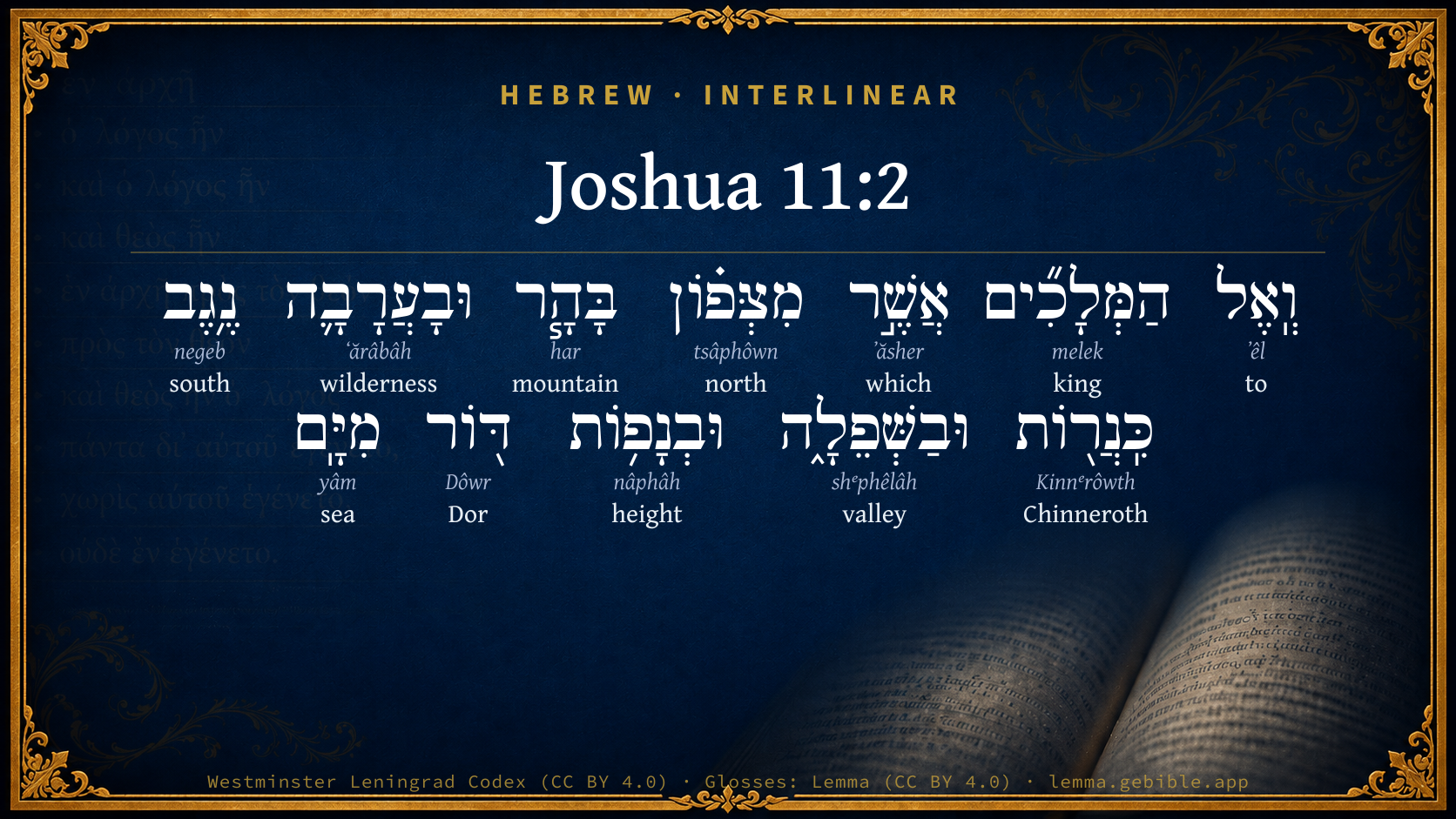
Hebrew (Westminster Leningrad Codex) Joshua 11:2 appears in the Hebrew Old Testament. The text above is from the Westminster Leningrad Codex. Each word links to its Strong’s number, a concise gloss, and parsing drawn from the Open Scriptures Hebrew Bible morphology. Click any word for its full Brown-Driver-Briggs (BDB) entry.
Download image
Cite this verse

Joshua 11:2 (World English Bible). Public Domain. Lemma interlinear Bible study tool, https://lemma.gebible.app/v/joshua/11/2.

Show BibTeX & RIS
BibTeX
RIS
English Translation
and to the kings who were on the north, in the hill-country, and in the Arabah south of Chinneroth, and in the lowland, and in the heights of Dor on the west,
World English Bible · Public Domain
Highlights
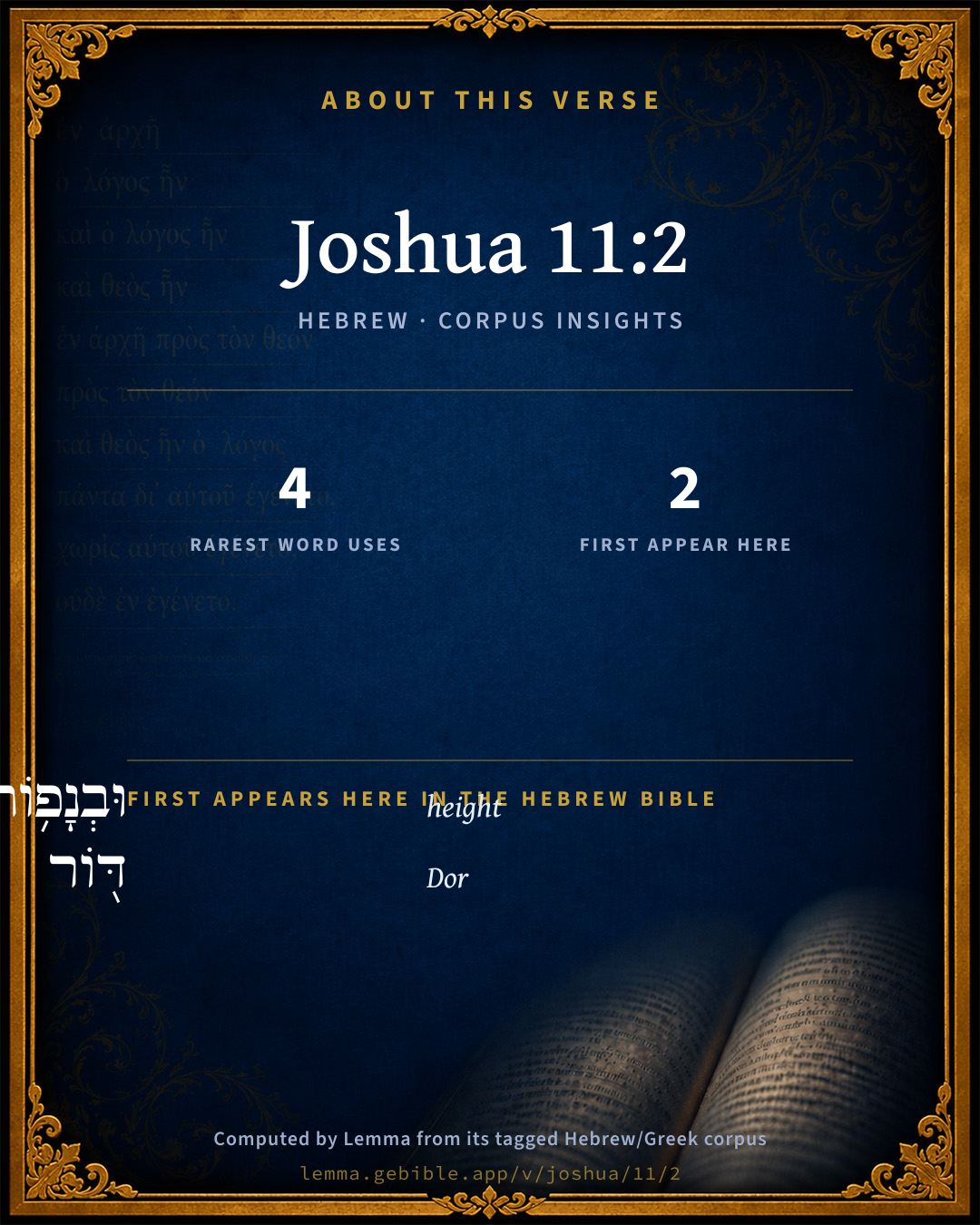
  • 2 first appearances in the Hebrew Bible
Full analysis ↓
Download a study sheet

One document with this verse’s original text, its word-by-word gloss line, the meaning frame, cross-references with their text, attributed commentary, and full source and license credits — printable, and it pastes into notes with its structure intact.

This verse Autodidact and up

Study sheet (.html) Plain text (.txt)

A passage Seminary Student

Up to 50 verses in one chapter. A passage sheet keeps up to 6 commentary sources and 12 cross-references per verse, in the order this page ranks them, and says so on the sheet whenever that leaves anything out. Ask for a single verse and you get the Autodidact verse sheet above.

Everything on this page stays free to read, with no account — the sheet is a download of what is already on screen, not access to it.

Want to remove ads? Support Godless Engineer
Compare translations 3

The same verse in 3 English versions, stacked beneath the original-language interlinear above. Click any original word for its lexicon entry.

Each is an independent rendering of the whole verse — the interlinear is not word-aligned to these translations.

Highlighted words mark where these versions differ — a whole-verse word diff, not a word-by-word alignment.

  • World English Bible Public Domain
    and to the kings who were on the north, in the hill-country, and in the Arabah south of Chinneroth, and in the lowland, and in the heights of Dor on the west,
  • King James Version Public Domain
    And to the kings that were on the north of the mountains, and of the plains south of Chinneroth, and in the valley, and in the borders of Dor on the west,
  • unfoldingWord Literal Text CC BY-SA 4.0
    and to the kings who from the north in the hill country and in the Arabah south of Chinnereth and in the lowland and in the heights of Dor from the west,

unfoldingWord Literal Text — © unfoldingWord, licensed CC BY-SA 4.0. Word-aligned USFM3 via Door43 (git.door43.org/unfoldingWord/en_ult).

Versions to compare (up to 4)

3 of 4 selected

Show all 18 translations

Every available English version of this verse, each an independent rendering of the whole verse.

  • World English Bible Public Domain
    and to the kings who were on the north, in the hill-country, and in the Arabah south of Chinneroth, and in the lowland, and in the heights of Dor on the west,
  • Berean Standard Bible Public Domain
    to the kings of the north in the mountains, in the Arabah south of Chinnereth, in the foothills, and in Naphoth-dor to the west;
  • Majority Standard Bible Public Domain
    to the kings of the north in the mountains, in the Arabah south of Chinnereth, in the foothills, and in Naphoth-dor to the west;
  • King James Version Public Domain
    And to the kings that were on the north of the mountains, and of the plains south of Chinneroth, and in the valley, and in the borders of Dor on the west,
  • American Standard Version (1901) Public Domain
    and to the kings that were on the north, in the hill-country, and in the Arabah south of Chinneroth, and in the lowland, and in the heights of Dor on the west,
  • Revised Version (1885) Public Domain
    and to the kings that were on the north, in the hill country, and in the Arabah south of Chinneroth, and in the lowland, and in the heights of Dor on the west,
  • Geneva Bible (1599) Public Domain
    And vnto the Kings that were by ye North in the mountaines and plaines toward the Southside of Cinneroth, and in the valleys, and in the borders of Dor Westward,
  • Douay-Rheims (1899) Public Domain
    And to the kings of the north, that dwelt in the mountains and in the plains over against the south side of Ceneroth, and in the levels and the countries of Dor by the sea side:
  • Young's Literal Translation Public Domain
    and unto the kings who `are' on the north in the hill-country, and in the plain south of Chinneroth, and in the low country, and in the elevations of Dor, on the west,
  • Literal Standard Version CC BY-SA 4.0
    and to the kings who [are] on the north in the hill-country, and in the plain south of Chinneroth, and in the low country, and in the elevations of Dor, on the west,
  • Unlocked Literal Bible CC BY-SA 4.0
    He also sent the message to the kings who were in the northern hill country, in the Jordan River valley south of Kinnereth, in the lowlands, and in Naphoth Dor to the west.
  • unfoldingWord Literal Text CC BY-SA 4.0
    and to the kings who from the north in the hill country and in the Arabah south of Chinnereth and in the lowland and in the heights of Dor from the west,
  • Darby Bible Public Domain
    and to the kings that were northward in the mountains, and in the plain south of Chinneroth, and in the lowland, and on the upland of Dor on the west,
  • World Messianic Bible Public Domain
    and to the kings who were on the north, in the hill country, in the Arabah south of Chinneroth, in the lowland, and in the heights of Dor on the west,
  • Webster's Bible Public Domain
    And to the kings that were on the north of the mountains, and of the plains south of Cinneroth, and in the valley, and in the borders of Dor on the west,
  • Free Bible Version CC BY-SA 4.0
    and to the kings of the northern hill country, the Jordan Valley south of Kinnereth, the western foothills, and the foothills of Dor to the west,
  • Bible in Basic English Public Domain
    And to the kings on the north in the hill-country, and in the Arabah south of Chinneroth, and in the lowland, and in the highlands of Dor on the west,
  • JPS Tanakh (1917) Public Domain
    and to the kings that were on the north, in the hill-country and in the Arabah south of Chinneroth, and in the Lowland, and in the regions of Dor on the west,

Literal Standard Version (2020), Covenant Press — licensed CC BY-SA 4.0. Text via the HelloAO Bible API (eBible.org). Unlocked Literal Bible (unfoldingWord) — licensed CC BY-SA 4.0. Text via the HelloAO Bible API (eBible.org). unfoldingWord Literal Text — © unfoldingWord, licensed CC BY-SA 4.0. Word-aligned USFM3 via Door43 (git.door43.org/unfoldingWord/en_ult). Free Bible Version, Dr. Jonathan Gallagher — licensed CC BY-SA 4.0. Text via the HelloAO Bible API (eBible.org).

Word by word

More ways to search: Search by grammar → Find every occurrence → Compare this word →

Practice this passage: Drill this verse → Learn its vocabulary →

וּבְנָפ֥וֹת
nâphâh
H5299
“and · in/at · heights of”
Conjunction + Preposition + Noun, Common, Feminine, Plural, Construct
Part of Speech
Conjunction + Preposition + Noun
Type
Common
Gender
Feminine
Number
Plural
State
Construct
Full BDB Definition

Origin: from H5130 in the sense of lifting

TWOT: 1331b , 1330a

a lofty place, height - sieve, winnowing implement
  1. וְֽאֶל ʼêl H413 “and · to” Conjunction + Preposition
  2. הַמְּלָכִ֞ים melek H4428 “the · kings” Particle, Definite Article + Noun, Common, Masculine, Plural, Absolute
  3. אֲשֶׁ֣ר ʼăsher H834 “which” Particle, Relative
  4. מִצְּפ֗וֹן tsâphôwn H6828 “from · north of” Preposition + Noun, Common, Feminine, Singular, Construct
  5. בָּהָ֧ר har H2022 “in/at the · mountain” Preposition, Determined + Noun, Common, Masculine, Singular, Absolute
  6. וּבָעֲרָבָ֛ה ʻărâbâh H6160 “and · in/at the · wilderness” Conjunction + Preposition, Determined + Noun, Common, Feminine, Singular, Absolute
  7. נֶ֥גֶב negeb H5045 “south of” Noun, Common, Masculine, Singular, Construct
  8. כִּֽנֲר֖וֹת Kinnᵉrôwth H3672 “Chinneroth” Noun, Proper
  9. וּבַשְּׁפֵלָ֑ה shᵉphêlâh H8219 “and · in/at the · valley” Conjunction + Preposition, Determined + Noun, Common, Feminine, Singular, Absolute
  10. דּ֖וֹר Dôwr H1756 “Dor” Noun, Proper
  11. מִיָּֽם yâm H3220 “from · sea” Preposition + Noun, Common, Masculine, Singular, Absolute

About this verse

These counts appear in no published source. They are computed here, from the morphology-tagged text and Lemma’s own curated glosses. What Lemma adds →

12
words
12
distinct lemmas
Historical
section

Notable vocabulary

The rarest word here is וּבְנָפ֥וֹת height H5299 — appearing just 4 times in the whole Hebrew Bible.

First appearance in Scripture

These words make their first canonical appearance in the Hebrew Bible here:

  • וּבְנָפ֥וֹת height H5299
  • דּ֖וֹר Dor H1756

Shared distinctive vocabulary

וּבְנָפ֥וֹת height H5299 occurs in 4 verses of the Hebrew Bible. Also found in:

Grammatical profile

  • 10 nouns
  • 1 preposition
  • 1 particle

Hebrew & Septuagint length

In English translation the verse runs 32 words from the Hebrew and 26 from the Septuagint (LXX English) — closely comparable.

A rough comparison of the two English renderings, which tokenize alike — not a word-level alignment.

Word counts can differ between the Hebrew and the Greek without any difference in meaning — e.g. the Hebrew direct-object marker אֵת has no separate Greek word, and Greek often adds the article ὁ.

Cross-references

12

Topical passages linked to Joshua 11:2 in the Treasury of Scripture Knowledge — connected by theme and wording, ordered by reader-vote popularity; previews shown in the World English Bible.

  • Joshua 12:3 and the Arabah to the sea of Chinneroth, eastward, and to the sea of the Arabah, even the Salt Sea, eastward, the way to Beth-jeshimoth; and on the south, under the slopes of Pisgah:
  • Judges 1:27 Manasseh did not drive out [the inhabitants of] Beth-shean and its towns, nor [of] Taanach and its towns, nor the inhabitants of Dor and its towns, nor the inhabitants of Ibleam and its towns, nor the inhabitants of Megiddo and its towns; but the Canaanites would dwell in that land.
  • Numbers 34:11 and the border shall go down from Shepham to Riblah, on the east side of Ain; and the border shall go down, and shall reach to the side of the sea of Chinnereth eastward;
  • Joshua 17:11 Manasseh had in Issachar and in Asher Beth-shean and its towns, and Ibleam and its towns, and the inhabitants of Dor and its towns, and the inhabitants of En-dor and its towns, and the inhabitants of Taanach and its towns, and the inhabitants of Megiddo and its towns, even the three heights.
  • Joshua 12:23 the king of Dor in the height of Dor, one; the king of Goiim in Gilgal, one;
  • 1 Kings 4:11 Ben Abinadab, in all the height of Dor (he had Taphath the daughter of Solomon as wife);
  • Joshua 10:6 The men of Gibeon sent to Joshua to the camp to Gilgal, saying, Don't slack your hand from your servants; come up to us quickly, and save us, and help us: for all the kings of the Amorites that dwell in the hill-country are gathered together against us.
  • Joshua 10:40 So Joshua struck all the land, the hill-country, and the South, and the lowland, and the slopes, and all their kings: he left none remaining, but he utterly destroyed all that breathed, as Yahweh, the God of Israel, commanded.
  • Joshua 11:21 Joshua came at that time, and cut off the Anakim from the hill-country, from Hebron, from Debir, from Anab, and from all the hill-country of Judah, and from all the hill-country of Israel: Joshua utterly destroyed them with their cities.
  • Joshua 13:27 and in the valley, Beth Haram, and Beth Nimrah, and Succoth, and Zaphon, the rest of the kingdom of Sihon king of Heshbon, the Jordan and the border [of it], to the uttermost part of the sea of Chinnereth beyond the Jordan eastward.
  • Luke 1:39 Mary arose in those days and went into the hill country with haste, into a city of Judah,
  • Luke 5:1 Now it happened, while the multitude pressed on him and heard the word of God, that he was standing by the lake of Gennesaret.

Cross-references courtesy of OpenBible.info (CC BY 4.0).

Hebrew and Greek witnesses Masoretic Hebrew ↔ Greek Septuagint

The same verse in the two great witnesses to the Old Testament, shown verse-for-verse.

These are two independent witnesses, not word-aligned to each other, and the Septuagint is shown in lemma (dictionary) form.

Hebrew Joshua 11:2 Masoretic · Westminster Leningrad Codex

וְֽאֶל הַמְּלָכִ֞ים אֲשֶׁ֣ר מִצְּפ֗וֹן בָּהָ֧ר וּבָעֲרָבָ֛ה נֶ֥גֶב כִּֽנֲר֖וֹת וּבַשְּׁפֵלָ֑ה וּבְנָפ֥וֹת דּ֖וֹר מִיָּֽם

and to the kings who were on the north, in the hill-country, and in the Arabah south of Chinneroth, and in the lowland, and in the heights of Dor on the west,

World English Bible · Public Domain

Greek LXX Joshua 11:2 Septuagint · lemma form

καί πρός ὁ βασιλεύς ὁ κατά σιδών ὁ μέγας εἰς ὁ ὀρεινή καί εἰς ὁ ραβα ἀπέναντι κενερωθ καί εἰς ὁ πεδίον καί εἰς ναφεδδωρ

and to the kings who were by the great Sidon, to the hill country and to Araba opposite Keneroth, and to the plain, and to Phenaeddor,

LXX2012 (modern English Septuagint) · Public Domain

On this verse, The Pulpit Commentary discusses the Septuagint’s reading. Read the note in Commentary ↓

Hebrew: Westminster Leningrad Codex (CC BY 4.0). Greek: Septuagint (public domain); English from LXX2012 (modern English Septuagint) (Public Domain). How the Septuagint differs from the Hebrew →

Targum (Aramaic paraphrase)

1

The Targum is the ancient Jewish Aramaic paraphrase of the Hebrew Scriptures — an interpretive translation, not the Hebrew text itself. Onkelos (literal) and Pseudo-Jonathan (expansive) render the Torah, and Jonathan the Prophets. Coverage is partial: where no permissively-licensed English translation exists for a verse, only the Aramaic is shown. This is verse-level text, not a word-by-word alignment to the Hebrew.

  1. Targum Jonathan Prophets (Joshua–Malachi)
    וּלְוַת מַלְכַיָא דְמִצְפּוּנָא בְּטוּרָא וּבְמֵישְׁרָא דָרוֹם גִינוֹסָר וּבִשְׁפֶלְתָּא וּבְפִלְכֵי דוֹר מַעֲרָבָא:

    (no public-domain English translation for this verse)

    Targum Jonathan — Aramaic: “Mikraot Gedolot” (public domain). English: “Sefaria Community Translation” (CC0 1.0 (public-domain dedication)); “London "Chaldee Paraphrase," 1871” (public domain). Text via Sefaria.

Commentary

Notes on Joshua 11:2 from classic Christian and Jewish commentators (each source and its license shown beneath its notes). The classic Christian expositions comment on the surrounding passage and are grouped to its opening verse, so a note may address several verses; the Jewish commentaries on the Tanakh (Rashi and others) are per-verse, so they appear only where the commentator wrote on this verse.

Lemma curates 59 commentaries, every one of them public domain or Creative Commons licensed, each selected and text-cleaned for this edition rather than reprinted as found. About our sources →

Trapp's Complete Commentary

John Trapp

Jos 11:2 And to the kings that [were] on the north of the mountains, and of the plains south of Chinneroth, and in the valley, and in the borders of Dor on the west,

Ver. 2. South of Cinneroth.] Afterwards called the lake of Gennesareth, {Luk 5:1} and the Sea of Galilee or Tiberias. {Joh 6:1}

John Trapp, A Commentary or Exposition upon All the Books of the Old and New Testament (1647–1656) — public domain. Text from a community e-Sword module.

Joseph Benson's Commentary

Jos 11:2. On the north of the mountains — Rather, according to the Hebrew, On the north in the mountain. That is, either mount Lebanon, called the mountain by way of eminence, or in the mountainous country. This seems to be the general designation of all the particular places following: they were in the northern parts of Canaan, as those mentioned chap. 10 were in the southern parts. And of the plain, &c. — Hebrew, in the plain, southward from Chinneroth, on the lake of Gennesareth. Dor — A place upon the coast of the midland sea.

Joseph Benson's Commentary on the Old and New Testaments (1811–1818) — public domain. Text from a community e-Sword module.

Geneva Bible (1599)

Geneva Bible translators

Which the Evangelists call the lake of Gennesaret, or Tiberias.

Geneva Bible (1599) marginal notes — public domain. Text via Bolls.life.

Jamieson, Fausset & Brown

Robert Jamieson, A. R. Fausset & David Brown

the kings that were on the north of the mountains--the Anti-libanus district.

the plains south of Chinneroth--the northern part of the Arabah, or valley of the Jordan.

the valley--the low and level country, including the plain of Sharon.

borders of Dor on the west--the highlands of Dor, reaching to the town of Dor on the Mediterranean coast, below mount Carmel.

Jamieson, Fausset & Brown — Commentary Critical and Explanatory on the Whole Bible (1871) — public domain (CC PDM 1.0). Text via the HelloAO Bible API.

Adam Clarke's Commentary

Verse 2. On the north of the mountains] Or the mountain, probably Hermon, or some mountain not far from the lake of Gennesareth.

And of the plains] That is, the valleys of the above mountains, which had the sea of Chinneroth or Gennesareth on the south.

Chinneroth] This city is supposed by St. Jerome and several others since his time, to be the same as was afterwards called Tiberias. From this city or village the sea of Chinneroth or Gennesareth probably had its name.

And in the borders of Dor] Calmet supposes this to mean the champaign country of the higher and lower Galilee, on to the Mediterranean Sea, and to the village or city of Dor, which was the farthermost city of Phoenicia. Dor was in the lot of the half tribe of Manasseh, and was situated on the Mediterranean Sea, three leagues from Caesarea, and seven from Ptolemais.

Adam Clarke's Commentary on the Bible (1810–1826) — public domain. Text from a community e-Sword/MySword module.

Ellicott's Commentary for English Readers

(2) Chinneroth—i.e., Ginizer, the Gennesaret of the New Testament.

Dor is identified as Tantûra.

A Bible Commentary for English Readers, edited by Charles John Ellicott (1878–1897) — public domain. Text from a community e-Sword module.

The Cambridge Bible for Schools and Colleges

gen. ed. J. J. S. Perowne

2. that were on the north] Or, that were “northwards in the mountains,” i.e. “the mountains of Naphtali” (Jos_20:7), the mountainous region of Galilee.

the plains south of Cinneroth] Literally, “in the Arabah, south of Chinneroth,” i.e. the “Ghôr” of the Jordan, the northern portion of the depressed tract which extends along the Jordan from the Lake of Gennesareth southwards.

Cinneroth] or Chinnereth, or Chinneroth, was the name of a fortified town in Naphtali (Jos_19:35), situated on the shore of the Sea of Galilee, and giving its earliest name to that lake (Num_34:11).

and in the valley] “In the wild feeldis,” Wyclif; i.e. “the lowlands,” the level plain bordering the sea between Akko and Sidon.

in the borders of Dor] Rather, the highlands of Dor. Dor was an ancient royal city of the Canaanites (Jos_12:23), situated on the coast of the Mediterranean, 14 miles south of the promontory of Carmel, and 7 north of Cæsarea. The district, of which it was the capital, was afterwards within the allotted territory of Asher, but was assigned to Manasseh (Jos_17:11), but the Israelites could never obtain possession of this strong city (Jos_17:12; Jdg_1:27), though they made the inhabitants pay tribute in the days of Solomon (1Ki_4:11). What is here rendered “the borders of Dor,” is rendered “the coast of Dor” Jos_12:23, and the “region of Dor” 1Ki_4:11. The original word Napheth, thus variously translated, means an “elevated tract,” and hence a coast as being raised above the water. Dor stood on a rocky promontory, behind which lies a beautiful and fertile plain, extending southward to Sharon, and northward to Carmel. This plain is the “coast” or “region” of Dor. Dor was one of the Phœnician seats of commerce, deriving its importance from (i) its well-sheltered haven, (ii) the abundance amidst its rocks of the murex, a shell-fish yielding the famous purple dye. It was still a flourishing town in the Roman age, and afterwards became the seat of a bishop, who was, in the days of the Crusades, a suffragan in the province of Cæsarea. The modern Tantûra or Dandora is a corruption of the ancient name. It is now represented by a little fishing village, consisting of some thirty houses, while the site of the old city lies to the north of it, covered for a space of half a mile with massive ruins.

The Cambridge Bible for Schools and Colleges (gen. ed. J. J. S. Perowne; Cambridge University Press, 1878–1918) — public domain. Text from a community e-Sword module.

John Gill's Exposition

And to the kings that were on the north of the mountains,.... Of Libanus and Antilibanus, with others near them; so Josephus (t) says, the kings about Lebanon being Canaanites, fought against them, i.e. the Israelites; for Lebanon lay to the north of the land:

and of the plains south of Cinneroth; or Gennesaret, of the land and lake of which we read in the New Testament, Mat 14:34; and seems to have respect chiefly to the famous plain of Jezreel, or Esdraelon, of which See Gill on Hos 1:5,

and in the valley; which may more especially design the valley of Jezreel, as it is called in the above place, and distinguish it from other plains; it was two miles broad, and ten long:

and in the borders of Dor, on the west; which fell to the lot of the tribe of Manasseh, Jos 17:11; which Pliny (u) calls Dorum, and mentions it along with the promontory of Carmel; so Josephus says (w), in Phoenicia, near Mount Carmel, is a city called Dora, four days' journey distant from Judea; that is, that part of the land of Israel particularly so called; some copies read Idumea. According to Jerom (x), it was nine miles from Caesarea of Palestine, as you go to Tyre; and in his time a desert. It was a haven in the Mediterranean sea, and lies three leagues from the castle of the "pilgrims" near Mount Carmel; and, as a traveller says, is now so decayed, that there is nothing more extant than a large and high tower, which the inhabitants still call Dorteite (y).

(t) Antiqu. l. 5. c. 1. sect. 18. (u) Nat. Hist. l. 5. c 19. (w) Contr. Apion. l. 2. c. 9. (x) De loc. Heb. fol. 92. I. (y) Rauwolff's Travels, par. 3. c. 1. p. 211. Ed. Ray.

John Gill's Exposition of the Whole Bible (1746–1763) — public domain (CC PDM 1.0). Text via the HelloAO Bible API.

Albert Barnes' Notes on the Bible

On the north of the mountains - Rather, “northward in the mountains.” The reference is to the mountain district of Galilee, called Jos 20:7 “mount Naphtali.”

On the plains south of Chinneroth - literally, “in the Arabah south of Chinneroth.” The words describe the northern portion of the “Arabah” (see Deu 1:1), or depressed tract, which extends along the Jordan from the lake of Gennesaret southward.

Chinneroth - Identical with the later Gennesaret (see Num 34:10). The lake derived its name from a town on its banks (compare Jos 19:35).

In the valley - The northern part of the same flat district mentioned in Jos 9:1. This “valley” is the level plain adjacent to the sea and extending from Carmel southward.

Borders of Dor - Render “highlands of Dor.” Dor was a royal city, and gave its name to the district around it (compare Jos 12:23; 1Ki 4:11). Its importance was derived from its having an excellent and well-sheltered haven, and from the abundance among its rocks of the shellfish which furnished the famous Tyrian purple. The site of Dor is identified by travelers as the modern Tantura or Dandora - a name which is itself only a corruption of the ancient Dor. It lies near the foot of Carmel some six miles north of Caesarea.

Albert Barnes' Notes on the Bible (1834–1885) — public domain. Text from a community e-Sword/MySword module.

Haydock's Catholic Bible Commentary

Ceneroth, or having the lake Genesareth on the south. They city of Cineroth, or of Tiberias, was situated on the southern borders of the lake. (St. Jerome) --- Side. Dor lay on the Mediterranean, the last of the cities of Phœnicia. All below was in a manner subdued. The Philistines did not enter into this league, nor were they invited, as they bore a certain antipathy to the people of Chanaan.

George Leo Haydock (1774–1849), Haydock's Catholic Family Bible and Commentary, 1859 edition — public domain. Excludes Psalms (Douay-Rheims chapter numbering differs from Protestant) and Deuterocanonical books (Catholic canon only).

Matthew Poole's English Annotations

On the north of the mountains, Heb. on the north (which may be the general designation of all the particular places following, that they were in the northern parts of Canaan, as those mentioned Jos 10, were in the southern parts) in the mountain; either in or near the famous mountain of Lebanon, called the mountain by way of eminency; or in the mountainous country. South of Chinneroth, Heb. in the plain lying southward from Chinneroth, or the lake of Gennesaret. See Deu 3:17; Luk 5:1.

Dor; a place upon the coast of the midland sea.

Matthew Poole's English Annotations on the Holy Bible (1683–1685) — public domain. Text from a community e-Sword/MySword module.

Whedon's Commentary on the Bible

Daniel D. Whedon

2. Kings that were on the north of the mountains — Heb, on the north in the mountain. Mount Hermon and its northern extension, called Anti-Libanus, are perhaps here meant. Chinneroth was a small enclosed district north of Tiberias, and by the side of the lake to which it subsequently gave the name Genesareth. See at Num_34:11; notes on Mat_4:13.

The valley — The plain by the Mediterranean, the shephelah. See the note on Jos_10:40.

Borders of Dor — The word for borders is used in the Hebrew only in connexion with Dor, and it designates the plain of Sharon at the foot of Carmel. Dor, now Tantura, was probably the southern limit of Phenicia. Of its site there is no doubt. “Its situation, with its little harbour enclosed within the wild rocks rising over the shell-strewn beach, and covered by the fragments of the later city of Tantura, is still a striking feature on the desolate shore.” — Stanley.

Daniel D. Whedon (gen. ed.), Commentary on the Old and New Testaments (1874–1909) — public domain. Text from a community e-Sword module.

The Pulpit Commentary

On the north of the mountains. Rather, to the northward, in the mountain district. Not necessarily the Lebanon and Anti-Lebanon range, but the mountains of Galilee, which lay within the boundaries of Naphtali. The LXX reads wOdx for wOpx and therefore renders kata Sidwna adding thn megalhn from ver. 8. The plains south of Chinneroth. Rather, the Arabah south of Chinneroth (see note on Jos_3:16). The word Arabah is given untranslated in Jos_18:18. This was, no doubt, the great Ghor, or depression of the Jordan, or at least the northern part of it, extending for some distance south of the town of Chinneroth. (Jos_19:35 Deu_3:17) This town gave its name to the lake or inland sea now better known to the student of Scriptures as the sea of Tiberias, or lake of Gennesareth. (see Num_34:11) "As we enter upon the geological character of the basin which contains the sea of Galilee, we see at once that it is simply one element of the Jordan Valley and the Dead Sea, which extends due north and south for a distance of sixty hours. This is the Ghor, or Sunken Valley of the Arabah", (see note on Jos_3:16) "extending from Hasbeya to the Aelanitic gulf as a continuous cleft the deepest one known to us" (Ritter, 2:241). He goes on to enumerate the various signs of volcanic agency in this region; the frequent earthquakes, the form of the basin of Gennesareth (though he denies it to be a crater), the hot springs, the frequent eaves, the naphtha deposits and springs, the hot water springs to be found even in the Dead Sea, the lofty crystalline masses of the Sinaitic peninsula, and the porphyritic dykes found at the southern end Of the Ghor, as well as the general conformation of the country east of Jordan. The sea of Chinneroth, or Tiberias, is stated by Conder (Handbook, pp. 212, 216) to be 682.5 feet below the level of the Mediterranean. And in the valley. The Shephelah, or lowland district (see above Jos_9:1). The borders of Dot. Rather, the heights, or highlands (twOpn Vulg. regionibus) of Dor. This elevated position was a remarkable feature of the neighbourhood, though the various translations of the word (as "coast," Jos_12:23; "region," 1Ki_4:11) rather obscure the prominence given to this physical characteristic in the Scripture narrative. Rosenmuller would translate it the "promontory" of Dor, for Dot (now Tantura, Tortura, or Dandora) was upon the sea coast south of Carmel, and nine Roman miles north of Caesarea. Thus situated, its position on a hill, though the hill is not a lofty one, would strike the observer, and it accounts for the peculiar form of speech noticed above, which is so common that in the LXX it is usually given as part of the proper name, Nafeddwr . (cf. Nafaydwr , Jos_12:23; Nefyadwr , 1Ki_4:11) And behind it are still higher rocky ridges, to which the name also applies. Dor, with its excellent harbour, was a noted place of commerce in ancient times, especially in the murex coccineus, from which the far famed Tyrian dye was obtained. These are a species of mussel, and Seetzen mentions two varieties, the murex trunculus of Linnaeus, and the Helix ianthina. The latter is of a whitish green, but when taken out of the water it passes from red to purple, and after death to violet. Its use has been superseded by that of the cochineal insect, but the Tyrian purple was in great demand in early times. Its costliness may be inferred from the fact that in each insect a little pouch behind the head, not the size of a pea, contains the dye. See Ritter, 4:280, 281; Pliny, "Nat. Hist." 9, 36 (60 in some editions); and" Epist." 50, 10, 26. The allusions to it by Horace, Virgil, Juvenal, and other classical authors are too numerous for quotation. We may take as instances Virgil, Gen_3:17: "Illi victor ego, et Tyrio conspectus in ostro" (cf. Aen. 4:262): and Juvenal, Sat. 7:134; "Spondet enim Tyrio stlataria purpura filo." The ruins of the ancient city still crown the steeps of its site (see Vandevelde"s Memoir, and Conder"s Handbook. Also Keil in loc. ). On the west. The LXX renders, "And to the Amorites on the sea coast" (see last note), leaving out all mention of the Canaanites.

The Pulpit Commentary (1880–1919), ed. H.D.M. Spence-Jones & Joseph S. Exell — public domain. Text from a community e-Sword module.

John Wesley's Explanatory Notes

On the north - The general designation of all the particular places following: they were in the northern parts of Canaan, as those mentioned chap. x, 1-43, were in the southern parts; in the mountain, either in or near the mountain of Lebanon, called the mountain by way of eminency; or in the mountainous country. Cinneroth - Hebrew. in the plain lying southward from Cinneroth, or the lake of Genesareth. Dor - A place upon the coast of the midland-sea.

John Wesley, Explanatory Notes Upon the Whole Bible (1754–1765) — public domain. Text via the GEBible commentary corpus.

Rashi

Rabbi Shlomo Yitzchaki (Rashi)

South of Kinros.— South of Ginosar.

The region of Dor.—The districts of Dor. Contree in French.

מִיָם—on the west.

Rashi on the Tanakh — English translations: “The Judaica Press complete Tanach with Rashi, translated by A. J. Rosenberg” (CC BY 4.0); “Pentateuch with Rashi's commentary by M. Rosenbaum and A.M. Silbermann, 1929-1934” (public domain); “The Metsudah Tanach series, Lakewood, N.J” (CC BY 4.0); and “The Book of Joshua, Metsudah Publications, 1997” (CC BY 4.0). Text via Sefaria.

Lesson kit

Teaching starters — assembled from the data on this page, not authored interpretation. Every prompt links to the verse data it draws on. Edit before teaching.

Joshua, in the Historical, opens this verse with 12 words (12 distinct Hebrew lemmas). Its most distinctive word is nâphâh (“height”). A historical commentator’s framing appears above. Read the whole chapter for the surrounding context.

Discussion questions

  1. How does “height” (nâphâh) shape what this verse is saying?
  2. 2 words here appear for the first time in Scripture. What is being introduced at this debut?
  3. Joshua 12:23 shares the word «height» with this verse. How do the two illuminate each other?
  4. The translations on this page render this verse differently — a whole-verse word diff, not a word-by-word alignment. What might account for the different wordings?
  5. Reading how Trapp's Complete Commentary and Joseph Benson's Commentary read this verse, where do the two commentators agree and where do they part?

Things to notice

Reading settings

Reading text

Shown beneath each verse's original-language words.

Old Testament
Old Testament edition

Read the OT as the Masoretic Hebrew (MT) or the Greek Septuagint (LXX).

English shown for the Greek Septuagint (in the Hebrew ↔ Greek comparison).

Comparing translations? Open the Compare panel on any verse page to stack up to four side by side.