
2 Chronicles 8:18

Hebrew (Westminster Leningrad Codex) 2 Chronicles 8:18 appears in the Hebrew Old Testament. The text above is from the Westminster Leningrad Codex. Each word links to its Strong’s number, a concise gloss, and parsing drawn from the Open Scriptures Hebrew Bible morphology. Click any word for its full Brown-Driver-Briggs (BDB) entry.
Download image
Cite this verse

2 Chronicles 8:18 (World English Bible). Public Domain. Lemma interlinear Bible study tool, https://lemma.gebible.app/v/2-chronicles/8/18.

Show BibTeX & RIS
BibTeX
RIS
English Translation
Huram sent him by the hands of his servants ships, and servants who had knowledge of the sea; and they came with the servants of Solomon to Ophir, and fetched from there four hundred fifty talents of gold, and brought them to king Solomon.
World English Bible · Public Domain
Download a study sheet

One document with this verse’s original text, its word-by-word gloss line, the meaning frame, cross-references with their text, attributed commentary, and full source and license credits — printable, and it pastes into notes with its structure intact.

This verse Autodidact and up

Study sheet (.html) Plain text (.txt)

A passage Seminary Student

Up to 50 verses in one chapter. A passage sheet keeps up to 6 commentary sources and 12 cross-references per verse, in the order this page ranks them, and says so on the sheet whenever that leaves anything out. Ask for a single verse and you get the Autodidact verse sheet above.

Everything on this page stays free to read, with no account — the sheet is a download of what is already on screen, not access to it.

Want to remove ads? Support Godless Engineer
Compare translations 3

The same verse in 3 English versions, stacked beneath the original-language interlinear above. Click any original word for its lexicon entry.

Each is an independent rendering of the whole verse — the interlinear is not word-aligned to these translations.

Highlighted words mark where these versions differ — a whole-verse word diff, not a word-by-word alignment.

  • World English Bible Public Domain
    Huram sent him by the hands of his servants ships, and servants who had knowledge of the sea; and they came with the servants of Solomon to Ophir, and fetched from there four hundred fifty talents of gold, and brought them to king Solomon.
  • King James Version Public Domain
    And Huram sent him by the hands of his servants ships, and servants that had knowledge of the sea; and they went with the servants of Solomon to Ophir, and took thence four hundred and fifty talents of gold, and brought them to king Solomon.
  • unfoldingWord Literal Text CC BY-SA 4.0
    And Huram sent to him by the hand of his servants ships, and servants who knew the sea. And they came with the servants of Solomon to Ophir. And they took from there 450 talents of gold, and they brought to King Solomon.

unfoldingWord Literal Text — © unfoldingWord, licensed CC BY-SA 4.0. Word-aligned USFM3 via Door43 (git.door43.org/unfoldingWord/en_ult).

Versions to compare (up to 4)

3 of 4 selected

Show all 18 translations

Every available English version of this verse, each an independent rendering of the whole verse.

  • World English Bible Public Domain
    Huram sent him by the hands of his servants ships, and servants who had knowledge of the sea; and they came with the servants of Solomon to Ophir, and fetched from there four hundred fifty talents of gold, and brought them to king Solomon.
  • Berean Standard Bible Public Domain
    So Hiram sent him ships captained by his servants, along with crews of experienced sailors. They went with Solomon’s servants to Ophir and acquired from there 450 talents of gold, which they delivered to King Solomon.
  • Majority Standard Bible Public Domain
    So Hiram sent him ships captained by his servants, along with crews of experienced sailors. They went with Solomon’s servants to Ophir and acquired from there 450 talents of gold, which they delivered to King Solomon.
  • King James Version Public Domain
    And Huram sent him by the hands of his servants ships, and servants that had knowledge of the sea; and they went with the servants of Solomon to Ophir, and took thence four hundred and fifty talents of gold, and brought them to king Solomon.
  • American Standard Version (1901) Public Domain
    And Huram sent him by the hands of his servants ships, and servants that had knowledge of the sea; and they came with the servants of Solomon to Ophir, and fetched from thence four hundred and fifty talents of gold, and brought them to king Solomon.
  • Revised Version (1885) Public Domain
    And Huram sent him by the hands of his servants ships, and servants that had knowledge of the sea; and they came with the servants of Solomon to Ophir, and fetched from thence four hundred and fifty talents of gold, and brought them to king Solomon.
  • Geneva Bible (1599) Public Domain
    And Huram sent him by the handes of his seruants, shippes, and seruants that had knowledge of the sea: and they went with the seruants of Salomon to Ophir, and brought thence foure hundreth and fiftie talents of golde, and brought them to King Salomon.
  • Douay-Rheims (1899) Public Domain
    And Hiram sent him ships by the hands of his servants, and skilful mariners, and they went with Solomon's servants to Ophir, and they took thence four hundred and fifty talents of gold, and brought it to king Solomon.
  • Young's Literal Translation Public Domain
    and Huram sendeth to him, by the hand of his servants, ships and servants knowing the sea, and they go with servants of Solomon to Ophir, and take thence four hundred and fifty talents of gold, and bring in unto king Solomon.
  • Literal Standard Version CC BY-SA 4.0
    and Huram sends to him, by the hand of his servants, ships and servants knowing the sea, and they go with servants of Solomon to Ophir, and take four hundred and fifty talents of gold from there, and bring it to King Solomon.
  • Unlocked Literal Bible CC BY-SA 4.0
    Hiram sent him ships commanded by his own officers, men who knew the sea, and with the servants of Solomon they went to Ophir and they took from there 450 talents of gold and brought it to King Solomon.
  • unfoldingWord Literal Text CC BY-SA 4.0
    And Huram sent to him by the hand of his servants ships, and servants who knew the sea. And they came with the servants of Solomon to Ophir. And they took from there 450 talents of gold, and they brought to King Solomon.
  • Darby Bible Public Domain
    And Huram sent him by his servants ships, and servants that had knowledge of the sea; and they went with the servants of Solomon to Ophir, and fetched thence four hundred and fifty talents of gold, and brought them to king Solomon.
  • World Messianic Bible Public Domain
    Huram sent him ships and servants who had knowledge of the sea by the hands of his servants; and they came with the servants of Solomon to Ophir, and brought from there four hundred fifty talents of gold, and brought them to King Solomon.
  • Webster's Bible Public Domain
    And Huram sent to him by the hands of his servants, ships, and servants that had knowledge of the sea; and they went with the servants of Solomon to Ophir, and took thence four hundred and fifty talents of gold, and brought them to king Solomon.
  • Free Bible Version CC BY-SA 4.0
    Hiram sent him ships under the command of his own officers, along with experienced sailors. They went with Solomon's men to Ophir where they loaded 450 talents of gold, which they then brought back to King Solomon.
  • Bible in Basic English Public Domain
    And Huram sent him, by his servants, ships and experienced seamen, who went with the servants of Solomon to Ophir and came back with four hundred and fifty talents of gold, which they took to King Solomon.
  • JPS Tanakh (1917) Public Domain
    And Huram sent him by the hands of his servants ships, and servants that had knowledge of the sea; and they came with the servants of Solomon to Ophir, and fetched from thence four hundred and fifty talents of gold, and brought them to king Solomon.

Literal Standard Version (2020), Covenant Press — licensed CC BY-SA 4.0. Text via the HelloAO Bible API (eBible.org). Unlocked Literal Bible (unfoldingWord) — licensed CC BY-SA 4.0. Text via the HelloAO Bible API (eBible.org). unfoldingWord Literal Text — © unfoldingWord, licensed CC BY-SA 4.0. Word-aligned USFM3 via Door43 (git.door43.org/unfoldingWord/en_ult). Free Bible Version, Dr. Jonathan Gallagher — licensed CC BY-SA 4.0. Text via the HelloAO Bible API (eBible.org).

Word by word

More ways to search: Search by grammar → Find every occurrence → Compare this word →

Practice this passage: Drill this verse → Learn its vocabulary →

חוּרָ֨ם
Chûwrâm
H2361
“Huram”
Noun, Proper
Part of Speech
Noun
Type
Proper
Full BDB Definition

Origin: probably from H2353

TWOT: None

Huram = "noble born" - son of Bela and grandson of Benjamin - king of Tyre allied with David and Solomon; alternate spelling for 'Hiram' - a chief architect of Solomon's temple; alternate spelling for 'Hiram'
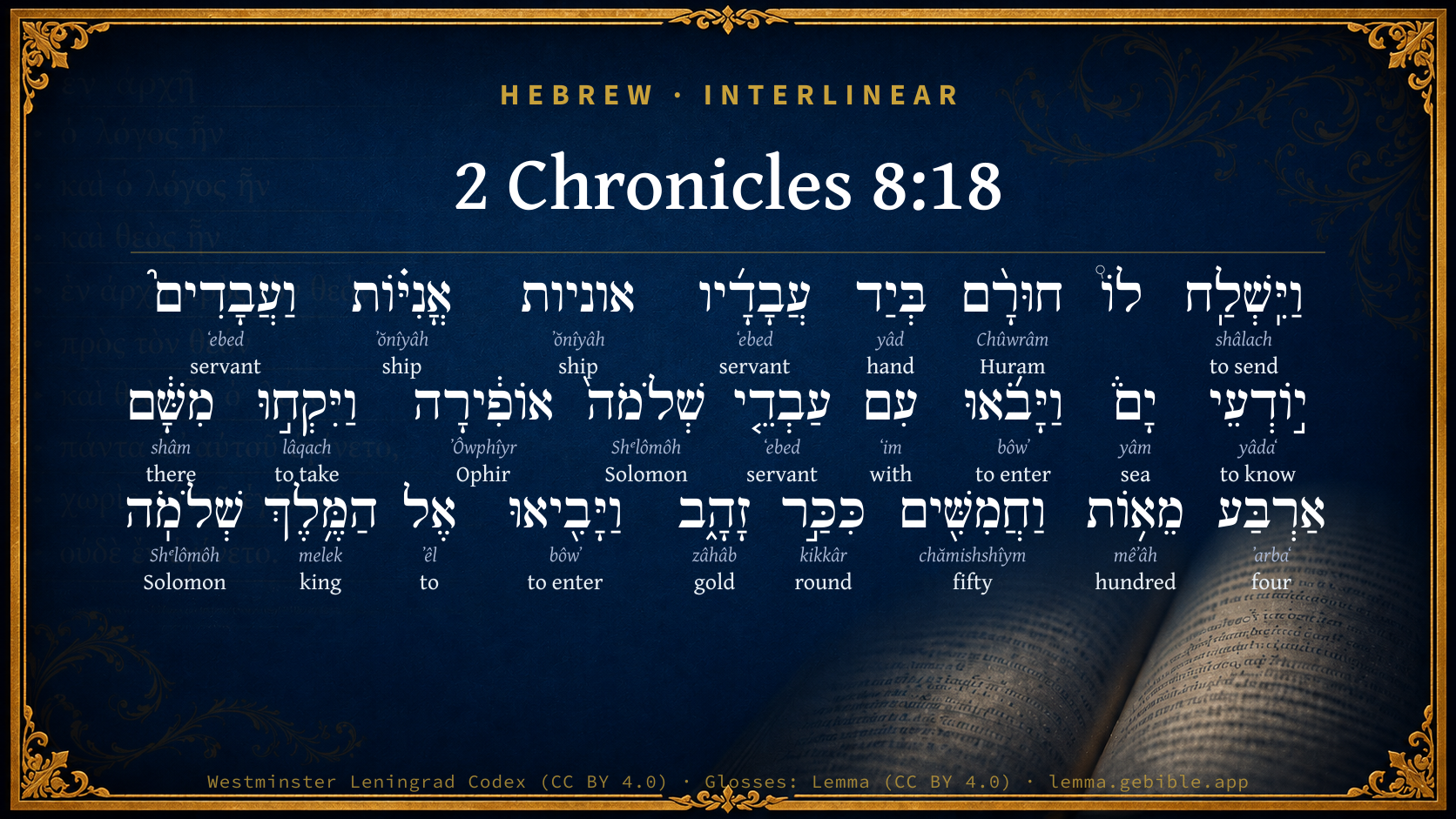
  1. וַיִּֽשְׁלַֽח shâlach H7971 “and · to send” Conjunction + Verb, Qal, Sequential Imperfect, 3rd Person, Masculine, Singular
  2. בְּיַד yâd H3027 “in/at · hand of” Preposition + Noun, Common, Both, Singular, Construct
  3. עֲבָדָ֜יו ʻebed H5650 “servants · his” Noun, Common, Masculine, Plural, Construct + Suffix, Personal, 3rd Person, Masculine, Singular
  4. אוניות ʼŏnîyâh H591 “ships” Noun, Common, Feminine, Plural, Absolute
  5. אֳנִיּ֗וֹת ʼŏnîyâh H591 “ships” Noun, Common, Feminine, Plural, Absolute
  6. וַעֲבָדִים֮ ʻebed H5650 “and · servants” Conjunction + Noun, Common, Masculine, Plural, Absolute
  7. י֣וֹדְעֵי yâdaʻ H3045 “knowing” Verb, Qal, Participle Active, Masculine, Plural, Construct
  8. יָם֒ yâm H3220 “sea” Noun, Common, Masculine, Singular, Absolute
  9. וַיָּבֹ֜אוּ bôwʼ H935 “and · to enter” Conjunction + Verb, Qal, Sequential Imperfect, 3rd Person, Masculine, Plural
  10. עִם ʻim H5973 “with” Preposition
  11. עַבְדֵ֤י ʻebed H5650 “servants of” Noun, Common, Masculine, Plural, Construct
  12. שְׁלֹמֹה֙ Shᵉlômôh H8010 “Solomon” Noun, Proper
  13. אוֹפִ֔ירָה ʼÔwphîyr H211 “Ophir · toward” Noun, Proper + Suffix, Demonstrative
  14. וַיִּקְח֣וּ lâqach H3947 “and · to take” Conjunction + Verb, Qal, Sequential Imperfect, 3rd Person, Masculine, Plural
  15. מִשָּׁ֔ם shâm H8033 “from · there” Preposition + Adverb
  16. אַרְבַּע ʼarbaʻ H702 “four” Adjective, Cardinal number, Feminine, Singular, Absolute
  17. מֵא֥וֹת mêʼâh H3967 “hundred” Adjective, Cardinal number, Both, Plural, Absolute
  18. וַחֲמִשִּׁ֖ים chămishshîym H2572 “and · fifty” Conjunction + Adjective, Cardinal number, Both, Plural, Absolute
  19. כִּכַּ֣ר kikkâr H3603 “round of” Noun, Common, Both, Singular, Construct
  20. זָהָ֑ב zâhâb H2091 “gold” Noun, Common, Masculine, Singular, Absolute
  21. וַיָּבִ֖יאוּ bôwʼ H935 “and · to enter” Conjunction + Verb, Hiphil, Sequential Imperfect, 3rd Person, Masculine, Plural
  22. אֶל ʼêl H413 “to” Preposition
  23. הַמֶּ֥לֶךְ melek H4428 “the · king” Particle, Definite Article + Noun, Common, Masculine, Singular, Absolute
  24. שְׁלֹמֹֽה Shᵉlômôh H8010 “Solomon” Noun, Proper

About this verse

These counts appear in no published source. They are computed here, from the morphology-tagged text and Lemma’s own curated glosses. What Lemma adds →

26
words
20
distinct lemmas
Historical
section

Notable vocabulary

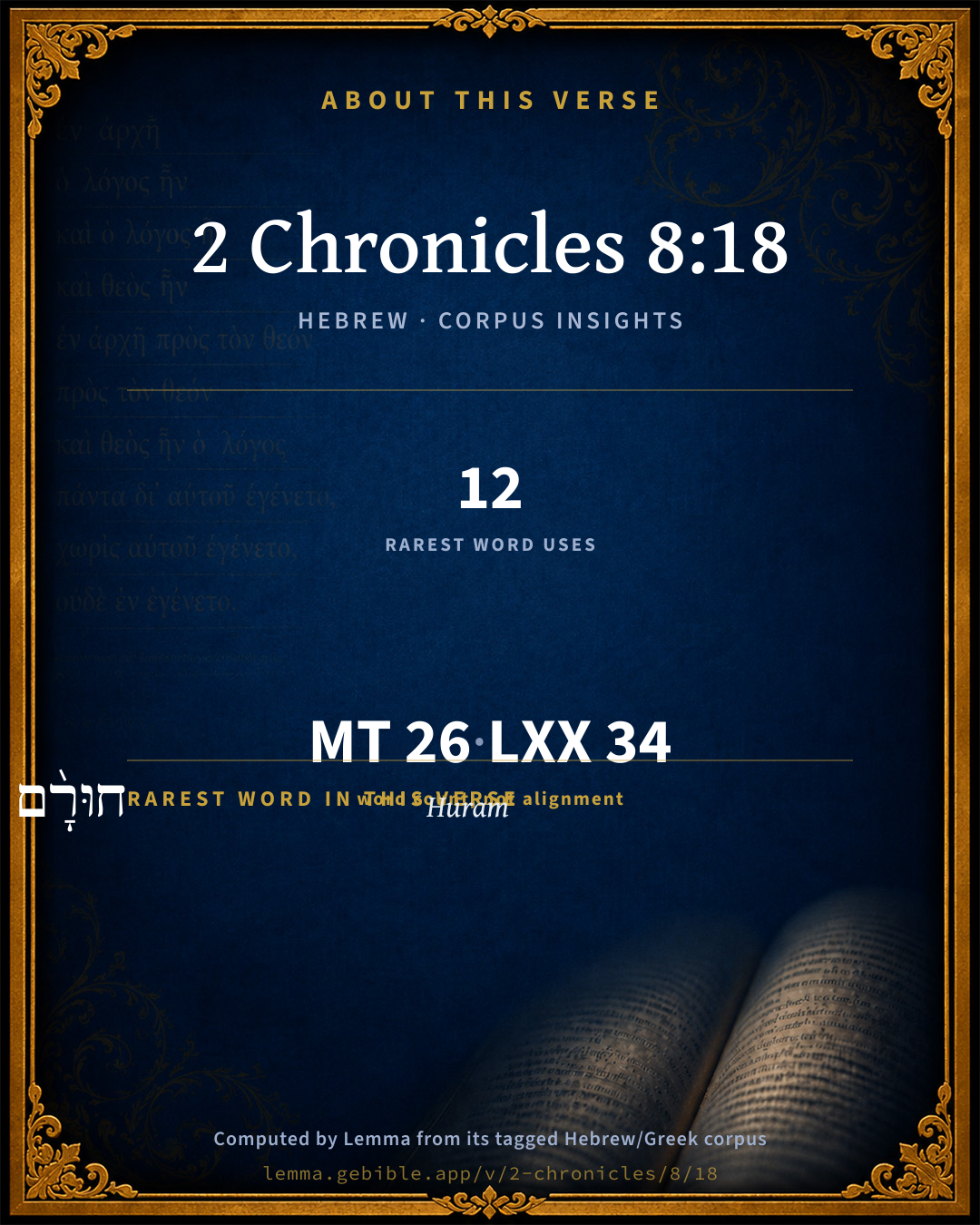
The rarest word here is חוּרָ֨ם Huram H2361 — appearing just 12 times in the whole Hebrew Bible.

Shared distinctive vocabulary

חוּרָ֨ם Huram H2361 occurs in 11 verses of the Hebrew Bible. Also found in:

Grammatical profile

  • 5 verbs
  • 14 nouns
  • 3 adjectives
  • 3 prepositions
  • 1 adverb

Verb forms

  • וַיִּֽשְׁלַֽח Qal · Sequential Imperfect
  • י֣וֹדְעֵי Qal · Participle Active
  • וַיָּבֹ֜אוּ Qal · Sequential Imperfect
  • וַיִּקְח֣וּ Qal · Sequential Imperfect
  • וַיָּבִ֖יאוּ Hiphil · Sequential Imperfect

Repetition

Words recur within this verse — often emphatic in Hebrew:

  • עֲבָדָ֜יו servant H5650 ×3
  • אוניות ship H591 ×2
  • וַיָּבֹ֜אוּ to enter H935 ×2
  • שְׁלֹמֹה֙ Solomon H8010 ×2

Hebrew & Septuagint length

In English translation the verse runs 44 words from the Hebrew and 42 from the Septuagint (LXX English) — closely comparable.

A rough comparison of the two English renderings, which tokenize alike — not a word-level alignment.

Word counts can differ between the Hebrew and the Greek without any difference in meaning — e.g. the Hebrew direct-object marker אֵת has no separate Greek word, and Greek often adds the article ὁ.

In the original languages it is 26 Hebrew tokens and 34 Greek tokens — but the two are counted differently (Hebrew bundles its prefixes and suffixes into one token; the Greek is in lemma form), so that isn’t a like-for-like length.

Cross-references

5

Topical passages linked to 2 Chronicles 8:18 in the Treasury of Scripture Knowledge — connected by theme and wording, ordered by reader-vote popularity; previews shown in the World English Bible.

  • 2 Chronicles 9:10 The servants also of Huram, and the servants of Solomon, who brought gold from Ophir, brought algum trees and precious stones.
  • 2 Chronicles 9:13 Now the weight of gold that came to Solomon in one year was six hundred and sixty-six talents of gold,
  • 1 Kings 9:27–28 Hiram sent in the navy his servants, sailors who had knowledge of the sea, with the servants of Solomon.
  • 1 Kings 10:22 For the king had at sea a navy of Tarshish with the navy of Hiram: once every three years came the navy of Tarshish, bringing gold, and silver, ivory, and apes, and peacocks.
  • Ecclesiastes 2:8 I also gathered silver and gold for myself, and the treasure of kings and of the provinces. I got myself men-singers and women-singers, and the delights of the sons of men--musical instruments, and that of all sorts.

Cross-references courtesy of OpenBible.info (CC BY 4.0).

Hebrew and Greek witnesses Masoretic Hebrew ↔ Greek Septuagint

The same verse in the two great witnesses to the Old Testament, shown verse-for-verse.

These are two independent witnesses, not word-aligned to each other, and the Septuagint is shown in lemma (dictionary) form.

Hebrew 2 Chronicles 8:18 Masoretic · Westminster Leningrad Codex

וַיִּֽשְׁלַֽח לוֹ֩ חוּרָ֨ם בְּיַד עֲבָדָ֜יו אוניות אֳנִיּ֗וֹת וַעֲבָדִים֮ י֣וֹדְעֵי יָם֒ וַיָּבֹ֜אוּ עִם עַבְדֵ֤י שְׁלֹמֹה֙ אוֹפִ֔ירָה וַיִּקְח֣וּ מִשָּׁ֔ם אַרְבַּע מֵא֥וֹת וַחֲמִשִּׁ֖ים כִּכַּ֣ר זָהָ֑ב וַיָּבִ֖יאוּ אֶל הַמֶּ֥לֶךְ שְׁלֹמֹֽה

Huram sent him by the hands of his servants ships, and servants who had knowledge of the sea; and they came with the servants of Solomon to Ophir, and fetched from there four hundred fifty talents of gold, and brought them to king Solomon.

World English Bible · Public Domain

Greek LXX 2 Chronicles 8:18 Septuagint · lemma form

καί ἀποστέλλω χιραμ ἐν χείρ παῖς αὐτός πλοῖον καί παῖς εἶδον θάλασσα καί οἴχομαι μετά ὁ παῖς σαλωμών εἰς σωφιρα καί λαμβάνω ἐκεῖθεν τετρακόσιοι καί πεντήκοντα τάλαντον χρυσίον καί ἔρχομαι πρός ὁ βασιλεύς σαλωμών

And Chiram sent by the hand of his servants ships, and servants skilled in naval affairs; and they went with the servants of Solomon to Sophira, and brought thence four hundred and fifty talents of gold, and they came to king Solomon.

LXX2012 (modern English Septuagint) · Public Domain

On this verse, Ellicott's Commentary for English Readers discusses the Septuagint’s reading. Read the note in Commentary ↓

Hebrew: Westminster Leningrad Codex (CC BY 4.0). Greek: Septuagint (public domain); English from LXX2012 (modern English Septuagint) (Public Domain). How the Septuagint differs from the Hebrew →

Commentary

Notes on 2 Chronicles 8:18 from classic Christian and Jewish commentators (each source and its license shown beneath its notes). The classic Christian expositions comment on the surrounding passage and are grouped to its opening verse, so a note may address several verses; the Jewish commentaries on the Tanakh (Rashi and others) are per-verse, so they appear only where the commentator wrote on this verse.

Lemma curates 59 commentaries, every one of them public domain or Creative Commons licensed, each selected and text-cleaned for this edition rather than reprinted as found. About our sources →

The Biblical Illustrator

Joseph S. Exell

2Ch_8:12; 2Ch_8:18

Then Solomon offered burnt offerings unto the Lord.

Solomons burnt offerings

Solomon was great in burnt offerings. Do not men sometimes make up in burnt offerings what they lack in moral consistency? Is not an ostentatious religion sometimes the best proof of internal decay? It ought not to be so. The outward and inward should correspond. The action should be the incarnation of the thought. It is beautiful to look upon the Church engaged in much church-building and in strenuous endeavours against public sin; yet we must never forget that all this may possibly coexist with internal loss, decay, corruption. All action does not spring from life. Sometimes we try to make up by complex mechanism what is wanting in real vitality. It is often easier to offer burnt offering than to do some deed of moral heroism. (J. Parker, D. D.)

The Biblical Illustrator, edited by Joseph S. Exell (c. 1880s–1900s) — public domain. Text from a community e-Sword module.

Geneva Bible (1599)

Geneva Bible translators

Which sum is thought to mount to three million and six hundred thousand crowns, for here is mention made of thirty more than are spoken of, 1 Kings 9:28.

Geneva Bible (1599) marginal notes — public domain. Text via Bolls.life.

Jamieson, Fausset & Brown

Robert Jamieson, A. R. Fausset & David Brown

Huram sent him . . . ships--either sent him ship-men, able seamen, overland; or, taking the word "sent" in a looser sense, supplied him, that is, built him ships--namely, in docks at Eloth (compare Kg1 9:26-27). This navy of Solomon was manned by Tyrians, for Solomon had no seamen capable of performing distant expeditions. The Hebrew fishermen, whose boats plied on the Sea of Tiberias or coasted the shores of the Mediterranean, were not equal to the conducting of large vessels laden with valuable cargoes on long voyages and through the wide and unfrequented ocean.

four hundred and fifty talents of gold--(Compare Kg1 9:28). The text in one of these passages is corrupt.

Next: 2 Chronicles Chapter 9

Jamieson, Fausset & Brown — Commentary Critical and Explanatory on the Whole Bible (1871) — public domain (CC PDM 1.0). Text via the HelloAO Bible API.

Adam Clarke's Commentary

Verse 18. Knowledge of the sea] Skilful sailors. Solomon probably bore the expenses and his friend, the Tyrian king, furnished him with expert sailors; for the Jews, at no period of their history, had any skill in maritime affairs, their navigation being confined to the lakes of their own country, from which they could never acquire any nautical skill. The Tyrians, on the contrary, lived on and in the sea.

Adam Clarke's Commentary on the Bible (1810–1826) — public domain. Text from a community e-Sword/MySword module.

Ellicott's Commentary for English Readers

(18) And Huram sent him by the hands of his servants ships.—When Solomon began to evince an interest in maritime affairs, his Tyrian ally presented him with a number of vessels and their crews of trained seamen. To what port the vessels were sent is not expressly stated. Probably they put in at Joppa (2Ch_2:16). Others assume the meaning to be that the ships were sent from Tyre to Ezion-geber, and then ask whether they were dragged across the desert which divides the Mediterranean from the gulf of Akaba, or whether they circumnavigated Africa. The dilemma is only apparent. The Greek historians of later times often speak of the transport of ships overland; and the galleys of Solomon’s age were probably small. Even the circumnavigation of Africa was achieved by a Phœnician expedition sent out by Necho about four centuries later (Herod, iv. 42). But neither alternative seems necessary. If Huram provided Solomon with skilled mariners, they would naturally sail from Tyre to Joppa in their own ships. The Tyrian vessels may have been left at Joppa, while a portion of their crews proceeded, by Solomon’s order, to Ezion-geber. In short, “ships and servants” means “ships with servants,” or “ships conveying servants.”

And they went.—Huram’s mariners. Comp. 1Ki_9:27 : “And Huram sent in the fleet (which Solomon had built) his servants, men of ships that had knowledge of the sea.” So the Syr. and Arab. here.

To Ophir.—See 1Ki_9:28. LXX., Sophira.

Fifty.—Kings, twenty. The difference may be due to a scribe’s error, the letter kaf being confused with nun.

A Bible Commentary for English Readers, edited by Charles John Ellicott (1878–1897) — public domain. Text from a community e-Sword module.

The Cambridge Bible for Schools and Colleges

gen. ed. J. J. S. Perowne

18. sent him by the hand of his servants ships] The natural interpretation of these words is that Huram had ships transported overland from the Phœnician coast to the Gulf of Akaba, a difficult but not impossible task. In 1 Kin. however it is merely said that Solomon built ships in Ezion-geber—probably with the help of Huram—and that Huram helped to man them. Probably the text of Chron. should be corrected here from the text of Kings.

18. Ophir] The situation of this oft-mentioned place is not known. It has been identified with some part of the coast (a) of India, (b) of Africa, (c) of Arabia. The last identification is most probable; Ophir appears as the name of an Arabian tribe (Gen_10:29). The name is variously written in the LXX. but usually with an initial “S,” Sophir(a). This form may one day help to identify the place.

four hundred and fifty talents] So LXX., but in 1 Kin. “four hundred and twenty” (so Heb., in LXX. B “a hundred and twenty”).

The Cambridge Bible for Schools and Colleges (gen. ed. J. J. S. Perowne; Cambridge University Press, 1878–1918) — public domain. Text from a community e-Sword module.

Albert Barnes' Notes on the Bible

It has been supposed that these ships were conveyed from Tyre to Ezion-geber, either

(1) round the continent of Africa, or

(2) across the isthmus of Suez.

But the writer probably only means that ships were given by Hiram to Solomon at this time, and in connection with the Ophir enterprise. These vessels may have been delivered at Joppa, and have been there carefully studied by the Jewish shipwrights, who then preceeded to Ezion-geber, and, assisted by Phoenicians, constructed ships after their pattern.

Four hundred and fifty talents - “Four hundred and twenty talents” in Kings 1Ki 9:28. One or other of the two texts has suffered from that corruption to which numbers are so especially liable.

Albert Barnes' Notes on the Bible (1834–1885) — public domain. Text from a community e-Sword/MySword module.

Haydock's Catholic Bible Commentary

Ships; not perhaps from Tyre, but from the Red Sea. (Calmet) --- Others think that he sent them by a canal, which opened a communication between the Mediterranean and Suez, (Huet) the distance of about ninety miles. (Pliny, [Natural History?] ii. 68.) --- But this canal seems to have been made after the age of Solomon. Hence others imagine that the ships were taken in pieces, or conveyed by land, as has been sometimes done. Mahomet II transported ships across the isthmus of Corinth. Alexander the Great conveyed on chariots the ships which had been used to cross the Indus, as far as the Hydaspes. (Arrian vii.) (Calmet) --- Skilful mariners. They were the most expert, and the inventers of navigation. Prima ratem ventis tradere docta Tyrus. (Tibul.) See Wisdom xiv. 6. --- Ophir, the kingdom of Pegu, in the East Indies, (Tirinus) or some other distant land. (Haydock) --- Fifty. Thirty are omitted, 3 Kings ix. 28., as they were expended in the voyage. (Calmet) --- Yet the Hebrew letters for twenty and fifty are extremely similar. (Du Hamel)

George Leo Haydock (1774–1849), Haydock's Catholic Family Bible and Commentary, 1859 edition — public domain. Excludes Psalms (Douay-Rheims chapter numbering differs from Protestant) and Deuterocanonical books (Catholic canon only).

The Pulpit Commentary

The first impression created on reading this verse no doubt would he that Hiram sent ships to Solomon, at Ezion-geber and Eloth. But it is almost impossible to see how he could do so. The parallel much helps us, by saying that "Solomon made a navy," and Hiram assisted. by manning it with competent sailors; he "sent in the navy his servants," etc.. (1Ki_9:26, 1Ki_9:27) Some have suggested that the explanation is that Hiram gave materials, workmen, and models for Solomon"s ships, possibly having ships lying in the Red Sea. The parallel, however, meets all difficulties, and saves the necessity of going far for farfetched explanations. Ophir. This was the name of the son of Joktan, (Gen_10:25-29) who, it is supposed, gave his name to the place or land in the south of Arabia. It is still quite an unsettled question, however, where Ophir was situated, though an Arabian situation is on every account the most probable (see Exposition 1Ch_29:4; and Dr. Smith"s "Bible Dictionary," 2:637-642). Our four hundred and fifty talents of gold reads in the parallel (1Ki_9:28) as "four hundred and twenty."

The Pulpit Commentary (1880–1919), ed. H.D.M. Spence-Jones & Joseph S. Exell — public domain. Text from a community e-Sword module.

Lesson kit

Teaching starters — assembled from the data on this page, not authored interpretation. Every prompt links to the verse data it draws on. Edit before teaching.

2 Chronicles, in the Historical, opens this verse with 26 words (20 distinct Hebrew lemmas). Its most distinctive word is Chûwrâm (“Huram”). A historical commentator’s framing appears above. Read the whole chapter for the surrounding context.

Discussion questions

  1. What does “Huram” (Chûwrâm) contribute to the verse as a whole?
  2. How does 1 Chronicles 8:5, which shares the word «Huram», read alongside this verse?
  3. What does the repetition of “servant” (3× in this one verse) do in this verse?
  4. These translations render this verse differently; the difference is in the English rendering, not the original. What questions does that raise?
  5. «וַיִּֽשְׁלַֽח» is a Qal Sequential Imperfect verb. How does that grammatical form shape the action described?
  6. Compare how The Biblical Illustrator and Geneva Bible (1599) read this verse. Where do they agree or differ?

Things to notice

Reading settings

Reading text

Shown beneath each verse's original-language words.

Old Testament
Old Testament edition

Read the OT as the Masoretic Hebrew (MT) or the Greek Septuagint (LXX).

English shown for the Greek Septuagint (in the Hebrew ↔ Greek comparison).

Comparing translations? Open the Compare panel on any verse page to stack up to four side by side.