Joshua 18:15

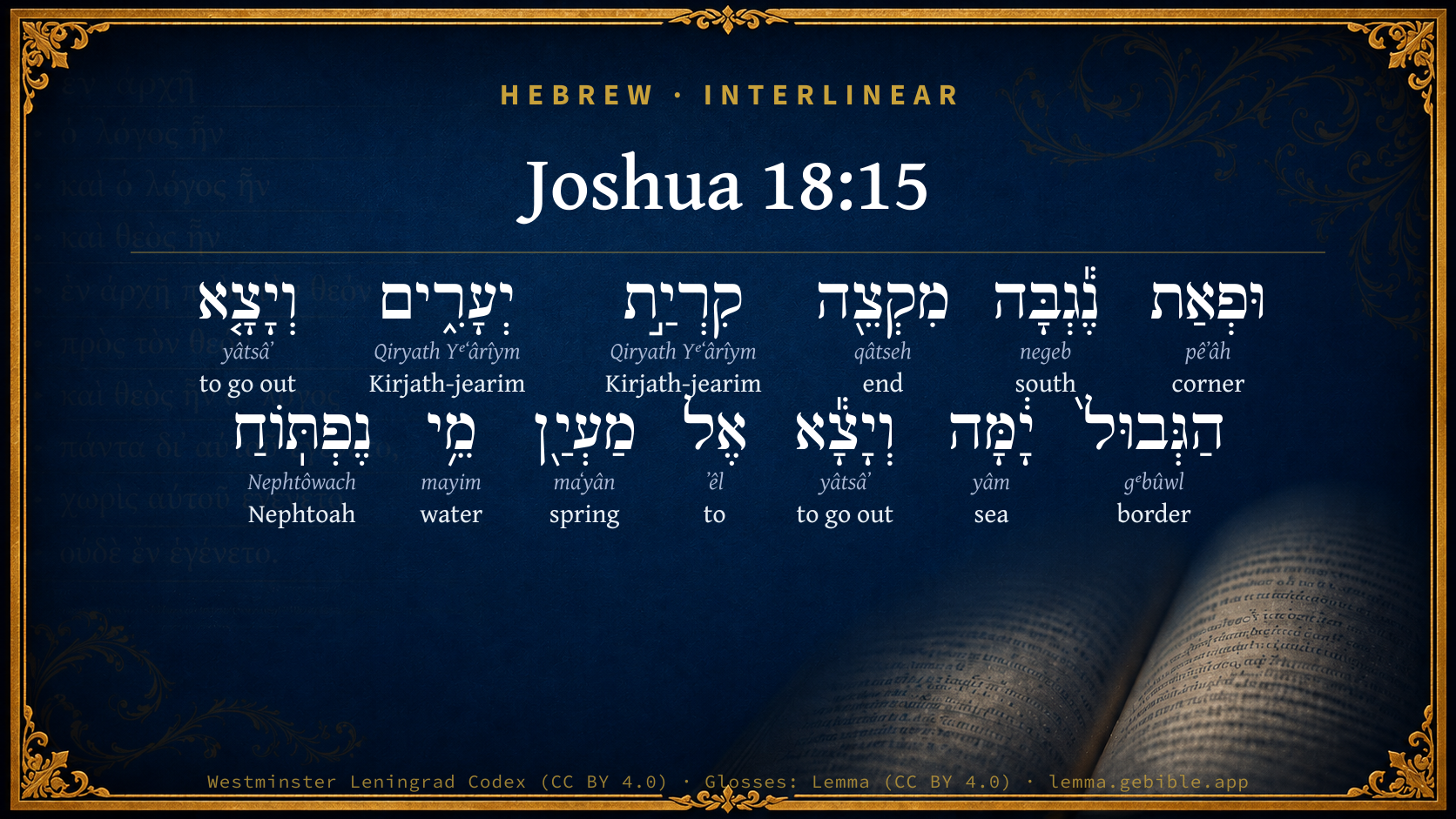
Hebrew (Westminster Leningrad Codex) Joshua 18:15 appears in the Hebrew Old Testament. The text above is from the Westminster Leningrad Codex. Each word links to its Strong’s number, a concise gloss, and parsing drawn from the Open Scriptures Hebrew Bible morphology. Click any word for its full Brown-Driver-Briggs (BDB) entry.
Download image
Cite this verse

Joshua 18:15 (World English Bible). Public Domain. Lemma interlinear Bible study tool, https://lemma.gebible.app/v/joshua/18/15.

Show BibTeX & RIS
BibTeX
RIS
English Translation
The south quarter was from the uttermost part of Kiriath Jearim; and the border went out westward, and went out to the spring of the waters of Nephtoah;
World English Bible · Public Domain
Download a study sheet

One document with this verse’s original text, its word-by-word gloss line, the meaning frame, cross-references with their text, attributed commentary, and full source and license credits — printable, and it pastes into notes with its structure intact.

This verse Autodidact and up

Study sheet (.html) Plain text (.txt)

A passage Seminary Student

Up to 50 verses in one chapter. A passage sheet keeps up to 6 commentary sources and 12 cross-references per verse, in the order this page ranks them, and says so on the sheet whenever that leaves anything out. Ask for a single verse and you get the Autodidact verse sheet above.

Everything on this page stays free to read, with no account — the sheet is a download of what is already on screen, not access to it.

Want to remove ads? Support Godless Engineer
Compare translations 3

The same verse in 3 English versions, stacked beneath the original-language interlinear above. Click any original word for its lexicon entry.

Each is an independent rendering of the whole verse — the interlinear is not word-aligned to these translations.

Highlighted words mark where these versions differ — a whole-verse word diff, not a word-by-word alignment.

  • World English Bible Public Domain
    The south quarter was from the uttermost part of Kiriath Jearim; and the border went out westward, and went out to the spring of the waters of Nephtoah;
  • King James Version Public Domain
    And the south quarter was from the end of Kirjathjearim, and the border went out on the west, and went out to the well of waters of Nephtoah:
  • unfoldingWord Literal Text CC BY-SA 4.0
    And the mouth southward was from the end of Kiriath Jearim. And the border went out seaward and went out to the spring of the waters of Nephtoah.

unfoldingWord Literal Text — © unfoldingWord, licensed CC BY-SA 4.0. Word-aligned USFM3 via Door43 (git.door43.org/unfoldingWord/en_ult).

Versions to compare (up to 4)

3 of 4 selected

Show all 18 translations

Every available English version of this verse, each an independent rendering of the whole verse.

  • World English Bible Public Domain
    The south quarter was from the uttermost part of Kiriath Jearim; and the border went out westward, and went out to the spring of the waters of Nephtoah;
  • Berean Standard Bible Public Domain
    On the south side the border began at the outskirts of Kiriath-jearim and extended westward to the spring at the Waters of Nephtoah.
  • Majority Standard Bible Public Domain
    On the south side the border began at the outskirts of Kiriath-jearim and extended westward to the spring at the Waters of Nephtoah.
  • King James Version Public Domain
    And the south quarter was from the end of Kirjathjearim, and the border went out on the west, and went out to the well of waters of Nephtoah:
  • American Standard Version (1901) Public Domain
    And the south quarter was from the uttermost part of Kiriath-jearim; and the border went out westward, and went out to the fountain of the waters of Nephtoah;
  • Revised Version (1885) Public Domain
    And the south quarter was from the uttermost part of Kirjath-jearim, and the border went out westward, and went out to the fountain of the waters of Nephtoah:
  • Geneva Bible (1599) Public Domain
    And the Southquarter is from the ende of Kiriath-iearim, and this border goeth out Westward, and commeth to the fountaine of waters of Nephtoah.
  • Douay-Rheims (1899) Public Domain
    And it bendeth thence going round towards the sea, south of the mountain that looketh towards Beth-horon to the southwest: and the outgoings thereof are into Cariathbaal, which is called also Cariathiarim, a city of the children of Juda. This is their coast towards the sea, westward.
  • Young's Literal Translation Public Domain
    And the south quarter `is' from the end of Kirjath-Jearim, and the border hath gone out westward, and gone out unto the fountain of the waters of Nephtoah;
  • Literal Standard Version CC BY-SA 4.0
    And the south quarter [is] from the end of Kirjath-Jearim, and the border has gone out westward, and has gone out to the fountain of the waters of Nephtoah;
  • Unlocked Literal Bible CC BY-SA 4.0
    The south side began just outside of Kiriath Jearim. The border went from there to Ephron, to the spring of the waters of Nephtoah.
  • unfoldingWord Literal Text CC BY-SA 4.0
    And the mouth southward was from the end of Kiriath Jearim. And the border went out seaward and went out to the spring of the waters of Nephtoah.
  • Darby Bible Public Domain
    -- And the south side was from the extreme end of Kirjath-jearim, and the border went out on the west, and went out to the spring of the waters of Nephtoah.
  • World Messianic Bible Public Domain
    The south quarter was from the farthest part of Kiriath Jearim. The border went out westward, and went out to the spring of the waters of Nephtoah.
  • Webster's Bible Public Domain
    And the south quarter was from the end of Kirjah-jearim, and the border went out on the west, and went out to the well of waters of Nephtoah:
  • Free Bible Version CC BY-SA 4.0
    The southern boundary began at the edge of Kiriath-jearim. It ran to the spring at Nephtoah,
  • Bible in Basic English Public Domain
    And the south part is from the farthest point of Kiriath-jearim, and the line goes out to the west to the fountain of the waters of Nephtoah:
  • JPS Tanakh (1917) Public Domain
    And the south side was from the uttermost part of Kiriath-jearim, and the border went out westward, and went out to the fountain of the waters of Nephtoah.

Literal Standard Version (2020), Covenant Press — licensed CC BY-SA 4.0. Text via the HelloAO Bible API (eBible.org). Unlocked Literal Bible (unfoldingWord) — licensed CC BY-SA 4.0. Text via the HelloAO Bible API (eBible.org). unfoldingWord Literal Text — © unfoldingWord, licensed CC BY-SA 4.0. Word-aligned USFM3 via Door43 (git.door43.org/unfoldingWord/en_ult). Free Bible Version, Dr. Jonathan Gallagher — licensed CC BY-SA 4.0. Text via the HelloAO Bible API (eBible.org).

Word by word

More ways to search: Search by grammar → Find every occurrence → Compare this word →

Practice this passage: Drill this verse → Learn its vocabulary →

נֶפְתּֽוֹחַ
Nephtôwach
H5318
“Nephtoah”
Noun, Proper
Part of Speech
Noun
Type
Proper
Full BDB Definition

Origin: from H6605

TWOT: None

Nephtoah = "opening" - a spring or source of water on the boundary of the territories of Judah and Benjamin; located northwest of Jerusalem
  1. וּפְאַת pêʼâh H6285 “and · corner of” Conjunction + Noun, Common, Feminine, Singular, Construct
  2. נֶ֕גְבָּה negeb H5045 “south · toward” Noun, Common, Masculine, Singular, Absolute + Suffix, Demonstrative
  3. מִקְצֵ֖ה qâtseh H7097 “from · end of” Preposition + Noun, Common, Both, Singular, Construct
  4. קִרְיַ֣ת Qiryath Yᵉʻârîym H7157 “Kirjath-jearim” Noun, Proper
  5. יְעָרִ֑ים Qiryath Yᵉʻârîym H7157 “Kirjath-jearim” Noun, Proper
  6. וְיָצָ֤א yâtsâʼ H3318 “and · to go out” Conjunction + Verb, Qal, Sequential Perfect, 3rd Person, Masculine, Singular
  7. הַגְּבוּל֙ gᵉbûwl H1366 “the · border” Particle, Definite Article + Noun, Common, Masculine, Singular, Absolute
  8. יָ֔מָּה yâm H3220 “sea · toward” Noun, Common, Masculine, Singular, Absolute + Suffix, Demonstrative
  9. וְיָצָ֕א yâtsâʼ H3318 “and · to go out” Conjunction + Verb, Qal, Sequential Perfect, 3rd Person, Masculine, Singular
  10. אֶל ʼêl H413 “to” Preposition
  11. מַעְיַ֖ן maʻyân H4599 “spring of” Noun, Common, Masculine, Singular, Construct
  12. מֵ֥י mayim H4325 “water(s) of” Noun, Common, Masculine, Plural, Construct

About this verse

These counts appear in no published source. They are computed here, from the morphology-tagged text and Lemma’s own curated glosses. What Lemma adds →

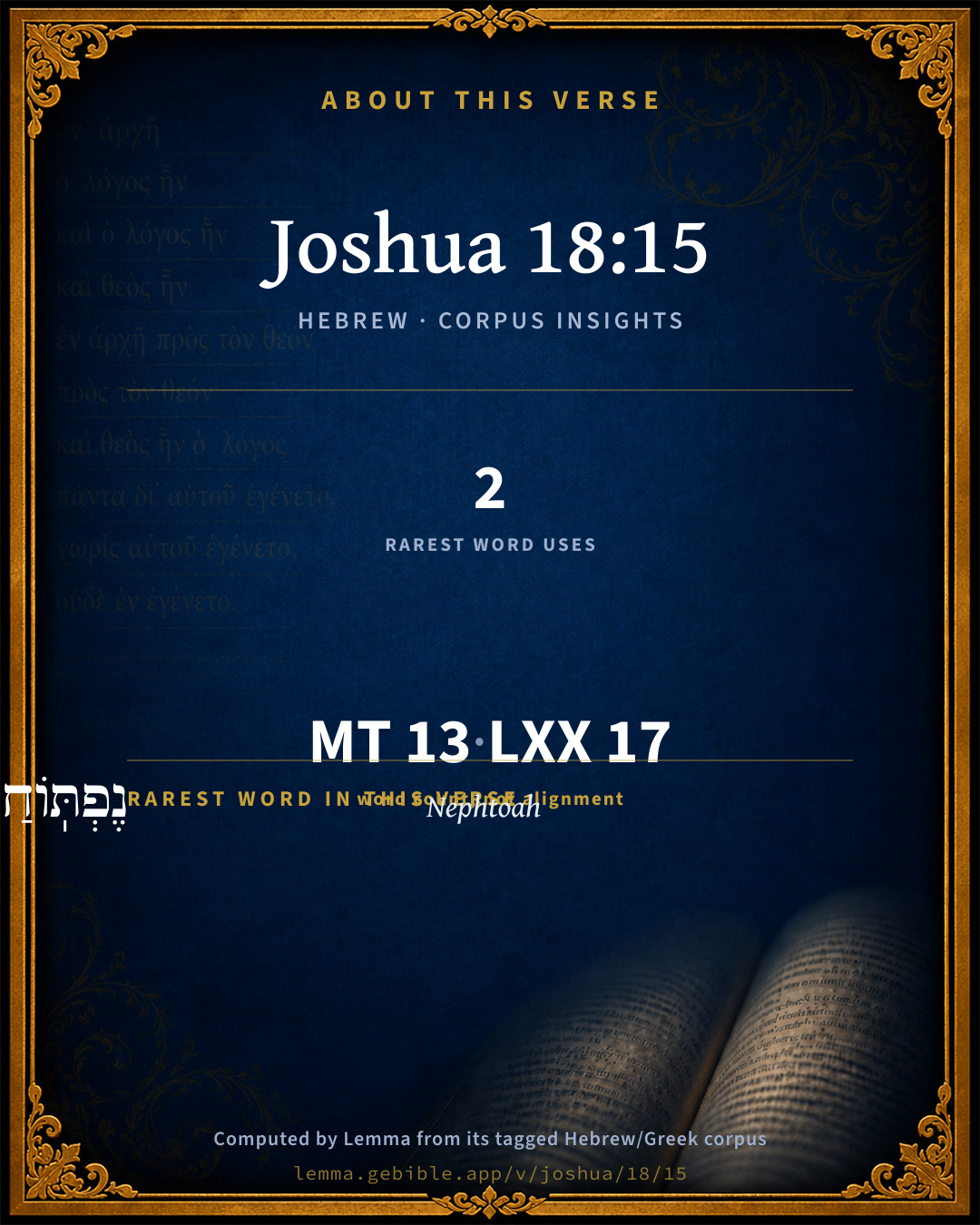
13
words
11
distinct lemmas
Historical
section

Notable vocabulary

The rarest word here is נֶפְתּֽוֹחַ Nephtoah H5318 — appearing just 2 times in the whole Hebrew Bible.

Shared distinctive vocabulary

נֶפְתּֽוֹחַ Nephtoah H5318 occurs in 2 verses of the Hebrew Bible. Also found in:

Grammatical profile

  • 2 verbs
  • 10 nouns
  • 1 preposition

Verb forms

  • וְיָצָ֤א Qal · Sequential Perfect
  • וְיָצָ֕א Qal · Sequential Perfect

Repetition

Words recur within this verse — often emphatic in Hebrew:

  • קִרְיַ֣ת Kirjath-jearim H7157 ×2
  • וְיָצָ֤א to go out H3318 ×2

Hebrew & Septuagint length

In English translation the verse runs 28 words from the Hebrew and 25 from the Septuagint (LXX English) — closely comparable.

A rough comparison of the two English renderings, which tokenize alike — not a word-level alignment.

Word counts can differ between the Hebrew and the Greek without any difference in meaning — e.g. the Hebrew direct-object marker אֵת has no separate Greek word, and Greek often adds the article ὁ.

In the original languages it is 13 Hebrew tokens and 17 Greek tokens — but the two are counted differently (Hebrew bundles its prefixes and suffixes into one token; the Greek is in lemma form), so that isn’t a like-for-like length.

Cross-references

1

Topical passages linked to Joshua 18:15 in the Treasury of Scripture Knowledge — connected by theme and wording, ordered by reader-vote popularity; previews shown in the World English Bible.

  • Joshua 15:9 and the border extended from the top of the mountain to the spring of the waters of Nephtoah, and went out to the cities of Mount Ephron; and the border extended to Baalah (the same is Kiriath Jearim);

Cross-references courtesy of OpenBible.info (CC BY 4.0).

Hebrew and Greek witnesses Masoretic Hebrew ↔ Greek Septuagint

The same verse in the two great witnesses to the Old Testament, shown verse-for-verse.

These are two independent witnesses, not word-aligned to each other, and the Septuagint is shown in lemma (dictionary) form.

Hebrew Joshua 18:15 Masoretic · Westminster Leningrad Codex

וּפְאַת נֶ֕גְבָּה מִקְצֵ֖ה קִרְיַ֣ת יְעָרִ֑ים וְיָצָ֤א הַגְּבוּל֙ יָ֔מָּה וְיָצָ֕א אֶל מַעְיַ֖ן מֵ֥י נֶפְתּֽוֹחַ

The south quarter was from the uttermost part of Kiriath Jearim; and the border went out westward, and went out to the spring of the waters of Nephtoah;

World English Bible · Public Domain

Greek LXX Joshua 18:15 Septuagint · lemma form

καί μέρος ὁ πρός λίψ ἀπό μέρος καριαθβααλ καί διαἔρχομαι ὅριον εἰς γασιν ἐπί πηγή ὕδωρ ναφθω

And the south side on the part of Cariath-Baal; and the borders shall go across to Gasin, to the fountain of the water of Naphtho.

LXX2012 (modern English Septuagint) · Public Domain

Hebrew: Westminster Leningrad Codex (CC BY 4.0). Greek: Septuagint (public domain); English from LXX2012 (modern English Septuagint) (Public Domain). How the Septuagint differs from the Hebrew →

Targum (Aramaic paraphrase)

1

The Targum is the ancient Jewish Aramaic paraphrase of the Hebrew Scriptures — an interpretive translation, not the Hebrew text itself. Onkelos (literal) and Pseudo-Jonathan (expansive) render the Torah, and Jonathan the Prophets. Coverage is partial: where no permissively-licensed English translation exists for a verse, only the Aramaic is shown. This is verse-level text, not a word-by-word alignment to the Hebrew.

  1. Targum Jonathan Prophets (Joshua–Malachi)
    וְרוּחַ דָרוֹמָא מִסְיָפֵי קִרְיַת יְעָרִים וְנָפַק תְּחוּמָא לְיַמָא וְנָפֵיק לְמַבּוּעֵי מֵי נֶפְתּוֹחַ:

    (no public-domain English translation for this verse)

    Targum Jonathan — Aramaic: “Mikraot Gedolot” (public domain). English: “Sefaria Community Translation” (CC0 1.0 (public-domain dedication)); “London "Chaldee Paraphrase," 1871” (public domain). Text via Sefaria.

Commentary

Notes on Joshua 18:15 from classic Christian and Jewish commentators (each source and its license shown beneath its notes). The classic Christian expositions comment on the surrounding passage and are grouped to its opening verse, so a note may address several verses; the Jewish commentaries on the Tanakh (Rashi and others) are per-verse, so they appear only where the commentator wrote on this verse.

Lemma curates 59 commentaries, every one of them public domain or Creative Commons licensed, each selected and text-cleaned for this edition rather than reprinted as found. About our sources →

Geneva Bible (1599)

Geneva Bible translators

Or, to the sea.

Geneva Bible (1599) marginal notes — public domain. Text via Bolls.life.

The Cambridge Bible for Schools and Colleges

gen. ed. J. J. S. Perowne

15. And the south quarter] This coincides exactly with the northern border of Judah, for which see above, Jos_15:5-9.

The Cambridge Bible for Schools and Colleges (gen. ed. J. J. S. Perowne; Cambridge University Press, 1878–1918) — public domain. Text from a community e-Sword module.

John Gill's Exposition

And the south quarter was from the end of Kirjathjearim,.... Where the western quarter ended:

and the border went out on the west; not directly south, but somewhat westerly. It is, in the original, "the sea", and should be rendered, "from the sea", or "from the west" (m); and Jarchi confesses his ignorance, and says, I know not what sea it is; and well he might, for there was no sea here; but the Mediterranean sea, being to the west of the land of Israel, it is often used for the west in the Hebrew language, and so here:

and went out to the well of waters of Nephtoah; See Gill on Jos 15:9;

(m) "a mari", Masius; "ab occidente", Noldius, No. 1083. p. 239.

John Gill's Exposition of the Whole Bible (1746–1763) — public domain (CC PDM 1.0). Text via the HelloAO Bible API.

Haydock's Catholic Bible Commentary

Sea, on the west. (Haydock) --- The northern limits of Juda form the southern ones of Benjamin, only here Josue proceeds in a contrary direction, from west to east. (Menochius) See chap. xv. 5, 8.

George Leo Haydock (1774–1849), Haydock's Catholic Family Bible and Commentary, 1859 edition — public domain. Excludes Psalms (Douay-Rheims chapter numbering differs from Protestant) and Deuterocanonical books (Catholic canon only).

Matthew Poole's English Annotations

The south quarter; the same with the north quarter of Judah. See Jos 15:5,6,11.

Matthew Poole's English Annotations on the Holy Bible (1683–1685) — public domain. Text from a community e-Sword/MySword module.

Whedon's Commentary on the Bible

Daniel D. Whedon

15. End of Kirjath-jearim — The extreme western suburbs of the town. The suburbs of the Levitical cities were a thousand cubits from the outer wall, or nearly half a mile, and the suburbs of Kirjath-jearim may have extended much further. This will explain the obscure statement that follows: the border went out on the west, or seaward. That is, the southern border of Benjamin, starting from Kirjath, ran first westward to the extreme suburbs of the city, perhaps a mile or two: then, starting again from the city, it ran eastward, and was identical with the northern border of Judah. See notes on Jos_15:5-9.

Daniel D. Whedon (gen. ed.), Commentary on the Old and New Testaments (1874–1909) — public domain. Text from a community e-Sword module.

unfoldingWord translationNotes

Door43 World Missions Community

Kiriath Jearim ... Ephron ... Nephtoah ... Ben Hinnom ... Rephaim ... Hinnom ... En Rogel

These are the names of places. (See: How to Translate Names)

translationWords

fountain

water

Jebus

unfoldingWord translationNotes — © Distant Shores Media and the Door43 World Missions Community, licensed CC BY-SA 4.0. Source: git.door43.org/Door43/en_tn.

Rashi

Rabbi Shlomo Yitzchaki (Rashi)

And the southern side— Referring to the southern border of Binyomin which is identical with the northern border of Yehudah. All the borders that are listed here are listed relative to the north of Yehudah, and every place described here as descending, is described in reference to Yehudah as going up because here he is listing [boundaries] from west to east and there he lists them from east to west.

And the boundary extended to the sea— to a sea, but I do not know which sea it is.

Rashi on the Tanakh — English translations: “The Judaica Press complete Tanach with Rashi, translated by A. J. Rosenberg” (CC BY 4.0); “Pentateuch with Rashi's commentary by M. Rosenbaum and A.M. Silbermann, 1929-1934” (public domain); “The Metsudah Tanach series, Lakewood, N.J” (CC BY 4.0); and “The Book of Joshua, Metsudah Publications, 1997” (CC BY 4.0). Text via Sefaria.

Lesson kit

Teaching starters — assembled from the data on this page, not authored interpretation. Every prompt links to the verse data it draws on. Edit before teaching.

Joshua, in the Historical, opens this verse with 13 words (11 distinct Hebrew lemmas). Its most distinctive word is Nephtôwach (“Nephtoah”). A historical commentator’s framing appears above. Read the whole chapter for the surrounding context.

Discussion questions

  1. The word Nephtôwach carries the sense “Nephtoah.” How does it shape the verse?
  2. How does Joshua 15:9, which shares the word «Nephtoah», read alongside this verse?
  3. What does the repetition of “Kirjath-jearim” (2× in this one verse) do in this verse?
  4. The translations on this page render this verse differently — a whole-verse word diff, not a word-by-word alignment. What might account for the different wordings?
  5. «וְיָצָ֤א» is a Qal Sequential Perfect verb. How does that grammatical form shape the action described?
  6. Compare how Geneva Bible (1599) and The Cambridge Bible for Schools and Colleges read this verse. Where do they agree or differ?

Things to notice

Reading settings

Reading text

Shown beneath each verse's original-language words.

Old Testament
Old Testament edition

Read the OT as the Masoretic Hebrew (MT) or the Greek Septuagint (LXX).

English shown for the Greek Septuagint (in the Hebrew ↔ Greek comparison).

Comparing translations? Open the Compare panel on any verse page to stack up to four side by side.