
2 Chronicles 4:2

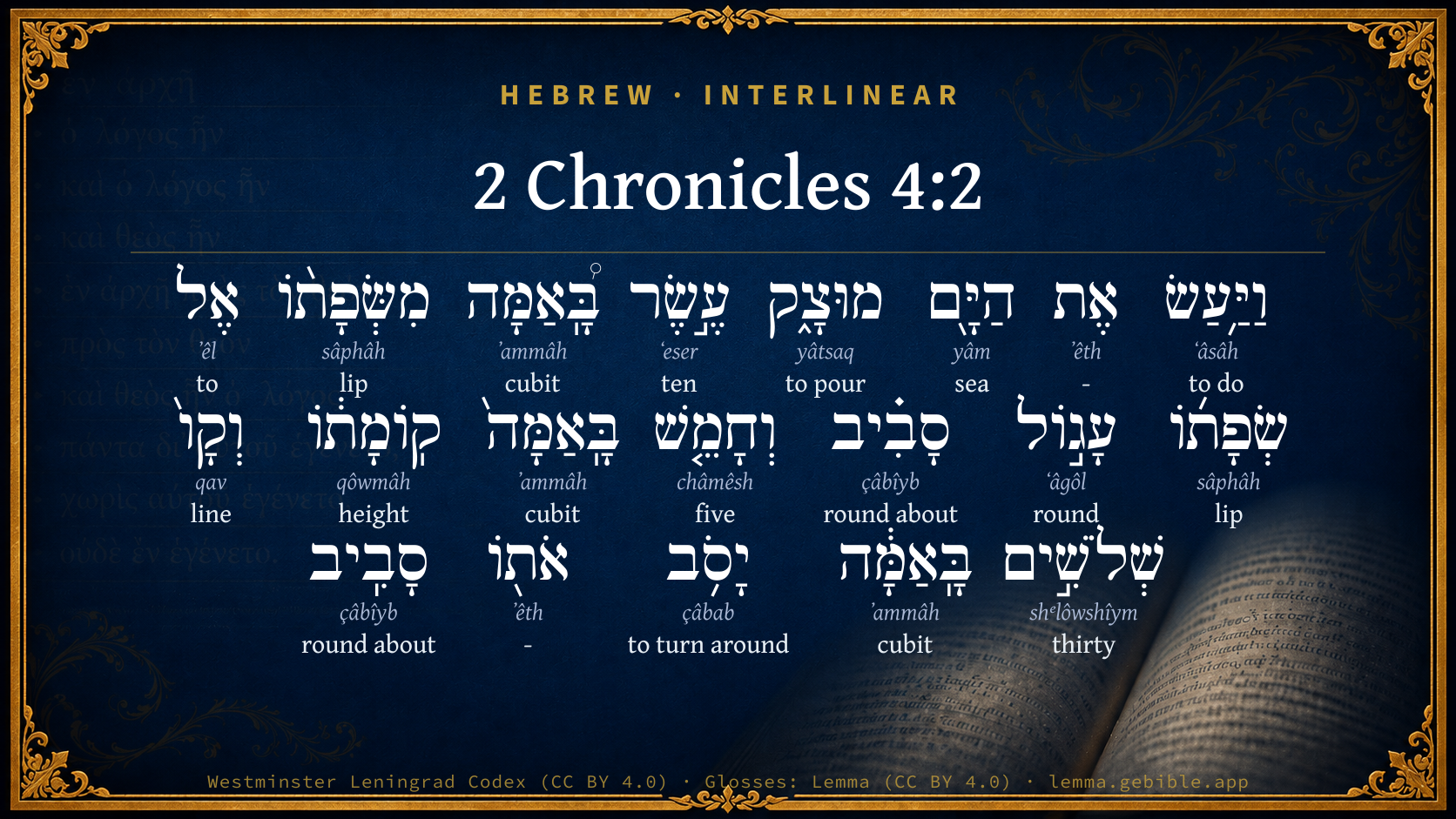
Hebrew (Westminster Leningrad Codex) 2 Chronicles 4:2 appears in the Hebrew Old Testament. The text above is from the Westminster Leningrad Codex. Each word links to its Strong’s number, a concise gloss, and parsing drawn from the Open Scriptures Hebrew Bible morphology. Click any word for its full Brown-Driver-Briggs (BDB) entry.
Download image
Cite this verse

2 Chronicles 4:2 (World English Bible). Public Domain. Lemma interlinear Bible study tool, https://lemma.gebible.app/v/2-chronicles/4/2.

Show BibTeX & RIS
BibTeX
RIS
English Translation
Also he made the molten sea of ten cubits from brim to brim, round in compass; and the height of it was five cubits; and a line of thirty cubits compassed it round about.
World English Bible · Public Domain
Download a study sheet

One document with this verse’s original text, its word-by-word gloss line, the meaning frame, cross-references with their text, attributed commentary, and full source and license credits — printable, and it pastes into notes with its structure intact.

This verse Autodidact and up

Study sheet (.html) Plain text (.txt)

A passage Seminary Student

Up to 50 verses in one chapter. A passage sheet keeps up to 6 commentary sources and 12 cross-references per verse, in the order this page ranks them, and says so on the sheet whenever that leaves anything out. Ask for a single verse and you get the Autodidact verse sheet above.

Everything on this page stays free to read, with no account — the sheet is a download of what is already on screen, not access to it.

Want to remove ads? Support Godless Engineer
Compare translations 3

The same verse in 3 English versions, stacked beneath the original-language interlinear above. Click any original word for its lexicon entry.

Each is an independent rendering of the whole verse — the interlinear is not word-aligned to these translations.

Highlighted words mark where these versions differ — a whole-verse word diff, not a word-by-word alignment.

  • World English Bible Public Domain
    Also he made the molten sea of ten cubits from brim to brim, round in compass; and the height of it was five cubits; and a line of thirty cubits compassed it round about.
  • King James Version Public Domain
    Also he made a molten sea of ten cubits from brim to brim, round in compass, and five cubits the height thereof; and a line of thirty cubits did compass it round about.
  • unfoldingWord Literal Text CC BY-SA 4.0
    And he made the Sea of cast metal, 10 by the cubit from its edge to its edge, round, all around, and 5 by the cubit its height; and a measuring string 30 by the cubit surrounding it all around.

unfoldingWord Literal Text — © unfoldingWord, licensed CC BY-SA 4.0. Word-aligned USFM3 via Door43 (git.door43.org/unfoldingWord/en_ult).

Versions to compare (up to 4)

3 of 4 selected

Show all 17 translations

Every available English version of this verse, each an independent rendering of the whole verse.

  • World English Bible Public Domain
    Also he made the molten sea of ten cubits from brim to brim, round in compass; and the height of it was five cubits; and a line of thirty cubits compassed it round about.
  • Berean Standard Bible Public Domain
    He also made the Sea of cast metal. It was circular in shape, measuring ten cubits from rim to rim, five cubits in height, and thirty cubits in circumference.
  • Majority Standard Bible Public Domain
    He also made the Sea of cast metal. It was circular in shape, measuring ten cubits from rim to rim, five cubits in height, and thirty cubits in circumference.
  • King James Version Public Domain
    Also he made a molten sea of ten cubits from brim to brim, round in compass, and five cubits the height thereof; and a line of thirty cubits did compass it round about.
  • American Standard Version (1901) Public Domain
    Also he made the molten sea of ten cubits from brim to brim, round in compass; and the height thereof was five cubits; and a line of thirty cubits compassed it round about.
  • Revised Version (1885) Public Domain
    Also he made the molten sea of ten cubits from brim to brim, round in compass, and the height thereof was five cubits; and a line of thirty cubits compassed it round about.
  • Geneva Bible (1599) Public Domain
    And he made a molten Sea of ten cubites from brim to brim, rounde in compasse, and fiue cubites hie: and a line of thirtie cubites did compasse it about.
  • Young's Literal Translation Public Domain
    And he maketh the molten sea; ten by the cubit, from its edge unto its edge, round in compass, and five by the cubit its height, and a line of thirty by the cubit doth compass it, round about.
  • Literal Standard Version CC BY-SA 4.0
    And he makes the molten sea; ten by the cubit, from its edge to its edge, round in encompassment, and its height [is] five by the cubit, and a line of thirty by the cubit surrounds it around.
  • Unlocked Literal Bible CC BY-SA 4.0
    He also made the round sea of cast metal, ten cubits from brim to brim. Its height was five cubits, and the sea was thirty cubits in circumference.
  • unfoldingWord Literal Text CC BY-SA 4.0
    And he made the Sea of cast metal, 10 by the cubit from its edge to its edge, round, all around, and 5 by the cubit its height; and a measuring string 30 by the cubit surrounding it all around.
  • Darby Bible Public Domain
    And he made the sea, molten, ten cubits from brim to brim, round all about; and its height was five cubits; and a line of thirty cubits encompassed it round about.
  • World Messianic Bible Public Domain
    Also he made the molten sea of ten cubits from brim to brim. It was round, five cubits high, and thirty cubits in circumference.
  • Webster's Bible Public Domain
    Also he made a molten sea of ten cubits from brim to brim, round in compass, and five cubits the hight of it; and a line of thirty cubits encompassed it.
  • Free Bible Version CC BY-SA 4.0
    He made a “Sea” from cast metal, ten cubits in diameter, five cubits in height, and thirty cubits in circumference.
  • Bible in Basic English Public Domain
    And he made the great water-vessel of metal, round in form, measuring ten cubits across from edge to edge; it was five cubits high and thirty cubits round.
  • JPS Tanakh (1917) Public Domain
    Also he made the molten sea of ten cubits from brim to brim, round in compass, and the height thereof was five cubits; and a line of thirty cubits did compass it round about.

Literal Standard Version (2020), Covenant Press — licensed CC BY-SA 4.0. Text via the HelloAO Bible API (eBible.org). Unlocked Literal Bible (unfoldingWord) — licensed CC BY-SA 4.0. Text via the HelloAO Bible API (eBible.org). unfoldingWord Literal Text — © unfoldingWord, licensed CC BY-SA 4.0. Word-aligned USFM3 via Door43 (git.door43.org/unfoldingWord/en_ult). Free Bible Version, Dr. Jonathan Gallagher — licensed CC BY-SA 4.0. Text via the HelloAO Bible API (eBible.org).

Word by word

More ways to search: Search by grammar → Find every occurrence → Compare this word →

Practice this passage: Drill this verse → Learn its vocabulary →

עָג֣וֹל
ʻâgôl
H5696
“round”
Adjective, Adjective, Masculine, Singular, Absolute
Part of Speech
Adjective
Type
Adjective
Gender
Masculine
Number
Singular
State
Absolute
Full BDB Definition

Origin: from an unused root meaning to revolve

TWOT: 1560c

round
  1. וַיַּ֥עַשׂ ʻâsâh H6213 “and · to do” Conjunction + Verb, Qal, Sequential Imperfect, 3rd Person, Masculine, Singular
  2. אֶת ʼêth H853 “-” Particle, Direct Object
  3. הַיָּ֖ם yâm H3220 “the · sea” Particle, Definite Article + Noun, Common, Masculine, Singular, Absolute
  4. מוּצָ֑ק yâtsaq H3332 “poured” Verb, Hophal, Participle Passive, Masculine, Singular, Absolute
  5. עֶ֣שֶׂר ʻeser H6235 “ten” Adjective, Cardinal number, Feminine, Singular, Absolute
  6. בָּֽ֠אַמָּה ʼammâh H520 “in/at the · cubit” Preposition, Determined + Noun, Common, Feminine, Singular, Absolute
  7. מִשְּׂפָת֨וֹ sâphâh H8193 “from · lip · his” Preposition + Noun, Common, Feminine, Singular, Construct + Suffix, Personal, 3rd Person, Masculine, Singular
  8. אֶל ʼêl H413 “to” Preposition
  9. שְׂפָת֜וֹ sâphâh H8193 “lip · his” Noun, Common, Feminine, Singular, Construct + Suffix, Personal, 3rd Person, Masculine, Singular
  10. סָבִ֗יב çâbîyb H5439 “round about” Noun, Common, Both, Singular, Absolute
  11. וְחָמֵ֤שׁ châmêsh H2568 “and · five” Conjunction + Adjective, Cardinal number, Feminine, Singular, Absolute
  12. בָּֽאַמָּה֙ ʼammâh H520 “in/at the · cubit” Preposition, Determined + Noun, Common, Feminine, Singular, Absolute
  13. קֽוֹמָת֔וֹ qôwmâh H6967 “height · his” Noun, Common, Feminine, Singular, Construct + Suffix, Personal, 3rd Person, Masculine, Singular
  14. וְקָו֙ qav H6957 “and · line” Conjunction + Noun, Common, Masculine, Singular, Absolute
  15. שְׁלֹשִׁ֣ים shᵉlôwshîym H7970 “thirty” Adjective, Cardinal number, Both, Plural, Absolute
  16. בָּֽאַמָּ֔ה ʼammâh H520 “in/at the · cubit” Preposition, Determined + Noun, Common, Feminine, Singular, Absolute
  17. יָסֹ֥ב çâbab H5437 “to turn around” Verb, Qal, Imperfect, 3rd Person, Masculine, Singular
  18. אֹת֖וֹ ʼêth H853 “- · him” Particle, Direct Object + Suffix, Personal, 3rd Person, Masculine, Singular
  19. סָבִֽיב çâbîyb H5439 “round about” Noun, Common, Both, Singular, Absolute

About this verse

These counts appear in no published source. They are computed here, from the morphology-tagged text and Lemma’s own curated glosses. What Lemma adds →

20
words
15
distinct lemmas
Historical
section

Notable vocabulary

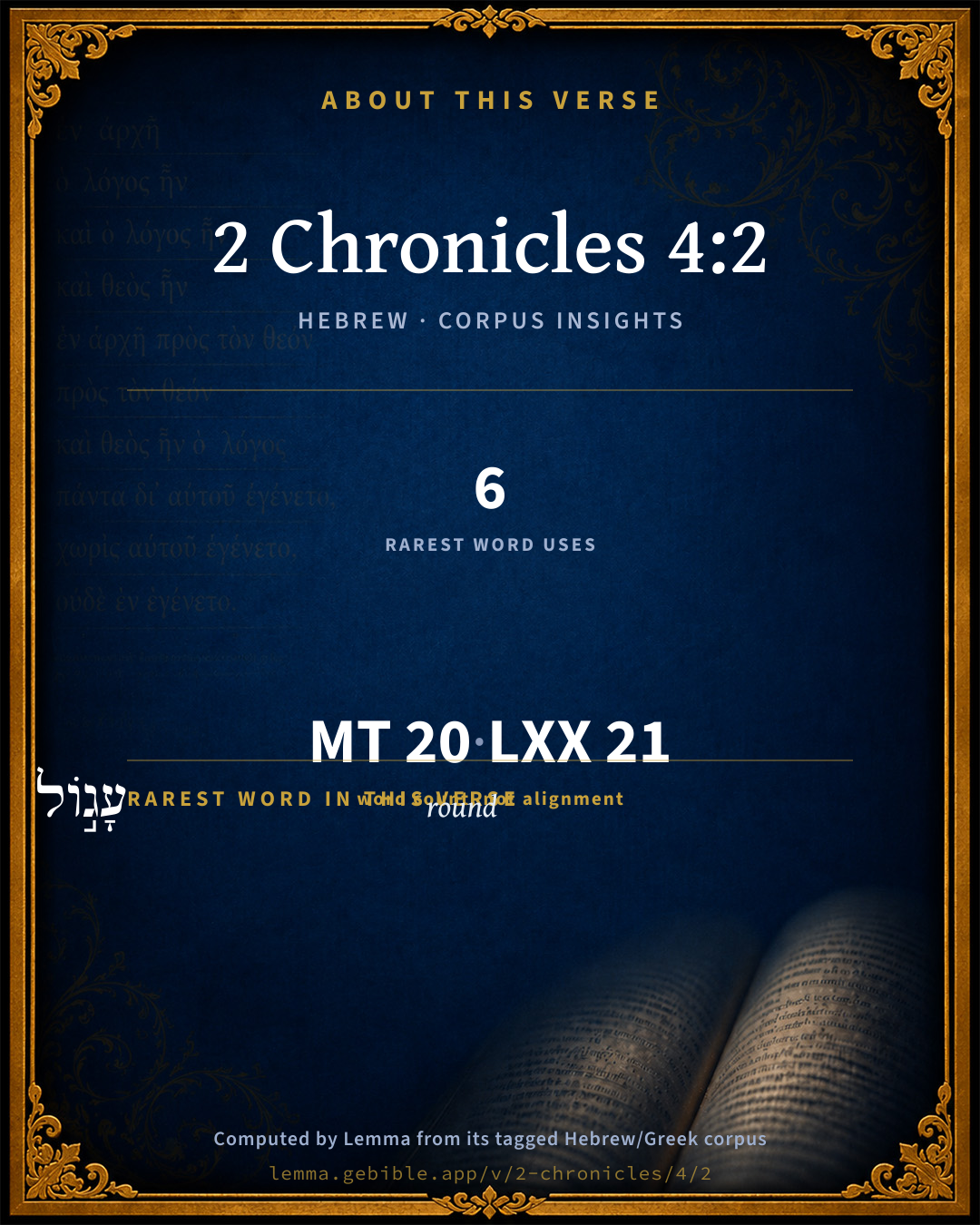
The rarest word here is עָג֣וֹל round H5696 — appearing just 6 times in the whole Hebrew Bible.

Shared distinctive vocabulary

עָג֣וֹל round H5696 occurs in 5 verses of the Hebrew Bible. Also found in:

Grammatical profile

  • 3 verbs
  • 10 nouns
  • 4 adjectives
  • 1 preposition
  • 2 particles

Verb forms

  • וַיַּ֥עַשׂ Qal · Sequential Imperfect
  • מוּצָ֑ק Hophal · Participle Passive
  • יָסֹ֥ב Qal · Imperfect

Repetition

Words recur within this verse — often emphatic in Hebrew:

  • בָּֽ֠אַמָּה cubit H520 ×3
  • מִשְּׂפָת֨וֹ lip H8193 ×2
  • סָבִ֗יב round about H5439 ×2

Hebrew & Septuagint length

In English translation the verse runs 34 words from the Hebrew and 24 from the Septuagint (LXX English) — the Septuagint runs noticeably shorter here. See the side-by-side →

A rough comparison of the two English renderings, which tokenize alike — not a word-level alignment.

Word counts can differ between the Hebrew and the Greek without any difference in meaning — e.g. the Hebrew direct-object marker אֵת has no separate Greek word, and Greek often adds the article ὁ.

In the original languages it is 20 Hebrew tokens and 21 Greek tokens — but the two are counted differently (Hebrew bundles its prefixes and suffixes into one token; the Greek is in lemma form), so that isn’t a like-for-like length.

Cross-references

5

Topical passages linked to 2 Chronicles 4:2 in the Treasury of Scripture Knowledge — connected by theme and wording, ordered by reader-vote popularity; previews shown in the World English Bible.

  • Exodus 30:18–21 "You shall also make a basin of brass, and the base of it of brass, in which to wash. You shall put it between the tent of meeting and the altar, and you shall put water in it.
  • 1 Kings 7:23–26 He made the molten sea of ten cubits from brim to brim, round in compass, and the height of it was five cubits; and a line of thirty cubits compassed it round about.
  • Zechariah 13:1 "In that day there will be a spring opened to the house of David and to the inhabitants of Jerusalem, for sin and for uncleanness.
  • Titus 3:5 not by works of righteousness, which we did ourselves, but according to his mercy, he saved us, through the washing of regeneration and renewing by the Holy Spirit,
  • Revelation 7:14 I told him, "My lord, you know." He said to me, "These are those who came out of the great tribulation. They washed their robes, and made them white in the Lamb's blood.

Cross-references courtesy of OpenBible.info (CC BY 4.0).

Hebrew and Greek witnesses Masoretic Hebrew ↔ Greek Septuagint

The same verse in the two great witnesses to the Old Testament, shown verse-for-verse.

Here the Septuagint runs noticeably shorter than the Hebrew — LXX2012 (modern English Septuagint) 24 words vs World English Bible 34. A rough length comparison of the two English translations, not a word-level alignment — read both below.

These are two independent witnesses, not word-aligned to each other, and the Septuagint is shown in lemma (dictionary) form.

Hebrew 2 Chronicles 4:2 Masoretic · Westminster Leningrad Codex

וַיַּ֥עַשׂ אֶת הַיָּ֖ם מוּצָ֑ק עֶ֣שֶׂר בָּֽ֠אַמָּה מִשְּׂפָת֨וֹ אֶל שְׂפָת֜וֹ עָג֣וֹל סָבִ֗יב וְחָמֵ֤שׁ בָּֽאַמָּה֙ קֽוֹמָת֔וֹ וְקָו֙ שְׁלֹשִׁ֣ים בָּֽאַמָּ֔ה יָסֹ֥ב אֹת֖וֹ סָבִֽיב

Also he made the molten sea of ten cubits from brim to brim, round in compass; and the height of it was five cubits; and a line of thirty cubits compassed it round about.

World English Bible · Public Domain

Greek LXX 2 Chronicles 4:2 Septuagint · lemma form

καί ποιέω ὁ θάλασσα χυτήν πῆχυς δέκα ὁ διαμέτρησις στρογγύλος κυκλόθεν καί πῆχυς πέντε ὁ ὕψος καί ὁ κύκλωμα πῆχυς τριάκοντα

And he made the molten sea, in diameter ten cubits, entirely round, and the height of it five cubits, and the circumference thirty cubits.

LXX2012 (modern English Septuagint) · Public Domain

Hebrew: Westminster Leningrad Codex (CC BY 4.0). Greek: Septuagint (public domain); English from LXX2012 (modern English Septuagint) (Public Domain). How the Septuagint differs from the Hebrew →

Commentary

Notes on 2 Chronicles 4:2 from classic Christian and Jewish commentators (each source and its license shown beneath its notes). The classic Christian expositions comment on the surrounding passage and are grouped to its opening verse, so a note may address several verses; the Jewish commentaries on the Tanakh (Rashi and others) are per-verse, so they appear only where the commentator wrote on this verse.

Lemma curates 59 commentaries, every one of them public domain or Creative Commons licensed, each selected and text-cleaned for this edition rather than reprinted as found. About our sources →

Jamieson, Fausset & Brown

Robert Jamieson, A. R. Fausset & David Brown

MOLTEN SEA. (Ch2 4:2-5)

he made a molten sea--(See on Kg1 7:23), as in that passage "knops" occur instead of "oxen." It is generally supposed that the rows of ornamental knops were in the form of ox heads.

Jamieson, Fausset & Brown — Commentary Critical and Explanatory on the Whole Bible (1871) — public domain (CC PDM 1.0). Text via the HelloAO Bible API.

Trapp's Complete Commentary

John Trapp

2Ch 4:2 Also he made a molten sea of ten cubits from brim to brim, round in compass, and five cubits the height thereof; and a line of thirty cubits did compass it round about.

Ver. 2. Also he made a molten sea.] See on 1Ki 7:23, &c.

John Trapp, A Commentary or Exposition upon All the Books of the Old and New Testament (1647–1656) — public domain. Text from a community e-Sword module.

Tyndale Open Study Notes

Tyndale Open Resources

4:2-5 The Temple, the house of God, depicted Eden, the garden of God (cp. Isa 51:3). The massive Sea that rested on the backs of the twelve bronze oxen represented either cosmic pre-creation waters or the waters of life that emanated from the Garden of Eden. Divine forces subdue the waters of chaos (Gen 1:2) so that they provide life-giving nourishment for plant, animal, and human life (see Rev 21:1, where the sea is removed forever).

Tyndale Open Study Notes — © Tyndale Open Resources, licensed CC BY-SA 4.0. Text via the HelloAO Bible API.

Geneva Bible (1599)

Geneva Bible translators

A great vessel of brass, so called, because of the great quantity of water, which it contained, 1 Kings 7:24.

Geneva Bible (1599) marginal notes — public domain. Text via Bolls.life.

Ellicott's Commentary for English Readers

(2) Even if pôthôth be correct in Kings, the chronicler might have understood the word to mean openings, rather than hinges, and so have substituted the common word pethah, which has that sense. The resemblance of the one word to the other would be a further consideration in its favour, according to ancient notions of interpretation.

A Bible Commentary for English Readers, edited by Charles John Ellicott (1878–1897) — public domain. Text from a community e-Sword module.

The Cambridge Bible for Schools and Colleges

gen. ed. J. J. S. Perowne

2–5 (= 1Ki_7:23-26). The Molten Sea

2. he made a molten sea] Render, he made the sea of molten metal. The “sea” or great laver was a well-known feature in temples, being a symbol of the purity needful for those who come into the divine presence. So in the heavenly temple before the throne there is a “sea” of glass (Rev_4:6).

five cubits the height thereof] R.V. the height thereof was five cubits.

a line of thirty cubits did compass it] i.e. it was thirty cubits in circumference.

The Cambridge Bible for Schools and Colleges (gen. ed. J. J. S. Perowne; Cambridge University Press, 1878–1918) — public domain. Text from a community e-Sword module.

Haydock's Catholic Bible Commentary

Sea, or great brazen vessel, and some other things that were not in the tabernacle of Moses, whose plan was followed, but with greater magnificence. (Worthington)

George Leo Haydock (1774–1849), Haydock's Catholic Family Bible and Commentary, 1859 edition — public domain. Excludes Psalms (Douay-Rheims chapter numbering differs from Protestant) and Deuterocanonical books (Catholic canon only).

Matthew Poole's English Annotations

A molten sea: of this and 2Ch 4:3-5, &c., See Poole "1Ki 7:23", &c.

Matthew Poole's English Annotations on the Holy Bible (1683–1685) — public domain. Text from a community e-Sword/MySword module.

The Pulpit Commentary

A molten sea. The Hebrew of this verse and of 1Ki_7:23 are facsimiles of one author, except that here wq; stands, where the parallel shows hwOq, probably the fruit merely of some error in transcription. Verses like these point not to the derivation of Chronicles from Kings, but rather of both from some older common source. This sea of brass superseded the laver of the tabernacle. (Exo_30:18, 28 31:9 35:16 39:39) It was called a sea on account of its size. We are told 1Ch_18:8 whence David had drawn the supplies of metal necessary for this work. The size of the diameter measured from upper rim to rim (ten cubits) harmonizes, of course, to all practical purposes, with that of the circumference (thirty cubits); it would assist questions connected with the contents of this large vessel, however, if we had been told whether the circumference were measured at the rim, or, as the form of language here used might slightly favour, round the girth. (For these questions, see ver. 5 below.) This sea for the washing of the priests significantly follows the altar. Beside the general suggestion of the need of purification or sanctification, it here reminds of the fact that the earthly priest and high priest must need the purification, which their great Antitype would not need.

The Pulpit Commentary (1880–1919), ed. H.D.M. Spence-Jones & Joseph S. Exell — public domain. Text from a community e-Sword module.

Keil & Delitzsch

C. F. Keil & F. Delitzsch

The brazen sea described as in Kg1 7:23-26. See the commentary on that passage, and the sketch in my Archaeol. i. plate iii. fig. 1. The differences in substance, such as the occurrence of בּקרים and הבּקר, Ch2 4:3, instead of פּקעים and הפּקים, and 3000 baths instead of 2000, are probably the result of orthographical errors in the Chronicle. יכיל in Ch2 4:5 appears superfluous after the preceding מחזיק, and Berth. considers it a gloss which has come from 1 Kings into our text by mistake. But the expression is only pleonastic: "receiving baths, 3000 it held;" and there is no sufficient reason to strike out the words.

Keil & Delitzsch — Biblical Commentary on the Old Testament (1861–1891) — public domain (CC PDM 1.0). Text via the HelloAO Bible API. (Old Testament only.)

Rashi

Rabbi Shlomo Yitzchaki (Rashi)

ten cubits from brim to brim Ten by ten in its center, circular around.

and a line of thirty cubits did encompass it round about Whatever has a circumference of three handbreadths has a diameter of one handbreadth.

and the height thereof was five cubits its depth.

Rashi on the Tanakh — English translations: “The Judaica Press complete Tanach with Rashi, translated by A. J. Rosenberg” (CC BY 4.0); “Pentateuch with Rashi's commentary by M. Rosenbaum and A.M. Silbermann, 1929-1934” (public domain); “The Metsudah Tanach series, Lakewood, N.J” (CC BY 4.0); and “The Book of Joshua, Metsudah Publications, 1997” (CC BY 4.0). Text via Sefaria.

Lesson kit

Teaching starters — assembled from the data on this page, not authored interpretation. Every prompt links to the verse data it draws on. Edit before teaching.

2 Chronicles, in the Historical, opens this verse with 20 words (15 distinct Hebrew lemmas). Its most distinctive word is ʻâgôl (“round”). The Greek Septuagint runs shorter here. A historical commentator’s framing appears above. Read the whole chapter for the surrounding context.

Discussion questions

  1. The word ʻâgôl carries the sense “round.” How does it shape the verse?
  2. 1 Kings 7:23 shares the word «round» with this verse. How do the two illuminate each other?
  3. “cubit” occurs 3× in this one verse. What is the effect of the repetition?
  4. Compared with the Hebrew, the Septuagint runs shorter here. What questions does that raise?
  5. The translations on this page render this verse differently — a whole-verse word diff, not a word-by-word alignment. What might account for the different wordings?
  6. The verb «וַיַּ֥עַשׂ» is Qal Sequential Imperfect. How does its form color the action?
  7. Reading how Jamieson, Fausset & Brown and Trapp's Complete Commentary read this verse, where do the two commentators agree and where do they part?

Things to notice

Reading settings

Reading text

Shown beneath each verse's original-language words.

Old Testament
Old Testament edition

Read the OT as the Masoretic Hebrew (MT) or the Greek Septuagint (LXX).

English shown for the Greek Septuagint (in the Hebrew ↔ Greek comparison).

Comparing translations? Open the Compare panel on any verse page to stack up to four side by side.