Psalms 65:5

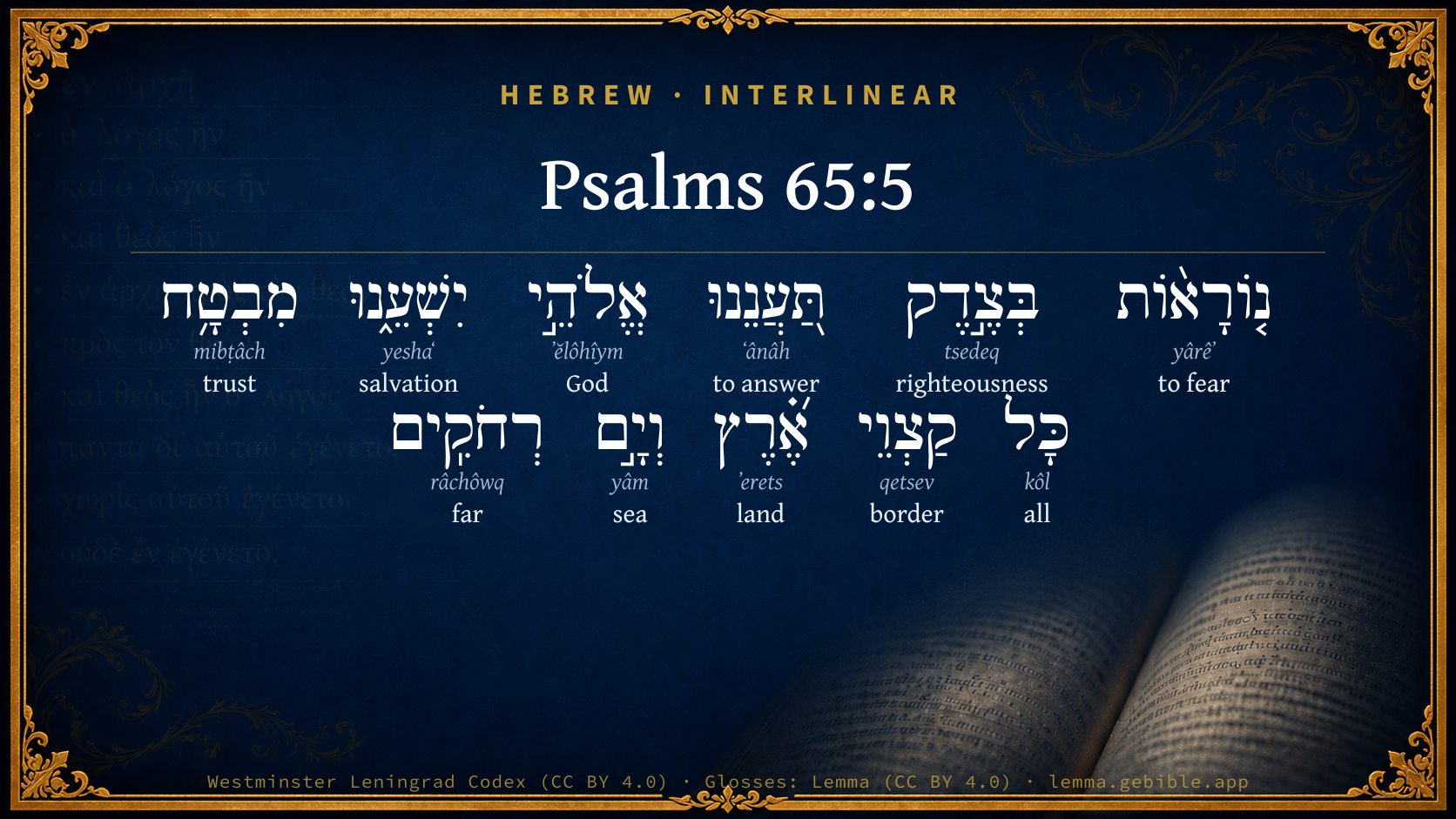
Hebrew (Westminster Leningrad Codex) Psalms 65:5 appears in the Hebrew Old Testament. The text above is from the Westminster Leningrad Codex. Each word links to its Strong’s number, a concise gloss, and parsing drawn from the Open Scriptures Hebrew Bible morphology. Click any word for its full Brown-Driver-Briggs (BDB) entry.
Download image
Cite this verse

Psalms 65:5 (World English Bible). Public Domain. Lemma interlinear Bible study tool, https://lemma.gebible.app/v/psalms/65/5.

Show BibTeX & RIS
BibTeX
RIS
English Translation
By awesome deeds of righteousness, you answer us, God of our salvation. You who are the hope of all the ends of the earth, Of those who are far away on the sea;
World English Bible · Public Domain
Download a study sheet

One document with this verse’s original text, its word-by-word gloss line, the meaning frame, cross-references with their text, attributed commentary, and full source and license credits — printable, and it pastes into notes with its structure intact.

This verse Autodidact and up

Study sheet (.html) Plain text (.txt)

A passage Seminary Student

Up to 50 verses in one chapter. A passage sheet keeps up to 6 commentary sources and 12 cross-references per verse, in the order this page ranks them, and says so on the sheet whenever that leaves anything out. Ask for a single verse and you get the Autodidact verse sheet above.

Everything on this page stays free to read, with no account — the sheet is a download of what is already on screen, not access to it.

Want to remove ads? Support Godless Engineer
Compare translations 3

The same verse in 3 English versions, stacked beneath the original-language interlinear above. Click any original word for its lexicon entry.

Each is an independent rendering of the whole verse — the interlinear is not word-aligned to these translations.

Highlighted words mark where these versions differ — a whole-verse word diff, not a word-by-word alignment.

  • World English Bible Public Domain
    By awesome deeds of righteousness, you answer us, God of our salvation. You who are the hope of all the ends of the earth, Of those who are far away on the sea;
  • King James Version Public Domain
    By terrible things in righteousness wilt thou answer us, O God of our salvation; who art the confidence of all the ends of the earth, and of them that are afar off upon the sea:
  • unfoldingWord Literal Text CC BY-SA 4.0
    Doing fearsome things, you answer us in righteousness, God of our salvation, the confidence of all of the ends of the earth and the distant seas,

unfoldingWord Literal Text — © unfoldingWord, licensed CC BY-SA 4.0. Word-aligned USFM3 via Door43 (git.door43.org/unfoldingWord/en_ult).

Versions to compare (up to 4)

3 of 4 selected

Show all 18 translations

Every available English version of this verse, each an independent rendering of the whole verse.

  • World English Bible Public Domain
    By awesome deeds of righteousness, you answer us, God of our salvation. You who are the hope of all the ends of the earth, Of those who are far away on the sea;
  • Berean Standard Bible Public Domain
    With awesome deeds of righteousness You answer us, O God of our salvation, the hope of all the ends of the earth and of the farthest seas.
  • Majority Standard Bible Public Domain
    With awesome deeds of righteousness You answer us, O God of our salvation, the hope of all the ends of the earth and of the farthest seas.
  • King James Version Public Domain
    By terrible things in righteousness wilt thou answer us, O God of our salvation; who art the confidence of all the ends of the earth, and of them that are afar off upon the sea:
  • American Standard Version (1901) Public Domain
    By terrible things thou wilt answer us in righteousness, Oh God of our salvation, Thou that art the confidence of all the ends of the earth, And of them that are afar off upon the sea:
  • Revised Version (1885) Public Domain
    By terrible things thou wilt answer us in righteousness, O God of our salvation; thou that art the confidence of all the ends of the earth, and of them that are afar off upon the sea:
  • Geneva Bible (1599) Public Domain
    O God of our saluation, thou wilt answere vs with fearefull signes in thy righteousnes, O thou the hope of all the ends of the earth, and of them that are farre off in the sea.
  • Douay-Rheims (1899) Public Domain
    Blessed is he whom thou hast chosen and taken to thee: he shall dwell in thy courts. We shall be filled with the good things of thy house; holy is thy temple,
  • Young's Literal Translation Public Domain
    By fearful things in righteousness Thou answerest us, O God of our salvation, The confidence of all far off ends of earth and sea.
  • Literal Standard Version CC BY-SA 4.0
    By fearful things in righteousness You answer us, || O God of our salvation, || The confidence of all far off || The ends of the earth and sea.
  • Unlocked Literal Bible CC BY-SA 4.0
    In righteousness you will answer us by doing amazing things, God of our salvation; you who are hope of all the ends of the earth and of those who are far across the sea.
  • unfoldingWord Literal Text CC BY-SA 4.0
    Doing fearsome things, you answer us in righteousness, God of our salvation, the confidence of all of the ends of the earth and the distant seas,
  • Darby Bible Public Domain
    By terrible things in righteousness wilt thou answer us, O God of our salvation, thou confidence of all the ends of the earth, and of the distant regions of the sea....
  • World Messianic Bible Public Domain
    By awesome deeds of righteousness, you answer us, God of our salvation. You who are the hope of all the ends of the earth, of those who are far away on the sea.
  • Webster's Bible Public Domain
    \\65:4\\Blessed is the man whom thou choosest, and causest to approach to thee, that he may dwell in thy courts: we shall be satisfied with the goodness of thy house, even of thy holy temple.
  • Free Bible Version CC BY-SA 4.0
    In your goodness you answer us through the wonderful things you do, God of our salvation. You can be trusted by everyone on earth, including those sailing distant oceans.
  • Bible in Basic English Public Domain
    You will give us an answer in righteousness by great acts of power, O God of our salvation; you who are the hope of all the ends of the earth, and of the far-off lands of the sea;
  • JPS Tanakh (1917) Public Domain
    (65-6) With wondrous works dost Thou answer us in righteousness, O God of our salvation; Thou the confidence of all the ends of the earth, and of the far distant seas;

Literal Standard Version (2020), Covenant Press — licensed CC BY-SA 4.0. Text via the HelloAO Bible API (eBible.org). Unlocked Literal Bible (unfoldingWord) — licensed CC BY-SA 4.0. Text via the HelloAO Bible API (eBible.org). unfoldingWord Literal Text — © unfoldingWord, licensed CC BY-SA 4.0. Word-aligned USFM3 via Door43 (git.door43.org/unfoldingWord/en_ult). Free Bible Version, Dr. Jonathan Gallagher — licensed CC BY-SA 4.0. Text via the HelloAO Bible API (eBible.org).

Word by word

More ways to search: Search by grammar → Find every occurrence → Compare this word →

Practice this passage: Drill this verse → Learn its vocabulary →

קַצְוֵי
qetsev
H7099
“borders of”
Noun, Common, Masculine, Plural, Construct
Part of Speech
Noun
Type
Common
Gender
Masculine
Number
Plural
State
Construct
Full BDB Definition

Origin: from H7096

TWOT: 2053d

end, border, boundary
  1. נ֤וֹרָא֨וֹת yârêʼ H3372 “fearing” Verb, Niphal, Participle Active, Feminine, Plural, Absolute
  2. בְּצֶ֣דֶק tsedeq H6664 “in/at · righteousness” Preposition + Noun, Common, Masculine, Singular, Absolute
  3. תַּ֭עֲנֵנוּ ʻânâh H6030 “to answer · us” Verb, Qal, Imperfect, 2nd Person, Masculine, Singular + Suffix, Personal, 1st Person, Common, Plural
  4. אֱלֹהֵ֣י ʼĕlôhîym H430 “God(s) of” Noun, Common, Masculine, Plural, Construct
  5. יִשְׁעֵ֑נוּ yeshaʻ H3468 “salvation · our” Noun, Common, Masculine, Singular, Construct + Suffix, Personal, 1st Person, Common, Plural
  6. מִבְטָ֥ח mibṭâch H4009 “trust” Noun, Common, Masculine, Singular, Absolute
  7. כָּל kôl H3605 “all of” Noun, Common, Masculine, Singular, Construct
  8. אֶ֝֗רֶץ ʼerets H776 “land” Noun, Common, Both, Singular, Absolute
  9. וְיָ֣ם yâm H3220 “and · sea” Conjunction + Noun, Common, Masculine, Singular, Absolute
  10. רְחֹקִֽים râchôwq H7350 “far” Adjective, Adjective, Masculine, Plural, Absolute

About this verse

These counts appear in no published source. They are computed here, from the morphology-tagged text and Lemma’s own curated glosses. What Lemma adds →

11
words
11
distinct lemmas
Wisdom
section

Notable vocabulary

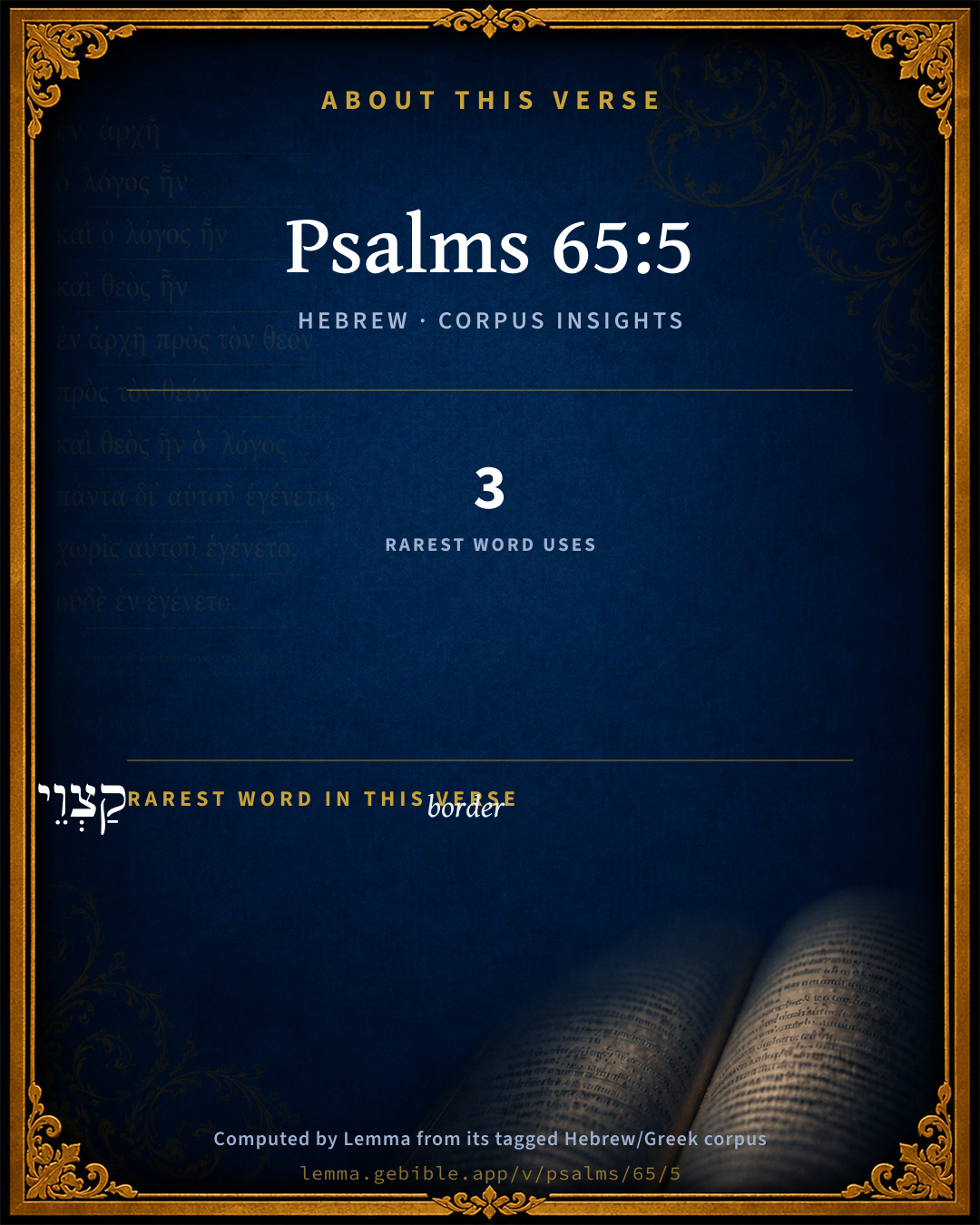
The rarest word here is קַצְוֵי border H7099 — appearing just 3 times in the whole Hebrew Bible.

Shared distinctive vocabulary

קַצְוֵי border H7099 occurs in 3 verses of the Hebrew Bible. Also found in:

Grammatical profile

  • 2 verbs
  • 8 nouns
  • 1 adjective

Verb forms

  • נ֤וֹרָא֨וֹת Niphal · Participle Active
  • תַּ֭עֲנֵנוּ Qal · Imperfect

Hebrew & Septuagint length

In English translation the verse runs 33 words from the Hebrew and 31 from the Septuagint (LXX English) — closely comparable.

A rough comparison of the two English renderings, which tokenize alike — not a word-level alignment.

Word counts can differ between the Hebrew and the Greek without any difference in meaning — e.g. the Hebrew direct-object marker אֵת has no separate Greek word, and Greek often adds the article ὁ.

Cross-references

25

Topical passages linked to Psalms 65:5 in the Treasury of Scripture Knowledge — connected by theme and wording, ordered by reader-vote popularity; previews shown in the World English Bible.

  • Deuteronomy 10:21 He is your praise, and he is your God, who has done for you these great and awesome things, which your eyes have seen.
  • Isaiah 45:22 Look to me, and be you saved, all the ends of the earth; for I am God, and there is none else.
  • Psalms 66:3 Tell God, "How awesome are your deeds! Through the greatness of your power, your enemies submit themselves to you.
  • Revelation 15:3–4 They sang the song of Moses, the servant of God, and the song of the Lamb, saying, "Great and marvelous are your works, Lord God, the Almighty; Righteous and true are your ways, you King of the nations.
  • Psalms 45:4 In your majesty ride on victoriously on behalf of truth, humility, and righteousness. Let your right hand display awesome deeds.
  • Psalms 22:27 All the ends of the earth shall remember and turn to Yahweh. All the relatives of the nations shall worship before you.
  • Psalms 68:19–20 Blessed be the Lord, who daily bears our burdens, Even the God who is our salvation. Selah.
  • Isaiah 51:5 My righteousness is near, my salvation is gone forth, and my arms shall judge the peoples; the isles shall wait for me, and on my arm shall they trust.
  • Isaiah 66:19 I will set a sign among them, and I will send such as escape of them to the nations, to Tarshish, Pul, and Lud, who draw the bow, to Tubal and Javan, to the isles afar off, who have not heard my fame, neither have seen my glory; and they shall declare my glory among the nations.
  • Romans 2:5 But according to your hardness and unrepentant heart you are treasuring up for yourself wrath in the day of wrath, revelation, and of the righteous judgment of God;
  • Deuteronomy 4:34 Or has God tried to go and take him a nation from the midst of [another] nation, by trials, by signs, and by wonders, and by war, and by a mighty hand, and by an outstretched arm, and by great terrors, according to all that Yahweh your God did for you in Egypt before your eyes?
  • Psalms 47:2–3 For Yahweh Most High is awesome. He is a great King over all the earth.
  • Psalms 76:3–9 There he broke the flaming arrows of the bow, The shield, and the sword, and the weapons of war. Selah.
  • Psalms 85:4 Turn us, God of our salvation, And cause your indignation toward us to cease.
  • Psalms 145:17 Yahweh is righteous in all his ways, And gracious in all his works.
  • Isaiah 37:36 The angel of Yahweh went forth, and struck in the camp of the Assyrians one hundred and eighty-five thousand; and when men arose early in the morning, behold, these were all dead bodies.
  • Isaiah 60:5 Then you shall see and be radiant, and your heart shall thrill and be enlarged; because the abundance of the sea shall be turned to you, the wealth of the nations shall come to you.
  • Zephaniah 2:11 Yahweh will be awesome to them, for he will famish all the gods of the land. Men will worship him, everyone from his place, even all the shores of the nations.
  • Zechariah 9:10 I will cut off the chariot from Ephraim, And the horse from Jerusalem; And the battle bow will be cut off; And he will speak peace to the nations: And his dominion will be from sea to sea, And from the River to the ends of the earth.
  • Matthew 28:19–20 Therefore go, and make disciples of all nations, baptizing them in the name of the Father and of the Son and of the Holy Spirit,
  • Romans 15:10–12 Again he says, "Rejoice, you Gentiles, with his people."
  • Ephesians 2:17–18 He came and preached peace to you who were far off and to those who were near.
  • Revelation 16:5 I heard the angel of the waters saying, "You are righteous, who are and who were, you Holy One, because you have judged these things.
  • Revelation 19:1–3 After these things I heard something like a loud voice of a great multitude in heaven, saying, "Hallelujah! Salvation, power, and glory belong to our God:
  • Psalms 107:23 Those who go down to the sea in ships, Who do business in great waters;

Cross-references courtesy of OpenBible.info (CC BY 4.0).

Hebrew and Greek witnesses Masoretic Hebrew ↔ Greek Septuagint

The same verse in the two great witnesses to the Old Testament, shown verse-for-verse.

You’re reading Greek Psalm 64 (Hebrew Psalm 65). The Septuagint counts the superscription, so verse numbers can differ from the Hebrew — chapter-level alignment, not verse-by-verse. Numbering follows Rahlfs.

These are two independent witnesses, not word-aligned to each other, and the Septuagint is shown in lemma (dictionary) form.

Hebrew Psalms 65:5 Masoretic · Westminster Leningrad Codex

נ֤וֹרָא֨וֹת בְּצֶ֣דֶק תַּ֭עֲנֵנוּ אֱלֹהֵ֣י יִשְׁעֵ֑נוּ מִבְטָ֥ח כָּל קַצְוֵי אֶ֝֗רֶץ וְיָ֣ם רְחֹקִֽים

By awesome deeds of righteousness, you answer us, God of our salvation. You who are the hope of all the ends of the earth, Of those who are far away on the sea;

World English Bible · Public Domain

Greek LXX Greek Psalm 64:5 Septuagint · lemma form

μακάριος ὅς ἐκλέγω καί προςλαμβάνω κατασκηνόω ἐν ὁ αὐλή σύ πίμπλημι ἐν ὁ ἀγαθός ὁ οἶκος σύ ἅγιος ὁ ναός σύ θαυμαστός ἐν δικαιοσύνη

You are wonderful in righteousness. Listen to us, O God our Saviour; the hope of all the ends of the earth, and of them that are on the sea afar off:

LXX2012 (modern English Septuagint) · Public Domain

On this verse, Ellicott's Commentary for English Readers discusses the Septuagint’s reading. Read the note in Commentary ↓

Hebrew: Westminster Leningrad Codex (CC BY 4.0). Greek: Septuagint (public domain); English from LXX2012 (modern English Septuagint) (Public Domain). How the Septuagint differs from the Hebrew →

Commentary

Notes on Psalms 65:5 from classic Christian and Jewish commentators (each source and its license shown beneath its notes). The classic Christian expositions comment on the surrounding passage and are grouped to its opening verse, so a note may address several verses; the Jewish commentaries on the Tanakh (Rashi and others) are per-verse, so they appear only where the commentator wrote on this verse.

Lemma curates 59 commentaries, every one of them public domain or Creative Commons licensed, each selected and text-cleaned for this edition rather than reprinted as found. About our sources →

Trapp's Complete Commentary

John Trapp

Psa 65:5 [By] terrible things in righteousness wilt thou answer us, O God of our salvation; [who art] the confidence of all the ends of the earth, and of them that are afar off [upon] the sea:

Ver. 5. By terrible things in righteousness wilt thou answer us] As he did when he gave the law in Mount Sinai, and ever after in his oracles and ordinances. God loveth at once familiarity and fear; familiarity in our conversation, and fear in his worships; he loves to be acquainted with men in the walks of their obedience; yet he taketh state upon him in his ordinances, and will be trembled at in his word and judgments.

Who art the confidence of all the ends of the earth, &c.] i.e. Of all thine elect abroad the whole world.

Of them that are afar off upon the sea] The islanders,

Ut penitus toto disiuncti abs orbe Britanni.

Venice is said to be situated six miles distant from any firm land, and built in the heart of the Adriatic Sea, the waters whereof do flow into the city, and beat upon it, through all the streets thereof. Now, it may be hoped that God hath many souls even in such places; since there are thought to be no fewer than twenty thousand Protestants in Seville itself, a chief city of Spain (Spec. Europ.). It was long since foretold that the isles should wait for God’s law, Isa 42:4; Isa 51:5; Isa 60:9.

John Trapp, A Commentary or Exposition upon All the Books of the Old and New Testament (1647–1656) — public domain. Text from a community e-Sword module.

The Biblical Illustrator

Joseph S. Exell

Psa_65:5

By terrible things in righteousness wilt Thou answer us, O God of our salvation.

Gods terrible things

Now, it is here we are to ponder such things, and to seek a solution of these mysteries. We have all had to do with them at one time or another. Holy men of old have known them (Isa_26:8-11; Psa_45:4; Isa_64:1; Isa_64:3-4).

I. God has here and now His terrible things, but they are also righteous things (Psa_97:8; Pro_16:4). If God has terrible things, as the exhibition of His righteousness and His power, so also men become sometimes terrible things, objects of terror, and I knew of nothing so terrible as a hard, and impenitent, and proud heart. But God is love! I feel that, but few arguments have convinced me of it; it is in my own consciousness, it is affirmed to me; but nature is so cruel I know not how to hang much consolation upon the compensations and kindnesses of natural theology, and Paleys celebrated assurance that it is a happy world, after all! But, alas, the world is one great calamity, and the contradictions to the assurance that God is love meet us in every age. It is thus I am often compelled to say, how perfect things are, how perplexing and cruel events are. What do you see? In one age a city ablaze beneath the calm and beautiful mountains and skies. I remember, years since, visiting, one bright mocking day, a village on the coast, near the scene of the horrible tragedy of Hartley; you come to it as you walk along that fine coast from Tynemouth; a quiet little village, called Cullercoats. I forget how many boats had been lost in the wild tempest, a night or two since; there was a sob of agony in every house. I did not think of Paleys selfish aphorism, Its a happy world, after all! just then, although the sea was bright, and birds were sailing pensively overhead: rather should I have said, By terrible things dost Thou answer us, O God. Natural theology has little to say in reply to such scenes as these.

II. The terrible things of God are not only righteous things, but not less than these, may be an answer to prayer. I believe you are a child of God, and I believe you will never now be prosperous in your outer life again, said an old patriarch to a new convert; and the prophecy was fulfilled. The old man spoke from some instinctive perception of spiritual means and ends; and, undoubtedly, shadowy and dark as the prophecy seems, it was far more prescient and wise than that which supposes that all pain, and adversity, and affliction, and disappointment retire from the circle in which the child of God moves. This is not invariable, but we must believe the plan and the order of our life require it. By terrible things in righteousness wilt Thou answer us. And thus, at last, we learn that all the ends of God, in us and with us, have relation to our final coronation in the palace of His love. The terrible things, all of them, work out for us, as Paul said (2Co_4:17). And the explanation is that--

III. God, in the midst of His terrible things, is not the less the God of salvation. Salvation belongeth to our God. The Bible grapples with this practical difficulty of our existence and experience--this dark and perplexed state of human affairs; and by innumerable images it labours to reach the heart, and to teach the heart that life and time are a seething furnace through which souls are passing, and over which God watches till the trial is complete. (Paxton Hood.)

Gods employment of the terrible

Plutarch affirms that the cruel wars which followed the march of Alexander introduced the civility, language and arts of Greece into the savage East; introduced marriage, built seventy cities, and united hostile nations under one government. The barbarians who broke up the Roman Empire did not arrive a day too soon. Schiller says, The Thirty Years War made Germany a nation. Rough, selfish despots serve men immensely, as Henry VIII. in the contest with the popes; as the infatuation no less than the wisdom of Cromwell; as the ferocity of the Russian Czars; as the fanaticism of the French regicides of 1789. The frost which kills the harvest of a year saves the harvests of a century by destroying the weevil or the locust. Wars, fires, plagues, break up immovable routine, clear the ground of rotten races and dens of distemper, and open a fair field to new men. (R. W. Emerson.)

Who art the confidence of all the ends of the earth.

God

I. Recognize the being and activity of God. This is a necessary call; for it is questionable how far in the average we have assimilated first principles, and in the rush of life we often slight the essentials that lie behind the activities of faith. We have yet to recognize how fully Christs life, and teaching, and mission concentre in God, how natural was His own attitude of complete submission to God, how persistently He directed men through Himself to God, and the significance of these facts. Rather than weakening it, the revelation of Christ ought to intensify our sense of God; for He lived to give man the highest conception of God it was possible for him to receive, and to safeguard his thought from the many errors to which it had always been exposed. Christ conserves in its integrity the idea of a personal God and of a paternal God; of One who feels, and thinks, and wills; who is distinct from all the world as we are distinct from each other; and yet who is as essentially akin to us as we are to each other.

II. Recognize that the world is Gods world and man Gods care. This also is a necessary call. There are dark facts in nature and in life that seem to belie the loving wisdom of the Creator, and that have made men doubt the gracious providence of the Father. They press themselves in upon us with a pertinacity that wearies us and often forms a severe trial to our faith. Even Wordsworth finds that the aching joys and dizzy raptures that came to him from his delight in woods and hills, and all beautiful sights, pass, are left behind as the hours of thoughtless youth; and in their place the sounds of nature sob with a human cry; he is chastened and subdued because he hears in them the still, sad music of humanity. Thomas Hardy finds a verdict of pessimism in nature confirming his verdict of pessimism on life. R.H. Hutton in an essay on Cardinal Newman, writes: Now, the more earnestly Newman embraced the doctrine that the universe is full of the types and instrumentality of spiritual things unseen, the more perplexing the external realities of human history and human conduct, barbarous or civilized, mediaeval or modern, seemed to him. His faith in the sacramental principle taught; him to look for a created universe from which the Creator should be reflected back at every point. But Newman kept his faith in God and its corollary, faith in redemption. The light within him was not turned into darkness, and he saw that his faith in God demanded faith in redemption also. The human race was implicated in a great aboriginal calamity, and that calamity he saw could only be rectified by some equally great supernatural interference. We believe this; it is our only way; it is the faith of the psalmist, and it is the faith that has been at the root of all human progress. The outgoings of morning and evening, the surety of seed-time and harvest, are our pledges of Divine faithfulness. God is not defeated, nor has He forsaken either His creation or His children. He is the God of our salvation; His tokens are in the uttermost parts; and in Him is the confidence of all the ends of the earth. (J. J. Leedal.)

And of them that are afar off upon the sea.--

A sermon to seamen

I. What God is to us who are His people--God of our salvation. Salvation is of the Lord in every point. Not a bit of it is of us. All of Him from first to last, and all the points between the first and the last. Have any of you got a salvation that you have manufactured of yourselves? Then lay it down and run away from it. It will be of no use to you. The only salvation that can redeem from hell is the salvation that comes from heaven.

II. What God will do for us. He will answer us. This shows that we must all pray. There is not a believing man in the world but what must pray, and we shall never get into such a state of grace that we have not need to pray.

III. What the Lord is to the ends of the earth. He is the confidence of all the ends of the earth. I am going to spiritualize that--Who are the ends of the earth?

1. Well, the people that live in the frozen regions, or, taking the other end, the people that live in the equatorial regions, beneath the burning sun. All that live at the extremes of heat or cold, we may liken them to the ends of the earth. They are furthest off from us. Well, and God is worthy to be the confidence of those who are furthest off from His Church, from Himself, from the Gospel, from hope, from anything that is good.

2. The people least known. We know those round us, but not those far away.

3. Those least thought of.

4. Those most tried.

5. Those hardest to reach.

IV. What God is to seafaring men. What should He be to them? He is the confidence of all them that are afar off upon the sea. I have often likened the life of a seafaring man to what the life of a Christian should be. Hundreds of years ago, when man went to sea at all, the boats always kept within sight of shore. Your Tyrian or your Greek might be quite the master of his vessel, but he could not bear to lose sight of the headland. And it is a wonderful thing, common as it is now, that a ship should lose sight of land for a month together, seeing nothing that belongs to land. It is just like the life of a Christian, a life of faith. We ought not to see anything, we ought not to want to see anything. We walk by faith, not by sight. We take our bearings by the heavenly bodies. We are guided by the Word of God, which is our chart, by the movement of the blessed Spirit within, which is our compass. We have bidden farewell to things below, we seek a heaven that we have not seen, we are sailing across a life of which we know nothing. Trusting in Him, we shall come to our desired haven without fear of shipwreck. Sailors live on the sea--an unstable element, full of danger. Now, you and I are often brought into difficulties. We have not any strength left at all. We look up to God and cry, I am lost. Oh, then, let God be your confidence. I exhort all believers here to have more confidence in God. The sailor is often brought where, if God does not keep him, he will be swallowed up. You and I ought not only to be brought there sometimes, but keep there, feeling that God is all, and we rest in Him without any other help. (C. H. Spurgeon.)

The Biblical Illustrator, edited by Joseph S. Exell (c. 1880s–1900s) — public domain. Text from a community e-Sword module.

The Treasury of David

Charles H. Spurgeon

Ver. 5. By terrible things in righteousness wilt thou answer us, O God of our salvation. God's memorial is that he hears prayer, and his glory is that he answers it in a manner fitted to inspire awe in the hearts of his people. The saints, in the commencement of the Psalm, offered praise in reverential silence; and now, in the like awe stricken spirit, they receive answers to their prayers. The direct allusion here is, no doubt, to the Lord's overthrow of the enemies of his people in ways calculated to strike terror into all beholders; his judgments in their severe righteousness were calculated to excite fear both among friends and foes. Who would not fear a God whose blows are so crushing? We do not always know what we are asking for when we pray; when the answer comes, the veritable answer, it is possible that we may be terrified by it. We seek sanctification, and trial will be the reply: we ask for more faith, and more affliction is the result: we pray for the spread of the gospel, and persecution scatters us. Nevertheless, it is good to ask on, for nothing which the Lord grants in his love can do us any harm. Terrible things will turn out to be blessed things after all, where they come in answer to prayer. See in this verse how righteousness and salvation are united, the terrible things with the gracious answers. Where but in Jesus could they be blended? The God who saves may answer our prayers in a way which puts unbelief into a flutter; but when faith spies the Saviour, she remembers that "things are not what they seem, "and she is of good courage. He who is terrible is also our refuge from terror when we see him in the Well beloved.

Who art the confidence of all the ends of the earth. The dwellers in the far off isles trust in God; those most remote from Zion yet confide in the ever living Jehovah. Even those who dwell in countries, frozen or torrid, where nature puts on her varied terrors, and those who see dread wonders on the deep, yet fly from the terrors of God and place their confidence in the God of terrors. His arm is strong to smite, but also strong to save.

And of them that are afar off upon the sea. Both elements have their elect band of believers. If the land gave Moses elders, the sea gave Jesus apostles. Noah, when all was ocean, was as calm with God as Abraham in his tent. All men are equally dependent upon God: the seafaring man is usually most conscious of this, but in reality he is not more so than the husbandman, nor the husbandman than anyone else. There is no room for self confidence on land or sea, since God is the only true confidence of men on earth or ocean. Faith is a plant of universal growth, it is a tree of life on shore and a plant of renown at sea; and, blessed be God, those who exercise faith in him anywhere shall find that he is swift and strong to answer their prayers. A remembrance of this should quicken our devotions when we approach unto the Lord our God.

Ver. 5. By terrible things in righteousness wilt thou answer us. The reason why he answers thus is, because what God doth for his people, take one thing with another, is still in order to the crucifying of the flesh; and what more terrible than such a death? We pray for pleasing things, as we imagine, but as we are flesh as well as spirit; so the flesh hath still a part in every prayer, and what we beg is partly carnal, and upon the matter, in part, we beg we know not what. Now, the answer as it comes from God, take all together, is spiritual, which is a crucifying thing to sinful flesh; hence comes all the terror... You pray for pardon; that is a pleasing thing, yet rightly understand not pleasing to the flesh; it mortifies corruption, breaks the heart, engages to a holy life: every answer from our God to us, one way or the other, first or last, shall tend that way. God useth so to give good things unto his children, as withal to give himself, and show to them his heavenly glory in what is done... Now God is terrible to sinful flesh: so far as he appears, it dies. Jacob, therefore, whilst he conquered God in prayer, himself was overcome, signified by that touch upon his thigh put out of joint, where the chiefest stress in wrestling lies. When we are weak, then are we strong; because, as God appears, we die unto ourselves and live in him. William Carter, in a Fast Sermon entitled, "Light in Darkness." 1648.

Ver. 5. God's judgments are these terribilia, terrible, fearful things; and he is faithful in his covenant; and by terrible judgments he will answer, that is, satisfy our expectation: and that is a convenient sense of these words. But the word which we translate righteousness here, is tzadok, and tzadok is not faithfulness, but holiness; and these terrible things are reverend things; and so Tremellius translates it, and well. Per res reverendas, by reverend things, things to which there belongs a reverence--thou shalt answer us. And thus, the sense of this place will be, that the God of our salvation (that is, God working in the Christian church) calls us to holiness, to righteousness, by terrible things; not terrible in the way and nature of revenge, but terrible, that is, stupendous, reverend, mysterious; so that we should not make religion too homely a thing, but come always to all acts and exercises of religion with reverence, with fear, and trembling, and make a difference between religious and civil actions. John Donne.

Ver. 5. God's deliverance of his church and people by terrible things is in righteousness. The meaning of the point is this: God in all the deliverances of his people by terrible things, doth therein manifest his righteousness. He doth therein nothing but what is according to righteousness and justice. To clear this, consider that there is a double righteousness, the righteousness of his word, which is the righteousness of his faithfulness, and the righteousness of his works, or his just acts of righteousness. And God doth manifest both these in his deliverance of his people by terrible things. John Bewick. 1644.

Ver. 5. But what is the meaning when they say, wilt thou answer us? Us, who are inhabitants of Zion, who are constituted thy people, and truly worship Thee; us, moreover, in contact with enemies, who stirred up strife against us, and wished us ill; us, lastly, who aim at and seek the stability of the Kingdom and Church, and every kind of felicity and safety; with such things wilt thou answer us, it says, that is, for our advantage and benefit, and according to our vows, and therefore by pleading our cause, and deciding in our favour, and satisfying our desires; and in this way rendering us happy and establishing us, and subduing and confounding our foes. Hermann Venema.

Ver. 5. Who art the confidence of all the ends of the earth. How could God be the confidence of all the ends of the earth, if he does not reign and constantly work? The stability of the mountains is ascribed not to certain physical laws, but to the power of God. The noise of the seas is stilled not by laws without a powerful agent, but by the immediate influence of the Almighty Ruler. Human laws also may be the means of restraining persecution, but they are only means; and it is God who stilleth the tumult of the people. It is God who maketh the outgoings of the morning and evening to sing. The Scriptures, in viewing the works which God does through means, never lose sight of God himself. God visits and waters the earth: God prepares the corn. Without his own immediate power, the laws of nature could not produce their effect. How consoling and satisfactory is this view of Divine Providence, compared with that of an infidel philosophy, that forbids us to go further back than to the power of certain physical laws, which it grants, indeed, were at first established by God, but which can now perform their office without him. Alexander Carson. (1776-1844.)

Ver. 5. All the ends of the earth. God is in himself potentially, The confidence of all the ends of the earth. Hereafter he will be recognised by all to be so (Ps 23:27-28), of which the Queen of Sheba's coming to Solomon "from the uttermost parts of the earth" is a type. Mt 12:42. A. R. Faussett.

Ver. 5. And of them that are afar off upon the sea. We must beseech God in the words of this Psalm, that since He stands upon the shore, and beholds our perils, he would make us, who are tossed on the turbulent sea, secure for his name's sake, and enable us to hold between Scylla and Charybdis, the middle course, and escaping the danger on either hand, with a sound vessel and safe merchandise, reach the port. Lorinus (from Augustine).

Ver. 5-8. The divine watering of the earth is obviously symbolical of the descent of the Holy Spirit after Christ's ascension; and when on the great day of Pentecost the devout Jews, "out of every nation under heaven, "heard the apostle speaking in their several tongues the wonderful works of God, it was a testimony that God was beginning spiritually to make the outgoings of the morning and evening to rejoice. To God, which stilleth the noise of the waves and the tumult of the people, the apostles betook themselves in prayer after their first conflict with Jewish authorities, the first conflict of the infant Christian community with the powers of this world: the language of the Psalm (Ps 65:5), O God of our salvation; who art the confidence of all the ends of the earth, and of them that are afar off upon the sea, is reflected in the opening words of their prayer on that occasion (Ac 4:24), "Lord, thou art God, which hast made heaven, and earth, and the sea, and all that in them is; "and if, when they prayed, "the place was shaken where they were assembled together, and they were all filled with the Holy Ghost, "it was no idle sign that by terrible things in righteousness were they being answered by the God of their salvation. These are, of course, mere illustrations of the inner harmony of Scripture; but, as such, they may not be without their value. Joseph Francis Thrupp.

Ver. 5. Treat the first clause experimentally, and show how prayers for our own sanctification are answered by trial; for God's glory, by our persecution; for our babes' salvation, by their death; for the good of others, by their sickness, etc.

Psalms 65:6*

Ver. 5-8. See Psalms on "Ps 65:5" for further information.

Ver. 5-8. See Psalms on "Ps 65:5" for further information.

Charles H. Spurgeon's The Treasury of David (1869–1885) — public domain. Psalms only. Text from a community e-Sword/MySword module.

Joseph Benson's Commentary

Psa 65:5. By terrible things, &c. — Or, in a terrible manner; that is, so as to strike thy people with a holy awe and reverence of thee, and of thy judgments, and thine enemies with dread and horror. The Chaldee renders the word, נוראת, noraoth, here used, in a wonderful manner. This may be understood of the rebukes which God, in his providence, sometimes gives to his own people; he often answers them by wonderful and terrible events, for the awakening and quickening of them; but always in righteousness; he neither doth them any wrong, nor intends them any hurt; for even then he is the God of their salvation. But it is rather to be understood of his judgments upon their enemies; God answers his people’s prayers by the destructions made for their sakes among those who reject his truth; and the recompense which he renders to their proud oppressors as a righteous God, the God to whom vengeance belongs, and the God that protects and saves his people. The clause may be read, by wonderful things wilt thou answer us; things which are very surprising, and which we looked not for, Isa 64:3. Or by things which strike an awe upon us. “The ancient church here foretels,” says Dr. Horne, “that God would answer her prayers for the coming of the Messiah, by wonderful things in righteousness, which were brought to pass by the death and the resurrection of Christ, the overthrow of idolatry, and the conversion of the nations.” Some again, by these wonderful things, understand the works of God’s providence mentioned in the following verses; “which, however they may be disregarded by us, through our familiarity with them, are indeed most stupendous, amazing, and awful; such as will always engage the inquiry and excite the wonder of the most profound philosophers; but will for ever surpass their comprehension.” See Dodd. Who art the confidence of all the ends of the earth — Of all thy saints all the world over, and not only of those who are of the seed of Israel. For he is the God of the Gentiles as well as of the Jews; the confidence of them that are afar off from his holy temple, that dwell in the islands of the Gentiles, or that are in distress upon the sea. They trust in him, and cry to him when they are at their wit’s end. Nor is there any other in whom they can safely trust, or to whom they can have recourse with any prospect of relief. For this God of our salvation is the only object of a safe and undeceiving confidence; there is no other person or thing in the world that any man living can trust to, without fear or certainty of disappointment.

Joseph Benson's Commentary on the Old and New Testaments (1811–1818) — public domain. Text from a community e-Sword module.

J. A. Alexander on Psalms

Joseph Addison Alexander

6. (Psa 65:5). Fearful things in righteousness thou wilt answer us, O God of our salvation, the confidence of all the ends of the land and sea—(even) the furthest. Thou wilt give us fearful answers to our prayers, i.e. such as are suited to excite religious reverence and awe. The confidence, the object, of their trust. Earth (or land) and sea are put together to describe the whole world, and the ends of both for the remotest countries, which idea is then expressed directly, by the word at the end of the sentence. The superlative cannot be expressed in Hebrew, but is here suggested by the context. The sense is not that all men actually feel this trust in God, but that whether they feel it or not, they are really dependent upon him alone. Compare Isa 42:4.

Joseph Addison Alexander, The Psalms Translated and Explained (1850) — public domain. Text from a community e-Sword module.

Geneva Bible (1599)

Geneva Bible translators

Thou wilt declare thyself to be the preserver of thy Church in destroying thine enemies, as thou didst in the red Sea.

As of all barbarous nations and far off.

Geneva Bible (1599) marginal notes — public domain. Text via Bolls.life.

Jamieson, Fausset & Brown

Robert Jamieson, A. R. Fausset & David Brown

terrible things--that is, by the manifestation of justice and wrath to enemies, accompanying that of mercy to His people (Psa 63:9-11; Psa 64:7-9).

the confidence--object of it.

of all . . . earth--the whole world; that is, deservedly such, whether men think so or not.

Jamieson, Fausset & Brown — Commentary Critical and Explanatory on the Whole Bible (1871) — public domain (CC PDM 1.0). Text via the HelloAO Bible API.

Adam Clarke's Commentary

Verse 5. By terrible things in righteousness] The Vulgate joins this clause to the preceding verse: "Thy holy temple is wonderful in righteousness: thou wilt hear us, O God of our salvation." But the psalmist may refer to those wonderful displays of God's providence in the change of seasons, and fertilization of the earth; and, consequently, in the sustenance of all animal beings.

The confidence of all the ends of the earth] Thou art the hope of thy people scattered through different parts of the world, and through the isles of the sea. This passage is also understood of the vocation of the Gentiles.

Adam Clarke's Commentary on the Bible (1810–1826) — public domain. Text from a community e-Sword/MySword module.

John Calvin's Commentaries

5 Terrible things in righteousness wilt thou answer to us He proceeds to illustrate, although in a somewhat different form, the same point of the blessedness of those who are admitted into the temple of God, and nourished in his house. He declares that God would answer his people by miracles or fearful signs, displaying his power; as if he had said, in deliverances as wonderful as those which he wrought for their fathers when they went out of Egypt. It is in no common or ordinary manner that God has preserved his Church, but with terrible majesty. It is well that this should be known, and the people of God taught to sustain their hopes in the most apparently desperate exigencies. The Psalmist speaks of the deliverances of God as specially enjoyed by the Jewish nation, but adds, that he was the hope of the ends of the earth, even to the world’s remotest extremities. Hence it follows, that the grace of God was to be extended to the Gentiles.

John Calvin's Commentaries (1540-1563) — public domain. Text from the Calvin Translation Society English edition (1840s-50s) via the Christian Classics Ethereal Library (ccel.org). Calvin's coverage is partial (roughly two-thirds of the Bible); uncommented books and verses are honest gaps, never fabricated. The 19th-century editor's footnotes and remarks are omitted so the notes are faithfully Calvin's own voice.

Ellicott's Commentary for English Readers

(5) By terrible things.—Rather, wondrously, a noun used adverbially.

Wilt thou answer us.—Better, Thou dost answer us; describing the usual course of God’s providence. The LXX. and Vulg. make it a prayer: “Hear us.”

The conviction that God, the God of Israel’s salvation or deliverance, would answer wonderfully in righteousness, was, of course, based on the whole experience of the Divine dealings. Righteousness was recognised as the foundation on which the moral order rested.

The confidence of all the ends of the earth.—This might refer to Israel in exile; but it seems more in accordance with the general tenor of the psalm to give the words their widest range. Consciously or unconsciously the whole world rests in God.

Of them that are afar off upon the sea.—Literally, of the sea of those at a distance, i.e., of the farthest seas. (Comp. Isa_11:11 : “of the islands of the sea.”)

A Bible Commentary for English Readers, edited by Charles John Ellicott (1878–1897) — public domain. Text from a community e-Sword module.

The Cambridge Bible for Schools and Colleges

gen. ed. J. J. S. Perowne

5. By terrible things &c.] The R.V. gives a better order: By terrible things thou wilt answer us in righteousness. As God Himself is ‘a terrible God’ (Psa_47:2; Psa_76:7 ff), so His acts are ‘terrible,’ inspiring His enemies with dread, and His people with reverent awe. The epithet is often applied to the mighty works of the Exodus (Deu_10:21; 2Sa_7:23; Isa_64:3; Psa_106:22; Psa_145:6); here to all similar deliverances, granted in answer to prayer. ‘Righteousness’ is the principle of the divine government; and it is closely related to ‘salvation’; for by it God’s honour is pledged to answer prayer and deliver His people. Cp. Psa_48:10; Isa_41:10; Isa_45:8; Isa_45:21; Isa_51:5; &c.

who art the confidence of all the ends of the earth] R.V. (cp. P.B.V.), thou that art the confidence &c. This may mean that He is the object of their unconscious trust, although they know Him not, because it is He who provides for their wants and rules their destinies (Psa_67:4; Amo_9:7; Act_17:23 ff); but the further thought is certainly included that His mighty deeds on behalf of His people in destroying their tyrannical oppressors will lead all the oppressed and needy throughout the world to turn to Him with a conscious trust. Cp. Isa_33:13.

and of them that are afar off upon the sea] Better, and of the sea afar off. A slight change of text would give the phrase of Isa_66:19, the isles, or coastlands, afar off. But the change is unnecessary; land and sea naturally stand for the entire world.

5–8. In the future, as in the past, God will prove His righteousness by awe-inspiring acts on behalf of His people in answer to their prayers, for He has created and sustains the universe, and controls the forces alike of nature and of the nations.

The Cambridge Bible for Schools and Colleges (gen. ed. J. J. S. Perowne; Cambridge University Press, 1878–1918) — public domain. Text from a community e-Sword module.

John Gill's Exposition

By terrible things in righteousness wilt thou answer us,.... Not by afflictive dispensations of Providence, which, though disagreeable to flesh and blood, and are sometimes terrible to good men, when they apprehend the wrath of God in them, and look upon them as punishments for sin; yet these are consistent with the love of God to them, are for their spiritual good, and, when viewed in this light, they rejoice and glory in them; but as afflictions are not prayed for, nor to be prayed for, there being no direction for it, nor example of it, they cannot be considered as answers of prayer; but the Lord answers his people in this way, by inflicting judgments on their enemies: by such terrible things did he answer the Israelites at the Red sea, in the wilderness, and in the land of Canaan, Deu 10:17; and in this way will he answer his people in the destruction of antichrist and his followers, Rev 6:9. Moreover, by "terrible things" may be meant things stupendous, marvellous, and even miraculous; and by such things does God sometimes answer his people, in destroying their enemies and saving them; and which are so called, because they inject horror and terror into their enemies, and fill them with fear and reverence of God: and which are done "in righteousness"; in faithfulness to his promises made to his people; in the exercise of his vindictive justice upon their enemies; in goodness, grace, and mercy to them, as "righteousness" sometimes signifies, as in Psa 51:14; and not for their righteousness, who do not present their supplications to him for the sake of that; but for the righteousness of his Son, for the sake of which they are heard and answered;

O God of our salvation: not only temporal, but spiritual and eternal; which he has resolved upon, and chose his people to, and has settled the way and manner of, in which it should be brought about; has secured it in covenant for them, promised it in his word, sent his Son to obtain it, and his Spirit to give knowledge and make application of it; and from this character of his, and the concern he has in salvation, it may be concluded he will answer the prayers of his people for their good;

who art the confidence of all the ends of the earth; of all that dwell upon the continent, to the uttermost parts of the habitable world;

and of them that are afar off upon the sea: not only in ships upon the sea, but upon islands in the sea; and so the Targum,

"and of the islands of the sea, which are afar off from the dry land;''

and Kimchi and Ben Melech interpret it in the same manner; such snare the isles in which we live: this seems to refer to Gospel times, in which the Lord is not only the "confidence" or "hope of Israel", but of the Gentiles also; who are encouraged to hope in the Lord, and put their confidence in him, seeing with him there is forgiving mercy, and plenteous redemption; hath appointed Christ to be his salvation to the ends of the earth; has sent his Gospel into all the world declaring this; and Christ in it encourages all the ends of the earth to look unto him for salvation; and multitudes upon the continent, and in different isles, have been enabled to hope in him.

John Gill's Exposition of the Whole Bible (1746–1763) — public domain (CC PDM 1.0). Text via the HelloAO Bible API.

Albert Barnes' Notes on the Bible

By terrible things in righteousness wilt thou answer us - That is, By things suited to inspire us and all people with awe, or with a deep sense of thy majesty, thy power, and thy glory. The answer to their prayers would be in such a manner as deeply to impress their minds and hearts. God’s judgments on his foes, and the manner of his manifesting his favor to his people, would be such as to impress the mind with a deep sense of his own greatness. Yet all this would be in righteousness; in the infliction of a just sentence on the wicked; in direct interposition in favor of the righteous. The judgments of God on guilty people have been always such as to keep the world in awe; such as were adapted deeply to impress mankind with a sense of his own majesty and glory.

O God of our salvation - The God on whom our salvation, or our safety depends.

Who art the confidence of all the ends of the earth - Of all parts of the earth, the word “ends” being used on the supposition that the earth is a plain having appropriate limits. This allusion is often found in the Scriptures, the sacred writers speaking, as all men do, as things appear to be. Thus all philosophers, as well as other people, speak of the sun as rising and setting, which is, in itself, no more strictly accurate than it is to speak of the earth as if it had limits or boundaries. The word confidence as used here means that God is the source of trust, or, that all proper reliance, by all people, in all parts of the earth and on the sea, must be in him; that is, that there is no other on whom people can properly rely. It does not mean that all people actually repose such confidence in him, which would not be true - but that he is the only true source of confidence.

And of them that are afar off upon the sea - That is, of all men on sea and land. The seaman has no other source of security amidst the dangers of the deep than God. Compare Psa 107:23-30. The language does not mean that all mariners actually do put their trust in God, but that they cannot confide in the winds and the waves - in the strength of their vessel - or their own power or skill in managing it - but that the true and only ground of trust is God.

Albert Barnes' Notes on the Bible (1834–1885) — public domain. Text from a community e-Sword/MySword module.

Matthew Poole's English Annotations

By terrible things; or, in a terrible manner, i.e. so as to strike thy people with a holy awe and reverence of thee and of thy judgments, and thine enemies with dread and horror. Or, in a wonderful manner, as this word is rendered in the Chaldee, Deu 10:21; things wonderful and terrible being put together, as expressing the same thing, Psa 106:22. In righteousness, i.e. by virtue of thy justice, or faithfulness, or goodness; whereby thou art inclined and engaged to help thy people when they are in distress, and resort unto thee by prayer. Wilt thou answer us; thou wilt graciously answer and grant our prayers and desires.

The confidence, i.e. the only object of a safe and undeceiving confidence; for there is no other person or thing in the world that any man living can trust to without fear and certainty of disappointment. Or, thou art the stay and support of all mankind, by thy powerful and gracious providence, Psa 104:27; Act 17:28; Heb 1:3. Others refer this to the calling of the Gentiles. But that seems not to suit with the following verses, which manifestly speak of God’s general providence. Of all the ends of the earth; not only of thy people Israel, but of all persons and nations, even as far as to the end of the earth, or of this vast continent in which we live.

Upon the sea; or, in the sea, i.e. in the islands of the sea, which are here distinguished from the continent; and under those two heads are comprehended all the inhabitants of the world.

Matthew Poole's English Annotations on the Holy Bible (1683–1685) — public domain. Text from a community e-Sword/MySword module.

Whedon's Commentary on the Bible

Daniel D. Whedon

5. By terrible things in righteousness—God’s work of salvation is often attended with acts of terror and judgment, as in the deliverance of Israel from Egypt. He hates sin as he loves holiness, and his “wrath is revealed from heaven against it.” Rom_1:18.

Who art the confidence of all the ends of the earth—Not that God is actually known and trusted by all men, but that he is the only true confidence of all, and this, as Perowne says, is his claim upon “all the ends of the earth” to be thus recognised and trusted. Tholuck thinks, “it implies the confession that the prayers of the heathen, (being offered in sincerity,) however erroneous their ideas of God may be, do after all ascend to the throne of the God of Israel,” which accords with Act_10:34-35; Rom_2:14-15

Daniel D. Whedon (gen. ed.), Commentary on the Old and New Testaments (1874–1909) — public domain. Text from a community e-Sword module.

The Pulpit Commentary

By terrible things in righteousness (i.e. "by terrible acts of righteous judgment upon our enemies") wilt thou answer us. This is a sequel to ver. 2. As God hears prayer and answers it, so when his people cry to him for protection and deliverance from their foes, the result can only be righteous judgments of a fearful character upon the persecutors. O God of our salvation; i.e. God through whom we obtain salvation. Who art the confidence of all the ends of the earth (see the comment on ver. 2, and comp. ver. 8). And of them that are afar off upon the sea; literally, and of the sea of those afar off. The reading is, perhaps, corrupt.

The Pulpit Commentary (1880–1919), ed. H.D.M. Spence-Jones & Joseph S. Exell — public domain. Text from a community e-Sword module.

John Wesley's Explanatory Notes

Righteousness - By virtue of thy faithfulness, and goodness. Wilt thou - Thou wilt graciously answer our prayers. The confidence - Thou art the stay and support of all mankind, by thy powerful and gracious providence.

John Wesley, Explanatory Notes Upon the Whole Bible (1754–1765) — public domain. Text via the GEBible commentary corpus.

Keil & Delitzsch

C. F. Keil & F. Delitzsch

The praise of God on account of the lovingkindness which Israel as a people among the peoples has experienced. The future תּעננוּ confesses, as a present, a fact of experience that still holds good in all times to come. נוראות might, according to Psa 20:7, as in Psa 139:14, be an accusative of the more exact definition; but why not, according to Sa1 20:10; Job 9:3, a second accusative under the government of the verb? God answers the prayer of His people superabundantly. He replies to it גוראות, terrible deeds, viz., בּצדק, by a rule which stringently executes the will of His righteousness (vid., on Jer 42:6); in this instance against the oppressors of His people, so that henceforth everywhere upon earth He is a ground of confidence to all those who are oppressed. "The sea (ים construct state, as is frequently the case, with the retention of the ) of the distant ones" is that of the regions lying afar off (cf. Psa 56:1). Venema observes, Significatur, Deum esse certissimum praesidium, sive agnoscatur ab hominibus et ei fidatur, sive non (therefore similar to γνόντες, Rom 1:21; Psychol. S. 347; tr. p. 408). But according tot he connection and the subjective colouring the idea seems to have, מבטח וגו is to be understood of the believing acknowledgment which the God of Israel attains among all mankind by reason of His judicial and redemptive self-attestation (cf. Isa 33:13; Ch2 32:22.). In the natural world and among men He proves Himself to be the Being girded with power to whom everything must yield. He it is who setteth fast the mountains (cf. Jer 10:12) and stilleth the raging of the ocean. In connection with the giant mountains the poet may have had even the worldly powers (vid., Isa 41:15) in his mind; in connection with the seas he gives expression to this allegorical conjunction of thoughts. The roaring of the billows and the wild tumult of the nations as a mass in the empire of the world, both are stilled by the threatening of the God of Israel (Isa 17:12-14). When He shall overthrow the proud empire of the world, whose tyranny the earth has been made to feel far and wide, then will reverential fear of Him and exultant joy at the end of the thraldom (vid., Isa 13:4-8) become universal. אותת (from the originally feminine אות = ăwăjat, from אוה, to mark, Num 34:10), σημεῖα, is the name given here to His marvellous interpositions in the history of our earth. קצוי, Psa 65:6 (also in Isa 26:15), out of construction is קצות. "The exit places of the morning and of the evening" are the East and West with reference to those who dwell there. Luther erroneously understands מוצאי as directly referring to the creatures which at morning and evening "sport about (webern), i.e., go safely and joyfully out and in." The meaning is, the regions whence the morning breaks forth and where the evening sets. The construction is zeugmatic so far as בּוא, not יצא, is said of the evening sun, but only to a certain extent, for neither does one say נבוא ערב (Ewald). Perret-Gentil renders it correctly: les lieux d'o surgissent l'aube et le crepuscule. God makes both these to shout for joy, inasmuch as He commands a calm to the din of war.

Keil & Delitzsch — Biblical Commentary on the Old Testament (1861–1891) — public domain (CC PDM 1.0). Text via the HelloAO Bible API. (Old Testament only.)

unfoldingWord translationNotes

Door43 World Missions Community

In righteousness

"Because you are righteous"

you who are

"you are"

of all the ends of the earth ... across the sea

These two phrases have similar meanings. AT: "of all the people who live throughout the earth and across the sea" (See: Doublet)

of all the ends of the earth

This refers to the people who live all over the earth. (See: Metonymy)

translationWords

righteous

amazed

save

confidence

earth

unfoldingWord translationNotes — © Distant Shores Media and the Door43 World Missions Community, licensed CC BY-SA 4.0. Source: git.door43.org/Door43/en_tn.

Rashi

Rabbi Shlomo Yitzchaki (Rashi)

Praiseworthy is he whom You choose and draw near, who will dwell in Your courts.

let us be sated with the goodness that is in Your house and of the sanctity of Your Temple, in which Your Shechinah dwells.

Rashi on the Tanakh — English translations: “The Judaica Press complete Tanach with Rashi, translated by A. J. Rosenberg” (CC BY 4.0); “Pentateuch with Rashi's commentary by M. Rosenbaum and A.M. Silbermann, 1929-1934” (public domain); “The Metsudah Tanach series, Lakewood, N.J” (CC BY 4.0); and “The Book of Joshua, Metsudah Publications, 1997” (CC BY 4.0). Text via Sefaria.

Lesson kit

Teaching starters — assembled from the data on this page, not authored interpretation. Every prompt links to the verse data it draws on. Edit before teaching.

Psalms, in the Wisdom, opens this verse with 11 words (11 distinct Hebrew lemmas). Its most distinctive word is qetsev (“border”). A historical commentator’s framing appears above. Read the whole chapter for the surrounding context.

Discussion questions

  1. What does “border” (qetsev) contribute to the verse as a whole?
  2. Psalms 48:10 shares the word «border» with this verse. How do the two illuminate each other?
  3. These translations render this verse differently. What is at stake in choosing one wording over another?
  4. The verb «נ֤וֹרָא֨וֹת» is Niphal Participle Active. How does its form color the action?
  5. Reading how Trapp's Complete Commentary and The Biblical Illustrator read this verse, where do the two commentators agree and where do they part?

Things to notice

Reading settings

Reading text

Shown beneath each verse's original-language words.

Old Testament
Old Testament edition

Read the OT as the Masoretic Hebrew (MT) or the Greek Septuagint (LXX).

English shown for the Greek Septuagint (in the Hebrew ↔ Greek comparison).

Comparing translations? Open the Compare panel on any verse page to stack up to four side by side.