
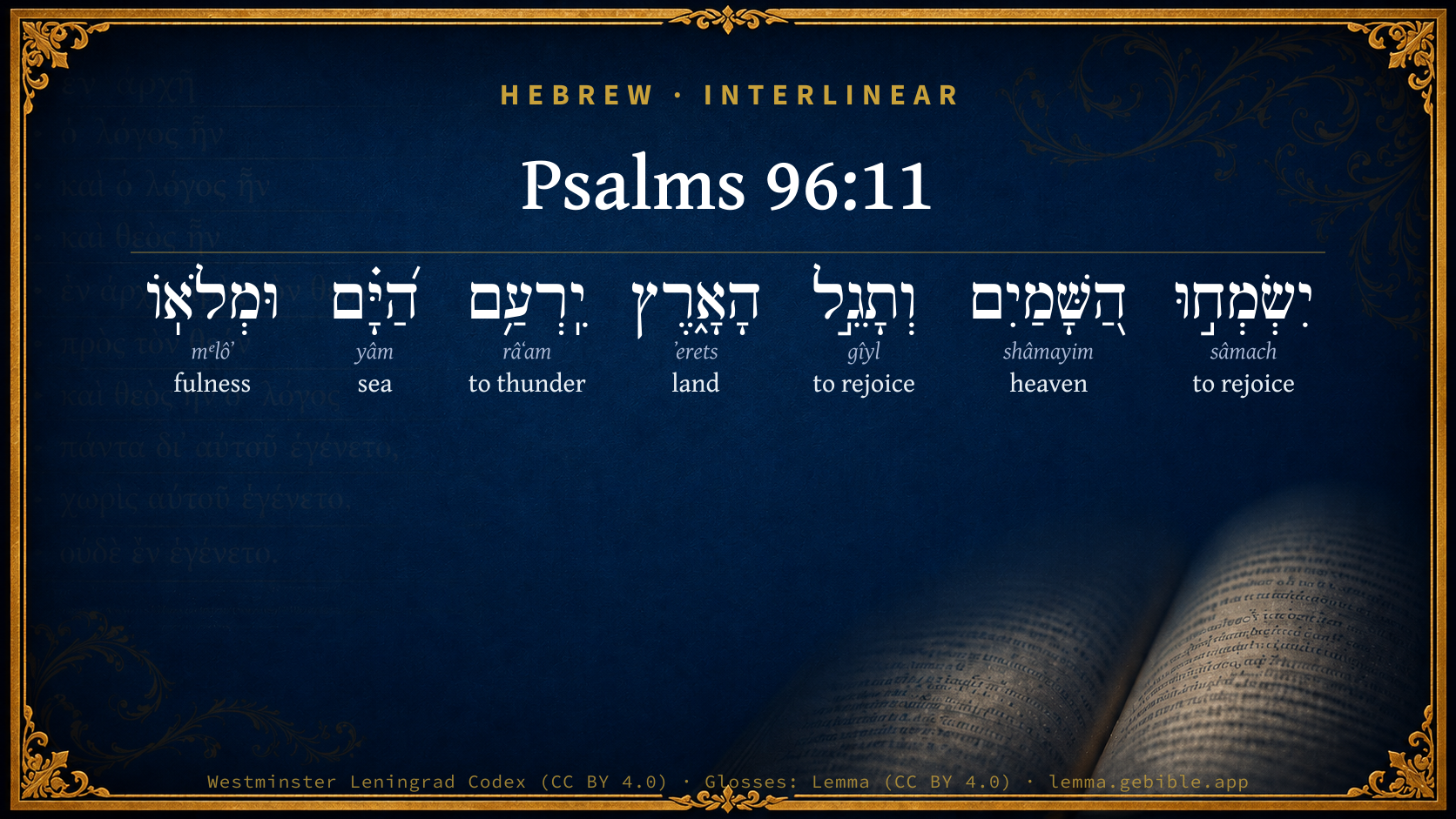
Psalms 96:11

Hebrew (Westminster Leningrad Codex) Psalms 96:11 appears in the Hebrew Old Testament. The text above is from the Westminster Leningrad Codex. Each word links to its Strong’s number, a concise gloss, and parsing drawn from the Open Scriptures Hebrew Bible morphology. Click any word for its full Brown-Driver-Briggs (BDB) entry.
Download image
Cite this verse

Psalms 96:11 (World English Bible). Public Domain. Lemma interlinear Bible study tool, https://lemma.gebible.app/v/psalms/96/11.

Show BibTeX & RIS
BibTeX
RIS
English Translation
Let the heavens be glad, and let the earth rejoice. Let the sea roar, and it's fullness!
World English Bible · Public Domain
Download a study sheet

One document with this verse’s original text, its word-by-word gloss line, the meaning frame, cross-references with their text, attributed commentary, and full source and license credits — printable, and it pastes into notes with its structure intact.

This verse Autodidact and up

Study sheet (.html) Plain text (.txt)

A passage Seminary Student

Up to 50 verses in one chapter. A passage sheet keeps up to 6 commentary sources and 12 cross-references per verse, in the order this page ranks them, and says so on the sheet whenever that leaves anything out. Ask for a single verse and you get the Autodidact verse sheet above.

Everything on this page stays free to read, with no account — the sheet is a download of what is already on screen, not access to it.

Want to remove ads? Support Godless Engineer
Compare translations 3

The same verse in 3 English versions, stacked beneath the original-language interlinear above. Click any original word for its lexicon entry.

Each is an independent rendering of the whole verse — the interlinear is not word-aligned to these translations.

Highlighted words mark where these versions differ — a whole-verse word diff, not a word-by-word alignment.

  • World English Bible Public Domain
    Let the heavens be glad, and let the earth rejoice. Let the sea roar, and it's fullness!
  • King James Version Public Domain
    Let the heavens rejoice, and let the earth be glad; let the sea roar, and the fulness thereof.
  • unfoldingWord Literal Text CC BY-SA 4.0
    Let the heavens be glad, and let the earth rejoice; let the sea roar and its fullness.

unfoldingWord Literal Text — © unfoldingWord, licensed CC BY-SA 4.0. Word-aligned USFM3 via Door43 (git.door43.org/unfoldingWord/en_ult).

Versions to compare (up to 4)

3 of 4 selected

Show all 18 translations

Every available English version of this verse, each an independent rendering of the whole verse.

  • World English Bible Public Domain
    Let the heavens be glad, and let the earth rejoice. Let the sea roar, and it's fullness!
  • Berean Standard Bible Public Domain
    Let the heavens be glad and the earth rejoice; let the sea resound, and all that fills it.
  • Majority Standard Bible Public Domain
    Let the heavens be glad and the earth rejoice; let the sea resound, and all that fills it.
  • King James Version Public Domain
    Let the heavens rejoice, and let the earth be glad; let the sea roar, and the fulness thereof.
  • American Standard Version (1901) Public Domain
    Let the heavens be glad, and let the earth rejoice; Let the sea roar, and the fulness thereof;
  • Revised Version (1885) Public Domain
    Let the heavens be glad, and let the earth rejoice; let the sea roar, and the fulness thereof;
  • Geneva Bible (1599) Public Domain
    Let the heauens reioyce, and let the earth be glad: let the sea roare, and all that therein is.
  • Douay-Rheims (1899) Public Domain
    Let the heavens rejoice, and let the earth be glad, let the sea be moved, and the fulness thereof:
  • Young's Literal Translation Public Domain
    The heavens joy, and the earth is joyful, The sea and its fulness roar.
  • Literal Standard Version CC BY-SA 4.0
    The heavens rejoice, and the earth is joyful, || The sea and its fullness roar.
  • Unlocked Literal Bible CC BY-SA 4.0
    Let the heavens be glad, and let the earth rejoice; let the sea roar and that which fills it shout with joy.
  • unfoldingWord Literal Text CC BY-SA 4.0
    Let the heavens be glad, and let the earth rejoice; let the sea roar and its fullness.
  • Darby Bible Public Domain
    Let the heavens rejoice, and let the earth be glad; let the sea roar, and the fulness thereof;
  • World Messianic Bible Public Domain
    Let the heavens be glad, and let the earth rejoice. Let the sea roar, and its fullness!
  • Webster's Bible Public Domain
    Let the heavens rejoice, and let the earth be glad; let the sea roar, and the fullness of it.
  • Free Bible Version CC BY-SA 4.0
    Let the heavens sing for joy, let the earth be happy, let the sea and everything in it shout with praise!
  • Bible in Basic English Public Domain
    Let the heavens have joy and the earth be glad; let the sea be thundering with all its waters;
  • JPS Tanakh (1917) Public Domain
    Let the heavens be glad, and let the earth rejoice; let the sea roar, and the fulness thereof;

Literal Standard Version (2020), Covenant Press — licensed CC BY-SA 4.0. Text via the HelloAO Bible API (eBible.org). Unlocked Literal Bible (unfoldingWord) — licensed CC BY-SA 4.0. Text via the HelloAO Bible API (eBible.org). unfoldingWord Literal Text — © unfoldingWord, licensed CC BY-SA 4.0. Word-aligned USFM3 via Door43 (git.door43.org/unfoldingWord/en_ult). Free Bible Version, Dr. Jonathan Gallagher — licensed CC BY-SA 4.0. Text via the HelloAO Bible API (eBible.org).

Word by word

More ways to search: Search by grammar → Find every occurrence → Compare this word →

Practice this passage: Drill this verse → Learn its vocabulary →

About this verse

These counts appear in no published source. They are computed here, from the morphology-tagged text and Lemma’s own curated glosses. What Lemma adds →

7
words
7
distinct lemmas
Wisdom
section

Notable vocabulary

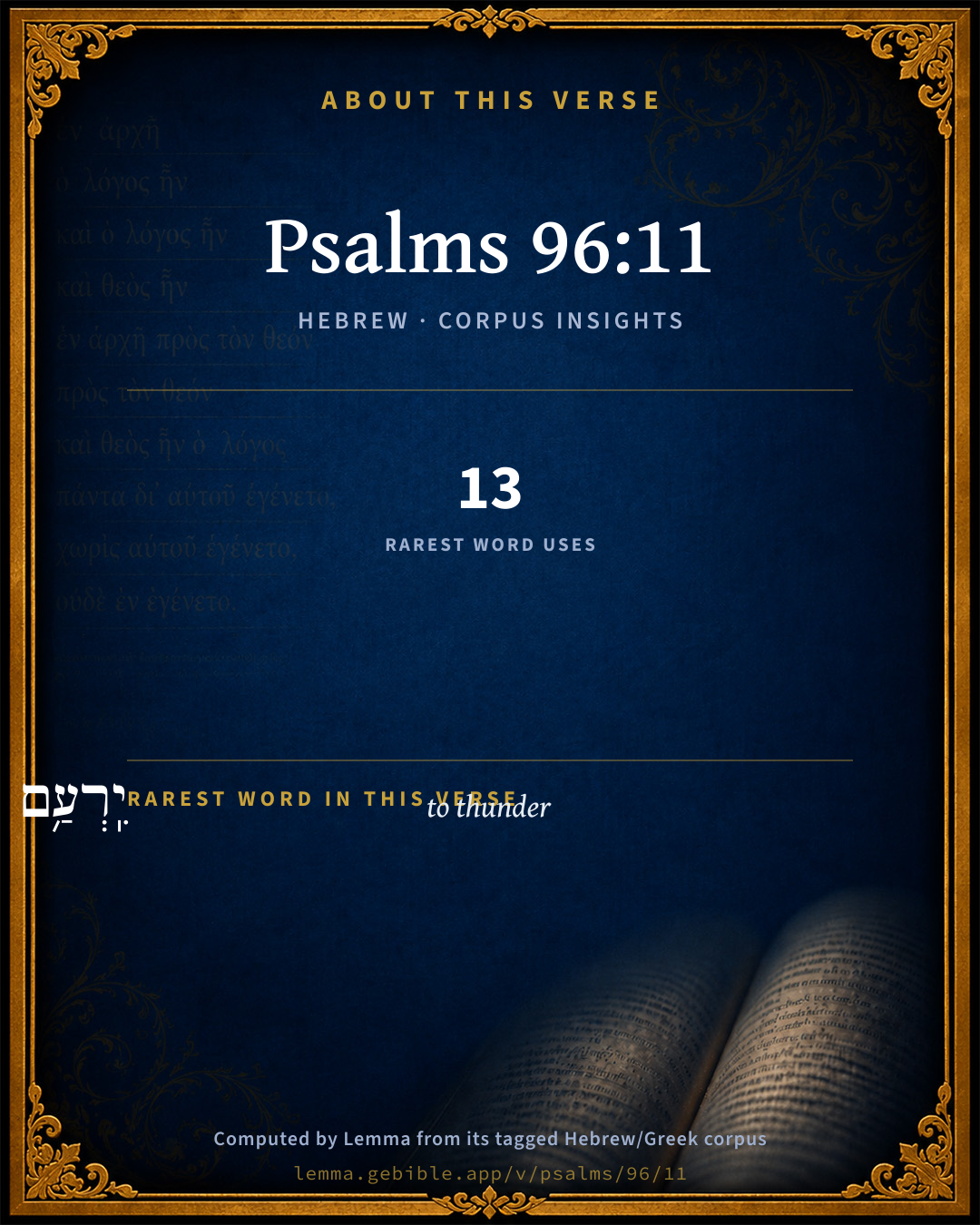
The rarest word here is יִֽרְעַ֥ם to thunder H7481 — appearing just 13 times in the whole Hebrew Bible.

Shared distinctive vocabulary

יִֽרְעַ֥ם to thunder H7481 occurs in 13 verses of the Hebrew Bible. Also found in:

Grammatical profile

  • 3 verbs
  • 4 nouns

Verb forms

  • יִשְׂמְח֣וּ Qal · Imperfect
  • וְתָגֵ֣ל Qal · Imperfect
  • יִֽרְעַ֥ם Qal · Imperfect

Hebrew & Septuagint length

In English translation the verse runs 17 words from the Hebrew and 18 from the Septuagint (LXX English) — closely comparable.

A rough comparison of the two English renderings, which tokenize alike — not a word-level alignment.

Word counts can differ between the Hebrew and the Greek without any difference in meaning — e.g. the Hebrew direct-object marker אֵת has no separate Greek word, and Greek often adds the article ὁ.

Cross-references

11

Topical passages linked to Psalms 96:11 in the Treasury of Scripture Knowledge — connected by theme and wording, ordered by reader-vote popularity; previews shown in the World English Bible.

  • Isaiah 49:13 Sing, heavens; and be joyful, earth; and break forth into singing, mountains: for Yahweh has comforted his people, and will have compassion on his afflicted.
  • Psalms 69:34 Let heaven and earth praise him; The seas, and everything that moves therein!
  • Psalms 97:1 Yahweh reigns! Let the earth rejoice! Let the multitude of islands be glad!
  • Psalms 98:7–9 Let the sea roar with its fullness; The world, and those who dwell therein.
  • Psalms 148:1–4 Praise Yah! Praise Yahweh from the heavens! Praise him in the heights!
  • Isaiah 44:23 Sing, you heavens, for Yahweh has done it; shout, you lower parts of the earth; break forth into singing, you mountains, O forest, and every tree therein: for Yahweh has redeemed Jacob, and will glorify himself in Israel.
  • Luke 2:10 The angel said to them, "Don't be afraid, for behold, I bring you good news of great joy which will be to all the people.
  • Luke 2:13–14 Suddenly, there was with the angel a multitude of the heavenly host praising God, and saying,
  • Luke 15:10 Even so, I tell you, there is joy in the presence of the angels of God over one sinner repenting."
  • Revelation 12:12 Therefore rejoice, heavens, and you who dwell in them. Woe to the earth and to the sea, because the devil has gone down to you, having great wrath, knowing that he has but a short time."
  • Revelation 19:1–7 After these things I heard something like a loud voice of a great multitude in heaven, saying, "Hallelujah! Salvation, power, and glory belong to our God:

Cross-references courtesy of OpenBible.info (CC BY 4.0).

Hebrew and Greek witnesses Masoretic Hebrew ↔ Greek Septuagint

The same verse in the two great witnesses to the Old Testament, shown verse-for-verse.

You’re reading Greek Psalm 95 (Hebrew Psalm 96). The Septuagint counts the superscription, so verse numbers can differ from the Hebrew — chapter-level alignment, not verse-by-verse. Numbering follows Rahlfs.

These are two independent witnesses, not word-aligned to each other, and the Septuagint is shown in lemma (dictionary) form.

Hebrew Psalms 96:11 Masoretic · Westminster Leningrad Codex

יִשְׂמְח֣וּ הַ֭שָּׁמַיִם וְתָגֵ֣ל הָאָ֑רֶץ יִֽרְעַ֥ם הַ֝יָּ֗ם וּמְלֹאֽוֹ

Let the heavens be glad, and let the earth rejoice. Let the sea roar, and it's fullness!

World English Bible · Public Domain

Greek LXX Greek Psalm 95:11 Septuagint · lemma form

εὐφραίνω ὁ οὐρανός καί ἀγαλλιάομαι ὁ γῆ σαλεύω ὁ θάλασσα καί ὁ πλήρωμα αὐτός

Let the heavens rejoice, and the earth exult; let the sea be moved, and the fullness of it.

LXX2012 (modern English Septuagint) · Public Domain

Hebrew: Westminster Leningrad Codex (CC BY 4.0). Greek: Septuagint (public domain); English from LXX2012 (modern English Septuagint) (Public Domain). How the Septuagint differs from the Hebrew →

Commentary

Notes on Psalms 96:11 from classic Christian and Jewish commentators (each source and its license shown beneath its notes). The classic Christian expositions comment on the surrounding passage and are grouped to its opening verse, so a note may address several verses; the Jewish commentaries on the Tanakh (Rashi and others) are per-verse, so they appear only where the commentator wrote on this verse.

Lemma curates 59 commentaries, every one of them public domain or Creative Commons licensed, each selected and text-cleaned for this edition rather than reprinted as found. About our sources →

Trapp's Complete Commentary

John Trapp

Psa 96:11 Let the heavens rejoice, and let the earth be glad; let the sea roar, and the fulness thereof.

Ver. 11. Let the heavens rejoice, &c.] Let there be a general joy for the general renovation by the coming of Christ, Rom 8:22, after which the whole creation groaneth also. Basil and others by heaven, earth, &c., understand angels, men of all sorts, as islanders, seamen, fieldmen, woodlanders, &c. Vel est similitudo ad denotandam in mundo pacem, saith Kimchi, Or it is a similitude to note peace all over the world. And surely when Christ came there was a universal aut pax aut pactio, saith Florus, peace or truce, under the government of Augustus.

Let the sea roar] Heb. thunder; Externo fragore et bombo testetur internam animi laetitiam, let it testify its joy perstrependo et reboando, by roaring its utmost.

John Trapp, A Commentary or Exposition upon All the Books of the Old and New Testament (1647–1656) — public domain. Text from a community e-Sword module.

Joseph Benson's Commentary

Psa 96:11-12. Let the heavens rejoice, &c. — These verses are a poetical description of the great causes of joy which this kingdom of Christ would bring to the world. The heavens, and earth, and sea, and trees, and fields, are here put together according to the Scripture style, to denote the whole world, which is here represented as being in a state of the greatest felicity, and as testifying its joy and thankfulness in the most lively and striking manner possible. “Transported,” says Dr. Horne, “with a view of these grand events, and beholding in spirit the advent of King Messiah, the psalmist exults in most jubilant and triumphant strains, calling the whole creation to break forth into joy, and to celebrate the glories of redemption. The heavens, with the innumerable orbs fixed in them, which, while they roll and shine, declare the glory of beatified saints; the earth, which, made fertile by celestial influences, showeth the work of grace on the hearts of men here below; the field which, crowned with a produce of a hundred- fold, displays an emblem of the fruit yielded by the seed of the Word in the church; the trees of the wood, lofty, verdant, and diffusive, apt representatives of holy persons, those trees of righteousness, the planting of Jehovah, Isa 61:3, whose examples are eminent, fair, and extensive; all these are, by the prophet, excited to join in a chorus of thanksgiving to the Maker and Redeemer of the world.”

Joseph Benson's Commentary on the Old and New Testaments (1811–1818) — public domain. Text from a community e-Sword module.

J. A. Alexander on Psalms

Joseph Addison Alexander

11. (Psa 96:11) Let the heavens rejoice and the earth exult; let the sea roar and its fulness. The optative form of the second verb determines the meaning of the other futures, which, however, really include a prediction, or what here amounts to the same thing, a confident anticipation. Its fulness, that which fills it, its contents. This verse does not necessarily imply a participation of inferior creatures in God's favour to his people (Rom 8:21), but may be understood as a strong poetical description of events so joyous that even the inanimate creation breaks forth into singing. Compare Isa 44:23; Isa 55:12. The verb translated roar is a cognate form of that which means to thunder, Psa 29:3.

Joseph Addison Alexander, The Psalms Translated and Explained (1850) — public domain. Text from a community e-Sword module.

Tyndale Open Study Notes

Tyndale Open Resources

96:11-13 The psalmist exhorts the created order to respond with joy to the news of the Lord’s coming. Cp. a similar theme in 98:7-9.

Tyndale Open Study Notes — © Tyndale Open Resources, licensed CC BY-SA 4.0. Text via the HelloAO Bible API.

Adam Clarke's Commentary

Verse 11. Let the heavens rejoice] The publication of the Gospel is here represented as a universal blessing; the heavens, the earth, the sea, and its inhabitants, the field, the grass, and the trees of the wood, are all called to rejoice at this glorious event. This verse is well and harmoniously translated in the old Psalter: -

Fayne be hevenes. - and the erth glad;

Styrde be the see, - and the fulnes of it;

Joy sal feldes, - and al that ere in thaim.

And the paraphrase is at least curious: -

Hevens, haly men. Erthe, meke men that receyves lare (learning.) Feldes, that is even men, mylde and softe: they shall joy in Criste. And all that is in thaim, that es, strengh, wyttes & skill."

I shall give the remaining part of this ancient paraphrase, which is an echo of the opinion of most of the Latin fathers.

Adam Clarke's Commentary on the Bible (1810–1826) — public domain. Text from a community e-Sword/MySword module.

John Calvin's Commentaries

11 Let the heavens rejoice, and let the earth be glad. With the view of giving us a more exalted conception of the display of God’s goodness in condescending to take all men under his government, the Psalmist calls upon the irrational things themselves, the trees, the earth, the seas, and the heavens, to join in the general joy. Nor are we to understand that by the heavens he means the angels, and by the earth men; for he calls even upon the dumb fishes of the deep to shout for joy. The language must therefore be hyperbolical, designed to express the desirableness and the blessedness of being brought unto the faith of God. At the same time, it denotes to us that God does not reign with terror, or as a tyrant, but that his power is exercised sweetly, and so as to diffuse joy amongst his subjects. The wicked may tremble when his kingdom is introduced, but the erection of it is only the cause of their fear indirectly. We might notice also, that the hyperbole here employed does not want a certain foundation of a more literal kind. As all elements in the creation groan and travail together with us, according to Paul’s declaration, (Romans 8:22) they may reasonably rejoice in the restoration of all things according to their earnest desire. The words teach us how infatuated that joy is, which is wantonly indulged in by men who are without God. From the close of the psalm, we learn that it is impossible to experience the slightest measure of true joy, as long as we have not seen the face of God, Rejoice before the Lord, because he cometh And if the very sea and land mourn so long as God is absent, may we not ask what shall become of us, who are properly the subjects of God’s dreadful curse? The Psalmist, to remove all doubt regarding an event which might seem incredible, repeats his assertion of it, and states, at the same time, in what that rectitude consists, which he had formerly mentioned, when he adds, that God shall govern the world with righteousness and truth. This shows us that it is only by the light of God’s righteousness and truth that the wickedness and hypocrisy of men can be removed and dispelled.

John Calvin's Commentaries (1540-1563) — public domain. Text from the Calvin Translation Society English edition (1840s-50s) via the Christian Classics Ethereal Library (ccel.org). Calvin's coverage is partial (roughly two-thirds of the Bible); uncommented books and verses are honest gaps, never fabricated. The 19th-century editor's footnotes and remarks are omitted so the notes are faithfully Calvin's own voice.

Ellicott's Commentary for English Readers

(11-13) Magnificent progress of the Divine Judge through His realm. There is only one thought, that of the inauguration of a righteous sway for all nations: at its advent, as in Isaiah’s glorious visions (see Isa_35:1-2; Isa_42:10; Isa_44:23; Isa_55:12), all nature seems to join the chorus of gladness.

A Bible Commentary for English Readers, edited by Charles John Ellicott (1878–1897) — public domain. Text from a community e-Sword module.

The Cambridge Bible for Schools and Colleges

gen. ed. J. J. S. Perowne

11. Let the heavens be glad and let the earth rejoice (R.V.)] Such appeals to Nature to rejoice in the redemption of Israel are characteristic of the later Isaiah (Isa_44:23; Isa_49:13). In the establishment of God’s righteous rule the Psalmist sees the prelude of the Messianic age which is to bring harmony and peace to all creation. Cp. Isa_11:1 ff; Isa_35:1 ff; Isa_55:12-13; Rom_8:19 ff.

roar] Lit. thunder. Cp. Psa_98:7.

the fulness thereof] I.e. all that is therein, as the same word is rendered in Isa_42:10. Cp. Psa_24:1.

The Cambridge Bible for Schools and Colleges (gen. ed. J. J. S. Perowne; Cambridge University Press, 1878–1918) — public domain. Text from a community e-Sword module.

John Gill's Exposition

Let the heavens rejoice,.... At the coming and kingdom of Christ; at what is said and done in the Gentile world; even the hosts of heaven, as the Targum, the angels that dwell there, and never left their habitation and first estate: these rejoiced at the incarnation of Christ, at the first setting up and appearance of his kingdom in the world; and as they rejoice at the conversion of a single sinner, much more must they be supposed to do at the conversion of multitudes in the Gentile world, and at the increase of the Redeemer's interest there: or heavenly men, such as are born from above, partakers of the heavenly calling; these rejoice when the kingdom of Christ is enlarged, and his cause flourishes: or the holy apostles and prophets of Christ, and ministers of the word, full of heavenly gifts and grace, are meant; who express their joy when sinners are converted, and made subject to Christ, at any time; and will be called upon to do it, when the fulness of the Gentiles is brought in, and Babylon is fallen, Rev 18:20,

and let the earth be glad; the righteous of the earth, as the Targum; the excellent of the earth, who are glad, and exult at the coming and kingdom of Christ, in every sense; in the salvation which he has wrought out; in the righteousness which he has brought in; at the sight of him, the glory of his person, and riches of his grace; in the enjoyment of his presence; at hearing his Gospel, and the comfortable truths of it; and when it is made useful to the souls of others; and in a view and hope of the glory of God, and of being partakers of it to all eternity:

let the sea roar, and the fulness thereof; the roaring of the waves is the voice of the sea, which sometimes speaks terror, and here expresses joy: its fulness is not literally the abundance of its waves, or the multitude of its fishes, as Kimchi; but the islands in it, the inhabitants of them; see Psa 97:1 and such as ours of Great Britain and Ireland, who have reason to rejoice and be glad at the bringing of the Gospel among us, the continuance of it with us, and the kingdom and, interest of Christ in the midst of us.

John Gill's Exposition of the Whole Bible (1746–1763) — public domain (CC PDM 1.0). Text via the HelloAO Bible API.

Albert Barnes' Notes on the Bible

Let the heavens rejoice, and let the earth be glad - Let all worlds be full of joy, as they are all interested in the fact here stated. The universe is one. It has been made by the same hand; it is under the control of the same mind; it is governed by the same laws. The God who reigns on earth reigns in heaven; and what affects one part of the universe affects all. Hence, in all the manifestation of the character of God, whether made in heaven or in the earth, it is proper to call on all the universe to partake in the general joy.

Let the sea roar - In praise to God. It is not uncommon in the Scriptures to call on inanimate things to praise God. Compare Psa 148:7-9. The same thing is common in all poetry.

And the fulness thereof - Its abundance. That which fills it. All that it contains. That is, Let all that dwell in the seas praise God. His reign is an occasion for universal gladness. All in the inanimate world; all among the irrational tribes of being; all in the air, in the waters, or on the earth, have occasion for praise, and would render praise if they could appreciate the wisdom and goodness evinced in their creation. Though unconscious, the lower creatures seem to celebrate his praise; but man only can give an intelligent utterance to thanksgiving.

Albert Barnes' Notes on the Bible (1834–1885) — public domain. Text from a community e-Sword/MySword module.

Matthew Poole's English Annotations

It is a figure called prosopopoeia, whereby he signifies the great felicity of those times, which shall be such that even those lifeless creatures would testify their joy and thankfulness for it, if they were in a capacity so to do.

Matthew Poole's English Annotations on the Holy Bible (1683–1685) — public domain. Text from a community e-Sword/MySword module.

The Treasury of David

Charles H. Spurgeon

Ver. 11. Let the heavens rejoice, and let the earth be glad. Above and below let the joy be manifested. Let the angels who have stood in amaze at the wickedness of men, now rejoice over their repentance and restoration to favour, and let men themselves express their pleasure in seeing their true prince set upon his throne. The book of creation has two covers, and on each of these let the glory of the Lord be emblazoned in letters of joy.

Let the sea roar, and the fulness thereof Let it be no more a troubled sea, wailing over shipwrecked mariners, and rehearsing the griefs of widows and orphans, but let it adopt a cheerful note, and rejoice in the kingdom of the Lord. Let it thunder out the name of the Lord when its tides are at its full, and let all its teeming life express the utmost joy because the Lord reigneth even in the depth of the sea. In common with the rest of the creation, the sea has groaned and travailed until now; is not the time close at hand in which its hollow murmur shall be exchanged for an outburst of joy? Will not every billow soon flash forth the praises of him who once trod the sea?

"Waft, waft, ye winds, his story!

And you ye waters, roll,

Till, like a sea of glory,

It spreads from pole to pole."

Ver. 11. Let the heavens rejoice. As the whole creation, both animate and inanimate, has groaned beneath the weight of the curse, so shall the whole creation partake of the great deliverance." The Speaker's Commentary, "1873.

Ver. 11. Let the sea roar.

Thou paragon of elemental powers,

Mystery of watersnever slumbering sea!

Impassioned orator with lips sublime,

Whose waves are arguments which prove a God! Robert Montgomery, 1807-1855.

Ver. 11-12. God will graciously accept the holy joys and praises of all the hearty well wishers to the kingdom of Christ, be their capacity never so mean. The sea can but roar, and how the trees of the wood can show that they rejoice, I know not; but "he that searcheth the heart, knows what is the mind of the Spirit, " and understands the language, the broken language of the weakest. Matthew Henry.

Ver. 11-13. These verses are full of comprehensive beauty and power. They present the gathering together of everything under the confessed dominion of the reigning Christ. Things in heaven, as well as things on earth, rejoice together in the acknowledged blessing of the Lord of peace. The Psalm is throughout a very sweet strain of millennial prophecy. Arthur Pridham.

Ver. 11-13. Nothing can excel that noble exultation of universal nature in the 96th Psalm, which has been so often commended, where the whole animate and inanimate creation unite in the praises of their Maker. Poetry here seems to assume the highest tone of triumph and exultation, and to revel, if I may so express myself, in all the extravagance of joy. Robert Lowth.

Ver. 11-13. Although there are some who by heaven understand angels;by the earth, men;by the sea, troublesome spirits;by trees and fields, the Gentiles who were to believe, yet this need not be thought strange, because such prosopopaeias are frequent in Scripture. Adam Clarke.

Ver. 11-12. The sympathy of nature with the work of grace; especially dwelling upon its fuller display in the millennial period.

Psalms 96:12*

Charles H. Spurgeon's The Treasury of David (1869–1885) — public domain. Psalms only. Text from a community e-Sword/MySword module.

Whedon's Commentary on the Bible

Daniel D. Whedon

11. Let the heavens rejoice—Fulfilled when, in prophetic vision, heaven saw the kingdom of Christ established over the nations. Rev_11:17-19. But the righteous dominion of Christ over the earth implies, not only the worship of one God and one Saviour, but the downfall of despotism, the abrogation of unjust laws, the administration of justice, the overthrow of antichrist, the uprooting of superstition, the destruction of idols, the universal rights of man, and the peace of the earth. These have never yet been accomplished by the gentle influence of moral suasion alone, without the concurring judgments of God to break the arm of the wicked.

Daniel D. Whedon (gen. ed.), Commentary on the Old and New Testaments (1874–1909) — public domain. Text from a community e-Sword module.

The Pulpit Commentary

Let the heavens rejoice, and let the earth be glad. "An appeal for the sympathy of nature" (Cheyne); comp. Isa_44:23 Jer_51:48. If the final coming of Messiah"s kingdom be the event alluded to in ver. 10, as is quite possible, the calling on heaven and earth to rejoice may indicate a real renovation of the material universe, such as to bring it into harmony with the newly established spiritual conditions of the period. (comp. Isa_65:17-25 Rev_21:1-4) Lot the sea roar, and the fulness thereof. (comp. Psa_98:7) The sea is to show its joy by raising its voice, and "roaring," or "thundering.

Vers. 11, 12. Nature sympathies.

There is a strange and wonderful response of material nature to the spiritual moods of men. Faces may not change, but expressions on faces change continually, and even seem different to different individuals. And so nature keeps the same, but seems ever-varying to us, according as our moods are to it. Lowth says on this verse, "Nothing can excel that noble exultation of universal nature, which has been so often commended. Poetry here seems to assume the highest tone of triumph and exultation, and to revel, if I may so express myself, in all the extravagance of joy." Keep in mind that nature is represented as suffering in consequence of the sin of man. It may well exult with man in the redemption which uplifts out of suffering both him and it. (Rom_8:20-23) In a very well known discourse, Dr. H. Bushnell illustrates these two propositions:

(1) God has hidden powers of music in things without life;

(2) when they are used, in right distinctions or properties of sound, they discourse what we know what meets, interprets, and works our feeling, as living and spiritual creatures.

I NATURE SYMPATHIES WITH MAN IN HIS INNOCENCE. Show the kindness between the Garden of Eden and the man put into it.

II NATURE SYMPATHIES WITH MAN IN HIS FALL. Bringing forth thorns, etc. Ground cursed for man"s sake. A well known artist has a picture of Adam and Eve after their fall. They are seated, in utmost distress, at a distance from each other, and what seems to divide them is a hideously shaped tree, the trunk of which seems to take almost demon form. The artist made nature kin to our fallen parents.

III NATURE SYMPATHIES WITH MAN IN HIS MOODS. Illustrate this by the darkness which fell behind the cross of Jesus when he died. See also the effect of the shading olives on Jesus in Gethsemane. Compare the harvest psalms the corn, etc., shouting for joy in response to the glad and thankful moods of men.

IV NATURE SYMPATHIES WITH MAN IN HIS REDEMPTION. For illustration, see Isa_11:6-9, where the very beasts are poetically represented as affected by the peace of eternal purity which one day shall come to men. R.T.

The Pulpit Commentary (1880–1919), ed. H.D.M. Spence-Jones & Joseph S. Exell — public domain. Text from a community e-Sword module.

unfoldingWord translationNotes

Door43 World Missions Community

Let the heavens be glad, and let the earth rejoice

Possible meanings are 1) the heavens and the earth are spoken of as if they have emotions like people. AT: "Let it be as if the heavens are glad and the earth rejoices" or 2) "the heavens" and "the earth" are metonyms for those who dwell in those places. AT: "Let those who live in the heavens be glad and let those who live on the earth rejoice" (See: Personification and Metonymy)

that which fills it shout with joy

The implied information is that this refers to all the creatures living in the sea. They are spoken of as if they should shout with joy like people might do. AT: "the sea creatures shout joyfully" (See: Assumed Knowledge and Implicit Information and Personification)

Let the fields rejoice and all that is in them

"Let the fields and all that is in them rejoice." The psalmist speaks as if "the fields" and the animals that live in them have emotions like people. AT: "Let it be as if the fields themselves and all the animals that live in them are rejoicing" (See: Personification)

let all the trees in the forest shout for joy

This speaks about the trees as if they were people who could shout for joy. AT: "let it be as if all the trees in the forest shout for joy" (See: Personification)

He is coming to judge the earth. He will judge the world ... and the peoples

The three phrase have similar meanings; the last two phases are used to strengthen the first. (See: Parallelism)

to judge ... will judge

Another possible meaning is "to rule ... will rule."

He will judge the world with righteousness

Here "the world" is a metonym for all the people in the world. See how these words are translated in Psalms 9:8. AT: "He will judge all the people of the world righteously" (See: Metonymy)

the peoples with his faithfulness

The words "he will judge" are understood. AT: "he will judge the peoples with his faithfulness" (See: Ellipsis)

with his faithfulness

The can be restated to remove the abstract noun "faithfulness." Possible meanings are 1) AT: "fairly, according to what he knows is true" or 2) AT: "using the same standard for all people" (See: Abstract Nouns)

translationWords

heaven

joy

joy

righteous

faithful

unfoldingWord translationNotes — © Distant Shores Media and the Door43 World Missions Community, licensed CC BY-SA 4.0. Source: git.door43.org/Door43/en_tn.

Rashi

Rabbi Shlomo Yitzchaki (Rashi)

the sea...will roar to raise its voice in praise.

Rashi on the Tanakh — English translations: “The Judaica Press complete Tanach with Rashi, translated by A. J. Rosenberg” (CC BY 4.0); “Pentateuch with Rashi's commentary by M. Rosenbaum and A.M. Silbermann, 1929-1934” (public domain); “The Metsudah Tanach series, Lakewood, N.J” (CC BY 4.0); and “The Book of Joshua, Metsudah Publications, 1997” (CC BY 4.0). Text via Sefaria.

Lesson kit

Teaching starters — assembled from the data on this page, not authored interpretation. Every prompt links to the verse data it draws on. Edit before teaching.

Psalms, in the Wisdom, opens this verse with 7 words (7 distinct Hebrew lemmas). Its most distinctive word is râʻam (“to thunder”). A historical commentator’s framing appears above. Read the whole chapter for the surrounding context.

Discussion questions

  1. The word râʻam carries the sense “to thunder.” How does it shape the verse?
  2. How does 1 Samuel 1:6, which shares the word «to thunder», read alongside this verse?
  3. These translations render this verse differently; the difference is in the English rendering, not the original. What questions does that raise?
  4. «יִשְׂמְח֣וּ» is a Qal Imperfect verb. How does that grammatical form shape the action described?
  5. Compare how Trapp's Complete Commentary and Joseph Benson's Commentary read this verse. Where do they agree or differ?

Things to notice

Reading settings

Reading text

Shown beneath each verse's original-language words.

Old Testament
Old Testament edition

Read the OT as the Masoretic Hebrew (MT) or the Greek Septuagint (LXX).

English shown for the Greek Septuagint (in the Hebrew ↔ Greek comparison).

Comparing translations? Open the Compare panel on any verse page to stack up to four side by side.