Leviticus 11:9

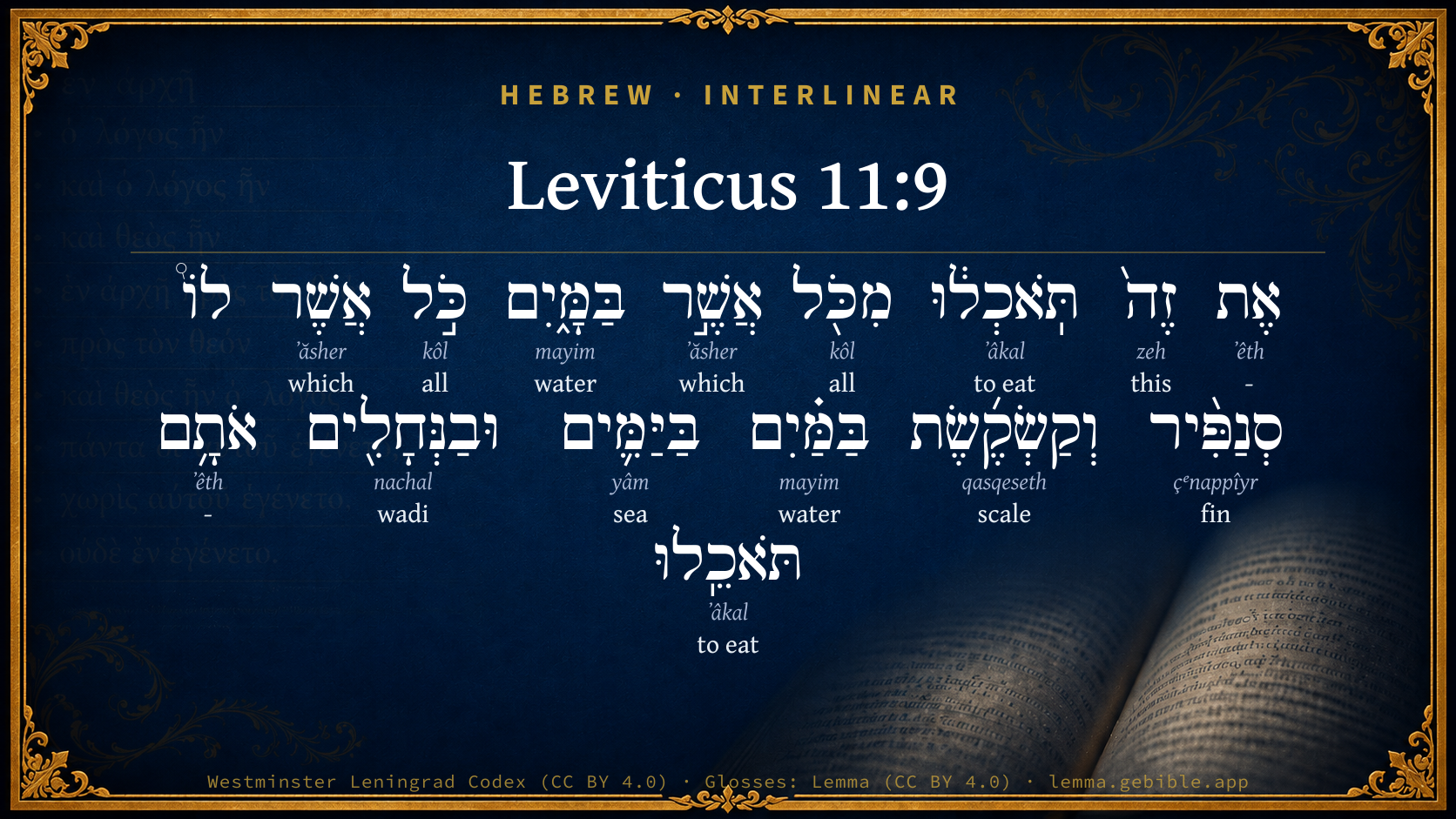
Hebrew (Westminster Leningrad Codex) Leviticus 11:9 appears in the Hebrew Old Testament. The text above is from the Westminster Leningrad Codex. Each word links to its Strong’s number, a concise gloss, and parsing drawn from the Open Scriptures Hebrew Bible morphology. Click any word for its full Brown-Driver-Briggs (BDB) entry.
Download image
Cite this verse

Leviticus 11:9 (World English Bible). Public Domain. Lemma interlinear Bible study tool, https://lemma.gebible.app/v/leviticus/11/9.

Show BibTeX & RIS
BibTeX
RIS
English Translation
These you may eat of all that are in the waters: whatever has fins and scales in the waters, in the seas, and in the rivers, that you may eat.
World English Bible · Public Domain
Highlights
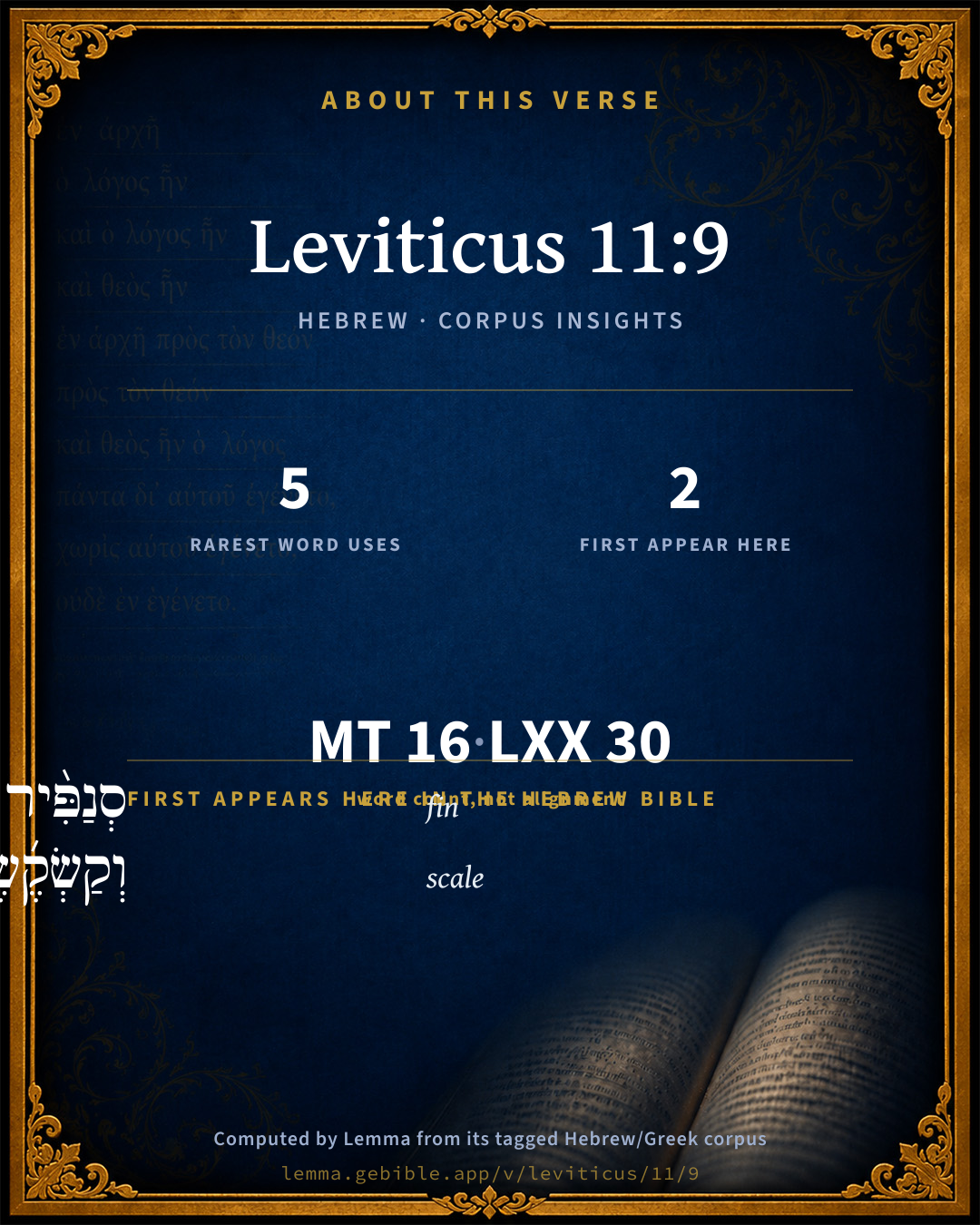
  • 2 first appearances in the Hebrew Bible
Full analysis ↓
Download a study sheet

One document with this verse’s original text, its word-by-word gloss line, the meaning frame, cross-references with their text, attributed commentary, and full source and license credits — printable, and it pastes into notes with its structure intact.

This verse Autodidact and up

Study sheet (.html) Plain text (.txt)

A passage Seminary Student

Up to 50 verses in one chapter. A passage sheet keeps up to 6 commentary sources and 12 cross-references per verse, in the order this page ranks them, and says so on the sheet whenever that leaves anything out. Ask for a single verse and you get the Autodidact verse sheet above.

Everything on this page stays free to read, with no account — the sheet is a download of what is already on screen, not access to it.

Want to remove ads? Support Godless Engineer
Compare translations 3

The same verse in 3 English versions, stacked beneath the original-language interlinear above. Click any original word for its lexicon entry.

Each is an independent rendering of the whole verse — the interlinear is not word-aligned to these translations.

Highlighted words mark where these versions differ — a whole-verse word diff, not a word-by-word alignment.

  • World English Bible Public Domain
    These you may eat of all that are in the waters: whatever has fins and scales in the waters, in the seas, and in the rivers, that you may eat.
  • King James Version Public Domain
    These shall ye eat of all that are in the waters: whatsoever hath fins and scales in the waters, in the seas, and in the rivers, them shall ye eat.
  • unfoldingWord Literal Text CC BY-SA 4.0
    This you shall eat from everything that is in the water: everything that is to it fins and scales in the water, in the seas, and in the rivers—them you shall eat.

unfoldingWord Literal Text — © unfoldingWord, licensed CC BY-SA 4.0. Word-aligned USFM3 via Door43 (git.door43.org/unfoldingWord/en_ult).

Versions to compare (up to 4)

3 of 4 selected

Show all 18 translations

Every available English version of this verse, each an independent rendering of the whole verse.

  • World English Bible Public Domain
    These you may eat of all that are in the waters: whatever has fins and scales in the waters, in the seas, and in the rivers, that you may eat.
  • Berean Standard Bible Public Domain
    Of all the creatures that live in the water, whether in the seas or in the streams, you may eat anything with fins and scales.
  • Majority Standard Bible Public Domain
    Of all the creatures that live in the water, whether in the seas or in the streams, you may eat anything with fins and scales.
  • King James Version Public Domain
    These shall ye eat of all that are in the waters: whatsoever hath fins and scales in the waters, in the seas, and in the rivers, them shall ye eat.
  • American Standard Version (1901) Public Domain
    These may ye eat of all that are in the waters: whatsoever hath fins and scales in the waters, in the seas, and in the rivers, that may ye eat.
  • Revised Version (1885) Public Domain
    These shall ye eat of all that are in the waters: whatsoever hath fins and scales in the waters, in the seas, and in the rivers, them shall ye eat.
  • Geneva Bible (1599) Public Domain
    These shall ye eate, of all that are in the waters: whatsoeuer hath finnes and skales in ye waters, in the seas, or in the riuers, them shall ye eate.
  • Douay-Rheims (1899) Public Domain
    These are the things that breed in the waters, and which it is lawful to eat. All that hath fins, and scales, as well in the sea, as in the rivers, and the pools, you shall eat.
  • Young's Literal Translation Public Domain
    `This ye do eat of all which `are' in the waters; any one that hath fins and scales in the waters, in the seas, and in the brooks, them ye do eat;
  • Literal Standard Version CC BY-SA 4.0
    This you eat of all which [are] in the waters: anything that has fins and scales in the waters, in the seas, and in the brooks, them you eat;
  • Unlocked Literal Bible CC BY-SA 4.0
    The animals living in the water that you may eat are all those that have fins and scales, whether in the ocean or in the rivers.
  • unfoldingWord Literal Text CC BY-SA 4.0
    This you shall eat from everything that is in the water: everything that is to it fins and scales in the water, in the seas, and in the rivers—them you shall eat.
  • Darby Bible Public Domain
    These shall ye eat of all that are in the waters: whatever hath fins and scales in waters, in seas and in rivers, these shall ye eat;
  • World Messianic Bible Public Domain
    “‘You may eat of all these that are in the waters: whatever has fins and scales in the waters, in the seas, and in the rivers, that you may eat.
  • Webster's Bible Public Domain
    These shall ye eat, of all that are in the waters: whatever hath fins and scales in the waters, in the seas, and in the rivers, them shall ye eat.
  • Free Bible Version CC BY-SA 4.0
    You are allowed to eat any creature with fins and scales that lives in the water, whether in the sea or in fresh water.
  • Bible in Basic English Public Domain
    These you may have for food of all things living in the water: anything living in the water, in the seas or rivers, which has special parts for swimming and skin formed of thin plates, may be used for food.
  • JPS Tanakh (1917) Public Domain
    These may ye eat of all that are in the waters: whatsoever hath fins and scales in the waters, in the seas, and in the rivers, them may ye eat.

Literal Standard Version (2020), Covenant Press — licensed CC BY-SA 4.0. Text via the HelloAO Bible API (eBible.org). Unlocked Literal Bible (unfoldingWord) — licensed CC BY-SA 4.0. Text via the HelloAO Bible API (eBible.org). unfoldingWord Literal Text — © unfoldingWord, licensed CC BY-SA 4.0. Word-aligned USFM3 via Door43 (git.door43.org/unfoldingWord/en_ult). Free Bible Version, Dr. Jonathan Gallagher — licensed CC BY-SA 4.0. Text via the HelloAO Bible API (eBible.org).

Word by word

More ways to search: Search by grammar → Find every occurrence → Compare this word →

Practice this passage: Drill this verse → Learn its vocabulary →

סְנַפִּ֨יר
çᵉnappîyr
H5579
“fin”
Noun, Common, Masculine, Singular, Absolute
Part of Speech
Noun
Type
Common
Gender
Masculine
Number
Singular
State
Absolute
Full BDB Definition

Origin: of uncertain derivation

TWOT: 1523

fin
  1. אֶת ʼêth H853 “-” Particle, Direct Object
  2. זֶה֙ zeh H2088 “this” Pronoun, Demonstrative, Masculine, Singular
  3. תֹּֽאכְל֔וּ ʼâkal H398 “to eat” Verb, Qal, Imperfect, 2nd Person, Masculine, Plural
  4. מִכֹּ֖ל kôl H3605 “from · all” Preposition + Noun, Common, Masculine, Singular, Absolute
  5. אֲשֶׁ֣ר ʼăsher H834 “which” Particle, Relative
  6. בַּמָּ֑יִם mayim H4325 “in/at the · water(s)” Preposition, Determined + Noun, Common, Masculine, Plural, Absolute
  7. כֹּ֣ל kôl H3605 “all” Noun, Common, Masculine, Singular, Absolute
  8. אֲשֶׁר ʼăsher H834 “which” Particle, Relative
  9. וְקַשְׂקֶ֜שֶׂת qasqeseth H7193 “and · scale” Conjunction + Noun, Common, Feminine, Singular, Absolute
  10. בַּמַּ֗יִם mayim H4325 “in/at the · water(s)” Preposition, Determined + Noun, Common, Masculine, Plural, Absolute
  11. בַּיַּמִּ֛ים yâm H3220 “in/at the · seas” Preposition, Determined + Noun, Common, Masculine, Plural, Absolute
  12. וּבַנְּחָלִ֖ים nachal H5158 “and · in/at the · wadis” Conjunction + Preposition, Determined + Noun, Common, Masculine, Plural, Absolute
  13. אֹתָ֥ם ʼêth H853 “- · them” Particle, Direct Object + Suffix, Personal, 3rd Person, Masculine, Plural
  14. תֹּאכֵֽלוּ ʼâkal H398 “to eat” Verb, Qal, Imperfect, 2nd Person, Masculine, Plural

About this verse

These counts appear in no published source. They are computed here, from the morphology-tagged text and Lemma’s own curated glosses. What Lemma adds →

16
words
10
distinct lemmas
Pentateuch
section

Notable vocabulary

The rarest word here is סְנַפִּ֨יר fin H5579 — appearing just 5 times in the whole Hebrew Bible.

First appearance in Scripture

These words make their first canonical appearance in the Hebrew Bible here:

  • סְנַפִּ֨יר fin H5579
  • וְקַשְׂקֶ֜שֶׂת scale H7193

Shared distinctive vocabulary

סְנַפִּ֨יר fin H5579 occurs in 5 verses of the Hebrew Bible. Also found in:

Grammatical profile

  • 2 verbs
  • 8 nouns
  • 1 pronoun
  • 1 preposition
  • 4 particles

Verb forms

  • תֹּֽאכְל֔וּ Qal · Imperfect
  • תֹּאכֵֽלוּ Qal · Imperfect

Repetition

Words recur within this verse — often emphatic in Hebrew:

  • תֹּֽאכְל֔וּ to eat H398 ×2
  • מִכֹּ֖ל all H3605 ×2
  • בַּמָּ֑יִם water H4325 ×2
  • אֲשֶׁ֣ר which H834 ×2

Hebrew & Septuagint length

In English translation the verse runs 30 words from the Hebrew and 36 from the Septuagint (LXX English) — closely comparable.

A rough comparison of the two English renderings, which tokenize alike — not a word-level alignment.

Word counts can differ between the Hebrew and the Greek without any difference in meaning — e.g. the Hebrew direct-object marker אֵת has no separate Greek word, and Greek often adds the article ὁ.

In the original languages it is 16 Hebrew tokens and 30 Greek tokens — but the two are counted differently (Hebrew bundles its prefixes and suffixes into one token; the Greek is in lemma form), so that isn’t a like-for-like length.

Cross-references

5

Topical passages linked to Leviticus 11:9 in the Treasury of Scripture Knowledge — connected by theme and wording, ordered by reader-vote popularity; previews shown in the World English Bible.

  • Deuteronomy 14:9–10 These you may eat of all that are in the waters: whatever has fins and scales may you eat;
  • Acts 20:21 testifying both to Jews and to Greeks repentance toward God, and faith toward our Lord Jesus.
  • Galatians 5:6 For in Christ Jesus neither circumcision amounts to anything, nor uncircumcision, but faith working through love.
  • James 2:18 Yes, a man will say, "You have faith, and I have works." Show me your faith from your works, and I by my works will show you my faith.
  • 1 John 5:2–5 By this we know that we love the children of God, when we love God and keep his commandments.

Cross-references courtesy of OpenBible.info (CC BY 4.0).

Hebrew and Greek witnesses Masoretic Hebrew ↔ Greek Septuagint

The same verse in the two great witnesses to the Old Testament, shown verse-for-verse.

These are two independent witnesses, not word-aligned to each other, and the Septuagint is shown in lemma (dictionary) form.

Hebrew Leviticus 11:9 Masoretic · Westminster Leningrad Codex

אֶת זֶה֙ תֹּֽאכְל֔וּ מִכֹּ֖ל אֲשֶׁ֣ר בַּמָּ֑יִם כֹּ֣ל אֲשֶׁר לוֹ֩ סְנַפִּ֨יר וְקַשְׂקֶ֜שֶׂת בַּמַּ֗יִם בַּיַּמִּ֛ים וּבַנְּחָלִ֖ים אֹתָ֥ם תֹּאכֵֽלוּ

These you may eat of all that are in the waters: whatever has fins and scales in the waters, in the seas, and in the rivers, that you may eat.

World English Bible · Public Domain

Greek LXX Leviticus 11:9 Septuagint · lemma form

καί οὗτος ὅς ἐσθίω ἀπό πᾶς ὁ ἐν ὁ ὕδωρ πᾶς ὅσος εἰμί αὐτός πτερυγίον καί λεπίς ἐν ὁ ὕδωρ καί ἐν ὁ θάλασσα καί ἐν ὁ χειμάρρους οὗτος ἐσθίω

And these are what you⌃ shall eat of all that are in the waters: all things that have fins and scales in the waters, and in the seas, and in the brooks, these you⌃ shall eat.

LXX2012 (modern English Septuagint) · Public Domain

On this verse, Haydock's Catholic Bible Commentary discusses the Septuagint’s reading. Read the note in Commentary ↓

Hebrew: Westminster Leningrad Codex (CC BY 4.0). Greek: Septuagint (public domain); English from LXX2012 (modern English Septuagint) (Public Domain). How the Septuagint differs from the Hebrew →

Targum (Aramaic paraphrase)

2

The Targum is the ancient Jewish Aramaic paraphrase of the Hebrew Scriptures — an interpretive translation, not the Hebrew text itself. Onkelos (literal) and Pseudo-Jonathan (expansive) render the Torah, and Jonathan the Prophets. Coverage is partial: where no permissively-licensed English translation exists for a verse, only the Aramaic is shown. This is verse-level text, not a word-by-word alignment to the Hebrew.

  1. Targum Onkelos Torah (Genesis–Deuteronomy)
    יָת דֵין תֵּיכְלוּן מִכֹּל דִי בְמַיָא כֹּל דִי לֵהּ צִיצִין וְקַלְפִין בְּמַיָא בְּיַמְמַיָא וּבְנַחֲלַיָא יַתְהוֹן תֵּיכְלוּן

    (no public-domain English translation for this verse)

    Targum Onkelos — Aramaic: “Onkelos Genesis” (public domain); “Onkelos Exodus” (public domain); “Onkelos Leviticus” (public domain); “Onkelos Numbers” (public domain); “Onkelos Deuteronomy” (public domain). English: “Sefaria Community Translation” (CC0 1.0 (public-domain dedication)); “J.W. Etheridge. The Targums of Onkelos and Jonathan Ben Uzziel on the Pentateuch. London: Longmans, Green, 1862” (public domain). Text via Sefaria.

  2. Targum Pseudo-Jonathan Torah (Genesis–Deuteronomy)
    יַת דֵין תֵּיכְלוּן מִן כָּל דִבְמַיָא כָּל דִילֵיהּ צִיצִין וְחַרְסְפִיתִין בְּיַמְמַיָא וּבְנַחֲלַיָא יַתְהוֹן תֵּיכְלוּן

    And these you may eat, of all that are in the waters: every one that hath fins and scales in the seas and the rivers,

    Targum Pseudo-Jonathan — Aramaic: “Targum Jonathan on Genesis” (public domain); “Targum Jonathan on Exodus” (public domain); “Targum Jonathan on Leviticus” (public domain); “Targum Jonathan on Numbers” (public domain); “Targum Jonathan on Deuteronomy” (public domain). English: “The Targum of Jonathan ben Uzziel, trans. J. W. Etheridge, London, 1862” (public domain). Text via Sefaria.

Commentary

Notes on Leviticus 11:9 from classic Christian and Jewish commentators (each source and its license shown beneath its notes). The classic Christian expositions comment on the surrounding passage and are grouped to its opening verse, so a note may address several verses; the Jewish commentaries on the Tanakh (Rashi and others) are per-verse, so they appear only where the commentator wrote on this verse.

Lemma curates 59 commentaries, every one of them public domain or Creative Commons licensed, each selected and text-cleaned for this edition rather than reprinted as found. About our sources →

Matthew Henry's Commentary

Here is, 1. A general rule concerning fishes, which were clean and which not. All that had fins and scales they might eat, and only those odd sorts of water-animals that have not were forbidden, Lev 11:9, Lev 11:10. The ancients accounted fish the most delicate food (so far were they from allowing it on fasting-days, or making it an instance of mortification to eat fish); therefore God did not lay much restraint upon his people in them; for he is a Master that allows his servants not only for necessity but for delight. Concerning the prohibited fish it is said, They shall be an abomination to you (Lev 11:10-12), that is, "You shall count them unclean, and not only not eat of them, but keep at a distance from them." Note, Whatever is unclean should be to us an abomination; touch not the unclean thing. But observe, It was to be an abomination only to Jews; the neighbouring nations were under none of these obligations, nor are these things to be an abomination to us Christians. The Jews were honoured with peculiar privileges, and therefore, lest they should be proud of those, Transeunt cum onere - They were likewise laid under peculiar restraints. Thus God's spiritual Israel, as they are dignified above others by the gospel-covenant of adoption and friendship, so they must be mortified more than others by the gospel-commands of self-denial and bearing the cross. 2. Concerning fowls here is no general rule given, but a particular enumeration of those fowls that they must abstain from as unclean, which implies an allowance of all others. The critics here have their hands full to find out what is the true signification of the Hebrew words here used, some of which still remain uncertain, some sorts of fowls being peculiar to some countries. Were the law in force now, we should be concerned to know with certainty what are prohibited by it; and perhaps if we did, and were better acquainted with the nature of the fowls here mentioned, we should admire the knowledge of Adam, in giving them names expressive of their natures, Gen 2:20. But the law being repealed, and the learning in a great measure lost, it is sufficient for us to observe that of the fowls here forbidden, (1.) Some are birds of prey, as the eagle, vulture, etc., and God would have his people to abhor every thing that is barbarous and cruel, and not to live by blood and rapine. Doves that are preyed upon were fit to be food for man and offerings to God; but kites and hawks that prey upon them must be looked upon as an abomination to God and man; for the condition of those that are persecuted for righteousness' sake appears to an eye of faith every way better than that of their persecutors. (2.) Others of them are solitary birds, that abide in dark and desolate places, as the owl and the pelican (Psa 102:6), and the cormorant and raven (Isa 34:11); for God's Israel should not be a melancholy people, nor affect sadness and constant solitude. (3.) Others of them feed upon that which is impure, as the stork on serpents, others of them on worms; and we must not only abstain from all impurity ourselves, but from communion with those that allow themselves in it. (4.) Others of them were used by the Egyptians and other Gentiles in their divinations. Some birds were reckoned fortunate, others ominous; and their soothsayers had great regard to the flights of these birds, all which therefore must be an abomination to God's people, who must not learn the way of the heathen.

Matthew Henry's Commentary on the Whole Bible (1708–1710) — public domain (CC PDM 1.0). Text via the HelloAO Bible API.

Ellicott's Commentary for English Readers

(9) These shall ye eat.—The water animals, which, as we have seen, constitute the second division of the animal kingdom, now follow the land animals. They are discussed in Lev_11:9-12. Like the clean quadrupeds, the salt-water and the fresh-water fish must comply with two conditions to bring them within the class of clean. They must have both scales and fins. It will be seen that in the case of the quadrupeds, not only are two criteria given by which the clean animals may be distinguished from the unclean, but that the law is illustrated by adducing ten land animals of the former kind (see Lev_11:2), and four of the latter (see Lev_11:4-7). In the case before us, however, not a single typical fish is given by name, and the law itself is expressed in the briefest and most generic manner possible. It was evidently left to those upon whom the administration of the law devolved to define it more minutely in order that it may be observed in practical life. Hence the following expanded definitions obtained during the second Temple:—(1) All fishes with scales have invariably also fins, but fishes which have fins have not always scales. Any fish, therefore, or even a piece of one exposed by itself for sale in the market, which exhibits scales may be eaten, for it is to be taken for granted that it had fins, or that the fins cannot be seen because of their extraordinary smallness. But, on the other hand, a fish with fins may exist without scales, and hence is unclean; (2) Clean fishes have a complete vertebral column, but the unclean have simply single joints, united by a gelatinous cord. To the former class belong, (a) “the soft fins,” or the salmon and trout, the capellan and grayling, the herring, the anchovy and the sardine, the pike and carp families, the cod, the hake and the haddock, the sole, the turbot, and the plaice; (b) “the spiny fins,” as the perch, the mackerel, and the tunny. To the latter class belong the shark tribe, the sturgeons with their caviare, the lamprey, and the nine-eyed eel; (3) The head of clean fishes is more or less broad, whilst that of the unclean kinds is more or less pointed at the end, as the eel, the mammalian species, &c.; (4) The swimming bladder of clean fishes is rounded at one end, and pointed at the other, whilst that of the unclean fishes is either rounded or pointed at both extremities alike. It is in allusion to this law that we are told in the parable of the fisherman, which is taken from Jewish life, that when they drew to shore the net with every kind of fishes, the fishermen sat down (i.e., to examine the clean and the unclean), and gathered the good (i.e., the clean), into the vessels, but cast the bad (i.e., the unclean) away (Mat_13:48). The orthodox Jews to this day strictly observe these regulations, and abhor eating those fishes which are enumerated under the four above-named criteria of not clean. It is moreover to be remarked that fishes without scales are also still regarded in Egypt as unwholesome, and that the Romans would not permit them to be offered in sacrifice.

A Bible Commentary for English Readers, edited by Charles John Ellicott (1878–1897) — public domain. Text from a community e-Sword module.

Trapp's Complete Commentary

John Trapp

Lev 11:9 These shall ye eat of all that [are] in the waters: whatsoever hath fins and scales in the waters, in the seas, and in the rivers, them shall ye eat.

Ver. 9. Whatsoever hath fins and scales.] The fins of the fish are for steering of their motion, the scales for smoothness of passage, for safeguard, for ornament. Those only are clean in the sight of God, Qui squamas et loricam habent patientiae, et pinnulas hilaritatis, saith Bernard. {a}

{a} Sermon I. in Die oct. And.

John Trapp, A Commentary or Exposition upon All the Books of the Old and New Testament (1647–1656) — public domain. Text from a community e-Sword module.

Joseph Benson's Commentary

Lev 11:9-10. Whatsoever hath fins and scales — Both of them. Such fishes being more cleanly and more wholesome food than others. All that have not fins nor scales shall be an abomination — A late commentator, by a strange mistake, probably of the press, says here: “Fish with scales sooner incline to putrefaction than those that are without.” The fact is exactly the reverse. These are what medicinal writers call pisces molles, the soft kind of fish. And, as all sorts of fish, according to Dr. James, “are very subject to an alkaline putrefaction, so those without scales incline sooner and more to putrefaction than those furnished with them, and shell-fish most of all. And it may be laid down as a certain rule, that, of all sorts of animals, whether terrestrial or aquatic, those which putrefy soonest, incline the juices of our bodies most to putrefaction, when used as food, and so are least fit for ailment.”

Joseph Benson's Commentary on the Old and New Testaments (1811–1818) — public domain. Text from a community e-Sword module.

Whedon's Commentary on the Bible

Daniel D. Whedon

CONCERNING FISHES, Lev_11:9-12.

No species of fish are here mentioned; the possession of both fins and scales is the line of demarcation between the clean and the unclean. It excludes from the table of the Hebrew all the eel genera, or snake-like fishes, whose scales are very minute and slimy; all the genus silurus, the scaleless fishes found in the inland waters of Europe, all the amphibious saurians, like the alligators, being finless, and all shellfish, whether testaceous, as the oyster, or crustaceous, as the lobster, since they have neither scales nor fins. Numa forbade the Romans offering scaleless fishes in sacrifice. The modern Egyptians regard them as unwholesome.

Daniel D. Whedon (gen. ed.), Commentary on the Old and New Testaments (1874–1909) — public domain. Text from a community e-Sword module.

Tyndale Open Study Notes

Tyndale Open Resources

11:9 marine animals: Fish considered clean for the Israelites had both fins and scales.

Tyndale Open Study Notes — © Tyndale Open Resources, licensed CC BY-SA 4.0. Text via the HelloAO Bible API.

Jamieson, Fausset & Brown

Robert Jamieson, A. R. Fausset & David Brown

These shall ye eat . . . whatsoever hath fins and scales--"The fins and scales are the means by which the excrescences of fish are carried off, the same as in animals by perspiration. I have never known an instance of disease produced by eating such fish; but those that have no fins and scales cause, in hot climates, the most malignant disorders when eaten; in many cases they prove a mortal poison" [WHITLAW].

Jamieson, Fausset & Brown — Commentary Critical and Explanatory on the Whole Bible (1871) — public domain (CC PDM 1.0). Text via the HelloAO Bible API.

Adam Clarke's Commentary

Verse 9. Whatsoever hath fins and scales] Because these, of all the fish tribe, are the most nourishing; the others which are without scales, or whose bodies are covered with a thick glutinous matter, being in general very difficult of digestion.

Adam Clarke's Commentary on the Bible (1810–1826) — public domain. Text from a community e-Sword/MySword module.

John Gill's Exposition

These shall ye eat of all that are in the waters,.... In the waters of the sea, or in rivers, pools, and ponds; meaning fishes; for though some persons abstain from eating them entirely, as the Egyptian priests, as Herodotus (m) relates; and it was a part of religion and holiness, not with the Egyptians only, but with the Syrians and Greeks, to forbear eating them (n); and Julian (o) gives two reasons why men should abstain from fishes; the one because what is not sacrificed to the gods ought not to be used for food; and the other is, because these being immersed in the deep waters, look not up to heaven; but God gave the people of Israel liberty of eating them, under certain limitations:

whatsoever hath fins and scales, in the waters, in the seas, and in the rivers, them shall ye eat; some render it disjunctively, "fins or scales" (p); but as Maimonides (q) observes, whatsoever has scales has fins; and who also says, if a fish has but one fin and one scale, it was lawful to eat: fins to fishes are like wings to birds, and oars to boats, with which they swim and move swiftly from place to place; and scales are a covering and a protection of them; and such fishes being much in motion, and so well covered, are less humid and more solid and substantial, and more wholesome: in a spiritual sense, fins may denote the exercise of grace, in which there is a motion of the soul, Godward, Christward, and heavenward; and scales may signify good works, which adorn believers, and protect them from the reproaches and calumnies of men.

(m) Euterpe, sive, l. 2. c. 37. (n) Plutarch. Sympos. p. 730. (o) Orat. 5. p. 330. (p) So Bootius. (q) Hilchot Maacolot Asurot, l. 1. sect. 24.

John Gill's Exposition of the Whole Bible (1746–1763) — public domain (CC PDM 1.0). Text via the HelloAO Bible API.

Albert Barnes' Notes on the Bible

Any fish, either from salt water or fresh, might be eaten if it had both scales and fins. but no other creature that lives in the waters. Shellfish of all kinds, whether mollusks or crustaceans, and cetaceous animals, were therefore prohibited, as well as fish which appear to have no scales, like the eel; probably because they were considered unwholesome, and (under certain circumstances) found to be so.

Albert Barnes' Notes on the Bible (1834–1885) — public domain. Text from a community e-Sword/MySword module.

Haydock's Catholic Bible Commentary

Eat. The Egyptians, and the priests of the Syrian goddess, abstained from fish. --- Pools. Hebrew and Septuagint torrents. (Calmet) --- Eels are prohibited, &c. (Menochius)

George Leo Haydock (1774–1849), Haydock's Catholic Family Bible and Commentary, 1859 edition — public domain. Excludes Psalms (Douay-Rheims chapter numbering differs from Protestant) and Deuterocanonical books (Catholic canon only).

Matthew Poole's English Annotations

Whatsoever hath fins and scales, to wit, both of them; such fishes being both more cleanly and more wholesome food than others. The names of them are not particularly mentioned, partly because most of them wanted names, the fishes not being brought to Adam and named by him as other creatures were; and partly because the land of Canaan had not many rivers, nor great store of fishes

Matthew Poole's English Annotations on the Holy Bible (1683–1685) — public domain. Text from a community e-Sword/MySword module.

The Pulpit Commentary

Vers. 9-12. Whatsoever hath fins and scales. The absence of fins and scales, or their apparent absence for phenomenal language is used, as before gives to fish a repulsive look, on which is grounded the prohibition to eat them. Eels and shell-fish are thus forbidden, though a long course of experience has now taken away the feeling of repulsion with which they were once looked upon. The flesh of the beasts for, bidden to be eaten is only described as unclean, but that of the prohibited fish, birds, insects, and vermin, is designated as an abomination unto you.

Vers. 9-12. The waters and their inhabitants.

"Here," says Maimonides, "the exposition of this sentence, "A word spoken according to his two faces is as apples of gold in (twyk maschyoth of silver". (Pro_25:11) Maschyoth are a kind of lattice or network having very small interstices. Therefore "when a word spoken according to both its faces" (that is, according to its exterior and interior signification) is likened to "apples of gold in network of silver," the meaning is that the exterior sense is good and precious as silver, but the interior is much more excellent as gold. An apple of gold covered with a silver network, viewed at a distance, seems to be all silver; but if by the worth and beauty of the silver yon be attracted to view it more narrowly, you may discover the apple of gold that is vailed within, So are the words of the Law in the letter useful and excellent for direction in morals, or for the outward government of the Church, while the interior part or spirit is of superior excellence to build up the believer in the sublime mysteries of faith." According to this principle, let us consider here

I THE MYSTERY OF THE WATERS.

1. They denote multitudes of peoples.

(1) This is expressed in such passages as Isa_55:5 and Rev_17:15.

(2) The reason, perhaps, is that they lave the shores of the earth and are the highway of commerce. At all times they sustain a multitude of navigators; and at one time, in the ark of Noah, the entire population of the world was afloat.

(3) In the text the waters are distributed into "seas" and "rivers.

2. The sea may be diversely considered,

(1) Before the formation of light, when its consistency was muddy, it was called the deep, or the abyss, and was the symbol of hell. (Gen_1:2 Luk_8:31 Rom_10:7 Rev_20:3)

(2) Under the action of light, the earthy particles precipitated, and the upper portion became gradually clearer and more liquid. Then the mass received the name of "seas", (Gen_1:10) In this condition the waters became stocked with living creatures and capable of supporting fleets, when it became a figure of the peoples of the world.

(3) When disturbed by fierce winds, and the sediment from the bottom worked up, as if the abyss of hell had been moved, the state of the wicked is described. (see Isa_57:20) The winds by which the wicked are stirred are their passions, and the effects am turbulence and insurrection. (see Psa_65:7 Psa_107:26 Jud_1:13)

(4) We carry waves and storms within us; they threaten to drown us; (Jam_1:6) none can save us from ourselves but that Jesus who miraculously stilled the tempest. (Mat_8:26)

3. Rivers also may be variously considered.

(1) They are taken in a good sense when they keep their channels, for then they are sources of blessing. The river of Eden represented the covenant of God, which, branching into "four heads," showed how the blessings of the gospel were to be carried to the four quarters of the world. (Gen_2:10 Psa_36:8 Psa_46:4 Psa_65:9 Rev_22:1) The peaceful people of the covenant would also be represented.

(2) Rivers are taken in a bad sense when they overflow their banks, in which case they become muddy, and carry desolation where they rush. Hence they are compared to invading armies and to ungodly men moved to violence. (Jud_1:5:21 Psa_69:15 Isa_8:7, Isa_8:18 Isa_59:19 Rev_12:15)

II THE INHABITANTS OF THE WATERS.

1. The clean are distinguished by fins and scales.

(1) The fins are their instruments of locomotion. By means of these they rise to the surface and swim in purer water under the clearer light of the heavens. Thus they teach us that a holy people should be active, not in the darkness of sin and ignorance, but in the day of goodness and truth. (Joh_3:21 Joh_8:12 Joh 9:4, Joh_9:5)

(2) The scales, which have a beautiful metallic luster, suggest the idea of armour; and, when the creature swims near the surface, these brilliantly reflect the glories of the sun. They teach us to "put on the armour of light". (Rom_13:12 Eph_6:7)

2. The unclean are those without fins and scales.

(1) Those destitute of both, like the eel, shun the light, and bury themselves in the mud at the bottom. They teach us to avoid the corresponding habits of the wicked, who rush into sin and ignorance and wallow in moral filth. (Job_24:13-17 Joh_3:19, 20 Eph_5:13)

(2) Those who have fins but no scales are covered with a thick glutinous matter, which in appearance contrasts unfavourably with the silver and golden armour in which the clean creatures are clad. If they use their fins to rise out of their depths, it is to make havoc upon shoals of brighter creatures. So are the wicked bloodthirsty and voracious, who therefore should be shunned.

(3) In the imagery of the prophets, anti-Christian kingdoms are sometimes described as great sea-monsters. (see Dan_7:2, 3 Rev_13:1) Such kingdoms must be held in abomination by the thoughtful student of the Law, and the time, earnestly longed for, when the Lamb will appear on Mount Sion. J.A.M.

The Pulpit Commentary (1880–1919), ed. H.D.M. Spence-Jones & Joseph S. Exell — public domain. Text from a community e-Sword module.

John Wesley's Explanatory Notes

Fins and scales - Both of them; such fishes being more cleanly, and more wholesome food than others. The names of them are not particularly mentioned, partly because most of them wanted names, the fish not being brought to Adam and named by him as other creatures were; and partly because the land of Canaan had not many rivers, nor great store of fish.

John Wesley, Explanatory Notes Upon the Whole Bible (1754–1765) — public domain. Text via the GEBible commentary corpus.

Keil & Delitzsch

C. F. Keil & F. Delitzsch

(cf. Deu 14:9 and Deu 14:10). Of water animals, everything in the water, in seas and brooks, that had fins and scales was edible. Everything else that swarmed in the water was to be an abomination, its flesh was not to be eaten, and its carrion was to be avoided with abhorrence. Consequently, not only were all water animals other than fishes, such as crabs, salamanders, etc., forbidden as unclean; but also fishes without scales, such as eels for example. Numa laid down this law for the Romans: ut pisces qui sqamosi non essent ni pollicerent (sacrificed): Plin. h. n. 32, c. 2, s. 10. In Egypt fishes without scales are still regarded as unwholesome (Lane, Manners and Customs).

Keil & Delitzsch — Biblical Commentary on the Old Testament (1861–1891) — public domain (CC PDM 1.0). Text via the HelloAO Bible API. (Old Testament only.)

Kretzmann's Popular Commentary

Paul E. Kretzmann

Of Animals Living In Water

v. 9. These shall ye eat of all that are in the waters: whatsoever hath fins and scales in the waters, in the seas, and in the rivers, them shall ye eat, all the animals that are fishes according to the common use of the word.

v. 10. And all that have not fins and scales in the seas and in the rivers, of all that move in the waters, all the smaller animals that throng the ocean, including also lobsters, crabs, oysters, and every other kind of marine animal, and of any living thing which is in the waters, they shall be an abomination unto you;

v. 11. they shall be even an abomination unto you; ye shall not eat of their flesh, but ye shall have their carcasses in abomination.

v. 12. Whatsoever hath no fins nor scales in the waters, that shall be an abomination unto you, was utterly to be abhorred.

Paul E. Kretzmann, Popular Commentary of the Bible (1921–1924) — public domain. Text from a community e-Sword module.

unfoldingWord translationNotes

Door43 World Missions Community

General Information:

Yahweh continues telling Moses and Aaron what he permits the people to eat and what he forbids them to eat.

fins

the thin, flat part that the fish uses to move through the water

scales

the small plates that cover the body of the fish

all living creatures that do not have fins and scales in the ocean or rivers

"all creatures that live in the ocean or rivers that do not have fins and scales"

they must be detested by you

Yahweh commands the people to reject and despise eating these creatures. This can be translated in active form. AT: "you must detest them" or "you must completely reject them" (See: Active or Passive)

translationWords

life

water

detest

unfoldingWord translationNotes — © Distant Shores Media and the Door43 World Missions Community, licensed CC BY-SA 4.0. Source: git.door43.org/Door43/en_tn.

Rashi

Rabbi Shlomo Yitzchaki (Rashi)

סנפיר — These are what it (the fish) swims with — FINS.

קשקשת — These are the scales attached to it (see Chullin 59a) as it is said (I Samuel 17:5) "in a scaly coat of mail (שריון קשקשים) was he clothed".

Rashi on the Tanakh — English translations: “The Judaica Press complete Tanach with Rashi, translated by A. J. Rosenberg” (CC BY 4.0); “Pentateuch with Rashi's commentary by M. Rosenbaum and A.M. Silbermann, 1929-1934” (public domain); “The Metsudah Tanach series, Lakewood, N.J” (CC BY 4.0); and “The Book of Joshua, Metsudah Publications, 1997” (CC BY 4.0). Text via Sefaria.

Ramban (Nachmanides)

Rabbi Moshe ben Nachman (Ramban / Nachmanides)

SNAPIR V’KASKESES’ (FINS AND SCALES). “Snapirim — these are what [the fish] swim with. Kaskeses — these are the scales attached to [the body of the fish].” This is Rashi’s language, and so also it is found in the Gemara of Tractate Chullin. But you should not [be led to] understand from their language that these scales are really [inflexibly] fixed to their bodies and attached to the skin of the fish [so that they do not come off at all]. Rather, they are called “fixed” because they do not move to and fro from the fish, nor do they quiver as do the fins. They are the round coverings, the plates of which are like finger-nails, and they can be removed from the skin of the fish by hand or knife. But those [scales] which are fixed and attached to the skin of the fish and cannot be removed from the skin at all, are not kaskeses (scales), and the fish [which has them] is prohibited food. It is for this reason that the Sages in the Gemara, 66 b. See in Exodus, Seder Bo, p. 132, for meaning of the word “Gemara.” said that “Kaskeses is the cover of the fish.” In the words of the Tosephta: “The kaskasim are those [objects] which cover the fish, and the snapirim are those with which the fish moves.” This is also the translation of Onkelos, who rendered the word kaskeses as klippin, [which means literally “shells”], for they are the “shells” of the fish which can be taken off and peeled away like the bark of trees and the peel of fruits. Such is also the meaning of the verse stating, and he [Goliath] was clad with a coat of ‘kaskasim’, for all their [war-] coats were made of rings, and some people made “scales” in them in order to close up the openings of the rings, so that thin arrows should not be able to penetrate them, and it was those “scales” that were called kaskasim. The Sages also mentioned them in the Gemara [Tractate Sanhedrin] in the Chapter Cheilek: “Dressed in coats of mail made with scales.” Now Jonathan the son of Uziel translated [in the above-mentioned verse concerning Goliath that he was clad with] “a coat of galbin,” this being of the expression, the razor of ‘hagalabim,’ which are “leather workers.” [By so translating, Jonathan thus] intended to say that the covering at the openings of the rings in this coat of mail was like that of the scales on a skin of a fish, as they used to boil hard skin and cover the coats of armor with them, a practice they do to this day. Understand this.The reason why fins and scales [are signs of permissibility as food] is that those fish which have them always dwell in the upper clear waters, and they are sustained through the air that enters there. Therefore their bodies contain a certain amount of heat which counteracts the abundance of moistness [of the waters], just as wool, hair and nails function in man and beast. Those fish which have no fins and scales always dwell in the lower turbid waters, and due to the great abundance of moistness and gatherings of water there, they cannot repel anything. Hence they are creatures of cold fluid, Note 264. which cleaves to them and is therefore more easily able to cause death, and it [the cold fluid] does in fact cause death in some waters, such as stagnant lakes.

Ramban (Nachmanides) on the Tanakh — English translation: “Commentary on the Torah by Ramban (Nachmanides). Translated and annotated by Charles B. Chavel. New York, Shilo Pub. House, 1971-1976” (CC BY 4.0). Text via Sefaria.

Lesson kit

Teaching starters — assembled from the data on this page, not authored interpretation. Every prompt links to the verse data it draws on. Edit before teaching.

Leviticus, in the Pentateuch, opens this verse with 16 words (10 distinct Hebrew lemmas). Its most distinctive word is çᵉnappîyr (“fin”). A historical commentator’s framing appears above. Read the whole chapter for the surrounding context.

Discussion questions

  1. What does “fin” (çᵉnappîyr) contribute to the verse as a whole?
  2. 2 words make their first appearance in Scripture here. What does this debut establish?
  3. How does Leviticus 11:10, which shares the word «fin», read alongside this verse?
  4. What does the repetition of “to eat” (2× in this one verse) do in this verse?
  5. These translations render this verse differently; the difference is in the English rendering, not the original. What questions does that raise?
  6. «תֹּֽאכְל֔וּ» is a Qal Imperfect verb. How does that grammatical form shape the action described?
  7. Compare how Matthew Henry's Commentary and Ellicott's Commentary for English Readers read this verse. Where do they agree or differ?

Things to notice

Reading settings

Reading text

Shown beneath each verse's original-language words.

Old Testament
Old Testament edition

Read the OT as the Masoretic Hebrew (MT) or the Greek Septuagint (LXX).

English shown for the Greek Septuagint (in the Hebrew ↔ Greek comparison).

Comparing translations? Open the Compare panel on any verse page to stack up to four side by side.