
Joshua 17:10

Hebrew (Westminster Leningrad Codex) Joshua 17:10 appears in the Hebrew Old Testament. The text above is from the Westminster Leningrad Codex. Each word links to its Strong’s number, a concise gloss, and parsing drawn from the Open Scriptures Hebrew Bible morphology. Click any word for its full Brown-Driver-Briggs (BDB) entry.
Download image
Cite this verse

Joshua 17:10 (World English Bible). Public Domain. Lemma interlinear Bible study tool, https://lemma.gebible.app/v/joshua/17/10.

Show BibTeX & RIS
BibTeX
RIS
English Translation
southward it was Ephraim's, and northward it was Manasseh's, and the sea was his border; and they reached to Asher on the north, and to Issachar on the east.
World English Bible · Public Domain
Download a study sheet

One document with this verse’s original text, its word-by-word gloss line, the meaning frame, cross-references with their text, attributed commentary, and full source and license credits — printable, and it pastes into notes with its structure intact.

This verse Autodidact and up

Study sheet (.html) Plain text (.txt)

A passage Seminary Student

Up to 50 verses in one chapter. A passage sheet keeps up to 6 commentary sources and 12 cross-references per verse, in the order this page ranks them, and says so on the sheet whenever that leaves anything out. Ask for a single verse and you get the Autodidact verse sheet above.

Everything on this page stays free to read, with no account — the sheet is a download of what is already on screen, not access to it.

Want to remove ads? Support Godless Engineer
Compare translations 3

The same verse in 3 English versions, stacked beneath the original-language interlinear above. Click any original word for its lexicon entry.

Each is an independent rendering of the whole verse — the interlinear is not word-aligned to these translations.

Highlighted words mark where these versions differ — a whole-verse word diff, not a word-by-word alignment.

  • World English Bible Public Domain
    southward it was Ephraim's, and northward it was Manasseh's, and the sea was his border; and they reached to Asher on the north, and to Issachar on the east.
  • King James Version Public Domain
    Southward it was Ephraim's, and northward it was Manasseh's, and the sea is his border; and they met together in Asher on the north, and in Issachar on the east.
  • unfoldingWord Literal Text CC BY-SA 4.0
    Southward to Ephraim, and northward to Manasseh, and the sea was its border. And it met with Asher from the north and with Issachar from the sunrise.

unfoldingWord Literal Text — © unfoldingWord, licensed CC BY-SA 4.0. Word-aligned USFM3 via Door43 (git.door43.org/unfoldingWord/en_ult).

Versions to compare (up to 4)

3 of 4 selected

Show all 18 translations

Every available English version of this verse, each an independent rendering of the whole verse.

  • World English Bible Public Domain
    southward it was Ephraim's, and northward it was Manasseh's, and the sea was his border; and they reached to Asher on the north, and to Issachar on the east.
  • Berean Standard Bible Public Domain
    Ephraim’s territory was to the south, and Manasseh’s was to the north, having the Sea as its border and adjoining Asher on the north and Issachar on the east.
  • Majority Standard Bible Public Domain
    Ephraim’s territory was to the south, and Manasseh’s was to the north, having the Sea as its border and adjoining Asher on the north and Issachar on the east.
  • King James Version Public Domain
    Southward it was Ephraim's, and northward it was Manasseh's, and the sea is his border; and they met together in Asher on the north, and in Issachar on the east.
  • American Standard Version (1901) Public Domain
    southward it was Ephraim's, and northward it was Manasseh's, and the sea was his border; and they reached to Asher on the north, and to Issachar on the east.
  • Revised Version (1885) Public Domain
    southward it was Ephraim’s, and northward it was Manasseh’s, and the sea was his border; and they reached to Asher on the north, and to Issachar on the east.
  • Geneva Bible (1599) Public Domain
    The South perteyneth to Ephraim, and the North to Manasseh, and the Sea is his border: and they met together in Asher Northwarde, and in Issachar Eastward.
  • Douay-Rheims (1899) Public Domain
    So that the possession of Ephraim is on the south, and on the north that of Manasses, and the sea is the border of both, and they are joined together in the tribe of Aser on the north, and in the tribe of Issachar on the east.
  • Young's Literal Translation Public Domain
    Southward `is' to Ephraim and northward to Manasseh, and the sea is his border, and in Asher they meet on the north, and in Issachar on the east.
  • Literal Standard Version CC BY-SA 4.0
    Southward [is] for Ephraim and northward for Manasseh, and the sea is his border, and in Asher they meet on the north, and in Issachar on the east.
  • Unlocked Literal Bible CC BY-SA 4.0
    The land to the south belonged to Ephraim, and the land to the north was Manasseh's; the sea was the border. On the north side Asher can be reached, and to the east, Issachar.
  • unfoldingWord Literal Text CC BY-SA 4.0
    Southward to Ephraim, and northward to Manasseh, and the sea was its border. And it met with Asher from the north and with Issachar from the sunrise.
  • Darby Bible Public Domain
    Southward it was Ephraim's, and northward it was Manasseh's, and the sea was his border. And they touched upon Asher on the north, and upon Issachar on the east.
  • World Messianic Bible Public Domain
    Southward it was Ephraim’s, and northward it was Manasseh’s, and the sea was his border. They reached to Asher on the north, and to Issachar on the east.
  • Webster's Bible Public Domain
    Southward it was Ephraim's, and northward it was Manasseh's, and the sea is his border; and they met together in Asher on the north, and in Issachar on the east.
  • Free Bible Version CC BY-SA 4.0
    To the south the land belonged to Ephraim, and to the north, to Manasseh. The sea is the boundary. The boundary to the north was with Asher, and with Issachar to the east.
  • Bible in Basic English Public Domain
    To the south it is Ephraim's, and to the north it is Manasseh's, and the sea is his limit; and they are touching Asher on the north, and Issachar on the east.
  • JPS Tanakh (1917) Public Domain
    southward it was Ephraim's, and northward it was Manasseh's, and the sea was his border; and they reached to Asher on the north, and to Issachar on the east.

Literal Standard Version (2020), Covenant Press — licensed CC BY-SA 4.0. Text via the HelloAO Bible API (eBible.org). Unlocked Literal Bible (unfoldingWord) — licensed CC BY-SA 4.0. Text via the HelloAO Bible API (eBible.org). unfoldingWord Literal Text — © unfoldingWord, licensed CC BY-SA 4.0. Word-aligned USFM3 via Door43 (git.door43.org/unfoldingWord/en_ult). Free Bible Version, Dr. Jonathan Gallagher — licensed CC BY-SA 4.0. Text via the HelloAO Bible API (eBible.org).

Word by word

More ways to search: Search by grammar → Find every occurrence → Compare this word →

Practice this passage: Drill this verse → Learn its vocabulary →

וּבְאָשֵׁר֙
ʼÂshêr
H836
“and · in/at · Asher”
Conjunction + Preposition + Noun, Proper
Part of Speech
Conjunction + Preposition + Noun
Type
Proper
Full BDB Definition

Origin: from H833

TWOT: None

Asher = "happy" - son of Jacob and Zilpah - the tribe descended from Asher - a city east of Shechem in Manasseh
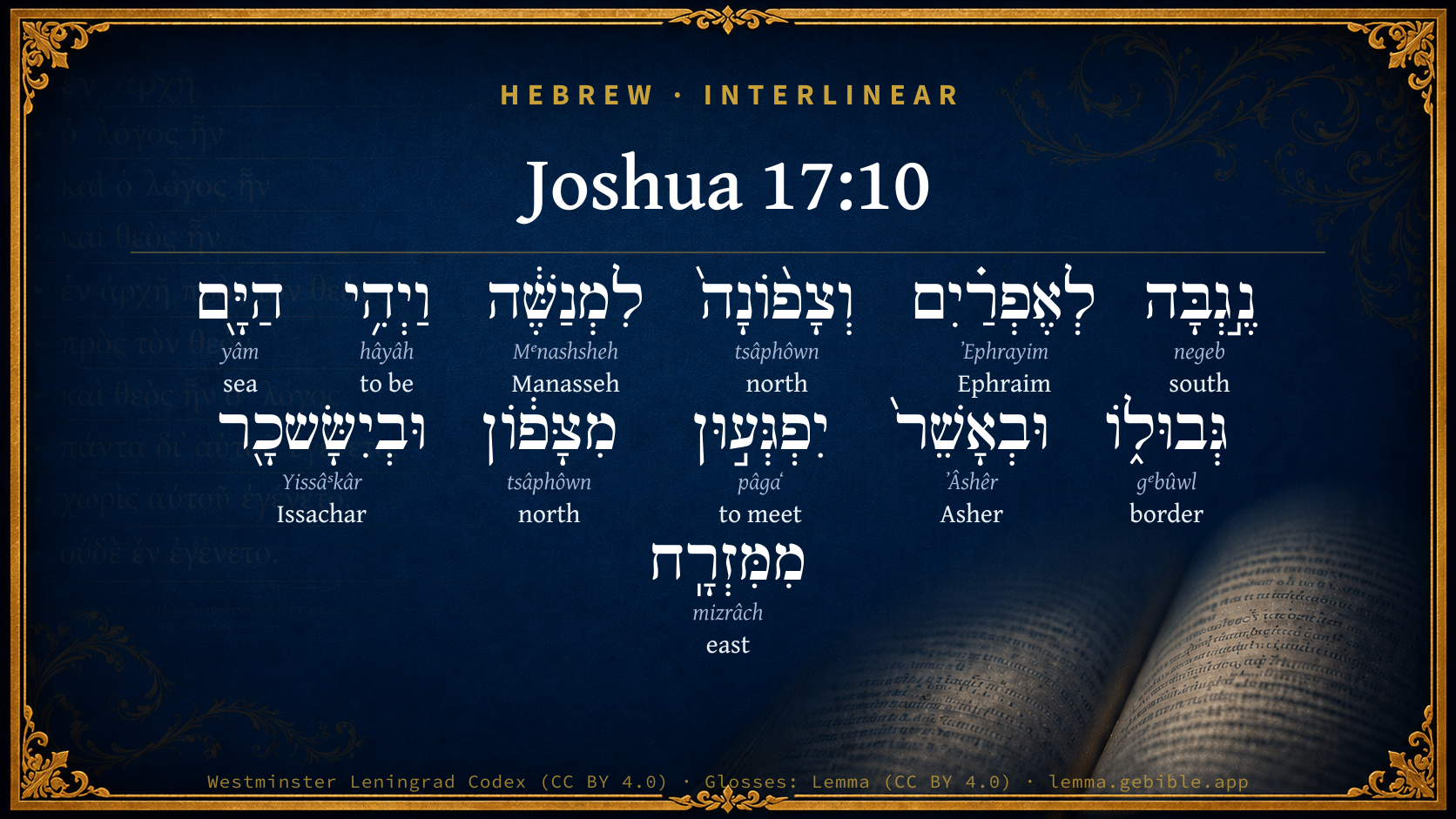
  1. נֶ֣גְבָּה negeb H5045 “south · toward” Noun, Common, Masculine, Singular, Absolute + Suffix, Demonstrative
  2. לְאֶפְרַ֗יִם ʼEphrayim H669 “to/for · Ephraim” Preposition + Noun, Proper
  3. וְצָפ֨וֹנָה֙ tsâphôwn H6828 “and · north · toward” Conjunction + Noun, Common, Feminine, Singular, Absolute + Suffix, Demonstrative
  4. לִמְנַשֶּׁ֔ה Mᵉnashsheh H4519 “to/for · Manasseh” Preposition + Noun, Proper
  5. וַיְהִ֥י hâyâh H1961 “and · to be” Conjunction + Verb, Qal, Sequential Imperfect, 3rd Person, Masculine, Singular
  6. הַיָּ֖ם yâm H3220 “the · sea” Particle, Definite Article + Noun, Common, Masculine, Singular, Absolute
  7. גְּבוּל֑וֹ gᵉbûwl H1366 “border · his” Noun, Common, Masculine, Singular, Construct + Suffix, Personal, 3rd Person, Masculine, Singular
  8. יִפְגְּע֣וּן pâgaʻ H6293 “to meet” Verb, Qal, Imperfect, 3rd Person, Masculine, Plural + Suffix, n
  9. מִצָּפ֔וֹן tsâphôwn H6828 “from · north” Preposition + Noun, Common, Feminine, Singular, Absolute
  10. וּבְיִשָּׂשכָ֖ר Yissâˢkâr H3485 “and · in/at · Issachar” Conjunction + Preposition + Noun, Proper
  11. מִמִּזְרָֽח mizrâch H4217 “from · east” Preposition + Noun, Common, Masculine, Singular, Absolute

About this verse

These counts appear in no published source. They are computed here, from the morphology-tagged text and Lemma’s own curated glosses. What Lemma adds →

12
words
11
distinct lemmas
Historical
section

Shared distinctive vocabulary

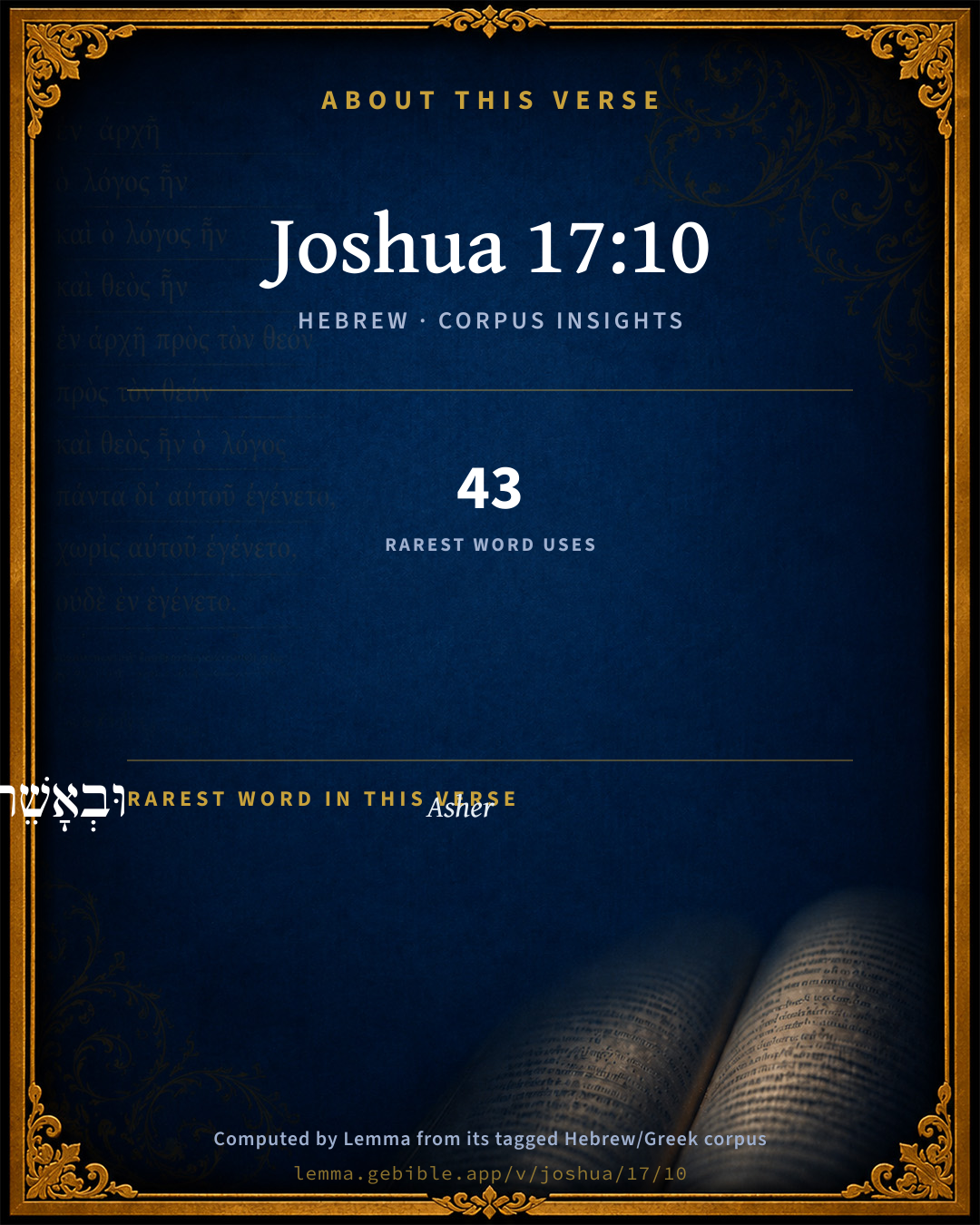
וּבְאָשֵׁר֙ Asher H836 occurs in 41 verses of the Hebrew Bible. Also found in:

Grammatical profile

  • 2 verbs
  • 10 nouns

Verb forms

  • וַיְהִ֥י Qal · Sequential Imperfect
  • יִפְגְּע֣וּן Qal · Imperfect

Repetition

A word recurs within this verse — often emphatic in Hebrew:

  • וְצָפ֨וֹנָה֙ north H6828 ×2

Hebrew & Septuagint length

In English translation the verse runs 29 words from the Hebrew and 28 from the Septuagint (LXX English) — closely comparable.

A rough comparison of the two English renderings, which tokenize alike — not a word-level alignment.

Word counts can differ between the Hebrew and the Greek without any difference in meaning — e.g. the Hebrew direct-object marker אֵת has no separate Greek word, and Greek often adds the article ὁ.

Hebrew and Greek witnesses Masoretic Hebrew ↔ Greek Septuagint

The same verse in the two great witnesses to the Old Testament, shown verse-for-verse.

These are two independent witnesses, not word-aligned to each other, and the Septuagint is shown in lemma (dictionary) form.

Hebrew Joshua 17:10 Masoretic · Westminster Leningrad Codex

נֶ֣גְבָּה לְאֶפְרַ֗יִם וְצָפ֨וֹנָה֙ לִמְנַשֶּׁ֔ה וַיְהִ֥י הַיָּ֖ם גְּבוּל֑וֹ וּבְאָשֵׁר֙ יִפְגְּע֣וּן מִצָּפ֔וֹן וּבְיִשָּׂשכָ֖ר מִמִּזְרָֽח

southward it was Ephraim's, and northward it was Manasseh's, and the sea was his border; and they reached to Asher on the north, and to Issachar on the east.

World English Bible · Public Domain

Greek LXX Joshua 17:10 Septuagint · lemma form

ἀπό λίψ ὁ ἐφράιμ καί ἐπί βορέας μανασσή καί εἰμί ὁ θάλασσα ὅριον αὐτός καί ἐπί ασηρ συνἅπτω ἐπί βορέας καί ὁ ισσαχαρ ἀπό ἀνατολή

Southward the land belongs to Ephraim, and northward to Manasse; and the sea shall be their cost; and northward they shall border upon Aseb, and eastward upon Issachar.

LXX2012 (modern English Septuagint) · Public Domain

Hebrew: Westminster Leningrad Codex (CC BY 4.0). Greek: Septuagint (public domain); English from LXX2012 (modern English Septuagint) (Public Domain). How the Septuagint differs from the Hebrew →

Targum (Aramaic paraphrase)

1

The Targum is the ancient Jewish Aramaic paraphrase of the Hebrew Scriptures — an interpretive translation, not the Hebrew text itself. Onkelos (literal) and Pseudo-Jonathan (expansive) render the Torah, and Jonathan the Prophets. Coverage is partial: where no permissively-licensed English translation exists for a verse, only the Aramaic is shown. This is verse-level text, not a word-by-word alignment to the Hebrew.

  1. Targum Jonathan Prophets (Joshua–Malachi)
    דָרוֹמָא לְאֶפְרַיִם וְצִפּוּנָא לִמְנַשֶׁה וַהֲוָה יַמָא תְּחוּמֵיהּ וּבְאָשֵׁר מְעַרְעִין מִצִפּוּנָא וּבְיִשָׂשכָר מִמַדִינְחָא:

    (no public-domain English translation for this verse)

    Targum Jonathan — Aramaic: “Mikraot Gedolot” (public domain). English: “Sefaria Community Translation” (CC0 1.0 (public-domain dedication)); “London "Chaldee Paraphrase," 1871” (public domain). Text via Sefaria.

Commentary

Notes on Joshua 17:10 from classic Christian and Jewish commentators (each source and its license shown beneath its notes). The classic Christian expositions comment on the surrounding passage and are grouped to its opening verse, so a note may address several verses; the Jewish commentaries on the Tanakh (Rashi and others) are per-verse, so they appear only where the commentator wrote on this verse.

Lemma curates 59 commentaries, every one of them public domain or Creative Commons licensed, each selected and text-cleaned for this edition rather than reprinted as found. About our sources →

Trapp's Complete Commentary

John Trapp

Jos 17:10 Southward [it was] Ephraim’s, and northward [it was] Manasseh’s, and the sea is his border; and they met together in Asher on the north, and in Issachar on the east.

Ver. 10. And the sea is his border.] The Syrian or Midland Sea.

And they met together in Asher on the north, and in Issachar on the east.] And yet their spirits lay sometimes like that haven in Act 27:12, "toward the south-west and north-west," two opposite points.

John Trapp, A Commentary or Exposition upon All the Books of the Old and New Testament (1647–1656) — public domain. Text from a community e-Sword module.

Joseph Benson's Commentary

Jos 17:10. The sea is his border — Manasseh’s, whose portion is here described, and whose name was last mentioned. In Asher — That is, upon the tribe of Asher; for though Zebulun came between Asher and them for the greatest part of their land; yet it seems there were some necks of land, both of Ephraim’s and of Manasseh’s, which jutted out farther than the rest, and touched the borders of Asher.

Joseph Benson's Commentary on the Old and New Testaments (1811–1818) — public domain. Text from a community e-Sword module.

Geneva Bible (1599)

Geneva Bible translators

In the tribe of Asher, and tribe of Issachar.

Geneva Bible (1599) marginal notes — public domain. Text via Bolls.life.

Adam Clarke's Commentary

Verse 10. They met together in Asher on the north] The tribe of Asher extended from the Mediterranean Sea to Mount Carmel, Jos 19:26, and the tribe of Manasseh extended to Dor and her towns, (see the following verse Jos 17:11), which were in the vicinity of Carmel; and thus it appears that these two tribes formed a junction at the Mediterranean Sea. This may serve to remove the difficulties in this verse; but still it does appear that in several cases the tribes were intermingled; for Manasseh had several towns, both in Issachar and in Asher, see Jos 17:11. In like manner, Judah had towns in Dan and Simeon; and Simeon had towns in Judah; and what is spoken of the boundaries of the tribes, may be sometimes understood of those towns which certain tribes had within the limits of others. For, in several cases, towns seem to be interchanged, or purchased, by mutual consent, so that in some instances the possessions were intermingled, without any confusion of the tribes or families.

Adam Clarke's Commentary on the Bible (1810–1826) — public domain. Text from a community e-Sword/MySword module.

The Cambridge Bible for Schools and Colleges

gen. ed. J. J. S. Perowne

10. southward] Southward of the brook the land belonged to Ephraim, northward of the same it belonged to Manasseh, and the sea constituted the western border.

they met] or “struck upon” Asher in the north and on Issachar in the east. Thus the two tribes were bounded (a) on the east by Issachar; (b) on the north by Asher; (c) on the west by the sea; (d) and on the south by Benjamin and Dan.

The Cambridge Bible for Schools and Colleges (gen. ed. J. J. S. Perowne; Cambridge University Press, 1878–1918) — public domain. Text from a community e-Sword module.

John Gill's Exposition

Southward it was Ephraim's, and northward it was Manasseh's,.... As Ephraim lay to the south of Manasseh, Manasseh lay to the north of Ephraim:

and the sea is his border; the Mediterranean sea was their boundary on the west:

and they met together in Asher on the north; that is, on the northwest towards the Mediterranean sea, as, at Mount Carmel:

and in Issachar on the east; towards Jordan.

John Gill's Exposition of the Whole Bible (1746–1763) — public domain (CC PDM 1.0). Text via the HelloAO Bible API.

Albert Barnes' Notes on the Bible

Southward - i. e. of the river Kanah.

Render, “they (i. e. the two kindred tribes of Ephraim and Manasseh, the northern border being treated here as common to the two) reached unto Asher.” (See the map.) The northern border is only indicated in general terms, perhaps because the Israelites were not yet completely masters of this part of the country, and so had not precisely determined it.

Albert Barnes' Notes on the Bible (1834–1885) — public domain. Text from a community e-Sword/MySword module.

Haydock's Catholic Bible Commentary

CHAPTER XVII.

East. These two tribes are contiguous to the tribe of Joseph, taken all together, ver. 14. (Menochius) --- Aser extended as far as Mount Carmel, which was not far from Dor, a city of Manasses, ver. 11., chap. xix. 26. The tribes of Issachar and of Zabulon seem, indeed, to come between Manasses and Aser; so that we might say, that the tribe of Joseph finding itself too much straitened, was forced to seek for more room in the cities of the other tribes, which we find it really inhabited, ver. 11. We might avoid all difficulties, by translating "they invaded (or made an irruption into) the tribe of Aser," &c., as the Hebrew will allow. Thus Dan conquered Lais, which lies at so great a distance from his own portion, and the tribes of Juda and Simeon were frequently intermixed. (Calmet) --- Aser and Manasses may, however, have been really united on the north-west, or Mediterranean point. (Menochius)

George Leo Haydock (1774–1849), Haydock's Catholic Family Bible and Commentary, 1859 edition — public domain. Excludes Psalms (Douay-Rheims chapter numbering differs from Protestant) and Deuterocanonical books (Catholic canon only).

Matthew Poole's English Annotations

His border; either,

1. Manasseh’s, whose portion is here described, and whose name was last mentioned. Or,

2. Ephraim’s and Manasseh’s, both expressed in the foregoing words, and implied in the following,

they.

In Asher, i.e. upon the tribe of Asher; for though Zebulun came between Asher and them for the greatest part of their land, yet it seems there were some necks or parcels of land, both of Ephraim’s and of Manasseh’s, which jutted out farther than the rest, and touched the borders of Asher. And it is certain there were many such incursions of the land of one tribe upon some parcels of another, although they were otherwise considerably distant one from the other. See Jos 19:34. And you must not judge of these things by the present maps, which are drawn according to the opinions of late authors, which many times are false; and they are to be judged by the Scripture, and not the Scripture by them: but that part of Manasseh did reach to Asher, appears from hence, that Dor, a city of Manasseh, Jos 17:11, was, as Josephus witnesseth, near Carmel, which belonged to Asher, Jos 19:26.

Matthew Poole's English Annotations on the Holy Bible (1683–1685) — public domain. Text from a community e-Sword/MySword module.

Whedon's Commentary on the Bible

Daniel D. Whedon

10. Met together in Asher — Touched upon, bordered on, (literally, struck,) Asher on the north, etc.

Daniel D. Whedon (gen. ed.), Commentary on the Old and New Testaments (1874–1909) — public domain. Text from a community e-Sword module.

The Pulpit Commentary

And they met together. Rather, they (i.e. , the Manassites) impinged (this is the very same word as the Hebrew Wgpyi), i.e. , "touched upon." There has been great discussion concerning this passage. The literal meaning is clearly that Manasseh was bordered by Asher on the north, and Issachar on the east. The idea of an Asher-ham-Michmethah must be given up if we take this rendering of the Hebrew. Its only justification is the fact that if Michmethah be at once the northern border of Ephraim and Manasseh, the territory of Manasseh is cut almost in half. And, in fact, such a supposition makes confusion worse confounded. Is it probable that in vers. 7 and 10 Asher-ham-Michmethah is meant; that the town Asher is mentioned in similar terms to the tribe Issachar in the latter verse; and that in ver. 11, without a single intimation of the change of meaning, the tribes Issachar and Asher are mentioned? Again: if Dor considerably to the south of Mount Carmel was within the territory of Asher (ver. 11), how can we possibly, as Conder"s "Handbook" does, place the limits of Asher at Accho, and bring Zebulun to the sea (which it never reaches, for "toward the sea," in Jos_19:11 clearly means "westward"), interposing a large strip of territory between Manasseh and Asher, placing Dor, in spite of ver. 11, far within the limits of Manasseh, and giving this last tribe, or rather half tribe, an extraordinarily disproportioned share of the land? (See the complaint in ver. 16). Zebulun, too, was on the eastern border of Asher, (Jos_19:27) and it is by no means certain that Shihor Libnath (see Jos_19:26) is not the Wady Zerka, south of Dor. This is the view of Knobel, a commentator by no means void of acuteness. This contraction of Manasseh"s territory explains why cities had to be given to it out of Asher and Issachar, as well as the complaint in the latter part of this chapter. Issachar, too, must have stretched considerably southward. But the vagueness of the description of Manasseh"s border, especially on the north, prevents us from assigning any limits to Issachar in this direction; while it is impossible, with a writer in the Quarterly Papers of the Palestine Exploration Fund, to suppose that it extended from Jezreel and Shunem and Endor on the north as far as Jericho to the south.

The Pulpit Commentary (1880–1919), ed. H.D.M. Spence-Jones & Joseph S. Exell — public domain. Text from a community e-Sword module.

John Wesley's Explanatory Notes

His border - Manasseh's, whose portion is here described, and whose name was last mentioned. In Asher - That is, upon the tribe of Asher; for though Zebulon came between Asher and them for the greatest part of their land; yet it seems there was some necks of land, both of Ephraim's and of Manasseh's, which jutted out farther than the rest, and touched the borders of Asher. And it is certain there were many such incursions of the land of one tribe upon some parcels of another, although they were otherwise considerably distant one from the other.

John Wesley, Explanatory Notes Upon the Whole Bible (1754–1765) — public domain. Text via the GEBible commentary corpus.

Rashi

Rabbi Shlomo Yitzchaki (Rashi)

The southern side belonged to Ephraim: Ephraim took his share from the south, facing the land between the descendants of Yehudah and the rest of the tribes.

The northern side belonged to Menashe. Menashe took the land to the north.

Rashi on the Tanakh — English translations: “The Judaica Press complete Tanach with Rashi, translated by A. J. Rosenberg” (CC BY 4.0); “Pentateuch with Rashi's commentary by M. Rosenbaum and A.M. Silbermann, 1929-1934” (public domain); “The Metsudah Tanach series, Lakewood, N.J” (CC BY 4.0); and “The Book of Joshua, Metsudah Publications, 1997” (CC BY 4.0). Text via Sefaria.

Lesson kit

Teaching starters — assembled from the data on this page, not authored interpretation. Every prompt links to the verse data it draws on. Edit before teaching.

Joshua, in the Historical, opens this verse with 12 words (11 distinct Hebrew lemmas). Its most distinctive word is ʼÂshêr (“Asher”). A historical commentator’s framing appears above. Read the whole chapter for the surrounding context.

Discussion questions

  1. How does “Asher” (ʼÂshêr) shape what this verse is saying?
  2. How does Genesis 30:13, which shares the word «Asher», read alongside this verse?
  3. What does the repetition of “north” (2× in this one verse) do in this verse?
  4. These translations render this verse differently; the difference is in the English rendering, not the original. What questions does that raise?
  5. «וַיְהִ֥י» is a Qal Sequential Imperfect verb. How does that grammatical form shape the action described?
  6. Compare how Trapp's Complete Commentary and Joseph Benson's Commentary read this verse. Where do they agree or differ?

Things to notice

Reading settings

Reading text

Shown beneath each verse's original-language words.

Old Testament
Old Testament edition

Read the OT as the Masoretic Hebrew (MT) or the Greek Septuagint (LXX).

English shown for the Greek Septuagint (in the Hebrew ↔ Greek comparison).

Comparing translations? Open the Compare panel on any verse page to stack up to four side by side.