Numbers 34:5

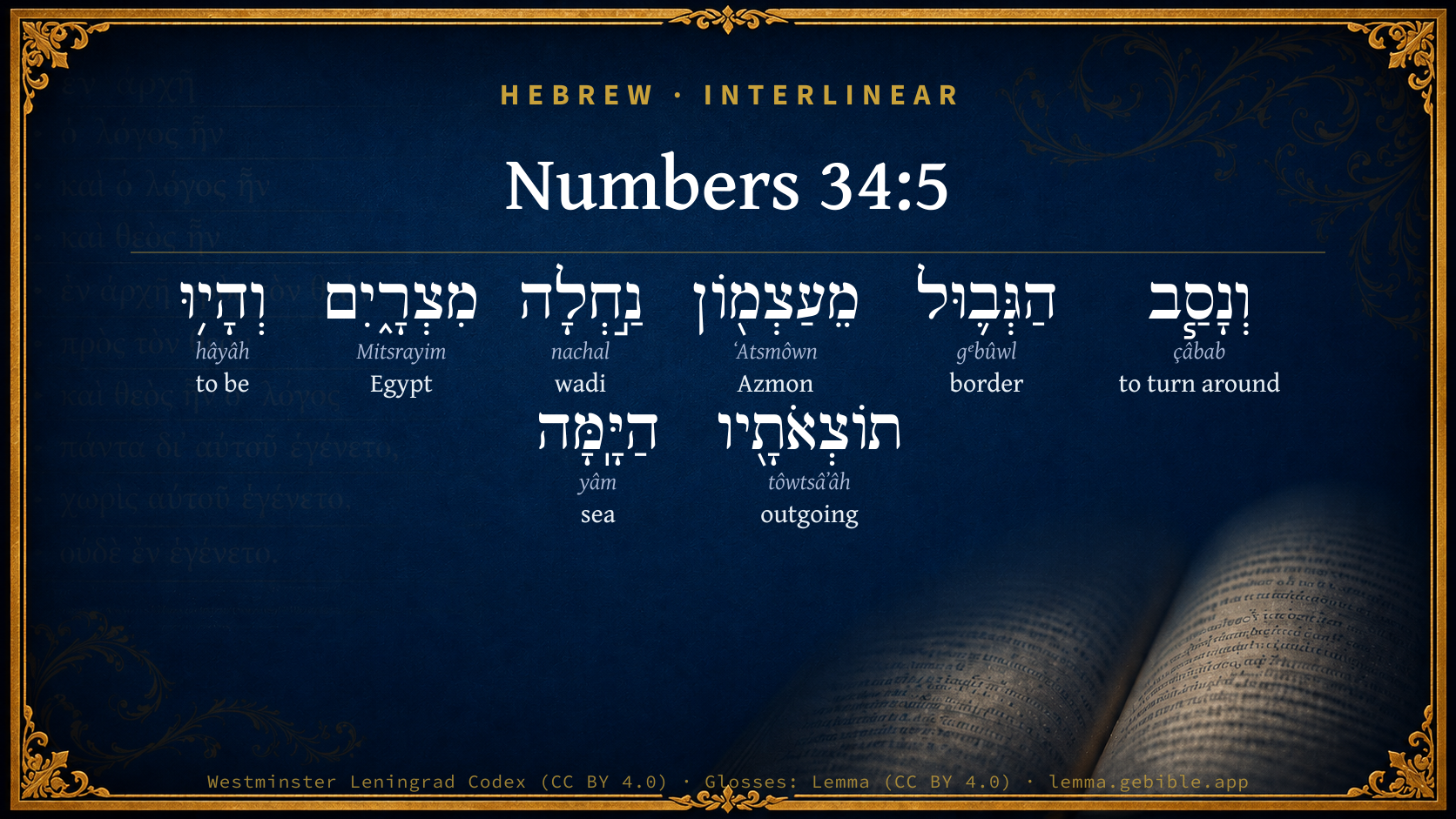
Hebrew (Westminster Leningrad Codex) Numbers 34:5 appears in the Hebrew Old Testament. The text above is from the Westminster Leningrad Codex. Each word links to its Strong’s number, a concise gloss, and parsing drawn from the Open Scriptures Hebrew Bible morphology. Click any word for its full Brown-Driver-Briggs (BDB) entry.
Download image
Cite this verse

Numbers 34:5 (World English Bible). Public Domain. Lemma interlinear Bible study tool, https://lemma.gebible.app/v/numbers/34/5.

Show BibTeX & RIS
BibTeX
RIS
English Translation
and the border shall turn about from Azmon to the brook of Egypt, and the goings out of it shall be at the sea.
World English Bible · Public Domain
Download a study sheet

One document with this verse’s original text, its word-by-word gloss line, the meaning frame, cross-references with their text, attributed commentary, and full source and license credits — printable, and it pastes into notes with its structure intact.

This verse Autodidact and up

Study sheet (.html) Plain text (.txt)

A passage Seminary Student

Up to 50 verses in one chapter. A passage sheet keeps up to 6 commentary sources and 12 cross-references per verse, in the order this page ranks them, and says so on the sheet whenever that leaves anything out. Ask for a single verse and you get the Autodidact verse sheet above.

Everything on this page stays free to read, with no account — the sheet is a download of what is already on screen, not access to it.

Want to remove ads? Support Godless Engineer
Compare translations 3

The same verse in 3 English versions, stacked beneath the original-language interlinear above. Click any original word for its lexicon entry.

Each is an independent rendering of the whole verse — the interlinear is not word-aligned to these translations.

Highlighted words mark where these versions differ — a whole-verse word diff, not a word-by-word alignment.

  • World English Bible Public Domain
    and the border shall turn about from Azmon to the brook of Egypt, and the goings out of it shall be at the sea.
  • King James Version Public Domain
    And the border shall fetch a compass from Azmon unto the river of Egypt, and the goings out of it shall be at the sea.
  • unfoldingWord Literal Text CC BY-SA 4.0
    And the border will turn from Azmon toward the wadi of Egypt, and its outer limits will be to the sea.

unfoldingWord Literal Text — © unfoldingWord, licensed CC BY-SA 4.0. Word-aligned USFM3 via Door43 (git.door43.org/unfoldingWord/en_ult).

Versions to compare (up to 4)

3 of 4 selected

Show all 18 translations

Every available English version of this verse, each an independent rendering of the whole verse.

  • World English Bible Public Domain
    and the border shall turn about from Azmon to the brook of Egypt, and the goings out of it shall be at the sea.
  • Berean Standard Bible Public Domain
    where it will turn from Azmon, join the Brook of Egypt, and end at the Sea.
  • Majority Standard Bible Public Domain
    where it will turn from Azmon, join the Brook of Egypt, and end at the Sea.
  • King James Version Public Domain
    And the border shall fetch a compass from Azmon unto the river of Egypt, and the goings out of it shall be at the sea.
  • American Standard Version (1901) Public Domain
    and the border shall turn about from Azmon unto the brook of Egypt, and the goings out thereof shall be at the sea.
  • Revised Version (1885) Public Domain
    and the border shall turn about from Azmon unto the brook of Egypt, and the goings out thereof shall be at the sea.
  • Geneva Bible (1599) Public Domain
    And the border shall compasse from Azmon vnto the riuer of Egypt, and shall goe out to the Sea.
  • Douay-Rheims (1899) Public Domain
    And the limits shall fetch a compass from Asemona to the torrent of Egypt, and shall end in the shore of the great sea.
  • Young's Literal Translation Public Domain
    and the border hath turned round from Azmon to the brook of Egypt, and its outgoings have been at the sea.
  • Literal Standard Version CC BY-SA 4.0
    and the border has turned around from Azmon to the Brook of Egypt, and its outgoings have been at the sea.
  • Unlocked Literal Bible CC BY-SA 4.0
    From there, the border will turn from Azmon toward the brook of Egypt and follow it to the sea.
  • unfoldingWord Literal Text CC BY-SA 4.0
    And the border will turn from Azmon toward the wadi of Egypt, and its outer limits will be to the sea.
  • Darby Bible Public Domain
    And the border shall turn from Azmon unto the torrent of Egypt, and shall end at the sea.
  • World Messianic Bible Public Domain
    The border shall turn about from Azmon to the brook of Egypt, and it shall end at the sea.
  • Webster's Bible Public Domain
    And the border shall form a circuit from Azmon to the river of Egypt, and the limits of it shall be at the sea.
  • Free Bible Version CC BY-SA 4.0
    There the boundary will turn from Azmon to the Wadi of Egypt, ending at the Mediterranean Sea.
  • Bible in Basic English Public Domain
    And from Azmon it will go round to the stream of Egypt as far as the sea.
  • JPS Tanakh (1917) Public Domain
    and the border shall turn about from Azmon unto the Brook of Egypt, and the goings out thereof shall be at the Sea.

Literal Standard Version (2020), Covenant Press — licensed CC BY-SA 4.0. Text via the HelloAO Bible API (eBible.org). Unlocked Literal Bible (unfoldingWord) — licensed CC BY-SA 4.0. Text via the HelloAO Bible API (eBible.org). unfoldingWord Literal Text — © unfoldingWord, licensed CC BY-SA 4.0. Word-aligned USFM3 via Door43 (git.door43.org/unfoldingWord/en_ult). Free Bible Version, Dr. Jonathan Gallagher — licensed CC BY-SA 4.0. Text via the HelloAO Bible API (eBible.org).

Word by word

More ways to search: Search by grammar → Find every occurrence → Compare this word →

Practice this passage: Drill this verse → Learn its vocabulary →

About this verse

These counts appear in no published source. They are computed here, from the morphology-tagged text and Lemma’s own curated glosses. What Lemma adds →

8
words
8
distinct lemmas
Pentateuch
section

Notable vocabulary

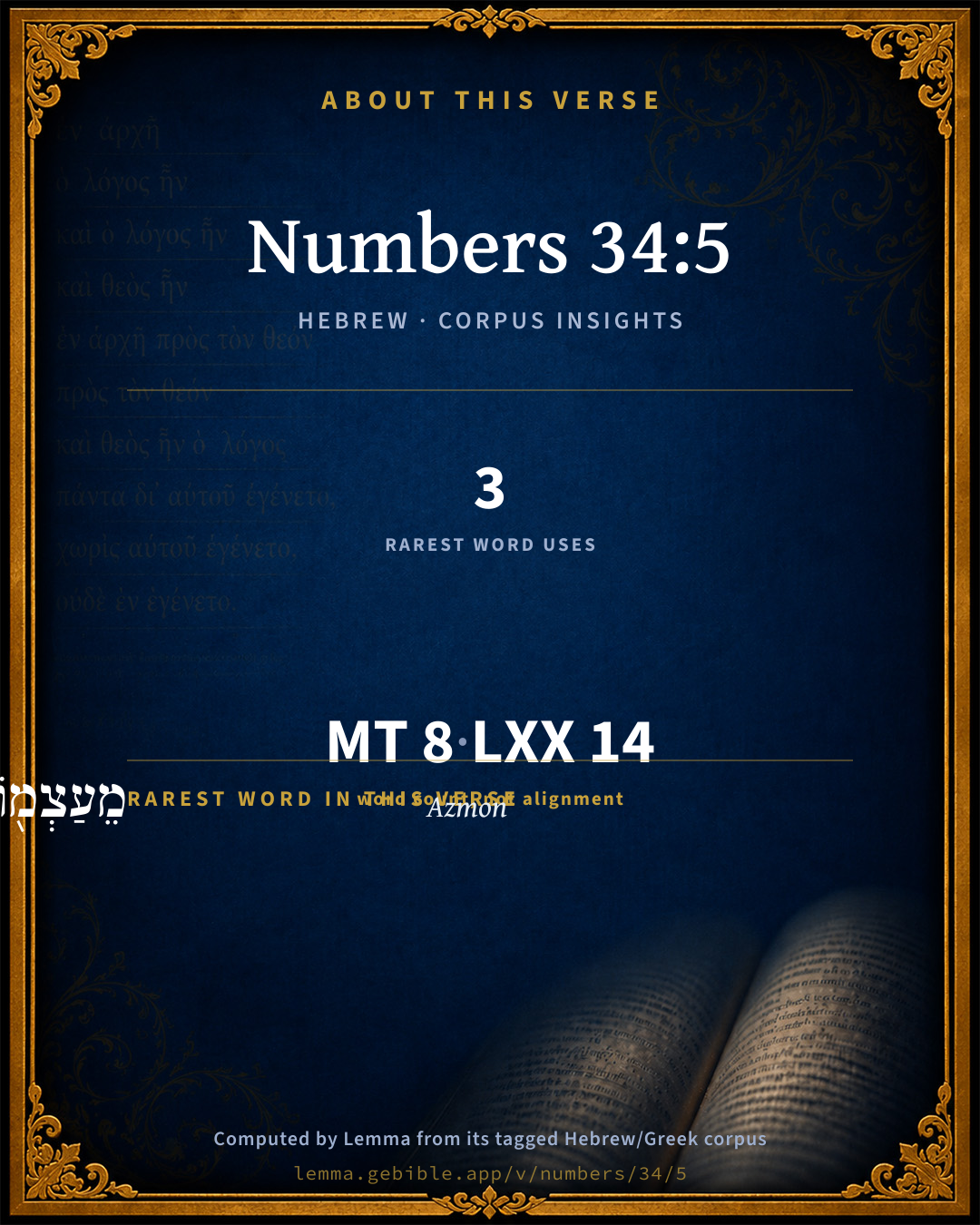
The rarest word here is מֵעַצְמ֖וֹן Azmon H6111 — appearing just 3 times in the whole Hebrew Bible.

Shared distinctive vocabulary

מֵעַצְמ֖וֹן Azmon H6111 occurs in 3 verses of the Hebrew Bible. Also found in:

Grammatical profile

  • 2 verbs
  • 6 nouns

Verb forms

  • וְנָסַ֧ב Niphal · Sequential Perfect
  • וְהָי֥וּ Qal · Sequential Perfect

Hebrew & Septuagint length

In English translation the verse runs 24 words from the Hebrew and 19 from the Septuagint (LXX English) — closely comparable.

A rough comparison of the two English renderings, which tokenize alike — not a word-level alignment.

Word counts can differ between the Hebrew and the Greek without any difference in meaning — e.g. the Hebrew direct-object marker אֵת has no separate Greek word, and Greek often adds the article ὁ.

In the original languages it is 8 Hebrew tokens and 14 Greek tokens — but the two are counted differently (Hebrew bundles its prefixes and suffixes into one token; the Greek is in lemma form), so that isn’t a like-for-like length.

Cross-references

6

Topical passages linked to Numbers 34:5 in the Treasury of Scripture Knowledge — connected by theme and wording, ordered by reader-vote popularity; previews shown in the World English Bible.

  • Joshua 15:4 and it passed along to Azmon, and went out at the brook of Egypt; and the goings out of the border were at the sea: this shall be your south border.
  • Genesis 15:18 In that day Yahweh made a covenant with Abram, saying, "To your seed have I given this land, from the river of Egypt to the great river, the river Euphrates:
  • Joshua 15:47 Ashdod, its towns and its villages; Gaza, its towns and its villages; to the brook of Egypt, and the great sea, and the border [of it].
  • 1 Kings 8:65 So Solomon held the feast at that time, and all Israel with him, a great assembly, from the entrance of Hamath to the brook of Egypt, before Yahweh our God, seven days and seven days, even fourteen days.
  • Isaiah 27:12 It shall happen in that day, that Yahweh will beat off [his fruit] from the flood of the River to the brook of Egypt; and you shall be gathered one by one, you children of Israel.
  • Numbers 34:6–7 For the western border, you shall have the great sea and the border [of it]: this shall be your west border.

Cross-references courtesy of OpenBible.info (CC BY 4.0).

Hebrew and Greek witnesses Masoretic Hebrew ↔ Greek Septuagint

The same verse in the two great witnesses to the Old Testament, shown verse-for-verse.

These are two independent witnesses, not word-aligned to each other, and the Septuagint is shown in lemma (dictionary) form.

Hebrew Numbers 34:5 Masoretic · Westminster Leningrad Codex

וְנָסַ֧ב הַגְּב֛וּל מֵעַצְמ֖וֹן נַ֣חְלָה מִצְרָ֑יִם וְהָי֥וּ תוֹצְאֹתָ֖יו הַיָּֽמָּה

and the border shall turn about from Azmon to the brook of Egypt, and the goings out of it shall be at the sea.

World English Bible · Public Domain

Greek LXX Numbers 34:5 Septuagint · lemma form

καί κυκλόω ὁ ὅριον ἀπό ασεμωνα χειμάρρους αἴγυπτος καί εἰμί ὁ διέξοδος ὁ θάλασσα

And the border shall compass from Asemona to the river of Egypt, and the sea shall be the termination.

LXX2012 (modern English Septuagint) · Public Domain

On this verse, The Pulpit Commentary discusses the Septuagint’s reading. Read the note in Commentary ↓

Hebrew: Westminster Leningrad Codex (CC BY 4.0). Greek: Septuagint (public domain); English from LXX2012 (modern English Septuagint) (Public Domain). How the Septuagint differs from the Hebrew →

Targum (Aramaic paraphrase)

2

The Targum is the ancient Jewish Aramaic paraphrase of the Hebrew Scriptures — an interpretive translation, not the Hebrew text itself. Onkelos (literal) and Pseudo-Jonathan (expansive) render the Torah, and Jonathan the Prophets. Coverage is partial: where no permissively-licensed English translation exists for a verse, only the Aramaic is shown. This is verse-level text, not a word-by-word alignment to the Hebrew.

  1. Targum Onkelos Torah (Genesis–Deuteronomy)
    וְיַסְחַר תְּחוּמָא מֵעַצְמוֹן לְנַחֲלָא דְמִצְרָיִם וִיהוֹן מַפְקָנוֹהִי לְיַמָא

    (no public-domain English translation for this verse)

    Targum Onkelos — Aramaic: “Onkelos Genesis” (public domain); “Onkelos Exodus” (public domain); “Onkelos Leviticus” (public domain); “Onkelos Numbers” (public domain); “Onkelos Deuteronomy” (public domain). English: “Sefaria Community Translation” (CC0 1.0 (public-domain dedication)); “J.W. Etheridge. The Targums of Onkelos and Jonathan Ben Uzziel on the Pentateuch. London: Longmans, Green, 1862” (public domain). Text via Sefaria.

  2. Targum Pseudo-Jonathan Torah (Genesis–Deuteronomy)
    וְיַקִיף תְּחוּמָא מִקֵיסָם לְנִילוֹס דְמִצְרָאֵי וִיהוֹן מַפְקָנוֹי לְמַעֲרָבָא

    And the border shall wind round from Kesam unto Nilos, of the Mizraee, and its outgoings shall be to the west.

    Targum Pseudo-Jonathan — Aramaic: “Targum Jonathan on Genesis” (public domain); “Targum Jonathan on Exodus” (public domain); “Targum Jonathan on Leviticus” (public domain); “Targum Jonathan on Numbers” (public domain); “Targum Jonathan on Deuteronomy” (public domain). English: “The Targum of Jonathan ben Uzziel, trans. J. W. Etheridge, London, 1862” (public domain). Text via Sefaria.

Commentary

Notes on Numbers 34:5 from classic Christian and Jewish commentators (each source and its license shown beneath its notes). The classic Christian expositions comment on the surrounding passage and are grouped to its opening verse, so a note may address several verses; the Jewish commentaries on the Tanakh (Rashi and others) are per-verse, so they appear only where the commentator wrote on this verse.

Lemma curates 59 commentaries, every one of them public domain or Creative Commons licensed, each selected and text-cleaned for this edition rather than reprinted as found. About our sources →

Tyndale Open Study Notes

Tyndale Open Resources

34:5 The Brook of Egypt (not to be confused with the Nile) designates the wadi that separates the land of Canaan from Egypt; it drains toward the Mediterranean Sea (cp. 1 Kgs 8:65). In Old Testament times, Israel exercised little control over this southern coastal region.

Tyndale Open Study Notes — © Tyndale Open Resources, licensed CC BY-SA 4.0. Text via the HelloAO Bible API.

Geneva Bible (1599)

Geneva Bible translators

Which was Nilus, or as some think, Rhinocotura.

Geneva Bible (1599) marginal notes — public domain. Text via Bolls.life.

Jamieson, Fausset & Brown

Robert Jamieson, A. R. Fausset & David Brown

river of Egypt--the ancient brook Sihor, the Rhinocolura of the Greeks, a little to the south of El-Arish, where this wady gently descends towards the Mediterranean (Jos 13:3).

Jamieson, Fausset & Brown — Commentary Critical and Explanatory on the Whole Bible (1871) — public domain (CC PDM 1.0). Text via the HelloAO Bible API.

Adam Clarke's Commentary

Verse 5. The river of Egypt] The eastern branch of the river Nile; or, according to others, a river which is south of the land of the Philistines, and fails into the gulf or bay near Calieh.

Adam Clarke's Commentary on the Bible (1810–1826) — public domain. Text from a community e-Sword/MySword module.

Ellicott's Commentary for English Readers

(5) And the border shall fetch a compass . . . —Although the exact spots of some of the places which determined the southern border have not been positively ascertained, there seems, on the whole, very little doubt that the boundary line ran along the valleys which form a natural division between the cultivated land and the desert, from the Arabah on the east to the Mediterranean on the west, the Brook of Egypt—i.e., the Wady-el-Arish—forming the western boundary until it reached the sea.

A Bible Commentary for English Readers, edited by Charles John Ellicott (1878–1897) — public domain. Text from a community e-Sword module.

The Cambridge Bible for Schools and Colleges

gen. ed. J. J. S. Perowne

5. the brook of Egypt] Heb. ‘the naḥal of Miẓraim.’ A.V. ‘the river of Egypt’ gives the erroneous impression that the Nile is meant. The name is that of a wady or torrent, now called Wâdy el-‘Arîsh, which rises in the centre of the Sinaitic peninsula, and flows northward into the Mediterranean about 50 miles S.W. of Gaza. It is possible that Miẓraim here denotes not Egypt proper, but the tract on the east of Egypt. The name Muẓur is frequently applied to the latter in Assyrian inscriptions.

The Cambridge Bible for Schools and Colleges (gen. ed. J. J. S. Perowne; Cambridge University Press, 1878–1918) — public domain. Text from a community e-Sword module.

John Gill's Exposition

And the border shall fetch a compass,.... Not go on in a straight line, but turn about:

from Azmon unto the river of Egypt; the river Nile, as both the Targums of Jonathan and Jerusalem; but Aben Ezra seems to deny that that river is meant: and some think that Rhinocolura, which flows into the Mediterranean sea, is meant; or the "valley of Egypt", Casiotis, which divided Judea from Egypt, as follows:

and the goings out of it; not of the river, but of the border:

shall be at the sea; the above sea, called in the next verse the great sea; all the Targums render it to the west.

John Gill's Exposition of the Whole Bible (1746–1763) — public domain (CC PDM 1.0). Text via the HelloAO Bible API.

Haydock's Catholic Bible Commentary

Egypt. Many suppose the rivulet of Rinocorura is meant. (Menochius) --- But it seems more probable that the Nile, the only river of Egypt, or the eastern branch of it, where Pelusium stands, is designated. There is no proof that the former rivulet belonged to Egypt; and though some assert that the Hebrews never dwelt to the west of it, the territory was so barren, that nothing may be said respecting that affair. We find, however, that under Solomon they inhabited as far as the river of Egypt; (1 Paralipomenon xiii. 5., and 3 Kings viii. 65,) and if they had not, God’s promise entitled them to that part of the country; as well as to that which extends to the great river Euphrates, though they perhaps never took possession of it. See Genesis xv. 18., and Josue xiii. 3. Pelusium is commonly reckoned the frontier town of Egypt, Ezechiel xxx. 15. (Stabo xvi.) In another place, the promised land extends from Emath to the torrent of Egypt, (1 Kings viii. 55,) or of the desert, Amos vi. 15. (Calmet)

George Leo Haydock (1774–1849), Haydock's Catholic Family Bible and Commentary, 1859 edition — public domain. Excludes Psalms (Douay-Rheims chapter numbering differs from Protestant) and Deuterocanonical books (Catholic canon only).

Matthew Poole's English Annotations

The river of Egypt, called Sihor, Jos 13:3, which divided Egypt from Canaan. See Gen 15:18.

The sea; the midland sea, called the sea emphatically; whereas the other seas there, as they are called, are indeed but lakes.

Matthew Poole's English Annotations on the Holy Bible (1683–1685) — public domain. Text from a community e-Sword/MySword module.

The Pulpit Commentary

The river of Egypt, or "brook (ljn) of Egypt." Septuagint, ceima roun Aiguptou . It was a winter torrent which drained the greater part of the western half of the northern desert of the Sinaitic peninsula. It was, however, only in its lower course, where a single channel receives the intermittent outflow of many wadys, that it was known as the "brook of Egypt," because it formed the well-marked boundary between Egypt and Canaan. (cf. 2Ch_7:8, and Isa_27:12, where the Septuagint has ewv Rinokorourwn , from the name of the frontier fort, Rhinocorura, afterwards built there) So far as we are able to follow the line drawn in these verses, it would appear to have held a course somewhat to the south of west for about half its length, then to have made a southerly deflection to Kadesh, and from thence to have struck north-west until it reached the sea, almost in the same latitude as the point from which it started.

The Pulpit Commentary (1880–1919), ed. H.D.M. Spence-Jones & Joseph S. Exell — public domain. Text from a community e-Sword module.

John Wesley's Explanatory Notes

The river of Egypt - Called Sihor, Josh. xiii, 3, which divided Egypt from Canaan. The sea - The midland sea, called the sea emphatically, whereas the other seas, as they are called, are indeed but lakes.

John Wesley, Explanatory Notes Upon the Whole Bible (1754–1765) — public domain. Text via the GEBible commentary corpus.

Rashi

Rabbi Shlomo Yitzchaki (Rashi)

והיו תוצאותיו הימה AND ITS GOINGS OUT SHALL BE AT THE SEA i.e. at the western boundary, because the southern border does not extend any more west of there and further on.

Rashi on the Tanakh — English translations: “The Judaica Press complete Tanach with Rashi, translated by A. J. Rosenberg” (CC BY 4.0); “Pentateuch with Rashi's commentary by M. Rosenbaum and A.M. Silbermann, 1929-1934” (public domain); “The Metsudah Tanach series, Lakewood, N.J” (CC BY 4.0); and “The Book of Joshua, Metsudah Publications, 1997” (CC BY 4.0). Text via Sefaria.

Lesson kit

Teaching starters — assembled from the data on this page, not authored interpretation. Every prompt links to the verse data it draws on. Edit before teaching.

Numbers, in the Pentateuch, opens this verse with 8 words (8 distinct Hebrew lemmas). Its most distinctive word is ʻAtsmôwn (“Azmon”). A historical commentator’s framing appears above. Read the whole chapter for the surrounding context.

Discussion questions

  1. How does “Azmon” (ʻAtsmôwn) shape what this verse is saying?
  2. Numbers 34:4 shares the word «Azmon» with this verse. How do the two illuminate each other?
  3. These translations render this verse differently. What is at stake in choosing one wording over another?
  4. The verb «וְנָסַ֧ב» is Niphal Sequential Perfect. How does its form color the action?
  5. Reading how Tyndale Open Study Notes and Geneva Bible (1599) read this verse, where do the two commentators agree and where do they part?

Things to notice

Reading settings

Reading text

Shown beneath each verse's original-language words.

Old Testament
Old Testament edition

Read the OT as the Masoretic Hebrew (MT) or the Greek Septuagint (LXX).

English shown for the Greek Septuagint (in the Hebrew ↔ Greek comparison).

Comparing translations? Open the Compare panel on any verse page to stack up to four side by side.