
1 Kings 7:25

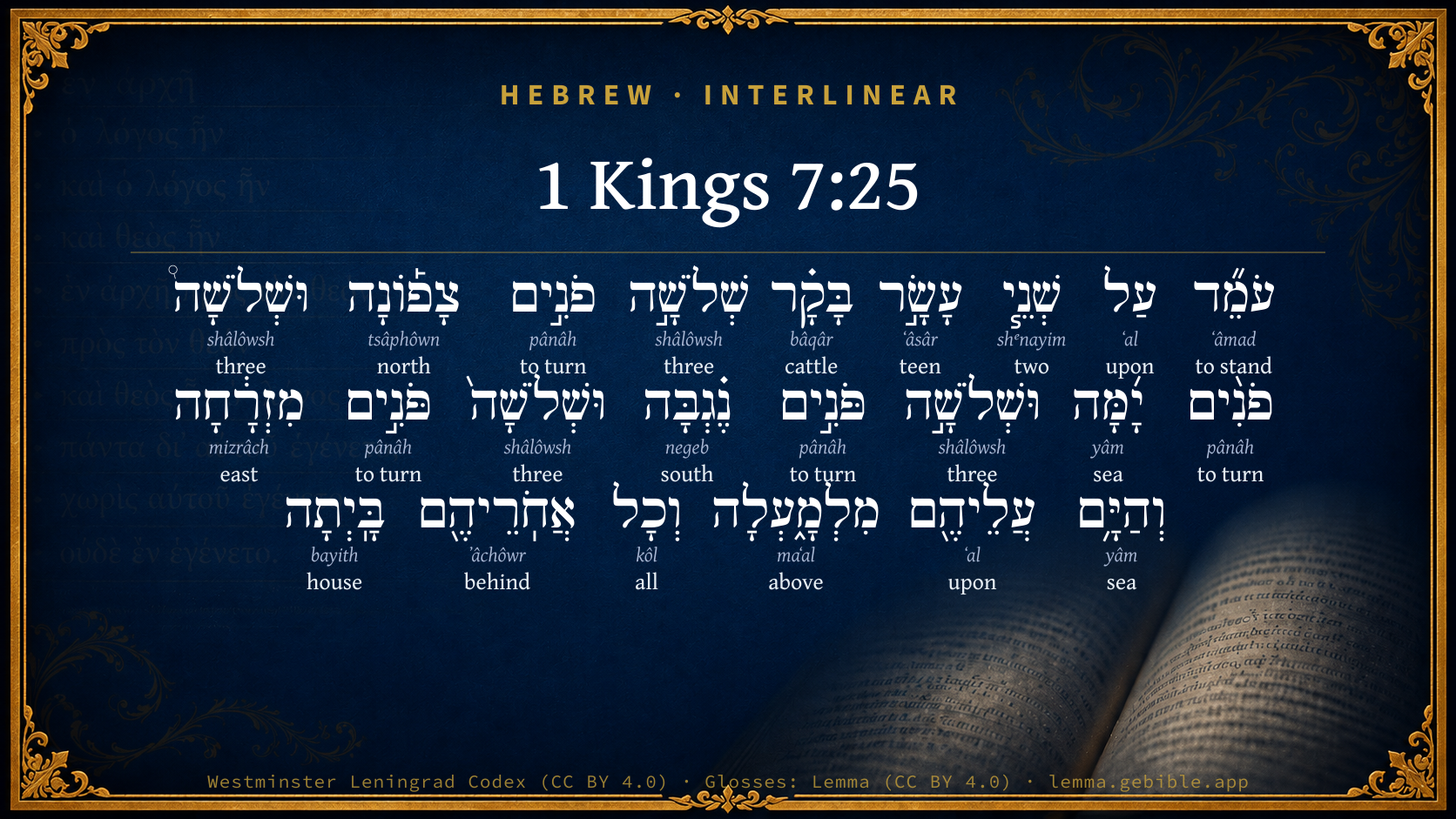
Hebrew (Westminster Leningrad Codex) 1 Kings 7:25 appears in the Hebrew Old Testament. The text above is from the Westminster Leningrad Codex. Each word links to its Strong’s number, a concise gloss, and parsing drawn from the Open Scriptures Hebrew Bible morphology. Click any word for its full Brown-Driver-Briggs (BDB) entry.
Download image
Cite this verse

1 Kings 7:25 (World English Bible). Public Domain. Lemma interlinear Bible study tool, https://lemma.gebible.app/v/1-kings/7/25.

Show BibTeX & RIS
BibTeX
RIS
English Translation
It stood on twelve oxen, three looking toward the north, and three looking toward the west, and three looking toward the south, and three looking toward the east; and the sea was set on them above, and all their hinder parts were inward.
World English Bible · Public Domain
Download a study sheet

One document with this verse’s original text, its word-by-word gloss line, the meaning frame, cross-references with their text, attributed commentary, and full source and license credits — printable, and it pastes into notes with its structure intact.

This verse Autodidact and up

Study sheet (.html) Plain text (.txt)

A passage Seminary Student

Up to 50 verses in one chapter. A passage sheet keeps up to 6 commentary sources and 12 cross-references per verse, in the order this page ranks them, and says so on the sheet whenever that leaves anything out. Ask for a single verse and you get the Autodidact verse sheet above.

Everything on this page stays free to read, with no account — the sheet is a download of what is already on screen, not access to it.

Want to remove ads? Support Godless Engineer
Compare translations 3

The same verse in 3 English versions, stacked beneath the original-language interlinear above. Click any original word for its lexicon entry.

Each is an independent rendering of the whole verse — the interlinear is not word-aligned to these translations.

Highlighted words mark where these versions differ — a whole-verse word diff, not a word-by-word alignment.

  • World English Bible Public Domain
    It stood on twelve oxen, three looking toward the north, and three looking toward the west, and three looking toward the south, and three looking toward the east; and the sea was set on them above, and all their hinder parts were inward.
  • King James Version Public Domain
    It stood upon twelve oxen, three looking toward the north, and three looking toward the west, and three looking toward the south, and three looking toward the east: and the sea was set above upon them, and all their hinder parts were inward.
  • unfoldingWord Literal Text CC BY-SA 4.0
    standing upon 12 cattle, three facing northward and three facing westward and three facing southward and three facing eastward, and the sea upon them from above. And all of their hindquarters inward.

unfoldingWord Literal Text — © unfoldingWord, licensed CC BY-SA 4.0. Word-aligned USFM3 via Door43 (git.door43.org/unfoldingWord/en_ult).

Versions to compare (up to 4)

3 of 4 selected

Show all 18 translations

Every available English version of this verse, each an independent rendering of the whole verse.

  • World English Bible Public Domain
    It stood on twelve oxen, three looking toward the north, and three looking toward the west, and three looking toward the south, and three looking toward the east; and the sea was set on them above, and all their hinder parts were inward.
  • Berean Standard Bible Public Domain
    The Sea stood on twelve oxen, three facing north, three facing west, three facing south, and three facing east. The Sea rested on them, with all their hindquarters toward the center.
  • Majority Standard Bible Public Domain
    The Sea stood on twelve oxen, three facing north, three facing west, three facing south, and three facing east. The Sea rested on them, with all their hindquarters toward the center.
  • King James Version Public Domain
    It stood upon twelve oxen, three looking toward the north, and three looking toward the west, and three looking toward the south, and three looking toward the east: and the sea was set above upon them, and all their hinder parts were inward.
  • American Standard Version (1901) Public Domain
    It stood upon twelve oxen, three looking toward the north, and three looking toward the west, and three looking toward the south, and three looking toward the east; and the sea was set upon them above, and all their hinder parts were inward.
  • Revised Version (1885) Public Domain
    It stood upon twelve oxen, three looking toward the north, and three looking toward the west, and three looking toward the south, and three looking toward the east: and the sea was set upon them above, and all their hinder parts were inward.
  • Geneva Bible (1599) Public Domain
    It stoode on twelue bulles, three looking towarde the North, and three toward the West, and three toward the South, and three towarde the East: and the sea stoode aboue vpon them, and all their hinder partes were inward.
  • Douay-Rheims (1899) Public Domain
    And it stood upon twelve oxen, of which three looked towards the north, and three towards the west, and three towards the south, and three towards the east, and the sea was above upon them, and their hinder parts were all hid within.
  • Young's Literal Translation Public Domain
    It is standing on twelve oxen, three facing the north, and three facing the west, and three facing the south, and three facing the east, and the sea `is' upon them above, and all their hinder parts `are' inward.
  • Literal Standard Version CC BY-SA 4.0
    It is standing on twelve oxen, three facing the north, and three facing the west, and three facing the south, and three facing the east, and the sea [is] on them above, and all their back parts [are] inward.
  • Unlocked Literal Bible CC BY-SA 4.0
    “The Sea” stood on twelve oxen, three looking toward the north, three looking toward the west, three looking toward the south, and three looking toward the east. “The Sea” was set on top of them, and all their hindquarters were toward the inside.
  • unfoldingWord Literal Text CC BY-SA 4.0
    standing upon 12 cattle, three facing northward and three facing westward and three facing southward and three facing eastward, and the sea upon them from above. And all of their hindquarters inward.
  • Darby Bible Public Domain
    It stood upon twelve oxen, three looking toward the north, and three looking toward the west, and three looking toward the south, and three looking toward the east; and the sea was above upon them, and all their hinder parts were inward.
  • World Messianic Bible Public Domain
    It stood on twelve oxen, three looking toward the north, and three looking toward the west, and three looking toward the south, and three looking toward the east; and the sea was set on them above, and all their hindquarters were inward.
  • Webster's Bible Public Domain
    It stood upon twelve oxen, three looking towards the north, and three looking towards the west, and three looking towards the south, and three looking towards the east: and the sea was set above upon them, and all their hinder parts were inward.
  • Free Bible Version CC BY-SA 4.0
    The Sea stood on twelve metal bulls. Three faced to the north, three to the west, three to the south, and three to the east. The Sea was placed on them, with their rears toward the center.
  • Bible in Basic English Public Domain
    It was supported on twelve oxen, with their back parts turned to the middle of it, three of them facing to the north, three to the west, three to the south, and three to the east; the vessel was resting on top of them.
  • JPS Tanakh (1917) Public Domain
    It stood upon twelve oxen, three looking toward the north, and three looking toward the west, and three looking toward the south, and three looking toward the east; and the sea was set upon them above, and all their hinder parts were inward.

Literal Standard Version (2020), Covenant Press — licensed CC BY-SA 4.0. Text via the HelloAO Bible API (eBible.org). Unlocked Literal Bible (unfoldingWord) — licensed CC BY-SA 4.0. Text via the HelloAO Bible API (eBible.org). unfoldingWord Literal Text — © unfoldingWord, licensed CC BY-SA 4.0. Word-aligned USFM3 via Door43 (git.door43.org/unfoldingWord/en_ult). Free Bible Version, Dr. Jonathan Gallagher — licensed CC BY-SA 4.0. Text via the HelloAO Bible API (eBible.org).

Word by word

More ways to search: Search by grammar → Find every occurrence → Compare this word →

Practice this passage: Drill this verse → Learn its vocabulary →

אֲחֹֽרֵיהֶ֖ם
ʼâchôwr
H268
“back parts · their”
Noun, Common, Masculine, Plural, Construct + Suffix, Personal, 3rd Person, Masculine, Plural
Part of Speech
Noun
Type
Common
Gender
Masculine
Number
Plural
State
Construct
Full BDB Definition

Origin: from H299

TWOT: 68d

the back side, the rear - backwards - hereafter (of time) - behind
  1. עֹמֵ֞ד ʻâmad H5975 “standing” Verb, Qal, Participle Active, Masculine, Singular, Absolute
  2. עַל ʻal H5921 “upon” Preposition
  3. שְׁנֵ֧י shᵉnayim H8147 “two” Adjective, Cardinal number, Masculine, Dual, Construct
  4. עָשָׂ֣ר ʻâsâr H6240 “teen” Adjective, Cardinal number, Masculine, Singular, Absolute
  5. בָּקָ֗ר bâqâr H1241 “cattle” Noun, Common, Both, Singular, Absolute
  6. שְׁלֹשָׁ֣ה shâlôwsh H7969 “three” Adjective, Cardinal number, Masculine, Singular, Absolute
  7. פֹנִ֣ים pânâh H6437 “turning” Verb, Qal, Participle Active, Masculine, Plural, Absolute
  8. צָפ֡וֹנָה tsâphôwn H6828 “north · toward” Noun, Common, Feminine, Singular, Absolute + Suffix, Demonstrative
  9. וּשְׁלֹשָׁה֩ shâlôwsh H7969 “and · three” Conjunction + Adjective, Cardinal number, Masculine, Singular, Absolute
  10. פֹנִ֨ים pânâh H6437 “turning” Verb, Qal, Participle Active, Masculine, Plural, Absolute
  11. יָ֜מָּה yâm H3220 “sea · toward” Noun, Common, Masculine, Singular, Absolute + Suffix, Demonstrative
  12. וּשְׁלֹשָׁ֣ה shâlôwsh H7969 “and · three” Conjunction + Adjective, Cardinal number, Masculine, Singular, Absolute
  13. פֹּנִ֣ים pânâh H6437 “turning” Verb, Qal, Participle Active, Masculine, Plural, Absolute
  14. נֶ֗גְבָּה negeb H5045 “south · toward” Noun, Common, Masculine, Singular, Absolute + Suffix, Demonstrative
  15. וּשְׁלֹשָׁה֙ shâlôwsh H7969 “and · three” Conjunction + Adjective, Cardinal number, Masculine, Singular, Absolute
  16. פֹּנִ֣ים pânâh H6437 “turning” Verb, Qal, Participle Active, Masculine, Plural, Absolute
  17. מִזְרָ֔חָה mizrâch H4217 “east · toward” Noun, Common, Masculine, Singular, Absolute + Suffix, Demonstrative
  18. וְהַיָּ֥ם yâm H3220 “and · the · sea” Conjunction + Particle, Definite Article + Noun, Common, Masculine, Singular, Absolute
  19. עֲלֵיהֶ֖ם ʻal H5921 “upon · them” Preposition + Suffix, Personal, 3rd Person, Masculine, Plural
  20. מִלְמָ֑עְלָה maʻal H4605 “from · to/for · above · toward” Preposition + Preposition + Adverb + Suffix, Demonstrative
  21. וְכָל kôl H3605 “and · all of” Conjunction + Noun, Common, Masculine, Singular, Construct
  22. בָּֽיְתָה bayith H1004 “house · toward” Noun, Common, Masculine, Singular, Absolute + Suffix, Demonstrative

About this verse

These counts appear in no published source. They are computed here, from the morphology-tagged text and Lemma’s own curated glosses. What Lemma adds →

23
words
15
distinct lemmas
Historical
section

Shared distinctive vocabulary

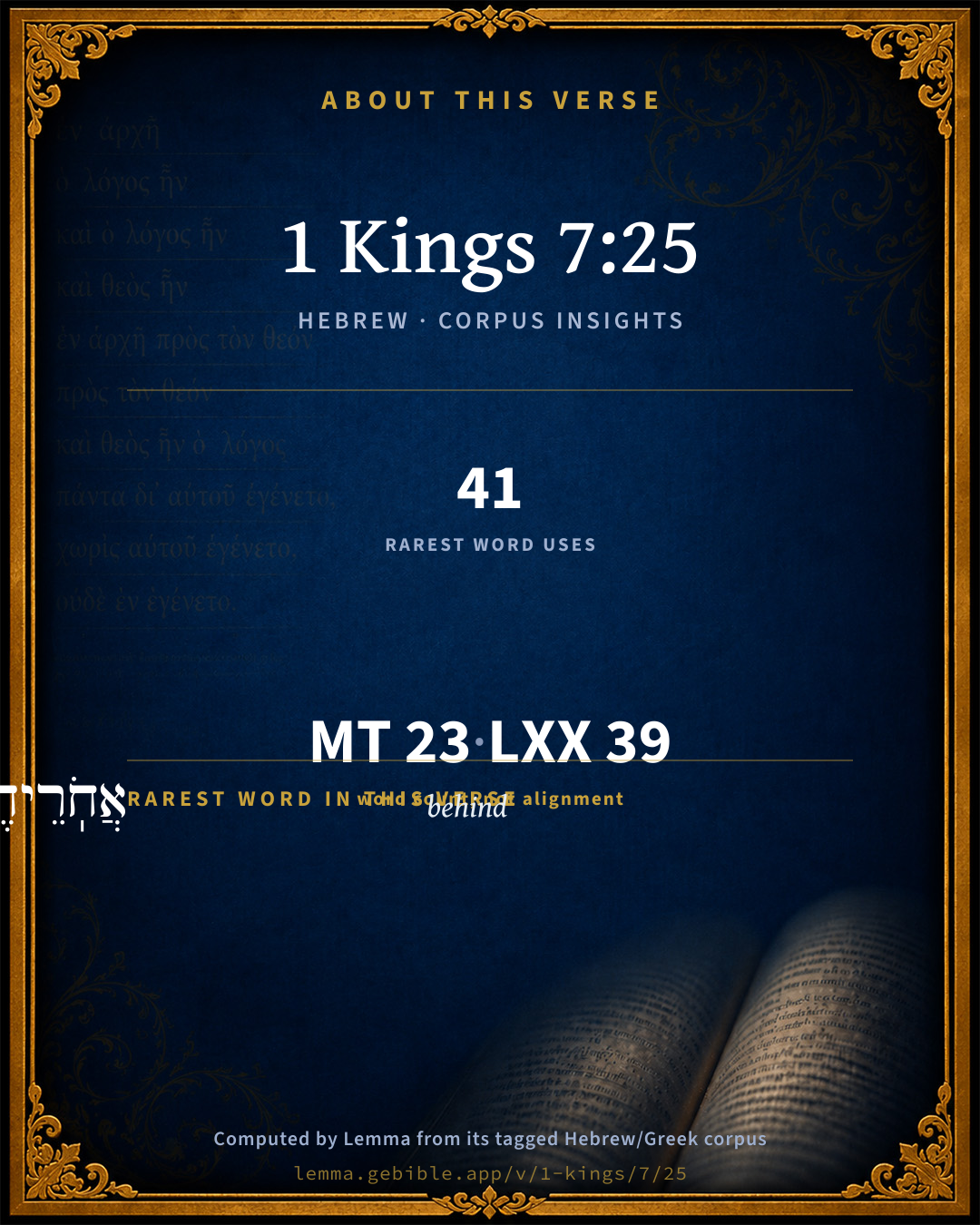
אֲחֹֽרֵיהֶ֖ם behind H268 occurs in 41 verses of the Hebrew Bible. Also found in:

Grammatical profile

  • 5 verbs
  • 9 nouns
  • 6 adjectives
  • 2 prepositions
  • 1 adverb

Verb forms

  • עֹמֵ֞ד Qal · Participle Active
  • פֹנִ֣ים Qal · Participle Active
  • פֹנִ֨ים Qal · Participle Active
  • פֹּנִ֣ים Qal · Participle Active
  • פֹּנִ֣ים Qal · Participle Active

Repetition

Words recur within this verse — often emphatic in Hebrew:

  • שְׁלֹשָׁ֣ה three H7969 ×4
  • פֹנִ֣ים to turn H6437 ×4
  • עַל upon H5921 ×2
  • יָ֜מָּה sea H3220 ×2

Hebrew & Septuagint length

In English translation the verse runs 43 words from the Hebrew and 45 from the Septuagint (LXX English) — closely comparable.

A rough comparison of the two English renderings, which tokenize alike — not a word-level alignment.

Word counts can differ between the Hebrew and the Greek without any difference in meaning — e.g. the Hebrew direct-object marker אֵת has no separate Greek word, and Greek often adds the article ὁ.

In the original languages it is 23 Hebrew tokens and 39 Greek tokens — but the two are counted differently (Hebrew bundles its prefixes and suffixes into one token; the Greek is in lemma form), so that isn’t a like-for-like length.

Cross-references

8

Topical passages linked to 1 Kings 7:25 in the Treasury of Scripture Knowledge — connected by theme and wording, ordered by reader-vote popularity; previews shown in the World English Bible.

  • Jeremiah 52:20 The two pillars, the one sea, and the twelve brazen bulls that were under the bases, which king Solomon had made for the house of Yahweh. The brass of all these vessels was without weight.
  • 2 Chronicles 4:4–5 It stood on twelve oxen, three looking toward the north, and three looking toward the west, and three looking toward the south, and three looking toward the east: and the sea was set on them above, and all their hinder parts were inward.
  • Ezekiel 1:10 As for the likeness of their faces, they had the face of a man; and they four had the face of a lion on the right side; and they four had the face of an ox on the left side; they four had also the face of an eagle.
  • Matthew 28:19 Therefore go, and make disciples of all nations, baptizing them in the name of the Father and of the Son and of the Holy Spirit,
  • Mark 16:15–16 He said to them, "Go into all the world, and preach the Gospel to the whole creation.
  • Luke 24:47 and that repentance and remission of sins should be preached in his name to all the nations, beginning at Jerusalem.
  • 1 Corinthians 9:9 For it is written in the law of Moses, "You shall not muzzle an ox while it treads out the grain." Is it for the oxen that God cares,
  • Revelation 4:6–7 Before the throne was something like a sea of glass, similar to crystal. In the midst of the throne, and around the throne were four living creatures full of eyes before and behind.

Cross-references courtesy of OpenBible.info (CC BY 4.0).

Hebrew and Greek witnesses Masoretic Hebrew ↔ Greek Septuagint

The same verse in the two great witnesses to the Old Testament, shown verse-for-verse.

These are two independent witnesses, not word-aligned to each other, and the Septuagint is shown in lemma (dictionary) form.

Hebrew 1 Kings 7:25 Masoretic · Westminster Leningrad Codex

עֹמֵ֞ד עַל שְׁנֵ֧י עָשָׂ֣ר בָּקָ֗ר שְׁלֹשָׁ֣ה פֹנִ֣ים צָפ֡וֹנָה וּשְׁלֹשָׁה֩ פֹנִ֨ים יָ֜מָּה וּשְׁלֹשָׁ֣ה פֹּנִ֣ים נֶ֗גְבָּה וּשְׁלֹשָׁה֙ פֹּנִ֣ים מִזְרָ֔חָה וְהַיָּ֥ם עֲלֵיהֶ֖ם מִלְמָ֑עְלָה וְכָל אֲחֹֽרֵיהֶ֖ם בָּֽיְתָה

It stood on twelve oxen, three looking toward the north, and three looking toward the west, and three looking toward the south, and three looking toward the east; and the sea was set on them above, and all their hinder parts were inward.

World English Bible · Public Domain

Greek LXX 1 Kings 7:25 Septuagint · lemma form

καί τίθημι ὁ δέκα μεχωνωθ πέντε ἀπό ὁ ὠμία ὁ οἶκος ἐκ δεξιός καί πέντε ἀπό ὁ ὠμία ὁ οἶκος ἐκ ἀριστερός καί ὁ θάλασσα ἀπό ὁ ὠμία ὁ οἶκος ἐκ δεξιός κατά ἀνατολή ἀπό ὁ κλίτος ὁ νότος

And there were twelve oxen under the sea: three looking to the north, and three looking to the west, and three looking to the south, and three looking to the east: and all their hinder parts were inward, and the sea was above upon them.

LXX2012 (modern English Septuagint) · Public Domain

Hebrew: Westminster Leningrad Codex (CC BY 4.0). Greek: Septuagint (public domain); English from LXX2012 (modern English Septuagint) (Public Domain). How the Septuagint differs from the Hebrew →

Targum (Aramaic paraphrase)

1

The Targum is the ancient Jewish Aramaic paraphrase of the Hebrew Scriptures — an interpretive translation, not the Hebrew text itself. Onkelos (literal) and Pseudo-Jonathan (expansive) render the Torah, and Jonathan the Prophets. Coverage is partial: where no permissively-licensed English translation exists for a verse, only the Aramaic is shown. This is verse-level text, not a word-by-word alignment to the Hebrew.

  1. Targum Jonathan Prophets (Joshua–Malachi)
    קָאֵים עַל תְּרֵי עֲסַר תּוֹרִין תְּלָתָא אַפֵּיהוֹן לְצִיפוּנָא וּתְלָתָא אַפֵּיהוֹן לְדָרוֹמָא וּתְלָתָא אַפֵּיהוֹן לְמַעַרְבָא וּתְלָתָא אַפֵּיהוֹן לְמַדִינְחָא וְיַמָא מְתַקֵן עִלַוֵיהוֹן מִלְעֵילָא וְכָל אֲחוֹרֵיהוֹן לְגָיו:

    (no public-domain English translation for this verse)

    Targum Jonathan — Aramaic: “Mikraot Gedolot” (public domain). English: “Sefaria Community Translation” (CC0 1.0 (public-domain dedication)); “London "Chaldee Paraphrase," 1871” (public domain). Text via Sefaria.

Commentary

Notes on 1 Kings 7:25 from classic Christian and Jewish commentators (each source and its license shown beneath its notes). The classic Christian expositions comment on the surrounding passage and are grouped to its opening verse, so a note may address several verses; the Jewish commentaries on the Tanakh (Rashi and others) are per-verse, so they appear only where the commentator wrote on this verse.

Lemma curates 59 commentaries, every one of them public domain or Creative Commons licensed, each selected and text-cleaned for this edition rather than reprinted as found. About our sources →

Trapp's Complete Commentary

John Trapp

1Ki 7:25 It stood upon twelve oxen, three looking toward the north, and three looking toward the west, and three looking toward the south, and three looking toward the east: and the sea [was set] above upon them, and all their hinder parts [were] inward.

Ver. 25. It stood upon twelve oxen.] Figuring out the twelve apostles and their successors, who went into all parts of the world, teaching "the baptism of repentance for the remission of sins."

John Trapp, A Commentary or Exposition upon All the Books of the Old and New Testament (1647–1656) — public domain. Text from a community e-Sword module.

Joseph Benson's Commentary

1Ki 7:25-26. It stood upon twelve oxen — Of solid brass, which was necessary to bear so great a weight. Probably the water was drawn by cocks out of the mouths of these oxen. It contained two thousand baths — That is, five hundred barrels, the bath being a measure of the same bigness with the ephah, each containing about eight gallons. It appears from 2Ch 4:5, that if filled up to the brim, it would receive three thousand baths. But it is probable they were not wont to put so much in it, lest, with the wind, it should run over; and that two thousand was the quantity usually kept in it.

Joseph Benson's Commentary on the Old and New Testaments (1811–1818) — public domain. Text from a community e-Sword module.

The Cambridge Bible for Schools and Colleges

gen. ed. J. J. S. Perowne

25. the sea was set above upon them] i.e. The bottom rested on the backs of the oxen. Thus the height from the ground to the rim would be five cubits, and the height of the oxen besides. Nothing is said of such a thing, but it is not unlikely that the water was drawn out through the mouths of the oxen.

The Cambridge Bible for Schools and Colleges (gen. ed. J. J. S. Perowne; Cambridge University Press, 1878–1918) — public domain. Text from a community e-Sword module.

John Gill's Exposition

And it was an hand breadth thick,.... Or four fingers, as in Jer 52:21.

and the brim thereof was wrought like the brim of a cup,

with flowers of lilies, embroidered and engraven on it for ornament sake:

it contained 2,000 baths; which is reckoned about five hundred barrels of water; it was filled by the Gibeonites; in Ch2 4:5, it is said to receive and hold 3,000 baths, which the Jewish writers (s) thus reconcile; they suppose here it means so many baths of liquid, as the Targum expresses, there of dry measure, which might be heaped up, and so contain more; but as this was a vessel for water, and this distinction seems to answer no purpose, it may be better to observe, that in common, for the use of the priests, whether for washing their hands and feet, or dipping their bodies, it had no more than 2,000 baths in it, but, if filled up to the brim, it would hold 3,000. How a vessel of such dimensions should hold so much is difficult to account for; the Rabbins say (t), that in the two upper cubits of it it was circular, and in the three lower cubits square, by which they imagine it would hold more, and the position of it on the oxen seems to countenance this; but very probably it was wider, and bellied out in the lower part of it, and so more capacious; but of the contents of this, according to mathematical rules, see a treatise of Bishop Cumberland's (u). It is said (w) of a temple of Neptune's, in the fore part of it were two signs of him, and another of Amphitrite, and that was a brasen sea. This brasen sea of Solomon was typical of Christ, the fountain opened to wash in for uncleanness, by all that are made priests unto God; and this being larger than the laver in the tabernacle, may denote the greater efficacy of Christ's blood than in anything in the law of Moses to cleanse from sin; and the larger provision made for it, not only for Israel, but for all the people of God in the several nations of the world, in the four quarters of it; being published, and proclaimed, and directed to by the twelve apostles of Christ, and by all Gospel ministers since, signified by oxen for their laboriousness and strength. In the second temple there were no sea, nor bases, after mentioned, nor lavers, but one, which stood between the porch and the altar, which was for the priests to wash their hands and feet at (x).

(s) Shilte Hagibborim, c. 27. fol. 23. 4. (t) T. Bab. Eruvin, fol. 14. 2. (u) Of Scripture Weights and Measures, c. 3. p. 93, &c. (w) Pausaniae Corinthiaca, sive, l. 2. p. 87. (x) Shilte Hagibborim, c. 27. fol. 24. 2.

John Gill's Exposition of the Whole Bible (1746–1763) — public domain (CC PDM 1.0). Text via the HelloAO Bible API.

Albert Barnes' Notes on the Bible

Josephus charged Solomon with a breach of the Commandment Exo 20:4-5, on account of the oxen here and the lions for his throne. The charge expresses the prohibition which some Jews have conceived the Commandment to urge against the arts of sculpture and painting.

Albert Barnes' Notes on the Bible (1834–1885) — public domain. Text from a community e-Sword/MySword module.

Haydock's Catholic Bible Commentary

Oxen. Josephus and the Jews would condemn Solomon for making these figures; but it is clear that his present was acceptable to God, as well as his person. (Calmet) --- Within. The oxen were of solid brass, to support such a weight. (Menochius) --- Some think that the water was discharged through their mouths. But Pelletier believes that there were cocks placed between each of the four divisions of oxen, which let water into a basin below, in which the priests might purify themselves. He supposes also that the vessel was double; the cup would contain 2000 baths, and the foot or basin another 1000, by which means he would reconcile this book with that of Chronicles. (Melanges, T. i. p. 115.)

George Leo Haydock (1774–1849), Haydock's Catholic Family Bible and Commentary, 1859 edition — public domain. Excludes Psalms (Douay-Rheims chapter numbering differs from Protestant) and Deuterocanonical books (Catholic canon only).

Matthew Poole's English Annotations

It stood upon twelve oxen, of solid brass, which was necessary to bear so great a weight. It is probably conceived that the water was by cocks drawn out of the mouths of these oxen. Three of these looked each way; partly for the more equal and convenient support of the vessel; and partly that divers persons might draw water out of it at the same time, which was frequently necessary, especially in great solemnities.

Matthew Poole's English Annotations on the Holy Bible (1683–1685) — public domain. Text from a community e-Sword/MySword module.

Whedon's Commentary on the Bible

Daniel D. Whedon

25. It stood upon twelve oxen — Josephus adds that its middle part rested on a short pillar ten cubits in diameter.

Daniel D. Whedon (gen. ed.), Commentary on the Old and New Testaments (1874–1909) — public domain. Text from a community e-Sword module.

The Pulpit Commentary

It stood Heb. standing upon twelve oxen The import of the number twelve is well explained by. Bahr, Symbolik, 1:201 sqq. Like seven, it is compounded out of three and four. But the primary reference here is to the twelve tribes), three looking toward the north, and three looking toward the west, and three looking toward the south, and three looking toward the east So the tribes in the camp formed a square round the tabernacle, three on each side east, south, west, and north: Nu 2 and the sea was set above upon them, and all their hinder parts were inward. .The same regard of the cardinal points (see Bahr, Symbolik, 1:210 sqq.) has been noticed in the pomegranates on the capitals of the two columns. See note on ver. 20. Keil says the feet of the oxen no doubt rested on a metal plate, so that they were fixed and immoveable; but this lacks proof. The oxen would be immovable in any case, owing to the weight of the metal and the water. All conjectures as to the height and size of the oxen are necessarily of little value.

The Pulpit Commentary (1880–1919), ed. H.D.M. Spence-Jones & Joseph S. Exell — public domain. Text from a community e-Sword module.

John Wesley's Explanatory Notes

Oxen - Of solid brass, which was necessary to bear so great a weight.

John Wesley, Explanatory Notes Upon the Whole Bible (1754–1765) — public domain. Text via the GEBible commentary corpus.

unfoldingWord translationNotes

Door43 World Missions Community

The Sea

This refers to the bronze tank or basin that held water for sacrifices.

stood on

"was on top of"

"The Sea" was set on top of them

This can be stated in active form. AT: "Huram's workers set 'The Sea' on top of the bronze oxen" (See: Active or Passive)

hindquarters

This is the back quarter of the body of an animal with four feet.

its brim was forged like the brim of a cup, like a lily blossom

This can be stated in active form. AT: "Huram forged the brim to look like the brim of a cup, to curve outward like a lily" (See: Simile and Active or Passive)

two thousand baths

A bath is a unit of volume equal to about 22 liters. AT: "2,000 baths" or "44,000 liters" (See: Biblical Volume)

translationWords

cow

unfoldingWord translationNotes — © Distant Shores Media and the Door43 World Missions Community, licensed CC BY-SA 4.0. Source: git.door43.org/Door43/en_tn.

Rashi

Rabbi Shlomo Yitzchaki (Rashi)

And all their hind parts. Of these oxen.

Were inward. Their hind parts were facing towards the bottom of the sea, the [three] (two) which were in the north towards [those in] the south, and [those in] the east towards those in the west.

Rashi on the Tanakh — English translations: “The Judaica Press complete Tanach with Rashi, translated by A. J. Rosenberg” (CC BY 4.0); “Pentateuch with Rashi's commentary by M. Rosenbaum and A.M. Silbermann, 1929-1934” (public domain); “The Metsudah Tanach series, Lakewood, N.J” (CC BY 4.0); and “The Book of Joshua, Metsudah Publications, 1997” (CC BY 4.0). Text via Sefaria.

Lesson kit

Teaching starters — assembled from the data on this page, not authored interpretation. Every prompt links to the verse data it draws on. Edit before teaching.

1 Kings, in the Historical, opens this verse with 23 words (15 distinct Hebrew lemmas). Its most distinctive word is ʼâchôwr (“behind”). A historical commentator’s framing appears above. Read the whole chapter for the surrounding context.

Discussion questions

  1. What does “behind” (ʼâchôwr) contribute to the verse as a whole?
  2. How does Genesis 49:17, which shares the word «behind», read alongside this verse?
  3. What does the repetition of “three” (4× in this one verse) do in this verse?
  4. The translations on this page render this verse differently — a whole-verse word diff, not a word-by-word alignment. What might account for the different wordings?
  5. «עֹמֵ֞ד» is a Qal Participle Active verb. How does that grammatical form shape the action described?
  6. Compare how Trapp's Complete Commentary and Joseph Benson's Commentary read this verse. Where do they agree or differ?

Things to notice

Reading settings

Reading text

Shown beneath each verse's original-language words.

Old Testament
Old Testament edition

Read the OT as the Masoretic Hebrew (MT) or the Greek Septuagint (LXX).

English shown for the Greek Septuagint (in the Hebrew ↔ Greek comparison).

Comparing translations? Open the Compare panel on any verse page to stack up to four side by side.