
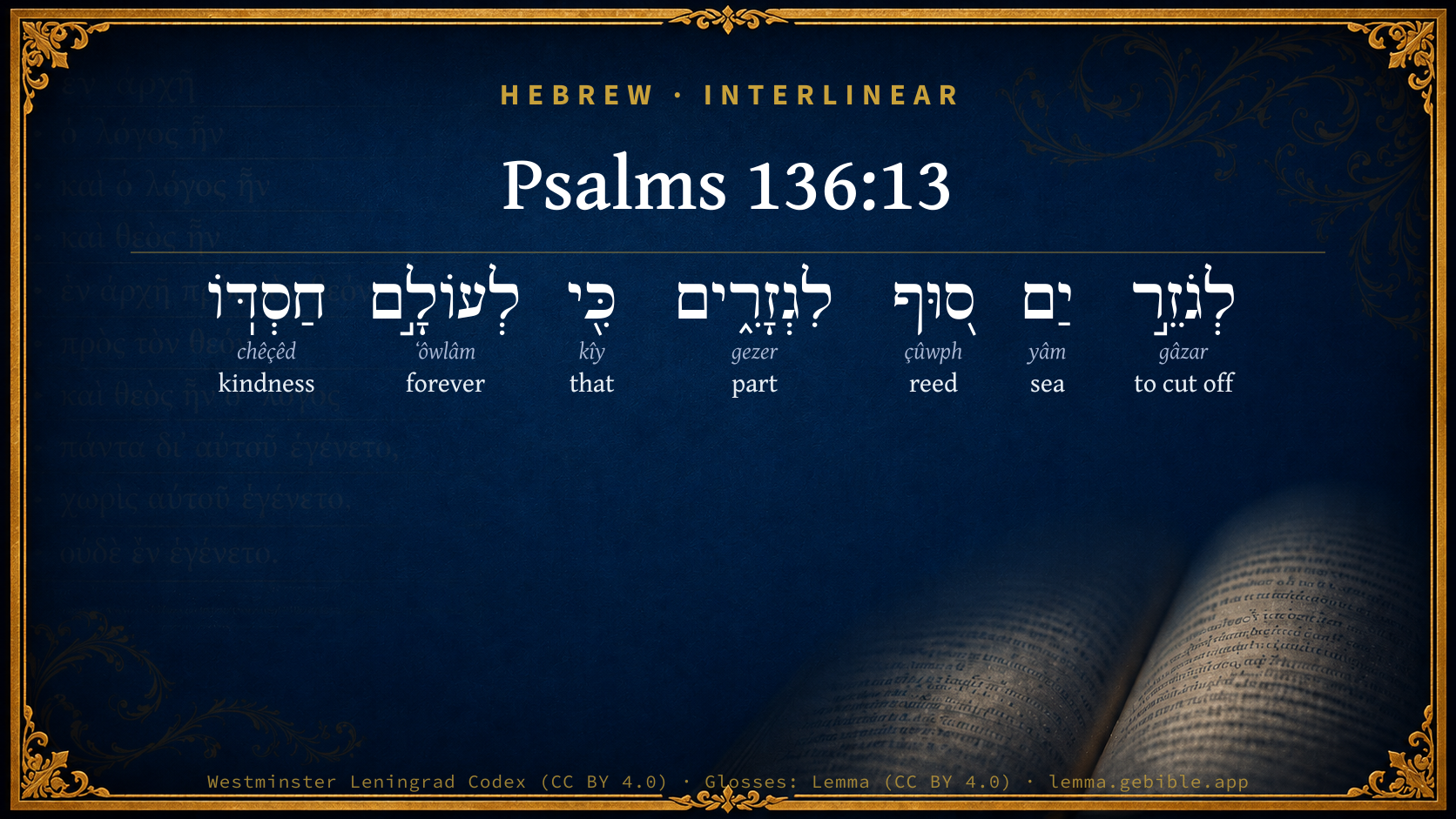
Psalms 136:13

Hebrew (Westminster Leningrad Codex) Psalms 136:13 appears in the Hebrew Old Testament. The text above is from the Westminster Leningrad Codex. Each word links to its Strong’s number, a concise gloss, and parsing drawn from the Open Scriptures Hebrew Bible morphology. Click any word for its full Brown-Driver-Briggs (BDB) entry.
Download image
Cite this verse

Psalms 136:13 (World English Bible). Public Domain. Lemma interlinear Bible study tool, https://lemma.gebible.app/v/psalms/136/13.

Show BibTeX & RIS
BibTeX
RIS
English Translation
To him who divided the Red Sea apart; For his loving kindness endures forever;
World English Bible · Public Domain
Download a study sheet

One document with this verse’s original text, its word-by-word gloss line, the meaning frame, cross-references with their text, attributed commentary, and full source and license credits — printable, and it pastes into notes with its structure intact.

This verse Autodidact and up

Study sheet (.html) Plain text (.txt)

A passage Seminary Student

Up to 50 verses in one chapter. A passage sheet keeps up to 6 commentary sources and 12 cross-references per verse, in the order this page ranks them, and says so on the sheet whenever that leaves anything out. Ask for a single verse and you get the Autodidact verse sheet above.

Everything on this page stays free to read, with no account — the sheet is a download of what is already on screen, not access to it.

Want to remove ads? Support Godless Engineer
Compare translations 3

The same verse in 3 English versions, stacked beneath the original-language interlinear above. Click any original word for its lexicon entry.

Each is an independent rendering of the whole verse — the interlinear is not word-aligned to these translations.

Highlighted words mark where these versions differ — a whole-verse word diff, not a word-by-word alignment.

  • World English Bible Public Domain
    To him who divided the Red Sea apart; For his loving kindness endures forever;
  • King James Version Public Domain
    To him which divided the Red sea into parts: for his mercy endureth for ever:
  • unfoldingWord Literal Text CC BY-SA 4.0
    To the parter of the Sea of Reeds into parts, for his covenant faithfulness to forever.

unfoldingWord Literal Text — © unfoldingWord, licensed CC BY-SA 4.0. Word-aligned USFM3 via Door43 (git.door43.org/unfoldingWord/en_ult).

Versions to compare (up to 4)

3 of 4 selected

Show all 18 translations

Every available English version of this verse, each an independent rendering of the whole verse.

  • World English Bible Public Domain
    To him who divided the Red Sea apart; For his loving kindness endures forever;
  • Berean Standard Bible Public Domain
    He divided the Red Sea in two His loving devotion endures forever.
  • Majority Standard Bible Public Domain
    He divided the Red Sea in two His loving devotion endures forever.
  • King James Version Public Domain
    To him which divided the Red sea into parts: for his mercy endureth for ever:
  • American Standard Version (1901) Public Domain
    To him that divided the Red Sea in sunder; For his lovingkindness `endureth' for ever;
  • Revised Version (1885) Public Domain
    To him which divided the Red Sea in sunder: for his mercy endureth for ever:
  • Geneva Bible (1599) Public Domain
    Which deuided the red Sea in two partes: for his mercie endureth for euer:
  • Douay-Rheims (1899) Public Domain
    Thy name, O Lord, is for ever: thy memorial, O Lord, unto all generations.
  • Young's Literal Translation Public Domain
    To Him cutting the sea of Suph into parts, For to the age `is' His kindness,
  • Literal Standard Version CC BY-SA 4.0
    To Him cutting the Sea of Suph into parts, || For His kindness [is] for all time,
  • Unlocked Literal Bible CC BY-SA 4.0
    Give thanks to him who divided the Sea of Reeds, for his covenant faithfulness endures forever—
  • unfoldingWord Literal Text CC BY-SA 4.0
    To the parter of the Sea of Reeds into parts, for his covenant faithfulness to forever.
  • Darby Bible Public Domain
    To him that divided the Red sea into parts, for his loving-kindness [endureth] for ever,
  • World Messianic Bible Public Domain
    to him who divided the Sea of Suf apart, for his loving kindness endures forever;
  • Webster's Bible Public Domain
    To him who divided the Red sea into parts: for his mercy endureth for ever.
  • Free Bible Version CC BY-SA 4.0
    To him who parted the Red Sea. For his trustworthy love lasts forever,
  • Bible in Basic English Public Domain
    To him who made a way through the Red Sea: for his mercy is unchanging for ever:
  • JPS Tanakh (1917) Public Domain
    To Him who divided the Red Sea in sunder, for His mercy endureth for ever;

Literal Standard Version (2020), Covenant Press — licensed CC BY-SA 4.0. Text via the HelloAO Bible API (eBible.org). Unlocked Literal Bible (unfoldingWord) — licensed CC BY-SA 4.0. Text via the HelloAO Bible API (eBible.org). unfoldingWord Literal Text — © unfoldingWord, licensed CC BY-SA 4.0. Word-aligned USFM3 via Door43 (git.door43.org/unfoldingWord/en_ult). Free Bible Version, Dr. Jonathan Gallagher — licensed CC BY-SA 4.0. Text via the HelloAO Bible API (eBible.org).

Word by word

More ways to search: Search by grammar → Find every occurrence → Compare this word →

Practice this passage: Drill this verse → Learn its vocabulary →

About this verse

These counts appear in no published source. They are computed here, from the morphology-tagged text and Lemma’s own curated glosses. What Lemma adds →

7
words
7
distinct lemmas
Wisdom
section

Notable vocabulary

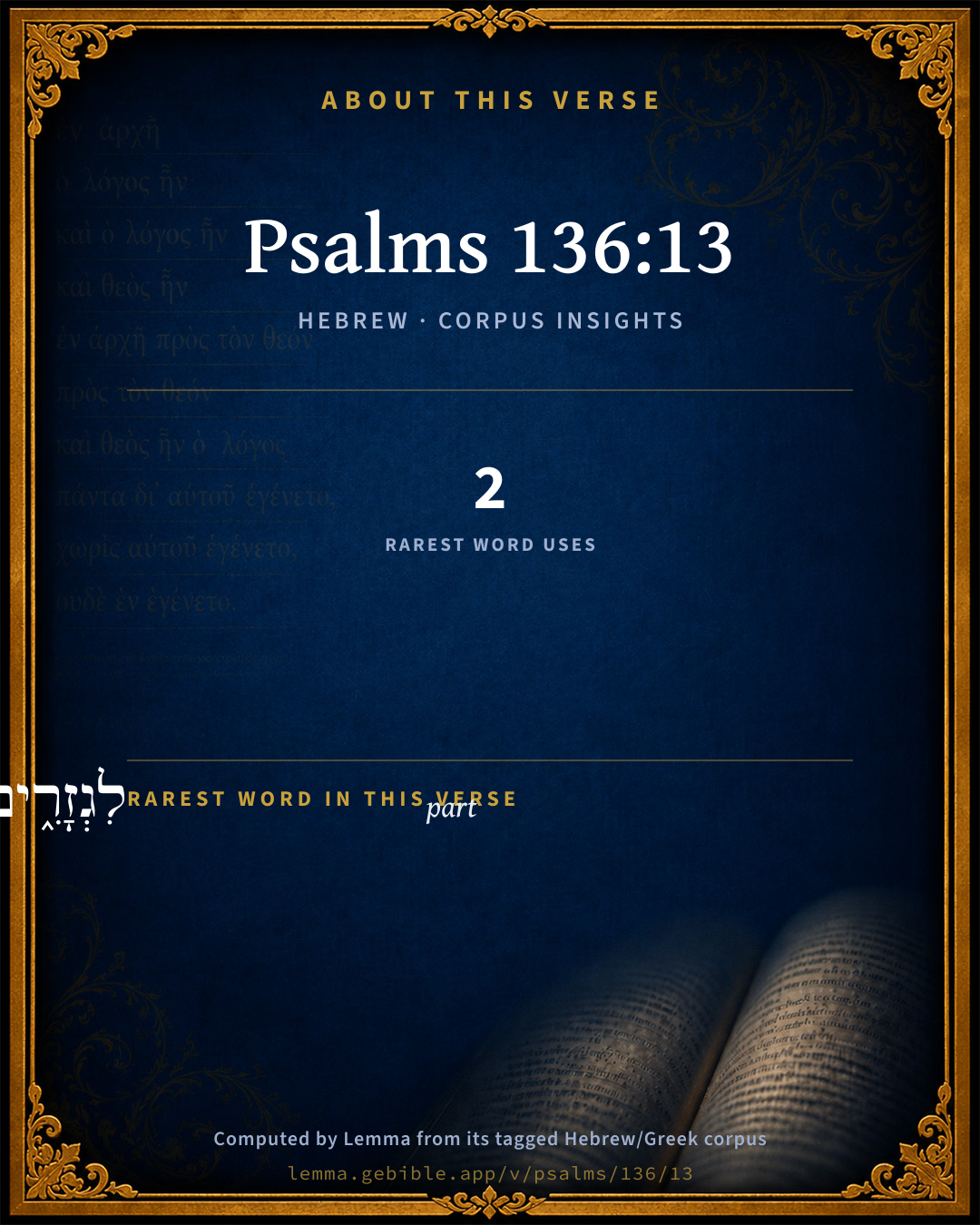
The rarest word here is לִגְזָרִ֑ים part H1506 — appearing just 2 times in the whole Hebrew Bible.

Shared distinctive vocabulary

לִגְזָרִ֑ים part H1506 occurs in 2 verses of the Hebrew Bible. Also found in:

Grammatical profile

  • 1 verb
  • 5 nouns
  • 1 conjunction

Verb forms

  • לְגֹזֵ֣ר Qal · Participle Active

Hebrew & Septuagint length

In English translation the verse runs 14 words from the Hebrew and 15 from the Septuagint (LXX English) — closely comparable.

A rough comparison of the two English renderings, which tokenize alike — not a word-level alignment.

Word counts can differ between the Hebrew and the Greek without any difference in meaning — e.g. the Hebrew direct-object marker אֵת has no separate Greek word, and Greek often adds the article ὁ.

Cross-references

8

Topical passages linked to Psalms 136:13 in the Treasury of Scripture Knowledge — connected by theme and wording, ordered by reader-vote popularity; previews shown in the World English Bible.

  • Psalms 78:13 He split the sea, and caused them to pass through; He made the waters stand as a heap.
  • Psalms 106:9–11 He rebuked the Red Sea also, and it was dried up; So he led them through the depths, as through a desert.
  • Exodus 14:21–22 Moses stretched out his hand over the sea, and Yahweh caused the sea to go back by a strong east wind all the night, and made the sea dry land, and the waters were divided.
  • Exodus 14:29 But the children of Israel walked on dry land in the midst of the sea, and the waters were a wall to them on their right hand, and on their left.
  • Psalms 66:5–6 Come, and see God's deeds-- Awesome work on behalf of the children of men.
  • Psalms 74:13 You divided the sea by your strength. You broke the heads of the sea monsters in the waters.
  • Isaiah 63:12–13 who caused his glorious arm to go at the right hand of Moses? who divided the waters before them, to make himself an everlasting name?
  • Hebrews 11:29 By faith, they passed through the Red sea as on dry land. When the Egyptians tried to do so, they were swallowed up.

Cross-references courtesy of OpenBible.info (CC BY 4.0).

Hebrew and Greek witnesses Masoretic Hebrew ↔ Greek Septuagint

The same verse in the two great witnesses to the Old Testament, shown verse-for-verse.

You’re reading Greek Psalm 135 (Hebrew Psalm 136). The Septuagint counts the superscription, so verse numbers can differ from the Hebrew — chapter-level alignment, not verse-by-verse. Numbering follows Rahlfs.

These are two independent witnesses, not word-aligned to each other, and the Septuagint is shown in lemma (dictionary) form.

Hebrew Psalms 136:13 Masoretic · Westminster Leningrad Codex

לְגֹזֵ֣ר יַם ס֭וּף לִגְזָרִ֑ים כִּ֖י לְעוֹלָ֣ם חַסְדּֽוֹ

To him who divided the Red Sea apart; For his loving kindness endures forever;

World English Bible · Public Domain

Greek LXX Greek Psalm 135:13 Septuagint · lemma form

ὁ κατα διααἱρέω ὁ ἐρυθρός θάλασσα εἰς διαίρεσις ὅτι εἰς ὁ αἰών ὁ ἔλεος αὐτός

To him who divided the Red Sea into parts: for his mercy endures for ever:

LXX2012 (modern English Septuagint) · Public Domain

Hebrew: Westminster Leningrad Codex (CC BY 4.0). Greek: Septuagint (public domain); English from LXX2012 (modern English Septuagint) (Public Domain). How the Septuagint differs from the Hebrew →

Commentary

Notes on Psalms 136:13 from classic Christian and Jewish commentators (each source and its license shown beneath its notes). The classic Christian expositions comment on the surrounding passage and are grouped to its opening verse, so a note may address several verses; the Jewish commentaries on the Tanakh (Rashi and others) are per-verse, so they appear only where the commentator wrote on this verse.

Lemma curates 59 commentaries, every one of them public domain or Creative Commons licensed, each selected and text-cleaned for this edition rather than reprinted as found. About our sources →

Trapp's Complete Commentary

John Trapp

Psa 136:13 To him which divided the Red sea into parts: for his mercy [endureth] for ever:

Ver. 13. To him which divided the Red Sea] Into twelve several parts, say the Jews, for the twelve tribes to pass through.

John Trapp, A Commentary or Exposition upon All the Books of the Old and New Testament (1647–1656) — public domain. Text from a community e-Sword module.

J. A. Alexander on Psalms

Joseph Addison Alexander

13. (Psa 136:13) To him that larted the Bed Sea into parts--for unto eternity (is) his mercy. Parted and parts have the same relation to each other as the Hebrew verb and noun.

Joseph Addison Alexander, The Psalms Translated and Explained (1850) — public domain. Text from a community e-Sword module.

Adam Clarke's Commentary

Verse 13. Divided the Red Sea into parts] Some of the Jews have imagined that God made twelve paths through the Red Sea, that each tribe might have a distinct passage. Many of the fathers were of the same opinion; but is this very likely?

Adam Clarke's Commentary on the Bible (1810–1826) — public domain. Text from a community e-Sword/MySword module.

John Calvin's Commentaries

13. Who divided the Red Sea I have already (Psalm 106:7) spoken of the word סוף, suph, and have not therefore hesitated to render it the Red Sea The Psalmist speaks of divisions in the plural number, which has led some Jewish authors to conjecture that there must have been more passages than one — an instance of their solemn trifling in firings of which they know nothing, and of their method of corrupting the Scriptures entirely with their vain fancies. ‘We may well laugh at such fooleries, yet we are to hold them at the same time in detestation; for there can be no doubt that the Rabbinical writers were led to this by the devil, as an artful way of discrediting the Scriptures. Moses plainly and explicitly asserts that the heaps of waters stood up on both sides, from which we infer that the space between was one and undivided. “Dont nous pouvons bien recueillir que l’espace d’entre deux estoit sans aucune separation.” — Fr.

“Sous des logettes de feuilles.” — Fr.

John Calvin's Commentaries (1540-1563) — public domain. Text from the Calvin Translation Society English edition (1840s-50s) via the Christian Classics Ethereal Library (ccel.org). Calvin's coverage is partial (roughly two-thirds of the Bible); uncommented books and verses are honest gaps, never fabricated. The 19th-century editor's footnotes and remarks are omitted so the notes are faithfully Calvin's own voice.

The Cambridge Bible for Schools and Colleges

gen. ed. J. J. S. Perowne

13. O give thanks unto him that hath chosen Zion (Psa_132:13), for &c.

13. into parts] R.V. in sunder. In two parts of P.B.V. is a printer’s error. The Great Bible of 1539 has into partes.

The Cambridge Bible for Schools and Colleges (gen. ed. J. J. S. Perowne; Cambridge University Press, 1878–1918) — public domain. Text from a community e-Sword module.

John Gill's Exposition

To him which divided the Red sea into parts,.... Into two parts, so that the waters of it stood as a wall on the right and left hand of the Israelites, as they passed through; this was done by means of a strong east wind, Exo 14:21. The Jews have a tradition, which Jarchi, Kimchi, and Arama, make mention of, that the sea was divided into twelve parts, according to the twelve tribes of Israel, and every tribe had a path by itself to walk in; but for this there is no foundation: however, the dividing it into parts was a wonderful work, and a rich display of mercy to Israel;

for his mercy endureth for ever; the children of Israel were encompassed about, and in the utmost distress: the rocks were on each side, Pharaoh and his host behind them, the Red sea before them; and so no visible way of escape; but the Lord cut a way for them through the sea, and saved them. The sea is an emblem of this world, which is like a tempestuous troubled sea; where everything is restless, fluctuating, and passing away; where the people of God are tossed with tempests; and where afflictions, like the waves and billows of the sea, come over them one after another; and through which they must pass and enter the kingdom: and God, that wills, orders, and appoints them, sets these proud waves of the sea their bounds, or makes them a calm; and, sooner or later, makes a way through them and out of them, which is owing to his enduring mercy, Co1 10:13.

John Gill's Exposition of the Whole Bible (1746–1763) — public domain (CC PDM 1.0). Text via the HelloAO Bible API.

Albert Barnes' Notes on the Bible

To him which divided the Red sea into parts - More literally, “Parted it into parts;” made parts of that which before was unbroken and a whole. It was actually divided into two parts, so that the Hebrews passed between them: Exo 14:21-22.

For his mercy ... - This, too, was an exercise of mercy, or a manifestation of benevolence toward them and toward the world, to be measured by all the good which would result from it in itself, and by all the power which was put forth to effect it.

Albert Barnes' Notes on the Bible (1834–1885) — public domain. Text from a community e-Sword/MySword module.

The Treasury of David

Charles H. Spurgeon

Ver. 13. To him which divided the Red sea into parts. He made a road across the sea bottom, causing the divided waters to stand like walls on either side. Men deny miracles; but, granted that there is a God, they become easy of belief. Since it requires me to be an atheist that I may logically reject miracles, I prefer the far smaller difficulty of believing in the infinite power of God. He who causes the waters of the sea ordinarily to remain as one mass can with equal readiness divide them. He who can throw a stone in one direction can with the same force throw it another way: the Lord can do precisely what he wills, and he wills to do anything which is ten the deliverance of his people.

For his mercy endureth for ever, and therefore it endures through the sea as well as over the dry land. He will do a new thing to keep his old promise. His way is in the sea, and he will make a way for his people in the same pathless region.

Lo, the Red Sea he divides,

For his mercy sure abides.

Ver. 13. Divided the Red Sea into parts. The entire space between the mountains of Ataka and Abon Deradj was dry. At the former point the gulf is eight miles across, at the latter more than double that distance. The waters that had filled this broad and deep chasm stood in two huge mounds on the right hand and on the left. The light of God shone brightly on the astonished multitude. The word was given, they advanced abreast; awe stricken, but quiet and confident..."Then the Egyptians pursued and went in after them into the midst of the sea, all Pharaoh's horses, even his chariots and his fleet horses": Ex 14:23. William Osburn, in "Israel in Egypt", 1856.

Ver. 13-14. God to be praised not only,

1. For clearing our way; but also,

2. For giving faith to traverse it. The last as great a mercy as the first.

Ver. 13-15. Mercy queen of the Exodus.

1. Her sceptre upon the sea. What cannot Love divine conquer for its chosen!

2. Her standard in the van. Whither shall saints fear to follow her?

3. Her frown upon the pursuers; life to the beloved, fatal to the foe.

4. To her let there be brought the chaplet of our praises. W.B.H.

Psalms 136:14*

Charles H. Spurgeon's The Treasury of David (1869–1885) — public domain. Psalms only. Text from a community e-Sword/MySword module.

The Pulpit Commentary

To him which divided the Red Sea into parts; literally, into section cut it, as it were, in two. (see Exo_14:21) For his mercy, etc.

Overcoming natural obstacles.

"Divided the sea in sunder." The peculiarity of the account given us of this miracle wrought for the deliverance of Israel is that it gives so distinctly the natural agencies by which it was wrought. A certain natural obstacle had to be overcome, and it was overcome by such forces as man would have used if he had had the nature-forces in his control. We can distinctly recognize the suitability of the agencies. But here the true miracle comes in. There was no manufacture of new forces; there was absolute control of existing forces. There was no accident of wind and tide; there was the Divine using of wind and tide. When God made natural forces he did not loosen them from his control. He is always controlling them, and we are made to feel sure that he is, by some such extraordinary cases of controlling as we have in this crossing of the sea. Geikie says, "Ebb and flood tide, in the narrow northern ford especially, are greatly affected by the wind prevailing at any given time A violent north-east gale blew all night, and drove the waters before it, at ebb-tide, into the south-west ford, till the sandy ridge of the ford was laid bare, the shore-waters thus becoming a wall or protection to the Hebrews on the right, and those of the open sea on the left hand. The storm prolonging the ebb, delayed the flow of the tide, and thus before morning the whole of the Hebrews were able to reach the east shore.

I NATURAL OBSTACLES STILL HINDER GOD"S PEOPLE. Such natural obstacles as are related to the circumstances of God"s people nowadays. They often appear as bodily frailty, or as sickness of those to whom we are bound in duty, or in limitation of means, or insufficiency of premises for Christian work, or hindering distances from fields of labor, or strange enmities that seem to check us in every enterprise. And it is not altogether easy to associate God with such material things, and to realize that he is actually working for us in the control or removal of them. And yet just that is the lesson for the ages to be learned from God"s removal of the hindering Red Sea.

II NATURAL OBSTACLES DO BUT REPRESENT THE SPIRITUAL OBSTACLES OF GOD"S PEOPLE. "We wrestle, not against flesh and blood, but against principalities and powers." The spiritual weaknesses of ourselves, the spiritual forces of evil. Of our spiritual enemy we may say, "We are not ignorant of his devices." Nor is God. Nor does he fail to master these obstacles or to counteract his devices. R.T.

The Pulpit Commentary (1880–1919), ed. H.D.M. Spence-Jones & Joseph S. Exell — public domain. Text from a community e-Sword module.

unfoldingWord translationNotes

Door43 World Missions Community

the Sea of Reeds

The soldiers of Pharaoh drowned in the Sea of Reeds.

for his covenant faithfulness endures forever

The abstract noun "faithfulness" can be translated with an adjective. See how you translated this in Psalms 136:1. AT: "because he remains faithful to his covenant forever" (See: Abstract Nouns)

overthrew Pharaoh

Here defeat is spoken of as if it were tipping someone over. AT: "defeated Pharaoh" or "defeated the king of Egypt" (See: Metaphor)

Pharaoh

That is, the army of Pharaoh. (See: Metonymy)

translationWords

Sea of Reeds

Israel

Pharaoh

unfoldingWord translationNotes — © Distant Shores Media and the Door43 World Missions Community, licensed CC BY-SA 4.0. Source: git.door43.org/Door43/en_tn.

Rashi

Rabbi Shlomo Yitzchaki (Rashi)

asunder In twelve pieces for the twelve tribes.

Rashi on the Tanakh — English translations: “The Judaica Press complete Tanach with Rashi, translated by A. J. Rosenberg” (CC BY 4.0); “Pentateuch with Rashi's commentary by M. Rosenbaum and A.M. Silbermann, 1929-1934” (public domain); “The Metsudah Tanach series, Lakewood, N.J” (CC BY 4.0); and “The Book of Joshua, Metsudah Publications, 1997” (CC BY 4.0). Text via Sefaria.

Lesson kit

Teaching starters — assembled from the data on this page, not authored interpretation. Every prompt links to the verse data it draws on. Edit before teaching.

Psalms, in the Wisdom, opens this verse with 7 words (7 distinct Hebrew lemmas). Its most distinctive word is gezer (“part”). A historical commentator’s framing appears above. Read the whole chapter for the surrounding context.

Discussion questions

  1. The word gezer carries the sense “part.” How does it shape the verse?
  2. Genesis 15:17 shares the word «part» with this verse. How do the two illuminate each other?
  3. The translations on this page render this verse differently — a whole-verse word diff, not a word-by-word alignment. What might account for the different wordings?
  4. The verb «לְגֹזֵ֣ר» is Qal Participle Active. How does its form color the action?
  5. Reading how Trapp's Complete Commentary and J. A. Alexander on Psalms read this verse, where do the two commentators agree and where do they part?

Things to notice

Reading settings

Reading text

Shown beneath each verse's original-language words.

Old Testament
Old Testament edition

Read the OT as the Masoretic Hebrew (MT) or the Greek Septuagint (LXX).

English shown for the Greek Septuagint (in the Hebrew ↔ Greek comparison).

Comparing translations? Open the Compare panel on any verse page to stack up to four side by side.