Numbers 34:6

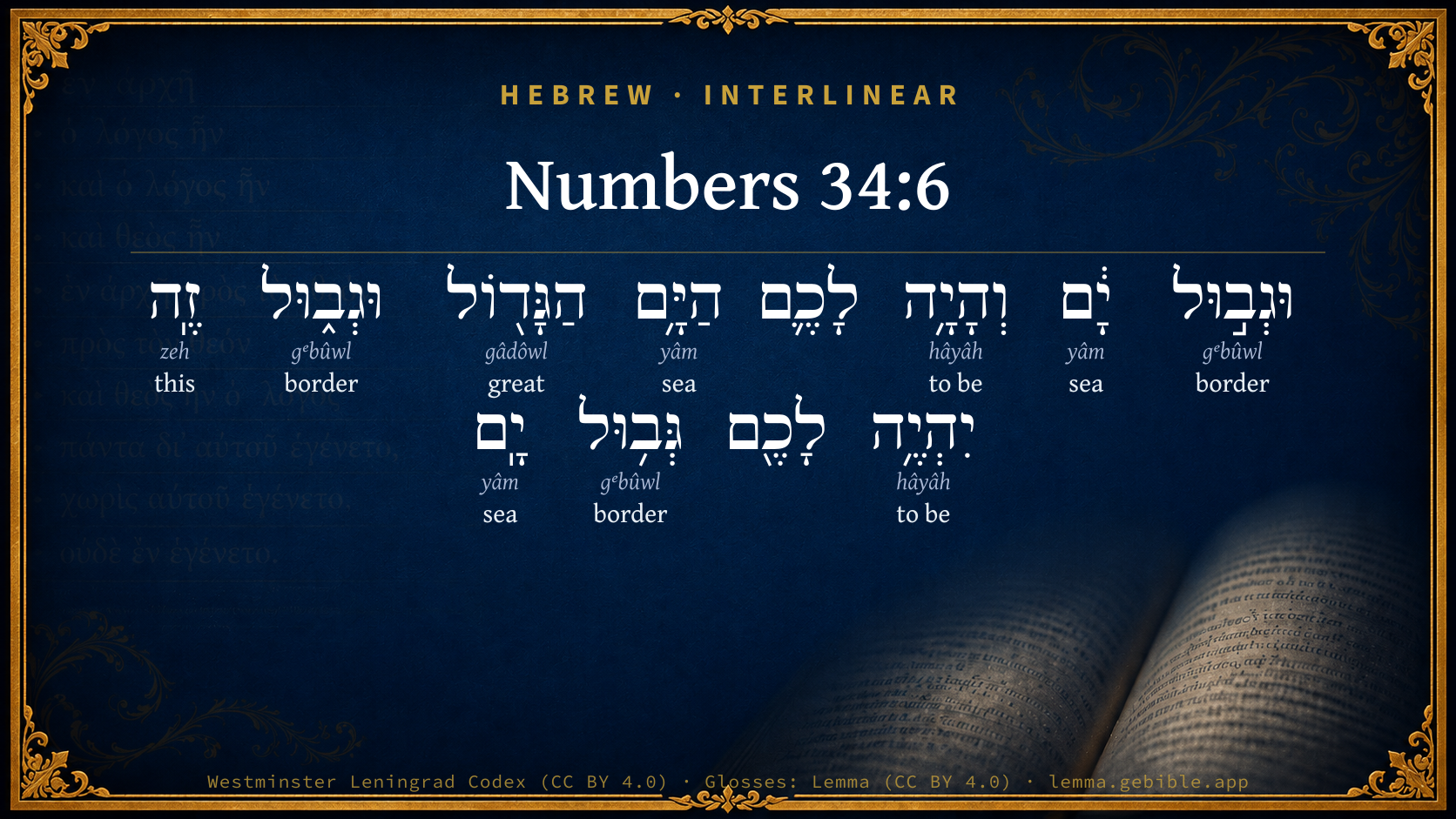
Hebrew (Westminster Leningrad Codex) Numbers 34:6 appears in the Hebrew Old Testament. The text above is from the Westminster Leningrad Codex. Each word links to its Strong’s number, a concise gloss, and parsing drawn from the Open Scriptures Hebrew Bible morphology. Click any word for its full Brown-Driver-Briggs (BDB) entry.
Download image
Cite this verse

Numbers 34:6 (World English Bible). Public Domain. Lemma interlinear Bible study tool, https://lemma.gebible.app/v/numbers/34/6.

Show BibTeX & RIS
BibTeX
RIS
English Translation
For the western border, you shall have the great sea and the border [of it]: this shall be your west border.
World English Bible · Public Domain
Download a study sheet

One document with this verse’s original text, its word-by-word gloss line, the meaning frame, cross-references with their text, attributed commentary, and full source and license credits — printable, and it pastes into notes with its structure intact.

This verse Autodidact and up

Study sheet (.html) Plain text (.txt)

A passage Seminary Student

Up to 50 verses in one chapter. A passage sheet keeps up to 6 commentary sources and 12 cross-references per verse, in the order this page ranks them, and says so on the sheet whenever that leaves anything out. Ask for a single verse and you get the Autodidact verse sheet above.

Everything on this page stays free to read, with no account — the sheet is a download of what is already on screen, not access to it.

Want to remove ads? Support Godless Engineer
Compare translations 3

The same verse in 3 English versions, stacked beneath the original-language interlinear above. Click any original word for its lexicon entry.

Each is an independent rendering of the whole verse — the interlinear is not word-aligned to these translations.

Highlighted words mark where these versions differ — a whole-verse word diff, not a word-by-word alignment.

  • World English Bible Public Domain
    For the western border, you shall have the great sea and the border [of it]: this shall be your west border.
  • King James Version Public Domain
    And as for the western border, ye shall even have the great sea for a border: this shall be your west border.
  • unfoldingWord Literal Text CC BY-SA 4.0
    And the border of the west, it will be for you the Great Sea and the border. This will be for you the border of the west.

unfoldingWord Literal Text — © unfoldingWord, licensed CC BY-SA 4.0. Word-aligned USFM3 via Door43 (git.door43.org/unfoldingWord/en_ult).

Versions to compare (up to 4)

3 of 4 selected

Show all 18 translations

Every available English version of this verse, each an independent rendering of the whole verse.

  • World English Bible Public Domain
    For the western border, you shall have the great sea and the border [of it]: this shall be your west border.
  • Berean Standard Bible Public Domain
    Your western border will be the coastline of the Great Sea; this will be your boundary on the west.
  • Majority Standard Bible Public Domain
    Your western border will be the coastline of the Great Sea; this will be your boundary on the west.
  • King James Version Public Domain
    And as for the western border, ye shall even have the great sea for a border: this shall be your west border.
  • American Standard Version (1901) Public Domain
    And for the western border, ye shall have the great sea and the border `thereof': this shall be your west border.
  • Revised Version (1885) Public Domain
    And for the western border, ye shall have the great sea and the border thereof: this shall be your west border.
  • Geneva Bible (1599) Public Domain
    And your Westquarter shall bee the great Sea: euen that border shalbe your Westcoast.
  • Douay-Rheims (1899) Public Domain
    And the west side shall begin from the great sea, and the same shall be the end thereof.
  • Young's Literal Translation Public Domain
    `As to the west border, even the great sea hath been to you a border; this is to you the west border.
  • Literal Standard Version CC BY-SA 4.0
    As for the west border, even the Great Sea has been a border to you; this is the west border to you.
  • Unlocked Literal Bible CC BY-SA 4.0
    The western border will be the coastline of the Great Sea. This will be your western border.
  • unfoldingWord Literal Text CC BY-SA 4.0
    And the border of the west, it will be for you the Great Sea and the border. This will be for you the border of the west.
  • Darby Bible Public Domain
    And as west border ye shall have the great sea, and [its] coast. This shall be your west border.
  • World Messianic Bible Public Domain
    “‘For the western border, you shall have the great sea and its border. This shall be your west border.
  • Webster's Bible Public Domain
    And as for the western border, ye shall even have the great sea for a border: this shall be your west border.
  • Free Bible Version CC BY-SA 4.0
    Your western border will be the coast of the Mediterranean Sea. This is to be your boundary to the west.
  • Bible in Basic English Public Domain
    And for your limit on the west you will have the Great Sea and its edge: this will be your limit on the west.
  • JPS Tanakh (1917) Public Domain
    And for the western border, ye shall have the Great Sea for a border; this shall be your west border.

Literal Standard Version (2020), Covenant Press — licensed CC BY-SA 4.0. Text via the HelloAO Bible API (eBible.org). Unlocked Literal Bible (unfoldingWord) — licensed CC BY-SA 4.0. Text via the HelloAO Bible API (eBible.org). unfoldingWord Literal Text — © unfoldingWord, licensed CC BY-SA 4.0. Word-aligned USFM3 via Door43 (git.door43.org/unfoldingWord/en_ult). Free Bible Version, Dr. Jonathan Gallagher — licensed CC BY-SA 4.0. Text via the HelloAO Bible API (eBible.org).

Word by word

More ways to search: Search by grammar → Find every occurrence → Compare this word →

Practice this passage: Drill this verse → Learn its vocabulary →

וּגְב֣וּל
gᵉbûwl
H1366
“and · border of”
Conjunction + Noun, Common, Masculine, Singular, Construct
Part of Speech
Conjunction + Noun
Type
Common
Gender
Masculine
Number
Singular
State
Construct
Full BDB Definition

Origin: from H1379

TWOT: 307a

border, territory - border - territory (enclosed within boundary) - region, territory (of darkness) (figuratively)
  1. יָ֔ם yâm H3220 “sea” Noun, Common, Masculine, Singular, Absolute
  2. וְהָיָ֥ה hâyâh H1961 “and · to be” Conjunction + Verb, Qal, Sequential Perfect, 3rd Person, Masculine, Singular
  3. הַיָּ֥ם yâm H3220 “the · sea” Particle, Definite Article + Noun, Common, Masculine, Singular, Absolute
  4. הַגָּד֖וֹל gâdôwl H1419 “the · great” Particle, Definite Article + Adjective, Adjective, Masculine, Singular, Absolute
  5. וּגְב֑וּל gᵉbûwl H1366 “and · border” Conjunction + Noun, Common, Masculine, Singular, Absolute
  6. זֶֽה zeh H2088 “this” Pronoun, Demonstrative, Masculine, Singular
  7. יִהְיֶ֥ה hâyâh H1961 “to be” Verb, Qal, Imperfect, 3rd Person, Masculine, Singular
  8. גְּב֥וּל gᵉbûwl H1366 “border of” Noun, Common, Masculine, Singular, Construct
  9. יָֽם yâm H3220 “sea” Noun, Common, Masculine, Singular, Absolute

About this verse

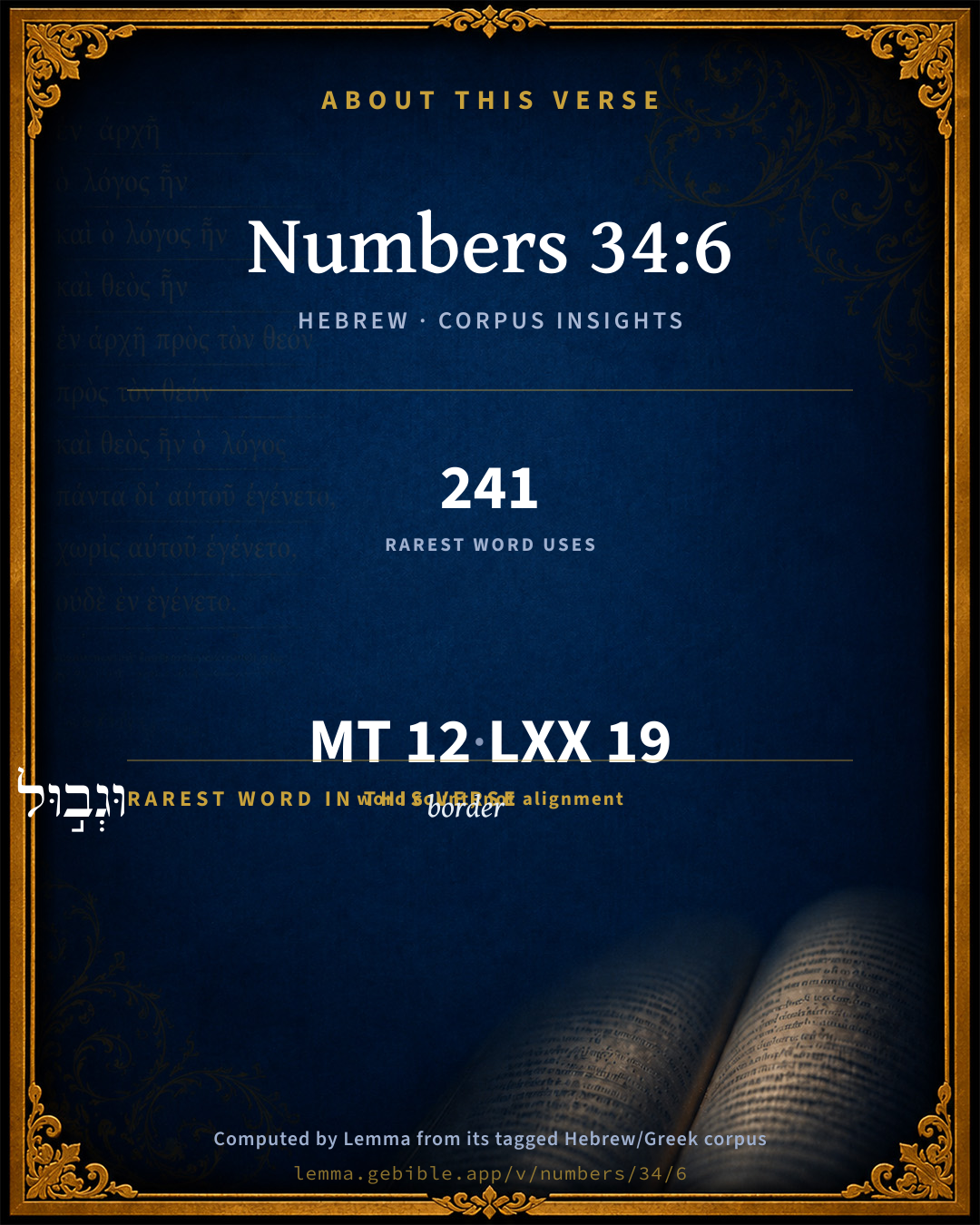
These counts appear in no published source. They are computed here, from the morphology-tagged text and Lemma’s own curated glosses. What Lemma adds →

12
words
5
distinct lemmas
Pentateuch
section

Grammatical profile

  • 2 verbs
  • 6 nouns
  • 1 adjective
  • 1 pronoun
  • 2 prepositions

Verb forms

  • וְהָיָ֥ה Qal · Sequential Perfect
  • יִהְיֶ֥ה Qal · Imperfect

Repetition

Words recur within this verse — often emphatic in Hebrew:

  • וּגְב֣וּל border H1366 ×3
  • יָ֔ם sea H3220 ×3
  • וְהָיָ֥ה to be H1961 ×2

Hebrew & Septuagint length

In English translation the verse runs 21 words from the Hebrew and 26 from the Septuagint (LXX English) — closely comparable.

A rough comparison of the two English renderings, which tokenize alike — not a word-level alignment.

Word counts can differ between the Hebrew and the Greek without any difference in meaning — e.g. the Hebrew direct-object marker אֵת has no separate Greek word, and Greek often adds the article ὁ.

In the original languages it is 12 Hebrew tokens and 19 Greek tokens — but the two are counted differently (Hebrew bundles its prefixes and suffixes into one token; the Greek is in lemma form), so that isn’t a like-for-like length.

Cross-references

8

Topical passages linked to Numbers 34:6 in the Treasury of Scripture Knowledge — connected by theme and wording, ordered by reader-vote popularity; previews shown in the World English Bible.

  • Joshua 1:4 From the wilderness, and this Lebanon, even to the great river, the river Euphrates, all the land of the Hittites, and to the great sea toward the going down of the sun, shall be your border.
  • Joshua 9:1 It happened, when all the kings who were beyond the Jordan, in the hill-country, and in the lowland, and on all the shore of the great sea in front of Lebanon, the Hittite, and the Amorite, the Canaanite, the Perizzite, the Hivite, and the Jebusite, heard of it;
  • Joshua 15:12 The west border was to the great sea, and the border [of it]. This is the border of the children of Judah round about according to their families.
  • Joshua 15:47 Ashdod, its towns and its villages; Gaza, its towns and its villages; to the brook of Egypt, and the great sea, and the border [of it].
  • Joshua 23:4 Behold, I have allotted to you these nations that remain, to be an inheritance for your tribes, from the Jordan, with all the nations that I have cut off, even to the great sea toward the going down of the sun.
  • Ezekiel 47:10 It shall happen, that fishermen shall stand by it: from En Gedi even to En Eglaim shall be a place for the spreading of nets; their fish shall be after their kinds, as the fish of the great sea, exceeding many.
  • Ezekiel 47:15 This shall be the border of the land: On the north side, from the great sea, by the way of Hethlon, to the entrance of Zedad;
  • Ezekiel 47:20 The west side shall be the great sea, from the [south] border as far as over against the entrance of Hamath. This is the west side.

Cross-references courtesy of OpenBible.info (CC BY 4.0).

Hebrew and Greek witnesses Masoretic Hebrew ↔ Greek Septuagint

The same verse in the two great witnesses to the Old Testament, shown verse-for-verse.

These are two independent witnesses, not word-aligned to each other, and the Septuagint is shown in lemma (dictionary) form.

Hebrew Numbers 34:6 Masoretic · Westminster Leningrad Codex

וּגְב֣וּל יָ֔ם וְהָיָ֥ה לָכֶ֛ם הַיָּ֥ם הַגָּד֖וֹל וּגְב֑וּל זֶֽה יִהְיֶ֥ה לָכֶ֖ם גְּב֥וּל יָֽם

For the western border, you shall have the great sea and the border [of it]: this shall be your west border.

World English Bible · Public Domain

Greek LXX Numbers 34:6 Septuagint · lemma form

καί ὁ ὅριον ὁ θάλασσα εἰμί σύ ὁ θάλασσα ὁ μέγας ὁρίζω οὗτος εἰμί σύ ὁ ὅριον ὁ θάλασσα

And you⌃ shall have your border on the west, the great sea shall be the boundary: this shall be to you the border on the west.

LXX2012 (modern English Septuagint) · Public Domain

Hebrew: Westminster Leningrad Codex (CC BY 4.0). Greek: Septuagint (public domain); English from LXX2012 (modern English Septuagint) (Public Domain). How the Septuagint differs from the Hebrew →

Targum (Aramaic paraphrase)

2

The Targum is the ancient Jewish Aramaic paraphrase of the Hebrew Scriptures — an interpretive translation, not the Hebrew text itself. Onkelos (literal) and Pseudo-Jonathan (expansive) render the Torah, and Jonathan the Prophets. Coverage is partial: where no permissively-licensed English translation exists for a verse, only the Aramaic is shown. This is verse-level text, not a word-by-word alignment to the Hebrew.

  1. Targum Onkelos Torah (Genesis–Deuteronomy)
    וּתְחוּם מַעַרְבָא וִיהֵי לְכוֹן יַמָא רַבָּא וּתְחוּמֵהּ דֵין יְהֵא לְכוֹן תְּחוּם מַעֲרְבָא

    (no public-domain English translation for this verse)

    Targum Onkelos — Aramaic: “Onkelos Genesis” (public domain); “Onkelos Exodus” (public domain); “Onkelos Leviticus” (public domain); “Onkelos Numbers” (public domain); “Onkelos Deuteronomy” (public domain). English: “Sefaria Community Translation” (CC0 1.0 (public-domain dedication)); “J.W. Etheridge. The Targums of Onkelos and Jonathan Ben Uzziel on the Pentateuch. London: Longmans, Green, 1862” (public domain). Text via Sefaria.

  2. Targum Pseudo-Jonathan Torah (Genesis–Deuteronomy)
    וּתְחוּם מַעֲרָבָא וְיֶהֱוֵי לְכוֹן יַמָא רַבָּא אוֹקְיָינוּס וּתְחוּמֵיהּ הִינוּן מֵי בְּרֵאשִׁית עִם מַיָא קַדְמָאִין דְהַווֹן בְּגַוֵיהּ אַבִּירוֹי וּפַרְכִּידוֹי כִּרְכוֹי וּמַדִנְתֵּיהּ נִיסוֹי וּמְחוּזוֹי סְפִינְתֵּיהּ וְאַלְגַוְתֵּיהּ דֵין יֶהֱוֵי לְכוֹן תְּחוּם מַעַרְבַיָא

    And for the western border you shall have the Great Ocean Sea; its limits are the waters of the beginning with the waters of old which are in its depth; its capes and havens, its creeks and its cities, its islands and ports, its ships and its recesses: this shall be your border westward.

    Targum Pseudo-Jonathan — Aramaic: “Targum Jonathan on Genesis” (public domain); “Targum Jonathan on Exodus” (public domain); “Targum Jonathan on Leviticus” (public domain); “Targum Jonathan on Numbers” (public domain); “Targum Jonathan on Deuteronomy” (public domain). English: “The Targum of Jonathan ben Uzziel, trans. J. W. Etheridge, London, 1862” (public domain). Text via Sefaria.

Commentary

Notes on Numbers 34:6 from classic Christian and Jewish commentators (each source and its license shown beneath its notes). The classic Christian expositions comment on the surrounding passage and are grouped to its opening verse, so a note may address several verses; the Jewish commentaries on the Tanakh (Rashi and others) are per-verse, so they appear only where the commentator wrote on this verse.

Lemma curates 59 commentaries, every one of them public domain or Creative Commons licensed, each selected and text-cleaned for this edition rather than reprinted as found. About our sources →

Trapp's Complete Commentary

John Trapp

Num 34:6 And [as for] the western border, ye shall even have the great sea for a border: this shall be your west border.

Ver. 6. The great sea.] Commonly called the Mediterranean Sea, betwixt which and the Jews lay the Philistines; as now betwixt the Church and the Turk lies the Pope and his followers, Italy being the mark that the Turk shoots at. Lo, a sweet providence of God!

John Trapp, A Commentary or Exposition upon All the Books of the Old and New Testament (1647–1656) — public domain. Text from a community e-Sword module.

Tyndale Open Study Notes

Tyndale Open Resources

34:6-9 The natural western boundary of Canaan was the Mediterranean coast (34:6). The northern boundary began at the Mediterranean and ran eastward to Mount Hor somewhere in the Lebanon range (not the place of Aaron’s death, 20:22-29). • Lebo-hamath: Cp. 13:21; 1 Kgs 8:65; Amos 6:14.

Tyndale Open Study Notes — © Tyndale Open Resources, licensed CC BY-SA 4.0. Text via the HelloAO Bible API.

Geneva Bible (1599)

Geneva Bible translators

Which is called Mediterranean.

Geneva Bible (1599) marginal notes — public domain. Text via Bolls.life.

Jamieson, Fausset & Brown

Robert Jamieson, A. R. Fausset & David Brown

the western border--There is no uncertainty about this boundary, as it is universally allowed to be the Mediterranean, which is called "the great sea" in comparison with the small inland seas or lakes known to the Hebrews.

Jamieson, Fausset & Brown — Commentary Critical and Explanatory on the Whole Bible (1871) — public domain (CC PDM 1.0). Text via the HelloAO Bible API.

Adam Clarke's Commentary

Verse 6. Ye shall even have the great sea for a border] The Mediterranean Sea, called here the Great Sea, to distinguish it from the Dead Sea, the Sea of Tiberias, &c., which were only a sort of lakes. In Hebrew there is properly but one term, ים yam, which is applied to all collections of water apparently stagnant, and which is generally translated sea. The Greek of the New Testament follows the Hebrew, and employs, in general, the word θαλασσα, SEA, whether it speaks of the Mediterranean, or of the sea or lake of Galilee.

Adam Clarke's Commentary on the Bible (1810–1826) — public domain. Text from a community e-Sword/MySword module.

Ellicott's Commentary for English Readers

(6) And as for the western border . . . —Better, And as for the western border, ye shall have the great sea and (its) border (i.e., its coast). (See Jos_15:47. “the great sea and the border thereof.”)

A Bible Commentary for English Readers, edited by Charles John Ellicott (1878–1897) — public domain. Text from a community e-Sword module.

The Cambridge Bible for Schools and Colleges

gen. ed. J. J. S. Perowne

6. and the border thereof] These words should be omitted. The word וּגְבוּל (ûgebhûl ‘and a border’) may have been accidentally added as a doublet of the preceding חַגָּדוֹל (haggâdhôl ‘the great’), which it somewhat resembles.

The Cambridge Bible for Schools and Colleges (gen. ed. J. J. S. Perowne; Cambridge University Press, 1878–1918) — public domain. Text from a community e-Sword module.

John Gill's Exposition

And as for the western border,.... Of the land of Canaan:

you shall even have the great sea for a border; and no other, meaning the Mediterranean sea, which lies west of the land of Judea; Aben Ezra calls it the Spanish sea: it has the name of "great", in comparison of some in the land of Canaan, as the salt sea, and the sea of Tiberias:

this shall be your west border; namely, the Mediterranean sea.

John Gill's Exposition of the Whole Bible (1746–1763) — public domain (CC PDM 1.0). Text via the HelloAO Bible API.

Haydock's Catholic Bible Commentary

Great sea, compared with those of Palestine, which were only like pools or lakes. The Hebrews call every great collection of water, a sea. The Mediterranean bounded the promised land entirely, on the west.

George Leo Haydock (1774–1849), Haydock's Catholic Family Bible and Commentary, 1859 edition — public domain. Excludes Psalms (Douay-Rheims chapter numbering differs from Protestant) and Deuterocanonical books (Catholic canon only).

Matthew Poole's English Annotations

The great sea; the midland sea from the south to the north so far as runs parallel with Mount Libanus.

Matthew Poole's English Annotations on the Holy Bible (1683–1685) — public domain. Text from a community e-Sword/MySword module.

The Pulpit Commentary

And as for the western border. The Hebrew word for "west" ( is simply that for "sea," because the Jews in their own land always had the sea on their west. Thus the verse reads literally, "And the sea boundary shall be to you the great sea and boundary; this shall be to you the sea boundary." It would seem very unlikely that the Jews familiarly used the word "yam for "west" after a residence of several centuries in a country where the sun set not over the sea, but over the desert. Nothing can of course be proved kern the use of the word here, but it cannot be overlooked as one small indication that the language of this passage at any rate is the language of an age subsequent to the conquest of Canaan (see Exo_10:19 Exo_26:22, and on Num_2:18) The line of coast from the brook of Egypt to the Leontes was upwards of 160 miles in length.

The Pulpit Commentary (1880–1919), ed. H.D.M. Spence-Jones & Joseph S. Exell — public domain. Text from a community e-Sword module.

John Wesley's Explanatory Notes

The great sea - This midland sea from the south to the north, so far as it runs parallel with mount Libanus.

John Wesley, Explanatory Notes Upon the Whole Bible (1754–1765) — public domain. Text via the GEBible commentary corpus.

Keil & Delitzsch

C. F. Keil & F. Delitzsch

The western boundary was to be "the great sea and its territory," i.e., the Mediterranean Sea with its territory or coast (cf. Deu 3:16-17; Jos 13:23, Jos 13:27; Jos 15:47).

Keil & Delitzsch — Biblical Commentary on the Old Testament (1861–1891) — public domain (CC PDM 1.0). Text via the HelloAO Bible API. (Old Testament only.)

unfoldingWord translationNotes

Door43 World Missions Community

General Information:

Yahweh continues telling Moses where the borders are for the land that he is giving to the Israelites.

translationWords

the sea

unfoldingWord translationNotes — © Distant Shores Media and the Door43 World Missions Community, licensed CC BY-SA 4.0. Source: git.door43.org/Door43/en_tn.

Rashi

Rabbi Shlomo Yitzchaki (Rashi)

ים וגבול These words (apparently unconnected with what follows) mean: AND THE WESTERN BOUNDARY, what forms that?

והיה לכם הים הגדול THE GREAT SEA SHALL BE UNTO YOU for the boundary.

וגבול AND THE BOUNDARY — the נסין which are in the sea also belong to the boundary; they are what are called isles in O. F. (Gittin 8a).

Rashi on the Tanakh — English translations: “The Judaica Press complete Tanach with Rashi, translated by A. J. Rosenberg” (CC BY 4.0); “Pentateuch with Rashi's commentary by M. Rosenbaum and A.M. Silbermann, 1929-1934” (public domain); “The Metsudah Tanach series, Lakewood, N.J” (CC BY 4.0); and “The Book of Joshua, Metsudah Publications, 1997” (CC BY 4.0). Text via Sefaria.

Lesson kit

Teaching starters — assembled from the data on this page, not authored interpretation. Every prompt links to the verse data it draws on. Edit before teaching.

Numbers, in the Pentateuch, opens this verse with 12 words (5 distinct Hebrew lemmas). Its most distinctive word is gᵉbûwl (“border”). A historical commentator’s framing appears above. Read the whole chapter for the surrounding context.

Discussion questions

  1. What does “border” (gᵉbûwl) contribute to the verse as a whole?
  2. How does Joshua 1:4, which shares this passage’s theme, read alongside this verse?
  3. What does the repetition of “border” (3× in this one verse) do in this verse?
  4. The translations on this page render this verse differently — a whole-verse word diff, not a word-by-word alignment. What might account for the different wordings?
  5. «וְהָיָ֥ה» is a Qal Sequential Perfect verb. How does that grammatical form shape the action described?
  6. Compare how Trapp's Complete Commentary and Tyndale Open Study Notes read this verse. Where do they agree or differ?

Things to notice

Reading settings

Reading text

Shown beneath each verse's original-language words.

Old Testament
Old Testament edition

Read the OT as the Masoretic Hebrew (MT) or the Greek Septuagint (LXX).

English shown for the Greek Septuagint (in the Hebrew ↔ Greek comparison).

Comparing translations? Open the Compare panel on any verse page to stack up to four side by side.