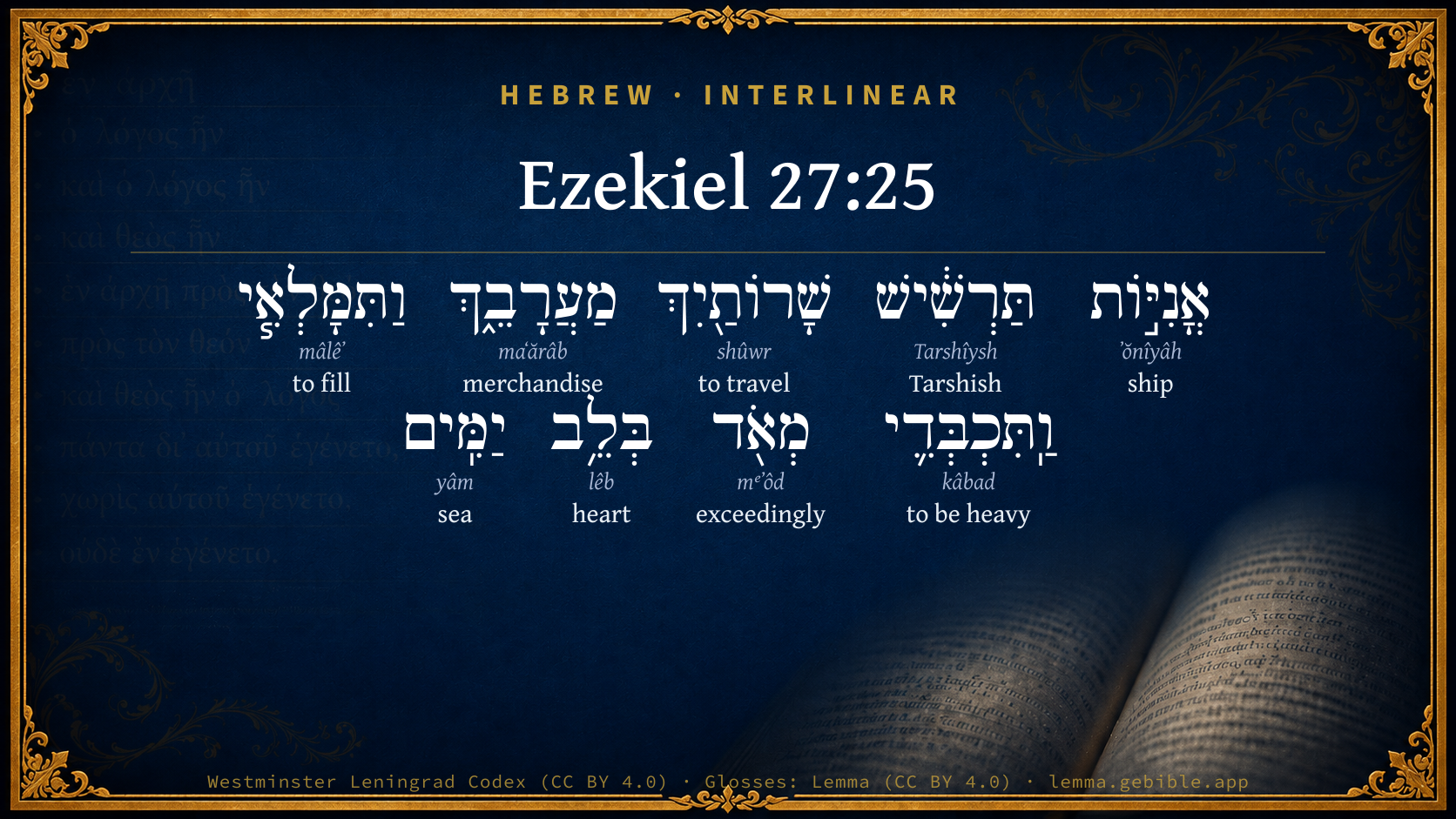
Ezekiel 27:25

Hebrew (Westminster Leningrad Codex) Ezekiel 27:25 appears in the Hebrew Old Testament. The text above is from the Westminster Leningrad Codex. Each word links to its Strong’s number, a concise gloss, and parsing drawn from the Open Scriptures Hebrew Bible morphology. Click any word for its full Brown-Driver-Briggs (BDB) entry.
Download image
Cite this verse

Ezekiel 27:25 (World English Bible). Public Domain. Lemma interlinear Bible study tool, https://lemma.gebible.app/v/ezekiel/27/25.

Show BibTeX & RIS
BibTeX
RIS
English Translation
The ships of Tarshish were your caravans for your merchandise: and you were replenished, and made very glorious in the heart of the seas.
World English Bible · Public Domain
Download a study sheet

One document with this verse’s original text, its word-by-word gloss line, the meaning frame, cross-references with their text, attributed commentary, and full source and license credits — printable, and it pastes into notes with its structure intact.

This verse Autodidact and up

Study sheet (.html) Plain text (.txt)

A passage Seminary Student

Up to 50 verses in one chapter. A passage sheet keeps up to 6 commentary sources and 12 cross-references per verse, in the order this page ranks them, and says so on the sheet whenever that leaves anything out. Ask for a single verse and you get the Autodidact verse sheet above.

Everything on this page stays free to read, with no account — the sheet is a download of what is already on screen, not access to it.

Want to remove ads? Support Godless Engineer
Compare translations 3

The same verse in 3 English versions, stacked beneath the original-language interlinear above. Click any original word for its lexicon entry.

Each is an independent rendering of the whole verse — the interlinear is not word-aligned to these translations.

Highlighted words mark where these versions differ — a whole-verse word diff, not a word-by-word alignment.

  • World English Bible Public Domain
    The ships of Tarshish were your caravans for your merchandise: and you were replenished, and made very glorious in the heart of the seas.
  • King James Version Public Domain
    The ships of Tarshish did sing of thee in thy market: and thou wast replenished, and made very glorious in the midst of the seas.
  • unfoldingWord Literal Text CC BY-SA 4.0
    The ships of Tarshish were the transporters of your merchandise! So you were filled up, heavily laden with cargo in the heart of the seas!

unfoldingWord Literal Text — © unfoldingWord, licensed CC BY-SA 4.0. Word-aligned USFM3 via Door43 (git.door43.org/unfoldingWord/en_ult).

Versions to compare (up to 4)

3 of 4 selected

Show all 18 translations

Every available English version of this verse, each an independent rendering of the whole verse.

  • World English Bible Public Domain
    The ships of Tarshish were your caravans for your merchandise: and you were replenished, and made very glorious in the heart of the seas.
  • Berean Standard Bible Public Domain
    The ships of Tarshish carried your merchandise. And you were filled with heavy cargo in the heart of the sea.
  • Majority Standard Bible Public Domain
    The ships of Tarshish carried your merchandise. And you were filled with heavy cargo in the heart of the sea.
  • King James Version Public Domain
    The ships of Tarshish did sing of thee in thy market: and thou wast replenished, and made very glorious in the midst of the seas.
  • American Standard Version (1901) Public Domain
    The ships of Tarshish were thy caravans for thy merchandise: and thou wast replenished, and made very glorious in the heart of the seas.
  • Revised Version (1885) Public Domain
    The ships of Tarshish were thy caravans for thy merchandise: and thou wast replenished, and made very glorious in the heart of the seas.
  • Geneva Bible (1599) Public Domain
    The shippes of Tarshish were thy chiefe in thy marchandise, and thou wast replenished and made very glorious in the middes of the sea.
  • Douay-Rheims (1899) Public Domain
    The ships of the sea, were thy chief in thy merchandise: and thou wast replenished, and glorified exceedingly in the heart of the sea.
  • Young's Literal Translation Public Domain
    Ships of Tarshish `are' thy double walls of thy merchandise, And thou art filled and honoured greatly, In the heart of the seas.
  • Literal Standard Version CC BY-SA 4.0
    Ships of Tarshish are journeying [with] your merchandise for you, || And you are filled and honored greatly, || In the heart of the seas.
  • Unlocked Literal Bible CC BY-SA 4.0
    The ships of Tarshish were the transporters of your merchandise! So you were filled up, heavily laden with cargo in the heart of the seas!
  • unfoldingWord Literal Text CC BY-SA 4.0
    The ships of Tarshish were the transporters of your merchandise! So you were filled up, heavily laden with cargo in the heart of the seas!
  • Darby Bible Public Domain
    The ships of Tarshish were thy caravans for thy traffic; and thou wast replenished, and highly honoured, in the heart of the seas.
  • World Messianic Bible Public Domain
    “‘“The ships of Tarshish were your caravans for your merchandise. You were replenished and made very glorious in the heart of the seas.
  • Webster's Bible Public Domain
    The ships of Tarshish did sing of thee in thy market; and thou wast replenished, and made very glorious in the midst of the seas.
  • Free Bible Version CC BY-SA 4.0
    Trade ships from Tarshish transported your goods. You were like a ship sailing the sea, filled with heavy cargo.
  • Bible in Basic English Public Domain
    Tarshish ships did business for you in your goods: and you were made full, and great was your glory in the heart of the seas.
  • JPS Tanakh (1917) Public Domain
    The ships of Tarshish brought thee tribute for thy merchandise; so wast thou replenished, and made very heavy in the heart of the seas.

Literal Standard Version (2020), Covenant Press — licensed CC BY-SA 4.0. Text via the HelloAO Bible API (eBible.org). Unlocked Literal Bible (unfoldingWord) — licensed CC BY-SA 4.0. Text via the HelloAO Bible API (eBible.org). unfoldingWord Literal Text — © unfoldingWord, licensed CC BY-SA 4.0. Word-aligned USFM3 via Door43 (git.door43.org/unfoldingWord/en_ult). Free Bible Version, Dr. Jonathan Gallagher — licensed CC BY-SA 4.0. Text via the HelloAO Bible API (eBible.org).

Word by word

More ways to search: Search by grammar → Find every occurrence → Compare this word →

Practice this passage: Drill this verse → Learn its vocabulary →

שָׁרוֹתַ֖יִךְ
shûwr
H7788
“traveling · you”
Verb, Qal, Participle Active, Feminine, Plural, Construct + Suffix, Personal, 2nd Person, Feminine, Singular
Part of Speech
Verb
Stem
Qal
Form
Participle Active
Gender
Feminine
Number
Plural
State
Construct
Full BDB Definition

Origin: a primitive root

TWOT: 2353

(Qal) to travel, journey, go - traveller (participle) - (BDB) meaning dubious
  1. אֳנִיּ֣וֹת ʼŏnîyâh H591 “ships of” Noun, Common, Feminine, Plural, Construct
  2. תַּרְשִׁ֔ישׁ Tarshîysh H8659 “Tarshish” Noun, Proper
  3. מַעֲרָבֵ֑ךְ maʻărâb H4627 “merchandise · your” Noun, Common, Masculine, Singular, Construct + Suffix, Personal, 2nd Person, Feminine, Singular
  4. וַתִּמָּלְאִ֧י mâlêʼ H4390 “and · to fill” Conjunction + Verb, Niphal, Sequential Imperfect, 2nd Person, Feminine, Singular
  5. וַֽתִּכְבְּדִ֛י kâbad H3513 “and · to be heavy” Conjunction + Verb, Qal, Sequential Imperfect, 2nd Person, Feminine, Singular
  6. מְאֹ֖ד mᵉʼôd H3966 “exceedingly” Adverb
  7. בְּלֵ֥ב lêb H3820 “in/at · heart of” Preposition + Noun, Common, Masculine, Singular, Construct
  8. יַמִּֽים yâm H3220 “seas” Noun, Common, Masculine, Plural, Absolute

About this verse

These counts appear in no published source. They are computed here, from the morphology-tagged text and Lemma’s own curated glosses. What Lemma adds →

9
words
9
distinct lemmas
Prophets
section

Notable vocabulary

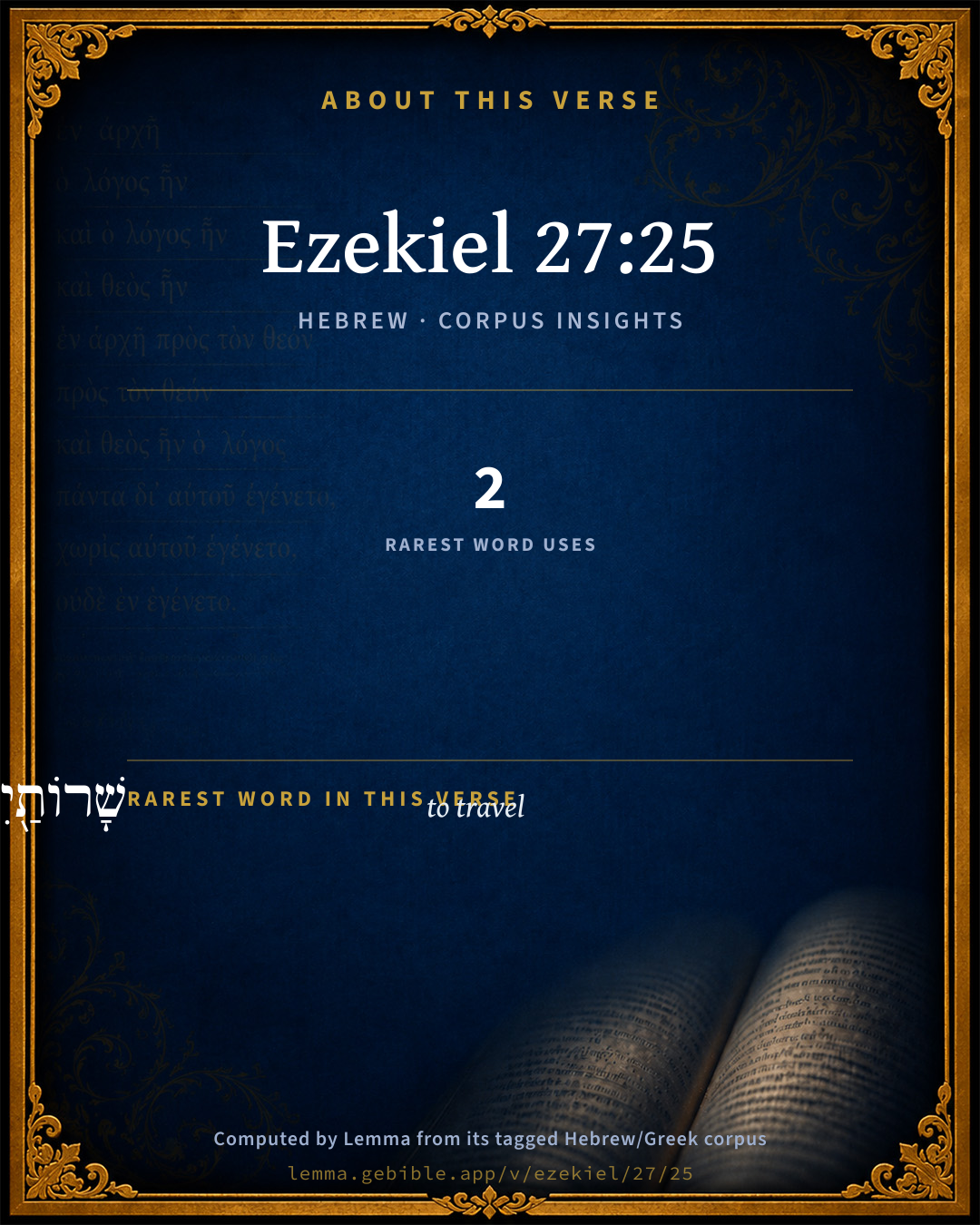
The rarest word here is שָׁרוֹתַ֖יִךְ to travel H7788 — appearing just 2 times in the whole Hebrew Bible.

Shared distinctive vocabulary

שָׁרוֹתַ֖יִךְ to travel H7788 occurs in 2 verses of the Hebrew Bible. Also found in:

Grammatical profile

  • 3 verbs
  • 5 nouns
  • 1 adverb

Verb forms

  • שָׁרוֹתַ֖יִךְ Qal · Participle Active
  • וַתִּמָּלְאִ֧י Niphal · Sequential Imperfect
  • וַֽתִּכְבְּדִ֛י Qal · Sequential Imperfect

Hebrew & Septuagint length

In English translation the verse runs 24 words from the Hebrew and 24 from the Septuagint (LXX English) — the same length.

A rough comparison of the two English renderings, which tokenize alike — not a word-level alignment.

Word counts can differ between the Hebrew and the Greek without any difference in meaning — e.g. the Hebrew direct-object marker אֵת has no separate Greek word, and Greek often adds the article ὁ.

Cross-references

5

Topical passages linked to Ezekiel 27:25 in the Treasury of Scripture Knowledge — connected by theme and wording, ordered by reader-vote popularity; previews shown in the World English Bible.

  • Isaiah 2:16 For all the ships of Tarshish, And for all pleasant imagery.
  • Psalms 48:7 With the east wind, you break the ships of Tarshish.
  • Isaiah 23:14 Howl, you ships of Tarshish; for your stronghold is laid waste.
  • 1 Kings 10:22 For the king had at sea a navy of Tarshish with the navy of Hiram: once every three years came the navy of Tarshish, bringing gold, and silver, ivory, and apes, and peacocks.
  • Isaiah 60:9 Surely the isles shall wait for me, and the ships of Tarshish first, to bring your sons from far, their silver and their gold with them, for the name of Yahweh your God, and for the Holy One of Israel, because he has glorified you.

Cross-references courtesy of OpenBible.info (CC BY 4.0).

Hebrew and Greek witnesses Masoretic Hebrew ↔ Greek Septuagint

The same verse in the two great witnesses to the Old Testament, shown verse-for-verse.

These are two independent witnesses, not word-aligned to each other, and the Septuagint is shown in lemma (dictionary) form.

Hebrew Ezekiel 27:25 Masoretic · Westminster Leningrad Codex

אֳנִיּ֣וֹת תַּרְשִׁ֔ישׁ שָׁרוֹתַ֖יִךְ מַעֲרָבֵ֑ךְ וַתִּמָּלְאִ֧י וַֽתִּכְבְּדִ֛י מְאֹ֖ד בְּלֵ֥ב יַמִּֽים

The ships of Tarshish were your caravans for your merchandise: and you were replenished, and made very glorious in the heart of the seas.

World English Bible · Public Domain

Greek LXX Ezekiel 27:25 Septuagint · lemma form

πλοῖον ἐν αὐτός καρχηδόνιοι ἔμπορος σύ ἐν ὁ πλῆθος ἐν ὁ συμμικτός σύ καί ἐνπίμπλημι καί βαρύνω σφόδρα ἐν καρδία θάλασσα

Ships were your merchants, in abundance, with your trading population: and you were filled and very heavily loaded in the heart of the sea.

LXX2012 (modern English Septuagint) · Public Domain

On this verse, Whedon's Commentary on the Bible discusses the Septuagint’s reading. Read the note in Commentary ↓

Hebrew: Westminster Leningrad Codex (CC BY 4.0). Greek: Septuagint (public domain); English from LXX2012 (modern English Septuagint) (Public Domain). How the Septuagint differs from the Hebrew →

Targum (Aramaic paraphrase)

1

The Targum is the ancient Jewish Aramaic paraphrase of the Hebrew Scriptures — an interpretive translation, not the Hebrew text itself. Onkelos (literal) and Pseudo-Jonathan (expansive) render the Torah, and Jonathan the Prophets. Coverage is partial: where no permissively-licensed English translation exists for a verse, only the Aramaic is shown. This is verse-level text, not a word-by-word alignment to the Hebrew.

  1. Targum Jonathan Prophets (Joshua–Malachi)
    בִּסְפִינֵי יַמָא הֲווֹ שַׁיְטִין וּמַיְתָן סְחוֹרָא לְגַוִיךְ וַעֲתַרְתְּ וּתְקֵיפְתְּ לַחֲדָא בְּגוֹ יַמַיָא:

    (no public-domain English translation for this verse)

    Targum Jonathan — Aramaic: “Mikraot Gedolot” (public domain). English: “Sefaria Community Translation” (CC0 1.0 (public-domain dedication)); “London "Chaldee Paraphrase," 1871” (public domain). Text via Sefaria.

Commentary

Notes on Ezekiel 27:25 from classic Christian and Jewish commentators (each source and its license shown beneath its notes). The classic Christian expositions comment on the surrounding passage and are grouped to its opening verse, so a note may address several verses; the Jewish commentaries on the Tanakh (Rashi and others) are per-verse, so they appear only where the commentator wrote on this verse.

Lemma curates 59 commentaries, every one of them public domain or Creative Commons licensed, each selected and text-cleaned for this edition rather than reprinted as found. About our sources →

Trapp's Complete Commentary

John Trapp

Eze 27:25 The ships of Tarshish did sing of thee in thy market: and thou wast replenished, and made very glorious in the midst of the seas.

Ver. 25. Thou wast replenished and made very glorious.] Or, Very heavy: {a} as a ship, though not top full, may yet have freight enough to sink it; so had this metaphorical ship Tyre enough to sink it, though not enough to satisfy it.

{a} Aggravata es.

John Trapp, A Commentary or Exposition upon All the Books of the Old and New Testament (1647–1656) — public domain. Text from a community e-Sword module.

Joseph Benson's Commentary

Eze 27:25. The ships of Tarshish did sing of thee, &c. — Ships of Tarshish signify sometimes in Scripture any trading or merchant ships; and in this general sense the expression seems to be used here: the prophet, having already reckoned up the principal countries which traded with Tyre, now adds, in comprehensive terms, that all merchants, or traders, sung or spake great things of her riches: see note on Isa 2:16. In the midst of the seas — Through all the islands of the sea, the sea-coasts, and from one part to another.

Joseph Benson's Commentary on the Old and New Testaments (1811–1818) — public domain. Text from a community e-Sword module.

Geneva Bible (1599)

Geneva Bible translators

Or, came in company toward thee.

Geneva Bible (1599) marginal notes — public domain. Text via Bolls.life.

Jamieson, Fausset & Brown

Robert Jamieson, A. R. Fausset & David Brown

sing of thee--personification; flay great merchant ships were palpable proofs of thy greatness. Others translate from a different Hebrew root, "were thy (mercantile) travellers." FAIRBAIRN translates, "Were thy walls." But the parallelism to "thou wast glorious" favors English Version, "sing of thee."

Jamieson, Fausset & Brown — Commentary Critical and Explanatory on the Whole Bible (1871) — public domain (CC PDM 1.0). Text via the HelloAO Bible API.

Adam Clarke's Commentary

Verse 25. The ships of Tarshish] The ships of Tharsis, in Cilicia, were the chief of those which traded with thee.

Adam Clarke's Commentary on the Bible (1810–1826) — public domain. Text from a community e-Sword/MySword module.

Ellicott's Commentary for English Readers

(25) Ships of Tarshish means simply, ships of the largest size, such as were fitted for the voyage to Tarshish: as we now say, “East Indiaman.” (Comp. 1Ki_22:48; Psa_48:7.) “Did sing of thee in thy market” is, literally, thy—, thy trade, the blank being an uncertain word, supposed by our translators to mean singers. Opinion is now divided as to whether the meaning is bulwarks or caravans; either gives a good sense. “Thy great ships were at once thy defence and the means of thy commerce,” or “were thy caravans of the sea, &c.” The former is preferable.

A Bible Commentary for English Readers, edited by Charles John Ellicott (1878–1897) — public domain. Text from a community e-Sword module.

The Cambridge Bible for Schools and Colleges

gen. ed. J. J. S. Perowne

25. The “ships of Tarshish” here are deep-sea ships, great ships trading to the most distant coasts, Isa_2:16; Psa_48:7.

did sing of thee] For this Ges. suggested “were thy caravans” from a verb signifying to travel (Isa_57:9). The camel has been called the ship of the desert, but conversely to call an east indiaman a caravan is too brilliant for the prophet. Probably by a slight change of reading: the ships of Tarshish did serve thee with (in) thy wares (Eze_27:13; Eze_27:17 &c.), cf. Isa_60:9-10, and above Eze_27:9. So Aquila (Field).

made very glorious] Rather: and wast heavily laden. The figure of a mistress served by all nations, who bring wares and riches to her from all lands, passes here again into the idea of the vessel deeply laden with cargo, and therefore more easily shipwrecked and broken in dangerous waters.

The Cambridge Bible for Schools and Colleges (gen. ed. J. J. S. Perowne; Cambridge University Press, 1878–1918) — public domain. Text from a community e-Sword module.

John Gill's Exposition

Thy rowers have brought thee into great waters,.... Here the city of Tyre is compared to a vessel at sea, with great propriety, it being built in the sea, and its trade chiefly there; and its rulers and governors, or the inhabitants of it, to rowers; literally the men of Zidon and Arvad were her rowers, Eze 27:8, the straits, difficulties, and distresses these brought Tyre into, are compared to great waters; who, by some unadvised step or another, provoked the king of Babylon to come against them with his army, and lay siege unto them:

the east wind hath broken thee in the midst of the seas; a wind very fatal to ships and mariners; see Psa 48:7, by it are meant Nebuchadnezzar and the Chaldean army; so called, because of their great force and fury; and because Babylon, from whence they came, lay somewhat to the east of Tyre. So the Targum,

"a king who is strong as the east wind hath broken thee in the midst of the seas.''

John Gill's Exposition of the Whole Bible (1746–1763) — public domain (CC PDM 1.0). Text via the HelloAO Bible API.

Albert Barnes' Notes on the Bible

Did sing of thee - Or, were thy bulwarks, i. e., bulwarks of thy traffic. Others render it: “were thy caravans,” thy merchandise.

Albert Barnes' Notes on the Bible (1834–1885) — public domain. Text from a community e-Sword/MySword module.

Haydock's Catholic Bible Commentary

Sea. Hebrew Tharsis, in Cilicia; or large, and fit for long voyages. Thine were the best. (Calmet)

George Leo Haydock (1774–1849), Haydock's Catholic Family Bible and Commentary, 1859 edition — public domain. Excludes Psalms (Douay-Rheims chapter numbering differs from Protestant) and Deuterocanonical books (Catholic canon only).

Matthew Poole's English Annotations

Ships of Tarshish; the ships from all parts of the sea, which came to thee, and traded with thee, praised thee, boasted of thee.

Did sing of thee; had their songs of praise, which were made to commend thy state.

In thy market; as mariners, in the ports where they arrive, usually do with mirth and songs entertain one another, so at Tyre.

Thou wast replenished; all trading came to thee, none like thee in thy warehouses or public stores.

Made very glorious; and, to do thee right, thou wert very glorious, magnificent, and beautiful, none like thee. Hitherto the prophet hath recounted Tyre’s greatness, now cometh her fall, foretold as if already come.

Matthew Poole's English Annotations on the Holy Bible (1683–1685) — public domain. Text from a community e-Sword/MySword module.

Whedon's Commentary on the Bible

Daniel D. Whedon

25. Ships of Tarshish — See note Eze_27:12.

Did sing of thee — Several versions have “served thee.” R.V., “were thy caravans.”

Glorious — LXX., heavy. The ship Tyre was laden to the water’s edge with treasure.

Daniel D. Whedon (gen. ed.), Commentary on the Old and New Testaments (1874–1909) — public domain. Text from a community e-Sword module.

The Pulpit Commentary

The verse beaus a new section, and glides back into the original metaphor of the ship, as in Vers. 4-9. The ships of Tarshish are used generically for merchant-ships. The catalogue of the commerce ends with Ver. 24, and the more poetic imagery reappears. It was, as centering in herself all that they brought to her that the merchant-city was very glorious in the midst of the waters. For sing of thee, read, the ships of Tarshish were thy caravans (Revised Version). The word has also the sense of "wall," as in Jer_5:10 and Job_24:11; and this, describing the ships as the "wooden wails" of Tyre, gives a tenable sense here.

The Pulpit Commentary (1880–1919), ed. H.D.M. Spence-Jones & Joseph S. Exell — public domain. Text from a community e-Sword module.

John Wesley's Explanatory Notes

The ships - The ships from all parts of the sea. Did sing - Had their songs to commend thy state.

John Wesley, Explanatory Notes Upon the Whole Bible (1754–1765) — public domain. Text via the GEBible commentary corpus.

Rashi

Rabbi Shlomo Yitzchaki (Rashi)

Ships...your plains [Heb. שָּׁרוֹתַיִךּ.] They were to you as a plain and a flat terrain. Just as the flat terrain is a paved road, upon which to bring merchandise to a city situated on dry land, the ships of Tarshish were for you instead of them (sic) as a highway for bringing your merchandise into your midst.

your plains [Heb. שָּׁרוֹתַיִךּ,] an expression for Sharon and flat terrain. A similar instance is (Jer. 5:10): “Ascend upon its rows בְּשָׁרוֹתֶיהָ.”

and you were filled and you became very heavy They brought a great burden into your midst and made your load too heavy.

Rashi on the Tanakh — English translations: “The Judaica Press complete Tanach with Rashi, translated by A. J. Rosenberg” (CC BY 4.0); “Pentateuch with Rashi's commentary by M. Rosenbaum and A.M. Silbermann, 1929-1934” (public domain); “The Metsudah Tanach series, Lakewood, N.J” (CC BY 4.0); and “The Book of Joshua, Metsudah Publications, 1997” (CC BY 4.0). Text via Sefaria.

Lesson kit

Teaching starters — assembled from the data on this page, not authored interpretation. Every prompt links to the verse data it draws on. Edit before teaching.

Ezekiel, in the Prophets, opens this verse with 9 words (9 distinct Hebrew lemmas). Its most distinctive word is shûwr (“to travel”). A historical commentator’s framing appears above. Read the whole chapter for the surrounding context.

Discussion questions

  1. The word shûwr carries the sense “to travel.” How does it shape the verse?
  2. How does Isaiah 57:9, which shares the word «to travel», read alongside this verse?
  3. These translations render this verse differently. What is at stake in choosing one wording over another?
  4. «שָׁרוֹתַ֖יִךְ» is a Qal Participle Active verb. How does that grammatical form shape the action described?
  5. Compare how Trapp's Complete Commentary and Joseph Benson's Commentary read this verse. Where do they agree or differ?

Things to notice

Reading settings

Reading text

Shown beneath each verse's original-language words.

Old Testament
Old Testament edition

Read the OT as the Masoretic Hebrew (MT) or the Greek Septuagint (LXX).

English shown for the Greek Septuagint (in the Hebrew ↔ Greek comparison).

Comparing translations? Open the Compare panel on any verse page to stack up to four side by side.