
2 Chronicles 4:6

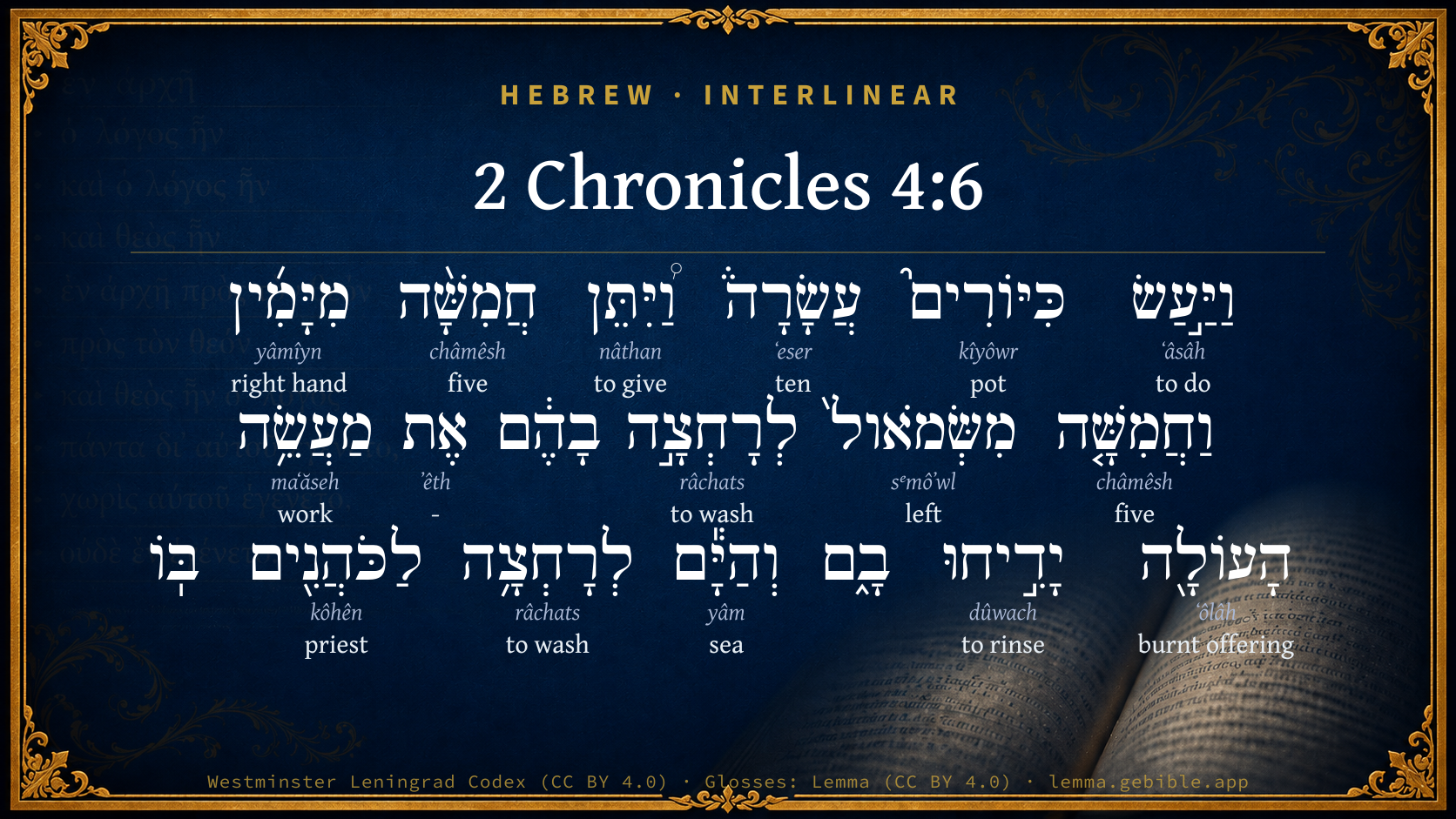
Hebrew (Westminster Leningrad Codex) 2 Chronicles 4:6 appears in the Hebrew Old Testament. The text above is from the Westminster Leningrad Codex. Each word links to its Strong’s number, a concise gloss, and parsing drawn from the Open Scriptures Hebrew Bible morphology. Click any word for its full Brown-Driver-Briggs (BDB) entry.
Download image
Cite this verse

2 Chronicles 4:6 (World English Bible). Public Domain. Lemma interlinear Bible study tool, https://lemma.gebible.app/v/2-chronicles/4/6.

Show BibTeX & RIS
BibTeX
RIS
English Translation
He made also ten basins, and put five on the right hand, and five on the left, to wash in them; such things as belonged to the burnt-offering they washed in them; but the sea was for the priests to wash in.
World English Bible · Public Domain
Highlights
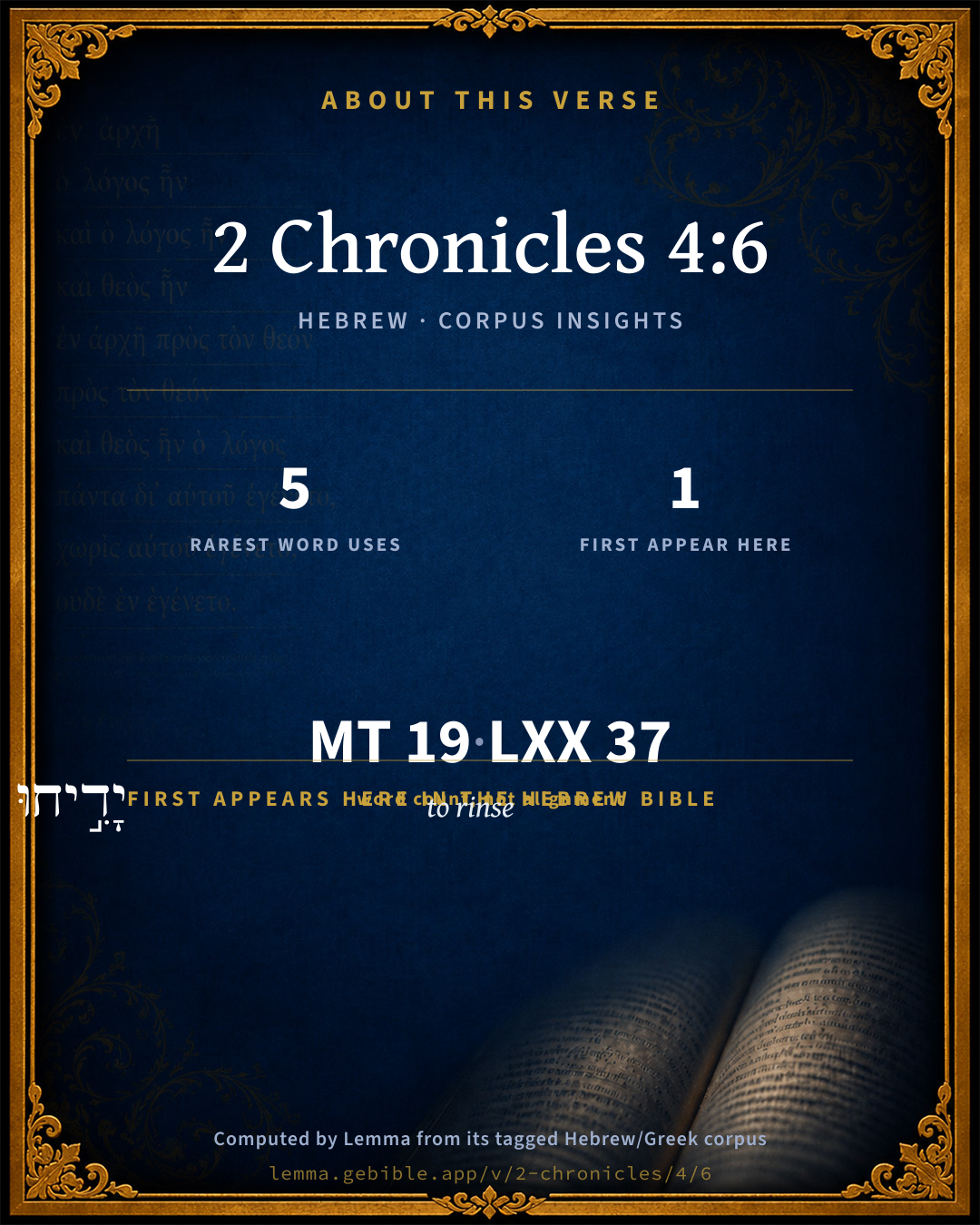
  • 1 first appearance in the Hebrew Bible
Full analysis ↓
Download a study sheet

One document with this verse’s original text, its word-by-word gloss line, the meaning frame, cross-references with their text, attributed commentary, and full source and license credits — printable, and it pastes into notes with its structure intact.

This verse Autodidact and up

Study sheet (.html) Plain text (.txt)

A passage Seminary Student

Up to 50 verses in one chapter. A passage sheet keeps up to 6 commentary sources and 12 cross-references per verse, in the order this page ranks them, and says so on the sheet whenever that leaves anything out. Ask for a single verse and you get the Autodidact verse sheet above.

Everything on this page stays free to read, with no account — the sheet is a download of what is already on screen, not access to it.

Want to remove ads? Support Godless Engineer
Compare translations 3

The same verse in 3 English versions, stacked beneath the original-language interlinear above. Click any original word for its lexicon entry.

Each is an independent rendering of the whole verse — the interlinear is not word-aligned to these translations.

Highlighted words mark where these versions differ — a whole-verse word diff, not a word-by-word alignment.

  • World English Bible Public Domain
    He made also ten basins, and put five on the right hand, and five on the left, to wash in them; such things as belonged to the burnt-offering they washed in them; but the sea was for the priests to wash in.
  • King James Version Public Domain
    He made also ten lavers, and put five on the right hand, and five on the left, to wash in them: such things as they offered for the burnt offering they washed in them; but the sea was for the priests to wash in.
  • unfoldingWord Literal Text CC BY-SA 4.0
    And he made 10 pots, and he placed five on the right and five on the left to wash in them; the work of the burnt offering, they will rinse in them. And the Sea for bathing for the priests in it.

unfoldingWord Literal Text — © unfoldingWord, licensed CC BY-SA 4.0. Word-aligned USFM3 via Door43 (git.door43.org/unfoldingWord/en_ult).

Versions to compare (up to 4)

3 of 4 selected

Show all 18 translations

Every available English version of this verse, each an independent rendering of the whole verse.

  • World English Bible Public Domain
    He made also ten basins, and put five on the right hand, and five on the left, to wash in them; such things as belonged to the burnt-offering they washed in them; but the sea was for the priests to wash in.
  • Berean Standard Bible Public Domain
    He also made ten basins for washing and placed five on the south side and five on the north. The parts of the burnt offering were rinsed in them, but the priests used the Sea for washing.
  • Majority Standard Bible Public Domain
    He also made ten basins for washing and placed five on the south side and five on the north. The parts of the burnt offering were rinsed in them, but the priests used the Sea for washing.
  • King James Version Public Domain
    He made also ten lavers, and put five on the right hand, and five on the left, to wash in them: such things as they offered for the burnt offering they washed in them; but the sea was for the priests to wash in.
  • American Standard Version (1901) Public Domain
    He made also ten lavers, and put five on the right hand, and five on the left, to wash in them; such things as belonged to the burnt-offering they washed in them; but the sea was for the priests to wash in.
  • Revised Version (1885) Public Domain
    He made also ten lavers, and put five on the right hand, and five on the left, to wash in them; such things as belonged to the burnt offering they washed in them: but the sea was for the priests to wash in.
  • Geneva Bible (1599) Public Domain
    He made also ten caldrons, and put fiue on the right hand, and fiue on the left, to wash in them, and to clense in them that which apperteined to the burnt offrings: but the Sea was for the Priests to wash in.
  • Douay-Rheims (1899) Public Domain
    Now the thickness of it was a handbreadth, and the brim of it was like the brim of a cup, or of a crisped lily: and it held three thousand measures.
  • Young's Literal Translation Public Domain
    And he maketh ten lavers, and putteth five on the right, and five on the left, to wash with them; the work of the burnt-offering they purge with them; and the sea `is' for priests to wash with.
  • Literal Standard Version CC BY-SA 4.0
    And he makes ten lavers, and puts five on the right, and five on the left, to wash with them; they purge the work of the burnt-offering with them; and the sea [is] for priests to wash with.
  • Unlocked Literal Bible CC BY-SA 4.0
    He made also ten basins for washing things; he put five on the south side, and five on the north; items used in performing the burnt offering were to be washed in them. The large basin known as “The Sea” was used by the priests for them to wash.
  • unfoldingWord Literal Text CC BY-SA 4.0
    And he made 10 pots, and he placed five on the right and five on the left to wash in them; the work of the burnt offering, they will rinse in them. And the Sea for bathing for the priests in it.
  • Darby Bible Public Domain
    And he made ten lavers, and put five on the right and five on the left, to wash in them: they rinsed in them what they prepared for the burnt-offering; and the sea was for the priests to wash in.
  • World Messianic Bible Public Domain
    He also made ten basins, and put five on the right hand and five on the left, to wash in them. The things that belonged to the burnt offering were washed in them, but the sea was for the priests to wash in.
  • Webster's Bible Public Domain
    He made also ten lavers, and put five on the right hand, and five on the left, to wash in them: such things as they offered for the burnt-offering they washed in them; but the sea was for the priests to wash in.
  • Free Bible Version CC BY-SA 4.0
    He also made ten basins on carts for washing. He placed five on the south side, and five on the north. They were used for cleaning what was used in burnt offerings, but the Sea was used by the priests for washing.
  • Bible in Basic English Public Domain
    And he made ten washing-vessels, putting five on the right side and five on the left; such things as were used in making the burned offering were washed in them; but the great water-vessel was to be used by the priests for washing themselves.
  • JPS Tanakh (1917) Public Domain
    He made also ten lavers, and put five on the right hand, and five on the left, to wash in them; such things as belonged to the burnt-offering they washed in them; but the sea was for the priests to wash in.

Literal Standard Version (2020), Covenant Press — licensed CC BY-SA 4.0. Text via the HelloAO Bible API (eBible.org). Unlocked Literal Bible (unfoldingWord) — licensed CC BY-SA 4.0. Text via the HelloAO Bible API (eBible.org). unfoldingWord Literal Text — © unfoldingWord, licensed CC BY-SA 4.0. Word-aligned USFM3 via Door43 (git.door43.org/unfoldingWord/en_ult). Free Bible Version, Dr. Jonathan Gallagher — licensed CC BY-SA 4.0. Text via the HelloAO Bible API (eBible.org).

Word by word

More ways to search: Search by grammar → Find every occurrence → Compare this word →

Practice this passage: Drill this verse → Learn its vocabulary →

יָדִ֣יחוּ
dûwach
H1740
“to rinse”
Verb, Hiphil, Imperfect, 3rd Person, Masculine, Plural
Part of Speech
Verb
Stem
Hiphil
Form
Imperfect
Person
3rd Person
Gender
Masculine
Number
Plural
Full BDB Definition

Origin: a primitive root

TWOT: 412

to rinse, cleanse away by rinsing, cast out, purge, wash, washing - (Hiphil) - to rinse - to cleanse (by washing) (figuratively)
  1. וַיַּ֣עַשׂ ʻâsâh H6213 “and · to do” Conjunction + Verb, Qal, Sequential Imperfect, 3rd Person, Masculine, Singular
  2. כִּיּוֹרִים֮ kîyôwr H3595 “pots” Noun, Common, Masculine, Plural, Absolute
  3. עֲשָׂרָה֒ ʻeser H6235 “ten” Adjective, Cardinal number, Masculine, Singular, Absolute
  4. וַ֠יִּתֵּן nâthan H5414 “and · to give” Conjunction + Verb, Qal, Sequential Imperfect, 3rd Person, Masculine, Singular
  5. חֲמִשָּׁ֨ה châmêsh H2568 “five” Adjective, Cardinal number, Masculine, Singular, Absolute
  6. מִיָּמִ֜ין yâmîyn H3225 “from · right hand” Preposition + Noun, Common, Feminine, Singular, Absolute
  7. וַחֲמִשָּׁ֤ה châmêsh H2568 “and · five” Conjunction + Adjective, Cardinal number, Masculine, Singular, Absolute
  8. מִשְּׂמֹאול֙ sᵉmôʼwl H8040 “from · left” Preposition + Noun, Common, Masculine, Singular, Absolute
  9. לְרָחְצָ֣ה râchats H7364 “to wash” Preposition + Verb, Qal, Infinitive Construct
  10. אֶת ʼêth H853 “-” Particle, Direct Object
  11. מַעֲשֵׂ֥ה maʻăseh H4639 “work of” Noun, Common, Masculine, Singular, Construct
  12. הָעוֹלָ֖ה ʻôlâh H5930 “the · burnt offering” Particle, Definite Article + Noun, Common, Feminine, Singular, Absolute
  13. וְהַיָּ֕ם yâm H3220 “and · the · sea” Conjunction + Particle, Definite Article + Noun, Common, Masculine, Singular, Absolute
  14. לְרָחְצָ֥ה râchats H7364 “to wash” Preposition + Verb, Qal, Infinitive Construct
  15. לַכֹּהֲנִ֖ים kôhên H3548 “to/for the · priests” Preposition, Determined + Noun, Common, Masculine, Plural, Absolute

About this verse

These counts appear in no published source. They are computed here, from the morphology-tagged text and Lemma’s own curated glosses. What Lemma adds →

19
words
14
distinct lemmas
Historical
section

Notable vocabulary

The rarest word here is יָדִ֣יחוּ to rinse H1740 — appearing just 5 times in the whole Hebrew Bible.

First appearance in Scripture

This word makes its first canonical appearance in the Hebrew Bible here:

  • יָדִ֣יחוּ to rinse H1740

Shared distinctive vocabulary

יָדִ֣יחוּ to rinse H1740 occurs in 4 verses of the Hebrew Bible. Also found in:

Grammatical profile

  • 5 verbs
  • 7 nouns
  • 3 adjectives
  • 3 prepositions
  • 1 particle

Verb forms

  • וַיַּ֣עַשׂ Qal · Sequential Imperfect
  • וַ֠יִּתֵּן Qal · Sequential Imperfect
  • לְרָחְצָ֣ה Qal · Infinitive Construct
  • יָדִ֣יחוּ Hiphil · Imperfect
  • לְרָחְצָ֥ה Qal · Infinitive Construct

Repetition

Words recur within this verse — often emphatic in Hebrew:

  • חֲמִשָּׁ֨ה five H2568 ×2
  • לְרָחְצָ֣ה to wash H7364 ×2

Hebrew & Septuagint length

In English translation the verse runs 42 words from the Hebrew and 45 from the Septuagint (LXX English) — closely comparable.

A rough comparison of the two English renderings, which tokenize alike — not a word-level alignment.

Word counts can differ between the Hebrew and the Greek without any difference in meaning — e.g. the Hebrew direct-object marker אֵת has no separate Greek word, and Greek often adds the article ὁ.

In the original languages it is 19 Hebrew tokens and 37 Greek tokens — but the two are counted differently (Hebrew bundles its prefixes and suffixes into one token; the Greek is in lemma form), so that isn’t a like-for-like length.

Cross-references

15

Topical passages linked to 2 Chronicles 4:6 in the Treasury of Scripture Knowledge — connected by theme and wording, ordered by reader-vote popularity; previews shown in the World English Bible.

  • 1 Kings 7:38 He made ten basins of brass: one basin contained forty baths; and every basin was four cubits; and on very one of the ten bases one basin.
  • Exodus 30:18–21 "You shall also make a basin of brass, and the base of it of brass, in which to wash. You shall put it between the tent of meeting and the altar, and you shall put water in it.
  • 1 Kings 7:40 Hiram made the basins, and the shovels, and the basins. So Hiram made an end of doing all the work that he worked for king Solomon in the house of Yahweh:
  • Psalms 51:2 Wash me thoroughly from my iniquity. Cleanse me from my sin.
  • Ezekiel 40:38 A chamber with the door of it was by the posts at the gates; there they washed the burnt offering.
  • Exodus 29:4 You shall bring Aaron and his sons to the door of the tent of meeting, and shall wash them with water.
  • Leviticus 1:9 but its innards and its legs he shall wash with water. The priest shall burn the whole on the altar, for a burnt offering, an offering made by fire, of a sweet savor to Yahweh.
  • Leviticus 1:13 but the innards and the legs he shall wash with water. The priest shall offer the whole, and burn it on the altar. It is a burnt offering, an offering made by fire, of a sweet savor to Yahweh.
  • 2 Chronicles 4:2 Also he made the molten sea of ten cubits from brim to brim, round in compass; and the height of it was five cubits; and a line of thirty cubits compassed it round about.
  • 1 Corinthians 6:11 Such were some of you, but you were washed. But you were sanctified. But you were justified in the name of the Lord Jesus, and in the Spirit of our God.
  • Hebrews 9:14 how much more will the blood of Christ, who through the eternal Spirit offered himself without blemish to God, cleanse your conscience from dead works to serve the living God?
  • Hebrews 9:23 It was necessary therefore that the copies of the things in the heavens should be cleansed with these; but the heavenly things themselves with better sacrifices than these.
  • 1 John 1:7 But if we walk in the light, as he is in the light, we have fellowship with one another, and the blood of Jesus Christ, his Son, cleanses us from all sin.
  • Revelation 1:5–6 and from Jesus Christ, the faithful witness, the firstborn of the dead, and the ruler of the kings of the earth. To him who loves us, and washed us from our sins by his blood;
  • Revelation 7:14 I told him, "My lord, you know." He said to me, "These are those who came out of the great tribulation. They washed their robes, and made them white in the Lamb's blood.

Cross-references courtesy of OpenBible.info (CC BY 4.0).

Hebrew and Greek witnesses Masoretic Hebrew ↔ Greek Septuagint

The same verse in the two great witnesses to the Old Testament, shown verse-for-verse.

These are two independent witnesses, not word-aligned to each other, and the Septuagint is shown in lemma (dictionary) form.

Hebrew 2 Chronicles 4:6 Masoretic · Westminster Leningrad Codex

וַיַּ֣עַשׂ כִּיּוֹרִים֮ עֲשָׂרָה֒ וַ֠יִּתֵּן חֲמִשָּׁ֨ה מִיָּמִ֜ין וַחֲמִשָּׁ֤ה מִשְּׂמֹאול֙ לְרָחְצָ֣ה בָהֶ֔ם אֶת מַעֲשֵׂ֥ה הָעוֹלָ֖ה יָדִ֣יחוּ בָ֑ם וְהַיָּ֕ם לְרָחְצָ֥ה לַכֹּהֲנִ֖ים בּֽוֹ

He made also ten basins, and put five on the right hand, and five on the left, to wash in them; such things as belonged to the burnt-offering they washed in them; but the sea was for the priests to wash in.

World English Bible · Public Domain

Greek LXX 2 Chronicles 4:6 Septuagint · lemma form

καί ποιέω λουτήρ δέκα καί τίθημι ὁ πέντε ἐκ δεξιός καί ὁ πέντε ἐκ ἀριστερός ὁ πλύνω ἐν αὐτός ὁ ἔργον ὁ ὁλοκαύτωμα καί ἀποκλύζω ἐν αὐτός καί ὁ θάλασσα εἰς ὁ νίπτω ὁ ἱερεύς ἐν αὐτός

And he made ten lavers, and set five on the right hand, and five on the left, to wash in them the instruments of the whole burnt offerings, and to rinse the vessels in them; and the sea was for the priests to wash in.

LXX2012 (modern English Septuagint) · Public Domain

On this verse, Ellicott's Commentary for English Readers discusses the Septuagint’s reading. Read the note in Commentary ↓

Hebrew: Westminster Leningrad Codex (CC BY 4.0). Greek: Septuagint (public domain); English from LXX2012 (modern English Septuagint) (Public Domain). How the Septuagint differs from the Hebrew →

Commentary

Notes on 2 Chronicles 4:6 from classic Christian and Jewish commentators (each source and its license shown beneath its notes). The classic Christian expositions comment on the surrounding passage and are grouped to its opening verse, so a note may address several verses; the Jewish commentaries on the Tanakh (Rashi and others) are per-verse, so they appear only where the commentator wrote on this verse.

Lemma curates 59 commentaries, every one of them public domain or Creative Commons licensed, each selected and text-cleaned for this edition rather than reprinted as found. About our sources →

Jamieson, Fausset & Brown

Robert Jamieson, A. R. Fausset & David Brown

THE TEN LAVERS, CANDLESTICKS, AND TABLES. (Ch2 4:6-18)

ten lavers--(See on Kg1 7:27). The laver of the tabernacle had probably been destroyed. The ten new ones were placed between the porch and the altar, and while the molten sea was for the priests to cleanse their hands and feet, these were intended for washing the sacrifices.

Jamieson, Fausset & Brown — Commentary Critical and Explanatory on the Whole Bible (1871) — public domain (CC PDM 1.0). Text via the HelloAO Bible API.

Ellicott's Commentary for English Readers

THE TEN LAVERS: THEIR USE, AND THAT OF THE SEA

(2Ch_4:6). (Comp. 1Ki_7:27-39.)

(6) The chronicler now returns to his abbreviating style, and omits altogether the description of the ten bases, or stands, upon which the lavers were placed, and which are described in full and curious detail in 1Ki_7:27-39. The unusual difficulty of the passage may have determined the omission, but it seems more likely that the sacred writer thought the bases of less importance than the objects described in 2Ch_4:7-9, the account of which he has interpolated between the first and second half of 1Ki_7:39.

He made also ten lavers.—And he made ten pans. The word kîyôr is used in 1Sa_2:14 as a pan for cooking, and in Zec_12:6 as a pan holding fire. Its meaning here and in the parallel place is a pan for washing. (Comp. Exo_30:18; Exo_30:28.) The LXX. renders λουτῆρας, “baths;” the Syriac, laqnê, “flagons” (lagenae, λάγηνοι).

To wash in them.—This statement, and, indeed, the rest of the verse is peculiar to the chronicler. On the other hand, 1Ki_7:38 specifies the size and capacity of the lavers here omitted.

Such things as they offered for the burnt offering they washed in them.—This gives the meaning. Literally, the work (comp. Exo_29:36, “to do” being equivalent to “to offer”) of the burnt offering they used to rinse (strictly, thrust, plunge) in them.

But the sea was for the priests to wash in.—The Hebrew words have been transposed apparently. The same infinitive (lĕrohçâh) occurs in Exo_30:18; Exo_40:30, in a similar context. Instead of all this, the Syriac and Arabic versions read: “put them five on the right hand and five on the left, that the priests might wash in them their hands and their feet,” which appears to be derived from Exo_30:19; Exo_40:31.

A Bible Commentary for English Readers, edited by Charles John Ellicott (1878–1897) — public domain. Text from a community e-Sword module.

Trapp's Complete Commentary

John Trapp

2Ch 4:6 He made also ten lavers, and put five on the right hand, and five on the left, to wash in them: such things as they offered for the burnt offering they washed in them; but the sea [was] for the priests to wash in.

Ver. 6. He made also ten lavers.] See on 1Ki 7:37.

John Trapp, A Commentary or Exposition upon All the Books of the Old and New Testament (1647–1656) — public domain. Text from a community e-Sword module.

Tyndale Open Study Notes

Tyndale Open Resources

4:6 The Sea served the same purpose as the bronze washbasin in the Tabernacle (cp. Exod 30:18-19).

Tyndale Open Study Notes — © Tyndale Open Resources, licensed CC BY-SA 4.0. Text via the HelloAO Bible API.

Adam Clarke's Commentary

Verse 6. He made also ten lavers] The lavers served to wash the different parts of the victims in; and the molten sea was for the use of the priests. In this they bathed, or drew water from it for their personal purification.

Adam Clarke's Commentary on the Bible (1810–1826) — public domain. Text from a community e-Sword/MySword module.

The Cambridge Bible for Schools and Colleges

gen. ed. J. J. S. Perowne

6 (cp. 2Ch_4:14 and 1Ki_7:38-39). The Lavers

6. such things as they offered for the burnt offering] R.V. such things as belonged to the burnt offering. The lavers were mounted on bases; cp. 2Ch_4:14.

for the priests] Cp. Exo_30:18-21; Exo_38:8; Exo_40:30-32.

7 (= 1Ki_7:49). The Golden Candlesticks

ten candlesticks] Rather, the ten lamp-stands; cp. Exo_40:4.

according to their form] R.V. according to the ordinance concerning them; cp. Exo_25:31-37; Exo_40:4.

in the temple] In 1Ki_7:49 more precisely, before the oracle, i.e. before the Holy of Holies.

The Cambridge Bible for Schools and Colleges (gen. ed. J. J. S. Perowne; Cambridge University Press, 1878–1918) — public domain. Text from a community e-Sword module.

Haydock's Catholic Bible Commentary

Holocaust, as well as all the necessary utensils. --- Priests. They did not bathe in the sea, but drew water into other vessels. The Chaldean supposes that the work of Beseleel was for the high priest alone. (Calmet)

George Leo Haydock (1774–1849), Haydock's Catholic Family Bible and Commentary, 1859 edition — public domain. Excludes Psalms (Douay-Rheims chapter numbering differs from Protestant) and Deuterocanonical books (Catholic canon only).

Matthew Poole's English Annotations

Ten lavers; of which see 1Ki 7:38, &c.

Matthew Poole's English Annotations on the Holy Bible (1683–1685) — public domain. Text from a community e-Sword/MySword module.

The Pulpit Commentary

This verse, with vers. 14, 15, are all here that represent the lengthy account of bases rather than layers, occupying in the parallel vers. 27-39 of 1Ki 7, which, however, omits to state the use of either sea or layers.

The Pulpit Commentary (1880–1919), ed. H.D.M. Spence-Jones & Joseph S. Exell — public domain. Text from a community e-Sword module.

Keil & Delitzsch

C. F. Keil & F. Delitzsch

The ten lavers which, according to Kg1 7:38, stood upon ten brazen stands, i.e., chests provided with carriage wheels. These stands, the artistic work on which is circumstantially described in Kg1 7:27-37, are omitted in the Chronicle, because they are merely subordinate parts of the lavers. The size or capacity of the lavers is not stated, only their position on both sides of the temple porch, and the purpose for which they were designed, "to wash therein, viz., the work of the burnt-offering (the flesh of the burnt-offering which was to be burnt upon the altar) they rinsed therein," being mentioned. For details, see in Kg1 7:38. and the figure in my Archaol. i. plate iii. fig. 4. Occasion is here taken to mention in a supplementary way the use of the brazen sea.

Keil & Delitzsch — Biblical Commentary on the Old Testament (1861–1891) — public domain (CC PDM 1.0). Text via the HelloAO Bible API. (Old Testament only.)

Rashi

Rabbi Shlomo Yitzchaki (Rashi)

And he made ten lavers in addition to Moses’.

and he placed five on the right of Moses’ laver.

and five on the left to wash with them This is the sanctification of the hands and feet.

the performance of the burnt offering they would rinse with them With the water of the laver they would rinse the innards of the burnt offering, and only the burnt offering, but not the peace offering, because it was eaten by the owners and throughout the city. The lavers were for sanctification and the sea for immersion.

Rashi on the Tanakh — English translations: “The Judaica Press complete Tanach with Rashi, translated by A. J. Rosenberg” (CC BY 4.0); “Pentateuch with Rashi's commentary by M. Rosenbaum and A.M. Silbermann, 1929-1934” (public domain); “The Metsudah Tanach series, Lakewood, N.J” (CC BY 4.0); and “The Book of Joshua, Metsudah Publications, 1997” (CC BY 4.0). Text via Sefaria.

Lesson kit

Teaching starters — assembled from the data on this page, not authored interpretation. Every prompt links to the verse data it draws on. Edit before teaching.

2 Chronicles, in the Historical, opens this verse with 19 words (14 distinct Hebrew lemmas). Its most distinctive word is dûwach (“to rinse”). A historical commentator’s framing appears above. Read the whole chapter for the surrounding context.

Discussion questions

  1. How does “to rinse” (dûwach) shape what this verse is saying?
  2. The word “to rinse” first appears here in Scripture. What is being introduced at this debut?
  3. Isaiah 4:4 shares the word «to rinse» with this verse. How do the two illuminate each other?
  4. “five” occurs 2× in this one verse. What is the effect of the repetition?
  5. These translations render this verse differently; the difference is in the English rendering, not the original. What questions does that raise?
  6. The verb «וַיַּ֣עַשׂ» is Qal Sequential Imperfect. How does its form color the action?
  7. Reading how Jamieson, Fausset & Brown and Ellicott's Commentary for English Readers read this verse, where do the two commentators agree and where do they part?

Things to notice

Reading settings

Reading text

Shown beneath each verse's original-language words.

Old Testament
Old Testament edition

Read the OT as the Masoretic Hebrew (MT) or the Greek Septuagint (LXX).

English shown for the Greek Septuagint (in the Hebrew ↔ Greek comparison).

Comparing translations? Open the Compare panel on any verse page to stack up to four side by side.