
Joshua 19:29

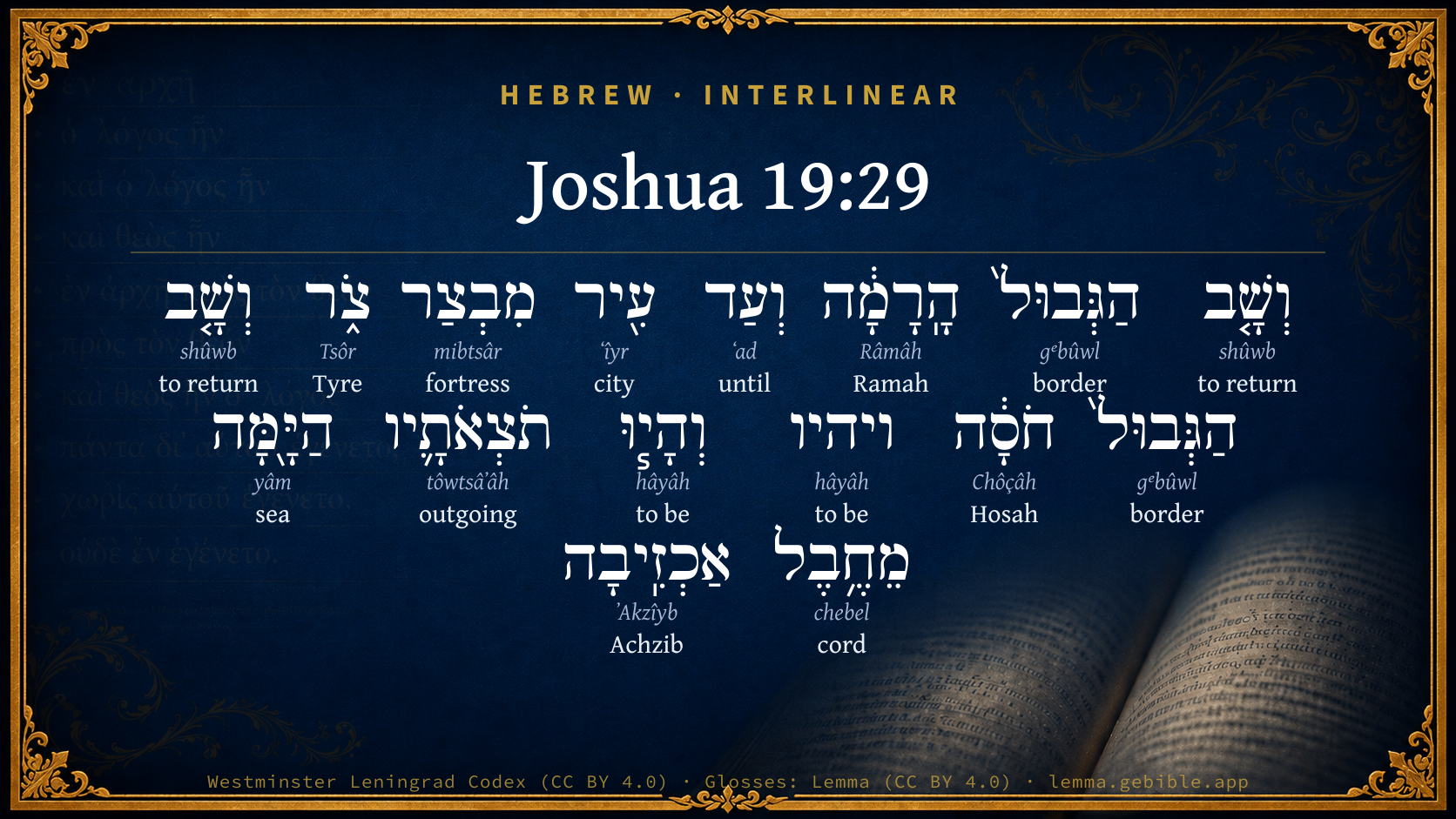
Hebrew (Westminster Leningrad Codex) Joshua 19:29 appears in the Hebrew Old Testament. The text above is from the Westminster Leningrad Codex. Each word links to its Strong’s number, a concise gloss, and parsing drawn from the Open Scriptures Hebrew Bible morphology. Click any word for its full Brown-Driver-Briggs (BDB) entry.
Download image
Cite this verse

Joshua 19:29 (World English Bible). Public Domain. Lemma interlinear Bible study tool, https://lemma.gebible.app/v/joshua/19/29.

Show BibTeX & RIS
BibTeX
RIS
English Translation
and the border turned to Ramah, and to the fortified city of Tyre; and the border turned to Hosah; and the goings out of it were at the sea by the region of Achzib;
World English Bible · Public Domain
Highlights
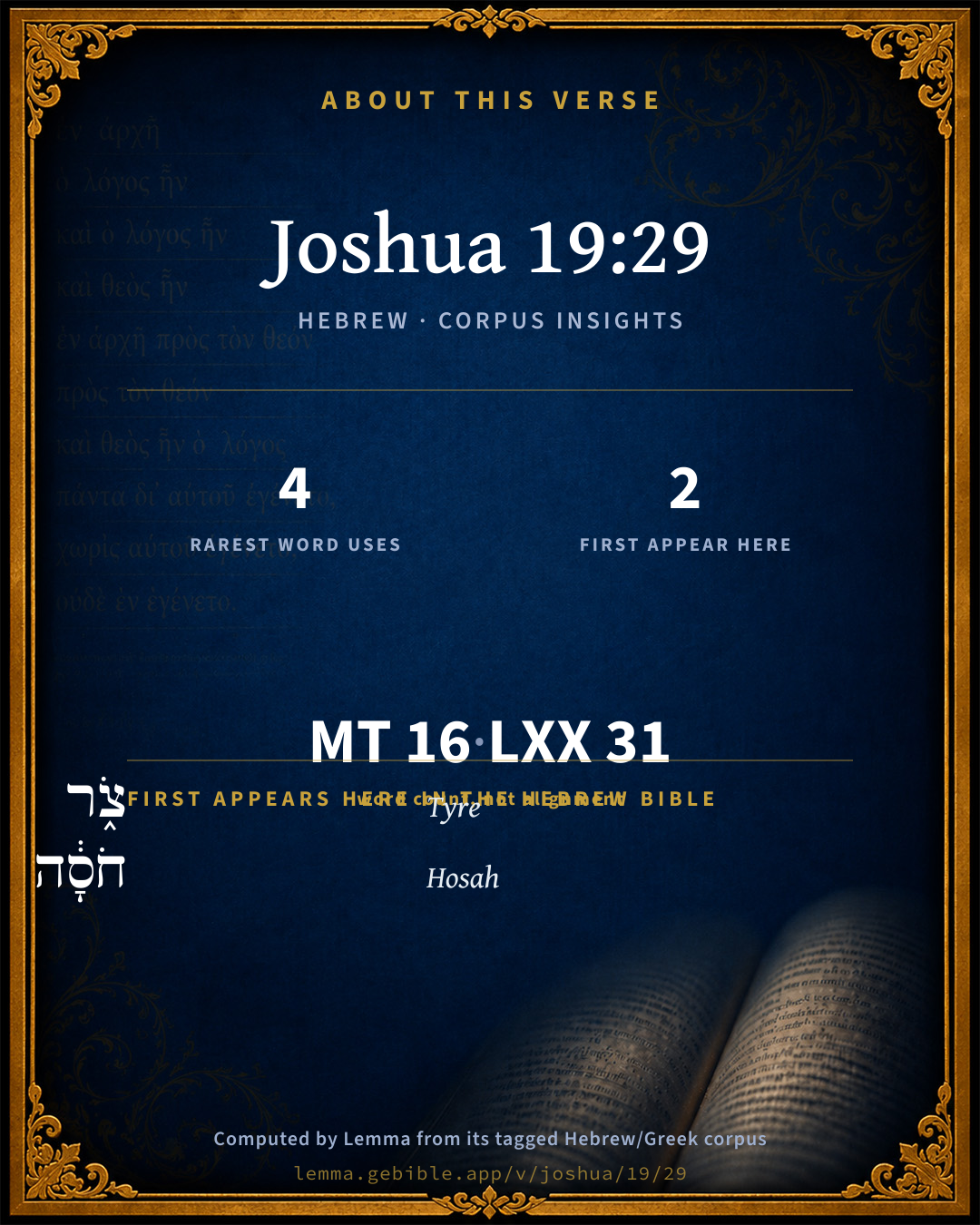
  • 2 first appearances in the Hebrew Bible
Full analysis ↓
Download a study sheet

One document with this verse’s original text, its word-by-word gloss line, the meaning frame, cross-references with their text, attributed commentary, and full source and license credits — printable, and it pastes into notes with its structure intact.

This verse Autodidact and up

Study sheet (.html) Plain text (.txt)

A passage Seminary Student

Up to 50 verses in one chapter. A passage sheet keeps up to 6 commentary sources and 12 cross-references per verse, in the order this page ranks them, and says so on the sheet whenever that leaves anything out. Ask for a single verse and you get the Autodidact verse sheet above.

Everything on this page stays free to read, with no account — the sheet is a download of what is already on screen, not access to it.

Want to remove ads? Support Godless Engineer
Compare translations 3

The same verse in 3 English versions, stacked beneath the original-language interlinear above. Click any original word for its lexicon entry.

Each is an independent rendering of the whole verse — the interlinear is not word-aligned to these translations.

Highlighted words mark where these versions differ — a whole-verse word diff, not a word-by-word alignment.

  • World English Bible Public Domain
    and the border turned to Ramah, and to the fortified city of Tyre; and the border turned to Hosah; and the goings out of it were at the sea by the region of Achzib;
  • King James Version Public Domain
    And then the coast turneth to Ramah, and to the strong city Tyre; and the coast turneth to Hosah; and the outgoings thereof are at the sea from the coast to Achzib:
  • unfoldingWord Literal Text CC BY-SA 4.0
    And the border turned Ramah and unto the city of fortification of Tyre. Then the border turned Hosah, and its goings out were seaward, from the portion of Akzib

unfoldingWord Literal Text — © unfoldingWord, licensed CC BY-SA 4.0. Word-aligned USFM3 via Door43 (git.door43.org/unfoldingWord/en_ult).

Versions to compare (up to 4)

3 of 4 selected

Show all 18 translations

Every available English version of this verse, each an independent rendering of the whole verse.

  • World English Bible Public Domain
    and the border turned to Ramah, and to the fortified city of Tyre; and the border turned to Hosah; and the goings out of it were at the sea by the region of Achzib;
  • Berean Standard Bible Public Domain
    The border then turned back toward Ramah as far as the fortified city of Tyre, turned toward Hosah, and came out at the Sea in the region of Achzib,
  • Majority Standard Bible Public Domain
    The border then turned back toward Ramah as far as the fortified city of Tyre, turned toward Hosah, and came out at the Sea in the region of Achzib,
  • King James Version Public Domain
    And then the coast turneth to Ramah, and to the strong city Tyre; and the coast turneth to Hosah; and the outgoings thereof are at the sea from the coast to Achzib:
  • American Standard Version (1901) Public Domain
    and the border turned to Ramah, and to the fortified city of Tyre; and the border turned to Hosah; and the goings out thereof were at the sea by the region of Achzib;
  • Revised Version (1885) Public Domain
    and the border turned to Ramah, and to the fenced city of Tyre; and the border turned to Hosah; and the goings out thereof were at the sea by the region of Achzib:
  • Geneva Bible (1599) Public Domain
    Then the coast turneth to Ramah and to the strong citie of Zor, and this border turneth to Hosah, and the ends thereof are at the Sea from Hebel to Achzib,
  • Douay-Rheims (1899) Public Domain
    And it returneth to Horma to the strong city of Tyre, and to Hosa: and the outgoings thereof shall be at the sea from the portion of Achziba:
  • Young's Literal Translation Public Domain
    and the border hath turned back to Ramah, and unto the fenced city Tyre; and the border hath turned back to Hosah, and its outgoings are at the sea, from the coast to Achzib,
  • Literal Standard Version CC BY-SA 4.0
    and the border has turned back to Ramah, and to the fortified city Tyre; and the border has turned back to Hosah, and its outgoings are at the sea, from the coast to Achzib,
  • Unlocked Literal Bible CC BY-SA 4.0
    The border turned back to Ramah, and then to the fortified city of Tyre. Then the border turned to Hosah and ended at the sea, in the region of Akzib,
  • unfoldingWord Literal Text CC BY-SA 4.0
    And the border turned Ramah and unto the city of fortification of Tyre. Then the border turned Hosah, and its goings out were seaward, from the portion of Akzib
  • Darby Bible Public Domain
    and the border turned to Ramah, and as far as the fortified city of Tyre; and the border turned to Hosah; and ended at the sea by the tract of country of Achzib;
  • World Messianic Bible Public Domain
    The border turned to Ramah, to the fortified city of Tyre; and the border turned to Hosah. It ended at the sea by the region of Achzib;
  • Webster's Bible Public Domain
    And then the border turneth to Ramah, and to the strong city Tyre; and the border turneth to Hosah: and the limits of it are at the sea from the coast to Achzib:
  • Free Bible Version CC BY-SA 4.0
    The boundary then turned towards Ramah and then the fortified town of Tyre, turning to Hosah and ending at the sea. Towns included Mehebel, Aczib,
  • Bible in Basic English Public Domain
    And the limit goes round to Ramah and the walled town of Tyre and Hosah, ending at the sea by Heleb and Achzib;
  • JPS Tanakh (1917) Public Domain
    And the border turned to Ramah, and to the fortified city of Tyre; and the border turned to Hosah; and the goings out thereof were at the sea from Hebel to Achzib;

Literal Standard Version (2020), Covenant Press — licensed CC BY-SA 4.0. Text via the HelloAO Bible API (eBible.org). Unlocked Literal Bible (unfoldingWord) — licensed CC BY-SA 4.0. Text via the HelloAO Bible API (eBible.org). unfoldingWord Literal Text — © unfoldingWord, licensed CC BY-SA 4.0. Word-aligned USFM3 via Door43 (git.door43.org/unfoldingWord/en_ult). Free Bible Version, Dr. Jonathan Gallagher — licensed CC BY-SA 4.0. Text via the HelloAO Bible API (eBible.org).

Word by word

More ways to search: Search by grammar → Find every occurrence → Compare this word →

Practice this passage: Drill this verse → Learn its vocabulary →

אַכְזִֽיבָה
ʼAkzîyb
H392
“Achzib · toward”
Noun, Proper + Suffix, Demonstrative
Part of Speech
Noun
Type
Proper
Full BDB Definition

Origin: from H391

TWOT: None

Achzib = "deceit" - a town in the lowland of west Judah - a town in Asher by the Sea of Galilee
  1. וְשָׁ֤ב shûwb H7725 “and · to return” Conjunction + Verb, Qal, Perfect, 3rd Person, Masculine, Singular
  2. הַגְּבוּל֙ gᵉbûwl H1366 “the · border” Particle, Definite Article + Noun, Common, Masculine, Singular, Absolute
  3. הָֽרָמָ֔ה Râmâh H7414 “the · Ramah” Particle, Definite Article + Noun, Proper
  4. וְעַד ʻad H5704 “and · until” Conjunction + Preposition
  5. עִ֖יר ʻîyr H5892 “city of” Noun, Common, Feminine, Singular, Construct
  6. מִבְצַר mibtsâr H4013 “fortress of” Noun, Common, Masculine, Singular, Construct
  7. צֹ֑ר Tsôr H6865 “Tyre” Noun, Proper
  8. וְשָׁ֤ב shûwb H7725 “and · to return” Conjunction + Verb, Qal, Perfect, 3rd Person, Masculine, Singular
  9. הַגְּבוּל֙ gᵉbûwl H1366 “the · border” Particle, Definite Article + Noun, Common, Masculine, Singular, Absolute
  10. חֹסָ֔ה Chôçâh H2621 “Hosah” Noun, Proper
  11. ויהיו hâyâh H1961 “and · to be” Conjunction + Verb, Qal, Imperfect, 3rd Person, Masculine, Plural
  12. וְהָי֧וּ hâyâh H1961 “and · to be” Conjunction + Verb, Qal, Perfect, 3rd Person, Common, Plural
  13. תֹצְאֹתָ֛יו tôwtsâʼâh H8444 “outgoings · his” Noun, Common, Feminine, Plural, Construct + Suffix, Personal, 3rd Person, Masculine, Singular
  14. הַיָּ֖מָּה yâm H3220 “the · sea · toward” Particle, Definite Article + Noun, Common, Masculine, Singular, Absolute + Suffix, Demonstrative
  15. מֵחֶ֥בֶל chebel H2256 “from · cord” Preposition + Noun, Common, Both, Singular, Absolute

About this verse

These counts appear in no published source. They are computed here, from the morphology-tagged text and Lemma’s own curated glosses. What Lemma adds →

16
words
13
distinct lemmas
Historical
section

Notable vocabulary

The rarest word here is אַכְזִֽיבָה Achzib H392 — appearing just 4 times in the whole Hebrew Bible.

First appearance in Scripture

These words make their first canonical appearance in the Hebrew Bible here:

Shared distinctive vocabulary

אַכְזִֽיבָה Achzib H392 occurs in 4 verses of the Hebrew Bible. Also found in:

Grammatical profile

  • 4 verbs
  • 11 nouns
  • 1 preposition

Verb forms

  • וְשָׁ֤ב Qal · Perfect
  • וְשָׁ֤ב Qal · Perfect
  • ויהיו Qal · Imperfect
  • וְהָי֧וּ Qal · Perfect

Repetition

Words recur within this verse — often emphatic in Hebrew:

  • וְשָׁ֤ב to return H7725 ×2
  • הַגְּבוּל֙ border H1366 ×2
  • ויהיו to be H1961 ×2

Hebrew & Septuagint length

In English translation the verse runs 34 words from the Hebrew and 36 from the Septuagint (LXX English) — closely comparable.

A rough comparison of the two English renderings, which tokenize alike — not a word-level alignment.

Word counts can differ between the Hebrew and the Greek without any difference in meaning — e.g. the Hebrew direct-object marker אֵת has no separate Greek word, and Greek often adds the article ὁ.

In the original languages it is 16 Hebrew tokens and 31 Greek tokens — but the two are counted differently (Hebrew bundles its prefixes and suffixes into one token; the Greek is in lemma form), so that isn’t a like-for-like length.

Cross-references

6

Topical passages linked to Joshua 19:29 in the Treasury of Scripture Knowledge — connected by theme and wording, ordered by reader-vote popularity; previews shown in the World English Bible.

  • Judges 1:31 Asher didn't drive out the inhabitants of Acco, nor the inhabitants of Sidon, nor of Ahlab, nor of Achzib, nor of Helbah, nor of Aphik, nor of Rehob;
  • 2 Samuel 5:11 Hiram king of Tyre sent messengers to David, and cedar trees, and carpenters, and masons; and they built David a house.
  • Genesis 38:5 She yet again bore a son, and named him Shelah: and he was at Chezib, when she bore him.
  • Isaiah 23:1–18 The burden of Tyre. Howl, you ships of Tarshish; for it is laid waste, so that there is no house, no entering in: from the land of Kittim it is revealed to them.
  • Ezekiel 26:1–21 It happened in the eleventh year, in the first [day] of the month, that the word of Yahweh came to me, saying,
  • Micah 1:14 Therefore you will give a parting gift to Moresheth-gath. The houses of Achzib will be a deceitful thing to the kings of Israel.

Cross-references courtesy of OpenBible.info (CC BY 4.0).

Hebrew and Greek witnesses Masoretic Hebrew ↔ Greek Septuagint

The same verse in the two great witnesses to the Old Testament, shown verse-for-verse.

These are two independent witnesses, not word-aligned to each other, and the Septuagint is shown in lemma (dictionary) form.

Hebrew Joshua 19:29 Masoretic · Westminster Leningrad Codex

וְשָׁ֤ב הַגְּבוּל֙ הָֽרָמָ֔ה וְעַד עִ֖יר מִבְצַר צֹ֑ר וְשָׁ֤ב הַגְּבוּל֙ חֹסָ֔ה ויהיו וְהָי֧וּ תֹצְאֹתָ֛יו הַיָּ֖מָּה מֵחֶ֥בֶל אַכְזִֽיבָה

and the border turned to Ramah, and to the fortified city of Tyre; and the border turned to Hosah; and the goings out of it were at the sea by the region of Achzib;

World English Bible · Public Domain

Greek LXX Joshua 19:29 Septuagint · lemma form

καί ἀναστρέφω ὁ ὅριον εἰς ραμα καί ἕως πηγή μασφασσατ καί ὁ τύριος καί ἀναστρέφω ὁ ὅριον ἐπί ιασιφ καί εἰμί ὁ διέξοδος αὐτός ὁ θάλασσα καί ἀπό λεβ καί εχοζοβ

And the borders shall turn back to Rama, and to the fountain of Masphassat, and the Tyrians; and the borders shall return to Jasiph, and their going forth shall be the sea, and Apoleb, and Echozob,

LXX2012 (modern English Septuagint) · Public Domain

On this verse, Adam Clarke's Commentary discusses the Septuagint’s reading. Read the note in Commentary ↓

Hebrew: Westminster Leningrad Codex (CC BY 4.0). Greek: Septuagint (public domain); English from LXX2012 (modern English Septuagint) (Public Domain). How the Septuagint differs from the Hebrew →

Targum (Aramaic paraphrase)

1

The Targum is the ancient Jewish Aramaic paraphrase of the Hebrew Scriptures — an interpretive translation, not the Hebrew text itself. Onkelos (literal) and Pseudo-Jonathan (expansive) render the Torah, and Jonathan the Prophets. Coverage is partial: where no permissively-licensed English translation exists for a verse, only the Aramaic is shown. This is verse-level text, not a word-by-word alignment to the Hebrew.

  1. Targum Jonathan Prophets (Joshua–Malachi)
    וְתַב תְּחוּמָא לְרָמָתָא וְעַד קִרְוִין כְּרִיכָן קִרְוֵי תוּקְפָא וְתַב תְּחוּמָא לְחוֹסָה וִיהוֹן מַפְקָנוֹהִי לְיַמָא מֵעֲדַב אַכְזִיב:

    (no public-domain English translation for this verse)

    Targum Jonathan — Aramaic: “Mikraot Gedolot” (public domain). English: “Sefaria Community Translation” (CC0 1.0 (public-domain dedication)); “London "Chaldee Paraphrase," 1871” (public domain). Text via Sefaria.

Commentary

Notes on Joshua 19:29 from classic Christian and Jewish commentators (each source and its license shown beneath its notes). The classic Christian expositions comment on the surrounding passage and are grouped to its opening verse, so a note may address several verses; the Jewish commentaries on the Tanakh (Rashi and others) are per-verse, so they appear only where the commentator wrote on this verse.

Lemma curates 59 commentaries, every one of them public domain or Creative Commons licensed, each selected and text-cleaned for this edition rather than reprinted as found. About our sources →

Trapp's Complete Commentary

John Trapp

Jos 19:29 And [then] the coast turneth to Ramah, and to the strong city Tyre; and the coast turneth to Hosah; and the outgoings thereof are at the sea from the coast to Achzib:

Ver. 29. To the strong city Tyre.] Founded upon a rock, environed with rocks, and encircled by the sea; whence she held herself invincible, but was sacked by great Alexander, and two thousand of her inhabitants were crucified. Let not the strong man glory in his strength.

John Trapp, A Commentary or Exposition upon All the Books of the Old and New Testament (1647–1656) — public domain. Text from a community e-Sword module.

Joseph Benson's Commentary

Jos 19:29-30. To Ramah — From the north southward. To the strong city of Tyre — This translation is questionable; for we never read one word of the city of Tyre (unless it be here) until the days of David; though we often read of Sidon in the books of Moses; even in the prophecy of Jacob. It is highly probable some other place is meant by Tzor, as the word is in the Hebrew. And the out-goings thereof, &c. — That is, it ended at the country which belonged to Achzib; for so hebel, which we here translate coast, signifies. Twenty-two cities — Here are more named, but some of them were not within this tribe, but only bordering places.

Joseph Benson's Commentary on the Old and New Testaments (1811–1818) — public domain. Text from a community e-Sword module.

Geneva Bible (1599)

Geneva Bible translators

Which was Tyre, a strong city in the sea.

Geneva Bible (1599) marginal notes — public domain. Text via Bolls.life.

Jamieson, Fausset & Brown

Robert Jamieson, A. R. Fausset & David Brown

and then the coast turneth to Ramah--now El-Hamra, which stood where the Leontes (Litany) ends its southern course and flows westward.

and to the strong city Tyre--The original city appears to have stood on the mainland, and was well-fortified. From Tyre the boundary ran to Hosah, an inland town; and then, passing the unconquered district of Achzib (Jdg 1:31), terminated at the seacoast.

Jamieson, Fausset & Brown — Commentary Critical and Explanatory on the Whole Bible (1871) — public domain (CC PDM 1.0). Text via the HelloAO Bible API.

Adam Clarke's Commentary

Verse 29. The strong city Tyre] I suspect this to be an improper translation. Perhaps the words of the original should be retained: And the coast turneth to Ramah and to the city, מבצר צר mibtsar tsor. Our translators have here left the Hebrew, and followed the Septuagint and Vulgate, a fault of which they are sometimes guilty. The former render the place ̔ως πολεως οχυρωματος των Τυριων, unto the fortified city of the Tyrians. The Vulgate is nearly the same: ad civitatem munitissimam Tyrum, to the well-fortified city Tyre; but this must be incorrect for the famous city of Tyre was not known tiil about A.M. 2760, about two hundred years after the days of Joshua. Homer, who frequently mentions Sidon and the Sidonians, never mentions Tyre; a proof that this afterwards very eminent city was not then known. Homer is allowed by some to have flourished in the time of Joshua, though others make him contemporary with the Israelitish judges.

The word צר Tsor or Tsar, which we translate or change into Tyre, signifies a rock or strong place; and as there were many rocks in the land of Judea, that with a little art were formed into strong places of defense, hence several places might have the name of Tsar or Tyre. The ancient and celebrated Tyre, so much spoken of both in sacred and profane history, was a rock or small island in the sea, about six or seven hundred paces from the main land. In order to reduce this city, Alexander the Great was obliged to fill up the channel between it and the main land, and after all took it with much difficulty. It is generally supposed that a town on the main land, opposite to this fortified rock, went by the same name; one being called old Tyre, the other, new Tyre: it was out of the ruins of the old Tyre, or that which was situated on the main land, that Alexander is said to have filled up the channel between it and the new city. Of this city Isaiah, Isa 23:1-18, and Ezekiel, Eze 27:1-28:26, have given a very grand description, and also predicted its irreparable ruin which prophecies have been most literally fulfilled. See more on the above places.

Achzib] Called afterwards Ecdippe, and now called Zib; it is about nine miles' distance from Ptolemais, towards Tyre.

Adam Clarke's Commentary on the Bible (1810–1826) — public domain. Text from a community e-Sword/MySword module.

The Cambridge Bible for Schools and Colleges

gen. ed. J. J. S. Perowne

29. and then the coast turneth to Ramah] Having reached Zidon by Kanah, the boundary bent southward by Ramah, and so turned to the “strong,” or “fortified city” of Tyre. Robinson would identify Ramah with Rameh, south-east of Tyre, on a solitary hill in the midst of a basin of green fields, and surrounded by greater heights (Bib. Res. iii. 63).

the strong city Tyre] “The most strengthened citie Tyruns” (Wyclif) here alluded to is not the island of Tyre, but the city standing on the mainland, now Sûr.

turneth to Hosah] From Tyre the border turned toward Hosah, the site of which is unknown, and finally ran towards the sea in the region of Achzib, the modern es-Zib, on the sea-shore, little more than two hours from Acre. The Canaanites, we are told (Jdg_1:31), were afterwards not expelled from it by the tribe of Asher, and in classical times it was known as Ecdippa. It is to be noted that both the fortified city Tyre and great Zidon were included in Asher’s inheritance, but no effort was made by the Israelites to obtain possession of these Phœnician cities.

The Cambridge Bible for Schools and Colleges (gen. ed. J. J. S. Perowne; Cambridge University Press, 1878–1918) — public domain. Text from a community e-Sword module.

John Gill's Exposition

Ummah also,.... Ummah is not mentioned any where else:

and Aphek; of which; see Gill on Jos 12:18,

and Rehob; of which; see Gill on Jos 19:28,

twenty and two cities with their villages: there are more set down in the account, but some of them did not belong to the tribe, only were on the border of it.

John Gill's Exposition of the Whole Bible (1746–1763) — public domain (CC PDM 1.0). Text via the HelloAO Bible API.

Haydock's Catholic Bible Commentary

Horma. Hebrew, Septuagint, &c., Rama, "a height." --- Of Tyre. When this city was founded, is wrapped up in obscurity. The Tyrian priests claim a very high antiquity; whereas Josephus (Antiquities viii. 2,) allows that the city was founded only 200 years after Josue, on which supposition this name must have been added by a subsequent writer. The matter, however, is so uncertain, that nothing can be concluded. It was a colony of Sidon, Isaias xxiii. 12. Old Tyre was on the continent; the new city was built in an island, where the temple of Jupiter Olympius formerly stood. Alexander made a road between the two cities, when he besieged New Tyre: which, on that account, may be considered either as an island, or as part of the continent. He used for this purpose the ruins of the old city, which he threw into the sea. Hiram had formed a similar road to the temple of Jupiter. (Dius. ap. Josephus, contra Apion i.) Whether Nebuchodonosor besieged the Old or the New Tyre, soon after he had taken Jerusalem, authors are not agreed. St. Jerome (in Ezechiel xxviii., and Amos i., &c.) seems to think that he attacked the new city; whereas Marsham believes that it was built only after the other had fallen a prey to the arms of the Chaldeans. It was only five or 700 paces from the continent. Tyrus quondam insula præalto mari septingentis passibus divisa, nunc vero Alexandri oppugnantis operibu continens. (Pliny, [Natural History?] v. 19.) --- Portion. Hebrew, "from the coast of Achzib," which is the same town as Ecdippe, south of Tyre, and nine miles from Ptolemais. (Calmet)

George Leo Haydock (1774–1849), Haydock's Catholic Family Bible and Commentary, 1859 edition — public domain. Excludes Psalms (Douay-Rheims chapter numbering differs from Protestant) and Deuterocanonical books (Catholic canon only).

Matthew Poole's English Annotations

The coast turneth from the north southward.

To the strong city Tyre; exclusively, for this city was no part of the land given them.

Matthew Poole's English Annotations on the Holy Bible (1683–1685) — public domain. Text from a community e-Sword/MySword module.

Whedon's Commentary on the Bible

Daniel D. Whedon

29. Ramah — Robinson confidently identifies this place with the modern village Rameh, which stands on an isolated hill about ten miles southeast of Tyre. It has no traces of antiquity except some very ancient sarcophagi. Tyre, a rock, is a colony of Zidon, and is a few miles south on the seacoast. The old city stood on the main land and was strongly fortified.

New Tyre, which was taken by Alexander the Great, was built on a rock in the sea. It is probably Old Tyre that is named in the text, but Keil endeavours to prove that New Tyre was in existence in the days of Joshua, discrediting Josephus, who says that it was built two hundred and forty years before the Temple of Solomon. It was a great commercial emporium, and became the burden of prophecies (see Isaiah 23; Ezekiel 26) which have been remarkably fulfilled. Achzib, now called Zib, is on the coast nine miles north of Acre.

Daniel D. Whedon (gen. ed.), Commentary on the Old and New Testaments (1874–1909) — public domain. Text from a community e-Sword module.

The Pulpit Commentary

The strong city Tyre. Rather, the fortified city. The general impression among commentators appears to be that the island city of Tyre, afterwards so famous, had not as yet come into existence. And the word here used, rxbmi seems to be more in accordance with the idea of a land fortress than of one so exceptionally protected as an island fortress would be. This expression, like "great Zidon" above, implies the comparative antiquity of the Book of Joshua. The island city of Tyre, so famous in later history, was not yet founded. The city on the mainland (called Ancient Tyre by the historians) was "the chief seat of the population till the wars of the Assyrian monarchs against Phoenicia" (Kenrick, "Phoenicia," p. 344).

He adds, "The situation of Palae-Tyrus was one of the most fertile spots on the coast of Phoenicia. The plain, is here about five miles wide; the soft is dark, and the variety of its productions excited the wonder of the Crusaders." William of Tyre, the historian of the Crusades, tells us that, although the territory was scanty in extent, "exiguitatem suam multa redimit ubertate." The position of Tyre, as a city of vast commercial importance and artistic skill in the time of David and Solomon, is clear enough from the sacred records. It appears still (2Sa_24:6, 2Sa_24:7) to have been on the mainland, for the successors of Rameses II, up to the time of Sheshonk, or Shishak, were unwarlike monarchs, and the Assyrian power had not yet attained its subsequent formidable dimensions. We meet with Eth-baal, or Itho-baal, in later Scripture history, remarkable as the murderer of the last of Hiram"s descendants, and the father of the infamous Jezebel, from which we may conclude that a great moral and therefore political declension had taken place since the days of Hiram. The later history of Tyre may be inferred from the prophetic denunciations, intermingled with descriptive passages, found in Isaiah 23, and Eze 26 Eze 27 Joe_3:3-8 and Amo_1:9 had previously complained of the way in which the children of Israel had become the merchandise of Tyre, and had threatened the vengeance of God. But the minute and powerful description in Ezekiel 27, shows that Tyre was still great and prosperous. She was strong enough to resist the attacks of successive Assyrian monarchs. Shalmaneser"s victorious expedition (so Alexander tells us) was driven back from the island fortress of Tyre. Sennacherib, in his vainglorious boast of the cities he has conquered, (Isa 36 Isa 37) makes no mention of Tyre. Even Nebuchadnezzar, though he took and destroyed Palae-Tyrus, appears to have been baffled in his attempt to reduce the island city. Shorn of much of its ancient glory, Tyre still remained powerful, and only succumbed, after a resistance of seven months, to the splendid military genius of Alexander the Great. But Alexander refounded Tyre, and its position and its commercial reputation secured for it a large part of its former importance. The city continued to flourish, even though Phoenicia was for a long period the battleground between the Syrian and the Egyptian monarchies. To Christian readers, the description by Eusebius of the splendid church erected at Tyre by its Bishop Paulinus will have an interest. He describes it as by far the finest in all Phoenicia, and appends the sermon he preached on the occasion. Even in the fourth century after Christ, St. Jerome ("Comm. ad Ezekiel," 26:7) wonders why the prophecy concerning Tyre has never been fulfilled. "Quod sequitur, "nee aedificaberis ultra," videtur facere quaestionem quomodo non sit aedificata, quam hodie cernimus nobilissimam et pulcherrimam civitatem." But the present state of Tyre warns us not to be too hasty in pronouncing any Scripture prophecy to have failed. Even Sidon is not the wretched collection of huts and ruined columns which is all that remains of the once proud city Tyre. And the outgoings thereof are at the sea from the coast to Achzib. Rather, and the western extremity is from Hebel to Achzib. Hebel signifies a region or possession, as in ver. 9. Here, however, it seems to be a proper name. Achzib. "A city of Asher, not conquered by that tribe, (Jud 1:31) now the village of Zib, two-and-a-half hours north of Akka," or Acre (Vandevelde). Keil and Delitzsch make the journey a three hours" one. But Manndrell, who also corroborates St. Jerome in the distance (nine Roman miles), states that he performed the journey hence to Acre in two hours.

The Pulpit Commentary (1880–1919), ed. H.D.M. Spence-Jones & Joseph S. Exell — public domain. Text from a community e-Sword module.

John Wesley's Explanatory Notes

To Ramah - From the north southward. To Tyre - Exclusively, for this city was no part of the land given them. But this was not the same city we read of afterwards. For that was built on an island, this on the continent. Probably into these strong holds Tyre and Sidon, many of the Canaanites fled, when Joshua invaded them.

John Wesley, Explanatory Notes Upon the Whole Bible (1754–1765) — public domain. Text via the GEBible commentary corpus.

unfoldingWord translationNotes

Door43 World Missions Community

Hosah ... Akzib ... Ummah ... Aphek ... Rehob

These are the names of places. (See: How to Translate Names)

translationWords

Ramah

Tyre

unfoldingWord translationNotes — © Distant Shores Media and the Door43 World Missions Community, licensed CC BY-SA 4.0. Source: git.door43.org/Door43/en_tn.

Rashi

Rabbi Shlomo Yitzchaki (Rashi)

Fortified city of the Rock. Cities of fortress, cities of might.

Rock—צוּר means a rock.

From the lot of Achziv. [חֶבֶל means a rope of Achziv] but here it refers to the lot of Achziv.

Rashi on the Tanakh — English translations: “The Judaica Press complete Tanach with Rashi, translated by A. J. Rosenberg” (CC BY 4.0); “Pentateuch with Rashi's commentary by M. Rosenbaum and A.M. Silbermann, 1929-1934” (public domain); “The Metsudah Tanach series, Lakewood, N.J” (CC BY 4.0); and “The Book of Joshua, Metsudah Publications, 1997” (CC BY 4.0). Text via Sefaria.

Lesson kit

Teaching starters — assembled from the data on this page, not authored interpretation. Every prompt links to the verse data it draws on. Edit before teaching.

Joshua, in the Historical, opens this verse with 16 words (13 distinct Hebrew lemmas). Its most distinctive word is ʼAkzîyb (“Achzib”). A historical commentator’s framing appears above. Read the whole chapter for the surrounding context.

Discussion questions

  1. What does “Achzib” (ʼAkzîyb) contribute to the verse as a whole?
  2. 2 words make their first appearance in Scripture here. What does this debut establish?
  3. How does Joshua 15:44, which shares the word «Achzib», read alongside this verse?
  4. What does the repetition of “to return” (2× in this one verse) do in this verse?
  5. These translations render this verse differently. What is at stake in choosing one wording over another?
  6. «וְשָׁ֤ב» is a Qal Perfect verb. How does that grammatical form shape the action described?
  7. Compare how Trapp's Complete Commentary and Joseph Benson's Commentary read this verse. Where do they agree or differ?

Things to notice

Reading settings

Reading text

Shown beneath each verse's original-language words.

Old Testament
Old Testament edition

Read the OT as the Masoretic Hebrew (MT) or the Greek Septuagint (LXX).

English shown for the Greek Septuagint (in the Hebrew ↔ Greek comparison).

Comparing translations? Open the Compare panel on any verse page to stack up to four side by side.