
Joshua 18:19

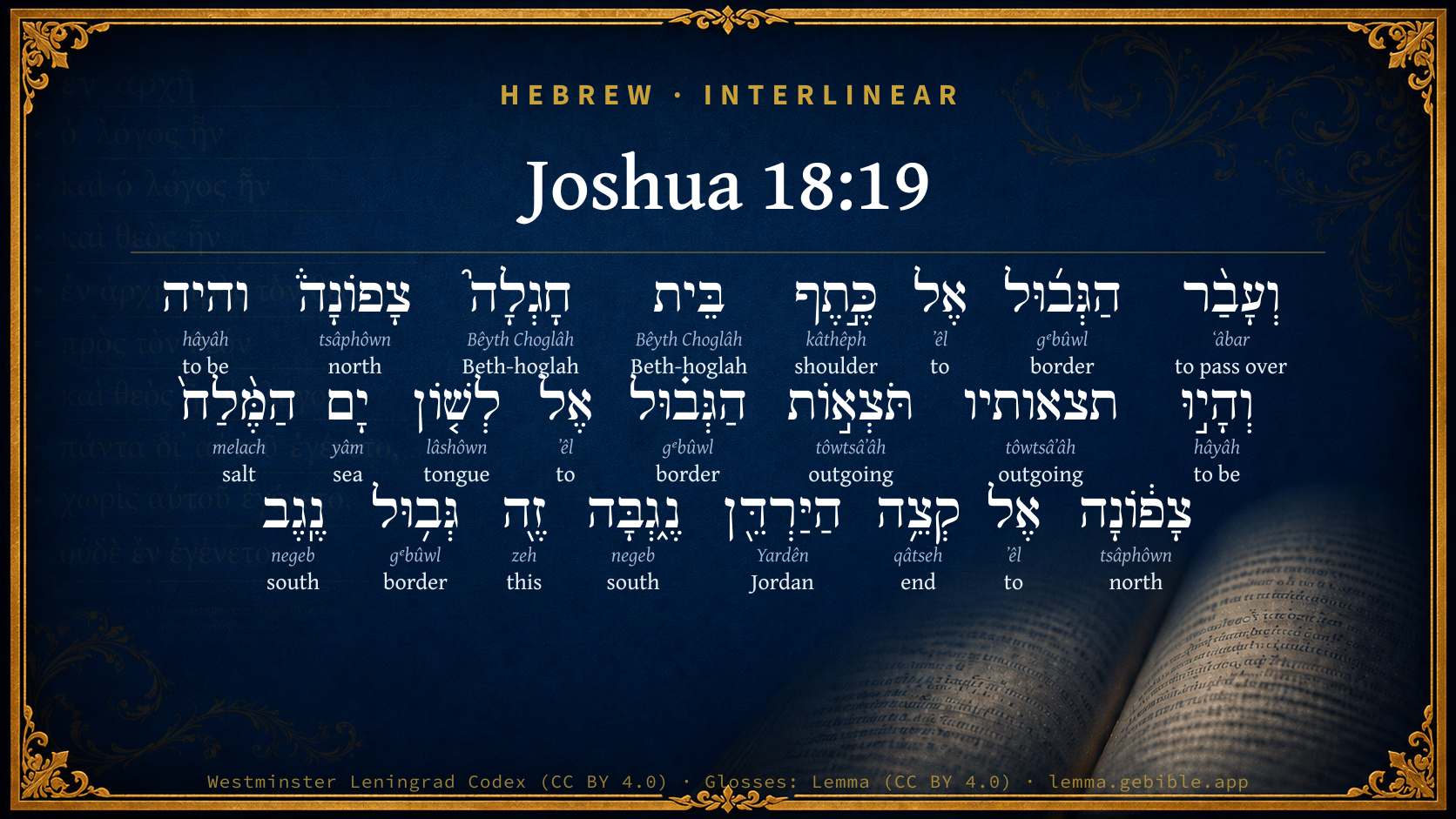
Hebrew (Westminster Leningrad Codex) Joshua 18:19 appears in the Hebrew Old Testament. The text above is from the Westminster Leningrad Codex. Each word links to its Strong’s number, a concise gloss, and parsing drawn from the Open Scriptures Hebrew Bible morphology. Click any word for its full Brown-Driver-Briggs (BDB) entry.
Download image
Cite this verse

Joshua 18:19 (World English Bible). Public Domain. Lemma interlinear Bible study tool, https://lemma.gebible.app/v/joshua/18/19.

Show BibTeX & RIS
BibTeX
RIS
English Translation
and the border passed along to the side of Beth Hoglah northward; and the goings out of the border were at the north bay of the Salt Sea, at the south end of the Jordan: this was the south border.
World English Bible · Public Domain
Download a study sheet

One document with this verse’s original text, its word-by-word gloss line, the meaning frame, cross-references with their text, attributed commentary, and full source and license credits — printable, and it pastes into notes with its structure intact.

This verse Autodidact and up

Study sheet (.html) Plain text (.txt)

A passage Seminary Student

Up to 50 verses in one chapter. A passage sheet keeps up to 6 commentary sources and 12 cross-references per verse, in the order this page ranks them, and says so on the sheet whenever that leaves anything out. Ask for a single verse and you get the Autodidact verse sheet above.

Everything on this page stays free to read, with no account — the sheet is a download of what is already on screen, not access to it.

Want to remove ads? Support Godless Engineer
Compare translations 3

The same verse in 3 English versions, stacked beneath the original-language interlinear above. Click any original word for its lexicon entry.

Each is an independent rendering of the whole verse — the interlinear is not word-aligned to these translations.

Highlighted words mark where these versions differ — a whole-verse word diff, not a word-by-word alignment.

  • World English Bible Public Domain
    and the border passed along to the side of Beth Hoglah northward; and the goings out of the border were at the north bay of the Salt Sea, at the south end of the Jordan: this was the south border.
  • King James Version Public Domain
    And the border passed along to the side of Bethhoglah northward: and the outgoings of the border were at the north bay of the salt sea at the south end of Jordan: this was the south coast.
  • unfoldingWord Literal Text CC BY-SA 4.0
    And the border passed over to the shoulder of Beth Hoglah northward. And the goings out of the border at the tongue of the Sea of Salt northward, at the end of the Jordan southward. This was the border of the south.

unfoldingWord Literal Text — © unfoldingWord, licensed CC BY-SA 4.0. Word-aligned USFM3 via Door43 (git.door43.org/unfoldingWord/en_ult).

Versions to compare (up to 4)

3 of 4 selected

Show all 18 translations

Every available English version of this verse, each an independent rendering of the whole verse.

  • World English Bible Public Domain
    and the border passed along to the side of Beth Hoglah northward; and the goings out of the border were at the north bay of the Salt Sea, at the south end of the Jordan: this was the south border.
  • Berean Standard Bible Public Domain
    The border continued to the northern slope of Beth-hoglah and came out at the northern bay of the Salt Sea, at the mouth of the Jordan. This was the southern border.
  • Majority Standard Bible Public Domain
    The border continued to the northern slope of Beth-hoglah and came out at the northern bay of the Salt Sea, at the mouth of the Jordan. This was the southern border.
  • King James Version Public Domain
    And the border passed along to the side of Bethhoglah northward: and the outgoings of the border were at the north bay of the salt sea at the south end of Jordan: this was the south coast.
  • American Standard Version (1901) Public Domain
    and the border passed along to the side of Beth-hoglah northward; and the goings out of the border were at the north bay of the Salt Sea, at the south end of the Jordan: this was the south border.
  • Revised Version (1885) Public Domain
    and the border passed along to the side of Beth-hoglah northward: and the goings out of the border were at the north bay of the Salt Sea, at the south end of Jordan: this was the south border.
  • Geneva Bible (1599) Public Domain
    After, this border goeth along to the side of Beth-hoglah Northward: and the endes thereof, that is, of the border, reach to the point of the salt Sea Northward, and to the ende of Iorden Southward: this is the Southcoast.
  • Douay-Rheims (1899) Public Domain
    And it passeth along to the hills that are over against the ascent of Adommim: and it goeth down to Abenboen, that is, the stone of Been the son of Ruben: and it passeth on the north side to the champaign countries; and goeth down into the plain,
  • Young's Literal Translation Public Domain
    and the border hath passed over unto the side of Beth-Hoglah northward, and the outgoings of the border have been unto the north bay of the salt sea, unto the south extremity of the Jordan; this `is' the south border;
  • Literal Standard Version CC BY-SA 4.0
    and the border has passed over to the side of Beth-Hoglah northward, and the outgoings of the border have been to the north bay of the Salt Sea, to the south extremity of the Jordan; this [is] the south border;
  • Unlocked Literal Bible CC BY-SA 4.0
    The border passed on to the north shoulder of Beth Hoglah. The border ended at the north bay of the Salt Sea, at the southern end of the Jordan. This was the boundary on the south.
  • unfoldingWord Literal Text CC BY-SA 4.0
    And the border passed over to the shoulder of Beth Hoglah northward. And the goings out of the border at the tongue of the Sea of Salt northward, at the end of the Jordan southward. This was the border of the south.
  • Darby Bible Public Domain
    and the border passed on to the side of Beth-hoglah on the north, and the border ended at the tongue of the salt sea northward, at the south end of the Jordan: this is the southern border.
  • World Messianic Bible Public Domain
    The border passed along to the side of Beth Hoglah northward; and the border ended at the north bay of the Salt Sea, at the south end of the Jordan. This was the south border.
  • Webster's Bible Public Domain
    And the border passed along to the side of Beth-hoglah northward: and the limits of the border were at the north bay of the salt sea at the south end of Jordan. This was the south border.
  • Free Bible Version CC BY-SA 4.0
    From there it ran along the north slope of Beth-hoglah, ending at the north bay of the Salt Sea, the southern end of the Jordan. This was the southern boundary.
  • Bible in Basic English Public Domain
    And on to the north side of Beth-hoglah, ending at the north inlet of the Salt Sea at the south end of Jordan; this is their limit on the south.
  • JPS Tanakh (1917) Public Domain
    And the border passed along to the side of Beth-hoglah northward; and the goings out of the border were at the north bay of the Salt Sea, at the south end of the Jordan; this was the south border.

Literal Standard Version (2020), Covenant Press — licensed CC BY-SA 4.0. Text via the HelloAO Bible API (eBible.org). Unlocked Literal Bible (unfoldingWord) — licensed CC BY-SA 4.0. Text via the HelloAO Bible API (eBible.org). unfoldingWord Literal Text — © unfoldingWord, licensed CC BY-SA 4.0. Word-aligned USFM3 via Door43 (git.door43.org/unfoldingWord/en_ult). Free Bible Version, Dr. Jonathan Gallagher — licensed CC BY-SA 4.0. Text via the HelloAO Bible API (eBible.org).

Word by word

More ways to search: Search by grammar → Find every occurrence → Compare this word →

Practice this passage: Drill this verse → Learn its vocabulary →

בֵּית
Bêyth Choglâh
H1031
“Beth-hoglah”
Noun, Proper
Part of Speech
Noun
Type
Proper
Full BDB Definition

Origin: from H1004 and the same as H2295

TWOT: None

Beth-hoglah = "house of the partridge" or " place of partridge" - a place in Benjamin on the border with Judah
  1. וְעָבַ֨ר ʻâbar H5674 “and · to pass over” Conjunction + Verb, Qal, Sequential Perfect, 3rd Person, Masculine, Singular
  2. הַגְּב֜וּל gᵉbûwl H1366 “the · border” Particle, Definite Article + Noun, Common, Masculine, Singular, Absolute
  3. אֶל ʼêl H413 “to” Preposition
  4. כֶּ֣תֶף kâthêph H3802 “shoulder of” Noun, Common, Feminine, Singular, Construct
  5. חָגְלָה֮ Bêyth Choglâh H1031 “Beth-hoglah” Noun, Proper
  6. צָפוֹנָה֒ tsâphôwn H6828 “north · toward” Noun, Common, Feminine, Singular, Absolute + Suffix, Demonstrative
  7. והיה hâyâh H1961 “and · to be” Conjunction + Verb, Qal, Sequential Perfect, 3rd Person, Masculine, Singular
  8. וְהָי֣וּ hâyâh H1961 “and · to be” Conjunction + Verb, Qal, Sequential Perfect, 3rd Person, Common, Plural
  9. תצאותיו tôwtsâʼâh H8444 “outgoings · his” Noun, Common, Feminine, Plural, Construct + Suffix, Personal, 3rd Person, Masculine, Singular
  10. תֹּצְא֣וֹת tôwtsâʼâh H8444 “outgoings of” Noun, Common, Feminine, Plural, Construct
  11. הַגְּב֗וּל gᵉbûwl H1366 “the · border” Particle, Definite Article + Noun, Common, Masculine, Singular, Absolute
  12. אֶל ʼêl H413 “to” Preposition
  13. לְשׁ֤וֹן lâshôwn H3956 “tongue of” Noun, Common, Both, Singular, Construct
  14. יָם yâm H3220 “sea of” Noun, Common, Masculine, Singular, Construct
  15. הַמֶּ֨לַח֙ melach H4417 “the · salt” Particle, Definite Article + Noun, Common, Masculine, Singular, Absolute
  16. צָפ֔וֹנָה tsâphôwn H6828 “north · toward” Noun, Common, Feminine, Singular, Absolute + Suffix, Demonstrative
  17. אֶל ʼêl H413 “to” Preposition
  18. קְצֵ֥ה qâtseh H7097 “end of” Noun, Common, Both, Singular, Construct
  19. הַיַּרְדֵּ֖ן Yardên H3383 “the · Jordan” Particle, Definite Article + Noun, Proper
  20. נֶ֑גְבָּה negeb H5045 “south · toward” Noun, Common, Masculine, Singular, Absolute + Suffix, Demonstrative
  21. זֶ֖ה zeh H2088 “this” Pronoun, Demonstrative, Masculine, Singular
  22. גְּב֥וּל gᵉbûwl H1366 “border of” Noun, Common, Masculine, Singular, Construct
  23. נֶֽגֶב negeb H5045 “south” Noun, Common, Masculine, Singular, Absolute

About this verse

These counts appear in no published source. They are computed here, from the morphology-tagged text and Lemma’s own curated glosses. What Lemma adds →

24
words
15
distinct lemmas
Historical
section

Notable vocabulary

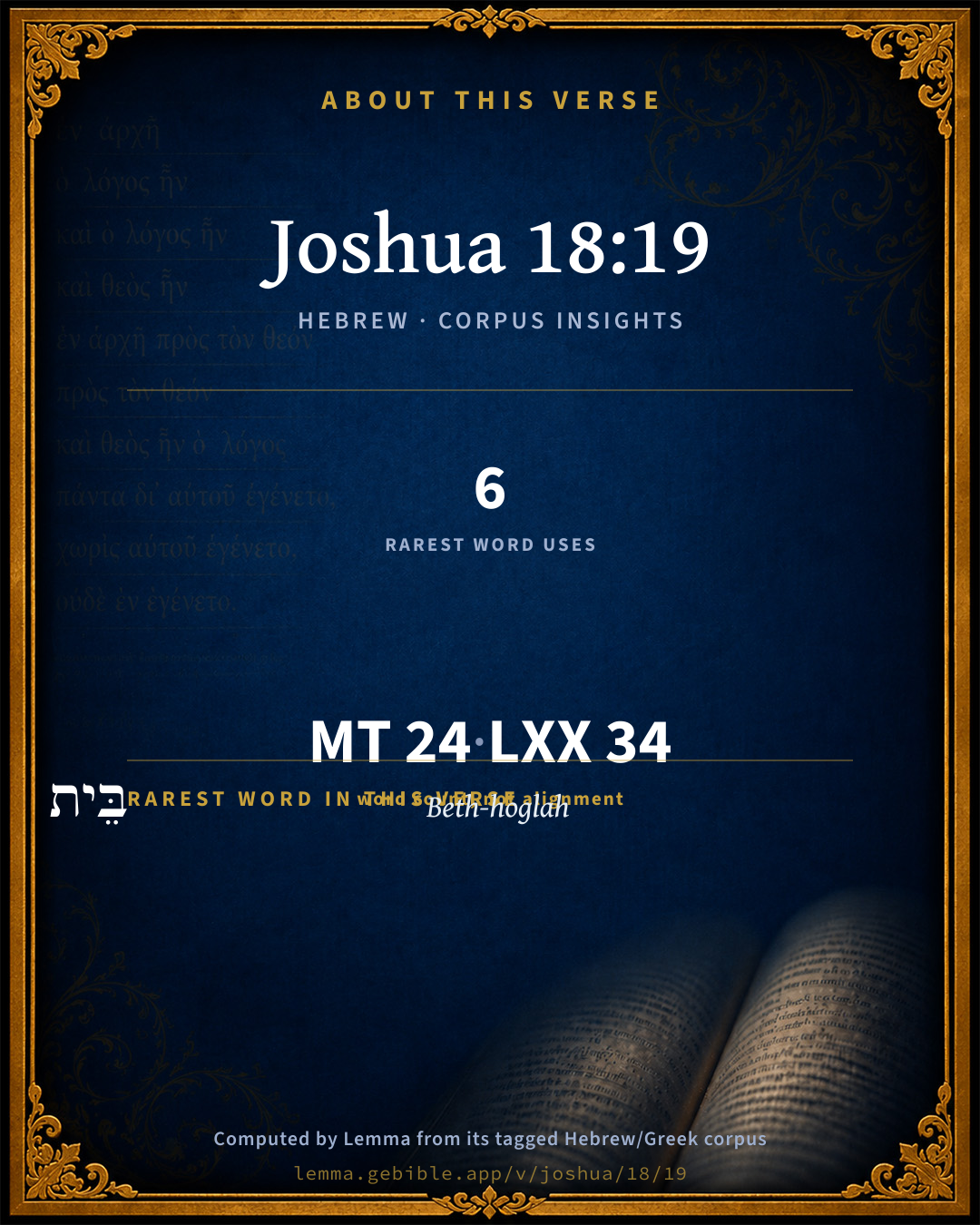
The rarest word here is בֵּית Beth-hoglah H1031 — appearing just 6 times in the whole Hebrew Bible.

Shared distinctive vocabulary

בֵּית Beth-hoglah H1031 occurs in 3 verses of the Hebrew Bible. Also found in:

Grammatical profile

  • 3 verbs
  • 17 nouns
  • 1 pronoun
  • 3 prepositions

Verb forms

  • וְעָבַ֨ר Qal · Sequential Perfect
  • והיה Qal · Sequential Perfect
  • וְהָי֣וּ Qal · Sequential Perfect

Repetition

Words recur within this verse — often emphatic in Hebrew:

  • הַגְּב֜וּל border H1366 ×3
  • בֵּית Beth-hoglah H1031 ×2
  • צָפוֹנָה֒ north H6828 ×2
  • והיה to be H1961 ×2
  • תצאותיו outgoing H8444 ×2
  • נֶ֑גְבָּה south H5045 ×2
  • אֶל to H413 ×3

Hebrew & Septuagint length

In English translation the verse runs 40 words from the Hebrew and 27 from the Septuagint (LXX English) — the Septuagint runs noticeably shorter here. See the side-by-side →

A rough comparison of the two English renderings, which tokenize alike — not a word-level alignment.

Word counts can differ between the Hebrew and the Greek without any difference in meaning — e.g. the Hebrew direct-object marker אֵת has no separate Greek word, and Greek often adds the article ὁ.

In the original languages it is 24 Hebrew tokens and 34 Greek tokens — but the two are counted differently (Hebrew bundles its prefixes and suffixes into one token; the Greek is in lemma form), so that isn’t a like-for-like length.

Cross-references

8

Topical passages linked to Joshua 18:19 in the Treasury of Scripture Knowledge — connected by theme and wording, ordered by reader-vote popularity; previews shown in the World English Bible.

  • Genesis 14:3 All these joined together in the valley of Siddim (the same is the Salt Sea).
  • Joshua 15:2 Their south border was from the uttermost part of the Salt Sea, from the bay that looks southward;
  • Genesis 19:25 He overthrew those cities, all the plain, all the inhabitants of the cities, and that which grew on the ground.
  • Numbers 34:3 then your south quarter shall be from the wilderness of Zin along by the side of Edom, and your south border shall be from the end of the Salt Sea eastward;
  • Deuteronomy 3:17 the Arabah also, and the Jordan and the border [of it], from Chinnereth even to the sea of the Arabah, the Salt Sea, under the slopes of Pisgah eastward.
  • Joshua 3:16 that the waters which came down from above stood, and rose up in one heap, a great way off, at Adam, the city that is beside Zarethan; and those that went down toward the sea of the Arabah, even the Salt Sea, were wholly cut off: and the people passed over right against Jericho.
  • Joshua 12:3 and the Arabah to the sea of Chinneroth, eastward, and to the sea of the Arabah, even the Salt Sea, eastward, the way to Beth-jeshimoth; and on the south, under the slopes of Pisgah:
  • Isaiah 11:15 Yahweh will utterly destroy the tongue of the Egyptian sea; and with his scorching wind will he wave his hand over the River, and will strike it into seven streams, and cause men to march over in sandals.

Cross-references courtesy of OpenBible.info (CC BY 4.0).

Hebrew and Greek witnesses Masoretic Hebrew ↔ Greek Septuagint

The same verse in the two great witnesses to the Old Testament, shown verse-for-verse.

Here the Septuagint runs noticeably shorter than the Hebrew — LXX2012 (modern English Septuagint) 27 words vs World English Bible 40. A rough length comparison of the two English translations, not a word-level alignment — read both below.

These are two independent witnesses, not word-aligned to each other, and the Septuagint is shown in lemma (dictionary) form.

Hebrew Joshua 18:19 Masoretic · Westminster Leningrad Codex

וְעָבַ֨ר הַגְּב֜וּל אֶל כֶּ֣תֶף בֵּית חָגְלָה֮ צָפוֹנָה֒ והיה וְהָי֣וּ תצאותיו תֹּצְא֣וֹת הַגְּב֗וּל אֶל לְשׁ֤וֹן יָם הַמֶּ֨לַח֙ צָפ֔וֹנָה אֶל קְצֵ֥ה הַיַּרְדֵּ֖ן נֶ֑גְבָּה זֶ֖ה גְּב֥וּל נֶֽגֶב

and the border passed along to the side of Beth Hoglah northward; and the goings out of the border were at the north bay of the Salt Sea, at the south end of the Jordan: this was the south border.

World English Bible · Public Domain

Greek LXX Joshua 18:19 Septuagint · lemma form

ἐπί ὁ ὅριον ἐπί νῶτον βαιθαγλα ἀπό βορέας καί εἰμί ὁ διέξοδος ὁ ὅριον ἐπί λοφιά ὁ θάλασσα ὁ ἅλς ἐπί βορέας εἰς μέρος ὁ ἰορδάνης ἀπό λίψ οὗτος ὁ ὅριον εἰμί ἀπό λίψ

And the termination of the borders shall be at the creek of the salt sea northward to the side of Jordan southward: these are their southern borders.

LXX2012 (modern English Septuagint) · Public Domain

Hebrew: Westminster Leningrad Codex (CC BY 4.0). Greek: Septuagint (public domain); English from LXX2012 (modern English Septuagint) (Public Domain). How the Septuagint differs from the Hebrew →

Targum (Aramaic paraphrase)

1

The Targum is the ancient Jewish Aramaic paraphrase of the Hebrew Scriptures — an interpretive translation, not the Hebrew text itself. Onkelos (literal) and Pseudo-Jonathan (expansive) render the Torah, and Jonathan the Prophets. Coverage is partial: where no permissively-licensed English translation exists for a verse, only the Aramaic is shown. This is verse-level text, not a word-by-word alignment to the Hebrew.

  1. Targum Jonathan Prophets (Joshua–Malachi)
    וַעֲבַר תְּחוּמָא לְעִיבַר בֵּית חָגְלָה לְצִפּוּנָא וַהֲווֹן מַפְקָנוֹהִי דִתְחוּמָה לְכֵיף יַמָא דְמִלְחָא צִפּוּנָא לִסְיָפֵי יַרְדְנָא דָרוֹמָא דֵין תְּחוּם דָרוֹמָא:

    (no public-domain English translation for this verse)

    Targum Jonathan — Aramaic: “Mikraot Gedolot” (public domain). English: “Sefaria Community Translation” (CC0 1.0 (public-domain dedication)); “London "Chaldee Paraphrase," 1871” (public domain). Text via Sefaria.

Commentary

Notes on Joshua 18:19 from classic Christian and Jewish commentators (each source and its license shown beneath its notes). The classic Christian expositions comment on the surrounding passage and are grouped to its opening verse, so a note may address several verses; the Jewish commentaries on the Tanakh (Rashi and others) are per-verse, so they appear only where the commentator wrote on this verse.

Lemma curates 59 commentaries, every one of them public domain or Creative Commons licensed, each selected and text-cleaned for this edition rather than reprinted as found. About our sources →

Geneva Bible (1599)

Geneva Bible translators

To the very strait, where the river runneth into the salt sea.

Geneva Bible (1599) marginal notes — public domain. Text via Bolls.life.

Adam Clarke's Commentary

Verse 19. The north bay of the Salt Sea] As the word לשון leshon signifies the tongue, it may here refer to the point of the Dead or Salt Sea. Of these tongues or points it had two, one on the north, and the other on the south.

Adam Clarke's Commentary on the Bible (1810–1826) — public domain. Text from a community e-Sword/MySword module.

John Gill's Exposition

And the border passed along to the side of Bethhoglah northward,.... Inclining somewhat toward the north, but not leaving the city to the north, for it is included in the lot of Benjamin, Jos 18:21; of which place see Jos 15:6,

and the outgoings of the border were at the north bay of the salt sea; here ended the southern border of Benjamin, even at the bay or creek of the salt sea, which looked northward, as the southern border of Judah began at that bay of it, which looked southward, Jos 15:2,

at the south end of Jordan; where it fell into the salt sea:

this was the south coast; as before described.

John Gill's Exposition of the Whole Bible (1746–1763) — public domain (CC PDM 1.0). Text via the HelloAO Bible API.

Haydock's Catholic Bible Commentary

Towards, (contra linguam) " the bay on the north," &c. (Haydock) --- There is another on the south, chap. xv. 2.

George Leo Haydock (1774–1849), Haydock's Catholic Family Bible and Commentary, 1859 edition — public domain. Excludes Psalms (Douay-Rheims chapter numbering differs from Protestant) and Deuterocanonical books (Catholic canon only).

unfoldingWord translationNotes

Door43 World Missions Community

the north shoulder of Beth Hoglah

Land that is in the form of a slope or ridge is spoken of as if it were a shoulder. AT: "the north slope of Beth Hoglah" (See: Metaphor)

Beth Hoglah

This is the name of a place. (See: How to Translate Names)

This was the inheritance of the tribe of Benjamin

The land that the tribe of Benjamin received is spoken of as if it were an inheritance that they received as a permanent possession. AT: "This was the land that the tribe of Benjamin received as an inheritance" (See: Metaphor)

it was given clan by clan

This can be stated in active form. AT: "Joshua gave it to each of their clans" (See: Active or Passive)

translationWords

Salt Sea

Jordan River

inherit

Benjamin

clan

unfoldingWord translationNotes — © Distant Shores Media and the Door43 World Missions Community, licensed CC BY-SA 4.0. Source: git.door43.org/Door43/en_tn.

Rashi

Rabbi Shlomo Yitzchaki (Rashi)

To the bay of the Salt Sea to the north. To the north of the bay. Thus the entire bay was in the portion of Yehudah.

[To the southern] end of the Jordan. Referring to the place where the Jordan falls [empties into] the Dead Sea. This was listed as the north-eastern edge [of the territory] of Yehudah. And here it is listed as the south-eastern edge [of the territory] of Binyomin.

Rashi on the Tanakh — English translations: “The Judaica Press complete Tanach with Rashi, translated by A. J. Rosenberg” (CC BY 4.0); “Pentateuch with Rashi's commentary by M. Rosenbaum and A.M. Silbermann, 1929-1934” (public domain); “The Metsudah Tanach series, Lakewood, N.J” (CC BY 4.0); and “The Book of Joshua, Metsudah Publications, 1997” (CC BY 4.0). Text via Sefaria.

Lesson kit

Teaching starters — assembled from the data on this page, not authored interpretation. Every prompt links to the verse data it draws on. Edit before teaching.

Joshua, in the Historical, opens this verse with 24 words (15 distinct Hebrew lemmas). Its most distinctive word is Bêyth Choglâh (“Beth-hoglah”). The Greek Septuagint runs shorter here. A historical commentator’s framing appears above. Read the whole chapter for the surrounding context.

Discussion questions

  1. The word Bêyth Choglâh carries the sense “Beth-hoglah.” How does it shape the verse?
  2. How does Joshua 15:6, which shares the word «Beth-hoglah», read alongside this verse?
  3. What does the repetition of “border” (3× in this one verse) do in this verse?
  4. The Septuagint runs shorter here than the Hebrew. What might account for the difference?
  5. The translations on this page render this verse differently — a whole-verse word diff, not a word-by-word alignment. What might account for the different wordings?
  6. «וְעָבַ֨ר» is a Qal Sequential Perfect verb. How does that grammatical form shape the action described?
  7. Compare how Geneva Bible (1599) and Adam Clarke's Commentary read this verse. Where do they agree or differ?

Things to notice

Reading settings

Reading text

Shown beneath each verse's original-language words.

Old Testament
Old Testament edition

Read the OT as the Masoretic Hebrew (MT) or the Greek Septuagint (LXX).

English shown for the Greek Septuagint (in the Hebrew ↔ Greek comparison).

Comparing translations? Open the Compare panel on any verse page to stack up to four side by side.