
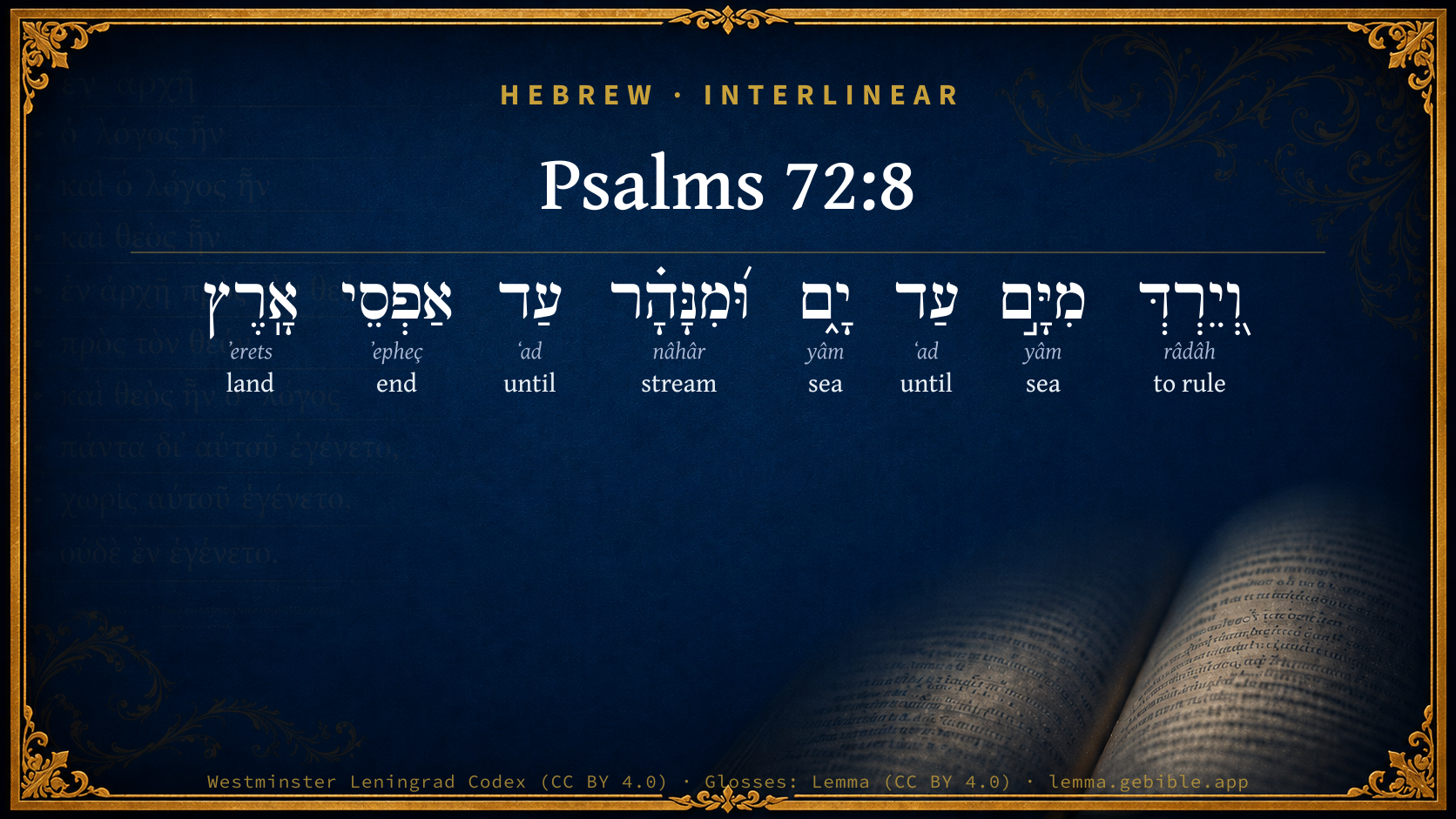
Psalms 72:8

Hebrew (Westminster Leningrad Codex) Psalms 72:8 appears in the Hebrew Old Testament. The text above is from the Westminster Leningrad Codex. Each word links to its Strong’s number, a concise gloss, and parsing drawn from the Open Scriptures Hebrew Bible morphology. Click any word for its full Brown-Driver-Briggs (BDB) entry.
Download image
Cite this verse

Psalms 72:8 (World English Bible). Public Domain. Lemma interlinear Bible study tool, https://lemma.gebible.app/v/psalms/72/8.

Show BibTeX & RIS
BibTeX
RIS
English Translation
He shall have dominion also from sea to sea, From the River to the ends of the earth.
World English Bible · Public Domain
Download a study sheet

One document with this verse’s original text, its word-by-word gloss line, the meaning frame, cross-references with their text, attributed commentary, and full source and license credits — printable, and it pastes into notes with its structure intact.

This verse Autodidact and up

Study sheet (.html) Plain text (.txt)

A passage Seminary Student

Up to 50 verses in one chapter. A passage sheet keeps up to 6 commentary sources and 12 cross-references per verse, in the order this page ranks them, and says so on the sheet whenever that leaves anything out. Ask for a single verse and you get the Autodidact verse sheet above.

Everything on this page stays free to read, with no account — the sheet is a download of what is already on screen, not access to it.

Want to remove ads? Support Godless Engineer
Compare translations 3

The same verse in 3 English versions, stacked beneath the original-language interlinear above. Click any original word for its lexicon entry.

Each is an independent rendering of the whole verse — the interlinear is not word-aligned to these translations.

Highlighted words mark where these versions differ — a whole-verse word diff, not a word-by-word alignment.

  • World English Bible Public Domain
    He shall have dominion also from sea to sea, From the River to the ends of the earth.
  • King James Version Public Domain
    He shall have dominion also from sea to sea, and from the river unto the ends of the earth.
  • unfoldingWord Literal Text CC BY-SA 4.0
    May he rule from sea to sea and from the River to the ends of the earth.

unfoldingWord Literal Text — © unfoldingWord, licensed CC BY-SA 4.0. Word-aligned USFM3 via Door43 (git.door43.org/unfoldingWord/en_ult).

Versions to compare (up to 4)

3 of 4 selected

Show all 18 translations

Every available English version of this verse, each an independent rendering of the whole verse.

  • World English Bible Public Domain
    He shall have dominion also from sea to sea, From the River to the ends of the earth.
  • Berean Standard Bible Public Domain
    May he rule from sea to sea, and from the Euphrates to the ends of the earth.
  • Majority Standard Bible Public Domain
    May he rule from sea to sea, and from the Euphrates to the ends of the earth.
  • King James Version Public Domain
    He shall have dominion also from sea to sea, and from the river unto the ends of the earth.
  • American Standard Version (1901) Public Domain
    He shall have dominion also from sea to sea, And from the River unto the ends of the earth.
  • Revised Version (1885) Public Domain
    He shall have dominion also from sea to sea, and from the River unto the ends of the earth.
  • Geneva Bible (1599) Public Domain
    His dominion shall be also from sea to sea, and from the Riuer vnto the endes of the land.
  • Douay-Rheims (1899) Public Domain
    And he shall rule from sea to sea, and from the river unto the ends of the earth.
  • Young's Literal Translation Public Domain
    And he ruleth from sea unto sea, And from the river unto the ends of earth.
  • Literal Standard Version CC BY-SA 4.0
    And He rules from sea to sea, || And from the river to the ends of the earth.
  • Unlocked Literal Bible CC BY-SA 4.0
    May he have dominion from sea to sea, and from the River to the ends of the earth.
  • unfoldingWord Literal Text CC BY-SA 4.0
    May he rule from sea to sea and from the River to the ends of the earth.
  • Darby Bible Public Domain
    And he shall have dominion from sea to sea, and from the river unto the ends of the earth.
  • World Messianic Bible Public Domain
    He shall have dominion also from sea to sea, from the River to the ends of the earth.
  • Webster's Bible Public Domain
    He shall have dominion also from sea to sea, and from the river to the ends of the earth.
  • Free Bible Version CC BY-SA 4.0
    May he rule from sea to sea, from the river to the ends of the earth.
  • Bible in Basic English Public Domain
    Let his kingdom be from sea to sea, from the River to the ends of the earth.
  • JPS Tanakh (1917) Public Domain
    May he have dominion also from sea to sea, and from the River unto the ends of the earth.

Literal Standard Version (2020), Covenant Press — licensed CC BY-SA 4.0. Text via the HelloAO Bible API (eBible.org). Unlocked Literal Bible (unfoldingWord) — licensed CC BY-SA 4.0. Text via the HelloAO Bible API (eBible.org). unfoldingWord Literal Text — © unfoldingWord, licensed CC BY-SA 4.0. Word-aligned USFM3 via Door43 (git.door43.org/unfoldingWord/en_ult). Free Bible Version, Dr. Jonathan Gallagher — licensed CC BY-SA 4.0. Text via the HelloAO Bible API (eBible.org).

Word by word

More ways to search: Search by grammar → Find every occurrence → Compare this word →

Practice this passage: Drill this verse → Learn its vocabulary →

About this verse

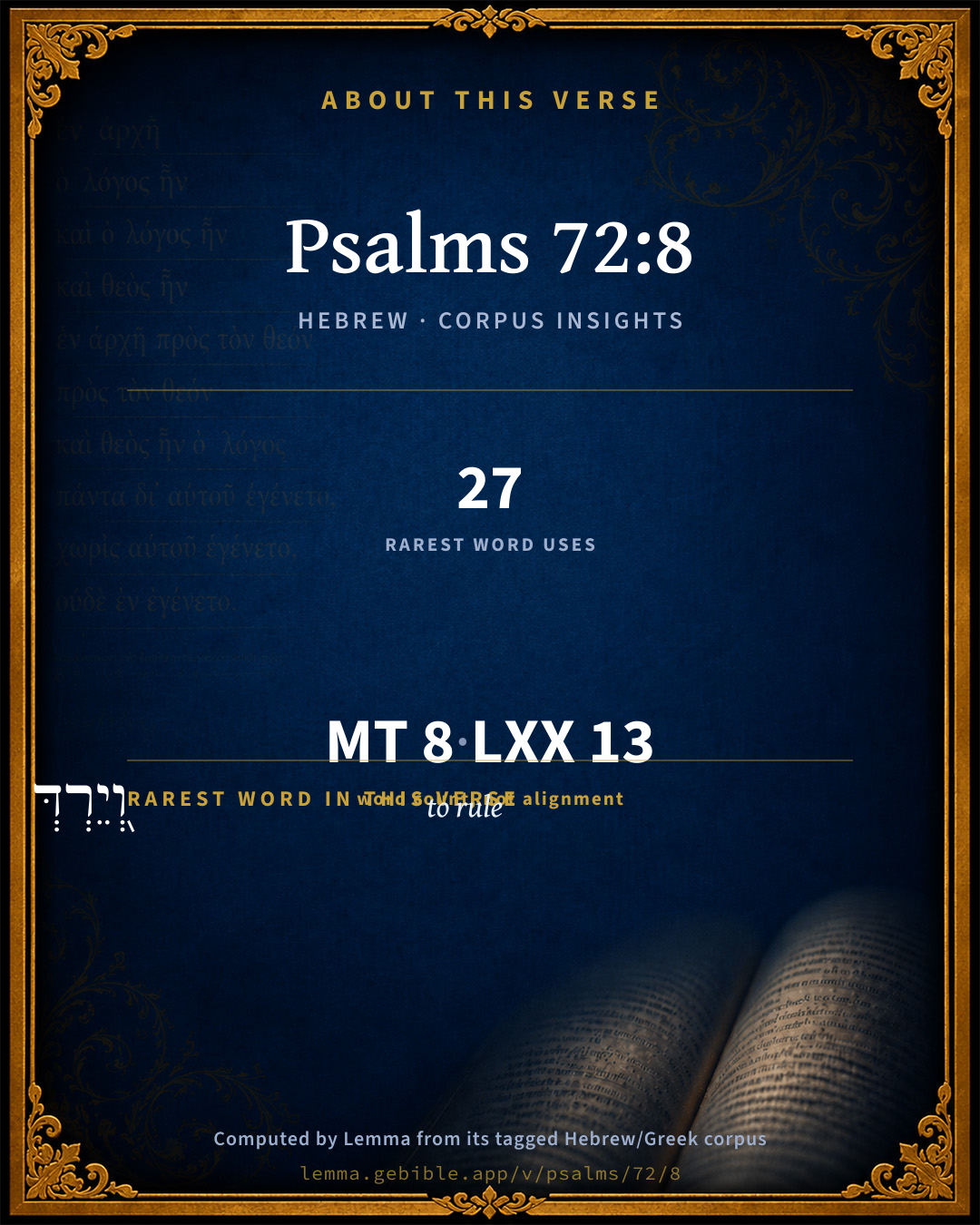
These counts appear in no published source. They are computed here, from the morphology-tagged text and Lemma’s own curated glosses. What Lemma adds →

8
words
6
distinct lemmas
Wisdom
section

Shared distinctive vocabulary

וְ֭יֵרְדְּ to rule H7287 occurs in 25 verses of the Hebrew Bible. Also found in:

Grammatical profile

  • 1 verb
  • 5 nouns
  • 2 prepositions

Verb forms

  • וְ֭יֵרְדְּ Qal · Jussive

Repetition

Words recur within this verse — often emphatic in Hebrew:

  • מִיָּ֣ם sea H3220 ×2
  • עַד until H5704 ×2

Hebrew & Septuagint length

In English translation the verse runs 18 words from the Hebrew and 19 from the Septuagint (LXX English) — closely comparable.

A rough comparison of the two English renderings, which tokenize alike — not a word-level alignment.

Word counts can differ between the Hebrew and the Greek without any difference in meaning — e.g. the Hebrew direct-object marker אֵת has no separate Greek word, and Greek often adds the article ὁ.

In the original languages it is 8 Hebrew tokens and 13 Greek tokens — but the two are counted differently (Hebrew bundles its prefixes and suffixes into one token; the Greek is in lemma form), so that isn’t a like-for-like length.

Cross-references

9

Topical passages linked to Psalms 72:8 in the Treasury of Scripture Knowledge — connected by theme and wording, ordered by reader-vote popularity; previews shown in the World English Bible.

  • Exodus 23:31 I will set your border from the Red Sea even to the sea of the Philistines, and from the wilderness to the River; for I will deliver the inhabitants of the land into your hand, and you shall drive them out before you.
  • Zechariah 9:10 I will cut off the chariot from Ephraim, And the horse from Jerusalem; And the battle bow will be cut off; And he will speak peace to the nations: And his dominion will be from sea to sea, And from the River to the ends of the earth.
  • 1 Kings 4:21–24 Solomon ruled over all the kingdoms from the River to the land of the Philistines, and to the border of Egypt: they brought tribute, and served Solomon all the days of his life.
  • Psalms 2:8 Ask of me, and I will give the nations for your inheritance, The uttermost parts of the earth for your possession.
  • Psalms 80:11 It sent out its branches to the sea, Its shoots to the River.
  • Psalms 89:25 I will set his hand also on the sea, And his right hand on the rivers.
  • Psalms 22:27–28 All the ends of the earth shall remember and turn to Yahweh. All the relatives of the nations shall worship before you.
  • Psalms 89:36 His seed will endure forever, His throne like the sun before me.
  • Revelation 11:15 The seventh angel sounded, and great voices in heaven followed, saying, "The kingdom of the world has become the Kingdom of our Lord, and of his Christ. He will reign forever and ever!"

Cross-references courtesy of OpenBible.info (CC BY 4.0).

Hebrew and Greek witnesses Masoretic Hebrew ↔ Greek Septuagint

The same verse in the two great witnesses to the Old Testament, shown verse-for-verse.

You’re reading Greek Psalm 71 (Hebrew Psalm 72). The Septuagint counts the superscription, so verse numbers can differ from the Hebrew — chapter-level alignment, not verse-by-verse. Numbering follows Rahlfs.

These are two independent witnesses, not word-aligned to each other, and the Septuagint is shown in lemma (dictionary) form.

Hebrew Psalms 72:8 Masoretic · Westminster Leningrad Codex

וְ֭יֵרְדְּ מִיָּ֣ם עַד יָ֑ם וּ֝מִנָּהָ֗ר עַד אַפְסֵי אָֽרֶץ

He shall have dominion also from sea to sea, From the River to the ends of the earth.

World English Bible · Public Domain

Greek LXX Greek Psalm 71:8 Septuagint · lemma form

καί κατακυριεύω ἀπό θάλασσα ἕως θάλασσα καί ἀπό ποταμός ἕως πέρας ὁ οἰκέω

And he shall have dominion from sea to sea, and from the river to the ends of the earth.

LXX2012 (modern English Septuagint) · Public Domain

Hebrew: Westminster Leningrad Codex (CC BY 4.0). Greek: Septuagint (public domain); English from LXX2012 (modern English Septuagint) (Public Domain). How the Septuagint differs from the Hebrew →

Commentary

Notes on Psalms 72:8 from classic Christian and Jewish commentators (each source and its license shown beneath its notes). The classic Christian expositions comment on the surrounding passage and are grouped to its opening verse, so a note may address several verses; the Jewish commentaries on the Tanakh (Rashi and others) are per-verse, so they appear only where the commentator wrote on this verse.

Lemma curates 59 commentaries, every one of them public domain or Creative Commons licensed, each selected and text-cleaned for this edition rather than reprinted as found. About our sources →

Trapp's Complete Commentary

John Trapp

Psa 72:8 He shall have dominion also from sea to sea, and from the river unto the ends of the earth.

Ver. 8. He shall have dominion also from sea to sea] Solomon shall, from the Mediterranean, in the west, to the Persian Sea, or Indian Ocean, in the east.

And from the river unto the ends of the earth] i.e. From Euphrates, and the northern countries, to Egypt, and the uttermost parts of all Africa. This was a type of Christ’s universal dominion throughout the whole world, Zec 9:9 Psa 110:1.

John Trapp, A Commentary or Exposition upon All the Books of the Old and New Testament (1647–1656) — public domain. Text from a community e-Sword module.

Joseph Benson's Commentary

Psa 72:8. He shall have dominion from sea to sea — Either, 1st, From the Sinus Arabicus, or Red sea, to the Mediterranean sea, for so far Solomon’s dominion extended; but so did David’s also; and, therefore, in that respect Solomon has not that pre-eminence, which this promise plainly seems to give him, above his predecessors. Or, rather, 2d, More generally from one sea to another, or in all parts of the habitable world. In which sense it is truly and fully accomplished in Christ, and in him only. And from the river — Namely, Euphrates: which was the eastern border of the kingdom of Canaan, allotted by God, (Exo 23:31; Num 34:3,) but possessed only by David and Solomon; unto the ends of the earth — To the border of Egypt, or the tract of country along the Mediterranean sea, the end of the land of Canaan. But if understood of the kingdom of Christ, the expression means literally to the remotest parts of the earth, or throughout the whole world. Thus, Psa 2:8, I will give thee the heathen for thine inheritance, and the uttermost parts of the earth for thy possession.

Joseph Benson's Commentary on the Old and New Testaments (1811–1818) — public domain. Text from a community e-Sword module.

Whedon's Commentary on the Bible

Daniel D. Whedon

8. In the preceding verses are set forth the character and duration of Messiah’s kingdom; Psa_72:8-11 chiefly describe the extent of his dominion. The words from sea to sea, and from the river unto the ends of the earth, are nowhere used to describe Palestine, or the political dominion of David or Solomon. Outside of Palestine the Hebrews, at this period, were acquainted with no seas but the Mediterranean and Red Seas.

These are specifically named in bounding the Hebrew dominion. Thus, in Exo_23:31, God says: “I will set thy bounds from the Red Sea, even unto the Sea of the Philistines, [Mediterranean,] and from the Desert [of Arabia] unto the River” [Euphrates]. These are definite geographical limits, and this extent of dominion was literally attained and enjoyed under both David and Solomon. But very different from this is the language of the text. “From the Red Sea to the Sea of the Philistines,” is not the same as “from sea to sea;” and “from the Desert [of Arabia] to the River [Euphrates,]” bears no comparison with the all-comprehensive language, “from the River [Euphrates] to the ends of the earth.” No allowance for the oriental imagination can make them equal, or interpret the latter as less than universal, beginning, as it does, at the utmost limit of Solomon’s dominion, and carrying that of Messiah “to the ends of the earth.” And to this sense the connexion agrees. Psa_72:9-11; Psa_72:15. These words of the psalmist are quoted (Zec_9:10) in a passage confessedly Messianic, to describe the extent of the dominion of “Zion’s king.”

Daniel D. Whedon (gen. ed.), Commentary on the Old and New Testaments (1874–1909) — public domain. Text from a community e-Sword module.

J. A. Alexander on Psalms

Joseph Addison Alexander

Psa 72:8. And he shall rule from sea to sea, and from the river to the ends of the earth. There is here an obvious allusion to the limits of the land of promise, as defined in Exo 23:31; but that these are not directly intended in the case before us, is clear from the mention of foreign kings and nations in the following verses. The meaning rather is, that as the realm of the theocratic kings was bounded by the Mediterranean and the Euphrates, that of the Messiah, whom they represented, should extend from sea to sea, i.e. from any sea to any other, even the most distant, or from any sea around to the same point again, and from the river (Euphrates), or from any other river, as a terminus a quo, to the ends of the earth. In other words, it should be universal. The same mode of describing the extent of Christ's dominion is adopted by the prophets. See Zec 8:10, and compare Amo 8:12, Mic 7:12.

Joseph Addison Alexander, The Psalms Translated and Explained (1850) — public domain. Text from a community e-Sword module.

Tyndale Open Study Notes

Tyndale Open Resources

72:8-11 The anointed king will rule over the whole world. Even hostile nations will submit to him. In the ancient Near East, bearing gifts to the king acknowledged his success and his reputation (see 1 Kgs 10).

72:8-9 from sea to sea: This phrase represents the whole world. • Solomon’s kingdom extended from the Euphrates River in the east to the Philistine territory in the west (1 Kgs 4:21; see Pss 80:8-11; 89:19-25), where the Mediterranean Sea appeared to be at the ends of the earth (see 2:8). Everyone will bow before this king, including the desert nomads (72:9), his enemies, and all the kings of the world (see Mic 7:17).

Tyndale Open Study Notes — © Tyndale Open Resources, licensed CC BY-SA 4.0. Text via the HelloAO Bible API.

Geneva Bible (1599)

Geneva Bible translators

That is, from the red sea to the sea called Syriacum, and from Euphrates forward, meaning, that Christ’s Kingdom should be large and universal.

Geneva Bible (1599) marginal notes — public domain. Text via Bolls.life.

Adam Clarke's Commentary

Verse 8. He shall have dominion also from sea to sea] The best comment on this, as it refers to Solomon, may be found in 1Kg 4:21; 1Kg 4:24: "And Solomon reigned over all kingdoms, from the river unto the land of the Philistines, and unto the border of Egypt; for he had dominion over all on this side the river, from Tiphsah even to Azzah, over all the kings on this side the river; and he had peace on all sides round about him."

Solomon, it appears, reigned over all the provinces from the river Euphrates to the land of the Philistines, even to the frontiers of Egypt. The Euphrates was on the east of Solomon's dominions; the Philistines were westward, on the Mediterranean sea; and Egypt was on the south. Solomon had therefore, as tributaries, the kingdoms of Syria, Damascus, Moab, and Ammon, which lay between the Euphrates and the Mediterranean. Thus he appears to have possessed all the land which God covenanted with Abraham to give to his posterity.

Unto the ends of the earth.] Or land, must mean the tract of country along the Mediterranean sea, which was the boundary of the land on that side: but, as the words may refer to Christ, every thing may be taken in its utmost latitude and extent.

Adam Clarke's Commentary on the Bible (1810–1826) — public domain. Text from a community e-Sword/MySword module.

John Calvin's Commentaries

8 He shall have dominion from sea to sea. As the Lord, when he promised his people the land of Canaan for an inheritance, assigned to it these four boundaries, (Genesis 15:18,) David intimates, that so long as the kingdom shall continue to exist, the possession of the promised land will be entire, to teach the faithful that the blessing of God cannot be fully realised, except whilst this kingdom shall flourish. He therefore declares that he will exercise dominion from the Red Sea, or from that arm of the Egyptian sea to the sea of Syria, which is called the Sea of the Philistines, and also from the river Euphrates to the great wilderness. If it is objected that such narrow bounds do not correspond with the kingdom of Christ, which was to be extended from the rising of the sun to the going down thereof, we reply, that David obviously accommodates his language to his own time, the amplitude of the kingdom of Christ not having been, as yet, fully unfolded. He has therefore begun his description in phraseology well known, and in familiar use under the law and the prophets; and even Christ himself commenced his reign within the limits here marked out before he penetrated to the uttermost boundaries of the earth; as it is said in Psalm 110:2,

“The Lord shall send the rod of thy strength out of Zion.”

But, soon after, the Psalmist proceeds to speak of the enlarged extent of the empire of this king, declaring that the kings beyond the sea shall also be tributaries to him; and also that the inhabitants of the desert shall receive his yoke. The word ציים, tsiim, which we have translated inhabitants of the desert, is, I have no doubt, to be understood of those who, dwelling towards the south, were at a great distance from the land of Canaan. The Prophet immediately adds, that the enemies of the king shall lick the dust in token of their reverence. This, as is well known, was in ancient times a customary ceremony among the nations of the East; and Alexander the Great, after he had conquered the East, wished to compel his subjects to practice it, from which arose great dissatisfaction and contentions, the Macedonians disdainfully refusing to yield such a slavish and degrading mark of subjection. The meaning then is, that the king chosen by God in Judea will obtain so complete a victory over all his enemies, far and wide, that they shall come humbly to pay him homage.

John Calvin's Commentaries (1540-1563) — public domain. Text from the Calvin Translation Society English edition (1840s-50s) via the Christian Classics Ethereal Library (ccel.org). Calvin's coverage is partial (roughly two-thirds of the Bible); uncommented books and verses are honest gaps, never fabricated. The 19th-century editor's footnotes and remarks are omitted so the notes are faithfully Calvin's own voice.

Ellicott's Commentary for English Readers

(8) He shall have. . . .—The original is more poetical, recalling the root idea of the verb, “may he tread down (the nations) from sea to sea.”

That the river in the next clause is the Euphrates there can be no question, but are we, therefore, to see precise geographical limits in the expression “from sea to sea” (from the Mediterranean to the Red Sea), as in Exo_23:31, or is it merely poetical for a wide extent of empire? The vague and general expression, “ends of the earth,” which takes the place of the definite “desert,” in the passage of Exodus, makes in favour of the latter view. So, too, do the hyperbolic expressions in Psa_72:5; Psa_72:11; Psa_72:17. On the other hand, Psa_72:10 mentions particular places. The same phrase in Zec_9:10 describes the Messianic kingdom, and is certainly poetical, but whether that or this passage is the original is doubtful.

A Bible Commentary for English Readers, edited by Charles John Ellicott (1878–1897) — public domain. Text from a community e-Sword module.

The Cambridge Bible for Schools and Colleges

gen. ed. J. J. S. Perowne

8. He shall have dominion also] Render, And may he have dominion. The form of the verb here is decisive in favour of rendering as a wish or prayer, and governs the meaning of the verbs in Psa_72:9-11, which should all be similarly rendered.

from sea to sea &c.] The words are a poetical generalisation of the promise to Israel in Exo_23:31, “I will set thy border from the Red Sea even unto the sea of the Philistines, and from the wilderness unto the River”; and of the language in which Solomon’s empire is described, 1Ki_4:21; 1Ki_4:24 (where note the use of the same word to have dominion). If any definite seas are intended, they would be the Mediterranean on the West, and the Red Sea or the Indian Ocean on the East; but more probably the phrase is quite general, meaning, ‘as far as the land extends’ (Amo_8:12; Mic_7:12). The River (rightly spelt in R.V. with a capital, as denoting the River par excellence) is the Euphrates: the ends of the earth (the same words as the uttermost parts of the earth in Psa_2:8) are the remotest parts of the known world. Extension, not limit, is the idea conveyed. The world belongs to God: may He confer upon His representative a world-wide dominion! a hope to be realised only in the universal kingdom of Christ. Almost the same words recur in Zec_9:10, and the son of Sirach combines them with the promise to Abraham in Sir_44:21.

8–14. May all nations submit to this best of rulers, recognising the paramount claim of moral supremacy.

The Cambridge Bible for Schools and Colleges (gen. ed. J. J. S. Perowne; Cambridge University Press, 1878–1918) — public domain. Text from a community e-Sword module.

John Gill's Exposition

He shall have dominion also from sea to sea,.... The same is said of the Messiah in Zac 9:10; where he is manifestly spoken of as here, and regards the extent of his dominion; not over the land of Israel only, as some think; but over the Gentile world, through the preaching of the Gospel in the several parts of it; and especially as it will be in the latter day, when the kingdoms of this world will be his, and he will be King over all the earth; see Rev 17:14; which cannot agree with Solomon, whose dominion reached only to the land of the Philistines, to the border of Egypt, Kg1 4:21; but Christ's dominion will be, as it follows,

and from the river unto the ends of the earth; which, as Kimchi owns, is clear, if applied to the Messiah, since his government shall be over all the world. The note of Aben Ezra on the text is worthy of regard.

"If this is said concerning Solomon, the meaning is, from the Red sea to the sea of the Philistines; and from the river, this is Euphrates; and the ends of the earth mean the wilderness; (see Exo 23:31); and, lo, mention is made of the length and breadth of the land of Israel: and if of the Messiah, the sense is, from the south sea, which is called the Idumean sea, to the northern sea, which is the sea of the ocean; and from the river, the river that goes out of Eden at the beginning of the east, unto the ends of the earth, which is at the end of the west;''

though rather the sense is, from the Indian ocean, the great sea, unto the Mediterranean sea; and from the river Euphrates to the end of the world. This text is applied to the Messiah by many Jewish writers (z), ancient and modern.

(z) Raya Mehimna in Zohar in Exod. fol. 49. 4. Bemidbar Rabba, s. 13. fol. 209. 4. Baal Hatturim in Num. fol. 178. 4. R. Nachman. Disput. cum fratre Paulo, p. 41.

John Gill's Exposition of the Whole Bible (1746–1763) — public domain (CC PDM 1.0). Text via the HelloAO Bible API.

Albert Barnes' Notes on the Bible

He shall have dominion also from sea to sea - There is probably an allusion here to the promise in Exo 23:31 : “And I will set thy bounds from the Red Sea even unto the sea of the Philistines, and from the desert unto the river.” This was the original promise in regard to the bounds of the promised land. A promise similar to this occurs also in Gen 15:18 : “In the same day the Lord made a covenant with Abram, saying, Unto thy seed have I given this land, from the river of Egypt unto the great river, the river Euphrates.” The meaning here is, that what was implied in these ancient promises would be carried out under the reign of the king referred to in the psalm. The “immediate” allusion, therefore, in the phrase “from sea to sea,” may have been from the Red Sea on the East to the Mediterranean on the West; but still the language is susceptible of a more enlarged application, and may mean from one sea to another; that is, embracing all the lands or countries lying between seas and oceans; or, in other words, that the dominion would be universal. Compare the notes at Psa 2:8.

And from the river ... - The Euphrates. This was emphatically “the river” to the Hebrews - the great river - the greatest river known to them; and this river would be naturally understood as intended by the expression, unless there was something to limit it. Besides, this was expressly designated in the original covenant as the boundary of the promised land. See, as above, Gen 15:18. The meaning here is, that, taking that river as one of the boundaries, or as a starting point, the dominion would extend from that to the utmost limits of the earth. It would have no other boundary but the limits of the world. The promise, therefore, is, that the dominion would be universal, or would pervade the earth; at once a kingdom of peace, and yet spreading itself all over the world. It is hardly necessary to say that this did not occur under Solomon, and that it could not have been expected that it would occur under him, and especially as it was expected that his reign would be one of peace and not of conquest. It would find its complete fulfillment only under the Messiah.

Albert Barnes' Notes on the Bible (1834–1885) — public domain. Text from a community e-Sword/MySword module.

Matthew Poole's English Annotations

From sea to sea; either,

1. From the Dead Sea or the Lake of Sodom, or from the Red Sea, to the Midland Sea; for so far did Solomon’s dominion extend: but so did David’s also; and therefore in that respect Solomon hath not that pre-eminence which this promise plainly seems to give him above his predecessors. Or,

2. More generally from one sea to another, or in all the parts of the habitable world. So it was truly and fully accomplished in Christ, and in him only.

The river, to wit, Euphrates, which was the eastern border of the kingdom of Canaan allotted by God, Exo 23:31; Num 34:3, but enjoyed only by David and Solomon, and afterwards by Christ; of whose kingdom this may be here mentioned, as one of the borders; partly because the kingdom of Christ is here described under the type and shadow of Solomon’s kingdom, whose bound this was; and partly because though Christ’s kingdom did for a time extend itself beyond Euphrates, yet the chief part, and almost the whole body of it, both did and doth lie on this side of it; and things do generally receive their denomination from the greatest part.

The ends of the earth; either,

1. Of the land of Canaan. Or,

2. Of the world.

Matthew Poole's English Annotations on the Holy Bible (1683–1685) — public domain. Text from a community e-Sword/MySword module.

The Treasury of David

Charles H. Spurgeon

Ver. 8. He shall have dominion also from sea to sea. Wide spread shall be the rule of Messiah; only the Land's End shall end his territory: to the Ultima Thule shall his sceptre be extended. From Pacific to Atlantic, and from Atlantic to Pacific, he shall be Lord, and the oceans which surround each pole shall be beneath his sway. All other power shall be subordinate to his; no rival nor antagonist shall he know. Men speak of the Emperor of all the Russias, but Jesus shall be Ruler of all mankind.

And from the river unto the ends of the earth. Start where you will, by any river you choose, and Messiah's kingdom shall reach on to the utmost bounds of the round world. As Solomon's realm embraced all the land of promise, and left no unconquered margin; so shall the Son of David rule all lands given him in the better covenant, and leave no nation to pine beneath the tyranny of the prince of darkness. We are encouraged by such a passage as this to look for the Saviour's universal reign; whether before or after his personal advent we leave for the discussion of others. In this Psalm, at least, we see a personal monarch, and he is the central figure, the focus of all the glory; not his servant, but himself do we see possessing the dominion and dispensing the government. Personal pronouns referring to our great King are constantly occurring in this Psalm; he has dominion kings fall down before him, and serve him; for he delivers, he spares, he saves, he lives, and daily is he praised.

Ver. 8. From the river. There are many modern interpreters who, from the mention of the "river" --namely, the river Euphrates--in the other clause of the verse, think that the boundaries of the land of Palestine are here to be understood, that country being described as extending from the Red Sea to the Sea of Syria, otherwise called the Sea of the Philistines, and the Great Sea; and from the Euphrates to the Great Desert lying behind Palestine and Egypt. These are the limits of the Israelitish territory: the former, from the south to the west; the latter, from the north to the east. (Ge 15:18.) But, in this passage, there can scarcely be a doubt that by the river --to wit, the Euphrates--is indicated the extreme boundary of the earth towards the east. In a highly poetical, magnificent description, such as is given in this song, of a king exalted above all others, nothing can be conceived more inappropriate than saying that the dominions of such a king should be bounded by the limits of Palestine. Ernest F. C. Rosenmueller (1768-1835), in "The Biblical Cabinet, " vol. 32.

Ver. 8. The universal spread of the gospel. Other theories as to the future overturned, and their evil influence exposed; while the benefit and certainty of this truth is vindicated.

Psalms 72:9*

Charles H. Spurgeon's The Treasury of David (1869–1885) — public domain. Psalms only. Text from a community e-Sword/MySword module.

The Pulpit Commentary

He shall have dominion also from sea to sea. It does not appear that any particular seas are meant, as in Exo_23:31 and Num_34:3, Num_34:6; rather, the idea is that the earth is set in the midst of the sea, and that Messiah"s dominion will reach from shore to shore. And from the river (i.e. the Euphrates) unto the ends of the earth. Israel"s promised dominion extended only as far as the great river, (Gen_15:18) which was also the boundary of Solomon"s kingdom eastward; (1Ki_4:21, 1Ki_4:24) Messiah"s was to reach indefinitely beyond the river to the world"s end.

The Pulpit Commentary (1880–1919), ed. H.D.M. Spence-Jones & Joseph S. Exell — public domain. Text from a community e-Sword module.

John Wesley's Explanatory Notes

Dominion - From one sea to another, or in all the parts of the habitable world. This was accomplished in Christ, and in him only. The river - Euphrates: which was the eastern border of the kingdom of Canaan, allotted by God, but enjoyed only by David, Solomon, and Christ. Of whose kingdom this may be mentioned, as one of the borders; because the kingdom of Christ is described under the shadow of Solomon's kingdom.

John Wesley, Explanatory Notes Upon the Whole Bible (1754–1765) — public domain. Text via the GEBible commentary corpus.

unfoldingWord translationNotes

Door43 World Missions Community

May he have dominion

"May the king have dominion"

from sea to sea, and from the River to the ends of the earth

Both of these expressions are merisms and refer to the whole earth. (See: Merism)

from sea to sea

from the Dead Sea and the Sea of Kinnereth in the east to the Mediterranean Sea in the west.

the River

"the Euphrates River," which the Israelites would travel to on land by going north

the ends of the earth

as far as people could travel on land by different routes to the south. The Israelites spoke of the earth as if it were a flat surface with ends. (See: Metaphor and Idiom)

lick the dust

This is a metaphor for extreme humiliation. AT: "do everything they can so he will allow them to live" (See: Metaphor)

Tarshish

the name of a place (See: How to Translate Names)

render

pay

offer gifts

"give gifts"

Seba

This is the name of a country. It is not the same country as Sheba. (See: How to Translate Names)

translationWords

dominion

Euphrates River

desert

bow

adversary

king

Tarshish

tribute

Sheba

gift

unfoldingWord translationNotes — © Distant Shores Media and the Door43 World Missions Community, licensed CC BY-SA 4.0. Source: git.door43.org/Door43/en_tn.

Rashi

Rabbi Shlomo Yitzchaki (Rashi)

And may he reign from sea to sea All of the land of Israel is from the Sea of Reeds to the Sea of the Philistines [the Mediterranean].

and from the river to the ends of the land (I Kings 5:4): “For he had dominion over all [the inhabitants of] this side of the river, etc.”

Rashi on the Tanakh — English translations: “The Judaica Press complete Tanach with Rashi, translated by A. J. Rosenberg” (CC BY 4.0); “Pentateuch with Rashi's commentary by M. Rosenbaum and A.M. Silbermann, 1929-1934” (public domain); “The Metsudah Tanach series, Lakewood, N.J” (CC BY 4.0); and “The Book of Joshua, Metsudah Publications, 1997” (CC BY 4.0). Text via Sefaria.

Lesson kit

Teaching starters — assembled from the data on this page, not authored interpretation. Every prompt links to the verse data it draws on. Edit before teaching.

Psalms, in the Wisdom, opens this verse with 8 words (6 distinct Hebrew lemmas). Its most distinctive word is râdâh (“to rule”). A historical commentator’s framing appears above. Read the whole chapter for the surrounding context.

Discussion questions

  1. How does “to rule” (râdâh) shape what this verse is saying?
  2. How does Genesis 1:26, which shares the word «to rule», read alongside this verse?
  3. What does the repetition of “sea” (2× in this one verse) do in this verse?
  4. The translations on this page render this verse differently — a whole-verse word diff, not a word-by-word alignment. What might account for the different wordings?
  5. «וְ֭יֵרְדְּ» is a Qal Jussive verb. How does that grammatical form shape the action described?
  6. Compare how Trapp's Complete Commentary and Joseph Benson's Commentary read this verse. Where do they agree or differ?

Things to notice

Reading settings

Reading text

Shown beneath each verse's original-language words.

Old Testament
Old Testament edition

Read the OT as the Masoretic Hebrew (MT) or the Greek Septuagint (LXX).

English shown for the Greek Septuagint (in the Hebrew ↔ Greek comparison).

Comparing translations? Open the Compare panel on any verse page to stack up to four side by side.