
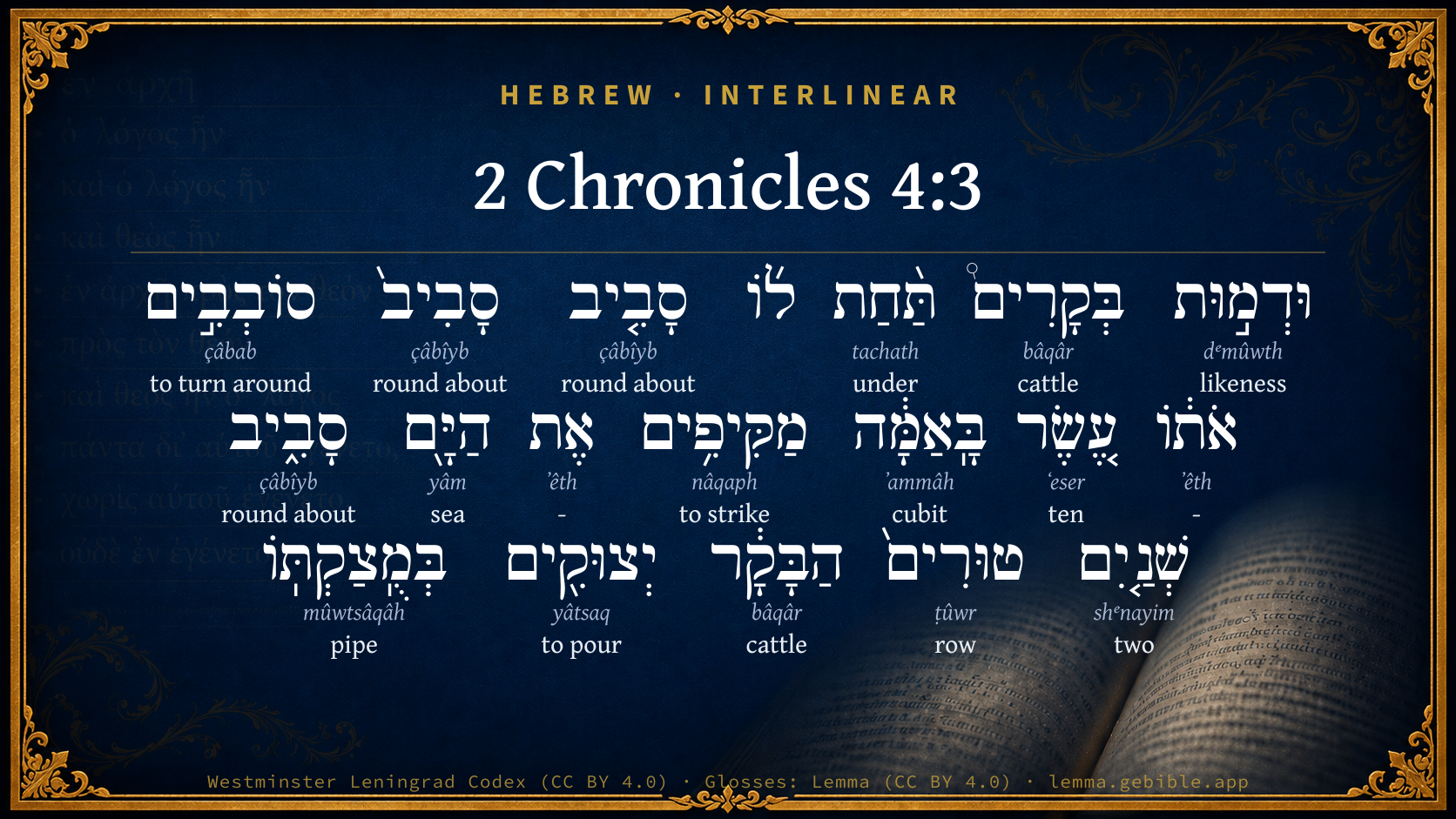
2 Chronicles 4:3

Hebrew (Westminster Leningrad Codex) 2 Chronicles 4:3 appears in the Hebrew Old Testament. The text above is from the Westminster Leningrad Codex. Each word links to its Strong’s number, a concise gloss, and parsing drawn from the Open Scriptures Hebrew Bible morphology. Click any word for its full Brown-Driver-Briggs (BDB) entry.
Download image
Cite this verse

2 Chronicles 4:3 (World English Bible). Public Domain. Lemma interlinear Bible study tool, https://lemma.gebible.app/v/2-chronicles/4/3.

Show BibTeX & RIS
BibTeX
RIS
English Translation
Under it was the likeness of oxen, which did compass it round about, for ten cubits, compassing the sea round about. The oxen were in two rows, cast when it was cast.
World English Bible · Public Domain
Highlights
  • 1 first appearance in the Hebrew Bible
Full analysis ↓
Download a study sheet

One document with this verse’s original text, its word-by-word gloss line, the meaning frame, cross-references with their text, attributed commentary, and full source and license credits — printable, and it pastes into notes with its structure intact.

This verse Autodidact and up

Study sheet (.html) Plain text (.txt)

A passage Seminary Student

Up to 50 verses in one chapter. A passage sheet keeps up to 6 commentary sources and 12 cross-references per verse, in the order this page ranks them, and says so on the sheet whenever that leaves anything out. Ask for a single verse and you get the Autodidact verse sheet above.

Everything on this page stays free to read, with no account — the sheet is a download of what is already on screen, not access to it.

Want to remove ads? Support Godless Engineer
Compare translations 3

The same verse in 3 English versions, stacked beneath the original-language interlinear above. Click any original word for its lexicon entry.

Each is an independent rendering of the whole verse — the interlinear is not word-aligned to these translations.

Highlighted words mark where these versions differ — a whole-verse word diff, not a word-by-word alignment.

  • World English Bible Public Domain
    Under it was the likeness of oxen, which did compass it round about, for ten cubits, compassing the sea round about. The oxen were in two rows, cast when it was cast.
  • King James Version Public Domain
    And under it was the similitude of oxen, which did compass it round about: ten in a cubit, compassing the sea round about. Two rows of oxen were cast, when it was cast.
  • unfoldingWord Literal Text CC BY-SA 4.0
    And a likeness of oxen was under it all around; all around, surrounding it, 10 cubits, encircling the Sea all around; two rows of the oxen, cast in its cast metal.

unfoldingWord Literal Text — © unfoldingWord, licensed CC BY-SA 4.0. Word-aligned USFM3 via Door43 (git.door43.org/unfoldingWord/en_ult).

Versions to compare (up to 4)

3 of 4 selected

Show all 17 translations

Every available English version of this verse, each an independent rendering of the whole verse.

  • World English Bible Public Domain
    Under it was the likeness of oxen, which did compass it round about, for ten cubits, compassing the sea round about. The oxen were in two rows, cast when it was cast.
  • Berean Standard Bible Public Domain
    Below the rim, figures of oxen encircled it, ten per cubit all the way around the Sea, cast in two rows as a part of the Sea.
  • Majority Standard Bible Public Domain
    Below the rim, figures of oxen encircled it, ten per cubit all the way around the Sea, cast in two rows as a part of the Sea.
  • King James Version Public Domain
    And under it was the similitude of oxen, which did compass it round about: ten in a cubit, compassing the sea round about. Two rows of oxen were cast, when it was cast.
  • American Standard Version (1901) Public Domain
    And under it was the likeness of oxen, which did compass it round about, for ten cubits, compassing the sea round about. The oxen were in two rows, cast when it was cast.
  • Revised Version (1885) Public Domain
    And under it was the similitude of oxen, which did compass it round about, for ten cubits, compassing the sea round about. The oxen were in two rows, cast when it was cast.
  • Geneva Bible (1599) Public Domain
    And vnder it was ye facion of oxen, which did compasse it rounde about, tenne in a cubite compassing the Sea about: two rowes of oxen were cast when it was molten.
  • Young's Literal Translation Public Domain
    And the likeness of oxen `is' under it, all round about encompassing it, ten in the cubit, compassing the sea round about; two rows of oxen are cast in its being cast.
  • Literal Standard Version CC BY-SA 4.0
    And the likeness of oxen [is] under it, encompassing it all around, ten to the cubit, surrounding the sea around; two rows of oxen are cast in its being cast.
  • Unlocked Literal Bible CC BY-SA 4.0
    Under the brim encircling the sea were bulls, ten to each cubit, cast in one piece with the sea when the sea itself was cast.
  • unfoldingWord Literal Text CC BY-SA 4.0
    And a likeness of oxen was under it all around; all around, surrounding it, 10 cubits, encircling the Sea all around; two rows of the oxen, cast in its cast metal.
  • Darby Bible Public Domain
    And under it was the similitude of oxen, encompassing it round about, ten in a cubit enclosing the sea round about, two rows of oxen, cast when it was cast.
  • World Messianic Bible Public Domain
    Under it was the likeness of oxen, which encircled it, for ten cubits, encircling the sea. The oxen were in two rows, cast when it was cast.
  • Webster's Bible Public Domain
    And under it was the similitude of oxen, which encompassed it: ten in a cubit, encompassing the sea. Two rows of oxen were cast, when it was cast.
  • Free Bible Version CC BY-SA 4.0
    Below it were ornamental bulls all around it, ten per cubit. They were in two rows when it was all cast.
  • Bible in Basic English Public Domain
    And under it was a design of flowers all round it, ten to a cubit, circling the water-vessel in two lines; they were made from liquid metal at the same time as the water-vessel.
  • JPS Tanakh (1917) Public Domain
    And under it was the similitude of oxen, which did compass it round about, for ten cubits, compassing the sea round about. The oxen were in two rows, cast when it was cast.

Literal Standard Version (2020), Covenant Press — licensed CC BY-SA 4.0. Text via the HelloAO Bible API (eBible.org). Unlocked Literal Bible (unfoldingWord) — licensed CC BY-SA 4.0. Text via the HelloAO Bible API (eBible.org). unfoldingWord Literal Text — © unfoldingWord, licensed CC BY-SA 4.0. Word-aligned USFM3 via Door43 (git.door43.org/unfoldingWord/en_ult). Free Bible Version, Dr. Jonathan Gallagher — licensed CC BY-SA 4.0. Text via the HelloAO Bible API (eBible.org).

Word by word

More ways to search: Search by grammar → Find every occurrence → Compare this word →

Practice this passage: Drill this verse → Learn its vocabulary →

בְּמֻֽצַקְתּֽוֹ
mûwtsâqâh
H4166
“in/at · pipe · his”
Preposition + Noun, Common, Feminine, Singular, Construct + Suffix, Personal, 3rd Person, Masculine, Singular
Part of Speech
Preposition + Noun
Type
Common
Gender
Feminine
Number
Singular
State
Construct
Full BDB Definition

Origin: from H3332

TWOT: 897c

pipe - a casting
  1. וּדְמ֣וּת dᵉmûwth H1823 “and · likeness of” Conjunction + Noun, Common, Feminine, Singular, Construct
  2. בְּקָרִים֩ bâqâr H1241 “cattle” Noun, Common, Both, Plural, Absolute
  3. תַּ֨חַת tachath H8478 “under” Preposition
  4. סָבִ֤יב çâbîyb H5439 “round about” Noun, Common, Both, Singular, Absolute
  5. סָבִיב֙ çâbîyb H5439 “round about” Noun, Common, Both, Singular, Absolute
  6. סוֹבְבִ֣ים çâbab H5437 “turning around” Verb, Qal, Participle Active, Masculine, Plural, Absolute
  7. אֹת֔וֹ ʼêth H853 “- · him” Particle, Direct Object + Suffix, Personal, 3rd Person, Masculine, Singular
  8. עֶ֚שֶׂר ʻeser H6235 “ten” Adjective, Cardinal number, Feminine, Singular, Absolute
  9. בָּֽאַמָּ֔ה ʼammâh H520 “in/at the · cubit” Preposition, Determined + Noun, Common, Feminine, Singular, Absolute
  10. מַקִּיפִ֥ים nâqaph H5362 “striking” Verb, Hiphil, Participle Active, Masculine, Plural, Absolute
  11. אֶת ʼêth H853 “-” Particle, Direct Object
  12. הַיָּ֖ם yâm H3220 “the · sea” Particle, Definite Article + Noun, Common, Masculine, Singular, Absolute
  13. סָבִ֑יב çâbîyb H5439 “round about” Noun, Common, Both, Singular, Absolute
  14. שְׁנַ֤יִם shᵉnayim H8147 “two” Adjective, Cardinal number, Masculine, Dual, Absolute
  15. טוּרִים֙ ṭûwr H2905 “rows” Noun, Common, Masculine, Plural, Absolute
  16. הַבָּקָ֔ר bâqâr H1241 “the · cattle” Particle, Definite Article + Noun, Common, Both, Singular, Absolute
  17. יְצוּקִ֖ים yâtsaq H3332 “poured” Verb, Qal, Participle Passive, Masculine, Plural, Absolute

About this verse

These counts appear in no published source. They are computed here, from the morphology-tagged text and Lemma’s own curated glosses. What Lemma adds →

19
words
14
distinct lemmas
Historical
section

Notable vocabulary

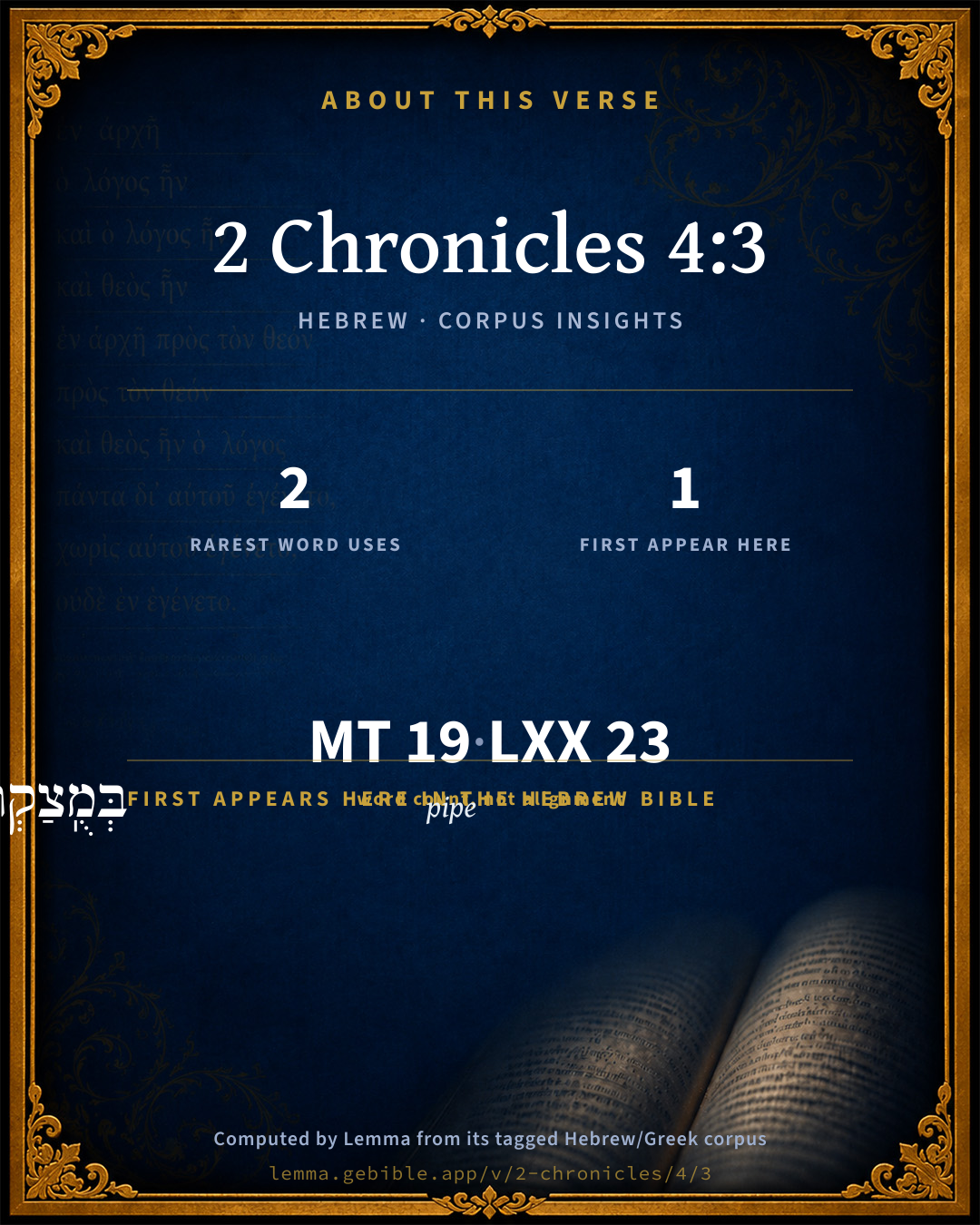
The rarest word here is בְּמֻֽצַקְתּֽוֹ pipe H4166 — appearing just 2 times in the whole Hebrew Bible.

First appearance in Scripture

This word makes its first canonical appearance in the Hebrew Bible here:

  • בְּמֻֽצַקְתּֽוֹ pipe H4166

Shared distinctive vocabulary

בְּמֻֽצַקְתּֽוֹ pipe H4166 occurs in 2 verses of the Hebrew Bible. Also found in:

Grammatical profile

  • 3 verbs
  • 10 nouns
  • 2 adjectives
  • 2 prepositions
  • 2 particles

Verb forms

  • סוֹבְבִ֣ים Qal · Participle Active
  • מַקִּיפִ֥ים Hiphil · Participle Active
  • יְצוּקִ֖ים Qal · Participle Passive

Repetition

Words recur within this verse — often emphatic in Hebrew:

  • סָבִ֤יב round about H5439 ×3
  • בְּקָרִים֩ cattle H1241 ×2

Hebrew & Septuagint length

In English translation the verse runs 32 words from the Hebrew and 28 from the Septuagint (LXX English) — closely comparable.

A rough comparison of the two English renderings, which tokenize alike — not a word-level alignment.

Word counts can differ between the Hebrew and the Greek without any difference in meaning — e.g. the Hebrew direct-object marker אֵת has no separate Greek word, and Greek often adds the article ὁ.

In the original languages it is 19 Hebrew tokens and 23 Greek tokens — but the two are counted differently (Hebrew bundles its prefixes and suffixes into one token; the Greek is in lemma form), so that isn’t a like-for-like length.

Cross-references

5

Topical passages linked to 2 Chronicles 4:3 in the Treasury of Scripture Knowledge — connected by theme and wording, ordered by reader-vote popularity; previews shown in the World English Bible.

  • 1 Kings 7:24–26 Under the brim of it round about there were buds which did compass it, for ten cubits, compassing the sea round about: the buds were in two rows, cast when it was cast.
  • Ezekiel 1:10 As for the likeness of their faces, they had the face of a man; and they four had the face of a lion on the right side; and they four had the face of an ox on the left side; they four had also the face of an eagle.
  • Ezekiel 10:14 Every one had four faces: the first face was the face of the cherub, and the second face was the face of a man, and the third face the face of a lion, and the fourth the face of an eagle.
  • 1 Corinthians 9:9–10 For it is written in the law of Moses, "You shall not muzzle an ox while it treads out the grain." Is it for the oxen that God cares,
  • Revelation 4:7 The first creature was like a lion, and the second creature like a calf, and the third creature had a face like a man, and the fourth was like a flying eagle.

Cross-references courtesy of OpenBible.info (CC BY 4.0).

Hebrew and Greek witnesses Masoretic Hebrew ↔ Greek Septuagint

The same verse in the two great witnesses to the Old Testament, shown verse-for-verse.

These are two independent witnesses, not word-aligned to each other, and the Septuagint is shown in lemma (dictionary) form.

Hebrew 2 Chronicles 4:3 Masoretic · Westminster Leningrad Codex

וּדְמ֣וּת בְּקָרִים֩ תַּ֨חַת ל֜וֹ סָבִ֤יב סָבִיב֙ סוֹבְבִ֣ים אֹת֔וֹ עֶ֚שֶׂר בָּֽאַמָּ֔ה מַקִּיפִ֥ים אֶת הַיָּ֖ם סָבִ֑יב שְׁנַ֤יִם טוּרִים֙ הַבָּקָ֔ר יְצוּקִ֖ים בְּמֻֽצַקְתּֽוֹ

Under it was the likeness of oxen, which did compass it round about, for ten cubits, compassing the sea round about. The oxen were in two rows, cast when it was cast.

World English Bible · Public Domain

Greek LXX 2 Chronicles 4:3 Septuagint · lemma form

καί ὁμοίωμα μόσχος ὑποκάτωθεν αὐτός κύκλος κυκλόω αὐτός πῆχυς δέκα περιἔχω ὁ λουτήρ κυκλόθεν δύο γένος χωνεύω ὁ μόσχος ἐν ὁ χωνεύσις αὐτός

And beneath it the likeness of calves, they compass it round about: ten cubits compass the laver round about, they cast the calves two rows in their casting,

LXX2012 (modern English Septuagint) · Public Domain

On this verse, Ellicott's Commentary for English Readers discusses the Septuagint’s reading. Read the note in Commentary ↓

Hebrew: Westminster Leningrad Codex (CC BY 4.0). Greek: Septuagint (public domain); English from LXX2012 (modern English Septuagint) (Public Domain). How the Septuagint differs from the Hebrew →

Commentary

Notes on 2 Chronicles 4:3 from classic Christian and Jewish commentators (each source and its license shown beneath its notes). The classic Christian expositions comment on the surrounding passage and are grouped to its opening verse, so a note may address several verses; the Jewish commentaries on the Tanakh (Rashi and others) are per-verse, so they appear only where the commentator wrote on this verse.

Lemma curates 59 commentaries, every one of them public domain or Creative Commons licensed, each selected and text-cleaned for this edition rather than reprinted as found. About our sources →

Adam Clarke's Commentary

Verse 3. Under it was the similitude of oxen] In 1Kg 7:24, instead of oxen, בקרים bekarim, we have knops, פקעים pekaim; and this last is supposed by able critics to be the reading which ought to be received here. What we call knops may signify grapes, mushrooms, apples, or some such ornaments placed round about under the turned over lip or brim of this caldron. It is possible that בקרים bekarim, oxen, may be a corruption of פקעים pekaim, grapes, as the פ pe might be mistaken for a ב beth, to which in ancient MSS. it has often a great resemblance, the dot under the top being often faint and indistinct; and the ע ain, on the same account might be mistaken for a ר resh. Thus grapes might be turned into oxen. Houbigant contends that the words in both places are right; but that בקר bakar does not signify ox here, but al large kind of grape, according to its meaning in Arabic: and thus both places will agree. But I do not find that [Arabic] bakar, or [Arabic] bakarat, has any such meaning in Arabic. He was probably misled by the following, in the Arabic Lexicon, Camus, inserted under [Arabic] bakara, both by Giggeius and Golius, [Arabic] aino albikri, ox-eye, which is interpreted Genus uvae nigrae ac praeprandis, incredibilis dulcedinis. In Palaestina autem pro prunis absolute usurpatur. "A species of black grape, very large, and of incredible sweetness. It is used in Palestine for prune or plum." What is called the Damascene plum is doubtless meant; but בקרים bekarim, in the text, can never have this meaning, unless indeed we found it associated with עין ayin, eye, and then עיני בקרים eyney bekarim might, according to the Arabic, be translated plums, grapes, sloes, or such like, especially those of the largest kind, which in size resemble the eye of an ox. But the criticism of this great man is not solid. The likeliest method of reconciling the two places is supposing a change in the letters, as specified above. The reader will at once see that what are called the oxen, 2Ch 4:3, said to be round about the brim, are widely different from those 2Ch 4:4, by which this molten sea was supported.

Adam Clarke's Commentary on the Bible (1810–1826) — public domain. Text from a community e-Sword/MySword module.

Trapp's Complete Commentary

John Trapp

2Ch 4:3 And under it [was] the similitude of oxen, which did compass it round about: ten in a cubit, compassing the sea round about. Two rows of oxen [were] cast, when it was cast.

Ver. 3. The similitude of oxen.] Haply called knops. {1Ki 7:24}

John Trapp, A Commentary or Exposition upon All the Books of the Old and New Testament (1647–1656) — public domain. Text from a community e-Sword module.

Geneva Bible (1599)

Geneva Bible translators

Meaning, under the brim of the vessel, as 1 Kings 7:24.

In the length of every cubit were ten heads or knops which in all are 300.

Geneva Bible (1599) marginal notes — public domain. Text via Bolls.life.

Jamieson, Fausset & Brown

Robert Jamieson, A. R. Fausset & David Brown

Two rows of oxen were cast, when it was cast--The meaning is, that the circular basin and the brazen oxen which supported it were all of one piece, being cast in one and the same mould. There is a difference in the accounts given of the capacity of this basin, for while in Kg1 7:26 it is said that two thousand baths of water could be contained in it, in this passage no less than three thousand are stated. It has been suggested that there is here a statement not merely of the quantity of water which the basin held, but that also which was necessary to work it, to keep it flowing as a fountain; that which was required to fill both it and its accompaniments. In support of this view, it may be remarked that different words are employed: the one in Kg1 7:26 rendered contained; the two here rendered, received and held. There was a difference between receiving and holding. When the basin played as a fountain, and all its parts were filled for that purpose, the latter, together with the sea itself, received three thousand baths; but the sea exclusively held only two thousand baths, when its contents were restricted to those of the circular basin. It received and held three thousand baths [CALMET, Fragments].

Jamieson, Fausset & Brown — Commentary Critical and Explanatory on the Whole Bible (1871) — public domain (CC PDM 1.0). Text via the HelloAO Bible API.

Ellicott's Commentary for English Readers

(3) And under it was the similitude of oxen.—Literally, And a likeness of oxen (figured oxen) under it around surrounding it, ten in the cubit encompassing the sea around: two rows were the oxen, smelted in the smelting of it. In the parallel passage (1Ki_7:24) we read: And wild gourds underneath its lip around surrounding it,” &c., as here; two of rows were the gourds, smelted in the smelting thereof. The Hebrew words for “oxen” and “gourds” might easily be confused by a transcriber, and accordingly it is assumed by most commentators that the text of the chronicler has suffered corruption, and should be restored from that of Kings. But there seems no reason—unless we suppose that each writer has given an exhaustive description, which is clearly not the case—why the ornamental rows which ran round the great basin should not have included both features, small figures of oxen, as well as wild gourds. Reuss objects on the ground of the diminutive size of the axon (“ten in a cubit”); but such work was by no means beyond the resources of ancient art. (Comp. the reliefs on the bronze doors of Shalmaneser 11. (859-825 B.C. ); 1Ki_7:29 actually gives an analogous instance.) The word pĕqâ’îm, “wild gourds,” only occurs in one other place of Kings, viz., 1Ki_6:18. (Comp. paqqû‘ôth, 2Ki_4:39.) A copyist of Kings might nave inadvertently repeated the word from the former passage in 1Ki_7:24. In any case it is sheer dogmatism to assert that “the copyists (in the Chronicle) have absurdly changed the gourds into oxen” (Reuss). The Syriac and Arabic omit this verse; but the LXX. and Vulg. have it.

A Bible Commentary for English Readers, edited by Charles John Ellicott (1878–1897) — public domain. Text from a community e-Sword module.

The Cambridge Bible for Schools and Colleges

gen. ed. J. J. S. Perowne

3. under it was the similitude of oxen] This reading has the support of the LXX., but can hardly be correct. Read (cp. 1Ki_7:24), under it there were knops, “knops” being embossed ornaments of some kind.

ten in a cubit] R.V. for ten cubits. According to the A.V. there would be ten “knops” in every eighteen inches of the circumference, but the Hebrew is more correctly represented by the R.V. Probably there is some corruption of the text here (and in 1Ki_7:24).

Two rows of oxen were cast, when it was cast] Correct the reading as before and render, The knops were in two rows, cast when it was cast. It is mentioned as a triumph of the founder’s art that the laver was cast complete, with its ornaments from the first.

The Cambridge Bible for Schools and Colleges (gen. ed. J. J. S. Perowne; Cambridge University Press, 1878–1918) — public domain. Text from a community e-Sword module.

Albert Barnes' Notes on the Bible

For “oxen” we find in 1Ki 7:24, “knops” or “gourds.” An early copyist, not comprehending the comparatively rare word here used for “gourd,” and expecting to hear of oxen, as soon as the molten sea was mentioned, changed the reading.

Albert Barnes' Notes on the Bible (1834–1885) — public domain. Text from a community e-Sword/MySword module.

Haydock's Catholic Bible Commentary

Oxen. In 3 Kings vii. 24., we read Hebrew, "knops," (Haydock) or "apples." --- Of ten. Hebrew, "ten in a cubit." Hence there must have been 600 heads of oxen, as the sea was thirty cubits in circumference, and there were two rows. (Calmet) --- Others suppose that here were only five in each row, or only one in each cubit. See Vatable and 3 Kings. The Septuagint and Syriac omit this verse. (Calmet) --- Yet it is found in the best editions of the Septuagint. (Haydock)

George Leo Haydock (1774–1849), Haydock's Catholic Family Bible and Commentary, 1859 edition — public domain. Excludes Psalms (Douay-Rheims chapter numbering differs from Protestant) and Deuterocanonical books (Catholic canon only).

The Pulpit Commentary

The similitude of oxen. The parallel gives simply "knops" (i.e. flower-buds) in the room of this expression, and no word "similitude" at all, the characters spelling the word for "knops" being and those for "oxen" being The presence of the word "similitude" strongly suggests that the circles of decoration under description showed the likenesses of oxen, not necessarily (as Patrick) "stamped" on the so-called knops, but possibly constituting them. For the ambiguous under it of our present verse the parallel says with definiteness, "under the brim of it." There is intelligibility, at all events, in the ornamentation being of these miniature oxen, presumably three hundred in the circle of the thirty cubits. The symbolism would harmonize with that which dictated the superposition of the enormous vase on twelve probably life-size oxen. There is a general preference, however, accorded to the opinion that the present text has probably been the result of some copyist"s corruption, and that the text of the parallel should be followed.

The Pulpit Commentary (1880–1919), ed. H.D.M. Spence-Jones & Joseph S. Exell — public domain. Text from a community e-Sword module.

Rashi

Rabbi Shlomo Yitzchaki (Rashi)

And the likeness of oxen was beneath it And he cast the forms of the likeness of oxen from it to stand upon, and they were fastened to it, as is stated at the end of the verse: “The oxen were cast when it was cast.”

round about, encompassing it; ten cubits encompassing the sea It is not elucidated here what the thing that encompassed them was, but in I Kings (7:24) it is written: “And under the brim were ornamental knobs encompassing it round about, for ten cubits, encompassing the sea round about.” Knobs are like those made for cups, round pomels (apple-shaped) knobs, for the sake of beauty, and beneath its brim and round about, they stood in the three lowest cubits, which were square, and the two round upper ones. And it is impossible to contain [that which Scripture says] (ibid. verse 26): “it contained two thousand bath,” which are the equivalent of one hundred fifty purifying pools, except in this matter, as is delineated in Erubin (13a). And it is impossible to say that the upper ones were square and the lower ones were round, because that which is written: “it was round all about,” refers to its brim, and that which Scripture states about these knobs, “ten cubits” on each side, but where it was round, it is impossible to say, “ten cubits around.”

two rows the knobs were cast when it was cast;

all were cast together, not that he attached the knobs after its casting, with nails or with glue, called soldure in Old French, soldering.

Rashi on the Tanakh — English translations: “The Judaica Press complete Tanach with Rashi, translated by A. J. Rosenberg” (CC BY 4.0); “Pentateuch with Rashi's commentary by M. Rosenbaum and A.M. Silbermann, 1929-1934” (public domain); “The Metsudah Tanach series, Lakewood, N.J” (CC BY 4.0); and “The Book of Joshua, Metsudah Publications, 1997” (CC BY 4.0). Text via Sefaria.

Lesson kit

Teaching starters — assembled from the data on this page, not authored interpretation. Every prompt links to the verse data it draws on. Edit before teaching.

2 Chronicles, in the Historical, opens this verse with 19 words (14 distinct Hebrew lemmas). Its most distinctive word is mûwtsâqâh (“pipe”). A historical commentator’s framing appears above. Read the whole chapter for the surrounding context.

Discussion questions

  1. What does “pipe” (mûwtsâqâh) contribute to the verse as a whole?
  2. This is the first place “pipe” appears in Scripture (first appears here). What does its debut here establish?
  3. How does Zechariah 4:2, which shares the word «pipe», read alongside this verse?
  4. What does the repetition of “round about” (3× in this one verse) do in this verse?
  5. These translations render this verse differently. What is at stake in choosing one wording over another?
  6. «סוֹבְבִ֣ים» is a Qal Participle Active verb. How does that grammatical form shape the action described?
  7. Compare how Adam Clarke's Commentary and Trapp's Complete Commentary read this verse. Where do they agree or differ?

Things to notice

Reading settings

Reading text

Shown beneath each verse's original-language words.

Old Testament
Old Testament edition

Read the OT as the Masoretic Hebrew (MT) or the Greek Septuagint (LXX).

English shown for the Greek Septuagint (in the Hebrew ↔ Greek comparison).

Comparing translations? Open the Compare panel on any verse page to stack up to four side by side.