Exodus 15:21

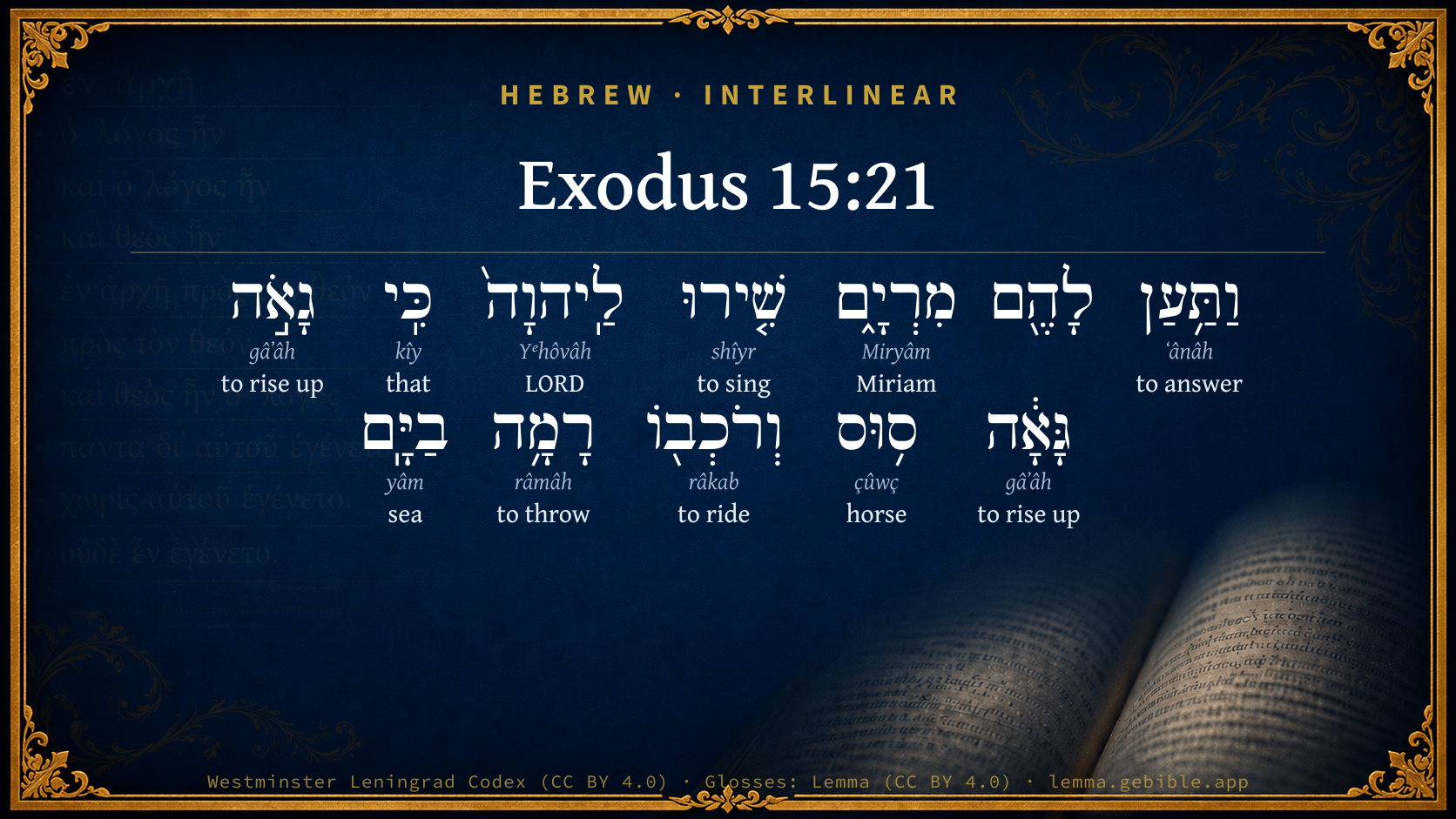
Hebrew (Westminster Leningrad Codex) Exodus 15:21 appears in the Hebrew Old Testament. The text above is from the Westminster Leningrad Codex. Each word links to its Strong’s number, a concise gloss, and parsing drawn from the Open Scriptures Hebrew Bible morphology. Click any word for its full Brown-Driver-Briggs (BDB) entry.
Download image
Cite this verse

Exodus 15:21 (World English Bible). Public Domain. Lemma interlinear Bible study tool, https://lemma.gebible.app/v/exodus/15/21.

Show BibTeX & RIS
BibTeX
RIS
English Translation
Miriam answered them, "Sing to Yahweh, for he has triumphed gloriously: The horse and his rider he has thrown into the sea."
World English Bible · Public Domain
Download a study sheet

One document with this verse’s original text, its word-by-word gloss line, the meaning frame, cross-references with their text, attributed commentary, and full source and license credits — printable, and it pastes into notes with its structure intact.

This verse Autodidact and up

Study sheet (.html) Plain text (.txt)

A passage Seminary Student

Up to 50 verses in one chapter. A passage sheet keeps up to 6 commentary sources and 12 cross-references per verse, in the order this page ranks them, and says so on the sheet whenever that leaves anything out. Ask for a single verse and you get the Autodidact verse sheet above.

Everything on this page stays free to read, with no account — the sheet is a download of what is already on screen, not access to it.

Want to remove ads? Support Godless Engineer
Compare translations 3

The same verse in 3 English versions, stacked beneath the original-language interlinear above. Click any original word for its lexicon entry.

Each is an independent rendering of the whole verse — the interlinear is not word-aligned to these translations.

Highlighted words mark where these versions differ — a whole-verse word diff, not a word-by-word alignment.

  • World English Bible Public Domain
    Miriam answered them, "Sing to Yahweh, for he has triumphed gloriously: The horse and his rider he has thrown into the sea."
  • King James Version Public Domain
    And Miriam answered them, Sing ye to the LORD, for he hath triumphed gloriously; the horse and his rider hath he thrown into the sea.
  • unfoldingWord Literal Text CC BY-SA 4.0
    And Miriam responded to them: “Sing to Yahweh, for he has triumphed triumphantly; the horse and the one riding it he threw into the sea.”

unfoldingWord Literal Text — © unfoldingWord, licensed CC BY-SA 4.0. Word-aligned USFM3 via Door43 (git.door43.org/unfoldingWord/en_ult).

Versions to compare (up to 4)

3 of 4 selected

Show all 18 translations

Every available English version of this verse, each an independent rendering of the whole verse.

  • World English Bible Public Domain
    Miriam answered them, "Sing to Yahweh, for he has triumphed gloriously: The horse and his rider he has thrown into the sea."
  • Berean Standard Bible Public Domain
    And Miriam sang back to them: “Sing to the LORD, for He is highly exalted; the horse and rider He has thrown into the sea.”
  • Majority Standard Bible Public Domain
    And Miriam sang back to them: “Sing to the LORD, for He is highly exalted; the horse and rider He has thrown into the sea.”
  • King James Version Public Domain
    And Miriam answered them, Sing ye to the LORD, for he hath triumphed gloriously; the horse and his rider hath he thrown into the sea.
  • American Standard Version (1901) Public Domain
    And Miriam answered them, Sing ye to Jehovah, for he hath triumphed gloriously; The horse and his rider hath he thrown into the sea.
  • Revised Version (1885) Public Domain
    And Miriam answered them, Sing ye to the LORD, for he hath triumphed gloriously; The horse and his rider hath he thrown into the sea.
  • Geneva Bible (1599) Public Domain
    And Miriam answered the men, Sing yee vnto the Lord: for he hath triumphed gloriously: the horse and his rider hath hee ouerthrowen in the Sea.
  • Douay-Rheims (1899) Public Domain
    And she began the song to them, saying: Let us sing to the Lord, for he is gloriously magnified, the horse and his rider he hath thrown into the sea.
  • Young's Literal Translation Public Domain
    and Miriam answereth to them: -- `Sing ye to Jehovah, For Triumphing He hath triumphed; The horse and its rider He hath thrown into the sea!'
  • Literal Standard Version CC BY-SA 4.0
    and Miriam answers to them: “Sing to YHWH, || For triumphing He has triumphed; The horse and its rider He has thrown into the sea!”
  • Unlocked Literal Bible CC BY-SA 4.0
    Miriam sang to them: “Sing to Yahweh, for he has triumphed gloriously. The horse and his rider he has thrown into the sea.”
  • unfoldingWord Literal Text CC BY-SA 4.0
    And Miriam responded to them: “Sing to Yahweh, for he has triumphed triumphantly; the horse and the one riding it he threw into the sea.”
  • Darby Bible Public Domain
    And Miriam answered them, Sing to Jehovah, for he is highly exalted: The horse and his rider hath he thrown into the sea.
  • World Messianic Bible Public Domain
    Miriam answered them, “Sing to the LORD, for he has triumphed gloriously. He has thrown the horse and his rider into the sea.”
  • Webster's Bible Public Domain
    And Miriam answered them, Sing ye to the LORD, for he hath triumphed gloriously; the horse and his rider hath he thrown into the sea.
  • Free Bible Version CC BY-SA 4.0
    Miriam sang to them: “Sing to the Lord, for he is supreme! He has thrown the horses and their riders into the sea.”
  • Bible in Basic English Public Domain
    And Miriam, answering, said, Make a song to the Lord, for he is lifted up in glory; the horse and the horseman he has sent into the sea.
  • JPS Tanakh (1917) Public Domain
    And Miriam sang unto them: Sing ye to the LORD, for He is highly exalted: the horse and his rider hath He thrown into the sea.

Literal Standard Version (2020), Covenant Press — licensed CC BY-SA 4.0. Text via the HelloAO Bible API (eBible.org). Unlocked Literal Bible (unfoldingWord) — licensed CC BY-SA 4.0. Text via the HelloAO Bible API (eBible.org). unfoldingWord Literal Text — © unfoldingWord, licensed CC BY-SA 4.0. Word-aligned USFM3 via Door43 (git.door43.org/unfoldingWord/en_ult). Free Bible Version, Dr. Jonathan Gallagher — licensed CC BY-SA 4.0. Text via the HelloAO Bible API (eBible.org).

Word by word

More ways to search: Search by grammar → Find every occurrence → Compare this word →

Practice this passage: Drill this verse → Learn its vocabulary →

גָאֹ֣ה
gâʼâh
H1342
“to rise up”
Verb, Qal, Infinitive Absolute
Part of Speech
Verb
Stem
Qal
Form
Infinitive Absolute
Full BDB Definition

Origin: a primitive root

TWOT: 299

to rise up, grow up, be exalted in triumph - (Qal) - to rise up - to grow up - to be lifted up, be raised up, be exalted
  1. וַתַּ֥עַן ʻânâh H6030 “and · to answer” Conjunction + Verb, Qal, Sequential Imperfect, 3rd Person, Feminine, Singular
  2. מִרְיָ֑ם Miryâm H4813 “Miriam” Noun, Proper
  3. שִׁ֤ירוּ shîyr H7891 “sing” Verb, Qal, Imperative, 2nd Person, Masculine, Plural
  4. לַֽיהוָה֙ Yᵉhôvâh H3068 “to/for · LORD” Preposition + Noun, Proper
  5. כִּֽי kîy H3588 “that” Conjunction
  6. גָּאָ֔ה gâʼâh H1342 “to rise up” Verb, Qal, Perfect, 3rd Person, Masculine, Singular
  7. ס֥וּס çûwç H5483 “horse” Noun, Common, Masculine, Singular, Absolute
  8. וְרֹכְב֖וֹ râkab H7392 “and · riding · him” Conjunction + Verb, Qal, Participle Active, Masculine, Singular, Construct + Suffix, Personal, 3rd Person, Masculine, Singular
  9. רָמָ֥ה râmâh H7411 “to throw” Verb, Qal, Perfect, 3rd Person, Masculine, Singular
  10. בַיָּֽם yâm H3220 “in/at the · sea” Preposition, Determined + Noun, Common, Masculine, Singular, Absolute

About this verse

These counts appear in no published source. They are computed here, from the morphology-tagged text and Lemma’s own curated glosses. What Lemma adds →

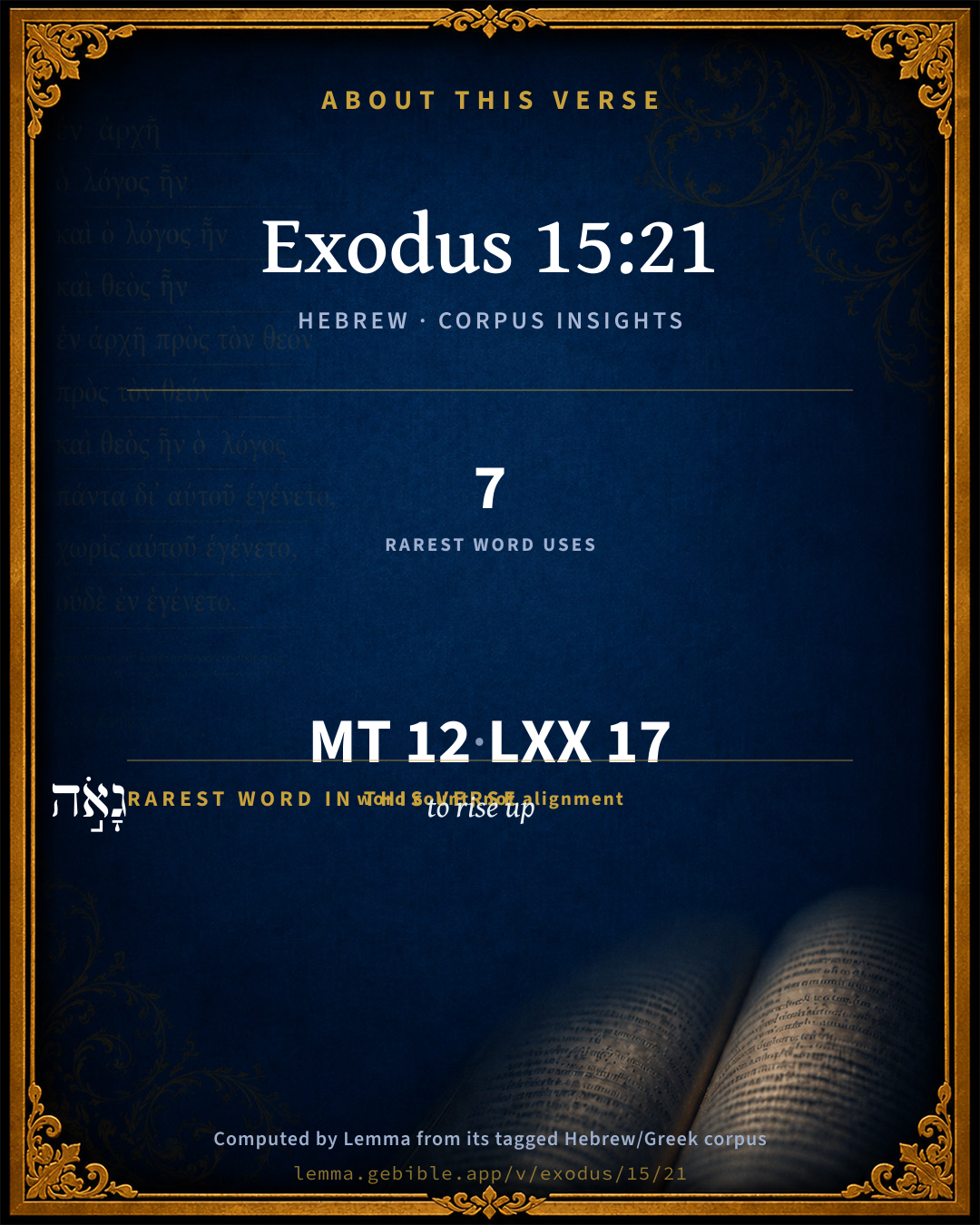
12
words
10
distinct lemmas
Pentateuch
section

Notable vocabulary

The rarest word here is גָאֹ֣ה to rise up H1342 — appearing just 7 times in the whole Hebrew Bible.

Shared distinctive vocabulary

גָאֹ֣ה to rise up H1342 occurs in 5 verses of the Hebrew Bible. Also found in:

Grammatical profile

  • 6 verbs
  • 4 nouns
  • 1 preposition
  • 1 conjunction

Verb forms

  • וַתַּ֥עַן Qal · Sequential Imperfect
  • שִׁ֤ירוּ Qal · Imperative
  • גָאֹ֣ה Qal · Infinitive Absolute
  • גָּאָ֔ה Qal · Perfect
  • וְרֹכְב֖וֹ Qal · Participle Active
  • רָמָ֥ה Qal · Perfect

Repetition

A word recurs within this verse — often emphatic in Hebrew:

  • גָאֹ֣ה to rise up H1342 ×2

Hebrew & Septuagint length

In English translation the verse runs 22 words from the Hebrew and 28 from the Septuagint (LXX English) — closely comparable.

A rough comparison of the two English renderings, which tokenize alike — not a word-level alignment.

Word counts can differ between the Hebrew and the Greek without any difference in meaning — e.g. the Hebrew direct-object marker אֵת has no separate Greek word, and Greek often adds the article ὁ.

In the original languages it is 12 Hebrew tokens and 17 Greek tokens — but the two are counted differently (Hebrew bundles its prefixes and suffixes into one token; the Greek is in lemma form), so that isn’t a like-for-like length.

Cross-references

12

Topical passages linked to Exodus 15:21 in the Treasury of Scripture Knowledge — connected by theme and wording, ordered by reader-vote popularity; previews shown in the World English Bible.

  • Exodus 15:1 Then Moses and the children of Israel sang this song to Yahweh, and said, "I will sing to Yahweh, for he has triumphed gloriously: The horse and his rider he has thrown into the sea.
  • Revelation 7:10–12 They cried with a loud voice, saying, "Salvation be to our God, who sits on the throne, and to the Lamb!"
  • Revelation 15:3 They sang the song of Moses, the servant of God, and the song of the Lamb, saying, "Great and marvelous are your works, Lord God, the Almighty; Righteous and true are your ways, you King of the nations.
  • Revelation 5:9 They sang a new song, saying, "You are worthy to take the book, And to open its seals: For you were killed, And bought us for God with your blood, Out of every tribe, language, people, and nation,
  • Revelation 19:1–6 After these things I heard something like a loud voice of a great multitude in heaven, saying, "Hallelujah! Salvation, power, and glory belong to our God:
  • Judges 5:3 Hear, you kings; give ear, you princes; I, [even] I, will sing to Yahweh; I will sing praise to Yahweh, the God of Israel.
  • 1 Samuel 18:7 The women sang one to another as they played, and said, Saul has slain his thousands, David his ten thousands.
  • 2 Chronicles 5:13 it happened, when the trumpeters and singers were as one, to make one sound to be heard in praising and thanking Yahweh; and when they lifted up their voice with the trumpets and cymbals and instruments of music, and praised Yahweh, [saying], For he is good; for his loving kindness endures forever; that then the house was filled with a cloud, even the house of Yahweh,
  • Psalms 24:7–10 Lift up your heads, you gates; Be lifted up, you everlasting doors: The King of glory will come in.
  • Psalms 134:1–3 Look! Praise Yahweh, all you servants of Yahweh, Who stand by night in Yahweh's house!
  • Isaiah 5:1–30 Let me sing for my well beloved a song of my beloved about his vineyard. My beloved had a vineyard on a very fruitful hill.
  • Revelation 14:3 They sing a new song before the throne, and before the four living creatures and the elders. No one could learn the song except the one hundred forty-four thousand, those who had been redeemed out of the earth.

Cross-references courtesy of OpenBible.info (CC BY 4.0).

Hebrew and Greek witnesses Masoretic Hebrew ↔ Greek Septuagint

The same verse in the two great witnesses to the Old Testament, shown verse-for-verse.

These are two independent witnesses, not word-aligned to each other, and the Septuagint is shown in lemma (dictionary) form.

Hebrew Exodus 15:21 Masoretic · Westminster Leningrad Codex

וַתַּ֥עַן לָהֶ֖ם מִרְיָ֑ם שִׁ֤ירוּ לַֽיהוָה֙ כִּֽי גָאֹ֣ה גָּאָ֔ה ס֥וּס וְרֹכְב֖וֹ רָמָ֥ה בַיָּֽם

Miriam answered them, "Sing to Yahweh, for he has triumphed gloriously: The horse and his rider he has thrown into the sea."

World English Bible · Public Domain

Greek LXX Exodus 15:21 Septuagint · lemma form

ἐκἄρχω δέ αὐτός μαριαμ λέγω ᾄδω ὁ κύριος ἐνδόξως γάρ δοξάζω ἵππος καί ἀναβάτης ῥίπτω εἰς θάλασσα

And Mariam led them, saying, Let us sing to the Lord, for he has been very greatly glorified: the horse and rider has he cast into the sea.

LXX2012 (modern English Septuagint) · Public Domain

Hebrew: Westminster Leningrad Codex (CC BY 4.0). Greek: Septuagint (public domain); English from LXX2012 (modern English Septuagint) (Public Domain). How the Septuagint differs from the Hebrew →

Targum (Aramaic paraphrase)

2

The Targum is the ancient Jewish Aramaic paraphrase of the Hebrew Scriptures — an interpretive translation, not the Hebrew text itself. Onkelos (literal) and Pseudo-Jonathan (expansive) render the Torah, and Jonathan the Prophets. Coverage is partial: where no permissively-licensed English translation exists for a verse, only the Aramaic is shown. This is verse-level text, not a word-by-word alignment to the Hebrew.

  1. Targum Onkelos Torah (Genesis–Deuteronomy)
    וּמְעַנְיָא לְהוֹן מִרְיָם שַׁבָּחוּ וְאוֹדוּ קֳדָם יְיָ אֲרֵי אִתְגָאֵי עַל גֵוְתָנַיָא וְגֵאוּתָא דִילֵהּ הִיא סוּסְיָא וְרָכְבֵהּ רְמָא בְיַמָא:

    (no public-domain English translation for this verse)

    Targum Onkelos — Aramaic: “Onkelos Genesis” (public domain); “Onkelos Exodus” (public domain); “Onkelos Leviticus” (public domain); “Onkelos Numbers” (public domain); “Onkelos Deuteronomy” (public domain). English: “Sefaria Community Translation” (CC0 1.0 (public-domain dedication)); “J.W. Etheridge. The Targums of Onkelos and Jonathan Ben Uzziel on the Pentateuch. London: Longmans, Green, 1862” (public domain). Text via Sefaria.

  2. Targum Pseudo-Jonathan Torah (Genesis–Deuteronomy)
    וְזָמְרַת לְהוֹן מִרְיָם נוֹדֵי וּנְשַׁבְּחָא קֳדָם יְיָ אֲרוּם תּוּקְפָא וְרוֹמְמוּתָא דִידֵיהּ הוּא עַל גֵּיוְותָנִין הוּא מִתְגָאֵי וְעַל רָמִין הוּא מִתְנַטֵּל עַל דִּי אָזִיד פַּרְעה רַשִׁיעָא וְרָדַף בָּתַר עַמָּא בְּנֵי יִשְרָאֵל סוּסְוָותֵיהּ וּרְתִיכוֹי רְמָא וּטְמַע יַתְהוֹן בְּיַמָא דְסוּף

    And Miriam sang to them, Let us give thanks and praise before the Lord, for might and supremacy are His; above the proud He is glorified, and above the lofty He is exalted. When the wicked, Pharoh in his pride followed after the people of the sons of Israel, his horses and his chariots did He cast and drown in the sea of Suph.

    Targum Pseudo-Jonathan — Aramaic: “Targum Jonathan on Genesis” (public domain); “Targum Jonathan on Exodus” (public domain); “Targum Jonathan on Leviticus” (public domain); “Targum Jonathan on Numbers” (public domain); “Targum Jonathan on Deuteronomy” (public domain). English: “The Targum of Jonathan ben Uzziel, trans. J. W. Etheridge, London, 1862” (public domain). Text via Sefaria.

Commentary

Notes on Exodus 15:21 from classic Christian and Jewish commentators (each source and its license shown beneath its notes). The classic Christian expositions comment on the surrounding passage and are grouped to its opening verse, so a note may address several verses; the Jewish commentaries on the Tanakh (Rashi and others) are per-verse, so they appear only where the commentator wrote on this verse.

Lemma curates 59 commentaries, every one of them public domain or Creative Commons licensed, each selected and text-cleaned for this edition rather than reprinted as found. About our sources →

Trapp's Complete Commentary

John Trapp

Exo 15:21 And Miriam answered them, Sing ye to the LORD, for he hath triumphed gloriously; the horse and his rider hath he thrown into the sea.

Ver. 21. Sing ye to the Lord.] This seems to have been the burden of the song: as Psa 134:1.

John Trapp, A Commentary or Exposition upon All the Books of the Old and New Testament (1647–1656) — public domain. Text from a community e-Sword module.

Geneva Bible (1599)

Geneva Bible translators

By singing the like song of thanksgiving.

Geneva Bible (1599) marginal notes — public domain. Text via Bolls.life.

Jamieson, Fausset & Brown

Robert Jamieson, A. R. Fausset & David Brown

Miriam answered them--"them" in the Hebrew is masculine, so that Moses probably led the men and Miriam the women--the two bands responding alternately, and singing the first verse as a chorus.

Jamieson, Fausset & Brown — Commentary Critical and Explanatory on the Whole Bible (1871) — public domain (CC PDM 1.0). Text via the HelloAO Bible API.

Ellicott's Commentary for English Readers

(21) Miriam answered them.—Miriam and her maidens at the close of each portion of the “Song”—i.e., at the end of Exo_15:5; Exo_15:10; Exo_15:12; Exo_15:18—sang the refrain which is here given—a refrain very slightly altered from the opening verse of the “Song” itself, marking, no doubt, the time with their timbrels, and moving gracefully through a stately and solemn dance.

A Bible Commentary for English Readers, edited by Charles John Ellicott (1878–1897) — public domain. Text from a community e-Sword module.

The Cambridge Bible for Schools and Colleges

gen. ed. J. J. S. Perowne

21. answered] The word means (note the ל), answered antiphonally in song, even if,—as some think, connecting it with the Arab. ghanâ (Lex. 777a),—it does not mean simply sang (comp. Num_21:17 b; and esp. 1Sa_18:7; 1Sa_21:11; 1Sa_24:5 [where the same word is rendered, ‘sing one to another’]).

them] The pron. is masc., so the reference might seem to be to the men (v. 1a), after they had sung v. 1b. But this antecedent is rather remote: and as in the 2nd and 3rd plur. the masc. form is often used with reference to women (G.-K. § 135o), it is probably better (with Bä.) to suppose the women in v. 20b to be referred to; cf. 1Sa_18:7.

The Cambridge Bible for Schools and Colleges (gen. ed. J. J. S. Perowne; Cambridge University Press, 1878–1918) — public domain. Text from a community e-Sword module.

John Gill's Exposition

So Moses brought Israel from the Red sea,.... Or "caused them to journey" (a), which some think was done with difficulty, they being so eager and intent upon the spoil and plunder of the Egyptians cast upon the sea shore, the harness of their horses being, as Jarchi observes, ornamented with gold and silver, and precious stones; or as others, they had some inclination to return to Egypt, and take possession of the country for themselves; the inhabitants of it, at least its military force, being destroyed, and their armour in their possession; but the truer meaning of the word is, that Moses, as their general, gave them the word of command to march, and till they had it they stayed at the Red sea refreshing themselves, taking the spoils of the enemy, and singing the praises of God; but when Moses gave them orders to set forward, they proceeded on their journey:

and they went out into the wilderness of Shur; the same with the wilderness of Etham, as appears from Num 33:8 there might be, as Aben Ezra conjectures, two cities in or near this wilderness, of those two names, from whence it might be called: for, as Doctor Shaw says (b), Shur was a particular district of the wilderness of Etham, fronting the valley (of Baideah), from which, he supposes, the children of Israel departed: and Doctor Pocock says (c) that the wilderness of Shur might be the fourth part of the wilderness of Etham, for about six hours from the springs of Moses (where, according to the tradition of the country, the children of Israel landed, being directly over against Clysma or Pihahiroth) is a winter torrent, called Sedur (or Sdur), and there is a hill higher than the rest, called Kala Sedur (the fortress of Sedur), and from which this wilderness might have its name: and by another traveller (d) this wilderness is called the wilderness of Sedur: and now it was the wilderness of Etham they were in before they went into the Red sea, which has induced some to believe that they came out on the same shore again; for the solution of which difficulty See Gill on Exo 14:22,

and they went three days in the wilderness, and found no water; which must be very distressing to such a vast number of people and cattle, in a hot, sandy, desert: this doubtless gave occasion to the stories told by Heathen authors, as Tacitus (e), and others, that the people of the Jews, under the conduct of Moses, were near perishing for want of water, when, following a flock of wild asses, which led them to a rock covered with a grove of trees, they found large fountains of water: the three days they travelled here were the twenty second, third and fourth, of Nisan, in the beginning of April.

(a) "et fecit proficisci", Pagninus & Montanus, Drusius; "jussit proficisci", Junius & Tremellius, Piscator. (b) Travels. p. 312. (c) Travels, p. 156. (d) Journal from Cairo, &c. p. 13. (e) Hist. l. 5. c. 3.

John Gill's Exposition of the Whole Bible (1746–1763) — public domain (CC PDM 1.0). Text via the HelloAO Bible API.

Matthew Poole's English Annotations

Miriam addressed either,

1. The women, last spoken of, and then it is an enallage of the gender. Or,

2. The men spoken of before. They sung by turns, or by parts, either the same words being repeated, or some other words of a like nature added. See 1Ch 16:41; 2Ch 5:13; Ezr 3:11.

Matthew Poole's English Annotations on the Holy Bible (1683–1685) — public domain. Text from a community e-Sword/MySword module.

Whedon's Commentary on the Bible

Daniel D. Whedon

21. Miriam answered — That is, she led in these words the chorus or refrain. See on Exo_15:1.

Here closes the first division of the Book of Exodus. Israel has now gone forth, and, with the Sea behind and the Desert before, begins her career as a NATION.

Daniel D. Whedon (gen. ed.), Commentary on the Old and New Testaments (1874–1909) — public domain. Text from a community e-Sword module.

The Pulpit Commentary

Miriam answered them. Miriam, with her chorus of women, answered the chorus of men, responding at the termination of each stanza or separate part of the ode with the refrain, "Sing ye to the Lord," etc. (See the "Introduction" to this chapter.) While responding, the female chorus both danced and struck their tambourines. This use of dancing in a religious ceremonial, so contrary to Western ideas of decorum, is quite consonant with Oriental practice, both ancient and modern. Other examples of it in Scripture are David"s dancing before the ark, (2Sa_6:16) the dancing of Jephthah"s daughter, (Jud_1:11:34) and that of the virgins of Shiloh. (Jud_1:21:21) It is also mentioned with approval in the Psalms. (Psa_149:3) Dancing was practised as a religious ceremony in Egypt, in Phrygia, in Thrace, by the Phoenicians, by the Syrians, by the Romans, and others. In the nature of things there is clearly nothing unfitting or indecorous in a dedication to religion of what has been called "the poetry of gesture." But human infirmity has connected such terrible abuses with the practice that the purer religions have either discarded it or else denied it admission into their ceremonial. It still however lingers in Mohammedanism among those who are called "dancing dervishes," whose extraordinary performances are regarded as acts of devotion.

The Pulpit Commentary (1880–1919), ed. H.D.M. Spence-Jones & Joseph S. Exell — public domain. Text from a community e-Sword module.

John Wesley's Explanatory Notes

And Miriam answered them - The men: They sung by turns, or in parts.

John Wesley, Explanatory Notes Upon the Whole Bible (1754–1765) — public domain. Text via the GEBible commentary corpus.

Rashi

Rabbi Shlomo Yitzchaki (Rashi)

ותען להם מרים AND MIRIAM SANG UNTO THEM — Moses sang the Song to the men — he sang it and they repeated it after him; and Miriam sang the Song to the women and they repeated it after her (Mekhilta).

Rashi on the Tanakh — English translations: “The Judaica Press complete Tanach with Rashi, translated by A. J. Rosenberg” (CC BY 4.0); “Pentateuch with Rashi's commentary by M. Rosenbaum and A.M. Silbermann, 1929-1934” (public domain); “The Metsudah Tanach series, Lakewood, N.J” (CC BY 4.0); and “The Book of Joshua, Metsudah Publications, 1997” (CC BY 4.0). Text via Sefaria.

Lesson kit

Teaching starters — assembled from the data on this page, not authored interpretation. Every prompt links to the verse data it draws on. Edit before teaching.

Exodus, in the Pentateuch, opens this verse with 12 words (10 distinct Hebrew lemmas). Its most distinctive word is gâʼâh (“to rise up”). A historical commentator’s framing appears above. Read the whole chapter for the surrounding context.

Discussion questions

  1. The word gâʼâh carries the sense “to rise up.” How does it shape the verse?
  2. How does Exodus 15:1, which shares the word «to rise up», read alongside this verse?
  3. What does the repetition of “to rise up” (2× in this one verse) do in this verse?
  4. These translations render this verse differently; the difference is in the English rendering, not the original. What questions does that raise?
  5. «וַתַּ֥עַן» is a Qal Sequential Imperfect verb. How does that grammatical form shape the action described?
  6. Compare how Trapp's Complete Commentary and Geneva Bible (1599) read this verse. Where do they agree or differ?

Things to notice

Reading settings

Reading text

Shown beneath each verse's original-language words.

Old Testament
Old Testament edition

Read the OT as the Masoretic Hebrew (MT) or the Greek Septuagint (LXX).

English shown for the Greek Septuagint (in the Hebrew ↔ Greek comparison).

Comparing translations? Open the Compare panel on any verse page to stack up to four side by side.