
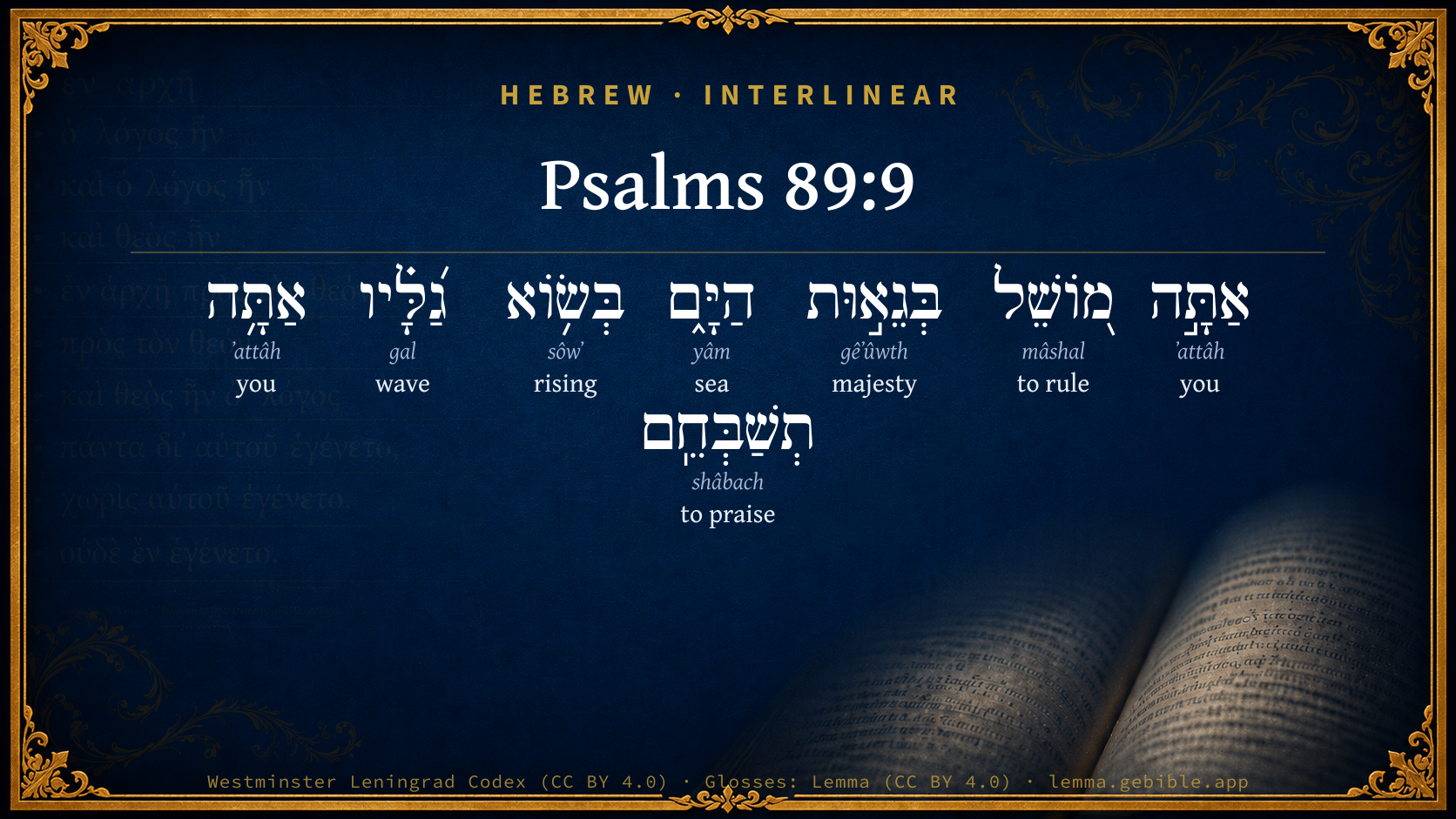
Psalms 89:9

Hebrew (Westminster Leningrad Codex) Psalms 89:9 appears in the Hebrew Old Testament. The text above is from the Westminster Leningrad Codex. Each word links to its Strong’s number, a concise gloss, and parsing drawn from the Open Scriptures Hebrew Bible morphology. Click any word for its full Brown-Driver-Briggs (BDB) entry.
Download image
Cite this verse

Psalms 89:9 (World English Bible). Public Domain. Lemma interlinear Bible study tool, https://lemma.gebible.app/v/psalms/89/9.

Show BibTeX & RIS
BibTeX
RIS
English Translation
You rule the pride of the sea. When its waves rise up, you calm them.
World English Bible · Public Domain
Highlights
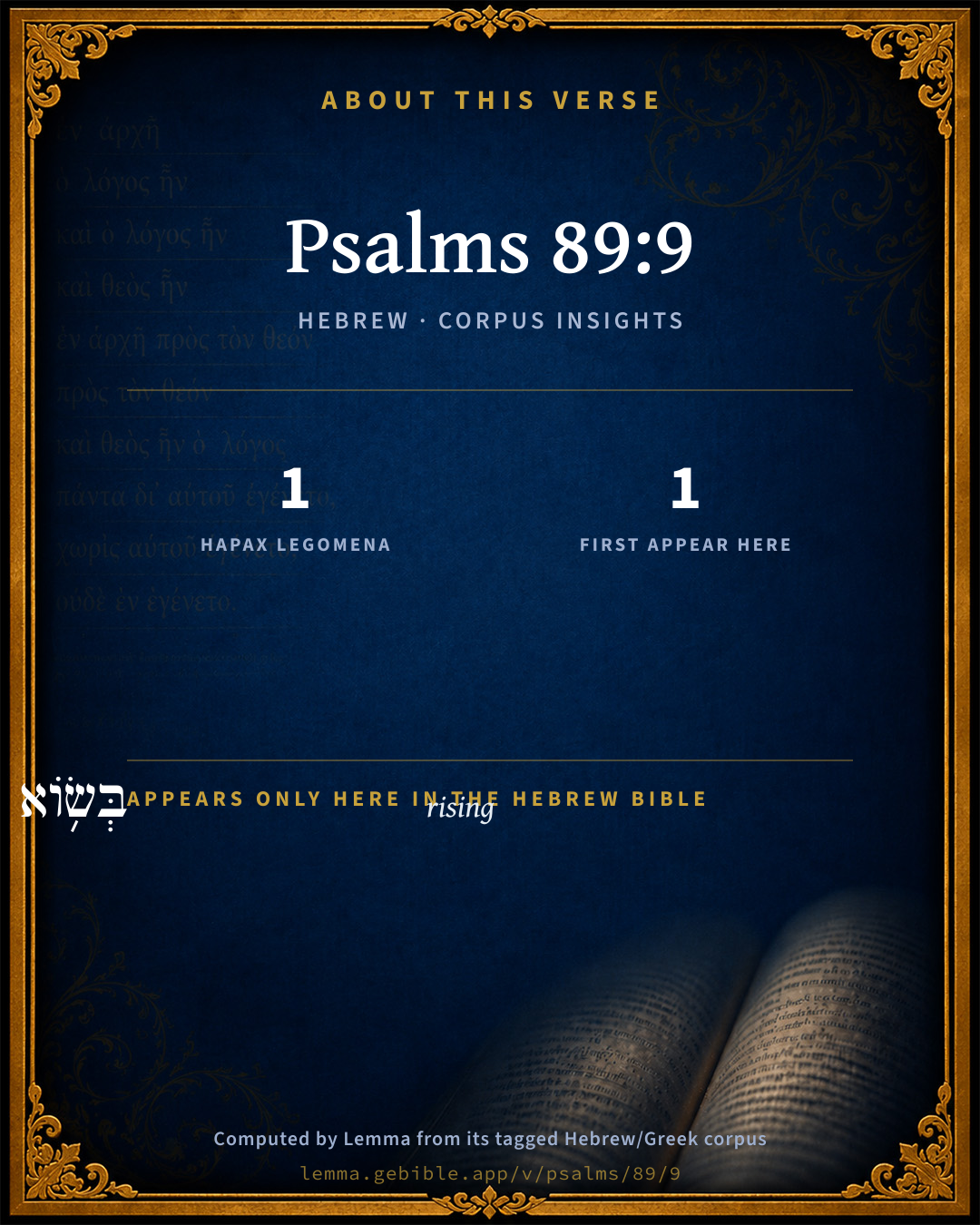
  • 1 hapax legomenon — only here in the Hebrew Bible
  • 1 first appearance in the Hebrew Bible
Full analysis ↓
Download a study sheet

One document with this verse’s original text, its word-by-word gloss line, the meaning frame, cross-references with their text, attributed commentary, and full source and license credits — printable, and it pastes into notes with its structure intact.

This verse Autodidact and up

Study sheet (.html) Plain text (.txt)

A passage Seminary Student

Up to 50 verses in one chapter. A passage sheet keeps up to 6 commentary sources and 12 cross-references per verse, in the order this page ranks them, and says so on the sheet whenever that leaves anything out. Ask for a single verse and you get the Autodidact verse sheet above.

Everything on this page stays free to read, with no account — the sheet is a download of what is already on screen, not access to it.

Want to remove ads? Support Godless Engineer
Compare translations 3

The same verse in 3 English versions, stacked beneath the original-language interlinear above. Click any original word for its lexicon entry.

Each is an independent rendering of the whole verse — the interlinear is not word-aligned to these translations.

Highlighted words mark where these versions differ — a whole-verse word diff, not a word-by-word alignment.

  • World English Bible Public Domain
    You rule the pride of the sea. When its waves rise up, you calm them.
  • King James Version Public Domain
    Thou rulest the raging of the sea: when the waves thereof arise, thou stillest them.
  • unfoldingWord Literal Text CC BY-SA 4.0
    You are ruling over the surging of the sea; when its waves rise, you, you still them.

unfoldingWord Literal Text — © unfoldingWord, licensed CC BY-SA 4.0. Word-aligned USFM3 via Door43 (git.door43.org/unfoldingWord/en_ult).

Versions to compare (up to 4)

3 of 4 selected

Show all 18 translations

Every available English version of this verse, each an independent rendering of the whole verse.

  • World English Bible Public Domain
    You rule the pride of the sea. When its waves rise up, you calm them.
  • Berean Standard Bible Public Domain
    You rule the raging sea; when its waves mount up, You still them.
  • Majority Standard Bible Public Domain
    You rule the raging sea; when its waves mount up, You still them.
  • King James Version Public Domain
    Thou rulest the raging of the sea: when the waves thereof arise, thou stillest them.
  • American Standard Version (1901) Public Domain
    Thou rulest the pride of the sea: When the waves thereof arise, thou stillest them.
  • Revised Version (1885) Public Domain
    Thou rulest the pride of the sea: when the waves thereof arise, thou stillest them.
  • Geneva Bible (1599) Public Domain
    Thou rulest the raging of the sea: when the waues thereof arise, thou stillest them.
  • Douay-Rheims (1899) Public Domain
    O Lord God of hosts, who is like to thee? thou art mighty, O Lord, and thy truth is round about thee.
  • Young's Literal Translation Public Domain
    Thou `art' ruler over the pride of the sea, In the lifting up of its billows Thou dost restrain them.
  • Literal Standard Version CC BY-SA 4.0
    You [are] ruler over the pride of the sea, || In the lifting up of its billows You restrain them.
  • Unlocked Literal Bible CC BY-SA 4.0
    You rule the raging sea; when the waves surge, you calm them.
  • unfoldingWord Literal Text CC BY-SA 4.0
    You are ruling over the surging of the sea; when its waves rise, you, you still them.
  • Darby Bible Public Domain
    *Thou* rulest the pride of the sea: when its waves arise, *thou* stillest them.
  • World Messianic Bible Public Domain
    You rule the pride of the sea. When its waves rise up, you calm them.
  • Webster's Bible Public Domain
    \\89:8\\O LORD God of hosts, who is a strong LORD like to thee? or to thy faithfulness around thee?
  • Free Bible Version CC BY-SA 4.0
    You rule the restless seas; you calm their stormy waves.
  • Bible in Basic English Public Domain
    You have rule over the sea in storm; when its waves are troubled, you make them calm.
  • JPS Tanakh (1917) Public Domain
    (89-10) Thou rulest the proud swelling of the sea; when the waves thereof arise, Thou stillest them.

Literal Standard Version (2020), Covenant Press — licensed CC BY-SA 4.0. Text via the HelloAO Bible API (eBible.org). Unlocked Literal Bible (unfoldingWord) — licensed CC BY-SA 4.0. Text via the HelloAO Bible API (eBible.org). unfoldingWord Literal Text — © unfoldingWord, licensed CC BY-SA 4.0. Word-aligned USFM3 via Door43 (git.door43.org/unfoldingWord/en_ult). Free Bible Version, Dr. Jonathan Gallagher — licensed CC BY-SA 4.0. Text via the HelloAO Bible API (eBible.org).

Word by word

More ways to search: Search by grammar → Find every occurrence → Compare this word →

Practice this passage: Drill this verse → Learn its vocabulary →

About this verse

These counts appear in no published source. They are computed here, from the morphology-tagged text and Lemma’s own curated glosses. What Lemma adds →

8
words
7
distinct lemmas
Wisdom
section

Notable vocabulary

1 hapax legomenon — a word that appears only here in the entire Hebrew Bible:

  • בְּשׂ֥וֹא rising H7721

First appearance in Scripture

This word makes its first canonical appearance in the Hebrew Bible here:

  • בְּשׂ֥וֹא rising H7721

Shared distinctive vocabulary

בְּגֵא֣וּת majesty H1348 occurs in 8 verses of the Hebrew Bible. Also found in:

Grammatical profile

  • 3 verbs
  • 3 nouns
  • 2 pronouns

Verb forms

  • מ֭וֹשֵׁל Qal · Participle Active
  • בְּשׂ֥וֹא Qal · Infinitive Construct
  • תְשַׁבְּחֵֽם Piel · Imperfect

Repetition

A word recurs within this verse — often emphatic in Hebrew:

  • אַתָּ֣ה you H859 ×2

Hebrew & Septuagint length

In English translation the verse runs 15 words from the Hebrew and 15 from the Septuagint (LXX English) — the same length.

A rough comparison of the two English renderings, which tokenize alike — not a word-level alignment.

Word counts can differ between the Hebrew and the Greek without any difference in meaning — e.g. the Hebrew direct-object marker אֵת has no separate Greek word, and Greek often adds the article ὁ.

Cross-references

11

Topical passages linked to Psalms 89:9 in the Treasury of Scripture Knowledge — connected by theme and wording, ordered by reader-vote popularity; previews shown in the World English Bible.

  • Psalms 65:7 Who stills the roaring of the seas, The roaring of their waves, And the turmoil of the nations.
  • Psalms 107:25–29 For he commands, and raises the stormy wind, Which lifts up its waves.
  • Mark 4:41 They were greatly afraid, and said to one another, "Who then is this, that even the wind and the sea obey him?"
  • Matthew 8:24–27 Behold, a great tempest arose in the sea, so much that the boat was covered with the waves, but he was asleep.
  • Mark 4:39 He awoke, and rebuked the wind, and said to the sea, "Peace! Be still!" The wind ceased, and there was a great calm.
  • Psalms 93:3–4 The floods have lifted up, Yahweh, The floods have lifted up their voice. The floods lift up their waves.
  • Job 38:8–11 "Or who shut up the sea with doors, When it broke forth from the womb,
  • Psalms 29:10 Yahweh sat enthroned at the Flood. Yes, Yahweh sits as King forever.
  • Nahum 1:4 He rebukes the sea, and makes it dry, and dries up all the rivers. Bashan languishes, and Carmel; and the flower of Lebanon languishes.
  • Matthew 14:32 When they got up into the boat, the wind ceased.
  • Psalms 66:5–6 Come, and see God's deeds-- Awesome work on behalf of the children of men.

Cross-references courtesy of OpenBible.info (CC BY 4.0).

Hebrew and Greek witnesses Masoretic Hebrew ↔ Greek Septuagint

The same verse in the two great witnesses to the Old Testament, shown verse-for-verse.

You’re reading Greek Psalm 88 (Hebrew Psalm 89). The Septuagint counts the superscription, so verse numbers can differ from the Hebrew — chapter-level alignment, not verse-by-verse. Numbering follows Rahlfs.

These are two independent witnesses, not word-aligned to each other, and the Septuagint is shown in lemma (dictionary) form.

Hebrew Psalms 89:9 Masoretic · Westminster Leningrad Codex

אַתָּ֣ה מ֭וֹשֵׁל בְּגֵא֣וּת הַיָּ֑ם בְּשׂ֥וֹא גַ֝לָּ֗יו אַתָּ֥ה תְשַׁבְּחֵֽם

You rule the pride of the sea. When its waves rise up, you calm them.

World English Bible · Public Domain

Greek LXX Greek Psalm 88:9 Septuagint · lemma form

κύριος ὁ θεός ὁ δύναμις τίς ὅμοιος σύ δυνατός εἰμί κύριος καί ὁ ἀλήθεια σύ κύκλος σύ

You rule the power of the sea; and you calm the tumult of its waves.

LXX2012 (modern English Septuagint) · Public Domain

Hebrew: Westminster Leningrad Codex (CC BY 4.0). Greek: Septuagint (public domain); English from LXX2012 (modern English Septuagint) (Public Domain). How the Septuagint differs from the Hebrew →

Commentary

Notes on Psalms 89:9 from classic Christian and Jewish commentators (each source and its license shown beneath its notes). The classic Christian expositions comment on the surrounding passage and are grouped to its opening verse, so a note may address several verses; the Jewish commentaries on the Tanakh (Rashi and others) are per-verse, so they appear only where the commentator wrote on this verse.

Lemma curates 59 commentaries, every one of them public domain or Creative Commons licensed, each selected and text-cleaned for this edition rather than reprinted as found. About our sources →

Trapp's Complete Commentary

John Trapp

Psa 89:9 Thou rulest the raging of the sea: when the waves thereof arise, thou stillest them.

Ver. 9. Thou rulest the raging of the sea] That it overwhelm not the earth: this work of God’s power is often celebrated, as well it may, all things considered.

John Trapp, A Commentary or Exposition upon All the Books of the Old and New Testament (1647–1656) — public domain. Text from a community e-Sword module.

The Biblical Illustrator

Joseph S. Exell

Psa_89:9

Thou rulest the raging of the sea: when the waves thereof arise, Thou stillest them.

The Divine government of the tumultuous

I. He rules the material sea. How furious does the old ocean sometimes become, how its billows often rise like mountains, roar like lions, and battle like demons! But God rules them. He has set a boundary to them. He holds the waters in the hollow of His hand.

II. He rules the mental sea. The material ocean is but a faint emblem of the mental seas, which are a thousand times deeper, larger and more awful.

1. There is the sea of thought. In every individual mind, thoughts rise and break like billows on the shore, and frequently they are most tumultuous. On this globe there are no less than twelve hundred million such seas, and what is the population of this globe compared to the mental population of the universe? He rules all these seas, rules them all even in their most raging condition.

2. There is the sea of passion. How the passions of men often rage in individuals, communities, nations! How rage, too, the passions of hell. But God rules them all. (Homilist.)

God ruling the storm

I. None who saw the sea, and the destruction it caused, could fail to realize the helplessness of men in presence of those forces by which we are surrounded. The spectators could only wonder. Life was in jeopardy: it was saved at the risk of life. All honour to the men who applied their knowledge of the ways of the sea; that, with their own lives in their hands, they sought to save--and succeeded, too, in rescuing--their fellows from a watery grave.

II. The goodness of God in restraining those forces against which we are so helpless. There is a point beyond which they cannot go. True, there are controlling laws. If the sea, rising under the influence of the sun and moon, reaches a very high point, it is stayed by other forces from going farther. But whence do these forces derive their existence? Not in the material itself. It is the working of His power. He rules the raging of the sea, etc. Thus we discover order and design in the whole range of Gods works; if one force presses downwards, others press upward; if one force imperils the existence of men, another force controls it; if in one direction there is danger, in another direction the means of safety are found.

III. The uncertain tenure on which material good is secured to us. In every combination there are seeds of destruction in the material itself.

IV. God is ever present in the varying conditions of our life. Can He be present in that storm? Did He see the danger of those who stood in peril of their life? No, He could not be there, is the hasty conclusion of most of us. When His waves overwhelm us can He be there? Did not the sea break loose from His hand? No; He rules the raging of the sea. There is a certain extent in which it can remove from its ordinary course, but then it is as much under control as when, with its smooth and glassy surface, it lies basking in the summer sun. And why? Because by His laws He is there. The force is His force, whether it be a storm or calm. Does He, then, destroy? No; the destruction is only to that which trespasses on the sea. His object is health, and the storm is the action of opposing forces restoring their equilibrium, working out purposes of sovereign skill. But God is there. What a consolation and strength! (H. W. Butcher.)

The Biblical Illustrator, edited by Joseph S. Exell (c. 1880s–1900s) — public domain. Text from a community e-Sword module.

J. A. Alexander on Psalms

Joseph Addison Alexander

10. (Psa 89:9) Thou rulest the swell of the sea; in the rise of its waves thou stillest them. The general declaration of God's power is now rendered more distinct by specifying one of the most striking forms in which it manifests itself. At the same time, there is no doubt an allusion to the scriptural usage of the sea as an emblem of the world and its conflicting powers. See above, on Psa 46:2-3; Psa 65:7. The appropriateness of the words both to physical and moral changes affords an easy and beautiful transition to the latter in the next verse. The verbal form at the beginning is a participle, thou (art) ruling, i. e. habitually, constantly. The connective particle may be retained by rendering it rulest over. The first noun is applied elsewhere (Ps. xvii. 10) to the swelling or elation of the heart with pride; but that this is only a derived and secondary meaning may be gathered from the use of the same word to denote the loftiness or majesty of God (Psa 93:1), and also from the application of the verbal root to the rise of water in an inundation (Eze 47:5). The parallel term is an abbreviated infinitive used as a noun, and therefore well represented by the English rise, which is also both noun and verb.

Joseph Addison Alexander, The Psalms Translated and Explained (1850) — public domain. Text from a community e-Sword module.

Tyndale Open Study Notes

Tyndale Open Resources

89:9-13 In this hymn, the psalmist celebrates God’s comprehensive and powerful sovereignty over nature.

89:9-10 The Lord rules over all parts of the created order, including evil. • You scattered your enemies: The Lord will crush (Luke 1:51) evil powers that oppose him (Ps 2:1-3). • with your mighty arm: This phrase represents God’s strength (89:13).

Tyndale Open Study Notes — © Tyndale Open Resources, licensed CC BY-SA 4.0. Text via the HelloAO Bible API.

Geneva Bible (1599)

Geneva Bible translators

For as he delivered the Church by the red Sea, and by destroying Rahab, that is, the Egyptians: so will he eftsoons deliver it, when the dangers be great.

Geneva Bible (1599) marginal notes — public domain. Text via Bolls.life.

Adam Clarke's Commentary

Verse 9. Thou rulest the raging of the sea] Whoever has seen the sea in a storm, when its waves run what is called mountain high, must acknowledge that nothing but omnipotent power could rule its raging.

When the waves thereof arise, thou stillest them.] Thou governest both its flux and reflux. Thou art the Author of storms and calms. There may be a reference here to the passage of the Red Sea, and the strong wind that agitated its waves at that time; as the next verse seems to indicate.

Adam Clarke's Commentary on the Bible (1810–1826) — public domain. Text from a community e-Sword/MySword module.

John Calvin's Commentaries

9. Thou governest the pride of the sea. I have already observed that what the prophet has hitherto spoken generally concerning the power of God, is to be referred to the miracle of the deliverance of the Israelites from Egypt, which he now celebrates in express terms. According to the interpretation of some, God is said to still the impetuous waves of the sea, because he does not suffer it to break forth and overflow the whole world by a deluge. But I would read the 9th and 10th verses connectedly, and would understand the prophet as speaking of the Red Sea, which God divided to make a way for the chosen tribes to pass over. The Psalmist adds immediately after, that all the land of Egypt was overthrown as a wounded man By these words he magnifies the grace of God, which was displayed in the deliverance of the Church. He intended, there can be no doubt, to set before his own mind and the minds of others, the paternal love of God, to encourage both himself and others to have recourse to Him for succor, with the greater freedom and alacrity. And in affirming that God had broken in pieces his enemies with his mighty arm, he concludes from the past experience of the Church, that his mode of acting will be always similar, whenever in his infinite wisdom he sees it to be required.

John Calvin's Commentaries (1540-1563) — public domain. Text from the Calvin Translation Society English edition (1840s-50s) via the Christian Classics Ethereal Library (ccel.org). Calvin's coverage is partial (roughly two-thirds of the Bible); uncommented books and verses are honest gaps, never fabricated. The 19th-century editor's footnotes and remarks are omitted so the notes are faithfully Calvin's own voice.

The Cambridge Bible for Schools and Colleges

gen. ed. J. J. S. Perowne

9, 10. In this and the following verses thou, thine are the emphatic words.

the raging] Or, proud swelling. Cp. Psa_46:3. The sea represents the most turbulent and formidable of the powers of nature. Cp. Psa_93:3 f.; Job_38:11. From the sea of nature the poet turns to the sea of nations of which it is the emblem (Psa_65:7). At the Red Sea God proved His sovereignty over both. For Rahab as a name of Egypt see note on Psa_87:4. Broken in pieces denotes crushing defeat (Psa_44:19): as one that is slain expresses the result; the ferocious monster lies pierced through and harmless. A comparison of Job_26:12-13 (on which see Dr Davidson’s notes) suggests that the language is chosen so as to allude not only to the destruction of the Egyptians at the Red Sea, but to the primitive mythological idea of a conflict between God and the powers of nature personified as ‘Rahab.’

with thy strong arm] Better, With the arm of thy strength didst thou scatter thine enemies. Cp. Isa_51:9-10.

The Cambridge Bible for Schools and Colleges (gen. ed. J. J. S. Perowne; Cambridge University Press, 1878–1918) — public domain. Text from a community e-Sword module.

John Gill's Exposition

Thou hast broken Rahab in pieces, as one that is slain,.... Or Egypt, as in Psa 87:4 or the Egyptians, and particularly Pharaoh their king; so the Targum explains it,

"Rahab or the proud one, this is Pharaoh the wicked;''

who and his people were broken to pieces by the plagues that were brought upon them, especially when all their firstborn were slain; and he and his host were broke in pieces at the Red sea, and were seen by the Israelites on the shore, all dead men; and this was done as easily by the Lord, as one slain with the sword, as a dead carcass which has no life, power, and strength to defend itself, may be trampled upon, crushed, bruised, and broken to pieces, by a living man. All this may be an emblem of the Lord's breaking in pieces the proud and insolent one Satan, as Rahab signifies; of his breaking his head, destroying his works, and spoiling his principalities and powers; and indeed of his destruction of every proud and haughty sinner, that says, Pharaoh like, who is the Lord, that I should obey him? and of every vain boaster, and self-righteous person, that trusts in his own righteousness, and will not submit to the righteousness of Christ; and particularly of mystical Egypt, the proud beast of Rome, antichrist, who sits in the temple of God as if he was God, showing himself to be so, blaspheming God, his name, his tabernacle, and his saints; who will be broken to shivers as a potter's vessel, when the vials of God's wrath are poured out, and at and by the coming of Christ:

thou hast scattered thine enemies with thy strong arm; as the Egyptians were in the Red sea, by the waves of it, and cast upon the shore by them; and as the Amorites were by Moses, and the Canaanites by Joshua; which instances may be here referred unto; see Num 10:35 these are further proofs of the power and strength of the Lord, Job 40:9.

John Gill's Exposition of the Whole Bible (1746–1763) — public domain (CC PDM 1.0). Text via the HelloAO Bible API.

Albert Barnes' Notes on the Bible

Thou rulest the raging of the sea - The pride; the anger; the lifting up of the sea. That is, when the sea is raging and boisterous; when it seems as if everything would be swept away before it, thou hast absolute control over it. There is, perhaps, no more impressive exhibition of divine power than the control which God has over the raging waves of the ocean: and yet this was the power which Jesus exercised over the raging sea of Galilee - showing that he had the power of God. Mar 4:39-41.

When the waves thereof arise - In the lifting up of the waves; when they seem to raise themselves up in defiance.

Thou stillest them - At thy pleasure. They rise no higher than thou dost permit; at thy command they settle down into a calm. So in the troubles of life - the storms - the waves of affliction; they rise as high as God permits, and no higher; when he commands they subside, and leave the mind as calm as the smooth sea when not a breath of wind moves over its surface, or makes a ripple on its placid bosom.

Albert Barnes' Notes on the Bible (1834–1885) — public domain. Text from a community e-Sword/MySword module.

Matthew Poole's English Annotations

Giving commands and setting bounds to its waves when they are most impetuous and unruly.

Matthew Poole's English Annotations on the Holy Bible (1683–1685) — public domain. Text from a community e-Sword/MySword module.

The Treasury of David

Charles H. Spurgeon

Ver. 9. Thou rulest the raging of the sea. Always, even in the hour of ocean's maddest fury, the Lord controls it. At the Red Sea the foaming billows saw their God and stood upright in awe.

When the waves thereof arise, thou stillest them. None else can do this; to attempt it would be madness, but the Lord's "hush" silences the boisterous storm. So did the Lord's Anointed calm the storms of Galilee, for he is Lord of all; so also does the great Ruler of Providence evermore govern the fickle wills of men, and quiet the tumults of the people. As a mother stills her babe to sleep, so the Lord calms the fury of the sea, the anger of men, the tempest of adversity, the despair of the soul, and the rage of hell. "The Lord sitteth upon the floods; yea, the Lord sitteth King for ever", and in all his ruling and over ruling he has respect unto his covenant; therefore, although our house be not so with God as our hearts would wish, yet we will rejoice in his covenant ordered in all things and sure, and delight in him as all our salvation and all our desire.

Ver. 9. Thou rulest the raging of the sea. Surely the Spirit of God would have us to take notice, that though the sea be indeed such a giant, such a monster, as will make a heart of oak shake, or a heart of brass melt, yet what is it to God, but an infant? He can bind it and lay it to sleep, even as a little child. And if the great sea be in the hand of God as a little child, what is great to God! and how great is God! What is strong to God! and how strong is God! What or who is too great, or too strong for God to deal with? Joseph Caryl.

Ver. 9. Thou rulest. Here under a figure taken from God's providential government, we have an exhibition of the power of God in defeating the efforts of the enemies of his Church. An instance of this, in the literal sense, we have in the appeasing of the storm by our Lord. "And he arose, and rebuked the wind, and said unto the sea, Peace, be still. And the wind ceased, and there was a great calm." Here we see that God reigns over the sea immediately, and alters or modifies the arrangements of nature according to his sovereign pleasure. That which Jesus did on one occasion is constantly done by the God of providence. He has not left the ocean to be disturbed at random by the winds, nor to be kept in peace by the laws of nature. He rules the raging of the sea. He raises the waves, and he stilleth them. This exhibits a continually working providence. And what he does in providence he does also in his kingdom of grace. He suffers the fury of the enemy to swell against his cause, but he stills it at his pleasure. Alexander Carson.

Ver. 9-10. God's present rule in the midst of confusion, and rebellion; and his ultimate overthrow of all adverse forces.

Psalms 89:10*

Charles H. Spurgeon's The Treasury of David (1869–1885) — public domain. Psalms only. Text from a community e-Sword/MySword module.

Whedon's Commentary on the Bible

Daniel D. Whedon

9. Thou rulest the raging of the sea—And therefore canst control the passions of men and the ambition of princes.

Daniel D. Whedon (gen. ed.), Commentary on the Old and New Testaments (1874–1909) — public domain. Text from a community e-Sword module.

The Pulpit Commentary

Thou rulest the raging of the sea. There is no reason why this should not be understood literally. God"s power over the sea is constantly put forward by the sacred writers as very specially indicative of his might and greatness. (comp. Job_38:8-11 Psa_107:29 Pro_8:29 Jer_5:22, etc.) When the waves thereof arise, thou stillest them. (comp. Psa_65:7 Psa_107:23-30 Mat_8:26, Mat_8:27)

Ancient sentiments concerning the sea.

Throughout the Scriptures the sea is regarded as an object of fear; its majesty, greatness, masterfulness, seem mostly to have impressed men. It had not then been tamed by human skill; the compass was not known; the few vessels were inefficiently constructed for ocean sailing, and they seldom ventured out of sight of land. Scripture speaks of "the raging of the sea," of "the raging waves of the sea," of its voice "roaring," of the "floods lifting up their voice," of the "wicked being like the troubled sea," of "those that go down to the sea" seeing "the wonders of the Lord, and his judgments in the deep," of the "great and wide sea, wherein are things creeping innumerable." And even when it seems to have a gentler thought, and says, "There go the ships," immediately it adds a note of power and fear, "There is that leviathan, whom thou hast made to play therein.

I THE SEA WAS A SYMBOL OF SEPARATION, AND SO OF THE EARTHLY TROUBLES THAT COME OUT OF SEPARATIONS. When friends in those days were carried away over the sea, they seemed to be utterly, hopelessly lost. We may have to some extent mastered this feeling by making of the ocean a highway, and yet still our friends are more truly lost to us when the sea divides us than when the land does. And yet, in family life, there are worse dividers than the sea.

II THE SEA BROUGHT THE SUPREME SENSE OF DANGER, AND SO SYMBOLIZED THE PERILS TO WHICH DAILY LIFE IS EXPOSED. The sea is ever raging as if it would devour. The waters sink as if they would swallow us up, or rise as if they would cast us out. In our boats there is but an inch of wood between us and death. Yet our real perils are those which come to our soul"s life. "Fear not them who can but kill the body." What the sea may typify is far more important than what the sea can do.

III THE SEA SEEMED TO EMBODY THE IDEA OF MYSTERY. We can never seem to understand the sea; never account for the sea; never feel sure what it is going to do; never read the secrets it holds in its bosom. It is the symbol for us of the mysteries, often so distressing, so agonizing, with which we are surrounded mysteries of life, of truth, of duty, of ourselves, of God, of eternity, which compel our life on earth to be a "life of faith.

IV THE SEA WAS AN EMBLEM OF THE CHANGEABLENESS THAT CHARACTERIZES ALL EARTHLY THINGS. It is well called the troubled, restless sea; and this we feel quite as truly in summer calm, when only gentle winds blow across it, as in winter conflicts, when wild winds raise high the tides. It ever reminds us that "the fashion of this world passeth away." Yet the psalmist could see God restraining and using even the sea, and with this thought encourages our fullest confidence in him. R.T.

The Pulpit Commentary (1880–1919), ed. H.D.M. Spence-Jones & Joseph S. Exell — public domain. Text from a community e-Sword module.

Keil & Delitzsch

C. F. Keil & F. Delitzsch

At the time of the poet the nation of the house of David was threatened with assault from violent foes; and this fact gives occasion for this picture of God's power in the kingdom of nature. He who rules the raging of the sea, also rules the raging of the sea of the peoples, Psa 65:8. גּאוּת, a proud rising, here of the sea, like גּאוה in Psa 46:4. Instead of בּשׂוע, Hitzig pleasantly enough reads בּשׁוא = בּשׁאו from שׁאה; but שׂוא is also possible so far as language is concerned, either as an infinitive = נשׂוא, Psa 28:2; Isa 1:14 (instead of שׂאת), or as an infinitival noun, like שׂיא, loftiness, Job 20:6, with a likewise rejected Nun. The formation of the clause favours our taking it as a verb: when its waves rise, Thou stillest them. From the natural sea the poet comes to the sea of the peoples; and in the doings of God at the Red Sea a miraculous subjugation of both seas took place at one and the same time. It is clear from Psa 74:13-17; Isa 51:9, that Egypt is to be understood by Rahab in this passage as in Psa 87:4. The word signifies first of all impetuosity, violence, then a monster, like "the wild beast of the reed," Psa 68:31, i.e., the leviathan or the dragon. דּכּאת is conjugated after the manner of the Lamed He verbs, as in Psa 44:20. כּחלל is to be understood as describing the event or issue (vid., Psa 18:43): so that in its fall the proudly defiant kingdom is like one fatally smitten. Thereupon in Psa 89:12-15 again follows in the same co-ordination first the praise of God drawn from nature, then from history. Jahve's are the heavens and the earth. He is the Creator, and for that very reason the absolute owner, of both. The north and the right hand, i.e., the south, represent the earth in its entire compass from one region of the heavens to the other. Tabor on this side of the Jordan represents the west (cf. Hos 5:1), and Hermon opposite the east of the Holy Land. Both exult by reason of the name of God; by their fresh, cheerful look they give the impression of joy at the glorious revelation of the divine creative might manifest in themselves. In Psa 89:14 the praise again enters upon the province of history. "An arm with (עם) heroic strength," says the poet, inasmuch as he distinguishes between the attribute inherent in God and the medium of its manifestation in history. His throne has as its מכון, i.e., its immovable foundation (Pro 16:12; Pro 25:5), righteousness of action and right, by which all action is regulated, and which is unceasingly realized by means of the action. And mercy and truth wait upon Him. קדּם פּני is not; to go before any one (הלּך לפני, Ps 85:14), but anticipatingly to present one's self to any one, Psa 88:14; Psa 95:2; Mic 6:6. Mercy and truth, these two genii of sacred history (Psa 43:3), stand before His face like waiting servants watching upon His nod.

Keil & Delitzsch — Biblical Commentary on the Old Testament (1861–1891) — public domain (CC PDM 1.0). Text via the HelloAO Bible API. (Old Testament only.)

unfoldingWord translationNotes

Door43 World Missions Community

You rule the raging sea

"You control the raging sea"

You crushed Rahab as one who is killed

The word "Rahab" here refers to a monster of the sea. (See: Assumed Knowledge and Implicit Information and How to Translate Names)

with your strong arm

Here "arm" represents power. AT: "with your great power" (See: Metonymy)

unfoldingWord translationNotes — © Distant Shores Media and the Door43 World Missions Community, licensed CC BY-SA 4.0. Source: git.door43.org/Door43/en_tn.

Lesson kit

Teaching starters — assembled from the data on this page, not authored interpretation. Every prompt links to the verse data it draws on. Edit before teaching.

Psalms, in the Wisdom, opens this verse with 8 words (7 distinct Hebrew lemmas). Its most distinctive word is sôwʼ (“rising”). A historical commentator’s framing appears above. Read the whole chapter for the surrounding context.

Discussion questions

  1. The word sôwʼ carries the sense “rising.” How does it shape the verse?
  2. This verse holds 1 word here found nowhere else in the Hebrew Bible. What might the rare word draw attention to?
  3. The word “rising” first appears here in Scripture. What is being introduced at this debut?
  4. Psalms 17:10 shares the word «majesty» with this verse. How do the two illuminate each other?
  5. “you” occurs 2× in this one verse. What is the effect of the repetition?
  6. The translations on this page render this verse differently — a whole-verse word diff, not a word-by-word alignment. What might account for the different wordings?
  7. The verb «מ֭וֹשֵׁל» is Qal Participle Active. How does its form color the action?
  8. Reading how Trapp's Complete Commentary and The Biblical Illustrator read this verse, where do the two commentators agree and where do they part?

Things to notice

  • 1 word in this verse appears nowhere else in the Hebrew Bible.
  • 1 word makes its first canonical appearance in Scripture here.
  • These translations choose different wording for 15 words in this verse.
  • “you” occurs 2× in this single verse.
  • 7 distinct Hebrew lemmas span 8 words in this verse.

Reading settings

Reading text

Shown beneath each verse's original-language words.

Old Testament
Old Testament edition

Read the OT as the Masoretic Hebrew (MT) or the Greek Septuagint (LXX).

English shown for the Greek Septuagint (in the Hebrew ↔ Greek comparison).

Comparing translations? Open the Compare panel on any verse page to stack up to four side by side.