
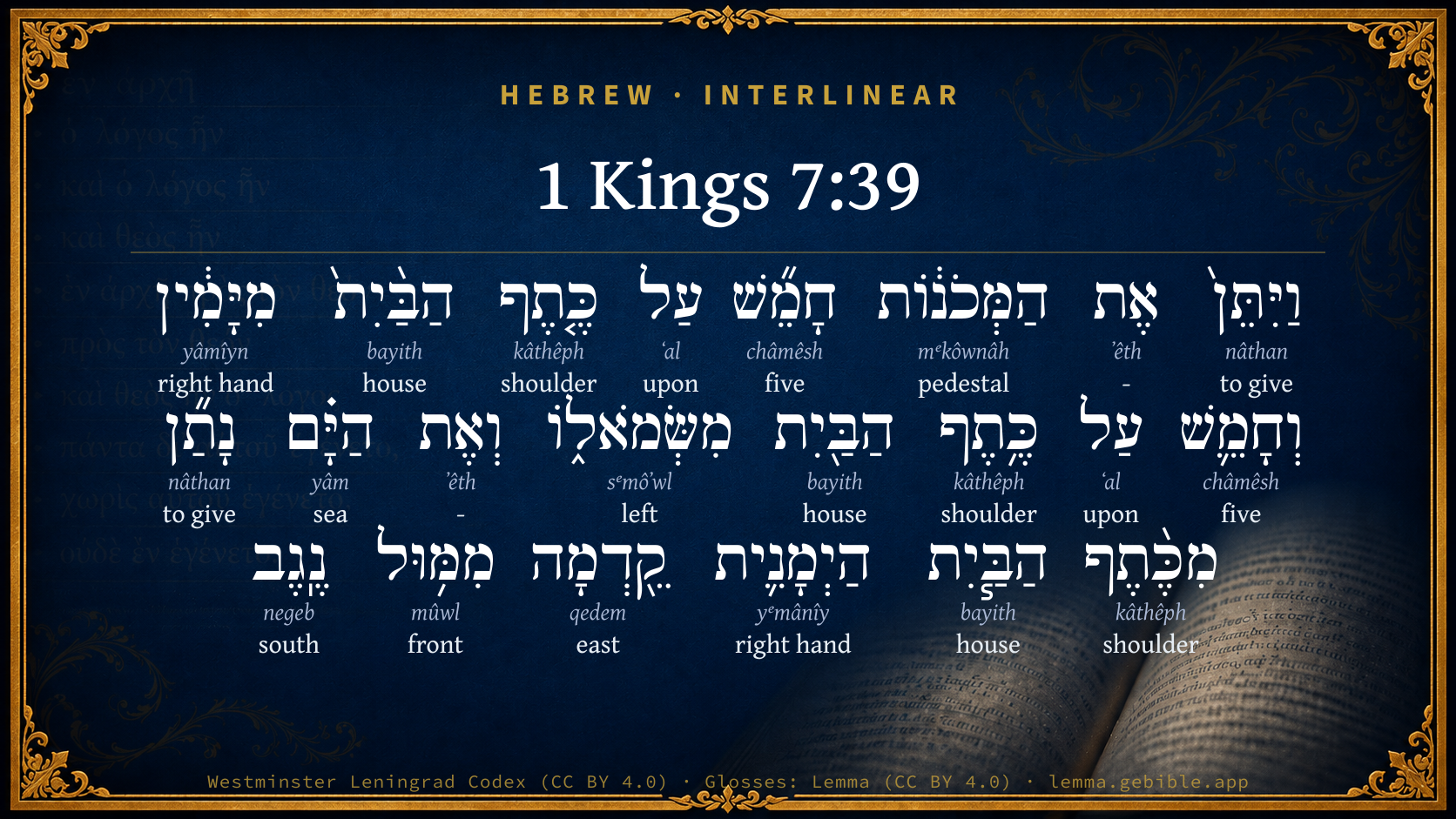
1 Kings 7:39

Hebrew (Westminster Leningrad Codex) 1 Kings 7:39 appears in the Hebrew Old Testament. The text above is from the Westminster Leningrad Codex. Each word links to its Strong’s number, a concise gloss, and parsing drawn from the Open Scriptures Hebrew Bible morphology. Click any word for its full Brown-Driver-Briggs (BDB) entry.
Download image
Cite this verse

1 Kings 7:39 (World English Bible). Public Domain. Lemma interlinear Bible study tool, https://lemma.gebible.app/v/1-kings/7/39.

Show BibTeX & RIS
BibTeX
RIS
English Translation
He set the bases, five on the right side of the house, and five on the left side of the house: and he set the sea on the right side of the house eastward, toward the south.
World English Bible · Public Domain
Download a study sheet

One document with this verse’s original text, its word-by-word gloss line, the meaning frame, cross-references with their text, attributed commentary, and full source and license credits — printable, and it pastes into notes with its structure intact.

This verse Autodidact and up

Study sheet (.html) Plain text (.txt)

A passage Seminary Student

Up to 50 verses in one chapter. A passage sheet keeps up to 6 commentary sources and 12 cross-references per verse, in the order this page ranks them, and says so on the sheet whenever that leaves anything out. Ask for a single verse and you get the Autodidact verse sheet above.

Everything on this page stays free to read, with no account — the sheet is a download of what is already on screen, not access to it.

Want to remove ads? Support Godless Engineer
Compare translations 3

The same verse in 3 English versions, stacked beneath the original-language interlinear above. Click any original word for its lexicon entry.

Each is an independent rendering of the whole verse — the interlinear is not word-aligned to these translations.

Highlighted words mark where these versions differ — a whole-verse word diff, not a word-by-word alignment.

  • World English Bible Public Domain
    He set the bases, five on the right side of the house, and five on the left side of the house: and he set the sea on the right side of the house eastward, toward the south.
  • King James Version Public Domain
    And he put five bases on the right side of the house, and five on the left side of the house: and he set the sea on the right side of the house eastward over against the south.
  • unfoldingWord Literal Text CC BY-SA 4.0
    And he put the stands, five on the shoulder of the house from the right and five on the shoulder of the house from its left. And he put the sea from the right shoulder of the house, eastward toward the south.

unfoldingWord Literal Text — © unfoldingWord, licensed CC BY-SA 4.0. Word-aligned USFM3 via Door43 (git.door43.org/unfoldingWord/en_ult).

Versions to compare (up to 4)

3 of 4 selected

Show all 18 translations

Every available English version of this verse, each an independent rendering of the whole verse.

  • World English Bible Public Domain
    He set the bases, five on the right side of the house, and five on the left side of the house: and he set the sea on the right side of the house eastward, toward the south.
  • Berean Standard Bible Public Domain
    He set five stands on the south side of the temple and five on the north, and he put the Sea on the south side, at the southeast corner of the temple.
  • Majority Standard Bible Public Domain
    He set five stands on the south side of the temple and five on the north, and he put the Sea on the south side, at the southeast corner of the temple.
  • King James Version Public Domain
    And he put five bases on the right side of the house, and five on the left side of the house: and he set the sea on the right side of the house eastward over against the south.
  • American Standard Version (1901) Public Domain
    And he set the bases, five on the right side of the house, and five on the left side of the house: and he set the sea on the right side of the house eastward, toward the south.
  • Revised Version (1885) Public Domain
    And he set the bases, five on the right side of the house, and five on the left side of the house: and he set the sea on the right side of the house eastward, toward the south.
  • Geneva Bible (1599) Public Domain
    And he set the bases, fiue on the right side of the house, and fiue on the left side of the house. And he set the sea on the right side of the house Eastward toward the South.
  • Douay-Rheims (1899) Public Domain
    And he set the ten bases, five on the right side of the temple, and five on the left: and the sea he put on the right side of the temple over against the east southward.
  • Young's Literal Translation Public Domain
    and he putteth the five bases on the right side of the house, and five on the left side of the house, and the sea he hath put on the right side of the house, eastward -- over-against the south.
  • Literal Standard Version CC BY-SA 4.0
    and he puts the five bases on the right side of the house, and five on the left side of the house, and he has put the sea on the right side of the house eastward—from toward the south.
  • Unlocked Literal Bible CC BY-SA 4.0
    He made five stands on the south-facing side of the temple and five on the north-facing side of the temple. He set “The Sea” on the east corner, facing toward the south of the temple.
  • unfoldingWord Literal Text CC BY-SA 4.0
    And he put the stands, five on the shoulder of the house from the right and five on the shoulder of the house from its left. And he put the sea from the right shoulder of the house, eastward toward the south.
  • Darby Bible Public Domain
    And he put the bases, five on the right side of the house, and five on the left side of the house; and he set the sea on the right side of the house eastward, over against the south.
  • World Messianic Bible Public Domain
    He set the bases, five on the right side of the house and five on the left side of the house. He set the sea on the right side of the house eastward and toward the south.
  • Webster's Bible Public Domain
    And he put five bases on the right side of the house, and five on the left side of the house: and he set the sea on the right side of the house eastward over against the south.
  • Free Bible Version CC BY-SA 4.0
    He placed five carts on the south side of the Temple and five on the north side. He placed the Sea on the south side, by the southeast corner of the Temple.
  • Bible in Basic English Public Domain
    And he put the bases by the house, five on the right side and five on the left; and he put the great water-vessel on the right side of the house, to the east, facing south.
  • JPS Tanakh (1917) Public Domain
    And he set the bases, five on the right side of the house, and five on the left side of the house; and he set the sea on the right side of the house eastward, toward the south.

Literal Standard Version (2020), Covenant Press — licensed CC BY-SA 4.0. Text via the HelloAO Bible API (eBible.org). Unlocked Literal Bible (unfoldingWord) — licensed CC BY-SA 4.0. Text via the HelloAO Bible API (eBible.org). unfoldingWord Literal Text — © unfoldingWord, licensed CC BY-SA 4.0. Word-aligned USFM3 via Door43 (git.door43.org/unfoldingWord/en_ult). Free Bible Version, Dr. Jonathan Gallagher — licensed CC BY-SA 4.0. Text via the HelloAO Bible API (eBible.org).

Word by word

More ways to search: Search by grammar → Find every occurrence → Compare this word →

Practice this passage: Drill this verse → Learn its vocabulary →

הַמְּכֹנ֔וֹת
mᵉkôwnâh
H4350
“the · pedestals”
Particle, Definite Article + Noun, Common, Feminine, Plural, Absolute
Part of Speech
Particle + Noun
Type
Common
Gender
Feminine
Number
Plural
State
Absolute
Full BDB Definition

Origin: from H4349

TWOT: 964d

fixed resting place, base, pedestal
  1. וַיִּתֵּן֙ nâthan H5414 “and · to give” Conjunction + Verb, Qal, Sequential Imperfect, 3rd Person, Masculine, Singular
  2. אֶת ʼêth H853 “-” Particle, Direct Object
  3. חָמֵ֞שׁ châmêsh H2568 “five” Adjective, Cardinal number, Feminine, Singular, Absolute
  4. עַל ʻal H5921 “upon” Preposition
  5. כֶּ֤תֶף kâthêph H3802 “shoulder of” Noun, Common, Feminine, Singular, Construct
  6. הַבַּ֨יִת֙ bayith H1004 “the · house” Particle, Definite Article + Noun, Common, Masculine, Singular, Absolute
  7. מִיָּמִ֔ין yâmîyn H3225 “from · right hand” Preposition + Noun, Common, Feminine, Singular, Absolute
  8. וְחָמֵ֛שׁ châmêsh H2568 “and · five” Conjunction + Adjective, Cardinal number, Feminine, Singular, Absolute
  9. עַל ʻal H5921 “upon” Preposition
  10. כֶּ֥תֶף kâthêph H3802 “shoulder of” Noun, Common, Feminine, Singular, Construct
  11. הַבַּ֖יִת bayith H1004 “the · house” Particle, Definite Article + Noun, Common, Masculine, Singular, Absolute
  12. מִשְּׂמֹאל֑וֹ sᵉmôʼwl H8040 “from · left · his” Preposition + Noun, Common, Masculine, Singular, Construct + Suffix, Personal, 3rd Person, Masculine, Singular
  13. וְאֶת ʼêth H853 “and · -” Conjunction + Particle, Direct Object
  14. הַיָּ֗ם yâm H3220 “the · sea” Particle, Definite Article + Noun, Common, Masculine, Singular, Absolute
  15. נָתַ֞ן nâthan H5414 “to give” Verb, Qal, Perfect, 3rd Person, Masculine, Singular
  16. מִכֶּ֨תֶף kâthêph H3802 “from · shoulder of” Preposition + Noun, Common, Feminine, Singular, Construct
  17. הַבַּ֧יִת bayith H1004 “the · house” Particle, Definite Article + Noun, Common, Masculine, Singular, Absolute
  18. הַיְמָנִ֛ית yᵉmânîy H3233 “the · right hand” Particle, Definite Article + Adjective, Adjective, Feminine, Singular, Absolute
  19. קֵ֖דְמָה qedem H6924 “east · toward” Noun, Common, Masculine, Singular, Absolute + Suffix, Demonstrative
  20. מִמּ֥וּל mûwl H4136 “from · front” Preposition + Preposition
  21. נֶֽגֶב negeb H5045 “south” Noun, Common, Masculine, Singular, Absolute

About this verse

These counts appear in no published source. They are computed here, from the morphology-tagged text and Lemma’s own curated glosses. What Lemma adds →

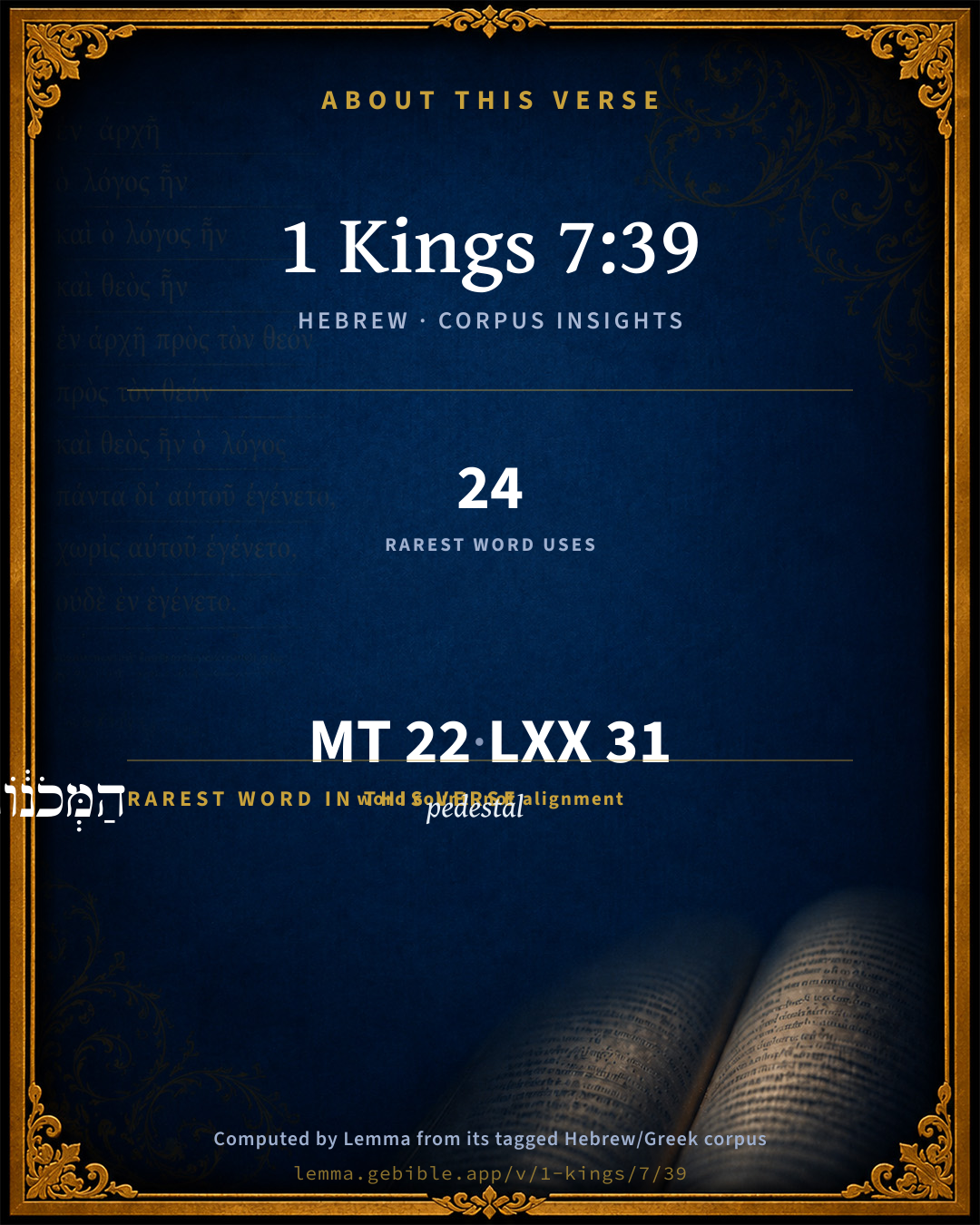
22
words
14
distinct lemmas
Historical
section

Notable vocabulary

The rarest word here is הַמְּכֹנ֔וֹת pedestal H4350 — appearing just 24 times in the whole Hebrew Bible.

Shared distinctive vocabulary

הַמְּכֹנ֔וֹת pedestal H4350 occurs in 18 verses of the Hebrew Bible. Also found in:

Grammatical profile

  • 2 verbs
  • 12 nouns
  • 3 adjectives
  • 3 prepositions
  • 2 particles

Verb forms

  • וַיִּתֵּן֙ Qal · Sequential Imperfect
  • נָתַ֞ן Qal · Perfect

Repetition

Words recur within this verse — often emphatic in Hebrew:

  • כֶּ֤תֶף shoulder H3802 ×3
  • הַבַּ֨יִת֙ house H1004 ×3
  • וַיִּתֵּן֙ to give H5414 ×2
  • חָמֵ֞שׁ five H2568 ×2
  • עַל upon H5921 ×2

Hebrew & Septuagint length

In English translation the verse runs 37 words from the Hebrew and 40 from the Septuagint (LXX English) — closely comparable.

A rough comparison of the two English renderings, which tokenize alike — not a word-level alignment.

Word counts can differ between the Hebrew and the Greek without any difference in meaning — e.g. the Hebrew direct-object marker אֵת has no separate Greek word, and Greek often adds the article ὁ.

In the original languages it is 22 Hebrew tokens and 31 Greek tokens — but the two are counted differently (Hebrew bundles its prefixes and suffixes into one token; the Greek is in lemma form), so that isn’t a like-for-like length.

Cross-references

2

Topical passages linked to 1 Kings 7:39 in the Treasury of Scripture Knowledge — connected by theme and wording, ordered by reader-vote popularity; previews shown in the World English Bible.

  • 2 Chronicles 4:6 He made also ten basins, and put five on the right hand, and five on the left, to wash in them; such things as belonged to the burnt-offering they washed in them; but the sea was for the priests to wash in.
  • 2 Chronicles 4:10 He set the sea on the right side [of the house] eastward, toward the south.

Cross-references courtesy of OpenBible.info (CC BY 4.0).

Hebrew and Greek witnesses Masoretic Hebrew ↔ Greek Septuagint

The same verse in the two great witnesses to the Old Testament, shown verse-for-verse.

These are two independent witnesses, not word-aligned to each other, and the Septuagint is shown in lemma (dictionary) form.

Hebrew 1 Kings 7:39 Masoretic · Westminster Leningrad Codex

וַיִּתֵּן֙ אֶת הַמְּכֹנ֔וֹת חָמֵ֞שׁ עַל כֶּ֤תֶף הַבַּ֨יִת֙ מִיָּמִ֔ין וְחָמֵ֛שׁ עַל כֶּ֥תֶף הַבַּ֖יִת מִשְּׂמֹאל֑וֹ וְאֶת הַיָּ֗ם נָתַ֞ן מִכֶּ֨תֶף הַבַּ֧יִת הַיְמָנִ֛ית קֵ֖דְמָה מִמּ֥וּל נֶֽגֶב

He set the bases, five on the right side of the house, and five on the left side of the house: and he set the sea on the right side of the house eastward, toward the south.

World English Bible · Public Domain

Greek LXX 1 Kings 7:39 Septuagint · lemma form

καί οἰκοδομέω ὁ οἶκος δρυμός ὁ λίβανος ἑκατόν πῆχυς μῆκος αὐτός καί πεντήκοντα πῆχυς πλάτος αὐτός καί τριάκοντα πῆχυς ὕψος αὐτός καί τρεῖς στίχος στῦλος κέδρινος καί ὠμία κέδρινος ὁ στῦλος

And he put five bases on the right side of the house, and five on the left side of the house: and the sea was placed on the right side of the house eastward in the direction of the south.

LXX2012 (modern English Septuagint) · Public Domain

Hebrew: Westminster Leningrad Codex (CC BY 4.0). Greek: Septuagint (public domain); English from LXX2012 (modern English Septuagint) (Public Domain). How the Septuagint differs from the Hebrew →

Targum (Aramaic paraphrase)

1

The Targum is the ancient Jewish Aramaic paraphrase of the Hebrew Scriptures — an interpretive translation, not the Hebrew text itself. Onkelos (literal) and Pseudo-Jonathan (expansive) render the Torah, and Jonathan the Prophets. Coverage is partial: where no permissively-licensed English translation exists for a verse, only the Aramaic is shown. This is verse-level text, not a word-by-word alignment to the Hebrew.

  1. Targum Jonathan Prophets (Joshua–Malachi)
    וִיהַב יַת בְּסִיסַיָא חֲמֵשׁ עַל עִבַּר בֵּיתָא מִימִינָא וַחֲמֵשׁ עַל עִבַר בֵּיתָא מִסְמָלֵיהּ וְיַת יַמָא יְהַב מֵעִבַר בֵּיתָא מִימִינָא קִדוּמָא מִקֳבֵיל דָרוֹמָא:

    (no public-domain English translation for this verse)

    Targum Jonathan — Aramaic: “Mikraot Gedolot” (public domain). English: “Sefaria Community Translation” (CC0 1.0 (public-domain dedication)); “London "Chaldee Paraphrase," 1871” (public domain). Text via Sefaria.

Commentary

Notes on 1 Kings 7:39 from classic Christian and Jewish commentators (each source and its license shown beneath its notes). The classic Christian expositions comment on the surrounding passage and are grouped to its opening verse, so a note may address several verses; the Jewish commentaries on the Tanakh (Rashi and others) are per-verse, so they appear only where the commentator wrote on this verse.

Lemma curates 59 commentaries, every one of them public domain or Creative Commons licensed, each selected and text-cleaned for this edition rather than reprinted as found. About our sources →

Trapp's Complete Commentary

John Trapp

1Ki 7:39 And he put five bases on the right side of the house, and five on the left side of the house: and he set the sea on the right side of the house eastward over against the south.

Ver. 39. On the right side of the house.] That is, Of the priests’ court, who had hereby plenty of water, wherein they might wash so soon as they entered to minister in the holy place. "Holiness becometh God’s house for ever."

John Trapp, A Commentary or Exposition upon All the Books of the Old and New Testament (1647–1656) — public domain. Text from a community e-Sword module.

Geneva Bible (1599)

Geneva Bible translators

To wit, of the Temple or Sanctuary.

Geneva Bible (1599) marginal notes — public domain. Text via Bolls.life.

Ellicott's Commentary for English Readers

(39) The sea.—This was placed on the south-eastern side of the Temple, on one side of the great altar; the ten smaller lavers were ranged five on each side.

A Bible Commentary for English Readers, edited by Charles John Ellicott (1878–1897) — public domain. Text from a community e-Sword module.

The Cambridge Bible for Schools and Colleges

gen. ed. J. J. S. Perowne

39. And he put] The verb is the same which later on in the verse is translated set. It is better to adhere to the same rendering in the same verse. It would also be more in accordance with the Hebrew to translate ‘And he set the bases, five on the right side (Heb. shoulder) of the house &c.’

eastward over against (better, towards) the south] The building looked north and south, so the sides would be east and west. The sea then stood at the south corner of the east side.

There is much uncertainty about the meaning of parts of the language in this description of the bases. They appear however to have been large box-shaped structures, set on four wheels. The wheels did not come up higher than the bottom of the box, and so needed shoulders and stays in which the axles might run and by which they might be kept in position. Above the box, which had a large hole in the top, rose a sort of capital on which was fixed the laver. The sides of the box and the capital as well as the stays were covered with figures. The purpose of these lavers as we are told 2Ch_4:6, was for washing such things as were offered for the burnt offering. This was most likely the reason why they were needed of some considerable height and so were supported on the box-shaped bases. The laver would be of necessity as high as the altar of burnt offering, to the side of which it must have been brought at the time of any offering. That the altar stood higher than the level of the court seems evident from 1Ki_8:22, where Solomon is described as standing before it in the sight of all the people.

The Cambridge Bible for Schools and Colleges (gen. ed. J. J. S. Perowne; Cambridge University Press, 1878–1918) — public domain. Text from a community e-Sword module.

John Gill's Exposition

And Hiram made the lavers, and the shovels, and the basins,.... The lavers are not the ten before mentioned, of the make of which an account is before given; but these, according to Jarchi and Ben Gersom, are the same with the pots, Kg1 7:45 and so they are called in Ch2 4:11 the use of which, as they say, was to put the ashes of the altar into; as the "shovels", next mentioned, were a sort of besoms to sweep them off, and the "basins" were to receive the blood of the sacrifices, and sprinkle it; no mention is here made of the altar of brass he made, but is in Ch2 4:11, nor of the fleshhooks to take the flesh out of the pots, as in Ch2 4:16,

so Hiram made an end of doing all the work that he made King Solomon for the house of the Lord; what he undertook, and was employed in, he finished, which were all works of brass; of which a recapitulation is made in the following verses to the end of the forty fifth, where they are said to be made of "bright brass", free of all dross and rust; "good", as the Targum, even the best brass they were made of; the brass David took from Hadarezer, Ch1 18:8 which Josephus (g) too much magnifies, when he says it was better than gold.

(g) Antiqu. l. 7. c. 5. sect. 3.

John Gill's Exposition of the Whole Bible (1746–1763) — public domain (CC PDM 1.0). Text via the HelloAO Bible API.

Haydock's Catholic Bible Commentary

Right side, to the south, between the temple and the altar of holocausts. --- Sea. It was the most towards the east, of the five basins, (Calmet) or near the eastern gate of the priests’ court, standing on the south of the entrance, that they might purify themselves. (Menochius) --- St. Justin Martyr (apology ii.) observes that the pagans imitated this custom. But this ought not to hinder Christians from employing a thing which is innocent in itself, and calculated to make them aspire to the greatest purity, when they approach to God. (Haydock) Spargit & ipse suos lauro rorante capillos

Incipit & solita fundere voce preces. (Ovid, Fast. v.)

George Leo Haydock (1774–1849), Haydock's Catholic Family Bible and Commentary, 1859 edition — public domain. Excludes Psalms (Douay-Rheims chapter numbering differs from Protestant) and Deuterocanonical books (Catholic canon only).

Matthew Poole's English Annotations

On the right side, i.e. in the south side, as is expressed in the end of the verse, and as the right side is used above, 1Ki 6:8; Psa 89:12.

On the right side of the house; not within the house, but in the priests’ court, where they washed either their hands or feet, or the parts of the sacrifices. On the left side of the house, i.e. on the north side; for this is here opposed to the right or south side.

Over against the south, i.e. in the south-east part, where the offerings were prepared.

Matthew Poole's English Annotations on the Holy Bible (1683–1685) — public domain. Text from a community e-Sword/MySword module.

Whedon's Commentary on the Bible

Daniel D. Whedon

39. The right side of the house — Hebrew, the right shoulder of the house; that is, the south side, near the front part of the building, or at the south side of the porch.

Left side — The corresponding north side of the building.

The sea… eastward, over against the south — That is, southeast from the front of the temple.

Daniel D. Whedon (gen. ed.), Commentary on the Old and New Testaments (1874–1909) — public domain. Text from a community e-Sword module.

The Pulpit Commentary

And he put five bases on the right side Heb. shoulder of the house, and five on the left side of the house i.e., on the south and north sides of the court of the priests: and he set the sea on the right side of the house eastward over against the south. This passage is decisive as to which was the right and which the left. The right side was the south. It was probably for convenience that the sea did not stand due east of the house, i.e., between the porch and altar.

The Pulpit Commentary (1880–1919), ed. H.D.M. Spence-Jones & Joseph S. Exell — public domain. Text from a community e-Sword module.

John Wesley's Explanatory Notes

Right side - In the south side, not within the house, but in the priests court, where they washed either their hands or feet, or the parts of the sacrifices. Left side - On the north side. The south - In the southeast part, where the offerings were prepared.

John Wesley, Explanatory Notes Upon the Whole Bible (1754–1765) — public domain. Text via the GEBible commentary corpus.

Rashi

Rabbi Shlomo Yitzchaki (Rashi)

On the [right] side of the Beis Hamikdosh. Against the right side of the Beis Hamikdosh.

[Away] from the right side of the Beis Hamikdosh. Extended from the south side toward the north side. The following [explains], “קדמה מול נגב”: The northeast corner against the space which is between the northern wall of the Beis Hamikdosh and the wall of the court; and the northern wall is called “ממול נגב,” extended and removed far away from the south, and מול and ממול are not translated the same.

Rashi on the Tanakh — English translations: “The Judaica Press complete Tanach with Rashi, translated by A. J. Rosenberg” (CC BY 4.0); “Pentateuch with Rashi's commentary by M. Rosenbaum and A.M. Silbermann, 1929-1934” (public domain); “The Metsudah Tanach series, Lakewood, N.J” (CC BY 4.0); and “The Book of Joshua, Metsudah Publications, 1997” (CC BY 4.0). Text via Sefaria.

Lesson kit

Teaching starters — assembled from the data on this page, not authored interpretation. Every prompt links to the verse data it draws on. Edit before teaching.

1 Kings, in the Historical, opens this verse with 22 words (14 distinct Hebrew lemmas). Its most distinctive word is mᵉkôwnâh (“pedestal”). A historical commentator’s framing appears above. Read the whole chapter for the surrounding context.

Discussion questions

  1. What does “pedestal” (mᵉkôwnâh) contribute to the verse as a whole?
  2. 1 Kings 7:27 shares the word «pedestal» with this verse. How do the two illuminate each other?
  3. “shoulder” occurs 3× in this one verse. What is the effect of the repetition?
  4. These translations render this verse differently; the difference is in the English rendering, not the original. What questions does that raise?
  5. The verb «וַיִּתֵּן֙» is Qal Sequential Imperfect. How does its form color the action?
  6. Reading how Trapp's Complete Commentary and Geneva Bible (1599) read this verse, where do the two commentators agree and where do they part?

Things to notice

Reading settings

Reading text

Shown beneath each verse's original-language words.

Old Testament
Old Testament edition

Read the OT as the Masoretic Hebrew (MT) or the Greek Septuagint (LXX).

English shown for the Greek Septuagint (in the Hebrew ↔ Greek comparison).

Comparing translations? Open the Compare panel on any verse page to stack up to four side by side.