
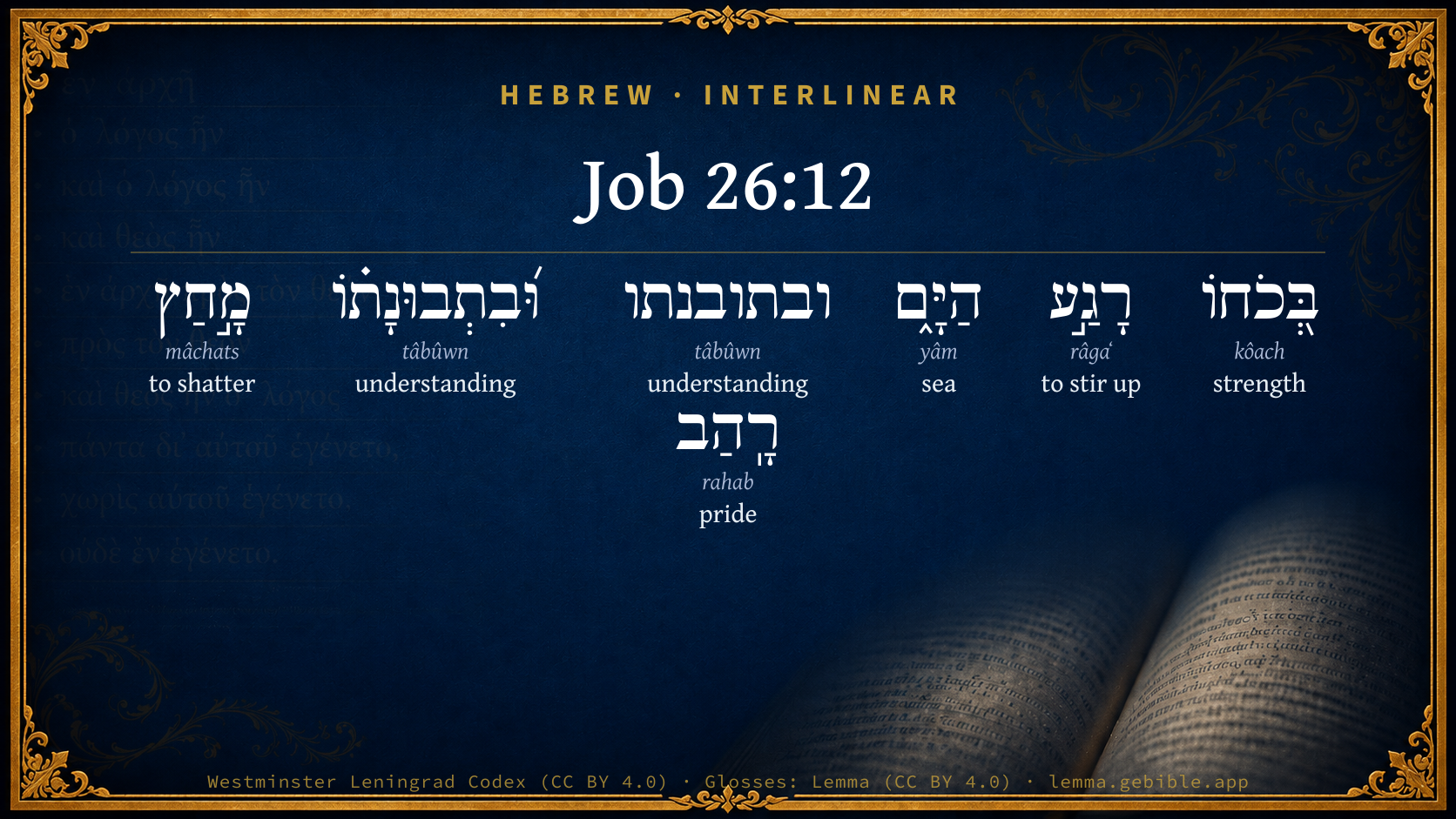
Job 26:12

Hebrew (Westminster Leningrad Codex) Job 26:12 appears in the Hebrew Old Testament. The text above is from the Westminster Leningrad Codex. Each word links to its Strong’s number, a concise gloss, and parsing drawn from the Open Scriptures Hebrew Bible morphology. Click any word for its full Brown-Driver-Briggs (BDB) entry.
Download image
Cite this verse

Job 26:12 (World English Bible). Public Domain. Lemma interlinear Bible study tool, https://lemma.gebible.app/v/job/26/12.

Show BibTeX & RIS
BibTeX
RIS
English Translation
He stirs up the sea with his power, And by his understanding he strikes through Rahab.
World English Bible · Public Domain
Download a study sheet

One document with this verse’s original text, its word-by-word gloss line, the meaning frame, cross-references with their text, attributed commentary, and full source and license credits — printable, and it pastes into notes with its structure intact.

This verse Autodidact and up

Study sheet (.html) Plain text (.txt)

A passage Seminary Student

Up to 50 verses in one chapter. A passage sheet keeps up to 6 commentary sources and 12 cross-references per verse, in the order this page ranks them, and says so on the sheet whenever that leaves anything out. Ask for a single verse and you get the Autodidact verse sheet above.

Everything on this page stays free to read, with no account — the sheet is a download of what is already on screen, not access to it.

Want to remove ads? Support Godless Engineer
Compare translations 3

The same verse in 3 English versions, stacked beneath the original-language interlinear above. Click any original word for its lexicon entry.

Each is an independent rendering of the whole verse — the interlinear is not word-aligned to these translations.

Highlighted words mark where these versions differ — a whole-verse word diff, not a word-by-word alignment.

  • World English Bible Public Domain
    He stirs up the sea with his power, And by his understanding he strikes through Rahab.
  • King James Version Public Domain
    He divideth the sea with his power, and by his understanding he smiteth through the proud.
  • unfoldingWord Literal Text CC BY-SA 4.0
    He calmed the sea with his power, and by his understanding he shattered Rahab.

unfoldingWord Literal Text — © unfoldingWord, licensed CC BY-SA 4.0. Word-aligned USFM3 via Door43 (git.door43.org/unfoldingWord/en_ult).

Versions to compare (up to 4)

3 of 4 selected

Show all 18 translations

Every available English version of this verse, each an independent rendering of the whole verse.

  • World English Bible Public Domain
    He stirs up the sea with his power, And by his understanding he strikes through Rahab.
  • Berean Standard Bible Public Domain
    By His power He stirred the sea; by His understanding He shattered Rahab.
  • Majority Standard Bible Public Domain
    By His power He stirred the sea; by His understanding He shattered Rahab.
  • King James Version Public Domain
    He divideth the sea with his power, and by his understanding he smiteth through the proud.
  • American Standard Version (1901) Public Domain
    He stirreth up the sea with his power, And by his understanding he smiteth through Rahab.
  • Revised Version (1885) Public Domain
    He stirreth up the sea with his power, and by his understanding he smiteth through Rahab.
  • Geneva Bible (1599) Public Domain
    The sea is calme by his power, and by his vnderstanding he smiteth the pride thereof.
  • Douay-Rheims (1899) Public Domain
    By his power the seas are suddenly gathered together, and his wisdom has struck the proud one.
  • Young's Literal Translation Public Domain
    By His power He hath quieted the sea, And by His understanding smitten the proud.
  • Literal Standard Version CC BY-SA 4.0
    By His power He has quieted the sea, || And by His understanding struck the proud.
  • Unlocked Literal Bible CC BY-SA 4.0
    He calmed the sea with his power; by his understanding he shattered Rahab.
  • unfoldingWord Literal Text CC BY-SA 4.0
    He calmed the sea with his power, and by his understanding he shattered Rahab.
  • Darby Bible Public Domain
    He stirreth up the sea by his power, and by his understanding he smiteth through Rahab.
  • World Messianic Bible Public Domain
    He stirs up the sea with his power, and by his understanding he strikes through Rahab.
  • Webster's Bible Public Domain
    He divideth the sea by his power, and by his understanding he smiteth through the proud.
  • Free Bible Version CC BY-SA 4.0
    He calmed the sea with his power; because he knew what to do, he crushed Rahab.
  • Bible in Basic English Public Domain
    By his power the sea was made quiet; and by his wisdom Rahab was wounded.
  • JPS Tanakh (1917) Public Domain
    He stirreth up the sea with His power, and by His understanding He smiteth through Rahab.

Literal Standard Version (2020), Covenant Press — licensed CC BY-SA 4.0. Text via the HelloAO Bible API (eBible.org). Unlocked Literal Bible (unfoldingWord) — licensed CC BY-SA 4.0. Text via the HelloAO Bible API (eBible.org). unfoldingWord Literal Text — © unfoldingWord, licensed CC BY-SA 4.0. Word-aligned USFM3 via Door43 (git.door43.org/unfoldingWord/en_ult). Free Bible Version, Dr. Jonathan Gallagher — licensed CC BY-SA 4.0. Text via the HelloAO Bible API (eBible.org).

Word by word

More ways to search: Search by grammar → Find every occurrence → Compare this word →

Practice this passage: Drill this verse → Learn its vocabulary →

About this verse

These counts appear in no published source. They are computed here, from the morphology-tagged text and Lemma’s own curated glosses. What Lemma adds →

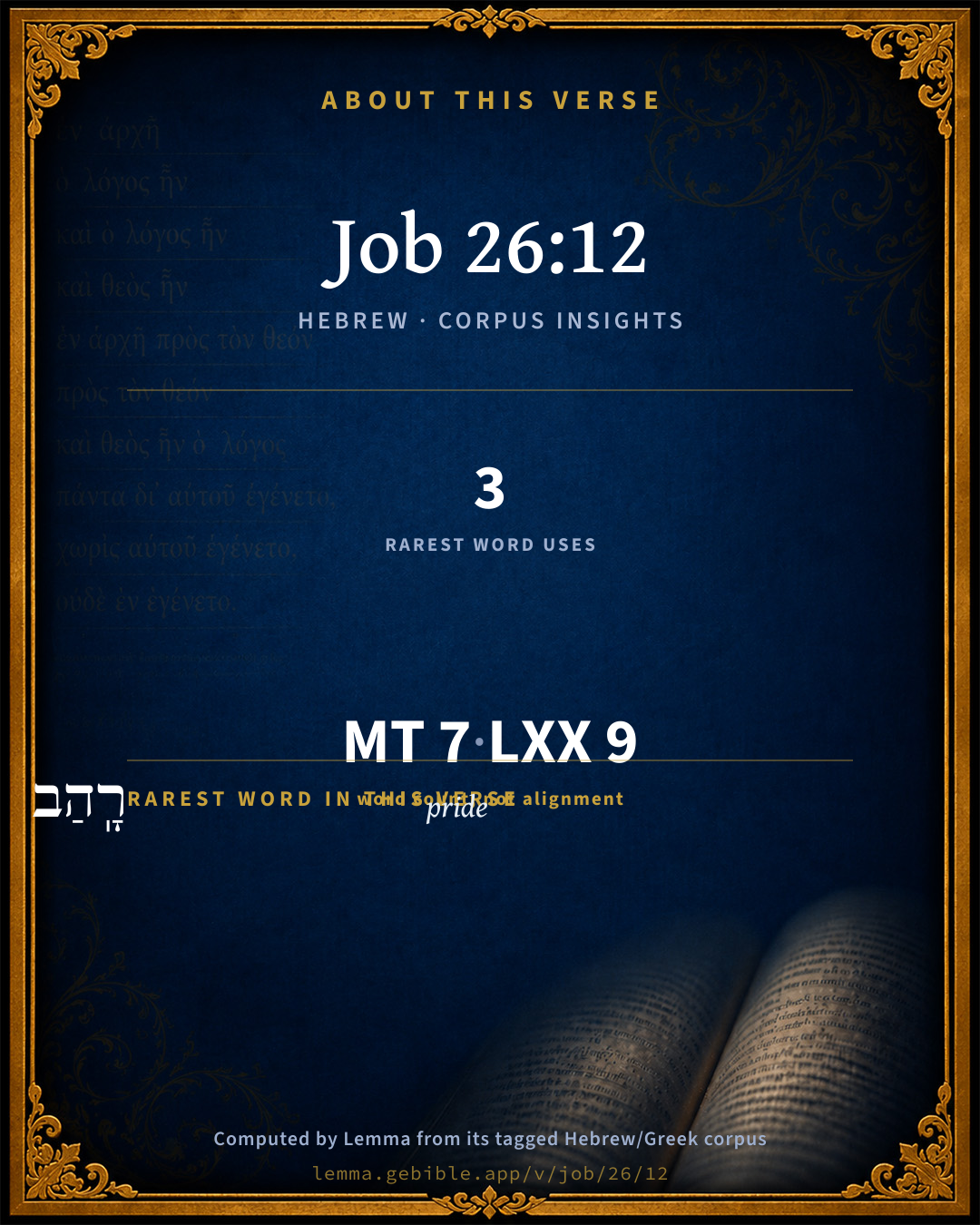
7
words
6
distinct lemmas
Wisdom
section

Notable vocabulary

The rarest word here is רָֽהַב pride H7293 — appearing just 3 times in the whole Hebrew Bible.

Shared distinctive vocabulary

רָֽהַב pride H7293 occurs in 3 verses of the Hebrew Bible. Also found in:

Grammatical profile

  • 2 verbs
  • 5 nouns

Verb forms

  • רָגַ֣ע Qal · Perfect
  • מָ֣חַץ Qal · Perfect

Repetition

A word recurs within this verse — often emphatic in Hebrew:

  • ובתובנתו understanding H8394 ×2

Hebrew & Septuagint length

In English translation the verse runs 16 words from the Hebrew and 17 from the Septuagint (LXX English) — closely comparable.

A rough comparison of the two English renderings, which tokenize alike — not a word-level alignment.

Word counts can differ between the Hebrew and the Greek without any difference in meaning — e.g. the Hebrew direct-object marker אֵת has no separate Greek word, and Greek often adds the article ὁ.

In the original languages it is 7 Hebrew tokens and 9 Greek tokens — but the two are counted differently (Hebrew bundles its prefixes and suffixes into one token; the Greek is in lemma form), so that isn’t a like-for-like length.

Cross-references

15

Topical passages linked to Job 26:12 in the Treasury of Scripture Knowledge — connected by theme and wording, ordered by reader-vote popularity; previews shown in the World English Bible.

  • Isaiah 51:15 For I am Yahweh your God, who stirs up the sea, so that the waves of it roar: Yahweh of Hosts is his name.
  • Jeremiah 31:35 Thus says Yahweh, who gives the sun for a light by day, and the ordinances of the moon and of the stars for a light by night, who stirs up the sea, so that the waves of it roar; Yahweh of hosts is his name:
  • Job 9:13 "God will not withdraw his anger; The helpers of Rahab stoop under him.
  • Job 12:13 "With God is wisdom and might. He has counsel and understanding.
  • Psalms 89:9–10 You rule the pride of the sea. When its waves rise up, you calm them.
  • Isaiah 51:9 Awake, awake, put on strength, arm of Yahweh; awake, as in the days of old, the generations of ancient times. Isn't it you who did cut Rahab in pieces, who pierced the monster?
  • Psalms 74:13 You divided the sea by your strength. You broke the heads of the sea monsters in the waters.
  • Psalms 93:3–4 The floods have lifted up, Yahweh, The floods have lifted up their voice. The floods lift up their waves.
  • Exodus 14:21–31 Moses stretched out his hand over the sea, and Yahweh caused the sea to go back by a strong east wind all the night, and made the sea dry land, and the waters were divided.
  • Job 40:11–12 Pour forth the fury of your anger. Look on everyone who is proud, and bring him low.
  • Psalms 29:10 Yahweh sat enthroned at the Flood. Yes, Yahweh sits as King forever.
  • Psalms 114:2–7 Judah became his sanctuary, Israel his dominion.
  • Isaiah 2:12 For there will be a day of Yahweh of Hosts for all that is proud and haughty, And for all that is lifted up; And it shall be brought low:
  • Daniel 4:37 Now I, Nebuchadnezzar, praise and extol and honor the King of heaven; for all his works are truth, and his ways justice; and those who walk in pride he is able to abase.
  • James 4:6 But he gives more grace. Therefore it says, "God resists the proud, but gives grace to the humble."

Cross-references courtesy of OpenBible.info (CC BY 4.0).

Hebrew and Greek witnesses Masoretic Hebrew ↔ Greek Septuagint

The same verse in the two great witnesses to the Old Testament, shown verse-for-verse.

These are two independent witnesses, not word-aligned to each other, and the Septuagint is shown in lemma (dictionary) form.

Hebrew Job 26:12 Masoretic · Westminster Leningrad Codex

בְּ֭כֹחוֹ רָגַ֣ע הַיָּ֑ם ובתובנתו וּ֝בִתְבוּנָת֗וֹ מָ֣חַץ רָֽהַב

He stirs up the sea with his power, And by his understanding he strikes through Rahab.

World English Bible · Public Domain

Greek LXX Job 26:12 Septuagint · lemma form

ἰσχύς καταπαύω ὁ θάλασσα ἐπιστήμη δέ τιτρώσκω ὁ κῆτος

He has calmed the sea with his might, and by his wisdom the whale has been overthrown.

LXX2012 (modern English Septuagint) · Public Domain

On this verse, Albert Barnes' Notes on the Bible discusses the Septuagint’s reading. Read the note in Commentary ↓

Hebrew: Westminster Leningrad Codex (CC BY 4.0). Greek: Septuagint (public domain); English from LXX2012 (modern English Septuagint) (Public Domain). How the Septuagint differs from the Hebrew →

Commentary

Notes on Job 26:12 from classic Christian and Jewish commentators (each source and its license shown beneath its notes). The classic Christian expositions comment on the surrounding passage and are grouped to its opening verse, so a note may address several verses; the Jewish commentaries on the Tanakh (Rashi and others) are per-verse, so they appear only where the commentator wrote on this verse.

Lemma curates 59 commentaries, every one of them public domain or Creative Commons licensed, each selected and text-cleaned for this edition rather than reprinted as found. About our sources →

Trapp's Complete Commentary

John Trapp

Job 26:12 He divideth the sea with his power, and by his understanding he smiteth through the proud.

Ver. 12. He divideth the sea with his power] i.e. With his strong winds causing tempests: see the like Isa 51:15 : so that it lieth as it were in ridges, the top of one wave far from another, Jer 31:35. That was a strange thing that is reported to have fallen out at London the last week. On Monday, Aug. 14, 1654, by reason of the great winds the tide was so low in the Thames, that boys waded over it from one side to the other, the old watermen affirming they never saw it so before.

And by his understanding he smiteth through the proud] Heb. Pride, or Rahab, which is oft put for Egypt, as Psa 87:4; Psa 89:10 Isa 51:9, whence some would have Pharaoh meant; others, the devil; others, the whale dashing against a rock, or driven to shore where he is taken; others, the proud waves of the sea, as Job 38:11, disabled by God to stir more, as a man mortally wounded is to fight longer. An instance hereof we have in the history of Jonah, and another in the Gospel, Mat 8:14. As God is powerful enough to raise storms, so he is wise enough to lay them again, Psa 107:25; Psa 107:29. He hath the sea in as great awe as a giant hath a pigmy.

John Trapp, A Commentary or Exposition upon All the Books of the Old and New Testament (1647–1656) — public domain. Text from a community e-Sword module.

Joseph Benson's Commentary

Job 26:12. He divideth the sea with his power — “By his power he raises tempests, which make great furrows in the sea, and divideth, as it were, one part of it from another;” and by his understanding he smiteth through the proud — “And, such is his wisdom, he knows how to appease it again, and repress its proud waves into the deadest calm.” — Bishop Patrick. Waterland and Schultens render רגע הים, ragang hajam, he shaketh the sea. Bishop Warburton tells us, that the destruction of Pharaoh and his host in the Red sea is here plainly referred to, and that רהב, rahab, rendered proud, signifies Egypt. But Mr. Peters justly observes, “Others may see nothing more in it than the description of a storm or tempest. The Hebrew word translated divide, is not the same that is used, Exodus 14., of the Red sea, but signifies a violent breaking and tossing of the waves as in a storm. And if the former part of the sentence means that God sometimes, by his power, raises a violent storm at sea, the latter may well enough be understood of the pride and swelling of the sea itself, allayed again by the same divine power and will which raised it.”

Joseph Benson's Commentary on the Old and New Testaments (1811–1818) — public domain. Text from a community e-Sword module.

Tyndale Open Study Notes

Tyndale Open Resources

26:12 the sea grew calm (cp. Exod 14:21; Mark 4:39): Or the sea was stirred up (cp. Isa 51:15; Jer 31:35). In either interpretation, God performed a miracle on behalf of his people. • crushed the great sea monster: God’s dominance over the sea demythologized popular beliefs about the sea’s divinity. See also Pss 74:13-14; 89:9-10; Isa 27:1; 51:9-10.

Tyndale Open Study Notes — © Tyndale Open Resources, licensed CC BY-SA 4.0. Text via the HelloAO Bible API.

Jamieson, Fausset & Brown

Robert Jamieson, A. R. Fausset & David Brown

divideth-- (Psa 74:13). Perhaps at creation (Gen 1:9-10). The parallel clause favors UMBREIT, "He stilleth." But the Hebrew means "He moves." Probably such a "moving" is meant as that at the assuaging of the flood by the wind which "God made to pass over" it (Gen 8:1; Psa 104:7).

the proud--rather, "its pride," namely, of the sea (Job 9:13).

Jamieson, Fausset & Brown — Commentary Critical and Explanatory on the Whole Bible (1871) — public domain (CC PDM 1.0). Text via the HelloAO Bible API.

Adam Clarke's Commentary

Verse 12. He divideth the sea with his power] Here is a manifest allusion to the passage of the Red Sea by the Israelites, and the overthrow of Pharaoh and his host, according to the opinion of the most eminent critics.

He smiteth through the proud.] רהב Rahab, the very name by which Egypt is called Isa 51:9, and elsewhere. Calmet remarks: "This appears to refer only to the passage of the Red Sea, and the destruction of Pharaoh. Were we not prepossessed with the opinion that Job died before Moses, every person at the first view of the subject must consider it in this light." I am not thus prepossessed. Let Job live when he might, I am satisfied the Book of Job was written long after the death of Moses, and not earlier than the days of Solomon, if not later. The farther I go in the work, the more this conviction is deepened; and the opposite sentiment appears to be perfectly gratuitous.

Adam Clarke's Commentary on the Bible (1810–1826) — public domain. Text from a community e-Sword/MySword module.

Ellicott's Commentary for English Readers

(12) He divideth the sea.—The word is taken in the two opposite senses of stirring up and calming; perhaps the latter is more appropriate to the context, which seems to speak of God’s mastery over nature.

By his understanding he smiteth through the proud.—Literally, Rahab, which certainly is at times a name for Egypt (see Isa_51:9, e.g.), and which, if used in that sense here, can only refer to the signal judgments on Egypt at the Exodus. According to our view of this matter will be the indication derived therefrom of the date of Job.

A Bible Commentary for English Readers, edited by Charles John Ellicott (1878–1897) — public domain. Text from a community e-Sword module.

The Cambridge Bible for Schools and Colleges

gen. ed. J. J. S. Perowne

12, 13. These verses probably read,

12. He quelleth the sea with his power,

And by his understanding he smiteth through Rahab.

13. By his breath the heavens are bright,

His hand pierceth the fleeing serpent.

Others for “quelleth” or stilleth, prefer the meaning “stirreth up.” Comp. Isa_51:15; Jer_31:35. The word means “to terrify,” and the parallelism of the second clause “smiteth through Rahab,” which refers to the subduing of a raging monster, suggests that the sea when “terrified” or rebuked is in a state of fury, and is quelled by the power of God. So already the Sept. κατέπαυσεν. This sense is also more suitable to the words “by his power.” On Rahab see notes, ch. Job_9:13.

The Cambridge Bible for Schools and Colleges (gen. ed. J. J. S. Perowne; Cambridge University Press, 1878–1918) — public domain. Text from a community e-Sword module.

John Gill's Exposition

He divideth the sea with his power,.... As at the first creation, when the waters were caused to go off the face of the earth, and were separated from it; and the one was called earth, and the other seas, Gen 1:9; or it may respect the division of those waters into divers seas and channels in the several parts of the world, for the better accommodation of the inhabitants of it, in respect of trade and commerce, and the more convenient supply of them with the various produce of different countries, and the transmitting of it to them: some have thought this has respect to the division of the Red sea for the children of Israel to walk in as on dry land, when pursued by the Egyptians, supposed to be meant by "Rahab" in the next clause; rather it may design the parting of the waves of the sea by a stormy wind, raised by the power of God, which lifts up the waves on high, and divides them in the sea, and dashes them one against another; wrinkles and furrows them, as Jarchi interprets the words, which is such an instance of the power and majesty or God, that he is sometimes described by it, Isa 51:15; though the word used is sometimes taken in a quite different sense, for the stilling of the waves of the sea, and so it is by some rendered here, "he stilleth the sea by his power" (b); the noise of its waves, and makes them quiet, and the sea a calm, which has been exceeding boisterous and tempestuous, and is taken notice of as an effect of his sovereign and uncontrollable power, Psa 65:7; and may be observed as a proof of our Lord's divinity, whom the winds and sea obeyed, to the astonishment of the mariners, who were convinced thereby that he must be some wonderful and extraordinary person, Mat 8:26;

and by his understanding he smiteth through the proud; the proud waves of the sea, and humbles them, and makes them still, as before; or the proud monstrous creatures in it, as whales and others, particularly the leviathan, the king over all the children of pride, Job 41:34; see Psa 74:13. The word used is "Rahab", one of the names of Egypt, Psa 87:4; and so Jarchi interprets it of the Egyptians, who were smitten of God with various plagues, and particularly in their firstborn; and at last at the Red sea, where multitudes perished, and Pharaoh their proud king, with his army; who was an emblem of the devil, whose sin, the cause of his fall and ruin, was pride; and the picture of proud and haughty sinners, whose destruction sooner or later is from the Lord; and which is an instance of his wisdom and understanding, who humbles the proud, and exalts the lowly.

(b) "pacavit mare", Bolducius; "quiescit mare ipsum", Vatablus; so Sept. and Ben Gersom.

John Gill's Exposition of the Whole Bible (1746–1763) — public domain (CC PDM 1.0). Text via the HelloAO Bible API.

Albert Barnes' Notes on the Bible

He divideth the sea with His power - Herder renders this:

By his power he scourgeth the sea,

By his wisdom he bindeth its pride.

Jerome (Vulgate), “By his power the seas are suddenly congregated together The Septuagint, “By his power - κατέπαυσε την θάλασσαν katepause tēn thalassan - he makes the sea calm.” Luther, Vor seiner Kraft wird das Meer plotzlich ungestum - “By his power the sea becomes suddenly tempestuous.” Noyes renders it, “By his power he stilleth the sea.” This is undoubtedly the true meaning. There is no allusion here to the dividing of the sea when the Israelites left Egypt; but the ideals, that God has power to calm the tempest, and hush the waves into peace. The word used here (רגע râga‛) means, to make afraid, to terrify; especially, to restrain by threats; see the notes at Isa 51:15; compare Jer 31:35. The reference here is to the exertion of the power of God, by which he is able to calm the tumultuous ocean, and to restore it to repose after a storm - one of the most striking exhibitions of omnipotence that can be conceived of.

By his understanding - By his wisdom.

He smiteth through - He scourges, or strikes - as if to punish.

The proud - The pride of the sea. The ocean is represented as enraged, and as lifted up with pride and rebellion. God scourges it, rebukes it, and makes it calm.

Albert Barnes' Notes on the Bible (1834–1885) — public domain. Text from a community e-Sword/MySword module.

Haydock's Catholic Bible Commentary

Together, at the beginning, Genesis i. 9. Hebrew, "By his strength he has divided the sea; and by his wisdom he has pierced the proud, or Egypt." Rahab, (Haydock) or Rachab, is often put for Egypt; (Psalm lxxxviii. 11.) and all would naturally have concluded that the fall of Pharao was pointed at, if it had not been supposed that Job lived before that event. That is, however, dubious. Isaias (li. 9.) uses the same terms in describing the fall of this tyrant. (Calmet) --- Yet the Septuagint translate, "the whale," (Haydock) or some sea monster, which God holds in subjection, (Pineda) like the weakest creature. (Haydock) --- The foaming billows (Menochius) are likewise subject to his control. (Haydock)

George Leo Haydock (1774–1849), Haydock's Catholic Family Bible and Commentary, 1859 edition — public domain. Excludes Psalms (Douay-Rheims chapter numbering differs from Protestant) and Deuterocanonical books (Catholic canon only).

Matthew Poole's English Annotations

He speaks either,

1. Of God’s dividing the Red Sea for the Israelites to pass over; and consequently the Hebrew word rahab, which here follows, and is translated pride, or the proud, is meant of Egypt, which is oft called Rahab, as Psa 87:4; 89:10; Isa 51:9. But it seems most probable that that work was not yet done, and that Job lived long before Israel’s coming out of Egypt. Or rather,

2. Of the common work of nature and providence in raising tempests, by which he breaketh or divideth the waves of the sea, by making deep furrows in it, and casting up part of the waters into the air, and splitting part of them upon the rocks and shores of the sea.

By his understanding, i.e. by his wise counsel and administration of things, so as may obtain his own glorious ends.

The proud; either,

1. The whale, which is called

king over all the children of pride, Job 41:34, and which is sometimes by force of tempests cast upon the shore. Or rather,

2. The sea, which is fitly called proud, as its waves are called, Job 38:11, because it is lofty, and fierce, and swelling, and unruly; which God is said to smite when he subdues and restrains its rage, and turns the storm into a calm.

Matthew Poole's English Annotations on the Holy Bible (1683–1685) — public domain. Text from a community e-Sword/MySword module.

Whedon's Commentary on the Bible

Daniel D. Whedon

12. Divideth the sea — A prime idea of רגע is “rouse,” thence terrify. Others, however, guided by its other root idea, translate it quell.

Smiteth through — Mahhats is rendered also to crush, break in pieces.

The proud — Hebrew, rahab, (see on Job_9:13,) is parallel to sea, and seems to call for “a sea-monster” of some kind, which is the version of the Septuagint. Such a monster may have represented to the popular mind the power of evil, and thus have paved the way for the allusion to “the fleeing serpent” of the next verse. Dillmann has as little reason for supposing that Job makes use of a traditionary saying which was equivalent to “he hath stilled the raging sea,” as others have for referring the text to the exodus, and the crushing of pride at the Red Sea.

Daniel D. Whedon (gen. ed.), Commentary on the Old and New Testaments (1874–1909) — public domain. Text from a community e-Sword module.

The Pulpit Commentary

He divideth the sea with his power. "Divideth" is certainly a wrong translation. The verb used (gA) means either "stirreth up" or "stilleth." In favour of the former rendering are Rosenmuller, Schultens, Delitzsch, Merx, and Canon Cook; in favour of the latter, the LXX, Dillmann, and Dr. Stanley Leathes. In either case the general sentiment is that God has full mastery over the sea, and can regulate its movements at his pleasure. And by his understanding he smiteth through the proud; literally, he smiteth through Rahab. (On Rahab, as the great power of evil, see the comment on Job_9:13) God is said to have "smitten him through by his understanding" since in the contest between good and evil it is rather intelligence than mere force that carries the day. Power alone is sufficient to control the sea.

The Pulpit Commentary (1880–1919), ed. H.D.M. Spence-Jones & Joseph S. Exell — public domain. Text from a community e-Sword module.

Rashi

Rabbi Shlomo Yitzchaki (Rashi)

the sea wrinkled Like (above 7:5), “my skin wrinkled.” Many wrinkles were formed. (So, when He said (Gen. 1:9), “Let the waters...gather,” they were gathered from their straightness and were wrinkled into many wrinkles) until they gathered into one place, which was prepared for them.

He smote Rahab The Egyptians, who are called רהב, haughty.

Rashi on the Tanakh — English translations: “The Judaica Press complete Tanach with Rashi, translated by A. J. Rosenberg” (CC BY 4.0); “Pentateuch with Rashi's commentary by M. Rosenbaum and A.M. Silbermann, 1929-1934” (public domain); “The Metsudah Tanach series, Lakewood, N.J” (CC BY 4.0); and “The Book of Joshua, Metsudah Publications, 1997” (CC BY 4.0). Text via Sefaria.

Lesson kit

Teaching starters — assembled from the data on this page, not authored interpretation. Every prompt links to the verse data it draws on. Edit before teaching.

Job, in the Wisdom, opens this verse with 7 words (6 distinct Hebrew lemmas). Its most distinctive word is rahab (“pride”). A historical commentator’s framing appears above. Read the whole chapter for the surrounding context.

Discussion questions

  1. How does “pride” (rahab) shape what this verse is saying?
  2. Job 9:13 shares the word «pride» with this verse. How do the two illuminate each other?
  3. “understanding” occurs 2× in this one verse. What is the effect of the repetition?
  4. The translations on this page render this verse differently — a whole-verse word diff, not a word-by-word alignment. What might account for the different wordings?
  5. The verb «רָגַ֣ע» is Qal Perfect. How does its form color the action?
  6. Reading how Trapp's Complete Commentary and Joseph Benson's Commentary read this verse, where do the two commentators agree and where do they part?

Things to notice

Reading settings

Reading text

Shown beneath each verse's original-language words.

Old Testament
Old Testament edition

Read the OT as the Masoretic Hebrew (MT) or the Greek Septuagint (LXX).

English shown for the Greek Septuagint (in the Hebrew ↔ Greek comparison).

Comparing translations? Open the Compare panel on any verse page to stack up to four side by side.