
Exodus 10:19

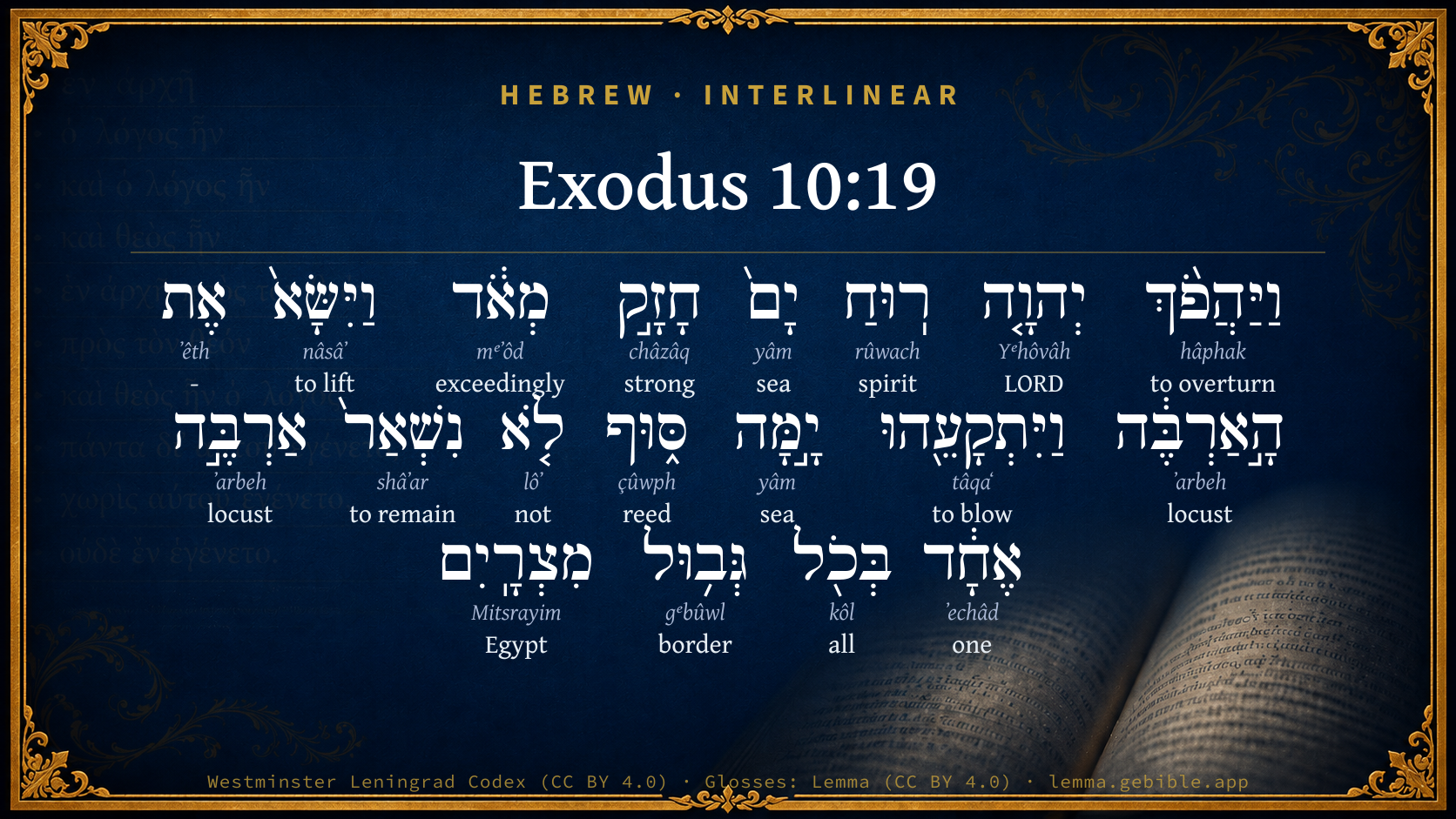
Hebrew (Westminster Leningrad Codex) Exodus 10:19 appears in the Hebrew Old Testament. The text above is from the Westminster Leningrad Codex. Each word links to its Strong’s number, a concise gloss, and parsing drawn from the Open Scriptures Hebrew Bible morphology. Click any word for its full Brown-Driver-Briggs (BDB) entry.
Download image
Cite this verse

Exodus 10:19 (World English Bible). Public Domain. Lemma interlinear Bible study tool, https://lemma.gebible.app/v/exodus/10/19.

Show BibTeX & RIS
BibTeX
RIS
English Translation
Yahweh turned an exceeding strong west wind, which took up the locusts, and drove them into the Red Sea. There remained not one locust in all the borders of Egypt.
World English Bible · Public Domain
Download a study sheet

One document with this verse’s original text, its word-by-word gloss line, the meaning frame, cross-references with their text, attributed commentary, and full source and license credits — printable, and it pastes into notes with its structure intact.

This verse Autodidact and up

Study sheet (.html) Plain text (.txt)

A passage Seminary Student

Up to 50 verses in one chapter. A passage sheet keeps up to 6 commentary sources and 12 cross-references per verse, in the order this page ranks them, and says so on the sheet whenever that leaves anything out. Ask for a single verse and you get the Autodidact verse sheet above.

Everything on this page stays free to read, with no account — the sheet is a download of what is already on screen, not access to it.

Want to remove ads? Support Godless Engineer
Compare translations 3

The same verse in 3 English versions, stacked beneath the original-language interlinear above. Click any original word for its lexicon entry.

Each is an independent rendering of the whole verse — the interlinear is not word-aligned to these translations.

Highlighted words mark where these versions differ — a whole-verse word diff, not a word-by-word alignment.

  • World English Bible Public Domain
    Yahweh turned an exceeding strong west wind, which took up the locusts, and drove them into the Red Sea. There remained not one locust in all the borders of Egypt.
  • King James Version Public Domain
    And the LORD turned a mighty strong west wind, which took away the locusts, and cast them into the Red sea; there remained not one locust in all the coasts of Egypt.
  • unfoldingWord Literal Text CC BY-SA 4.0
    And Yahweh turned a very strong sea wind, and it carried away the locust, and it drove it into the Sea of Reeds; not one locust remained in all of the territory of Egypt.

unfoldingWord Literal Text — © unfoldingWord, licensed CC BY-SA 4.0. Word-aligned USFM3 via Door43 (git.door43.org/unfoldingWord/en_ult).

Versions to compare (up to 4)

3 of 4 selected

Show all 18 translations

Every available English version of this verse, each an independent rendering of the whole verse.

  • World English Bible Public Domain
    Yahweh turned an exceeding strong west wind, which took up the locusts, and drove them into the Red Sea. There remained not one locust in all the borders of Egypt.
  • Berean Standard Bible Public Domain
    And the LORD changed the wind to a very strong west wind that carried off the locusts and blew them into the Red Sea. Not a single locust remained anywhere in Egypt.
  • Majority Standard Bible Public Domain
    And the LORD changed the wind to a very strong west wind that carried off the locusts and blew them into the Red Sea. Not a single locust remained anywhere in Egypt.
  • King James Version Public Domain
    And the LORD turned a mighty strong west wind, which took away the locusts, and cast them into the Red sea; there remained not one locust in all the coasts of Egypt.
  • American Standard Version (1901) Public Domain
    And Jehovah turned an exceeding strong west wind, which took up the locusts, and drove them into the Red Sea; there remained not one locust in all the border of Egypt.
  • Revised Version (1885) Public Domain
    And the LORD turned an exceeding strong west wind, which took up the locusts, and drove them into the Red Sea; there remained not one locust in all the border of Egypt.
  • Geneva Bible (1599) Public Domain
    And the Lord turned a mightie strong West winde, and tooke away the grashoppers, and violently cast them into the red Sea, so that there remained not one grashopper in all the coast of Egypt.
  • Douay-Rheims (1899) Public Domain
    And he made a very strong wind to blow from the west, and it took the locusts and cast them into the Red Sea: there remained not so much as one in all the coasts of Egypt.
  • Young's Literal Translation Public Domain
    and Jehovah turneth a very strong sea wind, and it lifteth up the locust, and bloweth it into the Red Sea -- there hath not been left one locust in all the border of Egypt;
  • Literal Standard Version CC BY-SA 4.0
    and YHWH turns a very strong sea wind, and it lifts up the locust, and blows it into the Red Sea—there has not been left one locust in all the border of Egypt;
  • Unlocked Literal Bible CC BY-SA 4.0
    Yahweh brought a very strong west wind that picked up the locusts and drove them into the Sea of Reeds; not a single locust remained in all the territory of Egypt.
  • unfoldingWord Literal Text CC BY-SA 4.0
    And Yahweh turned a very strong sea wind, and it carried away the locust, and it drove it into the Sea of Reeds; not one locust remained in all of the territory of Egypt.
  • Darby Bible Public Domain
    And Jehovah turned a very powerful west wind, which took away the locusts, and drove them into the Red Sea: there remained not one locust in all the borders of Egypt.
  • World Messianic Bible Public Domain
    The LORD sent an exceedingly strong west wind, which took up the locusts, and drove them into the Sea of Suf. There remained not one locust in all the borders of Egypt.
  • Webster's Bible Public Domain
    And the LORD turned a mighty strong west wind which took away the locusts, and cast them into the Red sea: there remained not one locust in all the borders of Egypt.
  • Free Bible Version CC BY-SA 4.0
    The Lord changed the direction of the wind so that a strong westerly wind blew the locusts into the Red Sea. There wasn't a single locust left anywhere in Egypt.
  • Bible in Basic English Public Domain
    And the Lord sent a very strong west wind, which took up the locusts, driving them into the Red Sea; not one locust was to be seen in any part of Egypt.
  • JPS Tanakh (1917) Public Domain
    And the LORD turned an exceeding strong west wind, which took up the locusts, and drove them into the Red Sea; there remained not one locust in all the border of Egypt.

Literal Standard Version (2020), Covenant Press — licensed CC BY-SA 4.0. Text via the HelloAO Bible API (eBible.org). Unlocked Literal Bible (unfoldingWord) — licensed CC BY-SA 4.0. Text via the HelloAO Bible API (eBible.org). unfoldingWord Literal Text — © unfoldingWord, licensed CC BY-SA 4.0. Word-aligned USFM3 via Door43 (git.door43.org/unfoldingWord/en_ult). Free Bible Version, Dr. Jonathan Gallagher — licensed CC BY-SA 4.0. Text via the HelloAO Bible API (eBible.org).

Word by word

More ways to search: Search by grammar → Find every occurrence → Compare this word →

Practice this passage: Drill this verse → Learn its vocabulary →

הָ֣אַרְבֶּ֔ה
ʼarbeh
H697
“the · locust”
Particle, Definite Article + Noun, Common, Masculine, Singular, Absolute
Part of Speech
Particle + Noun
Type
Common
Gender
Masculine
Number
Singular
State
Absolute
Full BDB Definition

Origin: from H7235

TWOT: 2103a

a kind of locust, locust swarm (collective) - (CLBL) - sudden disappearance (figuratively) - insignificance (figuratively) - activity (figuratively)
  1. וַיַּהֲפֹ֨ךְ hâphak H2015 “and · to overturn” Conjunction + Verb, Qal, Sequential Imperfect, 3rd Person, Masculine, Singular
  2. יְהוָ֤ה Yᵉhôvâh H3068 “LORD” Noun, Proper
  3. רֽוּחַ rûwach H7307 “spirit of” Noun, Common, Both, Singular, Construct
  4. יָם֙ yâm H3220 “sea” Noun, Common, Masculine, Singular, Absolute
  5. חָזָ֣ק châzâq H2389 “strong” Adjective, Adjective, Masculine, Singular, Absolute
  6. מְאֹ֔ד mᵉʼôd H3966 “exceedingly” Adverb
  7. וַיִּשָּׂא֙ nâsâʼ H5375 “and · to lift” Conjunction + Verb, Qal, Sequential Imperfect, 3rd Person, Masculine, Singular
  8. אֶת ʼêth H853 “-” Particle, Direct Object
  9. וַיִּתְקָעֵ֖הוּ tâqaʻ H8628 “and · to blow · him” Conjunction + Verb, Qal, Sequential Imperfect, 3rd Person, Masculine, Singular + Suffix, Personal, 3rd Person, Masculine, Singular
  10. יָ֣מָּה yâm H3220 “sea · toward” Noun, Common, Masculine, Singular, Construct + Suffix, Demonstrative
  11. סּ֑וּף çûwph H5488 “reed” Noun, Common, Masculine, Singular, Absolute
  12. לֹ֤א lôʼ H3808 “not” Particle, Negative
  13. נִשְׁאַר֙ shâʼar H7604 “to remain” Verb, Niphal, Perfect, 3rd Person, Masculine, Singular
  14. אַרְבֶּ֣ה ʼarbeh H697 “locust” Noun, Common, Masculine, Singular, Absolute
  15. אֶחָ֔ד ʼechâd H259 “one” Adjective, Cardinal number, Masculine, Singular, Absolute
  16. בְּכֹ֖ל kôl H3605 “in/at · all of” Preposition + Noun, Common, Masculine, Singular, Construct
  17. גְּב֥וּל gᵉbûwl H1366 “border of” Noun, Common, Masculine, Singular, Construct
  18. מִצְרָֽיִם Mitsrayim H4714 “Egypt” Noun, Proper

About this verse

These counts appear in no published source. They are computed here, from the morphology-tagged text and Lemma’s own curated glosses. What Lemma adds →

19
words
17
distinct lemmas
Pentateuch
section

Notable vocabulary

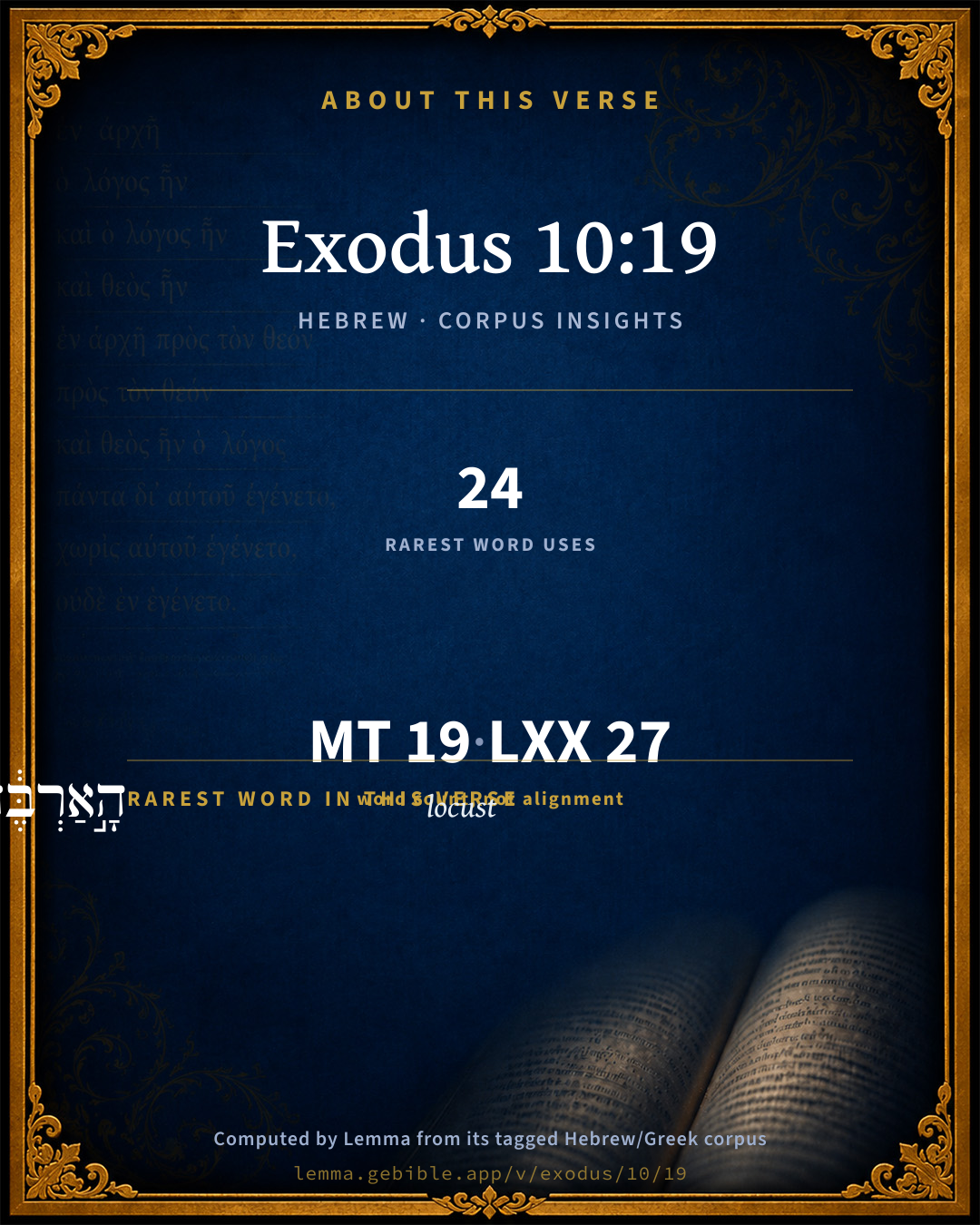
The rarest word here is הָ֣אַרְבֶּ֔ה locust H697 — appearing just 24 times in the whole Hebrew Bible.

Shared distinctive vocabulary

הָ֣אַרְבֶּ֔ה locust H697 occurs in 21 verses of the Hebrew Bible. Also found in:

Grammatical profile

  • 4 verbs
  • 10 nouns
  • 2 adjectives
  • 1 adverb
  • 2 particles

Verb forms

  • וַיַּהֲפֹ֨ךְ Qal · Sequential Imperfect
  • וַיִּשָּׂא֙ Qal · Sequential Imperfect
  • וַיִּתְקָעֵ֖הוּ Qal · Sequential Imperfect
  • נִשְׁאַר֙ Niphal · Perfect

Repetition

Words recur within this verse — often emphatic in Hebrew:

  • יָם֙ sea H3220 ×2
  • הָ֣אַרְבֶּ֔ה locust H697 ×2

Hebrew & Septuagint length

In English translation the verse runs 30 words from the Hebrew and 39 from the Septuagint (LXX English) — closely comparable.

A rough comparison of the two English renderings, which tokenize alike — not a word-level alignment.

Word counts can differ between the Hebrew and the Greek without any difference in meaning — e.g. the Hebrew direct-object marker אֵת has no separate Greek word, and Greek often adds the article ὁ.

In the original languages it is 19 Hebrew tokens and 27 Greek tokens — but the two are counted differently (Hebrew bundles its prefixes and suffixes into one token; the Greek is in lemma form), so that isn’t a like-for-like length.

Cross-references

4

Topical passages linked to Exodus 10:19 in the Treasury of Scripture Knowledge — connected by theme and wording, ordered by reader-vote popularity; previews shown in the World English Bible.

  • Joel 2:20 But I will remove the northern army far away from you, And will drive it into a barren and desolate land, Its front into the eastern sea, And its back into the western sea; And its stench will come up, And its bad smell will rise." Surely he has done great things.
  • Exodus 13:18 but God led the people around by the way of the wilderness by the Red Sea; and the children of Israel went up armed out of the land of Egypt.
  • Exodus 15:4 Pharaoh's chariots and his host has he cast into the sea; His chosen captains are sunk in the Red Sea.
  • Hebrews 11:29 By faith, they passed through the Red sea as on dry land. When the Egyptians tried to do so, they were swallowed up.

Cross-references courtesy of OpenBible.info (CC BY 4.0).

Hebrew and Greek witnesses Masoretic Hebrew ↔ Greek Septuagint

The same verse in the two great witnesses to the Old Testament, shown verse-for-verse.

These are two independent witnesses, not word-aligned to each other, and the Septuagint is shown in lemma (dictionary) form.

Hebrew Exodus 10:19 Masoretic · Westminster Leningrad Codex

וַיַּהֲפֹ֨ךְ יְהוָ֤ה רֽוּחַ יָם֙ חָזָ֣ק מְאֹ֔ד וַיִּשָּׂא֙ אֶת הָ֣אַרְבֶּ֔ה וַיִּתְקָעֵ֖הוּ יָ֣מָּה סּ֑וּף לֹ֤א נִשְׁאַר֙ אַרְבֶּ֣ה אֶחָ֔ד בְּכֹ֖ל גְּב֥וּל מִצְרָֽיִם

Yahweh turned an exceeding strong west wind, which took up the locusts, and drove them into the Red Sea. There remained not one locust in all the borders of Egypt.

World English Bible · Public Domain

Greek LXX Exodus 10:19 Septuagint · lemma form

καί μεταβάλλω κύριος ἄνεμος ἀπό θάλασσα σφοδρός καί ἀναλαμβάνω ὁ ἀκρίς καί ἐνβάλλω αὐτός εἰς ὁ ἐρυθρός θάλασσα καί οὐ ὑπολείπω ἀκρίς εἷς ἐν πᾶς γῆ αἴγυπτος

And the Lord brought in the opposite direction a strong wind from the sea, and took up the locusts and cast them into the Red Sea, and there was not one locust left in all the land of Egypt.

LXX2012 (modern English Septuagint) · Public Domain

On this verse, Adam Clarke's Commentary discusses the Septuagint’s reading. Read the note in Commentary ↓

Hebrew: Westminster Leningrad Codex (CC BY 4.0). Greek: Septuagint (public domain); English from LXX2012 (modern English Septuagint) (Public Domain). How the Septuagint differs from the Hebrew →

Targum (Aramaic paraphrase)

2

The Targum is the ancient Jewish Aramaic paraphrase of the Hebrew Scriptures — an interpretive translation, not the Hebrew text itself. Onkelos (literal) and Pseudo-Jonathan (expansive) render the Torah, and Jonathan the Prophets. Coverage is partial: where no permissively-licensed English translation exists for a verse, only the Aramaic is shown. This is verse-level text, not a word-by-word alignment to the Hebrew.

  1. Targum Onkelos Torah (Genesis–Deuteronomy)
    וַהֲפַךְ יְיָ רוּחָא מַעַרְבָא תַּקִיף לַחֲדָא וּנְטַל יָת גוֹבָא וּרְמָהִי לְיַמָא דְסוּף לָא אִשְׁתָּאַר גוֹבָא חַד בְּכֹל תְּחוּם מִצְרָיִם:

    (no public-domain English translation for this verse)

    Targum Onkelos — Aramaic: “Onkelos Genesis” (public domain); “Onkelos Exodus” (public domain); “Onkelos Leviticus” (public domain); “Onkelos Numbers” (public domain); “Onkelos Deuteronomy” (public domain). English: “Sefaria Community Translation” (CC0 1.0 (public-domain dedication)); “J.W. Etheridge. The Targums of Onkelos and Jonathan Ben Uzziel on the Pentateuch. London: Longmans, Green, 1862” (public domain). Text via Sefaria.

  2. Targum Pseudo-Jonathan Torah (Genesis–Deuteronomy)
    וַהֲפַךְ יְיָ יַת רוּחָא מִמְעַרְבָא תַּקִּיף לַחֲדָא וּנְטַל יַת גּוֹבָא וְטַלְקֵיהּ לְיַמָּא דְסוּף לָא אִשְׁתְּיַיר גּוֹבָא חָד בְּכָל תְּחוּם מִצְרַיִם וַאֲפִילּוּ מַה דְּמַלְחוּן בְּמָנַיָיא לִצְרוֹךְ מֵיכַלְהוֹן נָשָא הִינוּן רוּחַ מַעֲרְבָא וַאֲזָלוּ

    And the Lord turned a wind from the west of exceeding strength, and it carried away the locust, and bare him to the sea of Suph: there was not one locust left in all the borders of Mizraim. And even such as had been salted in vessels for needed food, those, too, the western wind bare away, and they went.

    Targum Pseudo-Jonathan — Aramaic: “Targum Jonathan on Genesis” (public domain); “Targum Jonathan on Exodus” (public domain); “Targum Jonathan on Leviticus” (public domain); “Targum Jonathan on Numbers” (public domain); “Targum Jonathan on Deuteronomy” (public domain). English: “The Targum of Jonathan ben Uzziel, trans. J. W. Etheridge, London, 1862” (public domain). Text via Sefaria.

Commentary

Notes on Exodus 10:19 from classic Christian and Jewish commentators (each source and its license shown beneath its notes). The classic Christian expositions comment on the surrounding passage and are grouped to its opening verse, so a note may address several verses; the Jewish commentaries on the Tanakh (Rashi and others) are per-verse, so they appear only where the commentator wrote on this verse.

Lemma curates 59 commentaries, every one of them public domain or Creative Commons licensed, each selected and text-cleaned for this edition rather than reprinted as found. About our sources →

Trapp's Complete Commentary

John Trapp

Exo 10:19 And the LORD turned a mighty strong west wind, which took away the locusts, and cast them into the Red sea; there remained not one locust in all the coasts of Egypt.

Ver. 19. A mighty strong west wind.] Rupertus calls the winds mundi scopas, the besoms wherewith God sweeps his great house of this world. Like as his spiritual house - the hearts of his people - he sweeps off all foul lusts, those hellish locusts, with that rushing mighty wind spoken of in Act 2:2.

John Trapp, A Commentary or Exposition upon All the Books of the Old and New Testament (1647–1656) — public domain. Text from a community e-Sword module.

Joseph Benson's Commentary

Exo 10:19. An east wind brought the locusts, and now a west wind carried them off. Whatever point of the compass the wind is in, it is fulfilling God’s word, and turns about by his counsel; the wind blows where it listeth for us, but not where it listeth for him; he directeth it under the whole heaven.

Joseph Benson's Commentary on the Old and New Testaments (1811–1818) — public domain. Text from a community e-Sword module.

Geneva Bible (1599)

Geneva Bible translators

The water seemed red, because the sand or gravel is red: the Hebrews called it the Sea of bulrushes.

Geneva Bible (1599) marginal notes — public domain. Text via Bolls.life.

Adam Clarke's Commentary

Verse 19. A mighty strong west wind] רוח ים ruach yam, literally the wind of the sea; the wind that blew from the Mediterranean Sea, which lay north-west of Egypt, which had the Red Sea on the east. Here again God works by natural means; he brought the locusts by the east wind, and took them away by the west or north-west wind, which carried them to the Red Sea where they were drowned.

The Red Sea] ים סוף yam suph, the weedy sea; so called, as some suppose, from the great quantity of alga or sea-weed which grows in it and about its shores. But Mr. Bruce, who has sailed the whole extent of it, declares that he never saw in it a weed of any kind; and supposes it has its name suph from the vast quantity of coral which grows in it, as trees and plants do on land. "One of these," he observes, "from a root nearly central, threw out ramifications in a nearly circular form measuring twenty-six feet diameter every way." - Travels, vol. ii., p. 138. In the Septuagint it is called θαλασσα ερυθρα, the Red Sea, from which version we have borrowed the name; and Mr. Bruce supposes that it had this name from Edom or Esau, whose territories extended to its coasts; for it is well known that the word אדם Edom in Hebrew signifies red or ruddy. The Red Sea, called also the Arabic Gulf, separates Arabia from Upper AEthiopia and part of Egypt. It is computed to be three hundred and fifty leagues in length from Suez to the Straits of Babelmandel, and is about forty leagues in breadth. It is not very tempestuous, and the winds usually blow from north to south, and from south to north, six months in the year; and, like the monsoons of India, invariably determine the seasons of sailing into or out of this sea. It is divided into two gulfs: that to the east called the Elanitic Gulf, from the city of Elana to the north end of it; and that to the west called the Heroopolitan Gulf, from the city of Heroopolis; the former of which belongs to Arabia, the latter to Egypt. The Heroopolitan Gulf is called by the Arabians Bahr el Kolzum, the sea of destruction, or of Clysmae, an ancient town in that quarter; and the Elanitic Gulf Bahr el Akaba, the sea of Akaba, a town situated on its most inland point.

Adam Clarke's Commentary on the Bible (1810–1826) — public domain. Text from a community e-Sword/MySword module.

Ellicott's Commentary for English Readers

(19) The Lord turned a mighty strong west wind . . . —As locusts come, so they commonly go, with a wind. They cannot fly far without one. It often happens that a wind blows them into the sea. Pallas says, speaking of Crimean locusts in the year 1799:—“Great numbers of them were carried [from the Crimea] by northerly winds into the sea, where they perished, and were afterwards washed on shore in heaps” (Travels, vol. ii., p. 424).

The Red sea.—Heb., the sea of weeds, or of rushes. The Red Sea probably acquired this name among the Hebrews from the fact that in the time of Moses its north-western recess communicated with a marshy tract, extending as far as the Bitter Lakes, and abounding in aquatic plants of a luxuriant growth. (Comp. Exo_2:3, where the same term designates the water-plants of the Nile.)

There remained not one locust . . . —Niebuhr says of locusts in Arabia:—“Souvent il en reste beaucoup après le départ général” (Description de l’ Arabie, p. 153). But, on the other hand, there are times when the whole swarm takes its departure at once. “A wind from the south-west,” says Morier, “which had brought them, so completely drove them forwards that not a vestige of them was to be seen two hours afterwards” (Second Journey, p. 98).

A Bible Commentary for English Readers, edited by Charles John Ellicott (1878–1897) — public domain. Text from a community e-Sword module.

The Cambridge Bible for Schools and Colleges

gen. ed. J. J. S. Perowne

19. turned, &c.] i.e. caused by a change a west wind to blow.

west wind] Heb. a sea-wind. The ‘west’ is regularly in Heb. the sea (Gen_12:8; Gen_13:14, &c.). The idiom must have formed itself in Palestine, where the ‘sea’ was on the west. It is a common fate of locust swarms to be driven away by the wind, and to perish in the sea. Cf. Joe_2:20, with the writer’s note (p. 60). Pliny (H.N. xi. 35) writes, ‘Gregatim sublatae vento in maria aut stagna decidunt.’ The swarm described by Denon (on v. 4) was driven back by a change of wind into the desert on the East.

The Cambridge Bible for Schools and Colleges (gen. ed. J. J. S. Perowne; Cambridge University Press, 1878–1918) — public domain. Text from a community e-Sword module.

John Gill's Exposition

But the Lord hardened Pharaoh's heart,.... For as yet he had not brought all his judgments on him he designed to bring:

so that he would not let the children of Israel go: though he had promised to do it, and that he would never offend more in this way.

John Gill's Exposition of the Whole Bible (1746–1763) — public domain (CC PDM 1.0). Text via the HelloAO Bible API.

Albert Barnes' Notes on the Bible

West wind - Literally, “a sea wind,” a wind blowing from the sea on the northwest of Egypt.

Red sea - The Hebrew has the “Sea of Suph”: the exact meaning of which is disputed. Gesenius renders it “rush” or “seaweed;” but it is probably an Egyptian word. A sea-weed resembling wood is thrown up abundantly on the shores of the Red Sea. The origin of the name “Red” Sea is uncertain: (naturalists have connected it with the presence of red infusoria, Exo 7:17).

Albert Barnes' Notes on the Bible (1834–1885) — public domain. Text from a community e-Sword/MySword module.

Haydock's Catholic Bible Commentary

West. Hebrew sea, (Mediterranean) to the north and west of Egypt. --- Red sea. Hebrew, "of suph," or green herbs, which abound there. It has also a reddish appearance in some places, from the coral branches of a saffron colour. It probably was called red from Edom, or Erythros, the son of Isaac. (Calmet) --- God drowned the locusts in this sea, by means of the wind, which often proves the destruction of those animals. (Pliny, Natural History xi. 29.)

George Leo Haydock (1774–1849), Haydock's Catholic Family Bible and Commentary, 1859 edition — public domain. Excludes Psalms (Douay-Rheims chapter numbering differs from Protestant) and Deuterocanonical books (Catholic canon only).

Matthew Poole's English Annotations

A mighty strong west wind; Heb. a wind of the sea, i.e. coming from the sea, called there the great sea, and the Mediterranean Sea, from whence came the north-west wind, which did blow the locusts directly into the Red Sea.

Cast them, as the Hebrew word signifies, with a great noise, and with great force, so as they should never rise again to molest them.

The Red Sea; Heb. the sea of bulrushes, so called from the great number of bulrushes near its shore; or, the sea of bounds or limits, q.d. the narrow sea, whereas they could see no bounds nor shore beyond the Mediterranean Sea. It was called the Arabian Gulf, and by others the Red Sea, either from its red sand, or rather from Esau, called also Edom, which signifies red, Gen 25:30, from whom as the adjoining country was called Edom, or red, so this was called the Red Sea.

Matthew Poole's English Annotations on the Holy Bible (1683–1685) — public domain. Text from a community e-Sword/MySword module.

Whedon's Commentary on the Bible

Daniel D. Whedon

19. A mighty strong west wind — Literally, wind of the sea, that is, the Mediterranean, which is west from Palestine, but northwest from the Egyptian Delta, which is the scene of this history. This wind would sweep the locusts into the Red Sea.

Daniel D. Whedon (gen. ed.), Commentary on the Old and New Testaments (1874–1909) — public domain. Text from a community e-Sword module.

The Pulpit Commentary

And the Lord turned a mighty strong west wind. Literally, "a very strong sea-windi.e. one which blew from the Mediterranean, and which might, therefore, so far, be north, north-west, or north-east. As it blew the locusts into the "Sea of Weeds," i.e. the Red Sea, it must have been actually a north-west wind, and so passing obliquely over Egypt, have carried the locusts in a south-easterly direction. Cast them into the Red Sea. Literally, "the Sea of Weeds." No commentater doubts that the Red Sea is here meant. It "seems to have received its Hebrew appellation, Yam Suph, "Sea of Weeds," either from the quantity of sea-weed which it throws up, or, more probably, from the fact that anciently its north-western recess was connected with a marshy tract extending from the present head of the Gulf of Suez nearly to the Bitter Lakes, in which grew abundant weeds and water-plants. There remained not one locust. The sudden and entire departure of locusts is as remarkable as their coming. "At the hour of prime," says one writer, "they began to depart, and at midday there was not one remaining.", "A wind from the south-west," says another, "which had brought them, so completely drove them forwards that not a vestige of them was to be seen two hours afterwards" (Morier, "Second Journey," p. 98).

The Pulpit Commentary (1880–1919), ed. H.D.M. Spence-Jones & Joseph S. Exell — public domain. Text from a community e-Sword module.

John Wesley's Explanatory Notes

An east-wind brought the locusts and now a west-wind carried them off. Whatever point of the compass the wind is in, it is fulfilling God's word, and turns about by his counsel; the wind blows where it listeth for us, but not where it listeth for him; he directeth it under the whole heaven.

John Wesley, Explanatory Notes Upon the Whole Bible (1754–1765) — public domain. Text via the GEBible commentary corpus.

unfoldingWord translationNotes

Door43 World Missions Community

picked up the locusts

"moved the locusts upwards"

Yahweh hardened Pharaoh's heart

Here "heart" refers to Pharaoh. His stubborn attitude is spoken of as if his heart was hard. See how you translated this phrase in Exodus 9:12. AT: "caused Pharaoh to became more defiant" (See: Synecdoche and Metaphor)

translationWords

Sea of Reeds

heart

unfoldingWord translationNotes — © Distant Shores Media and the Door43 World Missions Community, licensed CC BY-SA 4.0. Source: git.door43.org/Door43/en_tn.

Rashi

Rabbi Shlomo Yitzchaki (Rashi)

רוח ים is A WEST WIND.

ימה סוף INTO THE RED SEA — I say that the Red Sea was, as to part of it, in the west opposite the whole southern side of Palestine, and was also eastward of the Land of Israel; therefore a west wind blew the locusts into the Red Sea which was in the opposite direction to the west of Egypt. Thus do we find mentioned regarding the boundaries of Palestine that it (the Red Sea) faces the east of Palestine, since it states, (Exodus 23:31) “[And I will set thy boundaries] from the Red Sea even unto the sea of the Philistines”, which means from east to west since the sea of the Philistines was in the west, as it is said of the Philistines, (Zephaniah 2:5) “the inhabitants of the sea-coast, the nation of the Cherethites (the Philistines)”.

לא נשאר ארבה אחד THERE REMAINED NOT ONE LOCUST — not even those which they had salted — for they had salted some of them (Exodus Rabbah 13:7).

Rashi on the Tanakh — English translations: “The Judaica Press complete Tanach with Rashi, translated by A. J. Rosenberg” (CC BY 4.0); “Pentateuch with Rashi's commentary by M. Rosenbaum and A.M. Silbermann, 1929-1934” (public domain); “The Metsudah Tanach series, Lakewood, N.J” (CC BY 4.0); and “The Book of Joshua, Metsudah Publications, 1997” (CC BY 4.0). Text via Sefaria.

Lesson kit

Teaching starters — assembled from the data on this page, not authored interpretation. Every prompt links to the verse data it draws on. Edit before teaching.

Exodus, in the Pentateuch, opens this verse with 19 words (17 distinct Hebrew lemmas). Its most distinctive word is ʼarbeh (“locust”). A historical commentator’s framing appears above. Read the whole chapter for the surrounding context.

Discussion questions

  1. The word ʼarbeh carries the sense “locust.” How does it shape the verse?
  2. How does Exodus 10:4, which shares the word «locust», read alongside this verse?
  3. What does the repetition of “sea” (2× in this one verse) do in this verse?
  4. These translations render this verse differently; the difference is in the English rendering, not the original. What questions does that raise?
  5. «וַיַּהֲפֹ֨ךְ» is a Qal Sequential Imperfect verb. How does that grammatical form shape the action described?
  6. Compare how Trapp's Complete Commentary and Joseph Benson's Commentary read this verse. Where do they agree or differ?

Things to notice

Reading settings

Reading text

Shown beneath each verse's original-language words.

Old Testament
Old Testament edition

Read the OT as the Masoretic Hebrew (MT) or the Greek Septuagint (LXX).

English shown for the Greek Septuagint (in the Hebrew ↔ Greek comparison).

Comparing translations? Open the Compare panel on any verse page to stack up to four side by side.