
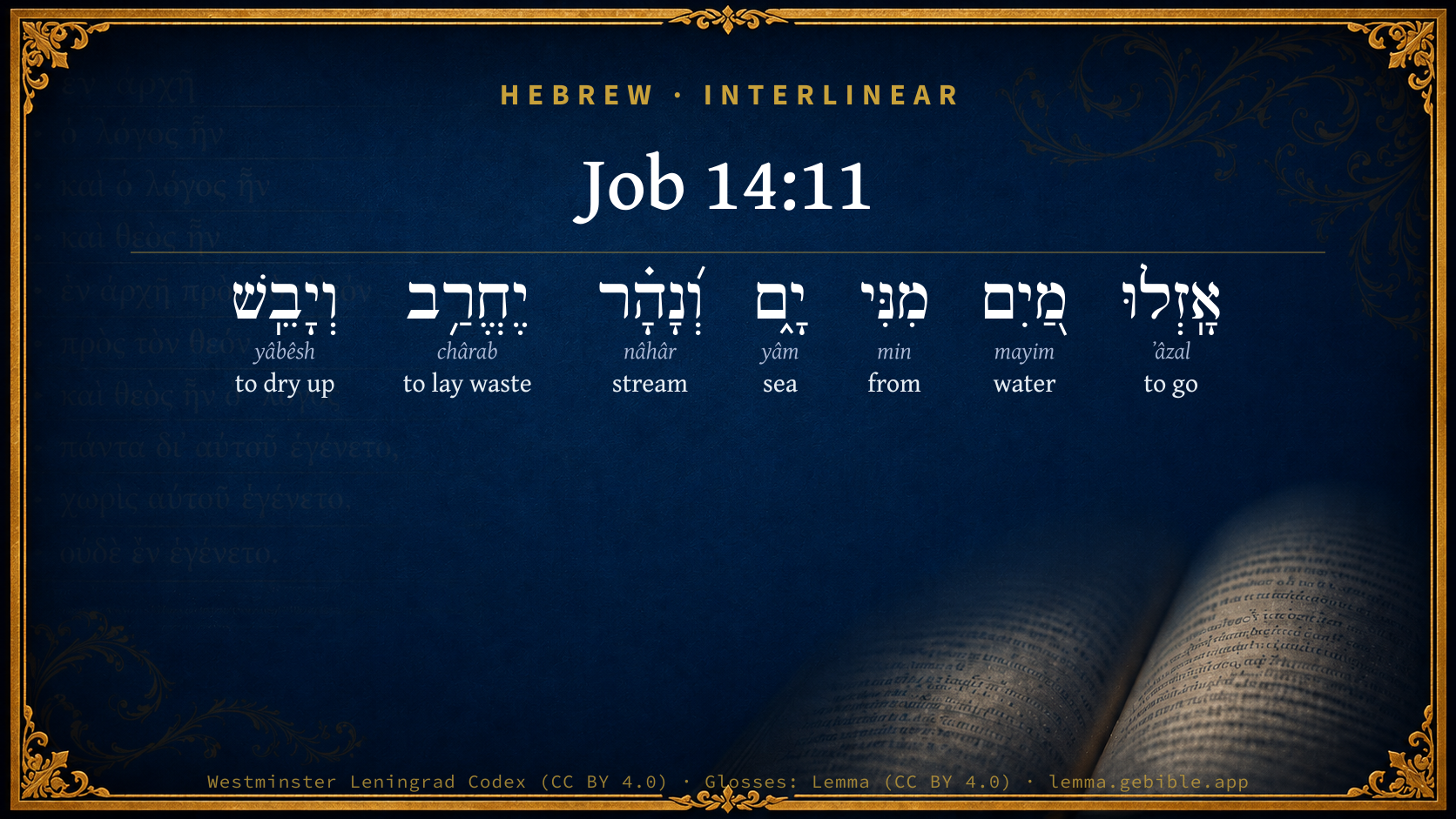
Job 14:11

Hebrew (Westminster Leningrad Codex) Job 14:11 appears in the Hebrew Old Testament. The text above is from the Westminster Leningrad Codex. Each word links to its Strong’s number, a concise gloss, and parsing drawn from the Open Scriptures Hebrew Bible morphology. Click any word for its full Brown-Driver-Briggs (BDB) entry.
Download image
Cite this verse

Job 14:11 (World English Bible). Public Domain. Lemma interlinear Bible study tool, https://lemma.gebible.app/v/job/14/11.

Show BibTeX & RIS
BibTeX
RIS
English Translation
As the waters fail from the sea, And the river wastes and dries up,
World English Bible · Public Domain
Download a study sheet

One document with this verse’s original text, its word-by-word gloss line, the meaning frame, cross-references with their text, attributed commentary, and full source and license credits — printable, and it pastes into notes with its structure intact.

This verse Autodidact and up

Study sheet (.html) Plain text (.txt)

A passage Seminary Student

Up to 50 verses in one chapter. A passage sheet keeps up to 6 commentary sources and 12 cross-references per verse, in the order this page ranks them, and says so on the sheet whenever that leaves anything out. Ask for a single verse and you get the Autodidact verse sheet above.

Everything on this page stays free to read, with no account — the sheet is a download of what is already on screen, not access to it.

Want to remove ads? Support Godless Engineer
Compare translations 3

The same verse in 3 English versions, stacked beneath the original-language interlinear above. Click any original word for its lexicon entry.

Each is an independent rendering of the whole verse — the interlinear is not word-aligned to these translations.

Highlighted words mark where these versions differ — a whole-verse word diff, not a word-by-word alignment.

  • World English Bible Public Domain
    As the waters fail from the sea, And the river wastes and dries up,
  • King James Version Public Domain
    As the waters fail from the sea, and the flood decayeth and drieth up:
  • unfoldingWord Literal Text CC BY-SA 4.0
    Waters disappear from a lake and a river dwindles and dries up,

unfoldingWord Literal Text — © unfoldingWord, licensed CC BY-SA 4.0. Word-aligned USFM3 via Door43 (git.door43.org/unfoldingWord/en_ult).

Versions to compare (up to 4)

3 of 4 selected

Show all 18 translations

Every available English version of this verse, each an independent rendering of the whole verse.

  • World English Bible Public Domain
    As the waters fail from the sea, And the river wastes and dries up,
  • Berean Standard Bible Public Domain
    As water disappears from the sea and a river becomes parched and dry,
  • Majority Standard Bible Public Domain
    As water disappears from the sea and a river becomes parched and dry,
  • King James Version Public Domain
    As the waters fail from the sea, and the flood decayeth and drieth up:
  • American Standard Version (1901) Public Domain
    `As' the waters fail from the sea, And the river wasteth and drieth up;
  • Revised Version (1885) Public Domain
    As the waters fail from the sea, and the river decayeth and drieth up;
  • Geneva Bible (1599) Public Domain
    As the waters passe from the sea, and as the flood decayeth and dryeth vp,
  • Douay-Rheims (1899) Public Domain
    As if the waters should depart out of the sea, and an emptied river should be dried up:
  • Young's Literal Translation Public Domain
    Waters have gone away from a sea, And a river becometh waste and dry.
  • Literal Standard Version CC BY-SA 4.0
    Waters have gone away from a sea, || And a river becomes waste and dry.
  • Unlocked Literal Bible CC BY-SA 4.0
    As water disappears from a lake, and as a river loses water and dries up,
  • unfoldingWord Literal Text CC BY-SA 4.0
    Waters disappear from a lake and a river dwindles and dries up,
  • Darby Bible Public Domain
    The waters recede from the lake, and the river wasteth and drieth up:
  • World Messianic Bible Public Domain
    As the waters fail from the sea, and the river wastes and dries up,
  • Webster's Bible Public Domain
    As the waters fail from the sea, and the flood decayeth and drieth up:
  • Free Bible Version CC BY-SA 4.0
    Like water evaporating from a lake and a river that dries up and disappears,
  • Bible in Basic English Public Domain
    The waters go from a pool, and a river becomes waste and dry;
  • JPS Tanakh (1917) Public Domain
    As the waters fail from the sea, and the river is drained dry;

Literal Standard Version (2020), Covenant Press — licensed CC BY-SA 4.0. Text via the HelloAO Bible API (eBible.org). Unlocked Literal Bible (unfoldingWord) — licensed CC BY-SA 4.0. Text via the HelloAO Bible API (eBible.org). unfoldingWord Literal Text — © unfoldingWord, licensed CC BY-SA 4.0. Word-aligned USFM3 via Door43 (git.door43.org/unfoldingWord/en_ult). Free Bible Version, Dr. Jonathan Gallagher — licensed CC BY-SA 4.0. Text via the HelloAO Bible API (eBible.org).

Word by word

More ways to search: Search by grammar → Find every occurrence → Compare this word →

Practice this passage: Drill this verse → Learn its vocabulary →

About this verse

These counts appear in no published source. They are computed here, from the morphology-tagged text and Lemma’s own curated glosses. What Lemma adds →

7
words
7
distinct lemmas
Wisdom
section

Notable vocabulary

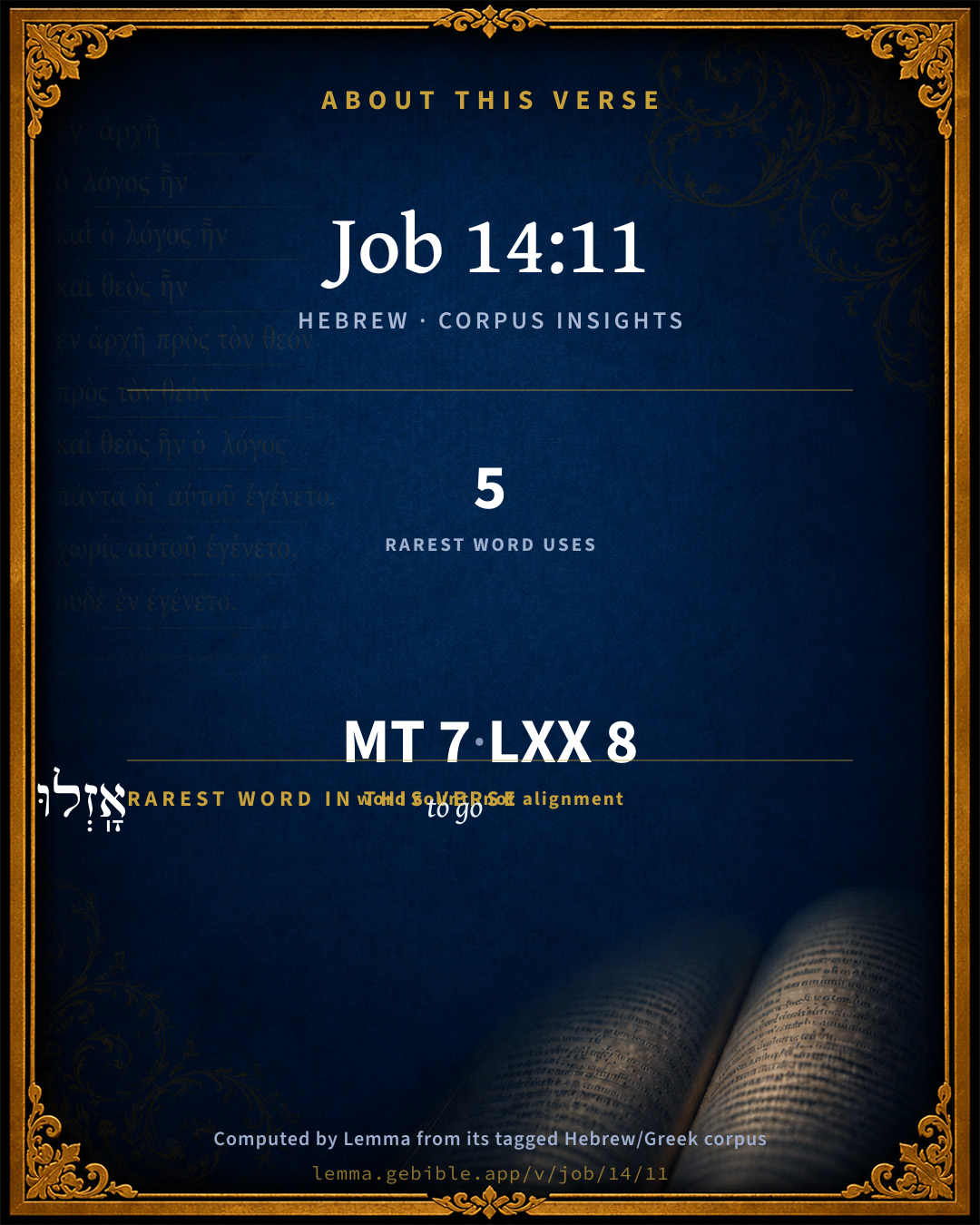
The rarest word here is אָֽזְלוּ to go H235 — appearing just 5 times in the whole Hebrew Bible.

Shared distinctive vocabulary

אָֽזְלוּ to go H235 occurs in 5 verses of the Hebrew Bible. Also found in:

Grammatical profile

  • 3 verbs
  • 3 nouns
  • 1 preposition

Verb forms

  • אָֽזְלוּ Qal · Perfect
  • יֶחֱרַ֥ב Qal · Imperfect
  • וְיָבֵֽשׁ Qal · Sequential Perfect

Hebrew & Septuagint length

In English translation the verse runs 14 words from the Hebrew and 16 from the Septuagint (LXX English) — closely comparable.

A rough comparison of the two English renderings, which tokenize alike — not a word-level alignment.

Word counts can differ between the Hebrew and the Greek without any difference in meaning — e.g. the Hebrew direct-object marker אֵת has no separate Greek word, and Greek often adds the article ὁ.

In the original languages it is 7 Hebrew tokens and 8 Greek tokens — but the two are counted differently (Hebrew bundles its prefixes and suffixes into one token; the Greek is in lemma form), so that isn’t a like-for-like length.

Cross-references

3

Topical passages linked to Job 14:11 in the Treasury of Scripture Knowledge — connected by theme and wording, ordered by reader-vote popularity; previews shown in the World English Bible.

  • Isaiah 19:5 The waters shall fail from the sea, and the river shall be wasted and become dry.
  • Job 6:15–18 My brothers have dealt deceitfully as a brook, As the channel of brooks that pass away;
  • Jeremiah 15:18 Why is my pain perpetual, and my wound incurable, which refuses to be healed? will you indeed be to me as a deceitful [brook], as waters that fail?

Cross-references courtesy of OpenBible.info (CC BY 4.0).

Hebrew and Greek witnesses Masoretic Hebrew ↔ Greek Septuagint

The same verse in the two great witnesses to the Old Testament, shown verse-for-verse.

These are two independent witnesses, not word-aligned to each other, and the Septuagint is shown in lemma (dictionary) form.

Hebrew Job 14:11 Masoretic · Westminster Leningrad Codex

אָֽזְלוּ מַ֭יִם מִנִּי יָ֑ם וְ֝נָהָ֗ר יֶחֱרַ֥ב וְיָבֵֽשׁ

As the waters fail from the sea, And the river wastes and dries up,

World English Bible · Public Domain

Greek LXX Job 14:11 Septuagint · lemma form

χρόνος γάρ σπανίζω θάλασσα ποταμός δέ ἐρημόω ξηραίνω

For the sea wastes in length of time, and a river fails and is dried up.

LXX2012 (modern English Septuagint) · Public Domain

Hebrew: Westminster Leningrad Codex (CC BY 4.0). Greek: Septuagint (public domain); English from LXX2012 (modern English Septuagint) (Public Domain). How the Septuagint differs from the Hebrew →

Commentary

Notes on Job 14:11 from classic Christian and Jewish commentators (each source and its license shown beneath its notes). The classic Christian expositions comment on the surrounding passage and are grouped to its opening verse, so a note may address several verses; the Jewish commentaries on the Tanakh (Rashi and others) are per-verse, so they appear only where the commentator wrote on this verse.

Lemma curates 59 commentaries, every one of them public domain or Creative Commons licensed, each selected and text-cleaned for this edition rather than reprinted as found. About our sources →

Trapp's Complete Commentary

John Trapp

Job 14:11 [As] the waters fail from the sea, and the flood decayeth and drieth up:

Ver. 11. As the waters fail from the sea] He sets forth the same truth by an elegant similitude drawn from drying up of waters. Look how these, after some exundation of the sea, or some great river, are separated and left (upon the reflux thereof) behind the rest upon the land, which cannot return (for then they must ascend, which is impossible to nature) nor continue, but do utterly dry up, and evaporate; sc, &c., Job 14:11. Others read it thus, As when the waters from the sea fail, the flood decayeth, and drieth up; so when man’s life is taken away, it returns no more while this world lasteth. God hath made in the bowels of the earth certain secret ways, passages, and veins through which water conveyeth itself from the sea to all parts, and hath its saltness taken away in the passage. Thence are our springs, and from them our rivers; but in hot countries and dry seasons springs are dry, and rivers lack water exceedingly; as at this time they do, March 7th, 1653. So when natural moisture decayeth in man, he faileth and dieth; the radical humour, that supplement and oil of life, is dried up, and can be no more renewed till the last day, when yet it shall not be restored to the same state and moisture, but, instead of natural, rise spiritual, 1Co 15:44.

John Trapp, A Commentary or Exposition upon All the Books of the Old and New Testament (1647–1656) — public domain. Text from a community e-Sword module.

Joseph Benson's Commentary

Job 14:11. As the waters fail from the sea — This may mean, either, 1st, As the waters go, or flow out from the sea, and return not thither again, Ecc 1:7 : or, 2d, As waters, that is, some portion of the waters, are exhaled from the sea by the sun, or are received and sunk into the dry and thirsty earth: or, 3d, As the waters of the sea fail, when the sea forsakes the place into which it used to flow; and the flood decayeth and drieth up — As a flood, or a river, or a pond (for the word signifies any considerable confluence of waters) in a great drought decayeth, and is dried up, in which cases the same waters never return to their former places, so it is with man; when once the fountain of his life is dried up he dies, and never revives again as to the present life.

Joseph Benson's Commentary on the Old and New Testaments (1811–1818) — public domain. Text from a community e-Sword module.

Jamieson, Fausset & Brown

Robert Jamieson, A. R. Fausset & David Brown

sea--that is, a lake, or pool formed from the outspreading of a river. Job lived near the Euphrates: and "sea" is applied to it (Jer 51:36; Isa 27:1). So of the Nile (Isa 19:5).

fail--utterly disappeared by drying up. The rugged channel of the once flowing water answers to the outstretched corpse ("lieth down," Job 14:12) of the once living man.

Jamieson, Fausset & Brown — Commentary Critical and Explanatory on the Whole Bible (1871) — public domain (CC PDM 1.0). Text via the HelloAO Bible API.

Adam Clarke's Commentary

Verse 11. The waters fail from the sea] I believe this refers to evaporation, and nothing else. As the waters are evaporated from the sea, and the river in passing over the sandy desert is partly exsiccated, and partly absorbed; and yet the waters of the sea are not exhausted, as these vapours, being condensed, fall down in rain, and by means of rivers return again into the sea: so man is imperceptibly removed from his fellows by death and dissolution; yet the human race is still continued, the population of the earth being kept up by perpetual generations.

Adam Clarke's Commentary on the Bible (1810–1826) — public domain. Text from a community e-Sword/MySword module.

Ellicott's Commentary for English Readers

(11) As the waters fail from the sea seems commonly to have been misunderstood from its having been taken as a comparison; but there is no particle denoting comparison in the Hebrew. Moreover, the water never fails from the sea, nor do great rivers like the Nile or the Euphrates ever dry up. The comparison that is implied, but not expressed, is one of contrariety. The waters will have failed from the sea, and the rivers will have wasted and become dry, and yet the man who hath lain down (in death) will not arise: i.e., sooner than that shall happen, the sea will fail and the great rivers become dry. This appears to give a sense far better and more appropriate to the context. The Authorised Version obscures the obvious meaning of the passage by the introduction of the “as,” which is not wanted. There is no hope of any future life, still less of any resurrection here; but neither can we regard the language as involving an absolute denial of it. What Job says is equally true even in full view of the life to come and of the resurrection; indeed, there seems to glimmer the hope of an ardent though unexpressed longing, through the very language that is used. At all events, the statement uttered so confidently is not proof against the inevitable doubt involved in Job_14:14.

A Bible Commentary for English Readers, edited by Charles John Ellicott (1878–1897) — public domain. Text from a community e-Sword module.

The Cambridge Bible for Schools and Colleges

gen. ed. J. J. S. Perowne

11. fail from the sea] i. e. the inland sea or pool, cf. Isa_19:5; so in Arabic bahr, sea, is any mass of water whether salt or fresh, and also a river.

the flood] the stream. A graphic figure for complete extinction.

The Cambridge Bible for Schools and Colleges (gen. ed. J. J. S. Perowne; Cambridge University Press, 1878–1918) — public domain. Text from a community e-Sword module.

John Gill's Exposition

As the waters fail from the sea,.... the words may be rendered either without the as, and denote dissimilitude, and the sense be, that the waters go from the sea and return again, as with the tide:

and the flood decays and dries up; and yet is supplied again with water: "but man lieth down, and riseth not again", Job 14:12; or else with the as, and express likeness; as the waters when they fail from the sea, or get out of lakes, and into another channel, never return more; and as a flood, occasioned by the waters of a river overflowing its banks, never return into it more; so man, when he dies, never returns to this world any more. The Targum restrains this to the Red sea, and the parting of that and the river Jordan, and the drying up of that before the ark of the Lord, and the return of both to their places again.

John Gill's Exposition of the Whole Bible (1746–1763) — public domain (CC PDM 1.0). Text via the HelloAO Bible API.

Albert Barnes' Notes on the Bible

As the waters fail from the sea - As the waters evaporate wholly, and leave the bottom wholly dry, so it is with man, who passes entirely away, and leaves nothing. But to what fact Job refers here, is not known. The sea or ocean has never been dried up, so as to furnish a ground for this comparison. Noyes renders it, “the lake.” Dr. Good, without the slightest authority, renders it, “as the billows pass away with the tides.” Herder supposes it to mean that until the waters fail from the sea man will not rise again, but the Hebrew will not bear this interpretation. Probably the true interpretation is, that which makes the word rendered sea (ים yâm) refer to a lake, or a stagnant pool; see Isa 11:15, note; Isa 19:5, note. The word is applied not unfrequently to a lake, as to the lake of Genesareth, Num 34:11; to the Dead Sea, Gen 14:3; Deu 4:49; Zec 14:8. It is used, also, to denote the Nile, Isa 19:5, and the Euphrates, Isa 27:1. It is also employed to denote the brass sea that was made by Solomon, and placed in front of the temple; 2Ki 25:13. I see no reason to doubt, therefore, that it may be used here to denote the collections of water, which were made by torrents pouring down from the mountains, and which would after a little while wholly evaporate.

And the flood decayeth - The river - נהר nâhâr. Such an occurrence would be common in the parched countries of the East; see the notes at Job 6:15 ff. As such torrents vanish wholly away, so it was with man. Every vestige disappeared; compare 2Sa 14:14.

Albert Barnes' Notes on the Bible (1834–1885) — public domain. Text from a community e-Sword/MySword module.

Haydock's Catholic Bible Commentary

Sea. There would be no supply of rain for the fountains. (Ecclesiastes i. 7.) All would continue dry: so when the blood is once gone, life is at an end. See 2 Kings xiv. 14. (Calmet) --- The water cannot go back. (Menochius)

George Leo Haydock (1774–1849), Haydock's Catholic Family Bible and Commentary, 1859 edition — public domain. Excludes Psalms (Douay-Rheims chapter numbering differs from Protestant) and Deuterocanonical books (Catholic canon only).

Matthew Poole's English Annotations

This may be understood either,

1. By way of opposition, the waters go or flow out of the sea, and return thither again, Ecc 1:7; and a lake or river sometimes decayeth, and drieth up, but afterwards is recruited and replenished. But man lieth, &c., as it follows. Or,

2. By way of resemblance; As waters, i.e. some portion of waters, fail from the sea, being either exhaled or drawn up by the sun, or received and sunk into the dry and thirsty earth, or overflowing its banks; and as the flood, or a river, or a pond (for the word signifies any considerable confluence of waters) in a great drought decayeth, and is dried up; in both which cases the selfsame waters never return to their former places; so it is with man. Or thus, As when the waters fail from the sea, i.e. when the sea forsakes the place into which it used to flow, the river, which was fed by it, Ecc 1:7, decayeth and drieth up, without all hopes of recovery; so man, when once the fountain of his radical moisture is dried up, dies, and never revives again.

Matthew Poole's English Annotations on the Holy Bible (1683–1685) — public domain. Text from a community e-Sword/MySword module.

Whedon's Commentary on the Bible

Daniel D. Whedon

11. The sea — The word sea is sometimes used for the River Nile, and sometimes for the Euphrates. (Jer_51:36.) The point of comparison, according to Umbreit, lies between the dried-up and rugged channel of a once flowing stream or lake, and the outstretched corpse of a once living and acting man. Compare Isa_19:5, where the Hebrew is almost a literal citation.

Daniel D. Whedon (gen. ed.), Commentary on the Old and New Testaments (1874–1909) — public domain. Text from a community e-Sword module.

The Pulpit Commentary

As the waters fail from the sea. The allusion seems to be to the actual desiccation of seas and rivers. Job, apparently, had known instances of both. A formation of new land in the place, of sea is always going on at the head of the Persian Gulf, through the deposits of the Tigris and Euphrates; and this formation was very rapid in ancient times, when the head of the gulf was narrower. The desiccation of river-courses is common in Mesopotamia, where arms thrown out by the Tigris and Euphrates get blocked, and then silted up. And the flood decayeth and drieth up; rather, and the river decayeth"etc. (see the comment on the preceding clause).

The Pulpit Commentary (1880–1919), ed. H.D.M. Spence-Jones & Joseph S. Exell — public domain. Text from a community e-Sword module.

John Wesley's Explanatory Notes

As - So it is with man. Or thus, as when the waters fail from the sea, when the sea forsakes the place into which it used to flow, the river which was fed by it, decayeth and drieth up without all hopes of recovery.

John Wesley, Explanatory Notes Upon the Whole Bible (1754–1765) — public domain. Text via the GEBible commentary corpus.

Rashi

Rabbi Shlomo Yitzchaki (Rashi)

As the waters fail from the sea From the place whence the river comes and emerges, from its source that comes to it from the sea. [Alternative explanation of Rashi: From the place whence the river comes, and they went away from its source (from) which (the water) comes to it.]

and the river that comes from there is drained dry forever. So does a man lie down and not rise.

Rashi on the Tanakh — English translations: “The Judaica Press complete Tanach with Rashi, translated by A. J. Rosenberg” (CC BY 4.0); “Pentateuch with Rashi's commentary by M. Rosenbaum and A.M. Silbermann, 1929-1934” (public domain); “The Metsudah Tanach series, Lakewood, N.J” (CC BY 4.0); and “The Book of Joshua, Metsudah Publications, 1997” (CC BY 4.0). Text via Sefaria.

Lesson kit

Teaching starters — assembled from the data on this page, not authored interpretation. Every prompt links to the verse data it draws on. Edit before teaching.

Job, in the Wisdom, opens this verse with 7 words (7 distinct Hebrew lemmas). Its most distinctive word is ʼâzal (“to go”). A historical commentator’s framing appears above. Read the whole chapter for the surrounding context.

Discussion questions

  1. The word ʼâzal carries the sense “to go.” How does it shape the verse?
  2. Deuteronomy 32:36 shares the word «to go» with this verse. How do the two illuminate each other?
  3. These translations render this verse differently. What is at stake in choosing one wording over another?
  4. The verb «אָֽזְלוּ» is Qal Perfect. How does its form color the action?
  5. Reading how Trapp's Complete Commentary and Joseph Benson's Commentary read this verse, where do the two commentators agree and where do they part?

Things to notice

Reading settings

Reading text

Shown beneath each verse's original-language words.

Old Testament
Old Testament edition

Read the OT as the Masoretic Hebrew (MT) or the Greek Septuagint (LXX).

English shown for the Greek Septuagint (in the Hebrew ↔ Greek comparison).

Comparing translations? Open the Compare panel on any verse page to stack up to four side by side.