Exodus 15:8

Hebrew (Westminster Leningrad Codex) Exodus 15:8 appears in the Hebrew Old Testament. The text above is from the Westminster Leningrad Codex. Each word links to its Strong’s number, a concise gloss, and parsing drawn from the Open Scriptures Hebrew Bible morphology. Click any word for its full Brown-Driver-Briggs (BDB) entry.
Download image
Cite this verse

Exodus 15:8 (World English Bible). Public Domain. Lemma interlinear Bible study tool, https://lemma.gebible.app/v/exodus/15/8.

Show BibTeX & RIS
BibTeX
RIS
English Translation
With the blast of your nostrils the waters were piled up. The floods stood upright as a heap. The deeps were congealed in the heart of the sea.
World English Bible · Public Domain
Highlights
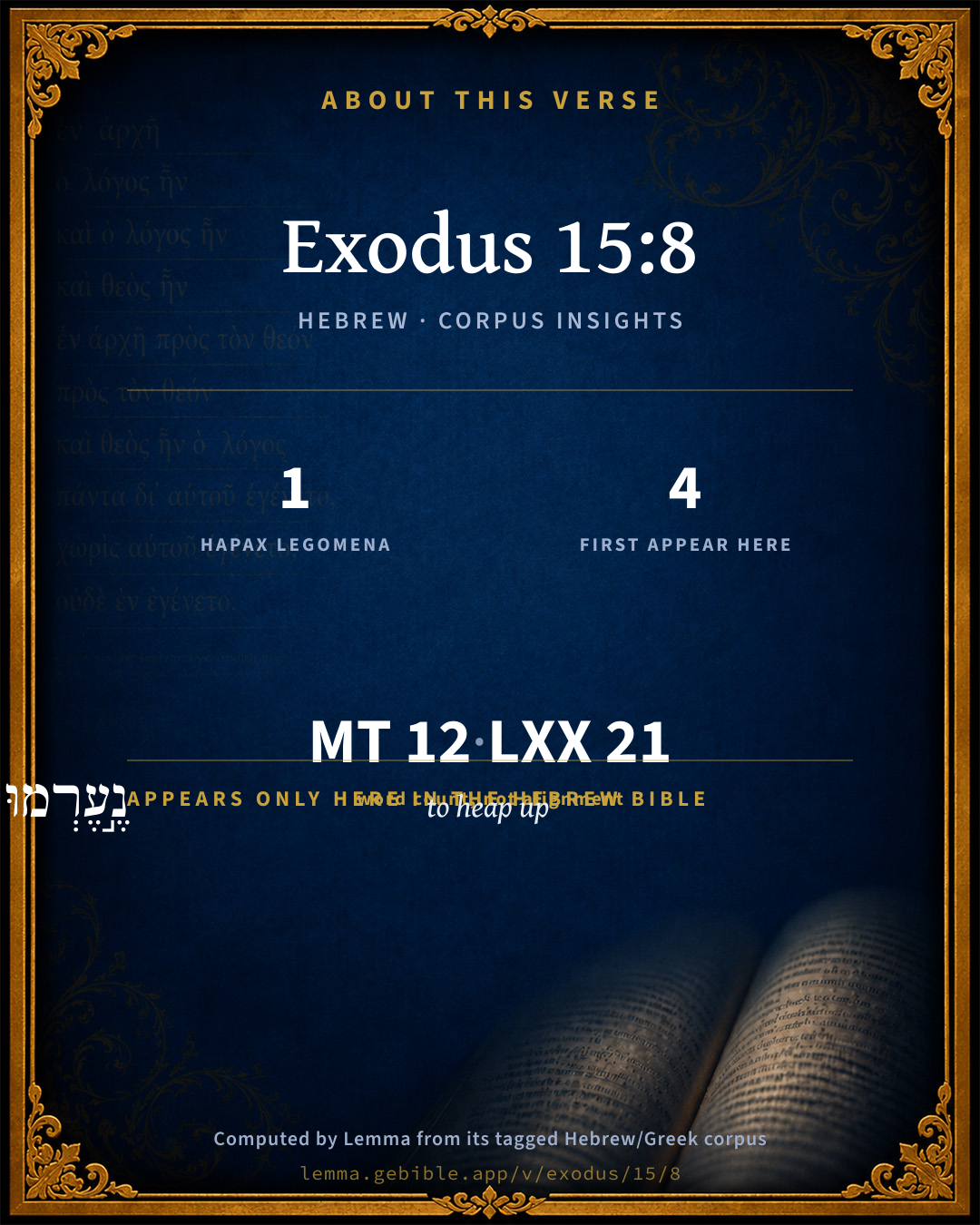
  • 1 hapax legomenon — only here in the Hebrew Bible
  • 4 first appearances in the Hebrew Bible
Full analysis ↓
Download a study sheet

One document with this verse’s original text, its word-by-word gloss line, the meaning frame, cross-references with their text, attributed commentary, and full source and license credits — printable, and it pastes into notes with its structure intact.

This verse Autodidact and up

Study sheet (.html) Plain text (.txt)

A passage Seminary Student

Up to 50 verses in one chapter. A passage sheet keeps up to 6 commentary sources and 12 cross-references per verse, in the order this page ranks them, and says so on the sheet whenever that leaves anything out. Ask for a single verse and you get the Autodidact verse sheet above.

Everything on this page stays free to read, with no account — the sheet is a download of what is already on screen, not access to it.

Want to remove ads? Support Godless Engineer
Compare translations 3

The same verse in 3 English versions, stacked beneath the original-language interlinear above. Click any original word for its lexicon entry.

Each is an independent rendering of the whole verse — the interlinear is not word-aligned to these translations.

Highlighted words mark where these versions differ — a whole-verse word diff, not a word-by-word alignment.

  • World English Bible Public Domain
    With the blast of your nostrils the waters were piled up. The floods stood upright as a heap. The deeps were congealed in the heart of the sea.
  • King James Version Public Domain
    And with the blast of thy nostrils the waters were gathered together, the floods stood upright as an heap, and the depths were congealed in the heart of the sea.
  • unfoldingWord Literal Text CC BY-SA 4.0
    And by the breath of your nostrils the waters were piled up; the flowing waters were stood upright like a heap; the deeps thickened in the heart of the sea.

unfoldingWord Literal Text — © unfoldingWord, licensed CC BY-SA 4.0. Word-aligned USFM3 via Door43 (git.door43.org/unfoldingWord/en_ult).

Versions to compare (up to 4)

3 of 4 selected

Show all 18 translations

Every available English version of this verse, each an independent rendering of the whole verse.

  • World English Bible Public Domain
    With the blast of your nostrils the waters were piled up. The floods stood upright as a heap. The deeps were congealed in the heart of the sea.
  • Berean Standard Bible Public Domain
    At the blast of Your nostrils the waters piled up; like a wall the currents stood firm; the depths congealed in the heart of the sea.
  • Majority Standard Bible Public Domain
    At the blast of Your nostrils the waters piled up; like a wall the currents stood firm; the depths congealed in the heart of the sea.
  • King James Version Public Domain
    And with the blast of thy nostrils the waters were gathered together, the floods stood upright as an heap, and the depths were congealed in the heart of the sea.
  • American Standard Version (1901) Public Domain
    And with the blast of thy nostrils the waters were piled up, The floods stood upright as a heap; The deeps were congealed in the heart of the sea.
  • Revised Version (1885) Public Domain
    And with the blast of thy nostrils the waters were piled up, The floods stood upright as an heap; The deeps were congealed in the heart of the sea.
  • Geneva Bible (1599) Public Domain
    And by the blast of thy nostrels the waters were gathered, the floods stoode still as an heape, the depthes congealed together in the heart of the Sea.
  • Douay-Rheims (1899) Public Domain
    And with the blast of thy anger the waters were gathered together: the flowing water stood, the depth were gathered together in the midst of the sea.
  • Young's Literal Translation Public Domain
    And by the spirit of Thine anger Have waters been heaped together; Stood as a heap have flowings; Congealed have been depths In the heart of a sea.
  • Literal Standard Version CC BY-SA 4.0
    And by the wind of Your anger || Waters have been heaped together; Flowings have stood as a heap; Depths have been congealed || In the heart of a sea.
  • Unlocked Literal Bible CC BY-SA 4.0
    By the blast of your nostrils the waters were piled up; the flowing waters stood upright in a heap; the deep water was congealed in the heart of the sea.
  • unfoldingWord Literal Text CC BY-SA 4.0
    And by the breath of your nostrils the waters were piled up; the flowing waters were stood upright like a heap; the deeps thickened in the heart of the sea.
  • Darby Bible Public Domain
    And by the breath of thy nostrils the waters were heaped up; The streams stood as a mound; The depths were congealed in the heart of the sea.
  • World Messianic Bible Public Domain
    With the blast of your nostrils, the waters were piled up. The floods stood upright as a heap. The deeps were congealed in the heart of the sea.
  • Webster's Bible Public Domain
    And with the blast of thy nostrils the waters were collected, the floods stood upright as a heap, and the depths were congealed in the heart of the sea.
  • Free Bible Version CC BY-SA 4.0
    You blew and the sea piled up. The waves stood straight like a wall. The depths of the ocean turned solid.
  • Bible in Basic English Public Domain
    By your breath the waves were massed together, the flowing waters were lifted up like a pillar; the deep waters became solid in the heart of the sea.
  • JPS Tanakh (1917) Public Domain
    And with the blast of Thy nostrils the waters were piled up — the floods stood upright as a heap; the deeps were congealed in the heart of the sea.

Literal Standard Version (2020), Covenant Press — licensed CC BY-SA 4.0. Text via the HelloAO Bible API (eBible.org). Unlocked Literal Bible (unfoldingWord) — licensed CC BY-SA 4.0. Text via the HelloAO Bible API (eBible.org). unfoldingWord Literal Text — © unfoldingWord, licensed CC BY-SA 4.0. Word-aligned USFM3 via Door43 (git.door43.org/unfoldingWord/en_ult). Free Bible Version, Dr. Jonathan Gallagher — licensed CC BY-SA 4.0. Text via the HelloAO Bible API (eBible.org).

Word by word

More ways to search: Search by grammar → Find every occurrence → Compare this word →

Practice this passage: Drill this verse → Learn its vocabulary →

נֶ֣עֶרְמוּ
ʻâram
H6192
“to heap up”
Verb, Niphal, Perfect, 3rd Person, Common, Plural
Part of Speech
Verb
Stem
Niphal
Form
Perfect
Person
3rd Person
Gender
Common
Number
Plural
Full BDB Definition

Origin: a primitive root; to pile up

TWOT: 1696

(Niphal) to heap up, pile, be heaped up
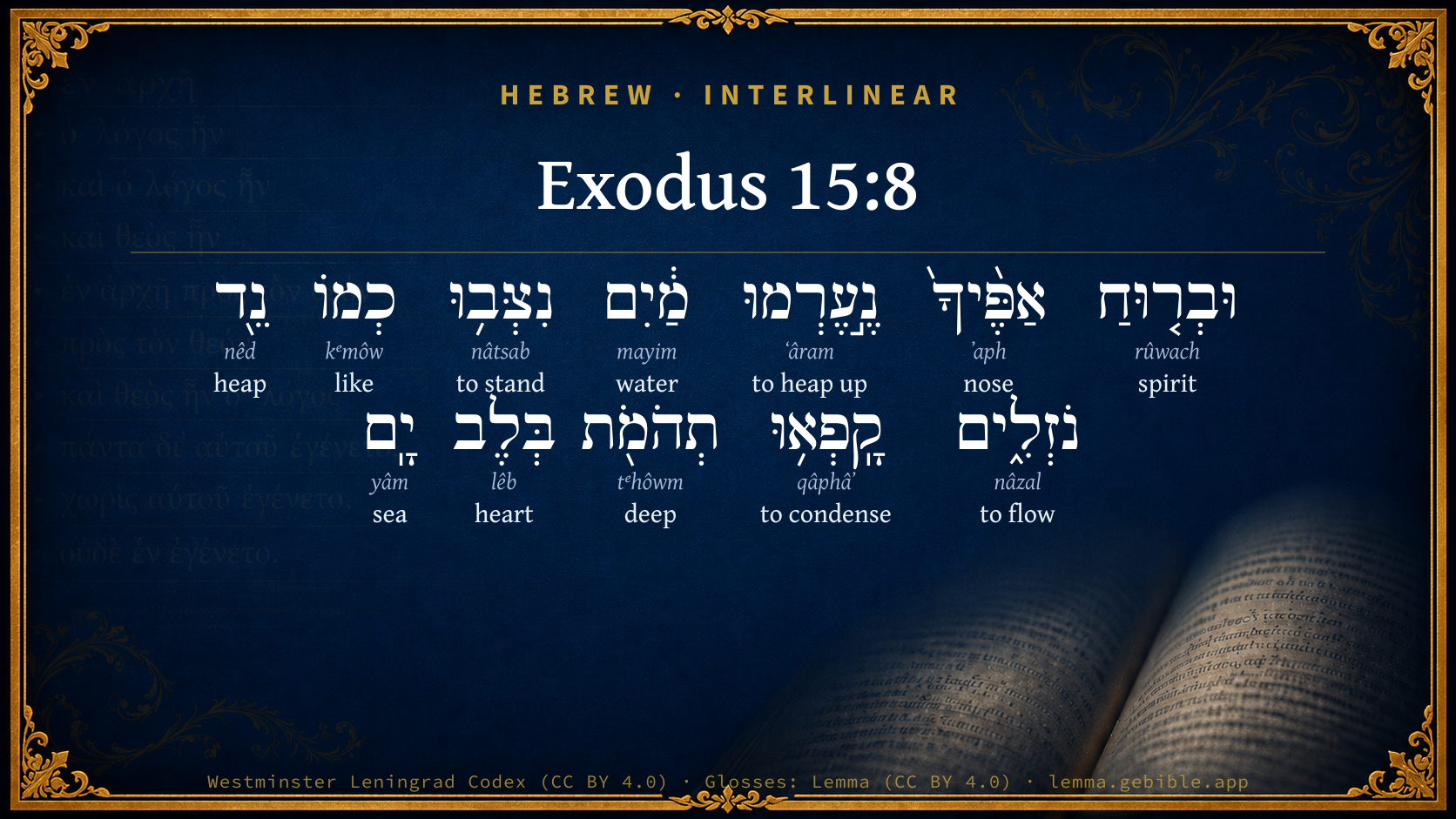
  1. וּבְר֤וּחַ rûwach H7307 “and · in/at · spirit of” Conjunction + Preposition + Noun, Common, Both, Singular, Construct
  2. אַפֶּ֨יךָ֙ ʼaph H639 “nostrils · your” Noun, Common, Masculine, Dual, Construct + Suffix, Personal, 2nd Person, Masculine, Singular
  3. מַ֔יִם mayim H4325 “water(s)” Noun, Common, Masculine, Plural, Absolute
  4. נִצְּב֥וּ nâtsab H5324 “to stand” Verb, Niphal, Perfect, 3rd Person, Common, Plural
  5. כְמוֹ kᵉmôw H3644 “like” Preposition
  6. נֵ֖ד nêd H5067 “heap” Noun, Common, Masculine, Singular, Absolute
  7. נֹזְלִ֑ים nâzal H5140 “flowing” Verb, Qal, Participle Active, Masculine, Plural, Absolute
  8. קָֽפְא֥וּ qâphâʼ H7087 “to condense” Verb, Qal, Perfect, 3rd Person, Common, Plural
  9. תְהֹמֹ֖ת tᵉhôwm H8415 “depths” Noun, Common, Both, Plural, Absolute
  10. בְּלֶב lêb H3820 “in/at · heart of” Preposition + Noun, Common, Masculine, Singular, Construct
  11. יָֽם yâm H3220 “sea” Noun, Common, Masculine, Singular, Absolute

About this verse

These counts appear in no published source. They are computed here, from the morphology-tagged text and Lemma’s own curated glosses. What Lemma adds →

12
words
12
distinct lemmas
Pentateuch
section

Notable vocabulary

1 hapax legomenon — a word that appears only here in the entire Hebrew Bible:

  • נֶ֣עֶרְמוּ to heap up H6192

First appearance in Scripture

These words make their first canonical appearance in the Hebrew Bible here:

  • נֶ֣עֶרְמוּ to heap up H6192
  • נֵ֖ד heap H5067
  • נֹזְלִ֑ים to flow H5140
  • קָֽפְא֥וּ to condense H7087

Shared distinctive vocabulary

קָֽפְא֥וּ to condense H7087 occurs in 4 verses of the Hebrew Bible. Also found in:

Grammatical profile

  • 4 verbs
  • 7 nouns
  • 1 preposition

Verb forms

  • נֶ֣עֶרְמוּ Niphal · Perfect
  • נִצְּב֥וּ Niphal · Perfect
  • נֹזְלִ֑ים Qal · Participle Active
  • קָֽפְא֥וּ Qal · Perfect

Hebrew & Septuagint length

In English translation the verse runs 28 words from the Hebrew and 28 from the Septuagint (LXX English) — the same length.

A rough comparison of the two English renderings, which tokenize alike — not a word-level alignment.

Word counts can differ between the Hebrew and the Greek without any difference in meaning — e.g. the Hebrew direct-object marker אֵת has no separate Greek word, and Greek often adds the article ὁ.

In the original languages it is 12 Hebrew tokens and 21 Greek tokens — but the two are counted differently (Hebrew bundles its prefixes and suffixes into one token; the Greek is in lemma form), so that isn’t a like-for-like length.

Cross-references

8

Topical passages linked to Exodus 15:8 in the Treasury of Scripture Knowledge — connected by theme and wording, ordered by reader-vote popularity; previews shown in the World English Bible.

  • Job 4:9 By the breath of God they perish, By the blast of his anger are they consumed.
  • Psalms 78:13 He split the sea, and caused them to pass through; He made the waters stand as a heap.
  • Exodus 14:21–22 Moses stretched out his hand over the sea, and Yahweh caused the sea to go back by a strong east wind all the night, and made the sea dry land, and the waters were divided.
  • 2 Samuel 22:16 Then the channels of the sea appeared, The foundations of the world were laid bare, By the rebuke of Yahweh, At the blast of the breath of his nostrils.
  • Isaiah 11:4 but with righteousness shall he judge the poor, and decide with equity for the humble of the earth; and he shall strike the earth with the rod of his mouth; and with the breath of his lips shall he kill the wicked.
  • Isaiah 37:7 Behold, I will put a spirit in him, and he shall hear news, and shall return to his own land; and I will cause him to fall by the sword in his own land.
  • Habakkuk 3:10 The mountains saw you, and were afraid. The tempest of waters passed by. The deep roared and lifted up its hands on high.
  • 2 Thessalonians 2:8 Then the lawless one will be revealed, whom the Lord will kill with the breath of his mouth, and bring to nothing by the brightness of his coming;

Cross-references courtesy of OpenBible.info (CC BY 4.0).

Hebrew and Greek witnesses Masoretic Hebrew ↔ Greek Septuagint

The same verse in the two great witnesses to the Old Testament, shown verse-for-verse.

These are two independent witnesses, not word-aligned to each other, and the Septuagint is shown in lemma (dictionary) form.

Hebrew Exodus 15:8 Masoretic · Westminster Leningrad Codex

וּבְר֤וּחַ אַפֶּ֨יךָ֙ נֶ֣עֶרְמוּ מַ֔יִם נִצְּב֥וּ כְמוֹ נֵ֖ד נֹזְלִ֑ים קָֽפְא֥וּ תְהֹמֹ֖ת בְּלֶב יָֽם

With the blast of your nostrils the waters were piled up. The floods stood upright as a heap. The deeps were congealed in the heart of the sea.

World English Bible · Public Domain

Greek LXX Exodus 15:8 Septuagint · lemma form

καί διά πνεῦμα ὁ θυμός σύ διαἵστημι ὁ ὕδωρ πήγνυμι ὡσεί τεῖχος ὁ ὕδωρ πήγνυμι ὁ κῦμα ἐν μέσος ὁ θάλασσα

And by the breath of your anger the water parted asunder; the waters were congealed as a wall, the waves were congealed in the midst of the sea.

LXX2012 (modern English Septuagint) · Public Domain

On this verse, Haydock's Catholic Bible Commentary discusses the Septuagint’s reading. Read the note in Commentary ↓

Hebrew: Westminster Leningrad Codex (CC BY 4.0). Greek: Septuagint (public domain); English from LXX2012 (modern English Septuagint) (Public Domain). How the Septuagint differs from the Hebrew →

Targum (Aramaic paraphrase)

2

The Targum is the ancient Jewish Aramaic paraphrase of the Hebrew Scriptures — an interpretive translation, not the Hebrew text itself. Onkelos (literal) and Pseudo-Jonathan (expansive) render the Torah, and Jonathan the Prophets. Coverage is partial: where no permissively-licensed English translation exists for a verse, only the Aramaic is shown. This is verse-level text, not a word-by-word alignment to the Hebrew.

  1. Targum Onkelos Torah (Genesis–Deuteronomy)
    וּבְמֵימַר פּוּמָךְ חַכִּימוּ מַיָא קָמוּ כְשׁוּר אֲזָלַיָא קָפוּ תְהוֹמִין בְּלִבָּא דְיַמָא:

    (no public-domain English translation for this verse)

    Targum Onkelos — Aramaic: “Onkelos Genesis” (public domain); “Onkelos Exodus” (public domain); “Onkelos Leviticus” (public domain); “Onkelos Numbers” (public domain); “Onkelos Deuteronomy” (public domain). English: “Sefaria Community Translation” (CC0 1.0 (public-domain dedication)); “J.W. Etheridge. The Targums of Onkelos and Jonathan Ben Uzziel on the Pentateuch. London: Longmans, Green, 1862” (public domain). Text via Sefaria.

  2. Targum Pseudo-Jonathan Torah (Genesis–Deuteronomy)
    וּבְמֵימַר מִן קֳדָמָךְ אִתְעֲבִידוּ מַיָא עוּרְמַן עוּרְמַן קָמוּ לְהֵין צְרִירִין הֵי כְזִיקִין מַיָא נָזְלַיָא קָפוּ עֲלֵיהוֹן תְּהוֹמַיָא בְּגוֹ פִילְגוּס דְּיַמָא רַבָּא

    For by the Word from before Thee the waters became heaps; they stood, as if bound like skins that confine flowing water, and the depths were congealed in the flood of the great sea.

    Targum Pseudo-Jonathan — Aramaic: “Targum Jonathan on Genesis” (public domain); “Targum Jonathan on Exodus” (public domain); “Targum Jonathan on Leviticus” (public domain); “Targum Jonathan on Numbers” (public domain); “Targum Jonathan on Deuteronomy” (public domain). English: “The Targum of Jonathan ben Uzziel, trans. J. W. Etheridge, London, 1862” (public domain). Text via Sefaria.

Commentary

Notes on Exodus 15:8 from classic Christian and Jewish commentators (each source and its license shown beneath its notes). The classic Christian expositions comment on the surrounding passage and are grouped to its opening verse, so a note may address several verses; the Jewish commentaries on the Tanakh (Rashi and others) are per-verse, so they appear only where the commentator wrote on this verse.

Lemma curates 59 commentaries, every one of them public domain or Creative Commons licensed, each selected and text-cleaned for this edition rather than reprinted as found. About our sources →

Trapp's Complete Commentary

John Trapp

Exo 15:8 And with the blast of thy nostrils the waters were gathered together, the floods stood upright as an heap, [and] the depths were congealed in the heart of the sea.

Ver. 8. And with the blast.] In celebrating God’s favours, we must be punctual and particular.

John Trapp, A Commentary or Exposition upon All the Books of the Old and New Testament (1647–1656) — public domain. Text from a community e-Sword module.

Joseph Benson's Commentary

Exo 15:8. With the blast of thy nostrils — Or, of thine anger, as the Hebrew word is often rendered. He means that vehement east wind, (Exo 15:10, and Exo 14:21,) which was raised by God’s anger in order to the ruin of his enemies. The floods — Hebrew, the streams, or the flowing waters, whose nature it is to be constantly in motion; stood upright as a heap — This is wonderfully beautiful and majestic, as indeed the whole song is. The inspired writer ennobles the wind by making God himself the principle of it; and animates the waters by making them susceptible of fear. The frighted waters withdrew with impetuosity from their wonted bed, and crowded suddenly one upon another. The depths were congealed — Hardened, stood still as if they had been frozen in the heart, the midst, of the sea. So that here the imagination figures to itself mountains of solid waters in the very centre of the liquid element.

Joseph Benson's Commentary on the Old and New Testaments (1811–1818) — public domain. Text from a community e-Sword module.

Tyndale Open Study Notes

Tyndale Open Resources

15:8 blast (literally nostrils): In other contexts, the same word may be translated “anger.” The hot breath from God’s nose is an image of God’s anger. • your breath: The Hebrew word translated as “breath” (ruakh) is the same one translated as “wind” in 14:21 and as “Spirit” in Gen 1:2. Nature is not God, but God is everywhere at work in nature.

Tyndale Open Study Notes — © Tyndale Open Resources, licensed CC BY-SA 4.0. Text via the HelloAO Bible API.

Geneva Bible (1599)

Geneva Bible translators

Or, in the depth of the sea.

Geneva Bible (1599) marginal notes — public domain. Text via Bolls.life.

Adam Clarke's Commentary

Verse 8. The depths were congealed] The strong east wind (Ex 14:21) employed to dry the bottom of the sea, is here represented as the blast of God's nostrils that had congealed or frozen the waters, so that they stood in heaps like a wall on the right hand and on the left.

Adam Clarke's Commentary on the Bible (1810–1826) — public domain. Text from a community e-Sword/MySword module.

The Cambridge Bible for Schools and Colleges

gen. ed. J. J. S. Perowne

8. the blast of thy nostrils] Fig. for the wind (v. 10), as Psa_18:15.

were piled up] The hyperbole, as Exo_14:22 (the ‘wall’). The Heb. word occurs only here. ‘Heap’ in Rth_3:7 is cognate.

floods] or streams, lit. the flowing ones. A poet. word; cf. Psa_78:16; Psa_78:44, Son_4:15, Isa_44:3.

an heap] Cf. Jos_3:13; Jos_3:16; Psa_78:13.

congealed] or, solidified (cf. Zep_1:12 RVm.,—the same word).

the heart of the sea] Cf. Psa_46:2, Eze_27:4.

The Cambridge Bible for Schools and Colleges (gen. ed. J. J. S. Perowne; Cambridge University Press, 1878–1918) — public domain. Text from a community e-Sword module.

John Gill's Exposition

And with the blast of thy nostrils the waters were gathered together,.... From the bottom of the sea, and divided and laid on heaps; and this by a strong east wind, called the blast of the nostrils of the Lord, because as easily brought by him as a man's breath or wind is drawn through his nostrils; and thus Christ with the breath of his mouth, and the brightness of his coming, will destroy antichrist, Th2 2:8.

the floods stood upright as an heap; though a fluid body, yet by the power of Christ were raised up and continued upright, firm and consistent; as things dry and solid may be laid and heaped up on one another, and remain firm and stable; and so did the waters of the sea, they stood like a wall, and were as firm as a rock; while the Israelites passed between them, they stood upright, and lift up their hands, as if they blessed them; or blessed God for the deliverance of them, or in admiration of it; see Exo 14:22,

John Gill's Exposition of the Whole Bible (1746–1763) — public domain (CC PDM 1.0). Text via the HelloAO Bible API.

Haydock's Catholic Bible Commentary

Together. "Congealed on either side," as the Chaldean and Septuagint express it. (Calmet)

George Leo Haydock (1774–1849), Haydock's Catholic Family Bible and Commentary, 1859 edition — public domain. Excludes Psalms (Douay-Rheims chapter numbering differs from Protestant) and Deuterocanonical books (Catholic canon only).

Matthew Poole's English Annotations

Of thy nostrils; or, of thine anger, to wit. that vehement east wind, Exo 15:10; 14:21, which was raised by thine anger in order to the ruin of thine enemies.

The floods, Heb. the streams, or the flowing waters, whose nature it is to be constantly in motion.

Were congealed, i.e. hardened, stood still, as if they had been frozen, and so they were a wall on both hands, Exo 14:22.

In the heart of the sea, i.e. the midst; as that word is used, Psa 18:16; 46:2; Eze 28:2.

Matthew Poole's English Annotations on the Holy Bible (1683–1685) — public domain. Text from a community e-Sword/MySword module.

The Pulpit Commentary

With the blast of thy nostril the waters were gathered together. Poetically, Moses describes the east wind which God set in motion as "the blast" or "breath of his nostrils." By means of it, he says, the waters were "gathered together," or "piled up;" then, growing bolder in his imagery, he represents the floods as "standing in a heap" on either side, and the depths as "congealed. No doubt, if these terms are meant to be taken literally, the miracle must have been one in which "the sea" (as Kalisch says) "giving up its nature, formed with its waves a firm wall, and instead of streaming like a fluid, congealed into a hard substance." But the question is, are we justified in taking literally the strong expressions of a highly wrought poetical description?

The Pulpit Commentary (1880–1919), ed. H.D.M. Spence-Jones & Joseph S. Exell — public domain. Text from a community e-Sword module.

John Wesley's Explanatory Notes

With the blast of thy nostrils - By thine anger: The depths were congealed - Stood still, as if they had been frozen: In the heart of the sea - The midst of it.

John Wesley, Explanatory Notes Upon the Whole Bible (1754–1765) — public domain. Text via the GEBible commentary corpus.

Rashi

Rabbi Shlomo Yitzchaki (Rashi)

וברוח אפיך AND WITH THE BREATH OF THY NOSTRILS — the breath that issues from both nostrils. Scripture speaks — if this were at all possible (i. e. if one may be permitted to speak so of God) of the Shechina (God) in the same manner as it does of a human monarch, in order to make peoples’ ears hear the facts in accordance with what usually happens to that they may understand the matter: when a man is angry the breath issues from his nostrils (and Scripture attributes this to God, also, when He is in anger). A similar idea is: (Psalms 18:9) “Smoke rose up in His nostril”, and also, (Job. 4:9) “By the breath of his nostril they are consumed”. And this is the meaning of what He said, (Isaiah 48:9) “For My name’s sake אאריך I will make long My אף”: when one’s anger subsides his breathing becomes long, whilst when one is in anger his breathing is short (consequently אאריך אפי signifies “I will not be angry”). The text continues ותהלתי אחטם לך which means “for the sake of My praise I will place a nose-ring in My nose to close up the nostrils against the anger and the breath so that they should not issue forth”. The word לך, for thee, in this text, means “for thy sake”, אחטם has the same meaning and root as in “a wild camel with a nose-ring (חֹטֶם)” which occurs in Mishna Treatise Sabbath (Mishnah Shabbat 5:1). Thus does the explanation appear to me. And wherever אף and חרון (i. e. where אף and words formed from the same root as חרון) occur in the Scriptures I say that it has the following sense: In the phrase חרה אף the first word is the same as (Job 30:30) “My bone is חרה with heat”, where חרה denotes burning and glowing, and this metaphor is used because the nostrils become hot and burning in a time of anger. The noun חרון is a derivation of חרה, just as רצון is a derivation of רצה, and therefore signifies “burning”. In the same way, חַמה which also signifies wrath really denotes heat (from a root יחם, not חמם, since the מ of חַמָה has no Dagesh. חַמָה is formed from יחם as עֵדָה, congregation, from יעד). That is why Scripture says, (Esther 1:12) וחמתו בערה בו “his wrath burned in him”, and when one’s wrath subsides one says, “his mind has become cooled” (נתקררה from קר cold).

נערמו מים THE WATERS WERE HEAPED UP — Onkelos translated this in the sense of ערמימות, subtlety (the waters showed themselves clever); (cf. ערום Genesis 3:1); but it is more in accordance with the elegance of Biblical style to take it as the noun of the same root as in (Song 7:3) “a stack of (ערמת) wheat”, and the following words, “the floods placed themselves like a mound”, prove that this is so (cf. Mekhilta). נערמו — Through the burning heat of the breath that issued from thy nostrils (וברוח אפיך) the waters were dried up and they became like heaps and piles of gain-stacks (ערמה) which are high.

כמו נד — Render this as the Targum does: like a שור, i. e. a wall.

נד is an expression for anything heaped up and gathered together, as, (Isaiah 17:11) “a heap (נד) of boughs in the day of grief”; (Psalms 33:7) “He gathereth as a heap (כַּנֵד) [the waters of the sea]”. It is not written “He gathereth כנאד”, but כנאד”, and if כנד, were the same as כנאד “like a water-skin”, and כונס were an expression for “bringing a thing in”, it should have written: “He gathered in (מכניס and not כונס) the waters of the sea as in a water-skin”, (כבנאד and not כנד), but כונס denotes gathering together and heaping up. And this must also be the meaning of נד in (Joshua 3:16) “[the waters] rose up as one נד”, and (Joshua v. 13) “and they shall stand in one נד”; for the expressions “rising up” and “standing up” cannot be used in reference to water in water-skins but only to water that stands up as walls and heaps (and this must therefore be the meaning of כמו נד in our text also). And, then again, we find the word נֹאד punctuated only with a Melopum (חולם), as, (Psalms 56:9) “Put thou my tears into thy bottle (נֹאדֶךָ)” and (Judges 4:19) “the bottle of (נֹאד) milk”.

קפאו WERE CONGEALED, like (Job 10:10) “thou hast curdled me (תקפיאני) like cheese”; the meaning is that the depths were hardened and became like stones, and the waters cast the Egyptians against the stony wall with force and battled against them with every harsh means (cf. Mekhilta).

בלב ים means IN THE VERY STRENGTH OF THE SEA. It is the way of Scripture-verses to speak thus (to use לב in a metaphorical sense); e. g., (Deuteronomy 4:11) “unto the very midst of (לב) heaven”; (II Samuel 18:14) “in the midst of (בלב) the terebinth”. It is an expression denoting the essence and strength of a thing.

Rashi on the Tanakh — English translations: “The Judaica Press complete Tanach with Rashi, translated by A. J. Rosenberg” (CC BY 4.0); “Pentateuch with Rashi's commentary by M. Rosenbaum and A.M. Silbermann, 1929-1934” (public domain); “The Metsudah Tanach series, Lakewood, N.J” (CC BY 4.0); and “The Book of Joshua, Metsudah Publications, 1997” (CC BY 4.0). Text via Sefaria.

Lesson kit

Teaching starters — assembled from the data on this page, not authored interpretation. Every prompt links to the verse data it draws on. Edit before teaching.

Exodus, in the Pentateuch, opens this verse with 12 words (12 distinct Hebrew lemmas). Its most distinctive word is ʻâram (“to heap up”). A historical commentator’s framing appears above. Read the whole chapter for the surrounding context.

Discussion questions

  1. The word ʻâram carries the sense “to heap up.” How does it shape the verse?
  2. This verse holds 1 word here found nowhere else in the Hebrew Bible. What might the rare word draw attention to?
  3. 4 words here appear for the first time in Scripture. What is being introduced at this debut?
  4. Job 10:10 shares the word «to condense» with this verse. How do the two illuminate each other?
  5. These translations render this verse differently. What is at stake in choosing one wording over another?
  6. The verb «נֶ֣עֶרְמוּ» is Niphal Perfect. How does its form color the action?
  7. Reading how Trapp's Complete Commentary and Joseph Benson's Commentary read this verse, where do the two commentators agree and where do they part?

Things to notice

Reading settings

Reading text

Shown beneath each verse's original-language words.

Old Testament
Old Testament edition

Read the OT as the Masoretic Hebrew (MT) or the Greek Septuagint (LXX).

English shown for the Greek Septuagint (in the Hebrew ↔ Greek comparison).

Comparing translations? Open the Compare panel on any verse page to stack up to four side by side.