
Ezekiel 28:2

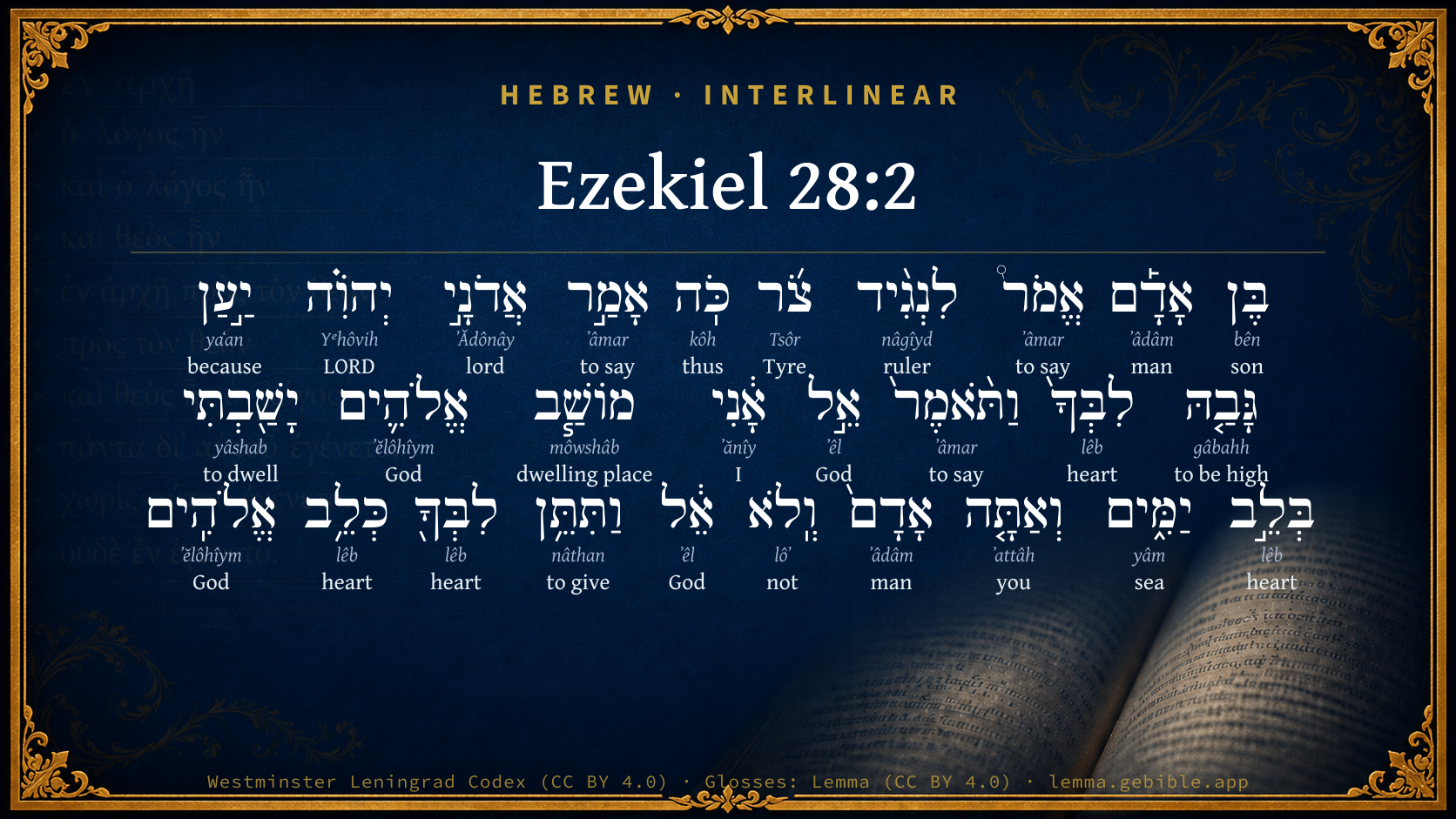
Hebrew (Westminster Leningrad Codex) Ezekiel 28:2 appears in the Hebrew Old Testament. The text above is from the Westminster Leningrad Codex. Each word links to its Strong’s number, a concise gloss, and parsing drawn from the Open Scriptures Hebrew Bible morphology. Click any word for its full Brown-Driver-Briggs (BDB) entry.
Download image
Cite this verse

Ezekiel 28:2 (World English Bible). Public Domain. Lemma interlinear Bible study tool, https://lemma.gebible.app/v/ezekiel/28/2.

Show BibTeX & RIS
BibTeX
RIS
English Translation
Son of man, tell the prince of Tyre, Thus says the Lord Yahweh: Because your heart is lifted up, and you have said, I am a god, I sit in the seat of God, in the midst of the seas; yet you are man, and not God, though you did set your heart as the heart of God;-
World English Bible · Public Domain
Download a study sheet

One document with this verse’s original text, its word-by-word gloss line, the meaning frame, cross-references with their text, attributed commentary, and full source and license credits — printable, and it pastes into notes with its structure intact.

This verse Autodidact and up

Study sheet (.html) Plain text (.txt)

A passage Seminary Student

Up to 50 verses in one chapter. A passage sheet keeps up to 6 commentary sources and 12 cross-references per verse, in the order this page ranks them, and says so on the sheet whenever that leaves anything out. Ask for a single verse and you get the Autodidact verse sheet above.

Everything on this page stays free to read, with no account — the sheet is a download of what is already on screen, not access to it.

Want to remove ads? Support Godless Engineer
Compare translations 3

The same verse in 3 English versions, stacked beneath the original-language interlinear above. Click any original word for its lexicon entry.

Each is an independent rendering of the whole verse — the interlinear is not word-aligned to these translations.

Highlighted words mark where these versions differ — a whole-verse word diff, not a word-by-word alignment.

  • World English Bible Public Domain
    Son of man, tell the prince of Tyre, Thus says the Lord Yahweh: Because your heart is lifted up, and you have said, I am a god, I sit in the seat of God, in the midst of the seas; yet you are man, and not God, though you did set your heart as the heart of God;-
  • King James Version Public Domain
    Son of man, say unto the prince of Tyrus, Thus saith the Lord GOD; Because thine heart is lifted up, and thou hast said, I am a God, I sit in the seat of God, in the midst of the seas; yet thou art a man, and not God, though thou set thine heart as the heart of God:
  • unfoldingWord Literal Text CC BY-SA 4.0
    “Son of man, say to the ruler of Tyre, ‘The Lord Yahweh says this: Your heart is arrogant! You have said, “I am a god! I will sit in the seat of the gods in the heart of the seas!” Even though you are a man and not a god, you make your heart like the heart of a god;

unfoldingWord Literal Text — © unfoldingWord, licensed CC BY-SA 4.0. Word-aligned USFM3 via Door43 (git.door43.org/unfoldingWord/en_ult).

Versions to compare (up to 4)

3 of 4 selected

Show all 18 translations

Every available English version of this verse, each an independent rendering of the whole verse.

  • World English Bible Public Domain
    Son of man, tell the prince of Tyre, Thus says the Lord Yahweh: Because your heart is lifted up, and you have said, I am a god, I sit in the seat of God, in the midst of the seas; yet you are man, and not God, though you did set your heart as the heart of God;-
  • Berean Standard Bible Public Domain
    “Son of man, tell the ruler of Tyre that this is what the Lord GOD says: Your heart is proud, and you have said, ‘I am a god; I sit in the seat of gods in the heart of the sea.’ Yet you are a man and not a god, though you have regarded your heart as that of a god.
  • Majority Standard Bible Public Domain
    “Son of man, tell the ruler of Tyre that this is what the Lord GOD says: Your heart is proud, and you have said, ‘I am a god; I sit in the seat of gods in the heart of the sea.’ Yet you are a man and not a god, though you have regarded your heart as that of a god.
  • King James Version Public Domain
    Son of man, say unto the prince of Tyrus, Thus saith the Lord GOD; Because thine heart is lifted up, and thou hast said, I am a God, I sit in the seat of God, in the midst of the seas; yet thou art a man, and not God, though thou set thine heart as the heart of God:
  • American Standard Version (1901) Public Domain
    Son of man, say unto the prince of Tyre, Thus saith the Lord Jehovah: Because thy heart is lifted up, and thou hast said, I am a god, I sit in the seat of God, in the midst of the seas; yet thou art man, and not God, though thou didst set thy heart as the heart of God;-
  • Revised Version (1885) Public Domain
    Son of man, say unto the prince of Tyre, Thus saith the Lord GOD: Because thine heart is lifted up, and thou hast said, I am a god, I sit in the seat of God, in the midst of the seas; yet thou art man, and not God, though thou didst set thine heart as the heart of God:
  • Geneva Bible (1599) Public Domain
    Sonne of man, say vnto the prince of Tyrus, Thus saieth the Lord God, Because thine heart is exalted, and thou hast said, I am a God, I sit in the seat of God in ye mids of the sea, yet thou art but a man and not God, and though thou didest thinke in thine heart, that thou wast equall with God,
  • Douay-Rheims (1899) Public Domain
    Son of man, say to the prince of Tyre: Thus saith the Lord God: Because thy heart is lifted up, and thou hast said: I am God, and T sit in the chair of God in the heart of the sea: whereas thou art a man, and not God: and hast set thy heart as if it were the heart of God.
  • Young's Literal Translation Public Domain
    `Son of man, say to the leader of Tyre: Thus said the Lord Jehovah: Because thy heart hath been high, And thou dost say: A god I `am', The habitation of God I have inhabited, In the heart of the seas, And thou `art' man, and not God, And thou givest out thy heart as the heart of God,
  • Literal Standard Version CC BY-SA 4.0
    “Son of man, say to the leader of Tyre, Thus said Lord YHWH: Because your heart has been high, || And you say: I [am] a god, || I have inhabited the habitation of God, || In the heart of the seas, || And you [are] man, and not God, || And you give out your heart as the heart of God,
  • Unlocked Literal Bible CC BY-SA 4.0
    “Son of man, say to the ruler of Tyre, 'The Lord Yahweh says this: Your heart is arrogant! You have said, “I am a god! I will sit in the seat of the gods in the heart of the seas!” Even though you are a man and not a god, you make your heart like the heart of a god;
  • unfoldingWord Literal Text CC BY-SA 4.0
    “Son of man, say to the ruler of Tyre, ‘The Lord Yahweh says this: Your heart is arrogant! You have said, “I am a god! I will sit in the seat of the gods in the heart of the seas!” Even though you are a man and not a god, you make your heart like the heart of a god;
  • Darby Bible Public Domain
    Son of man, say unto the prince of Tyre, Thus saith the Lord Jehovah: Because thy heart is lifted up, and thou hast said, I am a ùgod, I sit [in] the seat of God, in the heart of the seas, (and thou art a man, and not ùGod,) and thou settest thy heart as the heart of God:
  • World Messianic Bible Public Domain
    “Son of man, tell the prince of Tyre, ‘The Lord GOD says: “Because your heart is lifted up, and you have said, ‘I am a god, I sit in the seat of God, in the middle of the seas;’ yet you are man, and no god, though you set your heart as the heart of a god—
  • Webster's Bible Public Domain
    Son of man, say to the prince of Tyre, Thus saith the Lord GOD; Because thy heart is lifted up, and thou hast said, I am a god, I sit in the seat of God, in the midst of the seas; yet thou art a man, and not God, though thou settest thy heart as the heart of God:
  • Free Bible Version CC BY-SA 4.0
    “Son of man, tell the ruler of Tyre this is what the Lord God says: You're so proud of yourself, saying, ‘I'm a god! I sit on my throne like a god in the middle of the sea.’ But you're only a man. You're not a god, even though you think you are one.
  • Bible in Basic English Public Domain
    Son of man, say to the ruler of Tyre, This is what the Lord has said: Because your heart has been lifted up, and you have said, I am a god, I am seated on the seat of God in the heart of the seas; but you are man and not God, though you have made your heart as the heart of God:
  • JPS Tanakh (1917) Public Domain
    'Son of man, say unto the prince of Tyre: Thus saith the Lord GOD: Because thy heart is lifted up, and thou hast said: I am a god, I sit in the seat of God, in the heart of the seas; yet thou art man, and not God, though thou didst set thy heart as the heart of God —

Literal Standard Version (2020), Covenant Press — licensed CC BY-SA 4.0. Text via the HelloAO Bible API (eBible.org). Unlocked Literal Bible (unfoldingWord) — licensed CC BY-SA 4.0. Text via the HelloAO Bible API (eBible.org). unfoldingWord Literal Text — © unfoldingWord, licensed CC BY-SA 4.0. Word-aligned USFM3 via Door43 (git.door43.org/unfoldingWord/en_ult). Free Bible Version, Dr. Jonathan Gallagher — licensed CC BY-SA 4.0. Text via the HelloAO Bible API (eBible.org).

Word by word

More ways to search: Search by grammar → Find every occurrence → Compare this word →

Practice this passage: Drill this verse → Learn its vocabulary →

גָּבַ֤הּ
gâbahh
H1361
“to be high”
Verb, Qal, Perfect, 3rd Person, Masculine, Singular
Part of Speech
Verb
Stem
Qal
Form
Perfect
Person
3rd Person
Gender
Masculine
Number
Singular
Full BDB Definition

Origin: a primitive root

TWOT: 305

to be high, be exalted - (Qal) - to be high, lofty, tall - to be exalted - to be lofty - to be lofty (of Jehovah's ways - good sense) - to be haughty, be arrogant (bad sense) - (Hiphil) to make high, exalt
  1. בֶּן bên H1121 “son of” Noun, Common, Masculine, Singular, Construct
  2. אָדָ֡ם ʼâdâm H120 “man” Noun, Common, Masculine, Singular, Absolute
  3. אֱמֹר֩ ʼâmar H559 “say” Verb, Qal, Imperative, 2nd Person, Masculine, Singular
  4. לִנְגִ֨יד nâgîyd H5057 “to/for · ruler of” Preposition + Noun, Common, Masculine, Singular, Construct
  5. צֹ֜ר Tsôr H6865 “Tyre” Noun, Proper
  6. כֹּֽה kôh H3541 “thus” Adverb
  7. אָמַ֣ר ʼâmar H559 “to say” Verb, Qal, Perfect, 3rd Person, Masculine, Singular
  8. אֲדֹנָ֣י ʼĂdônây H136 “Lord · my” Noun, Common, Masculine, Plural, Construct + Suffix, Personal, 1st Person, Common, Singular
  9. יְהֹוִ֗ה Yᵉhôvih H3069 “LORD” Noun, Proper
  10. יַ֣עַן yaʻan H3282 “because” Conjunction
  11. לִבְּךָ֙ lêb H3820 “heart · your” Noun, Common, Masculine, Singular, Construct + Suffix, Personal, 2nd Person, Masculine, Singular
  12. וַתֹּ֨אמֶר֙ ʼâmar H559 “and · to say” Conjunction + Verb, Qal, Sequential Imperfect, 2nd Person, Masculine, Singular
  13. אֵ֣ל ʼêl H410 “God” Noun, Common, Masculine, Singular, Absolute
  14. אָ֔נִי ʼănîy H589 “I” Pronoun, Personal, 1st Person, Common, Singular
  15. מוֹשַׁ֧ב môwshâb H4186 “dwelling place of” Noun, Common, Masculine, Singular, Construct
  16. אֱלֹהִ֛ים ʼĕlôhîym H430 “God(s)” Noun, Common, Masculine, Plural, Absolute
  17. יָשַׁ֖בְתִּי yâshab H3427 “to dwell” Verb, Qal, Perfect, 1st Person, Common, Singular
  18. בְּלֵ֣ב lêb H3820 “in/at · heart of” Preposition + Noun, Common, Masculine, Singular, Construct
  19. יַמִּ֑ים yâm H3220 “seas” Noun, Common, Masculine, Plural, Absolute
  20. וְאַתָּ֤ה ʼattâh H859 “and · you” Conjunction + Pronoun, Personal, 2nd Person, Masculine, Singular
  21. אָדָם֙ ʼâdâm H120 “man” Noun, Common, Masculine, Singular, Absolute
  22. וְֽלֹא lôʼ H3808 “and · not” Conjunction + Particle, Negative
  23. אֵ֔ל ʼêl H410 “God” Noun, Common, Masculine, Singular, Absolute
  24. וַתִּתֵּ֥ן nâthan H5414 “and · to give” Conjunction + Verb, Qal, Sequential Imperfect, 2nd Person, Masculine, Singular
  25. לִבְּךָ֖ lêb H3820 “heart · your” Noun, Common, Masculine, Singular, Construct + Suffix, Personal, 2nd Person, Masculine, Singular
  26. כְּלֵ֥ב lêb H3820 “like/as · heart of” Preposition + Noun, Common, Masculine, Singular, Construct
  27. אֱלֹהִֽים ʼĕlôhîym H430 “God(s)” Noun, Common, Masculine, Plural, Absolute

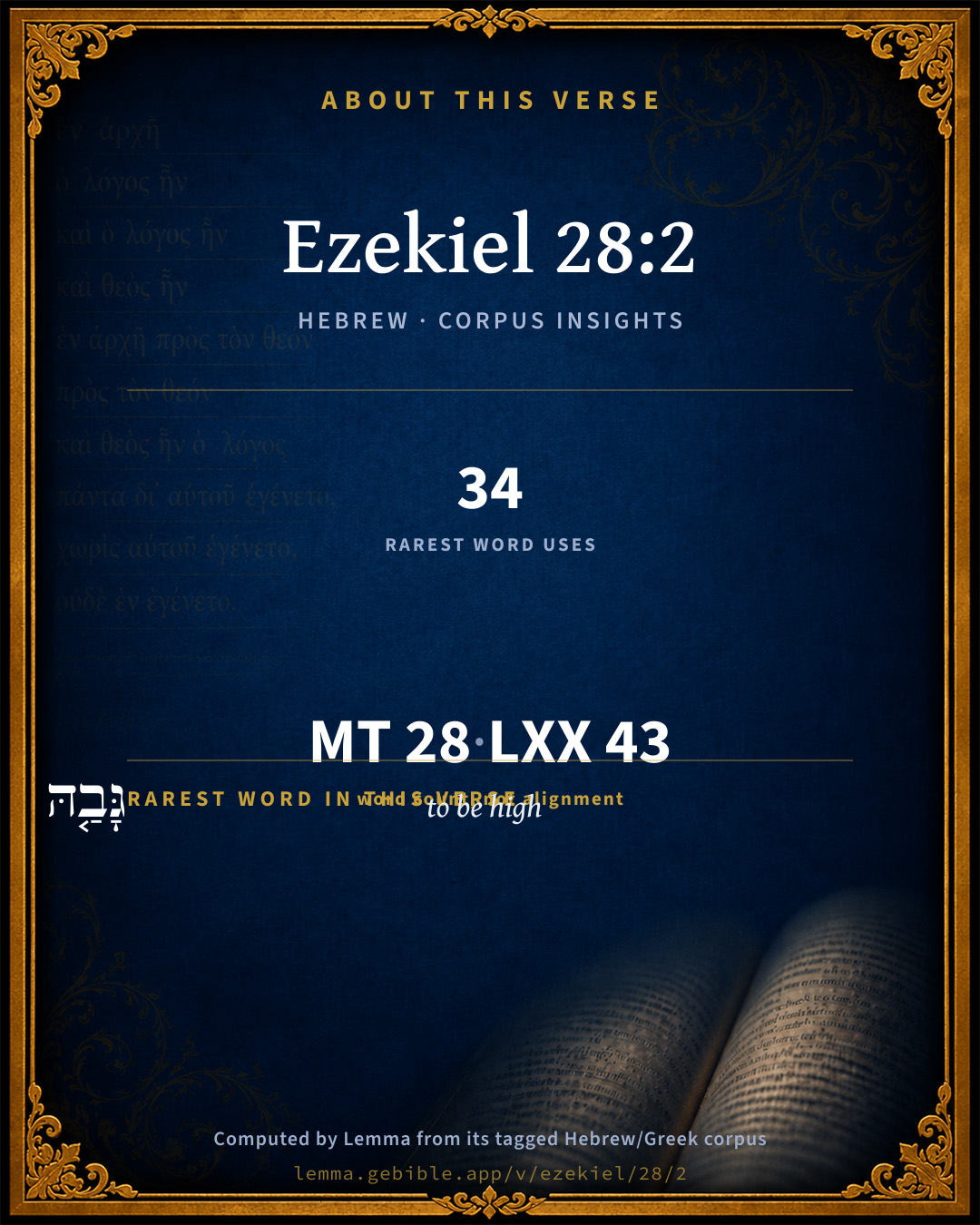
About this verse

These counts appear in no published source. They are computed here, from the morphology-tagged text and Lemma’s own curated glosses. What Lemma adds →

28
words
20
distinct lemmas
Prophets
section

Shared distinctive vocabulary

גָּבַ֤הּ to be high H1361 occurs in 33 verses of the Hebrew Bible. Also found in:

Grammatical profile

  • 6 verbs
  • 17 nouns
  • 2 pronouns
  • 1 conjunction
  • 1 adverb
  • 1 particle

Verb forms

  • אֱמֹר֩ Qal · Imperative
  • אָמַ֣ר Qal · Perfect
  • גָּבַ֤הּ Qal · Perfect
  • וַתֹּ֨אמֶר֙ Qal · Sequential Imperfect
  • יָשַׁ֖בְתִּי Qal · Perfect
  • וַתִּתֵּ֥ן Qal · Sequential Imperfect

Repetition

Words recur within this verse — often emphatic in Hebrew:

  • לִבְּךָ֙ heart H3820 ×4
  • אֱמֹר֩ to say H559 ×3
  • אָדָ֡ם man H120 ×2
  • אֵ֣ל God H410 ×2
  • אֱלֹהִ֛ים God H430 ×2

Hebrew & Septuagint length

In English translation the verse runs 58 words from the Hebrew and 59 from the Septuagint (LXX English) — closely comparable.

A rough comparison of the two English renderings, which tokenize alike — not a word-level alignment.

Word counts can differ between the Hebrew and the Greek without any difference in meaning — e.g. the Hebrew direct-object marker אֵת has no separate Greek word, and Greek often adds the article ὁ.

In the original languages it is 28 Hebrew tokens and 43 Greek tokens — but the two are counted differently (Hebrew bundles its prefixes and suffixes into one token; the Greek is in lemma form), so that isn’t a like-for-like length.

Cross-references

26

Topical passages linked to Ezekiel 28:2 in the Treasury of Scripture Knowledge — connected by theme and wording, ordered by reader-vote popularity; previews shown in the World English Bible.

  • Ezekiel 28:9 Will you yet say before him who kills you, I am God? but you are man, and not God, in the hand of him who wounds you.
  • 2 Thessalonians 2:4 he who opposes and exalts himself against all that is called God or that is worshiped; so that he sits as God in the temple of God, setting himself up as God.
  • Isaiah 14:13–14 You said in your heart, I will ascend into heaven, I will exalt my throne above the stars of God; and I will sit on the mountain of congregation, in the uttermost parts of the north;
  • Psalms 9:20 Put them in fear, Yahweh. Let the nations know that they are only men. Selah.
  • Proverbs 16:18 Pride goes before destruction, And a haughty spirit before a fall.
  • Isaiah 31:3 Now the Egyptians are men, and not God; and their horses flesh, and not spirit: and when Yahweh shall stretch out his hand, both he who helps shall stumble, and he who is helped shall fall, and they all shall be consumed together.
  • Acts 12:22–23 The people shouted, "The voice of a god, and not of a man!"
  • Isaiah 2:12 For there will be a day of Yahweh of Hosts for all that is proud and haughty, And for all that is lifted up; And it shall be brought low:
  • Genesis 3:5 for God knows that in the day you eat it, your eyes will be opened, and you will be like God, knowing good and evil."
  • Deuteronomy 8:14 then your heart be lifted up, and you forget Yahweh your God, who brought you forth out of the land of Egypt, out of the house of bondage;
  • 2 Chronicles 26:16 But when he was strong, his heart was lifted up, so that he did corruptly, and he trespassed against Yahweh his God; for he went into the temple of Yahweh to burn incense on the altar of incense.
  • Proverbs 18:12 Before destruction the heart of man is proud, But before honor is humility.
  • Ezekiel 27:3–4 and tell Tyre, you who dwell at the entry of the sea, who are the merchant of the peoples to many isles, thus says the Lord Yahweh: You, Tyre, have said, I am perfect in beauty.
  • Ezekiel 27:26–27 Your rowers have brought you into great waters: the east wind has broken you in the heart of the seas.
  • Ezekiel 28:5–6 by your great wisdom [and] by your traffic have you increased your riches, and your heart is lifted up because of your riches;-
  • Ezekiel 28:12–14 Son of man, take up a lamentation over the king of Tyre, and tell him, Thus says the Lord Yahweh: You seal up the sum, full of wisdom, and perfect in beauty.
  • Ezekiel 28:17 Your heart was lifted up because of your beauty; you have corrupted your wisdom by reason of your brightness: I have cast you to the ground; I have laid you before kings, that they may see you.
  • Ezekiel 31:10 Therefore thus said the Lord Yahweh: Because you are exalted in stature, and he has set his top among the thick boughs, and his heart is lifted up in his height;
  • Daniel 4:30–31 The king spoke and said, Is not this great Babylon, which I have built for the royal dwelling-place, by the might of my power and for the glory of my majesty?
  • Daniel 5:22–23 You his son, Belshazzar, have not humbled your heart, though you knew all this,
  • Habakkuk 2:4 Behold, his soul is puffed up. It is not upright in him, but the righteous will live by his faith.
  • 1 Timothy 3:6 not a new convert, lest being puffed up he fall into the same condemnation as the devil.
  • 1 Peter 5:5 Likewise, you younger ones, be subject to the elder. Yes, all of you gird yourselves with humility, to subject yourselves to one another; for "God resists the proud, but gives grace to the humble."
  • Revelation 17:3 He carried me away in the Spirit into a wilderness. I saw a woman sitting on a scarlet-colored animal, full of blasphemous names, having seven heads and ten horns.
  • Psalms 72:6–7 He will come down like rain on the mown grass, As showers that water the earth.
  • Psalms 82:6–7 I said, "You are gods, All of you are sons of the Most High.

Cross-references courtesy of OpenBible.info (CC BY 4.0).

Hebrew and Greek witnesses Masoretic Hebrew ↔ Greek Septuagint

The same verse in the two great witnesses to the Old Testament, shown verse-for-verse.

These are two independent witnesses, not word-aligned to each other, and the Septuagint is shown in lemma (dictionary) form.

Hebrew Ezekiel 28:2 Masoretic · Westminster Leningrad Codex

בֶּן אָדָ֡ם אֱמֹר֩ לִנְגִ֨יד צֹ֜ר כֹּֽה אָמַ֣ר אֲדֹנָ֣י יְהֹוִ֗ה יַ֣עַן גָּבַ֤הּ לִבְּךָ֙ וַתֹּ֨אמֶר֙ אֵ֣ל אָ֔נִי מוֹשַׁ֧ב אֱלֹהִ֛ים יָשַׁ֖בְתִּי בְּלֵ֣ב יַמִּ֑ים וְאַתָּ֤ה אָדָם֙ וְֽלֹא אֵ֔ל וַתִּתֵּ֥ן לִבְּךָ֖ כְּלֵ֥ב אֱלֹהִֽים

Son of man, tell the prince of Tyre, Thus says the Lord Yahweh: Because your heart is lifted up, and you have said, I am a god, I sit in the seat of God, in the midst of the seas; yet you are man, and not God, though you did set your heart as the heart of God;-

World English Bible · Public Domain

Greek LXX Ezekiel 28:2 Septuagint · lemma form

καί σύ υἱός ἄνθρωπος εἶπον ὁ ἄρχων τύρος ὅδε λέγω κύριος ἀντί ὅς ὑψόω σύ ὁ καρδία καί εἶπον θεός εἰμί ἐγώ κατοικία θεός καταοἰκέω ἐν καρδία θάλασσα σύ δέ εἰμί ἄνθρωπος καί οὐ θεός καί δίδωμι ὁ καρδία σύ ὡς καρδία θεός

And you, son of man, say to the prince of Tyrus, Thus says the Lord; Because your heart has been exalted, and you have said, I am God, I have inhabited the dwelling of God in the heart of the sea; yet you are man and not God, though you have set your heart as the heart of God:

LXX2012 (modern English Septuagint) · Public Domain

Hebrew: Westminster Leningrad Codex (CC BY 4.0). Greek: Septuagint (public domain); English from LXX2012 (modern English Septuagint) (Public Domain). How the Septuagint differs from the Hebrew →

Targum (Aramaic paraphrase)

1

The Targum is the ancient Jewish Aramaic paraphrase of the Hebrew Scriptures — an interpretive translation, not the Hebrew text itself. Onkelos (literal) and Pseudo-Jonathan (expansive) render the Torah, and Jonathan the Prophets. Coverage is partial: where no permissively-licensed English translation exists for a verse, only the Aramaic is shown. This is verse-level text, not a word-by-word alignment to the Hebrew.

  1. Targum Jonathan Prophets (Joshua–Malachi)
    בַּר אָדָם אֱמַר לְמַלְכָּא דְצוֹר כִּדְנַן אֲמַר לִיבָּךְ וַאֲמַרְתְּ דַחֲלָא אֲנָא יְיָ אֱלֹהִים חֲלַף דְרָאֵים מוֹתַב תַּקִיפִין יְתִיבֵית בְּגוֹ יַמַיָא וְאַתְּ אֱנָשָׁא וְלֵית בָּךְ צְרוֹךְ וַחֲשַׁבְתָּא בְלִיבָּךְ דְאַתְּ דַחֲלָא:

    (no public-domain English translation for this verse)

    Targum Jonathan — Aramaic: “Mikraot Gedolot” (public domain). English: “Sefaria Community Translation” (CC0 1.0 (public-domain dedication)); “London "Chaldee Paraphrase," 1871” (public domain). Text via Sefaria.

Commentary

Notes on Ezekiel 28:2 from classic Christian and Jewish commentators (each source and its license shown beneath its notes). The classic Christian expositions comment on the surrounding passage and are grouped to its opening verse, so a note may address several verses; the Jewish commentaries on the Tanakh (Rashi and others) are per-verse, so they appear only where the commentator wrote on this verse.

Lemma curates 59 commentaries, every one of them public domain or Creative Commons licensed, each selected and text-cleaned for this edition rather than reprinted as found. About our sources →

Ellicott's Commentary for English Readers

(2) I am a God.—The arraignment of the prince occupies Eze_28:2-5, his consequent doom Eze_28:6-10. The point of the charge is inordinate pride, begotten of great prosperity; this prosperity, being attributed to his own powers instead of to its true source, led him to imagine himself almost more than mortal. Similar instances of what may be called “the insanity of prosperity” may be seen in the case of Sennacherib (2Ki_18:33-35); of the then living monarch of Babylon, Nebuchadnezzar, to whom this prophecy might well serve as a warning (Dan_3:15; Dan_4:30; comp. also Dan_7:25, Dan_11:36-37); of Pharaoh (Eze_29:3); of Herod (Act_12:21-23); of the one foretold in 2Th_2:4; to which list might be added the names of some more modern conquerors, and, in their degree, of many who have been eminently successful in other walks of life, and have consequently sacrificed to their own net (Hab_1:16). It is not to be supposed that the king of Tyre, like some Oriental monarchs and later Roman emperors, actually claimed for himself religious homage; but he had that proud sense of elevation and self-sufficiency which is only translated into words in the expressions of the text.

The seat of God.—This expression is chosen not merely with reference to the great natural beauty and apparently impregnable position of Tyre, but also to the fact that it was called “the holy island,” and looked up to by all its colonies as the central sanctuary of their worship. The Temple of Melkarth was said by the priests to have been founded as far back as 2750 B.C., and Arrian speaks of it as the oldest sanctuary in the annals of mankind. (See also Note on Eze_28:6.)

A Bible Commentary for English Readers, edited by Charles John Ellicott (1878–1897) — public domain. Text from a community e-Sword module.

Trapp's Complete Commentary

John Trapp

Eze 28:2 Son of man, say unto the prince of Tyrus, Thus saith the Lord GOD; Because thine heart [is] lifted up, and thou hast said, I [am] a God, I sit [in] the seat of God, in the midst of the seas; yet thou [art] a man, and not God, though thou set thine heart as the heart of God:

Ver. 2. Say unto the prince of Tyrus.] Princes must be told their own, as well as others. It was partly by flattery that this prince was so high flown. His glory, wealth, and wit also had so blown him up that he forgot himself to be a man. Tabaal, Josephus, out of Berosus, calleth him; Diodorus Siculus, Ithobaal; others, Ethbaal. A most proud and presumptuous person he was, and a type of the devil, who is the "king of all the children of pride." {Job 41:34} Here he holdeth himself to be wiser than Daniel; {Eze 28:3} yea, to be the sum and perfection of all wisdom; {Eze 28:12} to excel the high priest in all his ornaments, os humerosque Deo similis {Eze 28:13} yea, to be above Adam (ib.); above the cherubims; {Eze 28:14} lastly, to be God himself, and to sit in his seat. {Eze 28:2} O Lucifer outdeviled! And yet as there were many Marii in one Caesar, so by nature there are many Ethbaals in the best of us; for "as in water face answereth to face, so doth the heart of a man to a man." {Pro 27:19} Julius Caesar allowed altars and temples to be dedicated unto him, as to a god; and what wonder, whereas his flatterers told him that the freckles in his face were like the stars in the firmament? {a} Valladerius told Pope Paul V, and he believed it, that he was a god, that he lived familiarly with the Godhead, that he heard predestination itself whispering to him, that he had a place to sit in council with the Divine Trinity, &c. Prodigious blasphemy! Is not this that "man of sin," that Merum scelus, pure wickedness spoken of by Paul in 2Th 2:4? See more of this there. Was it not he that made Dandalus, the Venetian ambassador, roll under his table, and, as a dog, eat crusts there? and that suffered the Sicilian ambassadors to use these words unto him, Domine Deus papa, miserere nostrum; O Lord God the Pope, have mercy upon us. And again, O Lamb of God, that takest away the sins of the world, grant us thy peace.

In the midst of the seas.] Where none can come at me. Yes, Nebuchadnezzar could, and did, though after thirteen years’ siege, as Josephus writeth. A hard tug and hot service he had of it; but yet he did the deed, as did afterwards also Alexander the Great, who never held anything unseizable.

{a} Sutton.

John Trapp, A Commentary or Exposition upon All the Books of the Old and New Testament (1647–1656) — public domain. Text from a community e-Sword module.

Joseph Benson's Commentary

Eze 28:2. Say to the prince of Tyrus — The name of this prince was Ithobalus, according to the Phenician annals. Because thy heart is lifted up — In pride and self-conceit; and thou hast said — Namely, in thy heart; I am a god — I am like a god. I sit in the seat of God — Inaccessible by mortals. In the midst of the seas — As God is safe from all injury in his throne in heaven, so am I as safe; for the sea secures me. These words express an insolent boast of self-sufficiency, as if he had said, I fear no man, nor stand in need of any: I am seated in a place of impregnable strength: the sea defends me, so that no enemy can assault me. And they represent the excessive pride and carnal security of this prince, who trusted in his own strength, and forgot his dependance upon God. The same crime was in like manner punished in the king of Egypt, Eze 29:3, and afterward in Nebuchadnezzar himself, Dan 4:30-31. Yet thou art man, and not God — Subject to all the infirmities, casualties, sorrows, and distresses that attend human nature, and to all the changes of human affairs, and hast not any of that innate, invincible power, and of that immutability of condition, which is in God. Though thou hast set thy heart as the heart of God — Hast entertained thoughts which become none but God.

Joseph Benson's Commentary on the Old and New Testaments (1811–1818) — public domain. Text from a community e-Sword module.

Geneva Bible (1599)

Geneva Bible translators

Hebrew, though thou set thine heart as the heart of God.

I am safe that none can come to hurt me, as God is in the heaven.

Geneva Bible (1599) marginal notes — public domain. Text via Bolls.life.

Adam Clarke's Commentary

Verse 2. Say unto the prince of Tyrus] But who was this prince of Tyrus? Some think Hiram; some, Sin; some, the devil; others, Ithobaal, with whom the chronology and circumstances best agree. Origen thought the guardian angel of the city was intended.

I am a god] That is, I am absolute, independent, and accountable to none. He was a man of great pride and arrogance.

Adam Clarke's Commentary on the Bible (1810–1826) — public domain. Text from a community e-Sword/MySword module.

The Cambridge Bible for Schools and Colleges

gen. ed. J. J. S. Perowne

2. am a God] I am God. Ezekiel speaks from his own point of view, which recognizes but one God, not from that of polytheism. The prince set his heart as the heart of God; he felt and acted as if divine. There is not the slightest allusion, of course, to actual worship being paid to the prince; it is his own feeling alone, his pride and self-exaltation, that is referred to.

I sit in the seat of God] Naturally the prince speaks of his own abode, Tyre; but he regards, it as divine. He is God and it is the seat of God. There is no doubt allusion to the idea that there was a seat of God or the gods; the prince identified Tyre with it. The beauty and splendour of the place, its richness and renown, possibly also its isolation, make it something not of the earth. In Isaiah 14 the king of Babylon affects to seat himself beside the Most High, here the prince of Tyre identifies himself with God.

The Cambridge Bible for Schools and Colleges (gen. ed. J. J. S. Perowne; Cambridge University Press, 1878–1918) — public domain. Text from a community e-Sword module.

John Gill's Exposition

Son of man, say unto the prince of Tyre,.... Whose name was Ethbaal, or Ithobalus, as he is called in Josephus; for that this was Hiram that was in the days of Solomon, and lived a thousand years, is a fable of the Jewish Rabbins, as Jerom relates: this prince of Tyre is thought by some to be an emblem of the devil; but rather of antichrist; and between them there is a great agreement, and it seems to have a prophetic respect to him:

thus saith the Lord God, because thine heart is lifted up: with pride, on account of his wisdom and knowledge, wealth and riches, as later mentioned:

and thou hast said, I am a god; this he said in his heart, in the pride of it, and perhaps expressed it with his lips, and required divine homage to be given him by his subjects, as some insolent, proud, and haughty monarchs have done; in which he was a lively type of antichrist, who shows himself, and behaves, as if he was God, taking upon him what belongs to God; pardoning the sins of men; opening and shutting the gates of heaven; binding men's consciences with laws of his own making, and dispensing with the laws of God and man; and calling himself or suffering himself to be called God, and to be worshipped as such; See Gill on Th2 2:4,

I sit in the seat of God; in a place as delightful, safe and happy, as heaven itself, where the throne of God is; so antichrist is said to sit in the temple of God, in the house and church of God; where he assumes a power that does not belong to him, calling himself God's vicegerent, and Christ's vicar; see Th2 2:4, and the Arabic version here renders it "in the house of God": it follows,

in the midst of the seas; surrounded with them as Tyre was, and lord of them as its king was; sending his ships into all parts, and to whom all brought their wares; thus the whore of Rome is said to sit upon many waters, Rev 17:2,

yet thou art a man, and not God; a frail, weak, mortal man, and not the mighty God, as his later destruction shows; and as the popes of Rome appear to be, by their dying as other men; and as antichrist will plainly be seen to be when he shall be destroyed with the breath of Christ's mouth, and the brightness of his coming:

though thou set thine heart as the heart of God; as if it was as full of wisdom and knowledge as his; and thinkest as well of thyself, that thou art a sovereign as he, and to be feared, obeyed, and submitted to by all.

John Gill's Exposition of the Whole Bible (1746–1763) — public domain (CC PDM 1.0). Text via the HelloAO Bible API.

Haydock's Catholic Bible Commentary

Prince. The Jews say Hiram, (St. Jerome) supposing that he lived a thousand years; though this is not requisite, as he died only four hundred and thirty years before. The idea is childish. The king who was taken and slain, at this siege, was probably (Calmet) Ithobalos. (Josephus, Antiquities x. 11.) --- Origen applies this to the angel guardian of Tyre. St. Augustine thins an allusion is made to the fall of Lucifer. But it may all refer to the king, (Calmet) though others explain part of him and the rest of the devil. (St. Jerome) (Estius)

George Leo Haydock (1774–1849), Haydock's Catholic Family Bible and Commentary, 1859 edition — public domain. Excludes Psalms (Douay-Rheims chapter numbering differs from Protestant) and Deuterocanonical books (Catholic canon only).

Matthew Poole's English Annotations

Unto; of.

The princes; king, whose name was either Ethbaal, or Ithobaal.

Thine heart is lifted up; thou art waxen proud, and aspirest above all reason, and boastest extravagantly in thyself, state policy, and power.

Hast said; thought, imagined, or flattered thyself.

A god; or the mighty and strong one, for so the Hebrew is, and perhaps were better so rendered; he gloried in his strength, as if he were a god. The like you have Isa 14:14.

In the seat of God: as a magistrate he did bear the name and authority of God; but he thought not of this; he dreams of the stateliness, strength, convenience, safety, and inaccessibleness of his seat, as if he were safe and impregnable as heaven itself.

A man, subject to all the casualties, sorrows, and distresses of man’s state and life, thou art Adam, of earth, not El, nor like unto the Mighty One in heaven.

Thou set thine heart as the heart of God; thou hast entertained thoughts which become none but God, thou hast projected things which none but God can effect, thou hast promised thyself perpetual peace, safety, riches, and happiness in thyself, and from thyself.

Matthew Poole's English Annotations on the Holy Bible (1683–1685) — public domain. Text from a community e-Sword/MySword module.

Whedon's Commentary on the Bible

Daniel D. Whedon

2. Tyrus — Tyre (rock), now at the height of its glory, having been already in existence over two thousand years. This island fortress was very proud and very beautiful, and seemed an impregnable Gibraltar. Its lack of drinking water was originally its greatest weakness, as is seen from a record of an Egyptian traveler in the fourteenth century B.C. and from a Tel-el-Amarna tablet, where Abimilki, the governor, appeals for help to the Pharaoh, saying that Zimrida the Sidonian had cut off his supplies of wood and water. But evidently this defect had been remedied before the Nebuchadnezzar campaign, which Josephus says lasted thirteen years (Antiquities of the Jews, Eze_10:11). The inscriptions mentioned above prove that even then Tyre was celebrated for her vast wealth, as in Isaiah’s time she was the city “that giveth crowns” (Isa_23:8). For history and commerce of Tyre see Jeremias’s Tyrus, Movers’s Phoenicia, and notes Eze_26:2; Ezekiel 27.

I am a god — So boasted the king of Babylon (Isa_14:13-14; Dan_4:30). The inscriptions prove this statement of the prophet to be a literal truth. (Compare self-deification of the Roman emperors, Act_12:21-23.)

Daniel D. Whedon (gen. ed.), Commentary on the Old and New Testaments (1874–1909) — public domain. Text from a community e-Sword module.

The Pulpit Commentary

I am a God. We are reminded of Isaiah"s words (Isa_14:13, Isa_14:14) as to the King of Babylon. Did Ezekiel emphasize and amplify the boasts of Ethbaal, with a side-glance at the Chaldean king, who also was lifted up in the pride of his heart? (Dan_4:30) For like examples, see the boast of Hophra, in Eze_29:3; and the praise given to Herod Agrippa by the Tyrians. (Act_12:21) It is noticeable that St. Paul"s description of the man of sin (2Th_2:4) presents the same picture in nearly the same words. I sit in the seat of God, etc. Tyro was known as the Holy Island (Sanchon., edit. Orelli, p. 36). The city was thought of as rising from its waters like the rock-throne of God. Though thou set thy heart. The words remind us of the temptation in Gen_3:5. To forget the limitations of human ignorance and weakness, to claim an authority and demand a homage which belong to God, was the sin of the Prince of Tyre, as it had been that of Sennacherib, as it was of Nebuchadnezzar, as it has been since of the emperors of Rome, and of other rulers.

HOMILETICS.

A prince"s sin.

I GREAT RESPONSIBILITY IS ATTACHED TO HIGH OFFICE. In the two previous chapters the prophet denounced judgment on the city of Tyre, and lamented its approaching accomplishment. Now he turns to the ruler of the city, selecting him for an ugly pre-eminence of guilt. This man is entrusted with the weal of the city. If Tyre is doomed, a heavy share of the blame must lie at his door. It is a fearful thing to be responsible for the fate of so great and splendid a community. In the sight of God accountability is always measured by power. Heedless men grasp hastily at the reins of government, little considering how severe must be the judgment of Heaven if they abuse their great trust. It is no light thing to be in a position of influence over our fellow-men. We need, therefore, especially to pray for the souls of princes and governors. The ambition that craves their privileges might be restrained if people considered the terrible questions that they will have to answer when called upon to give an account of their stewardship.

II PRIDE IS THE BESETTING SIN OF HIGH OFFICE. The Prince of Tyre exclaims, "I am a God, I sit in the seat of God." There are many temptations to this sin of pride.

1. Power. Holding high office necessarily confers great influence. The man in power may really be a weak person, but he has great resources at his command. Thus he is inclined to think too much of himself, and to transfer to the score of his merits what really only belongs to his position.

2. Flattery. The prince is not the only person to blame. They are highly culpable who encourage him in a belief in his own greatness by their base adulation. All people in office need to beware of the honeyed words of those beneath them.

III THE PRIDE OF HIGH OFFICE IS AN INSULT TO GOD. The prince compares himself to a god, and his throne to the seat of a god. This implies two evils.

1. Godlessness. Carrying out this notion in practice, the Prince of Tyre refuses to humble himself in the sight of Heaven. As all men bow to him, he is tempted to forget that he should look up to and bow before a higher Power.

2. Rebellion against God. The proud ruler usurps the place of God. He elects to become an earthly providence. He dispenses with any reference to the holy will of the Supreme, and sets up his own will as the highest authority.

IV SIN IN HIGH OFFICE IS ESPECIALLY CULPABLE BECAUSE IT INVOLVES A MULTITUDE IN ITS EVIL EFFECTS. The effects are seen in its contagious influence and in, its punishment.

1. Its influence. The bad ruler is like Jeroboam, whose awful climax of wickedness was seen in the fact that he "made Israel to sin". (1Ki_15:30) The power of a bad ruler is one that makes for wickedness. It sows seeds of sin broadcast. Society takes its fashion from the court, and then each order of the community from that next above it. It is a fearful thing to be the leader of a fashion of wickedness.

2. Its punishment. The ruler"s sin brings misery on the nation. The people must reap the consequences of the misdeeds of their princes. Tyre"s doom is the heavier because her prince is a bad man. Therefore

(1) the people should look well to the characters of the men they put in office;

(2) all persons in authority should dread the double guilt of brining ruin on the multitude as well as wrecking their own lives.

HOMILIES BY J.R. THOMSON

The height of arrogance.

In addressing the Prince of Tyre, the prophet is in reality dealing with what may be called the national spirit pervading the proud and mighty city a spirit regarded as embodying itself in the person of the chief ruler. The claim made by Tyre, and disputed by the prophet, is a claim to virtual divinity. Exalted above other cities, Tyre deems itself superior to human infirmity and to human fortune. This attitude God resents; and his representative here declares it to be the deep-seated and ultimate reason and cause of Tyre"s approaching overthrow and destruction.

I THE GROUND OF THIS ARROGANT CLAIM.

1. There is on the part of Tyre an assumption of extraordinary wisdom, superior to that of Daniel, a wisdom from which no secret can be hidden.

2. By the exercise of this singular wisdom and understanding, the city has devised means, such as the enterprise of its merchants, by which it has accumulated riches, and has filled its treasuries with store of gold and silver and all the conveniences and luxuries which wealth can purchase.

3. The eminent position among the nations which Tyre has thus attained, the honor accorded to it, its weight in political relations, have so lifted up its heart that it claims to be a god, and to sit in the seat of God. By this must be understood a claim and assumption to be superior to the need of any Divine care or protection, to be independent of all assistance of any kind, to be secure against the assault of any foe, and even against the mutability characteristic of the human lot. This is arrogance beyond what is to be found even in the wisest and the greatest of mankind.

II THE VANITY AND FOLLY OF THIS ARROGANT CLAIM. A state is a human institution; and although it undoubtedly embodies the Divine idea and principle of authority requiring submission, although there is such a thing as national character and national life, still every earthly and human institution, beginning in time, ends in time, and participates in human weakness and ignorance. They who claim deity for aught earthly cannot understand what Deity is, how it is creative and not created, eternal and not transitory, immutable and not shifting, perfect and not subject to development and dissolution. To know one"s self is true wisdom; he who forgets or disclaims his humanity is the subject of illusion, and illusion which must be speedily and irretrievably dispelled.

III THE SINFULNESS OF THIS ARROGANT CLAIM. The assumption of Tyre is rebuked and censured, not as a violation of good taste, not as an insult to other nations, but as a defiance of the Lord of all. To claim unfailing wisdom and irresistible power is to assume the attributes, to aspire to the throne, of the Eternal. Pride has been reckoned as one of the seven deadly sins. It is indeed pernicious in its effect upon the character of those who suffer it to take possession of their being and to control the habits of their life. It is offensive and injurious in its influence upon human society. But primarily it is a sin against God the placing of the creature in that supreme position which is God"s of right, and God"s alone.

IV THE DISPROOF OF THIS ARROGANT CLAIM. Events occur which dispel human illusions, confound human vanity, and unmask human pretensions. In the days of its prosperity and power, men, ever ready to flatter and to worship the great, were too ready to concede the extravagant and monstrous claims Tyre advanced. But the time of trial comes, and their baselessness and absurdity are exposed. Evils which a Divine power would avert prove able to assault and master the pretentious and self-confident. The one great lesson of human history is this man is but man, and not God.

V THE PUNISHMENT OF THIS ARROGANT CLAIM. In the zenith of its prosperity, the acme of its power, Tyre is confronted by a force mightier than its own. The agency is the king and army of Babylon; but the great Actor in the awful scenes which transpire is none other than the Eternal himself. The forces of Tyre are defeated, the fleets of Tyre destroyed, the walls of Tyre razed, the wealth of Tyre dispersed, the city of Tyre itself demolished. "Wilt thou yet say before him that slayeth thee, I am God? but thou shalt be a man, and no God, in the hand of him that slayeth thee." Here is something more than disproof; here is reversal, refutation, annihilation. Pride is humbled to the dust; and the proud are scattered and are no more. T.

The Pulpit Commentary (1880–1919), ed. H.D.M. Spence-Jones & Joseph S. Exell — public domain. Text from a community e-Sword module.

John Wesley's Explanatory Notes

Hast said - In thy heart. In the seat of God - Safe and impregnable as heaven itself. A man - Subject to casualties, sorrows, and distresses. Set thine heart - Thou hast entertained thoughts, which become none but God.

John Wesley, Explanatory Notes Upon the Whole Bible (1754–1765) — public domain. Text via the GEBible commentary corpus.

Rashi

Rabbi Shlomo Yitzchaki (Rashi)

a seat of God he made for himself in the air, over the sea, with a mechanism that was a replica of seven heavens, and he sat down on the highest one.

Rashi on the Tanakh — English translations: “The Judaica Press complete Tanach with Rashi, translated by A. J. Rosenberg” (CC BY 4.0); “Pentateuch with Rashi's commentary by M. Rosenbaum and A.M. Silbermann, 1929-1934” (public domain); “The Metsudah Tanach series, Lakewood, N.J” (CC BY 4.0); and “The Book of Joshua, Metsudah Publications, 1997” (CC BY 4.0). Text via Sefaria.

Lesson kit

Teaching starters — assembled from the data on this page, not authored interpretation. Every prompt links to the verse data it draws on. Edit before teaching.

Ezekiel, in the Prophets, opens this verse with 28 words (20 distinct Hebrew lemmas). Its most distinctive word is gâbahh (“to be high”). A historical commentator’s framing appears above. Read the whole chapter for the surrounding context.

Discussion questions

  1. How does “to be high” (gâbahh) shape what this verse is saying?
  2. How does 1 Samuel 10:23, which shares the word «to be high», read alongside this verse?
  3. What does the repetition of “heart” (4× in this one verse) do in this verse?
  4. These translations render this verse differently. What is at stake in choosing one wording over another?
  5. «אֱמֹר֩» is a Qal Imperative verb. How does that grammatical form shape the action described?
  6. Compare how Ellicott's Commentary for English Readers and Trapp's Complete Commentary read this verse. Where do they agree or differ?

Things to notice

Reading settings

Reading text

Shown beneath each verse's original-language words.

Old Testament
Old Testament edition

Read the OT as the Masoretic Hebrew (MT) or the Greek Septuagint (LXX).

English shown for the Greek Septuagint (in the Hebrew ↔ Greek comparison).

Comparing translations? Open the Compare panel on any verse page to stack up to four side by side.