
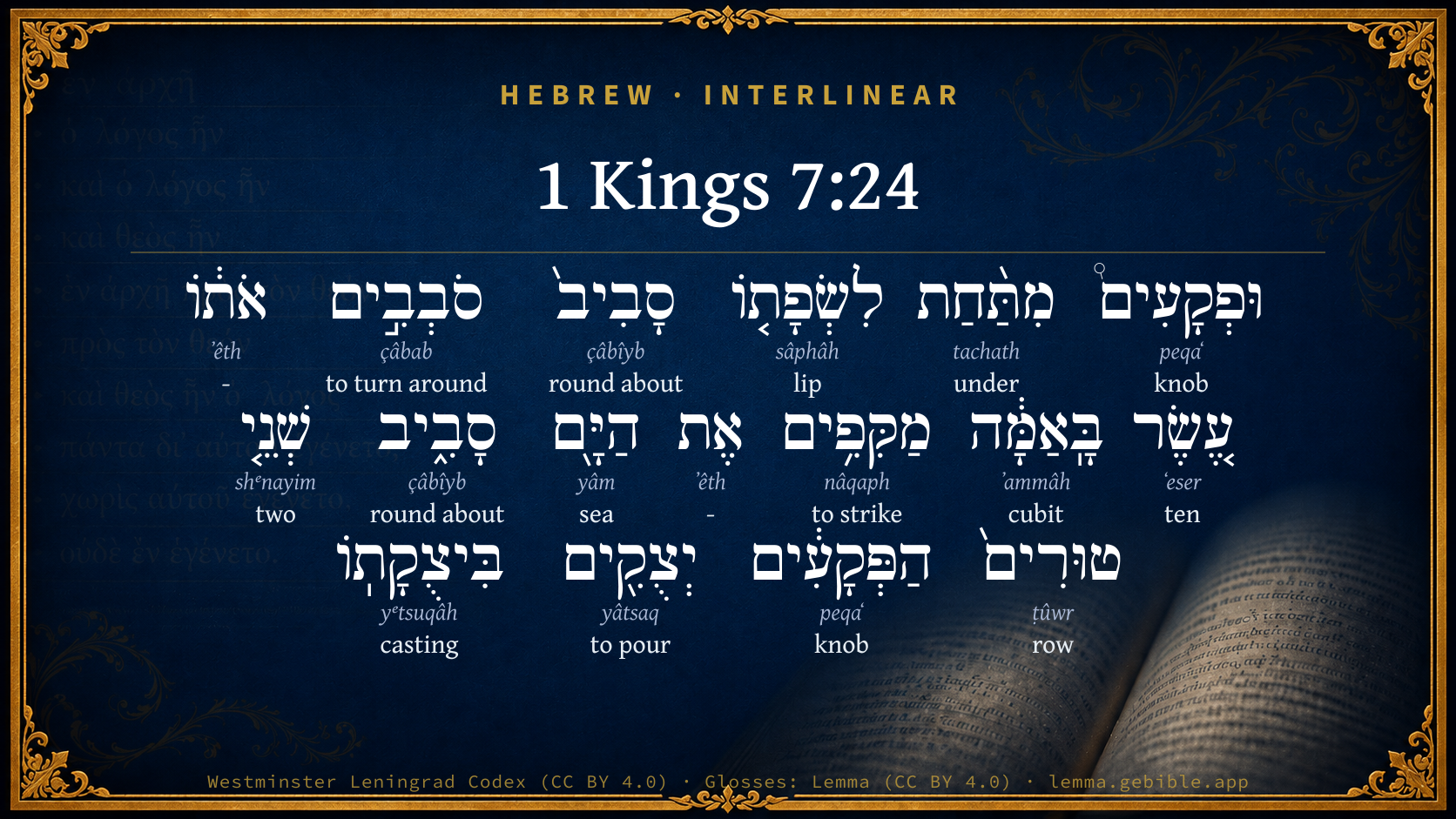
1 Kings 7:24

Hebrew (Westminster Leningrad Codex) 1 Kings 7:24 appears in the Hebrew Old Testament. The text above is from the Westminster Leningrad Codex. Each word links to its Strong’s number, a concise gloss, and parsing drawn from the Open Scriptures Hebrew Bible morphology. Click any word for its full Brown-Driver-Briggs (BDB) entry.
Download image
Cite this verse

1 Kings 7:24 (World English Bible). Public Domain. Lemma interlinear Bible study tool, https://lemma.gebible.app/v/1-kings/7/24.

Show BibTeX & RIS
BibTeX
RIS
English Translation
Under the brim of it round about there were buds which did compass it, for ten cubits, compassing the sea round about: the buds were in two rows, cast when it was cast.
World English Bible · Public Domain
Highlights Full analysis ↓
Download a study sheet

One document with this verse’s original text, its word-by-word gloss line, the meaning frame, cross-references with their text, attributed commentary, and full source and license credits — printable, and it pastes into notes with its structure intact.

This verse Autodidact and up

Study sheet (.html) Plain text (.txt)

A passage Seminary Student

Up to 50 verses in one chapter. A passage sheet keeps up to 6 commentary sources and 12 cross-references per verse, in the order this page ranks them, and says so on the sheet whenever that leaves anything out. Ask for a single verse and you get the Autodidact verse sheet above.

Everything on this page stays free to read, with no account — the sheet is a download of what is already on screen, not access to it.

Want to remove ads? Support Godless Engineer
Compare translations 3

The same verse in 3 English versions, stacked beneath the original-language interlinear above. Click any original word for its lexicon entry.

Each is an independent rendering of the whole verse — the interlinear is not word-aligned to these translations.

Highlighted words mark where these versions differ — a whole-verse word diff, not a word-by-word alignment.

  • World English Bible Public Domain
    Under the brim of it round about there were buds which did compass it, for ten cubits, compassing the sea round about: the buds were in two rows, cast when it was cast.
  • King James Version Public Domain
    And under the brim of it round about there were knops compassing it, ten in a cubit, compassing the sea round about: the knops were cast in two rows, when it was cast.
  • unfoldingWord Literal Text CC BY-SA 4.0
    And gourds from underneath to its lip all around, surrounding it, ten in a cubit, encircling the sea all around two rows. The gourds were cast when it was cast.

unfoldingWord Literal Text — © unfoldingWord, licensed CC BY-SA 4.0. Word-aligned USFM3 via Door43 (git.door43.org/unfoldingWord/en_ult).

Versions to compare (up to 4)

3 of 4 selected

Show all 18 translations

Every available English version of this verse, each an independent rendering of the whole verse.

  • World English Bible Public Domain
    Under the brim of it round about there were buds which did compass it, for ten cubits, compassing the sea round about: the buds were in two rows, cast when it was cast.
  • Berean Standard Bible Public Domain
    Below the rim, ornamental buds encircled it, ten per cubit all the way around the Sea, cast in two rows as a part of the Sea.
  • Majority Standard Bible Public Domain
    Below the rim, ornamental buds encircled it, ten per cubit all the way around the Sea, cast in two rows as a part of the Sea.
  • King James Version Public Domain
    And under the brim of it round about there were knops compassing it, ten in a cubit, compassing the sea round about: the knops were cast in two rows, when it was cast.
  • American Standard Version (1901) Public Domain
    And under the brim of it round about there were knops which did compass it, for ten cubits, compassing the sea round about: the knops were in two rows, cast when it was cast.
  • Revised Version (1885) Public Domain
    And under the brim of it round about there were knops which did compass it, for ten cubits, compassing the sea round about: the knops were in two rows, cast when it was cast.
  • Geneva Bible (1599) Public Domain
    And vnder the brimme of it were knoppes like wilde cucumers compassing it round about, ten in one cubite, compassing the sea round about: and the two rowes of knoppes were cast, when it was molten.
  • Douay-Rheims (1899) Public Domain
    And a graven work under the brim of it compassed it, for ten cubits going about the sea: there were two rows cast of chamfered sculptures.
  • Young's Literal Translation Public Domain
    and knops beneath its brim round about are compassing it, ten by the cubit, going round the sea round about; in two rows `are' the knops, cast in its being cast.
  • Literal Standard Version CC BY-SA 4.0
    and knobs beneath its brim around are going around it, ten by the cubit, going around the sea; the knobs [are] in two rows, cast in its being cast.
  • Unlocked Literal Bible CC BY-SA 4.0
    Under the brim encircling the sea were gourds, ten in each cubit, cast in one piece with “The Sea,” when that basin was cast.
  • unfoldingWord Literal Text CC BY-SA 4.0
    And gourds from underneath to its lip all around, surrounding it, ten in a cubit, encircling the sea all around two rows. The gourds were cast when it was cast.
  • Darby Bible Public Domain
    And under the brim of it round about there were colocynths, encompassing it, ten in a cubit enclosing the sea round about; two rows of colocynths, cast when it was cast.
  • World Messianic Bible Public Domain
    Under its brim around there were buds which encircled it for ten cubits, encircling the sea. The buds were in two rows, cast when it was cast.
  • Webster's Bible Public Domain
    And under the brim of it around there were knobs compassing it, ten in a cubit, compassing the sea around: the knobs were cast in two rows, when it was cast.
  • Free Bible Version CC BY-SA 4.0
    Below the edge it was decorated with ornamental gourds that encircled it, ten per cubit all the way around. They were in two rows cast as one piece with the Sea.
  • Bible in Basic English Public Domain
    And under the edge of it, circling it all round for ten cubits, were two lines of flower buds, made together with it from liquid metal.
  • JPS Tanakh (1917) Public Domain
    And under the brim of it round about there were knops which did compass it, for ten cubits, compassing the sea round about; the knops were in two rows, cast when it was cast.

Literal Standard Version (2020), Covenant Press — licensed CC BY-SA 4.0. Text via the HelloAO Bible API (eBible.org). Unlocked Literal Bible (unfoldingWord) — licensed CC BY-SA 4.0. Text via the HelloAO Bible API (eBible.org). unfoldingWord Literal Text — © unfoldingWord, licensed CC BY-SA 4.0. Word-aligned USFM3 via Door43 (git.door43.org/unfoldingWord/en_ult). Free Bible Version, Dr. Jonathan Gallagher — licensed CC BY-SA 4.0. Text via the HelloAO Bible API (eBible.org).

Word by word

More ways to search: Search by grammar → Find every occurrence → Compare this word →

Practice this passage: Drill this verse → Learn its vocabulary →

בִּיצֻקָתֽוֹ
yᵉtsuqâh
H3333
“in/at · casting · his”
Preposition + Noun, Common, Feminine, Singular, Construct + Suffix, Personal, 3rd Person, Masculine, Singular
Part of Speech
Preposition + Noun
Type
Common
Gender
Feminine
Number
Singular
State
Construct
Full BDB Definition

Origin: passive participle of H3332

TWOT: 897a

a casting (of metal)
  1. וּפְקָעִים֩ peqaʻ H6497 “and · knobs” Conjunction + Noun, Common, Masculine, Plural, Absolute
  2. מִתַּ֨חַת tachath H8478 “from · under” Preposition + Preposition
  3. לִשְׂפָת֤וֹ sâphâh H8193 “to/for · lip · his” Preposition + Noun, Common, Feminine, Singular, Construct + Suffix, Personal, 3rd Person, Masculine, Singular
  4. סָבִיב֙ çâbîyb H5439 “round about” Noun, Common, Both, Singular, Absolute
  5. סֹבְבִ֣ים çâbab H5437 “turning around” Verb, Qal, Participle Active, Masculine, Plural, Absolute
  6. אֹת֔וֹ ʼêth H853 “- · him” Particle, Direct Object + Suffix, Personal, 3rd Person, Masculine, Singular
  7. עֶ֚שֶׂר ʻeser H6235 “ten” Adjective, Cardinal number, Feminine, Singular, Absolute
  8. בָּֽאַמָּ֔ה ʼammâh H520 “in/at the · cubit” Preposition, Determined + Noun, Common, Feminine, Singular, Absolute
  9. מַקִּפִ֥ים nâqaph H5362 “striking” Verb, Hiphil, Participle Active, Masculine, Plural, Absolute
  10. אֶת ʼêth H853 “-” Particle, Direct Object
  11. הַיָּ֖ם yâm H3220 “the · sea” Particle, Definite Article + Noun, Common, Masculine, Singular, Absolute
  12. סָבִ֑יב çâbîyb H5439 “round about” Noun, Common, Both, Singular, Absolute
  13. שְׁנֵ֤י shᵉnayim H8147 “two” Adjective, Cardinal number, Masculine, Dual, Construct
  14. טוּרִים֙ ṭûwr H2905 “rows” Noun, Common, Masculine, Plural, Absolute
  15. הַפְּקָעִ֔ים peqaʻ H6497 “the · knobs” Particle, Definite Article + Noun, Common, Masculine, Plural, Absolute
  16. יְצֻקִ֖ים yâtsaq H3332 “poured” Verb, Qal, Participle Passive, Masculine, Plural, Absolute

About this verse

These counts appear in no published source. They are computed here, from the morphology-tagged text and Lemma’s own curated glosses. What Lemma adds →

17
words
14
distinct lemmas
Historical
section

Notable vocabulary

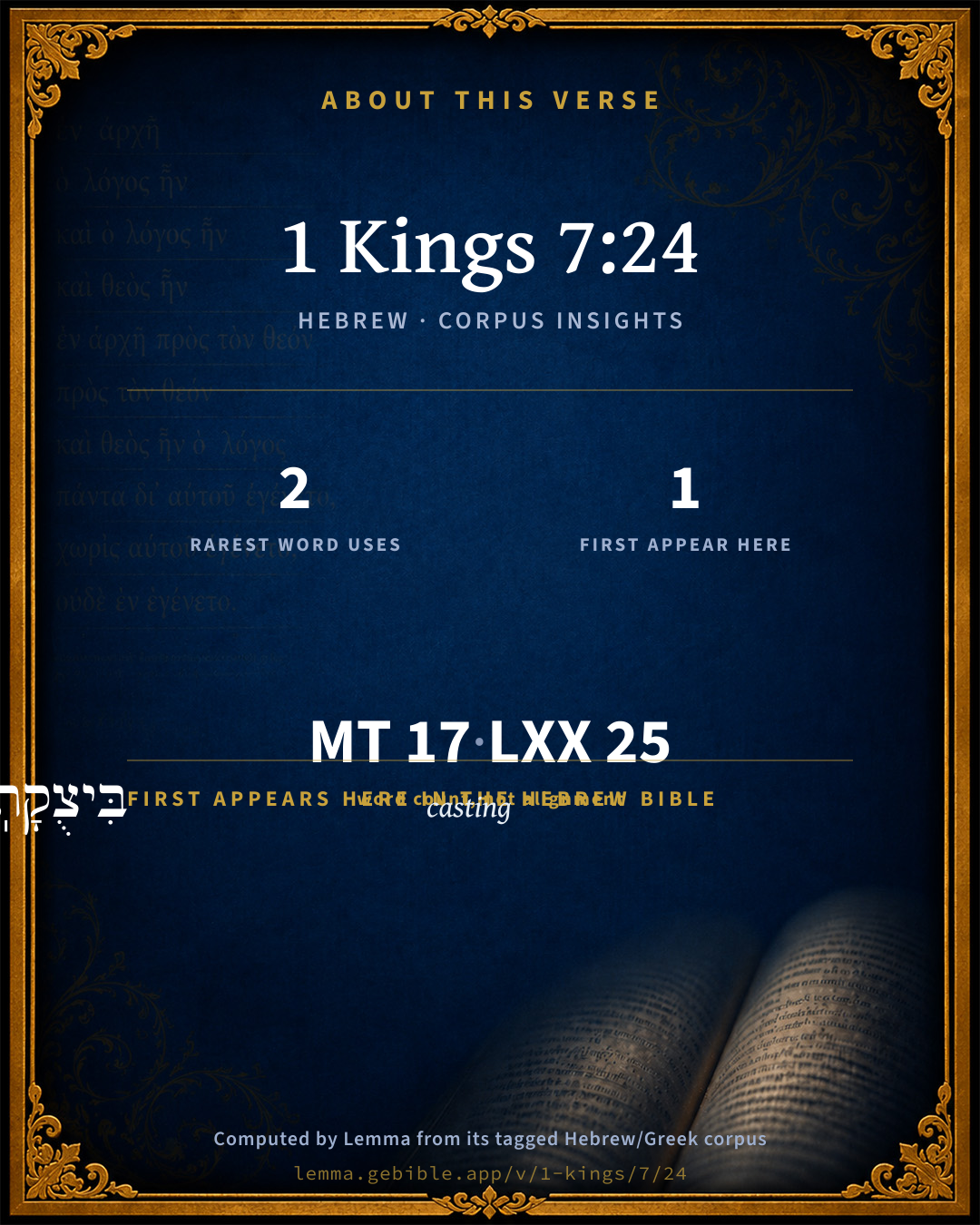
The rarest word here is בִּיצֻקָתֽוֹ casting H3333 — appearing just 2 times in the whole Hebrew Bible.

First appearance in Scripture

This word makes its first canonical appearance in the Hebrew Bible here:

  • בִּיצֻקָתֽוֹ casting H3333

Shared distinctive vocabulary

בִּיצֻקָתֽוֹ casting H3333 occurs in 2 verses of the Hebrew Bible. Also found in:

Grammatical profile

  • 3 verbs
  • 9 nouns
  • 2 adjectives
  • 1 preposition
  • 2 particles

Verb forms

  • סֹבְבִ֣ים Qal · Participle Active
  • מַקִּפִ֥ים Hiphil · Participle Active
  • יְצֻקִ֖ים Qal · Participle Passive

Repetition

Words recur within this verse — often emphatic in Hebrew:

  • וּפְקָעִים֩ knob H6497 ×2
  • סָבִיב֙ round about H5439 ×2

Hebrew & Septuagint length

In English translation the verse runs 33 words from the Hebrew and 12 from the Septuagint (LXX English) — the Septuagint runs noticeably shorter here. See the side-by-side →

A rough comparison of the two English renderings, which tokenize alike — not a word-level alignment.

Word counts can differ between the Hebrew and the Greek without any difference in meaning — e.g. the Hebrew direct-object marker אֵת has no separate Greek word, and Greek often adds the article ὁ.

In the original languages it is 17 Hebrew tokens and 25 Greek tokens — but the two are counted differently (Hebrew bundles its prefixes and suffixes into one token; the Greek is in lemma form), so that isn’t a like-for-like length.

Cross-references

4

Topical passages linked to 1 Kings 7:24 in the Treasury of Scripture Knowledge — connected by theme and wording, ordered by reader-vote popularity; previews shown in the World English Bible.

  • 1 Kings 6:18 There was cedar on the house within, carved with buds and open flowers: all was cedar; there was no stone seen.
  • 2 Chronicles 4:3 Under it was the likeness of oxen, which did compass it round about, for ten cubits, compassing the sea round about. The oxen were in two rows, cast when it was cast.
  • Exodus 25:31–36 "You shall make a lampstand of pure gold. Of hammered work shall the lampstand be made, even its base, its shaft, its cups, its buds, and its flowers, shall be of one piece with it.
  • Exodus 37:17–22 He made the lampstand of pure gold. He made the lampstand of beaten work. Its base, its shaft, its cups, its buds, and its flowers were of one piece with it.

Cross-references courtesy of OpenBible.info (CC BY 4.0).

Hebrew and Greek witnesses Masoretic Hebrew ↔ Greek Septuagint

The same verse in the two great witnesses to the Old Testament, shown verse-for-verse.

Here the Septuagint runs noticeably shorter than the Hebrew — LXX2012 (modern English Septuagint) 12 words vs World English Bible 33. A rough length comparison of the two English translations, not a word-level alignment — read both below.

These are two independent witnesses, not word-aligned to each other, and the Septuagint is shown in lemma (dictionary) form.

Hebrew 1 Kings 7:24 Masoretic · Westminster Leningrad Codex

וּפְקָעִים֩ מִתַּ֨חַת לִשְׂפָת֤וֹ סָבִיב֙ סֹבְבִ֣ים אֹת֔וֹ עֶ֚שֶׂר בָּֽאַמָּ֔ה מַקִּפִ֥ים אֶת הַיָּ֖ם סָבִ֑יב שְׁנֵ֤י טוּרִים֙ הַפְּקָעִ֔ים יְצֻקִ֖ים בִּיצֻקָתֽוֹ

Under the brim of it round about there were buds which did compass it, for ten cubits, compassing the sea round about: the buds were in two rows, cast when it was cast.

World English Bible · Public Domain

Greek LXX 1 Kings 7:24 Septuagint · lemma form

καί ποιέω δέκα χυτροκαύλος χαλκοῦς τεσσαράκοντα χοεύς χωρέω ὁ χυτρόκαυλος ὁ εἷς μέτρησις ὁ χυτρόκαυλος ὁ εἷς ἐπί ὁ μεχωνωθ ὁ εἷς ὁ δέκα μεχωνωθ

And stays underneath its rim round about compassed it ten cubits round;

LXX2012 (modern English Septuagint) · Public Domain

Hebrew: Westminster Leningrad Codex (CC BY 4.0). Greek: Septuagint (public domain); English from LXX2012 (modern English Septuagint) (Public Domain). How the Septuagint differs from the Hebrew →

Targum (Aramaic paraphrase)

1

The Targum is the ancient Jewish Aramaic paraphrase of the Hebrew Scriptures — an interpretive translation, not the Hebrew text itself. Onkelos (literal) and Pseudo-Jonathan (expansive) render the Torah, and Jonathan the Prophets. Coverage is partial: where no permissively-licensed English translation exists for a verse, only the Aramaic is shown. This is verse-level text, not a word-by-word alignment to the Hebrew.

  1. Targum Jonathan Prophets (Joshua–Malachi)
    וְצוּרַת בֵּיעִין מִלְרַע לְסִפְתֵּיהּ סְחוֹר סְחוֹר מַקְפִין לֵיהּ עֲסַר אַמִין מַקְפִין יַת יַמָא סְחוֹר סְחוֹר תְּרֵין סִדְרִין דְצוּרַת בֵּיעִין מַתְּכִין בְּאַתָּכוּתֵיהּ:

    (no public-domain English translation for this verse)

    Targum Jonathan — Aramaic: “Mikraot Gedolot” (public domain). English: “Sefaria Community Translation” (CC0 1.0 (public-domain dedication)); “London "Chaldee Paraphrase," 1871” (public domain). Text via Sefaria.

Commentary

Notes on 1 Kings 7:24 from classic Christian and Jewish commentators (each source and its license shown beneath its notes). The classic Christian expositions comment on the surrounding passage and are grouped to its opening verse, so a note may address several verses; the Jewish commentaries on the Tanakh (Rashi and others) are per-verse, so they appear only where the commentator wrote on this verse.

Lemma curates 59 commentaries, every one of them public domain or Creative Commons licensed, each selected and text-cleaned for this edition rather than reprinted as found. About our sources →

Trapp's Complete Commentary

John Trapp

1Ki 7:24 And under the brim of it round about [there were] knops compassing it, ten in a cubit, compassing the sea round about: the knops [were] cast in two rows, when it was cast.

Ver. 24. Ten in a cubit.] Three hundred knops under the lily work, on the brim of the sea. {2Ch 4:3}

John Trapp, A Commentary or Exposition upon All the Books of the Old and New Testament (1647–1656) — public domain. Text from a community e-Sword module.

Joseph Benson's Commentary

1Ki 7:24. There were knops compassing it — Molten figures: for the word

פקעים, pekagnim, signifies pictures or figures of all sorts, as gourds, flowers, beasts, &c. — Ten in a cubit — So there were three hundred of these knops in all, the sea being thirty cubits round. The knops were cast in two rows when it was cast — They were not carved afterward, but cast at first when the sea was molten. And, there being two rows of them, Abarbinel thence concludes there were six hundred in all, one under another.

Joseph Benson's Commentary on the Old and New Testaments (1811–1818) — public domain. Text from a community e-Sword module.

The Cambridge Bible for Schools and Colleges

gen. ed. J. J. S. Perowne

24. knops] The word is that which occurs in 1Ki_6:18, and the knops were probably of a gourd-shape. See note there. The description in 2 Chronicles (1Ki_4:3) says that oxen and not knops were the ornaments.

ten in a cubit] This would make the number of knops to be 300. But the R.V. renders for ten cubits. And so the words are rendered in 1Ki_6:26. But the A. V. must give the true sense. Otherwise why is it said that the sea was encompassed by these knops?

when it was cast] i.e. They were of the same piece with the whole rim, and not attached afterwards like some of the ornaments of the pillars.

The Cambridge Bible for Schools and Colleges (gen. ed. J. J. S. Perowne; Cambridge University Press, 1878–1918) — public domain. Text from a community e-Sword module.

John Gill's Exposition

It stood upon twelve oxen,.... Figures of them in brass, of full proportion:

three looking toward the north, and three looking toward the west, and three looking toward the south, and three looking toward the east; and so turned to the four quarters of the world:

and the sea was set above upon them; as it were on the backs of them, and their mouths served as spouts or cocks, to let water out of it on all sides:

and all their hinder parts were inward; that they might not be seen, and which met in a centre; they that were north came against those that were south, and they in the east met with those to the west. The brass of the sea, according to Jacob Leon (r), weighed 1,800 arobas, and, with twelve oxen under, 33,500; each aroba being twenty five pounds weight.

(r) Relation of Memorable Things in the Temple, ch. 4. p. 21.

John Gill's Exposition of the Whole Bible (1746–1763) — public domain (CC PDM 1.0). Text via the HelloAO Bible API.

Albert Barnes' Notes on the Bible

Knops - literally, “gourds,” - i. e. a boss or ball ornament encircled the rim of the bowl in two rows.

Albert Barnes' Notes on the Bible (1834–1885) — public domain. Text from a community e-Sword/MySword module.

Haydock's Catholic Bible Commentary

Ten cubits. All was not therefore ornamented. Protestants, "there were knops compassing it, ten in a cubit....the knops were cast in two rows, when it was cast." (Haydock) --- The signification of Pekehim is not ascertained, whether it be "apples, balls," &c., or perhaps a corrupt word for Bokrim, "oxen," or "ox heads;" as 2 Paralipomenon (iv. 3,) clearly explains it. (Calmet) --- There also it is insinuated, that the carvings commenced only towards the bottom, where the circumference was reduced to 10 cubits. (Menochius)

George Leo Haydock (1774–1849), Haydock's Catholic Family Bible and Commentary, 1859 edition — public domain. Excludes Psalms (Douay-Rheims chapter numbering differs from Protestant) and Deuterocanonical books (Catholic canon only).

Matthew Poole's English Annotations

Knops; or, carved or molten figures; for learned Hebricians note, that this word signifies the figures or pictures of all sorts, as flowers, beasts, &c. This general word is particularly explained of oxen, 2Ch 4:3, unless there were so many figures, or sculptures of gourds, or other flowers; and in each of these a little ox’s head.

Ten in a cubit; so there were three hundred in all.

The knops were cast together with the sea, not carved.

In two rows: it seems doubtful whether the second row had ten in each cubit, and so there were three hundred more; or whether the ten were distributed into five in each row.

Matthew Poole's English Annotations on the Holy Bible (1683–1685) — public domain. Text from a community e-Sword/MySword module.

Whedon's Commentary on the Bible

Daniel D. Whedon

24. Knops… in two rows — Egg-shaped representations of the wild gourd or cucumber, as in 1Ki_6:18, compassing the laver in a double row at the upper part.

Daniel D. Whedon (gen. ed.), Commentary on the Old and New Testaments (1874–1909) — public domain. Text from a community e-Sword module.

The Pulpit Commentary

And under the brim of it round about The edge of the laver was curved outwards (ver. 26) there were knops see note on 1Ki_6:18. The text of 2Ch_4:3, ("the similitude of oxen), is obviously a clerical error for (Keil), hut whether twmd is an interpolation may well be doubted. Keil thinks it was introduced to explain the mention of oxen compassing Heb. surrounding, some word it, ten in a cubit It does not follow from this that each gourd or knop was "a little over two inches in diameter" (Keil), for they may not have been in close contact, and, moreover the cubit was probably 18 inches, compassing the sea round about: the mops were cast in two rows, when it was cast. Lit., two rows; the knops were cast in its casting. The "brass," of which the laver was composed, had been taken by David from the cities of Hadarezer (1Ch_18:8; 1Sa_8:8, 1Sa_8:10)

The Pulpit Commentary (1880–1919), ed. H.D.M. Spence-Jones & Joseph S. Exell — public domain. Text from a community e-Sword module.

John Wesley's Explanatory Notes

Knops - Carved or molten figures: for this word signifies figures or pictures of all sorts. Ten, &c. - So there were three hundred in all. Cast - Together with the sea; not carved. Two rows - It seems doubtful whether the second row had ten in each cubit, and so there were three hundred more; or, whether the ten were distributed into five in each row.

John Wesley, Explanatory Notes Upon the Whole Bible (1754–1765) — public domain. Text via the GEBible commentary corpus.

Rashi

Rabbi Shlomo Yitzchaki (Rashi)

Knobs. [Targum] Yonoson rendered וצורת ביעין [and the form of eggs].

Beneath its rim. [The knobs were located] in the lower three amohs which were square, for so did we learn in the Gemara in Maseches Eruvin, “The three lower ones were square and the two upper ones were round.” It is impossible for one to contain two thousand bas which equal one hundred and fifty ritual baths of purity of forty [bas], except in this manner as explained by our Rabbis in [Maseches] Eruvin. The upper ones were square and the lower ones round, it is impossible to say for it is written, that its rim was “circular all around.” He, therefore, says regarding these knobs, “for ten amohs compassing the sea round about,” because in the place that it was square, [a perimeter of] forty amohs has ten amohs on each side, but in the place that it is round it is impossible to say it has ten amohs [on each side] around.

The knobs were in two rows, cast together with it. Everything was poured together, [and] not that he attached the knobs to it after they had been poured, through nails or through soldering which is called soudure, in O.F.

Rashi on the Tanakh — English translations: “The Judaica Press complete Tanach with Rashi, translated by A. J. Rosenberg” (CC BY 4.0); “Pentateuch with Rashi's commentary by M. Rosenbaum and A.M. Silbermann, 1929-1934” (public domain); “The Metsudah Tanach series, Lakewood, N.J” (CC BY 4.0); and “The Book of Joshua, Metsudah Publications, 1997” (CC BY 4.0). Text via Sefaria.

Lesson kit

Teaching starters — assembled from the data on this page, not authored interpretation. Every prompt links to the verse data it draws on. Edit before teaching.

1 Kings, in the Historical, opens this verse with 17 words (14 distinct Hebrew lemmas). Its most distinctive word is yᵉtsuqâh (“casting”). The Greek Septuagint runs shorter here. A historical commentator’s framing appears above. Read the whole chapter for the surrounding context.

Discussion questions

  1. How does “casting” (yᵉtsuqâh) shape what this verse is saying?
  2. The word “casting” first appears here in Scripture. What is being introduced at this debut?
  3. 1 Kings 7:30 shares the word «casting» with this verse. How do the two illuminate each other?
  4. “knob” occurs 2× in this one verse. What is the effect of the repetition?
  5. Compared with the Hebrew, the Septuagint runs shorter here. What questions does that raise?
  6. The translations on this page render this verse differently — a whole-verse word diff, not a word-by-word alignment. What might account for the different wordings?
  7. The verb «סֹבְבִ֣ים» is Qal Participle Active. How does its form color the action?
  8. Reading how Trapp's Complete Commentary and Joseph Benson's Commentary read this verse, where do the two commentators agree and where do they part?

Things to notice

Reading settings

Reading text

Shown beneath each verse's original-language words.

Old Testament
Old Testament edition

Read the OT as the Masoretic Hebrew (MT) or the Greek Septuagint (LXX).

English shown for the Greek Septuagint (in the Hebrew ↔ Greek comparison).

Comparing translations? Open the Compare panel on any verse page to stack up to four side by side.