
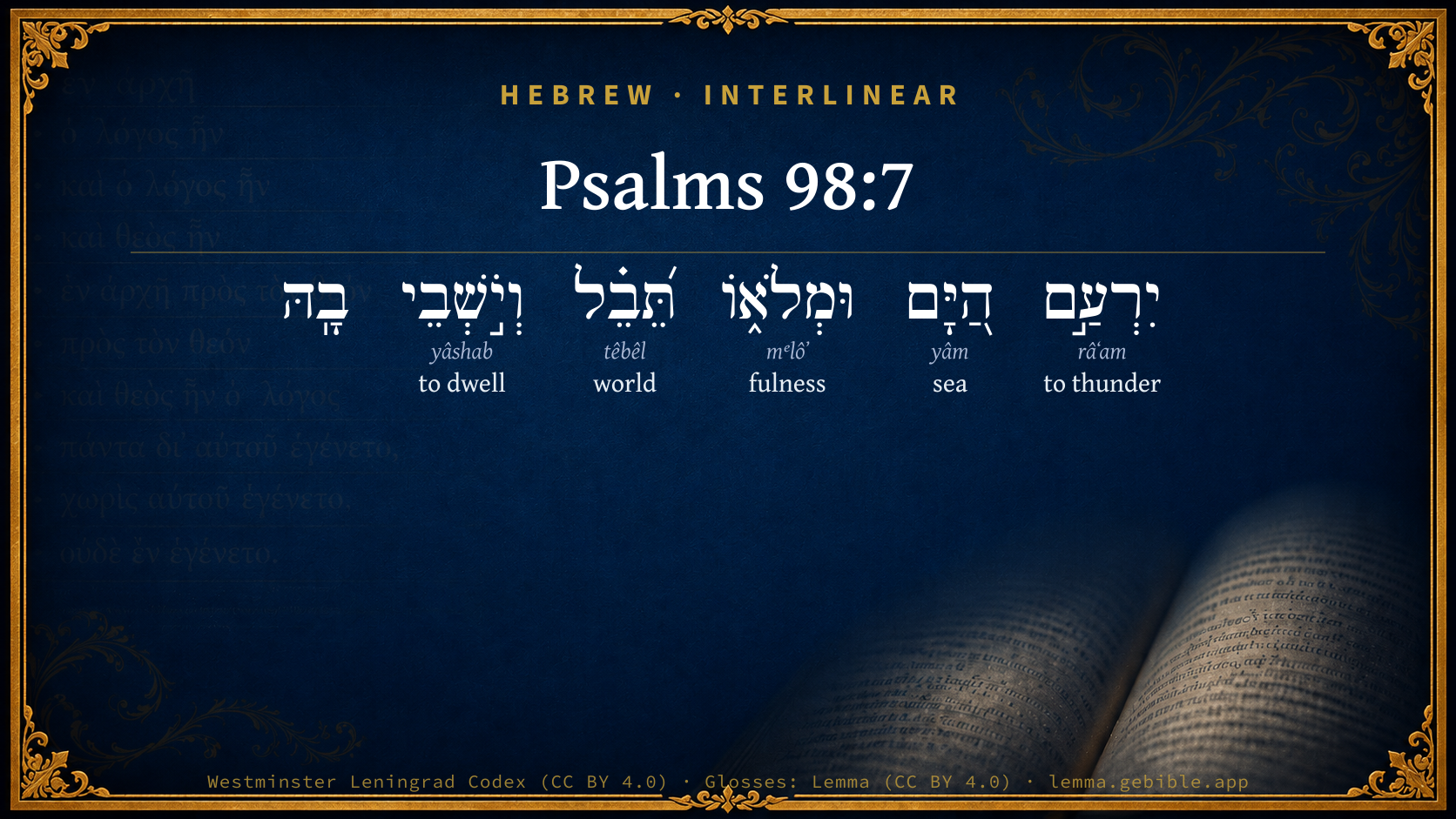
Psalms 98:7

Hebrew (Westminster Leningrad Codex) Psalms 98:7 appears in the Hebrew Old Testament. The text above is from the Westminster Leningrad Codex. Each word links to its Strong’s number, a concise gloss, and parsing drawn from the Open Scriptures Hebrew Bible morphology. Click any word for its full Brown-Driver-Briggs (BDB) entry.
Download image
Cite this verse

Psalms 98:7 (World English Bible). Public Domain. Lemma interlinear Bible study tool, https://lemma.gebible.app/v/psalms/98/7.

Show BibTeX & RIS
BibTeX
RIS
English Translation
Let the sea roar with its fullness; The world, and those who dwell therein.
World English Bible · Public Domain
Download a study sheet

One document with this verse’s original text, its word-by-word gloss line, the meaning frame, cross-references with their text, attributed commentary, and full source and license credits — printable, and it pastes into notes with its structure intact.

This verse Autodidact and up

Study sheet (.html) Plain text (.txt)

A passage Seminary Student

Up to 50 verses in one chapter. A passage sheet keeps up to 6 commentary sources and 12 cross-references per verse, in the order this page ranks them, and says so on the sheet whenever that leaves anything out. Ask for a single verse and you get the Autodidact verse sheet above.

Everything on this page stays free to read, with no account — the sheet is a download of what is already on screen, not access to it.

Want to remove ads? Support Godless Engineer
Compare translations 3

The same verse in 3 English versions, stacked beneath the original-language interlinear above. Click any original word for its lexicon entry.

Each is an independent rendering of the whole verse — the interlinear is not word-aligned to these translations.

Highlighted words mark where these versions differ — a whole-verse word diff, not a word-by-word alignment.

  • World English Bible Public Domain
    Let the sea roar with its fullness; The world, and those who dwell therein.
  • King James Version Public Domain
    Let the sea roar, and the fulness thereof; the world, and they that dwell therein.
  • unfoldingWord Literal Text CC BY-SA 4.0
    Let the sea roar and its fulness, the world and the dwellers in it!

unfoldingWord Literal Text — © unfoldingWord, licensed CC BY-SA 4.0. Word-aligned USFM3 via Door43 (git.door43.org/unfoldingWord/en_ult).

Versions to compare (up to 4)

3 of 4 selected

Show all 18 translations

Every available English version of this verse, each an independent rendering of the whole verse.

  • World English Bible Public Domain
    Let the sea roar with its fullness; The world, and those who dwell therein.
  • Berean Standard Bible Public Domain
    Let the sea resound, and all that fills it, the world, and all who dwell in it.
  • Majority Standard Bible Public Domain
    Let the sea resound, and all that fills it, the world, and all who dwell in it.
  • King James Version Public Domain
    Let the sea roar, and the fulness thereof; the world, and they that dwell therein.
  • American Standard Version (1901) Public Domain
    Let the sea roar, and the fulness thereof; The world, and they that dwell therein;
  • Revised Version (1885) Public Domain
    Let the sea roar, and the fulness thereof; the world, and they that dwell therein;
  • Geneva Bible (1599) Public Domain
    Let the sea roare, and all that therein is, the world, and they that dwell therein.
  • Douay-Rheims (1899) Public Domain
    let the sea be moved and the fulness thereof: the world end they that dwell therein.
  • Young's Literal Translation Public Domain
    Roar doth the sea and its fulness, The world and the inhabitants in it.
  • Literal Standard Version CC BY-SA 4.0
    The sea and its fullness roar, || The world and the inhabitants in it.
  • Unlocked Literal Bible CC BY-SA 4.0
    Let the sea shout and everything in it, the world and those who live in it!
  • unfoldingWord Literal Text CC BY-SA 4.0
    Let the sea roar and its fulness, the world and the dwellers in it!
  • Darby Bible Public Domain
    Let the sea roar, and the fulness thereof; the world, and they that dwell therein;
  • World Messianic Bible Public Domain
    Let the sea roar with its fullness; the world, and those who dwell therein.
  • Webster's Bible Public Domain
    Let the sea roar, and the fullness of it, the world, and they that dwell therein.
  • Free Bible Version CC BY-SA 4.0
    Let the sea and everything in it shout with praise, together with the earth and everything living in it.
  • Bible in Basic English Public Domain
    Let the sea be thundering, with all its waters; the world, and all who are living in it;
  • JPS Tanakh (1917) Public Domain
    Let the sea roar, and the fulness thereof; the world, and they that dwell therein;

Literal Standard Version (2020), Covenant Press — licensed CC BY-SA 4.0. Text via the HelloAO Bible API (eBible.org). Unlocked Literal Bible (unfoldingWord) — licensed CC BY-SA 4.0. Text via the HelloAO Bible API (eBible.org). unfoldingWord Literal Text — © unfoldingWord, licensed CC BY-SA 4.0. Word-aligned USFM3 via Door43 (git.door43.org/unfoldingWord/en_ult). Free Bible Version, Dr. Jonathan Gallagher — licensed CC BY-SA 4.0. Text via the HelloAO Bible API (eBible.org).

Word by word

More ways to search: Search by grammar → Find every occurrence → Compare this word →

Practice this passage: Drill this verse → Learn its vocabulary →

About this verse

These counts appear in no published source. They are computed here, from the morphology-tagged text and Lemma’s own curated glosses. What Lemma adds →

6
words
5
distinct lemmas
Wisdom
section

Notable vocabulary

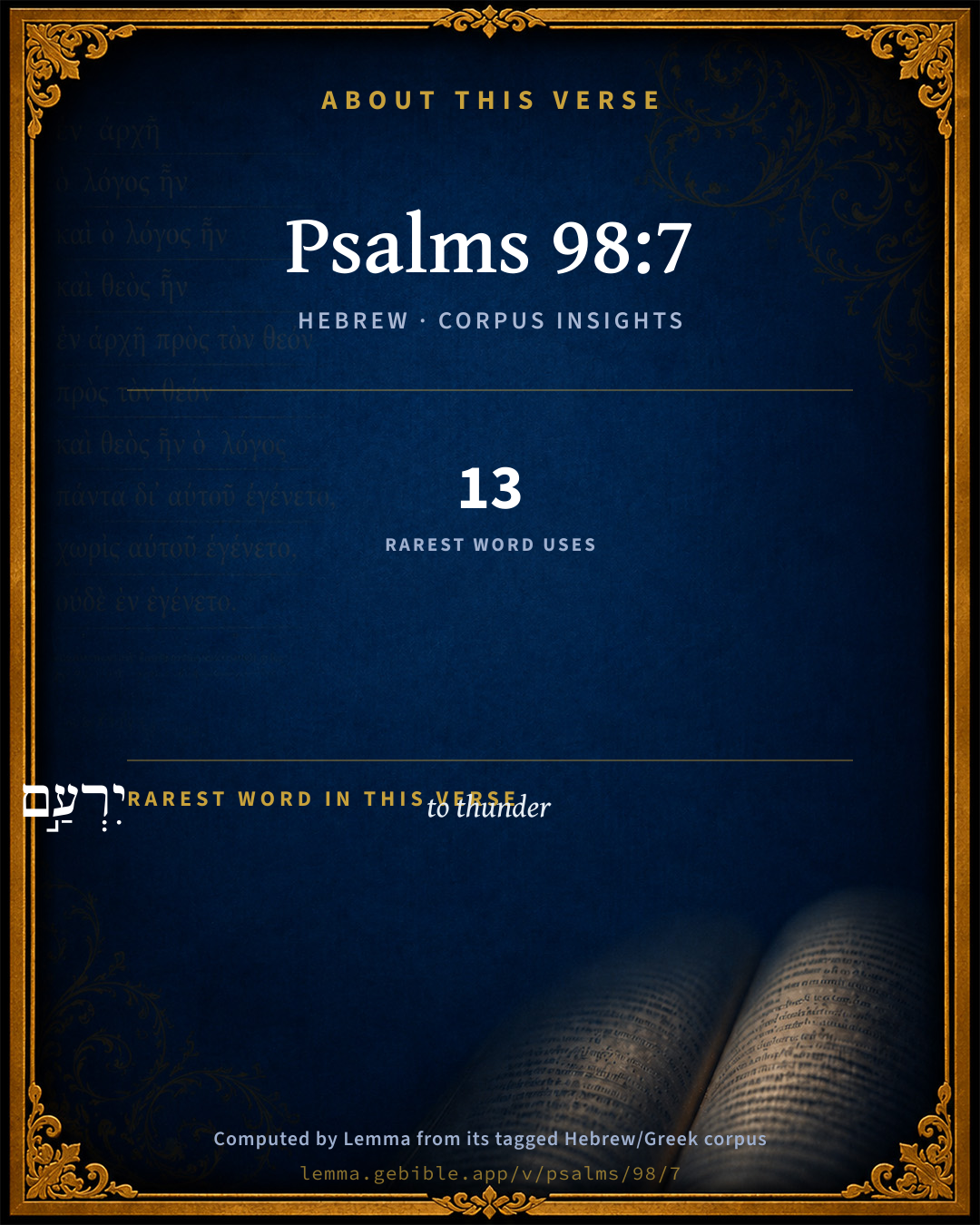
The rarest word here is יִרְעַ֣ם to thunder H7481 — appearing just 13 times in the whole Hebrew Bible.

Shared distinctive vocabulary

יִרְעַ֣ם to thunder H7481 occurs in 13 verses of the Hebrew Bible. Also found in:

Grammatical profile

  • 2 verbs
  • 3 nouns
  • 1 preposition

Verb forms

  • יִרְעַ֣ם Qal · Imperfect
  • וְיֹ֣שְׁבֵי Qal · Participle Active

Hebrew & Septuagint length

In English translation the verse runs 14 words from the Hebrew and 18 from the Septuagint (LXX English) — closely comparable.

A rough comparison of the two English renderings, which tokenize alike — not a word-level alignment.

Word counts can differ between the Hebrew and the Greek without any difference in meaning — e.g. the Hebrew direct-object marker אֵת has no separate Greek word, and Greek often adds the article ὁ.

Cross-references

4

Topical passages linked to Psalms 98:7 in the Treasury of Scripture Knowledge — connected by theme and wording, ordered by reader-vote popularity; previews shown in the World English Bible.

  • Isaiah 49:13 Sing, heavens; and be joyful, earth; and break forth into singing, mountains: for Yahweh has comforted his people, and will have compassion on his afflicted.
  • Psalms 24:1 The earth is Yahweh's, with its fullness; The world, and those who dwell therein.
  • Psalms 96:11–97:1 Let the heavens be glad, and let the earth rejoice. Let the sea roar, and it's fullness!
  • Isaiah 61:11 For as the earth brings forth its bud, and as the garden causes the things that are sown in it to spring forth; so the Lord Yahweh will cause righteousness and praise to spring forth before all the nations.

Cross-references courtesy of OpenBible.info (CC BY 4.0).

Hebrew and Greek witnesses Masoretic Hebrew ↔ Greek Septuagint

The same verse in the two great witnesses to the Old Testament, shown verse-for-verse.

You’re reading Greek Psalm 97 (Hebrew Psalm 98). The Septuagint counts the superscription, so verse numbers can differ from the Hebrew — chapter-level alignment, not verse-by-verse. Numbering follows Rahlfs.

These are two independent witnesses, not word-aligned to each other, and the Septuagint is shown in lemma (dictionary) form.

Hebrew Psalms 98:7 Masoretic · Westminster Leningrad Codex

יִרְעַ֣ם הַ֭יָּם וּמְלֹא֑וֹ תֵּ֝בֵ֗ל וְיֹ֣שְׁבֵי בָֽהּ

Let the sea roar with its fullness; The world, and those who dwell therein.

World English Bible · Public Domain

Greek LXX Greek Psalm 97:7 Septuagint · lemma form

σαλεύω ὁ θάλασσα καί ὁ πλήρωμα αὐτός ὁ οἰκέω καί ὁ καταοἰκέω ἐν αὐτός

Let the sea be moved, and the fullness of it; the world, and they that dwell in it.

LXX2012 (modern English Septuagint) · Public Domain

Hebrew: Westminster Leningrad Codex (CC BY 4.0). Greek: Septuagint (public domain); English from LXX2012 (modern English Septuagint) (Public Domain). How the Septuagint differs from the Hebrew →

Commentary

Notes on Psalms 98:7 from classic Christian and Jewish commentators (each source and its license shown beneath its notes). The classic Christian expositions comment on the surrounding passage and are grouped to its opening verse, so a note may address several verses; the Jewish commentaries on the Tanakh (Rashi and others) are per-verse, so they appear only where the commentator wrote on this verse.

Lemma curates 59 commentaries, every one of them public domain or Creative Commons licensed, each selected and text-cleaned for this edition rather than reprinted as found. About our sources →

Trapp's Complete Commentary

John Trapp

Psa 98:7 Let the sea roar, and the fulness thereof; the world, and they that dwell therein.

Ver. 7. {See Trapp on "Psa 96:11"}

John Trapp, A Commentary or Exposition upon All the Books of the Old and New Testament (1647–1656) — public domain. Text from a community e-Sword module.

The Biblical Illustrator

Joseph S. Exell

Psa_98:7-9

Let the sea roar, and the fulness thereof; the world, and they that dwell therein.

Man and nature

When piety and poetry are married to each other, such a song as this is the offspring of their marriage. Alas! that the two should be so often divorced--that the pious man should so often look abroad upon the earth with unimaginative gaze, and that the poet should so often revel in the beauties of nature with a heart unmoved by any perception of the Divine glory. Here we have a man who is elevated into a state of joyful adoration by the Spirit of God, transferring his own emotion to the world around him, and, without any sense of incongruity, calling upon the inanimate creation to share his gladness and to join him in his worship. The truth is that a religious man becomes or remains unimaginative, not in virtue of, but in spite of, his religion. And so far is it from being an unreal or sentimental thing for a devout man to associate the inanimate creation with himself in praising the Creator, that, on the contrary, such association is natural to all simple, fervid godliness. For man--according to the Divine idea--is the prophet, priest, and king of nature.

I. Man is natures king. The psalmist speaks as if he were the leader of natures orchestra. And indeed, insignificant as man may seem in presence of those forces by which he is surrounded, yet here he stands in the midst of the world, by the grace of God, its king. The earth was made for man, not man for the earth. If the Great King were governing nature capriciously, without any fixed or discoverable order, man would be the slave of nature, instead of her lord. He would be at the mercy of her ever-varying moods,--liable to have his plans nullified by the unexpected outbreaks of her power, and to be himself dragged as a captive at the wheels of her mighty chariot. But, as it is, every fresh discovery which man makes in the realm of science is a new gem in that royal crown which bespeaks his lordship over the world. All fuller knowledge of natures facts is virtually, for him, a more extended mastery over natures forces. And so he harnesses these forces to the chariot of human progress, and makes them do his bidding.

II. Man is natures priest. The whole inanimate creation, reflecting the glory of God, and radiant with the beauty which He has impressed upon it, seems to the mind of the psalmist to be praising its Creator. Or rather, looking abroad upon the world with the eye of a priest who is laying upon the Divine altar the sacrifice of grateful adoration, he takes it upon himself to interpret and present the inarticulate offering of nature. The most beautiful melody may be played upon the harp or the organ; you may call it a sacred melody if you please; and the sounds which are drawn forth from the instrument may, in their very nature, be such as would furnish a most fitting vehicle of worship; yet, in these sounds there is no actual praising of God, if there be no praise in the heart of player or listener. But, on the other hand, even if the player be himself an ungodly man, let there only be some one by who can interpret these sounds and who makes them his own through sympathy with their spiritual significance, having his heart attuned to the feeling which they are fitted to express,--and now the melody is no longer soulless; it becomes a living thing; the very sounds themselves rise up before God as acceptable worship. In like manner, throughout the whole region of the material world, considered merely in itself, there is no actual praise of God; for there is no spirit conscious of His presence, thankful for His goodness, exulting in His smile. The trees of the wood are beautiful as their green leaves glance in the sunbeams and rustle in the summer breeze; and the song of the birds amongst the branches harmonizes with the idea of thankful worship; but there is no thankfulness--no worship--there, until man comes, with a devout, joyful heart, consecrating the grove into a temple and making the birds his choristers. Influenced by the beauty and music of the world, be in turn fills all that beauty and music with a soul. To his eye the sun is as a bridegroom coming out of his chamber, and rejoicing as a strong man to run a race. To his ear the heavens declare the glory of God. And, having an ear for the voiceless language of nature, when she speaks to him of God, he in turn becomes, as it were, the voice of nature, enabling her to speak to God. And who can doubt that, through the exercise of this royal priesthood, the whole world becomes more beautiful in the sight of the Creator Himself? The smile upon the face of earth, as it brightens beneath the sunshine, becomes a living smile. And nature is thus made to praise God, just as the harp or the organ praises Him, when the listener has not only an appreciative ear, but also a worshipping soul.

III. Man is natures prophet. The psalmist feels sure that the righteous and merciful God will not allow sin to disfigure and curse His world for ever, that He will manifest Himself as the rectifier of the earths evil, the healer of the earths sorrow, the enlightener of the earths darkness. And there is no wonder that, in his glad hopefulness, he should call upon the inanimate creation to rejoice, as it were, with him, in prospect of that coming day which he himself delights in anticipating. For the prophetic vision of the worlds regeneration implies and includes the vision of natures redemption. Surely it is but natural that we should thus identify ourselves with the world in which we dwell, so as to associate its future, in our thoughts and hopes, with the future of its inhabitants. We know how much more heavenly this earth seems to us when we ourselves are in a heavenly frame of mind; and we can conceive in what a celestial light it would be apparelled were it only the abode of an unsinning race. We observe, moreover, how, as mankind advances in intelligence and goodness, the face of the earth undergoes a corresponding change, so that, even literally, the wilderness is often made to rejoice and blossom as the rose. And therefore, cherishing, as man ought to do, a faith in the ultimate perfection of the race, it is only right that, as the prophet of nature, he should also speak with glad hopefulness concerning the future which is in store for the material creation. We may well rejoice in the thought that this earth, linked to our memories by so many associations, is to share the destinies of our redeemed humanity. And, looking forward with prophetic eye to the time when this world shall be the perfect dwelling-place of a perfected race, we may, with poetic fitness, call upon the inanimate creation to share our gladness. (T. C. Finlayson.)

.

Psa_99:1-9

The Biblical Illustrator, edited by Joseph S. Exell (c. 1880s–1900s) — public domain. Text from a community e-Sword module.

Whedon's Commentary on the Bible

Daniel D. Whedon

7. Let the sea roar—Inanimate nature (Psa_98:7-8), is called to unite with the Gentile nations and the covenant people in the highest strains of joy, at this coming of Jehovah to judge the earth. For a still higher realization of this “new song” of the universe, see Rev_5:9-14. In both instances the occasion is the same: Jehovah’s righteous judgment of the world, or, in the New Testament, Christ’s victory over the nations.

Daniel D. Whedon (gen. ed.), Commentary on the Old and New Testaments (1874–1909) — public domain. Text from a community e-Sword module.

Keil & Delitzsch

C. F. Keil & F. Delitzsch

Here, too, it is all an echo of the earlier language of Psalms and prophets: Psa 98:7 = Psa 96:11; Psa 98:7 like Psa 24:1; Psa 98:8 after Isa 55:12 (where we find מחא כּף instead of the otherwise customary תּקע כּף, Psa 47:2; or הכּה כּף, Kg2 11:12, is said of the trees of the field); Psa 98:9 - Psa 96:13, cf. Psa 36:10. In the bringing in of nature to participate in the joy of mankind, the clapping rivers (נהרות) are original to this Psalm: the rivers cast up high waves, which flow into one another like clapping hands;

(Note: Luther renders: "the water-floods exult" (frohlocken); and Eychman's Vocabularius predicantium explains plaudere by "to exult (frohlocken) for joy, to smite the hands together prae gaudio;" cf. Luther's version of Eze 21:17.)

cf. Hab 3:10, where the abyss of the sea lifts up its hands on high, i.e., causes its waves to run mountain-high.

Keil & Delitzsch — Biblical Commentary on the Old Testament (1861–1891) — public domain (CC PDM 1.0). Text via the HelloAO Bible API. (Old Testament only.)

J. A. Alexander on Psalms

Joseph Addison Alexander

7. (Psa 98:7) Let the sea thunder and what fills it—the land and those dwelling on it. The last stanza represents the praise as universal. For the meaning of the first clause see above, on Psa 96:11; for that of the second, on Psa 24:1. The word there translated world is here used in opposition to sea, and therefore rendered land. See above, on Psa 90:2.

Joseph Addison Alexander, The Psalms Translated and Explained (1850) — public domain. Text from a community e-Sword module.

Tyndale Open Study Notes

Tyndale Open Resources

98:7-9 The created order is personified as rejoicing at the coming of the righteous Judge (see 93:3-4; 96:11-13).

Tyndale Open Study Notes — © Tyndale Open Resources, licensed CC BY-SA 4.0. Text via the HelloAO Bible API.

Adam Clarke's Commentary

Verse 7. Let the sea roar] These are either fine poetic images; or, if we take them as referring to the promulgation of the Gospel, by the sea all maritime countries and commercial nations may be intended.

Adam Clarke's Commentary on the Bible (1810–1826) — public domain. Text from a community e-Sword/MySword module.

Ellicott's Commentary for English Readers

(7) See Psa_96:11.

“Listen! the mighty Being is awake

And doth with His eternal motion make

A sound like thunder everlastingly.”

WORDSWORTH.

A Bible Commentary for English Readers, edited by Charles John Ellicott (1878–1897) — public domain. Text from a community e-Sword module.

The Cambridge Bible for Schools and Colleges

gen. ed. J. J. S. Perowne

7. Let the sea thunder, as Psa_96:11 b.

the world &c.] From Psa_24:1.

7–9. Let universal Nature swell the chorus of rejoicing.

The Cambridge Bible for Schools and Colleges (gen. ed. J. J. S. Perowne; Cambridge University Press, 1878–1918) — public domain. Text from a community e-Sword module.

John Gill's Exposition

Let the sea roar, and the fulness thereof,.... See Gill on Psa 96:11,

the world, and they that dwell therein; men, the inhabitants of the world; that is, let them rejoice because this glorious King has taken to himself his great power, and reigns, Rev 11:15.

John Gill's Exposition of the Whole Bible (1746–1763) — public domain (CC PDM 1.0). Text via the HelloAO Bible API.

Albert Barnes' Notes on the Bible

Let the sea roar, and the fulness thereof - See the notes at Psa 96:11.

The world, and they that dwell therein - The habitable world - the land - in contradistinction from the sea. Let there be universal praise on the water and the land.

Albert Barnes' Notes on the Bible (1834–1885) — public domain. Text from a community e-Sword/MySword module.

Matthew Poole's English Annotations

The fulness thereof; all those creatures wherewith it is replenished, which by a poetical strain are invited to praise God. See Poole "Psa 96:11", See Poole "Psa 96:12", See Poole "Psa 96:13".

Matthew Poole's English Annotations on the Holy Bible (1683–1685) — public domain. Text from a community e-Sword/MySword module.

The Treasury of David

Charles H. Spurgeon

Ver. 7. Let the sea roar, and the fulness thereof. Even its thunders will not be too grand for such a theme. Handel, in some of his sublime choruses, would have been glad of its aid to express his lofty conceptions, and assuredly the inspired psalmist did well to call in such infinite uproar. The sea is his, let it praise its Maker. Within and upon its bosom it bears a wealth of goodness, why should it be denied a place in the orchestra of nature? Its deep bass will excellently suit the mystery of the divine glory.

The world, and they that dwell therein. The land should be in harmony with the ocean. Its mountains and plains, cities and villages, should prolong the voice of jubilee which welcomes the Lord of all. Nothing can be more sublime than this verse; the muses of Parnassus cannot rival the muse of Zion, the Castallan fount never sparkled like that "fount of every blessing" to which sacred bands are wont to ascribe their inspiration. Yet no song is equal to the majesty of the theme when Jehovah, the King, is to be extolled.

Ver. 7-8. Let the sea roar, and the fulness thereof; the world, and they that dwell therein. Let the floods clap their hands.

And thou, majestic main!

A secret world of wonders in thyself,

Sound his stupendous praise, whose greater voice

Or bids you roar, or bids your roarings fall. James Thomson.

Ver. 7-8. These appeals to nature in her great departmentsof the sea in its mighty amplitude, and the earth with its floods and hillsform, not a warrant, but a call on Christian ministers to recognise God more in their prayers and sermons as the God of Creation, instead of restricting themselves so exclusively to the peculiar doctrines of Christianity. Do the one, and not leave the other undone. Thomas Chalmers.

Ver. 7-8. The setting forth the praise of Christ for the redemption of sinners, may not only furnish work to all reasonable creatures; but also if every drop of water in the sea, and in every river and flood, every fish in the sea, every fowl of the air, every living creature on the earth, and whatsoever else is in the world: if they all had reason and ability to express themselves; yea, and if all the hills were able by motion and gesticulation to communicate their joy one to another; there is work for them all to set out the praise of Christ. David Dickson.

Ver. 7-9. Matthew Henry on these verses quotes from Virgil's 4th Eclogue the verses (of which we subjoin Dryden's translation) in which the poet, he says, "either ignorantly or basely applies to Asinius Pollio the ancient prophecies which at that time were expected to be fulfilled; "adding that Ludovicus Vives thinks that these and many other things which Virgil says of this long looked for child "are applicable to Christ."

O of celestial seed! O foster son of Jove!

See, lab'ring Nature calls thee to sustain

The nodding frame of heaven, and earth, and main!

See to their base restored, earth, seas, and air;

And joyful ages, from behind, in crowding ranks appear.

Ver. 7-8. Nature at worship. The congregation is

1. Vast. Sea, earth, rivers, hills.

2. Varied. Diverse in character, word, aspect, each from each other, constant and alike in this alone, that all, always worship God.

3. Happy. In this like the worshippers in heaven, and for the same reasonsin is absent. E.G.G.

Psalms 98:8*

Charles H. Spurgeon's The Treasury of David (1869–1885) — public domain. Psalms only. Text from a community e-Sword/MySword module.

The Pulpit Commentary

Let the sea roar, and the fulness thereof (see above, Psa_96:11, where the same phrase occurs). The call on the inanimate things of nature to rejoice is grounded on man"s sympathy with nature, which makes him desire, and half believe, that nature may sympathize with him. The world, and they that dwell therein. (comp. Psa_24:1)

Vers. 7-9. Man"s relation to the natural world.

In a beautiful sermon on these verses by the late Revelation T.C. Finlayson, M.A., to which this homily is greatly indebted, he remarks, that when piety and poetry are married to each other, such a song as this is the offspring of their marriage; he notes also the unhappy rarity of this union. Where piety is, there, all too often, imagination is conspicuous by its absence, and such absence is regarded with much complacency, and as a thing desirable rather than otherwise. On the other hand, where the gift of a rich imagination has been bestowed, how sadly often it is divorced from all piety! But in this psalm, as in so many others, the two have been united, and the outcome is such an inspired burst of poetry as we have in these verses. In this exalted spiritual condition the soul sees its true relation to the natural world. The soul regards the world of nature

I AS ITS SERVANT. There is a tone of lordship and mastery in these verses. The sea, the earth, the floods, and the hills are bidden to take their parts in the great anthem of praise. The psalmist seems to be issuing his orders to them, and they are as servants ready to obey. It is here as in Psalm 8. All things are put beneath him, he is lord of all. Man has been placed on the earth, not merely to occupy, but to subdue and to rule over it. As generation after generation passes away, this rulership becomes ever more complete. By patient study of the laws of the great Overlord of all, man, the underlord, has learnt to bind the forces of nature, and to make them execute his will. They are his servants under him, and he says to this one, "Come," and it cometh, and to another, "Go," and it goeth. And so here he utters his command, "Let the sea roar," etc.

II AS FELLOW WORSHIPPER. The scenes, the sounds, the movements of nature are to the soul of the psalmist not merely scenes and sounds and movements, but show that, like himself, nature is a worshipper "before the Lord" Not that nature, the dead material world, can of itself render worship; only the soul can do that. And only a soul itself filled with the spirit of worship, can see and hear in the natural world what appears to be worship, joy, and praise. We speak of sacred music, but no sound of choir, or organ, or instrument of any kind can utter sacred music unless it express sacred thought in some soul. But let the soul be filled with such high, holy thought and emotion, and, lo! all nature becomes one vast choir, and its varied sounds one glorious anthem of praise.

III AS SHARER TOGETHER WITH HIMSELF IN THE VICTORIES OF GOD"S GRACE. The soul sees along with its own redemption, the redemption of nature. (Rom_8:19-21 Psa_67:6) The soul of the psalmist is looking on to the full victory of the Lord over all his foes, and the consequent redemption of man, and the earth likewise, under the Lord"s righteous rule; and so he calls on all the powers of nature to join with him in praise.

IV AS, LIKE HIMSELF, GLAD IN GOD. The undevout soul fails to see this, but the eye purged with the love of God in Christ beholds continually in all that is fair, beautiful, and good in the natural world and how much there is of this! the heart of nature praising God (see Keble"s hymn, "There is a book, who runs may read"). S.C.

The Pulpit Commentary (1880–1919), ed. H.D.M. Spence-Jones & Joseph S. Exell — public domain. Text from a community e-Sword module.

unfoldingWord translationNotes

Door43 World Missions Community

Let the sea shout and everything in it

The psalmist speaks as if the sea were a person who could shout to God. AT: "Let it be as if the sea and everything in it shout" (See: Personification)

the world and those who live in it

The psalmist speaks as if the world were a person. AT: "and let the world and those who live in it shout" (See: Ellipsis and Personification)

Let the rivers clap their hands, and let the mountains shout for joy

The psalmist speaks as if the rivers and mountains were people who could clap and shout. AT: "Let it be as though the rivers are clapping their hands and mountains were shouting for joy" (See: Personification)

the world ... the nations

These phrases are metonyms for "the people in the world" and "the people who live in the nations." (See: Metonymy)

the nations with fairness

The verb may be supplied from the previous phrase. AT: "he will judge the nations with fairness" (See: Ellipsis)

with fairness

"honestly" or "using the same standard for everyone"

translationWords

world

life

hand

Yahweh

judge

earth

righteous

nation

unfoldingWord translationNotes — © Distant Shores Media and the Door43 World Missions Community, licensed CC BY-SA 4.0. Source: git.door43.org/Door43/en_tn.

Lesson kit

Teaching starters — assembled from the data on this page, not authored interpretation. Every prompt links to the verse data it draws on. Edit before teaching.

Psalms, in the Wisdom, opens this verse with 6 words (5 distinct Hebrew lemmas). Its most distinctive word is râʻam (“to thunder”). A historical commentator’s framing appears above. Read the whole chapter for the surrounding context.

Discussion questions

  1. How does “to thunder” (râʻam) shape what this verse is saying?
  2. 1 Samuel 1:6 shares the word «to thunder» with this verse. How do the two illuminate each other?
  3. These translations render this verse differently. What is at stake in choosing one wording over another?
  4. The verb «יִרְעַ֣ם» is Qal Imperfect. How does its form color the action?
  5. Reading how Trapp's Complete Commentary and The Biblical Illustrator read this verse, where do the two commentators agree and where do they part?

Things to notice

Reading settings

Reading text

Shown beneath each verse's original-language words.

Old Testament
Old Testament edition

Read the OT as the Masoretic Hebrew (MT) or the Greek Septuagint (LXX).

English shown for the Greek Septuagint (in the Hebrew ↔ Greek comparison).

Comparing translations? Open the Compare panel on any verse page to stack up to four side by side.