Numbers 14:25

Hebrew (Westminster Leningrad Codex) Numbers 14:25 appears in the Hebrew Old Testament. The text above is from the Westminster Leningrad Codex. Each word links to its Strong’s number, a concise gloss, and parsing drawn from the Open Scriptures Hebrew Bible morphology. Click any word for its full Brown-Driver-Briggs (BDB) entry.
Download image
Cite this verse

Numbers 14:25 (World English Bible). Public Domain. Lemma interlinear Bible study tool, https://lemma.gebible.app/v/numbers/14/25.

Show BibTeX & RIS
BibTeX
RIS
English Translation
Now the Amalekite and the Canaanite dwell in the valley: tomorrow turn you, and get you into the wilderness by the way to the Red Sea.
World English Bible · Public Domain
Download a study sheet

One document with this verse’s original text, its word-by-word gloss line, the meaning frame, cross-references with their text, attributed commentary, and full source and license credits — printable, and it pastes into notes with its structure intact.

This verse Autodidact and up

Study sheet (.html) Plain text (.txt)

A passage Seminary Student

Up to 50 verses in one chapter. A passage sheet keeps up to 6 commentary sources and 12 cross-references per verse, in the order this page ranks them, and says so on the sheet whenever that leaves anything out. Ask for a single verse and you get the Autodidact verse sheet above.

Everything on this page stays free to read, with no account — the sheet is a download of what is already on screen, not access to it.

Want to remove ads? Support Godless Engineer
Compare translations 3

The same verse in 3 English versions, stacked beneath the original-language interlinear above. Click any original word for its lexicon entry.

Each is an independent rendering of the whole verse — the interlinear is not word-aligned to these translations.

Highlighted words mark where these versions differ — a whole-verse word diff, not a word-by-word alignment.

  • World English Bible Public Domain
    Now the Amalekite and the Canaanite dwell in the valley: tomorrow turn you, and get you into the wilderness by the way to the Red Sea.
  • King James Version Public Domain
    (Now the Amalekites and the Canaanites dwelt in the valley.) Tomorrow turn you, and get you into the wilderness by the way of the Red sea.
  • unfoldingWord Literal Text CC BY-SA 4.0
    And the Amalekite and the Canaanite are dwelling in the valley. Tomorrow turn and set out for you the wilderness, the way of the Sea of Reeds.”

unfoldingWord Literal Text — © unfoldingWord, licensed CC BY-SA 4.0. Word-aligned USFM3 via Door43 (git.door43.org/unfoldingWord/en_ult).

Versions to compare (up to 4)

3 of 4 selected

Show all 18 translations

Every available English version of this verse, each an independent rendering of the whole verse.

  • World English Bible Public Domain
    Now the Amalekite and the Canaanite dwell in the valley: tomorrow turn you, and get you into the wilderness by the way to the Red Sea.
  • Berean Standard Bible Public Domain
    Now since the Amalekites and Canaanites are living in the valleys, turn back tomorrow and head for the wilderness along the route to the Red Sea.”
  • Majority Standard Bible Public Domain
    Now since the Amalekites and Canaanites are living in the valleys, turn back tomorrow and head for the wilderness along the route to the Red Sea.”
  • King James Version Public Domain
    (Now the Amalekites and the Canaanites dwelt in the valley.) Tomorrow turn you, and get you into the wilderness by the way of the Red sea.
  • American Standard Version (1901) Public Domain
    Now the Amalekite and the Canaanite dwell in the valley: to-morrow turn ye, and get you into the wilderness by the way to the Red Sea.
  • Revised Version (1885) Public Domain
    Now the Amalekite and the Canaanite dwell in the valley: tomorrow turn ye, and get you into the wilderness by the way to the Red Sea.
  • Geneva Bible (1599) Public Domain
    Nowe the Amalekites and the Canaanites remaine in the valley: wherefore turne backe to morowe, and get you into the wildernesse, by the way of the red Sea.
  • Douay-Rheims (1899) Public Domain
    For the Amalecite and the Chanaanite dwell in the valleys. To morrow remove the camp, and return into the wilderness by the way of the Red Sea.
  • Young's Literal Translation Public Domain
    `And the Amalekite and the Canaanite are dwelling in the valley; to-morrow turn ye and journey for yourselves into the wilderness -- the way of the Red Sea.'
  • Literal Standard Version CC BY-SA 4.0
    And the Amalekite and the Canaanite are dwelling in the valley; tomorrow turn and journey for yourselves into the wilderness—the way of the Red Sea.”
  • Unlocked Literal Bible CC BY-SA 4.0
    (Now the Amalekites and Canaanites lived in the valley.) Tomorrow turn and go to the wilderness by the way of the Sea of Reeds.”
  • unfoldingWord Literal Text CC BY-SA 4.0
    And the Amalekite and the Canaanite are dwelling in the valley. Tomorrow turn and set out for you the wilderness, the way of the Sea of Reeds.”
  • Darby Bible Public Domain
    (Now the Amalekites and the Canaanites dwell in the valley.) To-morrow turn you, and take your journey into the wilderness, on the way to the Red sea.
  • World Messianic Bible Public Domain
    Since the Amalekite and the Canaanite dwell in the valley, tomorrow turn and go into the wilderness by the way to the Sea of Suf.”
  • Webster's Bible Public Domain
    (Now the Amalekites, and the Canaanites dwelt in the valley.) To-morrow turn you, and pass into the wilderness, by the way of the Red sea.
  • Free Bible Version CC BY-SA 4.0
    Since the Amalekites and Canaanites are living in the valleys, tomorrow you are to turn around and head back into the desert, taking the route towards the Red Sea.”
  • Bible in Basic English Public Domain
    Now the Amalekites and the Canaanites are in the valley; tomorrow, turning round, go into the waste land by the way to the Red Sea.
  • JPS Tanakh (1917) Public Domain
    Now the Amalekite and the Canaanite dwell in the Vale; tomorrow turn ye, and get you into the wilderness by the way to the Red Sea.'

Literal Standard Version (2020), Covenant Press — licensed CC BY-SA 4.0. Text via the HelloAO Bible API (eBible.org). Unlocked Literal Bible (unfoldingWord) — licensed CC BY-SA 4.0. Text via the HelloAO Bible API (eBible.org). unfoldingWord Literal Text — © unfoldingWord, licensed CC BY-SA 4.0. Word-aligned USFM3 via Door43 (git.door43.org/unfoldingWord/en_ult). Free Bible Version, Dr. Jonathan Gallagher — licensed CC BY-SA 4.0. Text via the HelloAO Bible API (eBible.org).

Word by word

More ways to search: Search by grammar → Find every occurrence → Compare this word →

Practice this passage: Drill this verse → Learn its vocabulary →

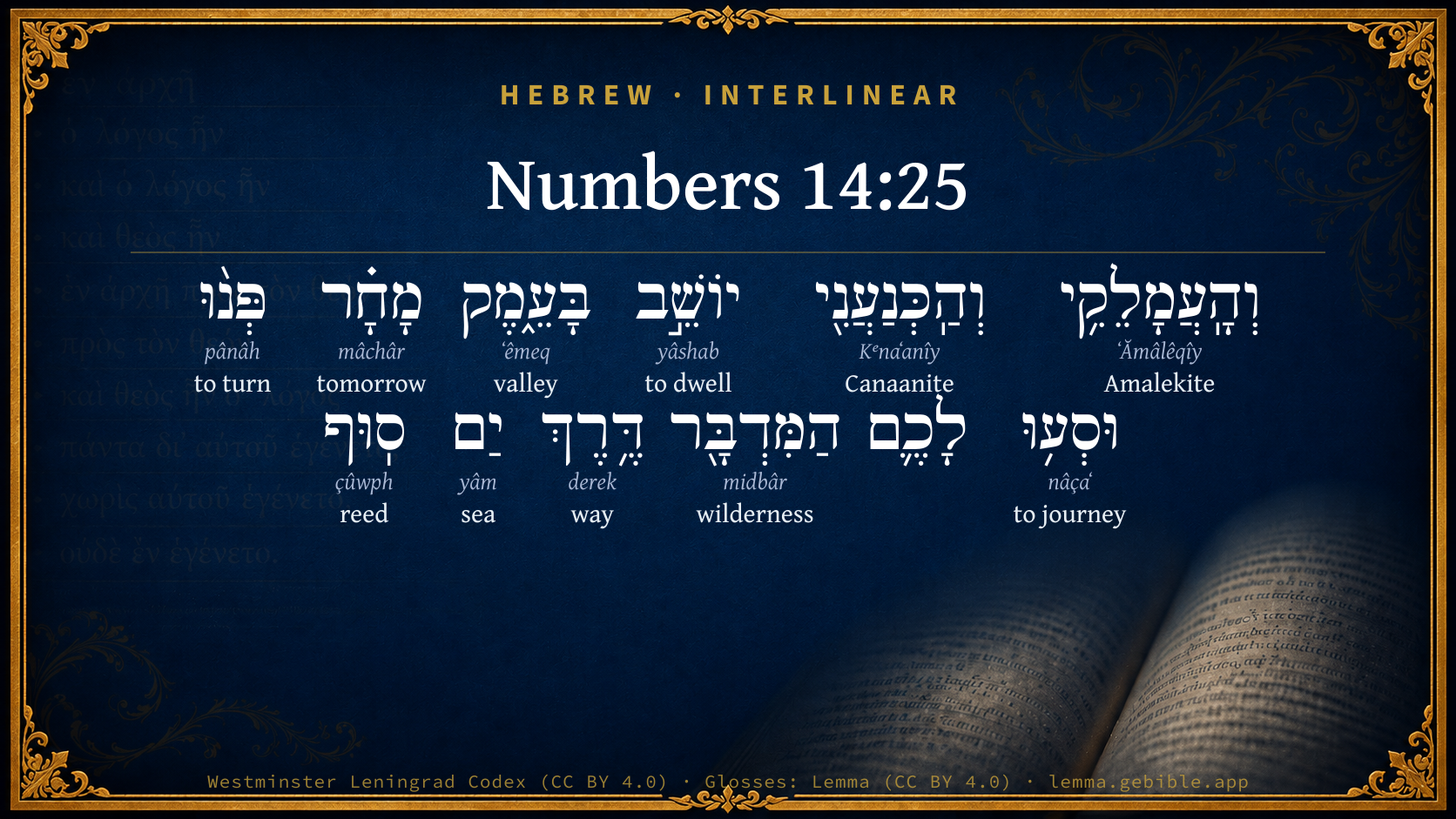
וְהָֽעֲמָלֵקִ֥י
ʻĂmâlêqîy
H6003
“and · the · Amalekite”
Conjunction + Particle, Definite Article + Noun, Gentilic, Masculine, Singular, Absolute
Part of Speech
Conjunction + Particle + Noun
Type
Gentilic
Gender
Masculine
Number
Singular
State
Absolute
Full BDB Definition

Origin: from H6002

TWOT: None

Amalekite = see Amalek " people of lapping" - descendants of Amalek, the grandson of Esau
  1. וְהַֽכְּנַעֲנִ֖י Kᵉnaʻanîy H3669 “and · the · Canaanite” Conjunction + Particle, Definite Article + Noun, Gentilic, Masculine, Singular, Absolute
  2. יוֹשֵׁ֣ב yâshab H3427 “dwelling” Verb, Qal, Participle Active, Masculine, Singular, Absolute
  3. בָּעֵ֑מֶק ʻêmeq H6010 “in/at the · valley” Preposition, Determined + Noun, Common, Masculine, Singular, Absolute
  4. מָחָ֗ר mâchâr H4279 “tomorrow” Noun, Common, Masculine, Singular, Absolute
  5. פְּנ֨וּ pânâh H6437 “turn” Verb, Qal, Imperative, 2nd Person, Masculine, Plural
  6. וּסְע֥וּ nâçaʻ H5265 “and · journey” Conjunction + Verb, Qal, Imperative, 2nd Person, Masculine, Plural
  7. הַמִּדְבָּ֖ר midbâr H4057 “the · wilderness” Particle, Definite Article + Noun, Common, Masculine, Singular, Absolute
  8. דֶּ֥רֶךְ derek H1870 “way of” Noun, Common, Both, Singular, Construct
  9. יַם yâm H3220 “sea of” Noun, Common, Masculine, Singular, Construct
  10. סֽוּף çûwph H5488 “reed” Noun, Common, Masculine, Singular, Absolute

About this verse

These counts appear in no published source. They are computed here, from the morphology-tagged text and Lemma’s own curated glosses. What Lemma adds →

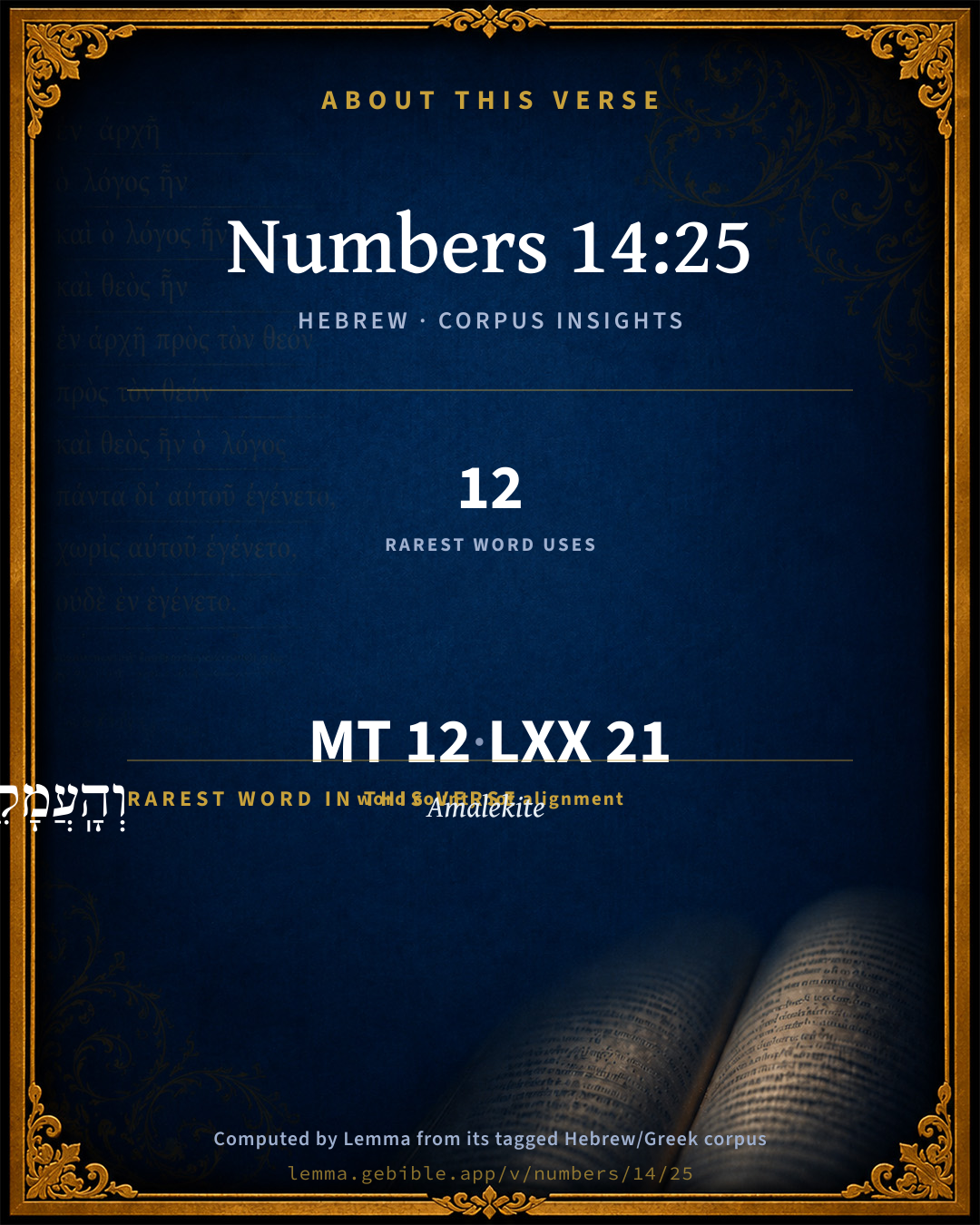
12
words
11
distinct lemmas
Pentateuch
section

Notable vocabulary

The rarest word here is וְהָֽעֲמָלֵקִ֥י Amalekite H6003 — appearing just 12 times in the whole Hebrew Bible.

Shared distinctive vocabulary

וְהָֽעֲמָלֵקִ֥י Amalekite H6003 occurs in 12 verses of the Hebrew Bible. Also found in:

Grammatical profile

  • 3 verbs
  • 8 nouns
  • 1 preposition

Verb forms

  • יוֹשֵׁ֣ב Qal · Participle Active
  • פְּנ֨וּ Qal · Imperative
  • וּסְע֥וּ Qal · Imperative

Hebrew & Septuagint length

In English translation the verse runs 26 words from the Hebrew and 23 from the Septuagint (LXX English) — closely comparable.

A rough comparison of the two English renderings, which tokenize alike — not a word-level alignment.

Word counts can differ between the Hebrew and the Greek without any difference in meaning — e.g. the Hebrew direct-object marker אֵת has no separate Greek word, and Greek often adds the article ὁ.

In the original languages it is 12 Hebrew tokens and 21 Greek tokens — but the two are counted differently (Hebrew bundles its prefixes and suffixes into one token; the Greek is in lemma form), so that isn’t a like-for-like length.

Cross-references

5

Topical passages linked to Numbers 14:25 in the Treasury of Scripture Knowledge — connected by theme and wording, ordered by reader-vote popularity; previews shown in the World English Bible.

  • Deuteronomy 1:40 But as for you, turn you, and take your journey into the wilderness by the way to the Red Sea.
  • Numbers 13:29 Amalek dwells in the land of the South: and the Hittite, and the Jebusite, and the Amorite, dwell in the hill-country; and the Canaanite dwells by the sea, and along by the side of the Jordan.
  • Numbers 14:4 They said one to another, Let us make a captain, and let us return into Egypt.
  • Psalms 81:11–13 But my people didn't listen to my voice. Israel desired none of me.
  • Proverbs 1:31 Therefore they will eat of the fruit of their own way, And be filled with their own schemes.

Cross-references courtesy of OpenBible.info (CC BY 4.0).

Hebrew and Greek witnesses Masoretic Hebrew ↔ Greek Septuagint

The same verse in the two great witnesses to the Old Testament, shown verse-for-verse.

These are two independent witnesses, not word-aligned to each other, and the Septuagint is shown in lemma (dictionary) form.

Hebrew Numbers 14:25 Masoretic · Westminster Leningrad Codex

וְהָֽעֲמָלֵקִ֥י וְהַֽכְּנַעֲנִ֖י יוֹשֵׁ֣ב בָּעֵ֑מֶק מָחָ֗ר פְּנ֨וּ וּסְע֥וּ לָכֶ֛ם הַמִּדְבָּ֖ר דֶּ֥רֶךְ יַם סֽוּף

Now the Amalekite and the Canaanite dwell in the valley: tomorrow turn you, and get you into the wilderness by the way to the Red Sea.

World English Bible · Public Domain

Greek LXX Numbers 14:25 Septuagint · lemma form

ὁ δέ αμαληκ καί ὁ χαναναῖος καταοἰκέω ἐν ὁ κοιλάς αὔριον ἐπιστρέφω σύ καί ἀποαἴρω εἰς ὁ ἔρημος ὁδός θάλασσα ἐρυθρός

But Amalec and the Chananite dwell in the valley: to-morrow turn and depart for the wilderness by the way of the Red Sea.

LXX2012 (modern English Septuagint) · Public Domain

On this verse, The Pulpit Commentary discusses the Septuagint’s reading. Read the note in Commentary ↓

Hebrew: Westminster Leningrad Codex (CC BY 4.0). Greek: Septuagint (public domain); English from LXX2012 (modern English Septuagint) (Public Domain). How the Septuagint differs from the Hebrew →

Targum (Aramaic paraphrase)

2

The Targum is the ancient Jewish Aramaic paraphrase of the Hebrew Scriptures — an interpretive translation, not the Hebrew text itself. Onkelos (literal) and Pseudo-Jonathan (expansive) render the Torah, and Jonathan the Prophets. Coverage is partial: where no permissively-licensed English translation exists for a verse, only the Aramaic is shown. This is verse-level text, not a word-by-word alignment to the Hebrew.

  1. Targum Onkelos Torah (Genesis–Deuteronomy)
    וַעֲמַלְקָאָה וּכְנַעֲנָאָה יָתֵב בְּמֵישְׁרָא מְחַר אִתְפְּנוּ וְטוּלוּ לְכוֹן לְמַדְבְּרָא אוֹרַח יַמָא דְסוּף

    (no public-domain English translation for this verse)

    Targum Onkelos — Aramaic: “Onkelos Genesis” (public domain); “Onkelos Exodus” (public domain); “Onkelos Leviticus” (public domain); “Onkelos Numbers” (public domain); “Onkelos Deuteronomy” (public domain). English: “Sefaria Community Translation” (CC0 1.0 (public-domain dedication)); “J.W. Etheridge. The Targums of Onkelos and Jonathan Ben Uzziel on the Pentateuch. London: Longmans, Green, 1862” (public domain). Text via Sefaria.

  2. Targum Pseudo-Jonathan Torah (Genesis–Deuteronomy)
    וַעֲמַלְקָאֵי וּכְנַעֲנָאֵי יָתֵיב בְּמֵישְׁרָא מְחַר אִתְפְּנוּ וְטוּלוּ לְכוֹן לְמַדְבְּרָא אוֹרַח יַמָא דְסוּף

    But the Amalekites and Kenaanites dwell in the valley: tomorrow turn you and go into the wilderness by the way of the Red Sea.

    Targum Pseudo-Jonathan — Aramaic: “Targum Jonathan on Genesis” (public domain); “Targum Jonathan on Exodus” (public domain); “Targum Jonathan on Leviticus” (public domain); “Targum Jonathan on Numbers” (public domain); “Targum Jonathan on Deuteronomy” (public domain). English: “The Targum of Jonathan ben Uzziel, trans. J. W. Etheridge, London, 1862” (public domain). Text via Sefaria.

Commentary

Notes on Numbers 14:25 from classic Christian and Jewish commentators (each source and its license shown beneath its notes). The classic Christian expositions comment on the surrounding passage and are grouped to its opening verse, so a note may address several verses; the Jewish commentaries on the Tanakh (Rashi and others) are per-verse, so they appear only where the commentator wrote on this verse.

Lemma curates 59 commentaries, every one of them public domain or Creative Commons licensed, each selected and text-cleaned for this edition rather than reprinted as found. About our sources →

Trapp's Complete Commentary

John Trapp

Num 14:25 (Now the Amalekites and the Canaanites dwelt in the valley.) To morrow turn you, and get you into the wilderness by the way of the Red sea.

Ver. 25. Now the Amalekites.] There was but a mountain between: so they were close by the Promised Land, and yet could not enter because of unbelief. Thou art not far from God’s kingdom? the greater is thine unhappiness, that fallest from so high hopes.

By the way of the Red Sea.] Since you have such a mind to it, you shall have enough of it. "The backslider in heart shall be filled with his own ways." {Pro 14:14}

John Trapp, A Commentary or Exposition upon All the Books of the Old and New Testament (1647–1656) — public domain. Text from a community e-Sword module.

The Biblical Illustrator

Joseph S. Exell

Num_14:25

The wilderness by the way of the Red Sea.

The rule of the road

Every traveller has heard of the rule of the road, which must be obeyed in order to avoid accidents. There are certain rules of the road also to be observed by the pilgrim band on our journey to the Eternal City.

1. First of all, there is only one road for Christs people to walk in. Walk in the old path, the Kings highway, the way of Gods commandments. And this road of ours is by the way of the Red Sea--the Red Sea of Christs most precious blood! We must always keep in sight of that.

2. Here is another rule of the road; do the duty which is nearest to you. There is an old English parsonage somewhere by the sea which has this sentence carved over its porch, Do the next thing. Let it be our motto. Some of us do nothing, because we do not know where to begin; we are thinking of next week, when to-days duty stands before us. Each day brings its own work; let us try to do it faithfully, prayerfully, cheerfully, trustingly, and then we may be sure we are going forward in the right way.

3. Another rule of the road is: be brave, only be strong and very courageous. Be brave enough to do what is right, no matter at what cost. The world will laugh at you, sneer at you, misjudge you. Trust in God and do the right.

4. Here is another rule of the road: be neighbourly. Never forget that you belong to one family, one army on the march--the Holy Catholic Church. Naturalists tell us that the pine tree is one of the most inhospitable, just as the oak is the most kindly, of trees. Beneath the shadow of the pine tree all is bare and desolate. No primrose opens its bright eyes there, no wild rose clings, no woodbine blossoms. There are some people like the inhospitable pine tree, they live only for themselves, and never offer help, or comfort, or shelter to another. Let us try by Gods grace to make our path of life bright for others, not sad and desolate, like the pine wood.

5. Yet another rule of the road: keep in the sunshine. On the journey through life there is always a sunny side for the Christian. A certain king once asked a famous general if he had seen the eclipse of the sun, and the Duke of Alva answered that he had too much to do on earth to have time to look up to heaven. Ah! if any of us are melancholy, discontented, it is because we are looking too much at the earth, and not lifting up our eyes to heaven. I say to you, come out of the gloom of your own thoughts into the sunshine, and thank God--Praise the Lord, O my soul, and forget not all His benefits.

6. One last rule of the road now: remember the road leads home. In all earthly journeys, however long and tiring, this thought always strengthens the traveller--I shall soon be home. Home, even an earthly home, is the central spot of every mans life. (H. J. Wilmot-Buxton, M. A.)

The Biblical Illustrator, edited by Joseph S. Exell (c. 1880s–1900s) — public domain. Text from a community e-Sword module.

Joseph Benson's Commentary

Num 14:25. In the valley — Beyond the mountain, at the foot whereof they now were, Num 14:40. And this clause is added, either, 1st, As an aggravation of Israel’s misery and punishment, that being now ready to enter and take possession of the land, they are forced to go back into the wilderness: or, 2d, As an argument to oblige them more willingly to obey the following command of returning into the wilderness, because their enemies were very near them, and severed from them only by that Idumean mountain, and if they did not speedily depart, their enemies would fall upon them, and so the evil which before they causelessly feared would come upon them; they, their wives, and their children, would become a prey to the Amalekites and Canaanites, because God would not assist nor defend them. By the way of the Red sea — That leadeth to the Red sea, and to Egypt, the place whither you desire to return.

Joseph Benson's Commentary on the Old and New Testaments (1811–1818) — public domain. Text from a community e-Sword module.

Geneva Bible (1599)

Geneva Bible translators

For I will not defend you.

And lie in wait for you.

Geneva Bible (1599) marginal notes — public domain. Text via Bolls.life.

Jamieson, Fausset & Brown

Robert Jamieson, A. R. Fausset & David Brown

(Now the Amalekites and the Canaanites dwelt in the valley)--that is, on the other side of the Idumean mountain, at whose base they were then encamped. Those nomad tribes had at that time occupied it with a determination to oppose the further progress of the Hebrew people. Hence God gave the command that they seek a safe and timely retreat into the desert, to escape the pursuit of those resolute enemies, to whom, with their wives and children, they would fall a helpless prey because they had forfeited the presence and protection of God. This verse forms an important part of the narrative and should be freed from the parenthetical form which our English translators have given it.

Jamieson, Fausset & Brown — Commentary Critical and Explanatory on the Whole Bible (1871) — public domain (CC PDM 1.0). Text via the HelloAO Bible API.

Ellicott's Commentary for English Readers

(25) Now the Amalekites and the Canaanites dwelt in the valley.—There is considerable difficulty in regard to the meaning and connection of these words. They may be attached to the words which precede: “And his seed shall possess it, and the Amalekites and the Canaanites dwelling in the valley”—i.e., shall possess the land occupied by them. There are strong objections, however, to this rendering, as well as to the rendering adopted by the Authorised Version, if the latter be understood as an historical statement respecting the geographical position of the Amalekites and Canaanites, of which Moses can scarcely be supposed to have been ignorant, and which may be assigned with greater probability to the “hill” than to the “valley.” (Comp. Num_14:45 and Note; also Deu_1:44, where one or both of these races are spoken of under the name of Amorites or mountaineers.) The word which is rendered “dwelt” is often used in reference to a temporary sojourn, as, e.g., in Jos_8:9 of the ambuscade sent by Joshua, which “abode” between Bethel and Ai, and in 1Sa_25:13 of a portion of David’s men who “abode by the stuff.” It is used also in Num_14:45 of this chapter in respect to the position of the Amalekites and Canaanites, whether temporary or permanent, in the “hill,” which appears to be used in contrast with the “valley.” The passage may be rendered thus: “Now the Amalekites and the Canaanites are abiding in the valley,” i.e., are lying in ambuscade in the valley, and waiting for an opportunity to attack the Israelites (comp. Num_14:43). If this interpretation of the words, which is that of Ibn Ezra, be adopted, they afford a strong reason for the command which follows:—“To morrow turn you, and get you into the wilderness by the way of the Red Sea”—i.e., do not fall into the snare which is laid for you, but turn and go in a contrary direction.

A Bible Commentary for English Readers, edited by Charles John Ellicott (1878–1897) — public domain. Text from a community e-Sword module.

The Cambridge Bible for Schools and Colleges

gen. ed. J. J. S. Perowne

25. Now the Amalekite … were dwelling in the valley] This is a parenthesis inserted by the narrator or compiler. It is omitted in Deu_1:40 which corresponds to the remainder of the present verse. It cannot be from the same pen as Num_13:29, where the Canaanites are described as living in the lowlands by the Mediterranean and along the Jordan, while the Amalekites live in the Negeb. On the other hand ‘the valley’ is not necessarily at variance with ‘mountain’ (or rather ‘hill country’) in Num_14:45, since it denotes not a broad valley or plain but ‘a deep place’ (צֵמֶק), a defile or declivity among the mountains.

turn ye] They were to retrace their steps, moving S.E. towards the eastern arm of the Red Sea.

The Cambridge Bible for Schools and Colleges (gen. ed. J. J. S. Perowne; Cambridge University Press, 1878–1918) — public domain. Text from a community e-Sword module.

John Gill's Exposition

And the Lord spake unto Moses and unto Aaron,.... Before he had been only speaking to Moses, who had interceded with him to pardon the people, which he had granted; but at the same time assured him they should not enter into and possess the land of Canaan, and the same he repeats to him and Aaron together:

saying: as follows.

John Gill's Exposition of the Whole Bible (1746–1763) — public domain (CC PDM 1.0). Text via the HelloAO Bible API.

Albert Barnes' Notes on the Bible

Render: And now the Amalekites and the Canaanites are dwelling (or abiding) in the valley: wherefore turn you, etc. (that so ye be not smitten before them). The Amalekites were the nomad bands that roved through the open pastures of the plain Num 14:45 : the Canaanites, a term here taken in its wider sense, were the Amorites of the neighboring cities (compare Num 14:45 with Deu 1:44), who probably lived in league with the Amalekites.

Tomorrow - Not necessarily the next day, but an idiom for “hereafter,” “henceforward” (compare the marginal reading in Exo 13:14; Jos 4:6).

By the way of the Red sea - That is, apparently, by the eastern or Elanitic gulf.

Albert Barnes' Notes on the Bible (1834–1885) — public domain. Text from a community e-Sword/MySword module.

Haydock's Catholic Bible Commentary

For. Hebrew, "Now," &c. The enemy is ready to attack you in the defiles, and I will not expose you at present to their fury, as you shall not enter the land for many years. Wherefore to-morrow, &c. (Haydock) --- It seems they complied reluctantly, for they probably encamped in that neighbourhood about a year. (Calmet)

George Leo Haydock (1774–1849), Haydock's Catholic Family Bible and Commentary, 1859 edition — public domain. Excludes Psalms (Douay-Rheims chapter numbering differs from Protestant) and Deuterocanonical books (Catholic canon only).

Matthew Poole's English Annotations

In the valley; beyond the mountain at the foot whereof they now were, Num 14:40. And this clause is added, either,

1. As an aggravation of Israel’s misery and punishment, that being now ready to enter and take possession of the land, they are forced to go back into the wilderness; or,

2. As an argument to oblige them more willingly to obey the following command of returning into the wilderness, because their enemies were very near them, and severed from them only by that Idumean mountain, and if they did not speedily depart, their enemies would hear of them and fall upon them, and so the evil which before they causelessly feared would come upon them; they, their wives, and their children would become a prey to the Amalekites and Canaanites, because God had forsaken them, and would not assist nor defend them. The verse may be rendered thus,

And, or But, for the present,

the Amalekite and the Canaanite dwell in the valley; therefore (which particle is here understood, as it is in other places)

to-morrow turn ye, & c. Though some knit these words to the former, and read the place thus, Caleb—and his seed shall possess it, to wit, the land near Hebron, and also the land of the Amalekites and of the Canaanites that dwell in the valley.

Quest. But how are the Canaanites said to dwell in the valley here, when they dwelt in the hill, Num 14:45, and by the sea-coasts, Num 21:1?

Answ. 1. Part of them dwelt in one place, and part in other places.

2. The word Canaanite may here be understood more generally of all the inhabitants of Canaan.

By the way of the Red Sea, i.e. that leadeth to the Red Sea, and to Egypt, the place whither you desire to return, Num 14:3,4.

Matthew Poole's English Annotations on the Holy Bible (1683–1685) — public domain. Text from a community e-Sword/MySword module.

Whedon's Commentary on the Bible

Daniel D. Whedon

25. Amalekites — See Num_13:29. Canaanites — In the wide meaning of the term, including all the inhabitants of Canaan exclusive of the Amorites dwelling in the southern mountains. Deu_1:44. See Num_13:29, note, for the narrow meaning. The valley is identified by Keil with the broad Wady Marreh, including a portion of the Negeb, in which the Amalekites roamed, while the Canaanites really dwelt upon the mountains (Num_14:45) close up to this wady. The statement relative to this valley supplies the reason for the following command. To advance into this valley would be to enter Canaan, from which they have been by solemn oath excluded.

Turn you — The probation of adult Israel, so far as Canaan is concerned, is ended. From this hour their corpses must be sown in the wilderness to which they are now remanded.

By the way of the Red sea — We find in the itinerary of Israel (Num_33:35) that Ezion-gaber was one of the stations, and in Deu_2:8, Elath is named with this place. They were situated near together at the head of the gulf of Akabah, the eastern arm of the Red sea. Here ends this communication to Moses. Num_14:26 begins the formal sentence of exclusion from Canaan. See Introductory Remarks.

Daniel D. Whedon (gen. ed.), Commentary on the Old and New Testaments (1874–1909) — public domain. Text from a community e-Sword module.

The Pulpit Commentary

Now the Amalekites and the Canaanites dwelt in the valley. This parenthesis bears on the face of it several difficulties, both as to the meaning of the statement and as to its position in the text.

1. It has been stated just before (Num_13:29) that the "Canaanites" dwelt by the sea, and in the Ghor, and it has been proposed by some to understand under this name the Phoenicians, because "Sidon" was the firstborn of Canaan, and because they are known to have occupied the coast. But if "Canaanite" means "Phoenician" in chapter 13:29, it is difficult to maintain that it is here equivalent to "Amorite." Again, if "Canaanite" be taken in this vaguer sense, yet it is clear that the Amorites dwelt in "the mountain", (cf. e.g., verse 45 with Deu_1:44) and not in the lowlands. This has been got over by supposing that qme may mean an upland vale, or plateau, such as that to which the Israelites presently ascended. It is, however, a straining of the word to assign such a meaning to it. It is rightly translated by the Septuagint en th koiladi . And even if one looking down from above might call an upland plain by this name, yet certainly one looking up from below would not. If the word stands rightly in this place, qmeB must mean "in the Wady Murreh," the broad sandy strait which bounded the "mountain of the Amorite" on the south. If so, we must conclude that not only the roving Amalekites, but also the Canaanites, or Amorites, had established themselves in some parts of the Wady.

2. It is scarcely credible that an observation of this sort, which would seem unusual and abrupt in any speech, should have formed a part of God"s message to Moses. It has no apparent connection with the context. It does not (as often alleged) afford a reason for the command which follows; it was not at all because enemies were already in possession before them that the Israelites had to turn their backs upon the promised land, but because God had withdrawn for the time his promised aid. If the "valley" be the Rakhmah plateau, they had always known that hostile tribes held it, and that they would have to conquer them. That the words are an interpolation, as the A.V represents them, seems as certain as internal evidence can make it; lint by whom made, and with what intent, is a question which will probably never be answered. It may be worth while to hazard a conjecture that the interpolated words are really connected with what goes before, viz., the promise of inheritance to Caleb. Now that promise was fulfilled in the gift of Hebron to Caleb and his seed. (Jos_14:14) But we have express mention in Gen_37:14 of the "vale of Hebron," and the same word, qme, is used in the Hebrew. Is it not possible that this parenthesis was originally the gloss of one who had a special interest in the heritage of Caleb, and wished to note that at the time it was given to him "the vale" was occupied by two hostile peoples? Into the wilderness, i.e., the Sinaitic peninsula, as distinguished from Palestine on the one hand, and from Egypt on the other. By the way of the Red Sea, i.e., towards the Red Sea; here apparently the Elanitic Gulf. (cf. Num_11:31)

The Pulpit Commentary (1880–1919), ed. H.D.M. Spence-Jones & Joseph S. Exell — public domain. Text from a community e-Sword module.

John Wesley's Explanatory Notes

In the valley - Beyond the mountain, at the foot whereof they now were, ver. 40. And this clause is added, either

1. As an aggravation of Israel's misery and punishment, that being now ready to enter and take possession of the land, they are forced to go back into the wilderness or

2. As an argument to oblige them more willingly to obey the following command of returning into the wilderness, because their enemies were very near them, and severed from them only by that Idumean mountain, and, if they did not speedily depart, their enemies would fall upon them, and so the evil which before they causelessly feared would come upon them; they, their wives and their children, would become a prey to the Amalekites and Canaanites, because God would not assist nor defend them. By the way of the Red-sea - That leadeth to the Red-sea, and to Egypt, the place whither you desire to return.

John Wesley, Explanatory Notes Upon the Whole Bible (1754–1765) — public domain. Text via the GEBible commentary corpus.

Keil & Delitzsch

C. F. Keil & F. Delitzsch

The divine reply to the intercession of Moses terminated with a command to the people to turn on the morrow, and go to the wilderness to the Red Sea, as the Amalekites and Canaanites dwelt in the valley. "The Amalekites," etc.: this clause furnishes the reason for the command which follows. On the Amalekites, see at Gen 36:12, and Exo 17:8. The term Canaanites is a general epithet applied to all the inhabitants of Canaan, instead of the Amorites mentioned in Deu 1:44, who held the southern mountains of Canaan. "The valley" is no doubt the broad Wady Murreh (see at Num 13:21), including a portion of the Negeb, in which the Amalekites led a nomad life, whilst the Canaanites really dwelt upon the mountains (Num 14:45), close up to the Wady Murreh.

Keil & Delitzsch — Biblical Commentary on the Old Testament (1861–1891) — public domain (CC PDM 1.0). Text via the HelloAO Bible API. (Old Testament only.)

Rashi

Rabbi Shlomo Yitzchaki (Rashi)

והעמלקי וגו׳ AND THE AMALEKITES [AND THE CANAANITES DWELL IN THE VALLEY] — This is not a mere statement that they dwell there; it is a warning: If you go there they will kill you, since I shall not be with you.

מחר פנו TOMORROW TURN YOU — i.e. turn backwards, וסעו לכם AND JOURNEY [INTO THE DESERT etc.].

Rashi on the Tanakh — English translations: “The Judaica Press complete Tanach with Rashi, translated by A. J. Rosenberg” (CC BY 4.0); “Pentateuch with Rashi's commentary by M. Rosenbaum and A.M. Silbermann, 1929-1934” (public domain); “The Metsudah Tanach series, Lakewood, N.J” (CC BY 4.0); and “The Book of Joshua, Metsudah Publications, 1997” (CC BY 4.0). Text via Sefaria.

Lesson kit

Teaching starters — assembled from the data on this page, not authored interpretation. Every prompt links to the verse data it draws on. Edit before teaching.

Numbers, in the Pentateuch, opens this verse with 12 words (11 distinct Hebrew lemmas). Its most distinctive word is ʻĂmâlêqîy (“Amalekite”). A historical commentator’s framing appears above. Read the whole chapter for the surrounding context.

Discussion questions

  1. What does “Amalekite” (ʻĂmâlêqîy) contribute to the verse as a whole?
  2. Genesis 14:7 shares the word «Amalekite» with this verse. How do the two illuminate each other?
  3. The translations on this page render this verse differently — a whole-verse word diff, not a word-by-word alignment. What might account for the different wordings?
  4. The verb «יוֹשֵׁ֣ב» is Qal Participle Active. How does its form color the action?
  5. Reading how Trapp's Complete Commentary and The Biblical Illustrator read this verse, where do the two commentators agree and where do they part?

Things to notice

Reading settings

Reading text

Shown beneath each verse's original-language words.

Old Testament
Old Testament edition

Read the OT as the Masoretic Hebrew (MT) or the Greek Septuagint (LXX).

English shown for the Greek Septuagint (in the Hebrew ↔ Greek comparison).

Comparing translations? Open the Compare panel on any verse page to stack up to four side by side.