
Exodus 14:28

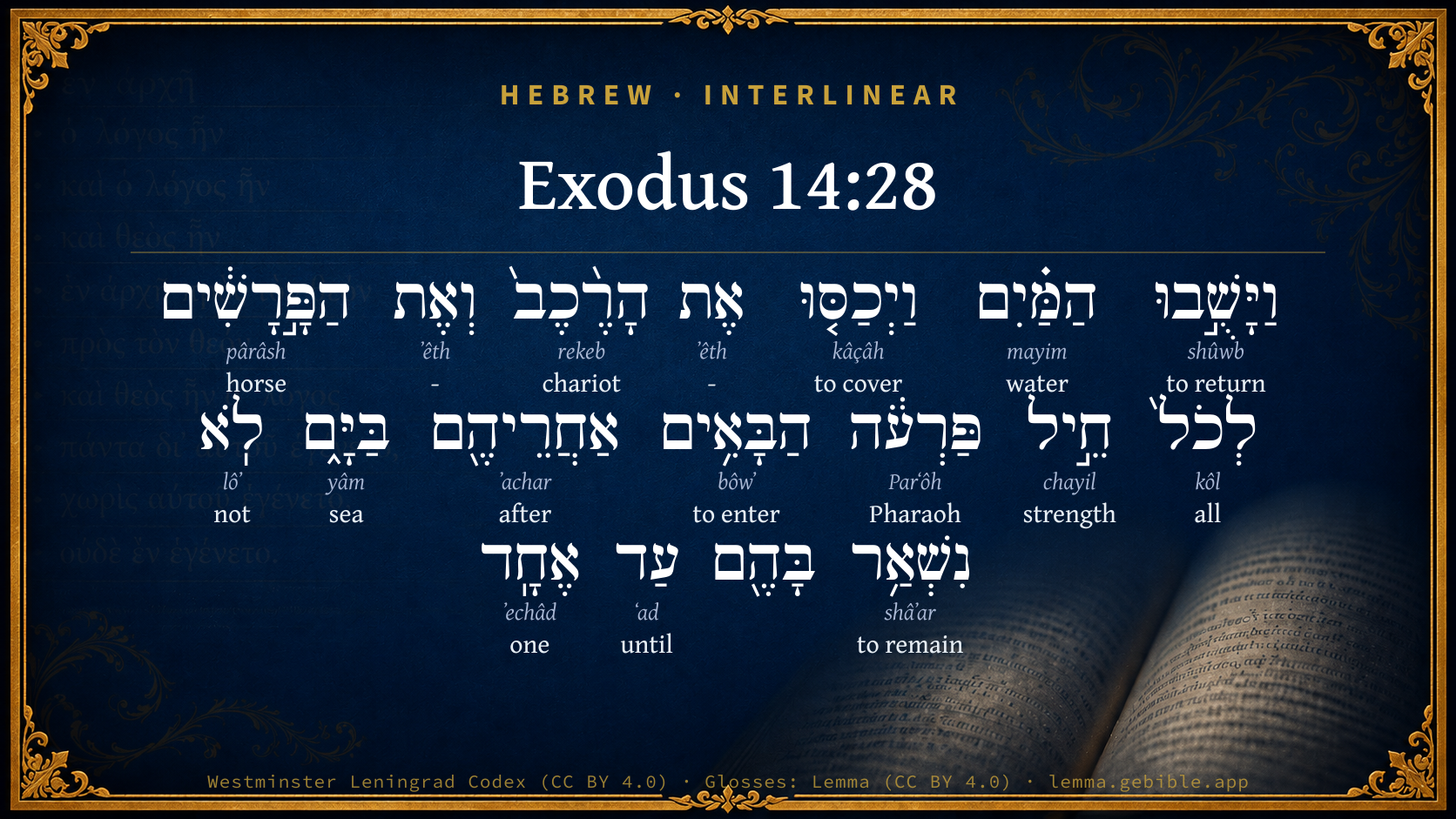
Hebrew (Westminster Leningrad Codex) Exodus 14:28 appears in the Hebrew Old Testament. The text above is from the Westminster Leningrad Codex. Each word links to its Strong’s number, a concise gloss, and parsing drawn from the Open Scriptures Hebrew Bible morphology. Click any word for its full Brown-Driver-Briggs (BDB) entry.
Download image
Cite this verse

Exodus 14:28 (World English Bible). Public Domain. Lemma interlinear Bible study tool, https://lemma.gebible.app/v/exodus/14/28.

Show BibTeX & RIS
BibTeX
RIS
English Translation
The waters returned, and covered the chariots and the horsemen, even all Pharaoh's army that went in after them into the sea. There remained not so much as one of them.
World English Bible · Public Domain
Download a study sheet

One document with this verse’s original text, its word-by-word gloss line, the meaning frame, cross-references with their text, attributed commentary, and full source and license credits — printable, and it pastes into notes with its structure intact.

This verse Autodidact and up

Study sheet (.html) Plain text (.txt)

A passage Seminary Student

Up to 50 verses in one chapter. A passage sheet keeps up to 6 commentary sources and 12 cross-references per verse, in the order this page ranks them, and says so on the sheet whenever that leaves anything out. Ask for a single verse and you get the Autodidact verse sheet above.

Everything on this page stays free to read, with no account — the sheet is a download of what is already on screen, not access to it.

Want to remove ads? Support Godless Engineer
Compare translations 3

The same verse in 3 English versions, stacked beneath the original-language interlinear above. Click any original word for its lexicon entry.

Each is an independent rendering of the whole verse — the interlinear is not word-aligned to these translations.

Highlighted words mark where these versions differ — a whole-verse word diff, not a word-by-word alignment.

  • World English Bible Public Domain
    The waters returned, and covered the chariots and the horsemen, even all Pharaoh's army that went in after them into the sea. There remained not so much as one of them.
  • King James Version Public Domain
    And the waters returned, and covered the chariots, and the horsemen, and all the host of Pharaoh that came into the sea after them; there remained not so much as one of them.
  • unfoldingWord Literal Text CC BY-SA 4.0
    And the waters returned, and they covered the chariots and the horsemen, even the entire army of Pharaoh that entered after them into the sea. Not even one of them remained.

unfoldingWord Literal Text — © unfoldingWord, licensed CC BY-SA 4.0. Word-aligned USFM3 via Door43 (git.door43.org/unfoldingWord/en_ult).

Versions to compare (up to 4)

3 of 4 selected

Show all 18 translations

Every available English version of this verse, each an independent rendering of the whole verse.

  • World English Bible Public Domain
    The waters returned, and covered the chariots and the horsemen, even all Pharaoh's army that went in after them into the sea. There remained not so much as one of them.
  • Berean Standard Bible Public Domain
    The waters flowed back and covered the chariots and horsemen—the entire army of Pharaoh that had chased the Israelites into the sea. Not one of them survived.
  • Majority Standard Bible Public Domain
    The waters flowed back and covered the chariots and horsemen—the entire army of Pharaoh that had chased the Israelites into the sea. Not one of them survived.
  • King James Version Public Domain
    And the waters returned, and covered the chariots, and the horsemen, and all the host of Pharaoh that came into the sea after them; there remained not so much as one of them.
  • American Standard Version (1901) Public Domain
    And the waters returned, and covered the chariots, and the horsemen, even all the host of Pharaoh that went in after them into the sea; there remained not so much as one of them.
  • Revised Version (1885) Public Domain
    And the waters returned, and covered the chariots, and the horsemen, even all the host of Pharaoh that went in after them into the sea; there remained not so much as one of them.
  • Geneva Bible (1599) Public Domain
    So the water returned and couered the charets and the horsemen, euen all the hoste of Pharaoh that came into the sea after them: there remained not one of them.
  • Douay-Rheims (1899) Public Domain
    And the waters returned, and covered the chariots and the horsemen of all the army of Pharao, who had come into the sea after them, neither did there so much as one of them remain.
  • Young's Literal Translation Public Domain
    and the waters turn back, and cover the chariots and the horsemen, even all the force of Pharaoh, who are coming in after them into the sea -- there hath not been left of them even one.
  • Literal Standard Version CC BY-SA 4.0
    and the waters turn back, and cover the chariots and the horsemen, even all the force of Pharaoh, who are coming in after them into the sea—there has not been left even one of them.
  • Unlocked Literal Bible CC BY-SA 4.0
    The waters came back and covered Pharaoh's chariots, horsemen, and his entire army that had followed the chariots into the sea. No one survived.
  • unfoldingWord Literal Text CC BY-SA 4.0
    And the waters returned, and they covered the chariots and the horsemen, even the entire army of Pharaoh that entered after them into the sea. Not even one of them remained.
  • Darby Bible Public Domain
    And the waters returned, and covered the chariots and the horsemen of all the host of Pharaoh that had come into the sea after them; there remained not even one of them.
  • World Messianic Bible Public Domain
    The waters returned, and covered the chariots and the horsemen, even all Pharaoh’s army that went in after them into the sea. There remained not so much as one of them.
  • Webster's Bible Public Domain
    And the waters returned, and covered the chariots, and the horsemen, and all the host of Pharaoh that came into the sea after them; there remained not so much as one of them.
  • Free Bible Version CC BY-SA 4.0
    The water poured back and covered the chariots and horsemen—the whole of Pharaoh's army that had chased after the Israelites into the sea. Not a single one of them survived.
  • Bible in Basic English Public Domain
    And the waters came back, covering the war-carriages and the horsemen and all the army of Pharaoh which went after them into the middle of the sea; not one of them was to be seen.
  • JPS Tanakh (1917) Public Domain
    And the waters returned, and covered the chariots, and the horsemen, even all the host of Pharaoh that went in after them into the sea; there remained not so much as one of them.

Literal Standard Version (2020), Covenant Press — licensed CC BY-SA 4.0. Text via the HelloAO Bible API (eBible.org). Unlocked Literal Bible (unfoldingWord) — licensed CC BY-SA 4.0. Text via the HelloAO Bible API (eBible.org). unfoldingWord Literal Text — © unfoldingWord, licensed CC BY-SA 4.0. Word-aligned USFM3 via Door43 (git.door43.org/unfoldingWord/en_ult). Free Bible Version, Dr. Jonathan Gallagher — licensed CC BY-SA 4.0. Text via the HelloAO Bible API (eBible.org).

Word by word

More ways to search: Search by grammar → Find every occurrence → Compare this word →

Practice this passage: Drill this verse → Learn its vocabulary →

הַפָּ֣רָשִׁ֔ים
pârâsh
H6571
“the · horses”
Particle, Definite Article + Noun, Common, Masculine, Plural, Absolute
Part of Speech
Particle + Noun
Type
Common
Gender
Masculine
Number
Plural
State
Absolute
Full BDB Definition

Origin: from H6567

TWOT: 1836a

horse, steed, warhorse - horseman
  1. וַיָּשֻׁ֣בוּ shûwb H7725 “and · to return” Conjunction + Verb, Qal, Sequential Imperfect, 3rd Person, Masculine, Plural
  2. הַמַּ֗יִם mayim H4325 “the · water(s)” Particle, Definite Article + Noun, Common, Masculine, Plural, Absolute
  3. וַיְכַסּ֤וּ kâçâh H3680 “and · to cover” Conjunction + Verb, Piel, Sequential Imperfect, 3rd Person, Masculine, Plural
  4. אֶת ʼêth H853 “-” Particle, Direct Object
  5. הָרֶ֨כֶב֙ rekeb H7393 “the · chariot” Particle, Definite Article + Noun, Common, Masculine, Singular, Absolute
  6. וְאֶת ʼêth H853 “and · -” Conjunction + Particle, Direct Object
  7. לְכֹל֙ kôl H3605 “to/for · all of” Preposition + Noun, Common, Masculine, Singular, Construct
  8. חֵ֣יל chayil H2428 “strength of” Noun, Common, Masculine, Singular, Construct
  9. פַּרְעֹ֔ה Parʻôh H6547 “Pharaoh” Noun, Proper
  10. הַבָּאִ֥ים bôwʼ H935 “the · entering” Particle, Definite Article + Verb, Qal, Participle Active, Masculine, Plural, Absolute
  11. אַחֲרֵיהֶ֖ם ʼachar H310 “after · them” Preposition + Suffix, Personal, 3rd Person, Masculine, Plural
  12. בַּיָּ֑ם yâm H3220 “in/at the · sea” Preposition, Determined + Noun, Common, Masculine, Singular, Absolute
  13. לֹֽא lôʼ H3808 “not” Particle, Negative
  14. נִשְׁאַ֥ר shâʼar H7604 “to remain” Verb, Niphal, Perfect, 3rd Person, Masculine, Singular
  15. עַד ʻad H5704 “until” Preposition
  16. אֶחָֽד ʼechâd H259 “one” Adjective, Cardinal number, Masculine, Singular, Absolute

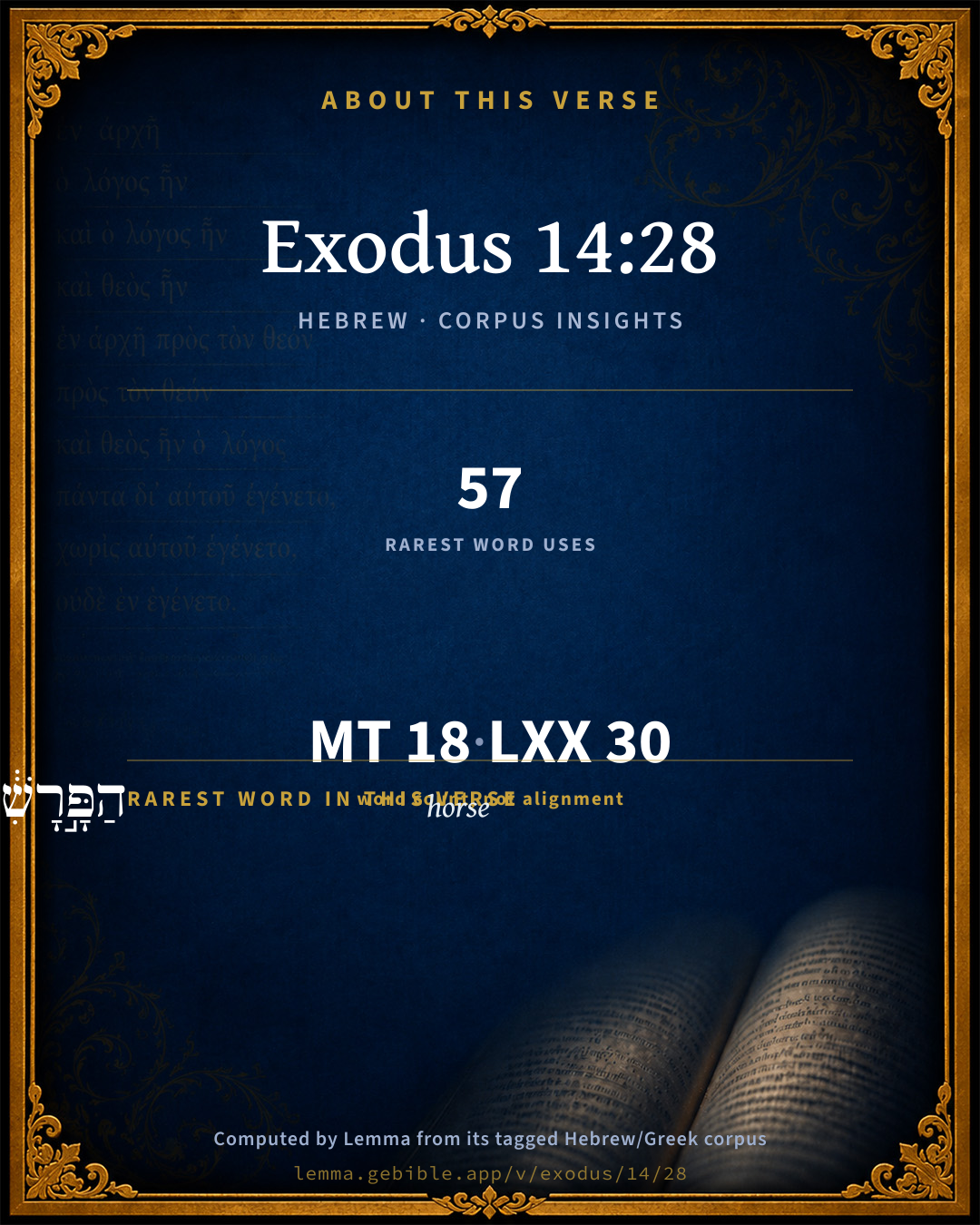
About this verse

These counts appear in no published source. They are computed here, from the morphology-tagged text and Lemma’s own curated glosses. What Lemma adds →

18
words
16
distinct lemmas
Pentateuch
section

Shared distinctive vocabulary

הַפָּ֣רָשִׁ֔ים horse H6571 occurs in 54 verses of the Hebrew Bible. Also found in:

Grammatical profile

  • 4 verbs
  • 7 nouns
  • 1 adjective
  • 3 prepositions
  • 3 particles

Verb forms

  • וַיָּשֻׁ֣בוּ Qal · Sequential Imperfect
  • וַיְכַסּ֤וּ Piel · Sequential Imperfect
  • הַבָּאִ֥ים Qal · Participle Active
  • נִשְׁאַ֥ר Niphal · Perfect

Hebrew & Septuagint length

In English translation the verse runs 31 words from the Hebrew and 33 from the Septuagint (LXX English) — closely comparable.

A rough comparison of the two English renderings, which tokenize alike — not a word-level alignment.

Word counts can differ between the Hebrew and the Greek without any difference in meaning — e.g. the Hebrew direct-object marker אֵת has no separate Greek word, and Greek often adds the article ὁ.

In the original languages it is 18 Hebrew tokens and 30 Greek tokens — but the two are counted differently (Hebrew bundles its prefixes and suffixes into one token; the Greek is in lemma form), so that isn’t a like-for-like length.

Cross-references

11

Topical passages linked to Exodus 14:28 in the Treasury of Scripture Knowledge — connected by theme and wording, ordered by reader-vote popularity; previews shown in the World English Bible.

  • Psalms 78:53 He led them safely, so that they weren't afraid, But the sea overwhelmed their enemies.
  • Psalms 106:9–11 He rebuked the Red Sea also, and it was dried up; So he led them through the depths, as through a desert.
  • Psalms 136:15 But overthrew Pharaoh and his host in the Red Sea; For his loving kindness endures forever:
  • Habakkuk 3:8–10 Was Yahweh displeased with the rivers? Was your anger against the rivers, Or your wrath against the sea, That you rode on your horses, On your chariots of salvation?
  • Habakkuk 3:13 You went forth for the salvation of your people, For the salvation of your anointed. You crushed the head of the land of wickedness. You stripped them head to foot. Selah.
  • Hebrews 11:29 By faith, they passed through the Red sea as on dry land. When the Egyptians tried to do so, they were swallowed up.
  • Exodus 14:13 Moses said to the people, "Don't be afraid. Stand still, and see the salvation of Yahweh, which he will work for you today: for the Egyptians whom you have seen today, you shall never see them again.
  • Exodus 15:10 You blew with your wind. The sea covered them. They sank like lead in the mighty waters.
  • Deuteronomy 11:4 and what he did to the army of Egypt, to their horses, and to their chariots; how he made the water of the Red Sea to overflow them as they pursued after you, and how Yahweh has destroyed them to this day;
  • 2 Chronicles 20:24 When Judah came to the watch-tower of the wilderness, they looked at the multitude; and, behold, they were dead bodies fallen to the earth, and there were none who escaped.
  • Nehemiah 9:11 You divided the sea before them, so that they went through the midst of the sea on the dry land; and their pursuers you did cast into the depths, as a stone into the mighty waters.

Cross-references courtesy of OpenBible.info (CC BY 4.0).

Hebrew and Greek witnesses Masoretic Hebrew ↔ Greek Septuagint

The same verse in the two great witnesses to the Old Testament, shown verse-for-verse.

These are two independent witnesses, not word-aligned to each other, and the Septuagint is shown in lemma (dictionary) form.

Hebrew Exodus 14:28 Masoretic · Westminster Leningrad Codex

וַיָּשֻׁ֣בוּ הַמַּ֗יִם וַיְכַסּ֤וּ אֶת הָרֶ֨כֶב֙ וְאֶת הַפָּ֣רָשִׁ֔ים לְכֹל֙ חֵ֣יל פַּרְעֹ֔ה הַבָּאִ֥ים אַחֲרֵיהֶ֖ם בַּיָּ֑ם לֹֽא נִשְׁאַ֥ר בָּהֶ֖ם עַד אֶחָֽד

The waters returned, and covered the chariots and the horsemen, even all Pharaoh's army that went in after them into the sea. There remained not so much as one of them.

World English Bible · Public Domain

Greek LXX Exodus 14:28 Septuagint · lemma form

καί ἐπι ἀναστρέφω ὁ ὕδωρ καλύπτω ὁ ἅρμα καί ὁ ἀναβάτης καί πᾶς ὁ δύναμις φαραώ ὁ εἰςπορεύομαι ὀπίσω αὐτός εἰς ὁ θάλασσα καί οὐ καταλείπω ἐκ αὐτός οὐδέ εἷς

and the water returned and covered the chariots and the riders, and all the forces of Pharao, who entered after them into the sea: and there was not left of them even one.

LXX2012 (modern English Septuagint) · Public Domain

Hebrew: Westminster Leningrad Codex (CC BY 4.0). Greek: Septuagint (public domain); English from LXX2012 (modern English Septuagint) (Public Domain). How the Septuagint differs from the Hebrew →

Targum (Aramaic paraphrase)

2

The Targum is the ancient Jewish Aramaic paraphrase of the Hebrew Scriptures — an interpretive translation, not the Hebrew text itself. Onkelos (literal) and Pseudo-Jonathan (expansive) render the Torah, and Jonathan the Prophets. Coverage is partial: where no permissively-licensed English translation exists for a verse, only the Aramaic is shown. This is verse-level text, not a word-by-word alignment to the Hebrew.

  1. Targum Onkelos Torah (Genesis–Deuteronomy)
    וְתָבוּ מַיָא וַחֲפוֹ יָת רְתִכַּיָא וְיָת פָּרָשַׁיָא לְכֹל מַשִׁרְיַת פַּרְעֹה דְעַלוּ בַתְרֵיהוֹן בְּיַמָא לָא אִשְׁתָּאַר בְּהוֹן עַד חָד:

    (no public-domain English translation for this verse)

    Targum Onkelos — Aramaic: “Onkelos Genesis” (public domain); “Onkelos Exodus” (public domain); “Onkelos Leviticus” (public domain); “Onkelos Numbers” (public domain); “Onkelos Deuteronomy” (public domain). English: “Sefaria Community Translation” (CC0 1.0 (public-domain dedication)); “J.W. Etheridge. The Targums of Onkelos and Jonathan Ben Uzziel on the Pentateuch. London: Longmans, Green, 1862” (public domain). Text via Sefaria.

  2. Targum Pseudo-Jonathan Torah (Genesis–Deuteronomy)
    וְתָבוּ גַלְלֵי יַמָא וְחָפוּן יַת רְתִיכַיָיא וְיַת פַּרְשַׁיָא לְכָל מַשִּׁרְיַת פַּרְעה דְּעָלַן בַּתְרֵיהוֹן בְּיַמָא לָא אִישְׁתַּיֵּיר בְּהוֹן עַד חָד

    And the waves of the sea returned, and covered the chariots, and the horsemen and all the host of Pharoh who had gone in after them, into the sea, not one among them was left.

    Targum Pseudo-Jonathan — Aramaic: “Targum Jonathan on Genesis” (public domain); “Targum Jonathan on Exodus” (public domain); “Targum Jonathan on Leviticus” (public domain); “Targum Jonathan on Numbers” (public domain); “Targum Jonathan on Deuteronomy” (public domain). English: “The Targum of Jonathan ben Uzziel, trans. J. W. Etheridge, London, 1862” (public domain). Text via Sefaria.

Commentary

Notes on Exodus 14:28 from classic Christian and Jewish commentators (each source and its license shown beneath its notes). The classic Christian expositions comment on the surrounding passage and are grouped to its opening verse, so a note may address several verses; the Jewish commentaries on the Tanakh (Rashi and others) are per-verse, so they appear only where the commentator wrote on this verse.

Lemma curates 59 commentaries, every one of them public domain or Creative Commons licensed, each selected and text-cleaned for this edition rather than reprinted as found. About our sources →

Trapp's Complete Commentary

John Trapp

Exo 14:28 And the waters returned, and covered the chariots, and the horsemen, [and] all the host of Pharaoh that came into the sea after them; there remained not so much as one of them.

Ver. 28. There remained not so much as one of them.] No more doth there of our subdued iniquities. {Mic 7:10} Peccata non redeunt. We shall see them no more, any otherwise than these Israelites did their enemies, dead upon the shore.

John Trapp, A Commentary or Exposition upon All the Books of the Old and New Testament (1647–1656) — public domain. Text from a community e-Sword module.

Jamieson, Fausset & Brown

Robert Jamieson, A. R. Fausset & David Brown

there remained not so much as one of them--It is surprising that, with such a declaration, some intelligent writers can maintain there is no evidence of the destruction of Pharaoh himself (Psa 106:11).

Jamieson, Fausset & Brown — Commentary Critical and Explanatory on the Whole Bible (1871) — public domain (CC PDM 1.0). Text via the HelloAO Bible API.

Adam Clarke's Commentary

Verse 28. There remained not so much as one of them.] Josephus says that the army of Pharaoh consisted of fifty thousand horse, and two hundred thousand foot, of whom not one remained to carry tidings of this most extraordinary catastrophe.

Adam Clarke's Commentary on the Bible (1810–1826) — public domain. Text from a community e-Sword/MySword module.

Ellicott's Commentary for English Readers

(28) The chariots, and the horsemen, and all the host . . . —This translation is misleading. The Heb. runs thus: “The chariots and the horsemen (who were) all the host of Pharaoh that came into the sea.” It is implied that his footmen did not enter the sea.

There remained not so much as one of them.—The armour of an Egyptian warrior would make it impossible for him to escape by swimming from such a catastrophe. All who were caught by the tide would certainly be drowned. The question whether the Pharaon was drowned or no cannot be ruled by the expression here used, nor by any parallel one in the Psalms (Psa_78:53; Psa_106:11); it depends on more general considerations. In the first place, is it likely that if the Pharaoh had been killed there would have been no explicit mention of it? Would the point have remained one open to question? Secondly, if the Pharaoh had been killed, would the Egyptian annals have retained no trace of it? Must we not have had some account of a great king cut off in the flower of his age, after a reign of two, or at the most three, years? (Comp. Exo_2:23; Exo_4:19, &c.) But Menephthah, to whom all the indications point, reigned at least eight years. The latter part of his reign was inglorious, and he left the empire a prey to pretenders; but he was not suddenly cut off after reigning a year or two. Thirdly, was an Egyptian king sure to lead an attack, and place himself in the position of most peril? This has been asserted, and it is so far true, that most Egyptian kings, according to the records which they have left of themselves, so acted. But it happens that Menephthah records it of himself that on one great occasion, at any rate, he kept himself out of danger. His country was invaded by a vast army of Libyans and others from the northwest in the fifth year of his reign; the assailants menaced his chief cities, and the peril was great. Menephthah collected all his forces to meet the danger, but declined to lead them out in person, pretending that one of the Egyptian gods, Phthah, had forbidden him to quit Memphis (Brugsch, History of Egypt, vol. ii., p. 119). It is thus quite probable that he would remain with the reserve of footmen when the chariots and horsemen entered the bed of the sea.

A Bible Commentary for English Readers, edited by Charles John Ellicott (1878–1897) — public domain. Text from a community e-Sword module.

John Gill's Exposition

And the waters returned,.... To their place, and so in the above tradition related by Diodorus Siculus, it is said that the sea returning with a mighty force was restored to its place again; See Gill on Exo 14:22.

and covered the chariots and the horsemen; the wall they made being much higher than a man on horseback, when they fell down, covered even those who had the advantage of horses and chariots; and much more must the infantry be covered by them, who may be meant in the next clause:

and all the host of Pharaoh that came into the sea after them; the foot, that went into the sea after the chariots and horsemen, or the whole army, including the cavalry and infantry, which went into the sea after the children of Israel. Who this Pharaoh was is not agreed; according to Berosus (x) his name was Cenchres, or Chenchres, whom Acherres succeeded; according to Bishop Usher (y) it was Amenophis; but our English poet (z) calls him Busiris; though Strabo (a) says there was no king or governor of that name. Diodorus Siculus (b) indeed speaks of two so called; yet he elsewhere (c) says, not that there was any king of the name, only the sepulchre of Osiris was so called:

there remained not so much as one of them; wherefore it must be a falsehood which is related by some, that Pharaoh himself was preserved, and afterwards reigned in Nineveh (d), since not one was saved; see Psa 106:11 and so Artapanus (e) the Heathen says, they all perished, and among these are said (f) to be Jannes and Jambres, the magicians of Egypt mentioned in Ti2 3:8 but this is contradicted by those (g) who ascribe the making of the golden calf to them.

(x) Antiqu. l. 5. fol. 88. 2. & 90. 2. (y) Annal. Vet. Test. p. 19. (z) "-------whose waves o'erthrew Busiris, and his Memphian chivalry." Milton's Paradise Lost, B. 1. v. 306, 307. (a) Geograph. l. 17. p. 552. (b) Bibliothec. l. 1. p. 42. (c) Bibliothec. l. 1. p. 79. (d) Dibre Hayamim, fol. 13. 2. (e) Ut supra. (Apud Euseb. Praepar. Evangel. l. 9. c. 27. p. 436.) (f) Midrash in Exod. xv. 10. & Arab. MS. apud Gregory's Notes & Observ. p. 6. (g) Shalshalet, fol. 7. 1.

John Gill's Exposition of the Whole Bible (1746–1763) — public domain (CC PDM 1.0). Text via the HelloAO Bible API.

Albert Barnes' Notes on the Bible

Not so much as one of them - Escape would be impossible Exo 14:26. Pharaoh’s destruction, independent of the distinct statement of the Psalmist, Psa 136:15, was in fact inevitable. The station of the king was in the vanguard: on every monument the Pharaoh is represented as the leader of the army. The death of the Pharaoh, and the entire loss of the chariotry and cavalry accounts for the undisturbed retreat of the Israelites through a district then subject to Egypt and easily accessible to their forces. If, as appears probable, Tothmosis II was the Pharaoh, the first recorded expedition into the Peninsula took place 17 years after his death; and 22 years elapsed before any measures were taken to recover the lost ascendancy of Egypt in Syria. So complete, so marvelous was the deliverance: thus the Israelites were “baptized unto Moses in the cloud and in the sea” 1Co 10:2. When they left Baal-Zephon they were separated finally from the idolatry of Egypt: when they passed the Red Sea their independence of its power was sealed; their life as a nation then began, a life inseparable henceforth from belief in Yahweh and His servant Moses, only to be merged in the higher life revealed by His Son.

Albert Barnes' Notes on the Bible (1834–1885) — public domain. Text from a community e-Sword/MySword module.

Matthew Poole's English Annotations

After them, i.e. after the children of Israel. Note here, the relative is put without an antecedent before it; the antecedent being to be understood and gathered out of the following verse, or out of the course of the story. An observation which is very useful for the understanding of many scriptures. See Poole "Gen 3:1".

Matthew Poole's English Annotations on the Holy Bible (1683–1685) — public domain. Text from a community e-Sword/MySword module.

The Pulpit Commentary

The chariots and the horsemen, and all the host of Pharaoh. Rather The chariots, and the chariot men of all the host of Pharaoh. " So Knobel correctly. Kalisch thinksWe are not permitted to suppose that only the Egyptian chariots pursued the Israelites into the sea, while the infantry remained behind, so that the former alone were devoured by the waves. " But even he admits that both in this and in the following chapter, and in most other parts generally, the destruction of the chariots (chariot force?) and its warriors is chiefly alluded to, so that this particular stress would perhaps justify that conclusion. What is clear is, that no force but the chariot force is said to have entered the bed of the sea in pursuit of Israel. There remained not so much as one of them. On the proper understanding of this statement, see the introductory paragraph to the chapter.

The Pulpit Commentary (1880–1919), ed. H.D.M. Spence-Jones & Joseph S. Exell — public domain. Text from a community e-Sword module.

John Wesley's Explanatory Notes

After them - That is, after the Israelites.

John Wesley, Explanatory Notes Upon the Whole Bible (1754–1765) — public domain. Text via the GEBible commentary corpus.

Rashi

Rabbi Shlomo Yitzchaki (Rashi)

ויכסו את הרכב... לכל חיל פרעה AND COVERED THE CHARIOTS … AND ALL THE FORCES OF PHARAOH — in regard to the ל of לכל, this is the way of Scripture verses (of Biblical Hebrew) to write a redundant ל, as in (Exodus 27:3) “all (לכל) its vessels shalt thou make of copper”.. So, too, (Exodus 27:19) ‘‘all (לכל) the vessels of the dwelling in all the service thereof”; (Numbers 4:32) “and their pins and their cords and all (לכל) their vessels”. It is only an elegancy of style.

Rashi on the Tanakh — English translations: “The Judaica Press complete Tanach with Rashi, translated by A. J. Rosenberg” (CC BY 4.0); “Pentateuch with Rashi's commentary by M. Rosenbaum and A.M. Silbermann, 1929-1934” (public domain); “The Metsudah Tanach series, Lakewood, N.J” (CC BY 4.0); and “The Book of Joshua, Metsudah Publications, 1997” (CC BY 4.0). Text via Sefaria.

Ramban (Nachmanides)

Rabbi Moshe ben Nachman (Ramban / Nachmanides)

AND THE WATERS RETURNED, AND COVERED THE CHARIOTS, AND THE HORSEMEN, ‘L’CHOL’ (TO ALL) THE HOST OF PHARAOH. “[The word l’chol should really have been kol without the letter lamed. However], it is the normal manner of expression of many verses to write a redundant lamed, as for example: ‘l’chol the instruments of the Tabernacle;, 27:19. Literally: ‘to all’ the instruments of the Tabernacle, but the meaning is “‘all’ the instruments.” ‘l’chol’ the vessels thereof thou shalt make of brass;, Verse 3. Literally: ‘to all’ the vessels, but the meaning is “‘all’ the vessels thereof.” It is only an elegance in Scriptural style.” Thus the language of Rashi.But it is not so in this place. as being in apposition to all the host. Therefore Rashi had written that the lamed of l’chol is redundant, since the expression all the host is added by way of explanation. But Ramban interprets all the host to mean the people Pharaoh took with him besides the chariots and the horsemen. Therefore the lamed is not an idiomatic form here and is a necessary part of the verse, as is explained further in the text. Instead its meaning is as follows: “And the waters covered the chariots and the horsemen and all the in the word l’chol thus indicates the object, and is as if it were written “v’eth (and the) host of Pharaoh.” See my Hebrew commentary, p. 352. host of Pharaoh that went in after them into the sea.” The host is not identical with the chariots and the horsemen, [as is suggested by Rashi’s explanation], but rather they are his people that Pharaoh took with him, just as it is said above: all the horses and chariots of Pharaoh, and his horsemen, and his host., Verse 9. Here it is clear that the host is separate from the chariots and horsemen, since it says “and the host.” A similar usage of the letter lamed in connection with the term “covering” is found in these verses: As the waters cover ‘la’yam;’, but the meaning is “the sea.” And thou shalt make a covering ‘la’ohel.’, but it means “and thou shalt make ‘the tent’ a covering of….” The term “covering” also appears [in conjunction] with the word al, e.g., The fat that covereth ‘al’ the inwards., but the word al is understood as eth, a word which indicates the direct object. There are many cases like this.

Ramban (Nachmanides) on the Tanakh — English translation: “Commentary on the Torah by Ramban (Nachmanides). Translated and annotated by Charles B. Chavel. New York, Shilo Pub. House, 1971-1976” (CC BY 4.0). Text via Sefaria.

Lesson kit

Teaching starters — assembled from the data on this page, not authored interpretation. Every prompt links to the verse data it draws on. Edit before teaching.

Exodus, in the Pentateuch, opens this verse with 18 words (16 distinct Hebrew lemmas). Its most distinctive word is pârâsh (“horse”). A historical commentator’s framing appears above. Read the whole chapter for the surrounding context.

Discussion questions

  1. The word pârâsh carries the sense “horse.” How does it shape the verse?
  2. How does Genesis 50:9, which shares the word «horse», read alongside this verse?
  3. These translations render this verse differently; the difference is in the English rendering, not the original. What questions does that raise?
  4. «וַיָּשֻׁ֣בוּ» is a Qal Sequential Imperfect verb. How does that grammatical form shape the action described?
  5. Compare how Trapp's Complete Commentary and Jamieson, Fausset & Brown read this verse. Where do they agree or differ?

Things to notice

Reading settings

Reading text

Shown beneath each verse's original-language words.

Old Testament
Old Testament edition

Read the OT as the Masoretic Hebrew (MT) or the Greek Septuagint (LXX).

English shown for the Greek Septuagint (in the Hebrew ↔ Greek comparison).

Comparing translations? Open the Compare panel on any verse page to stack up to four side by side.