Joshua 19:11

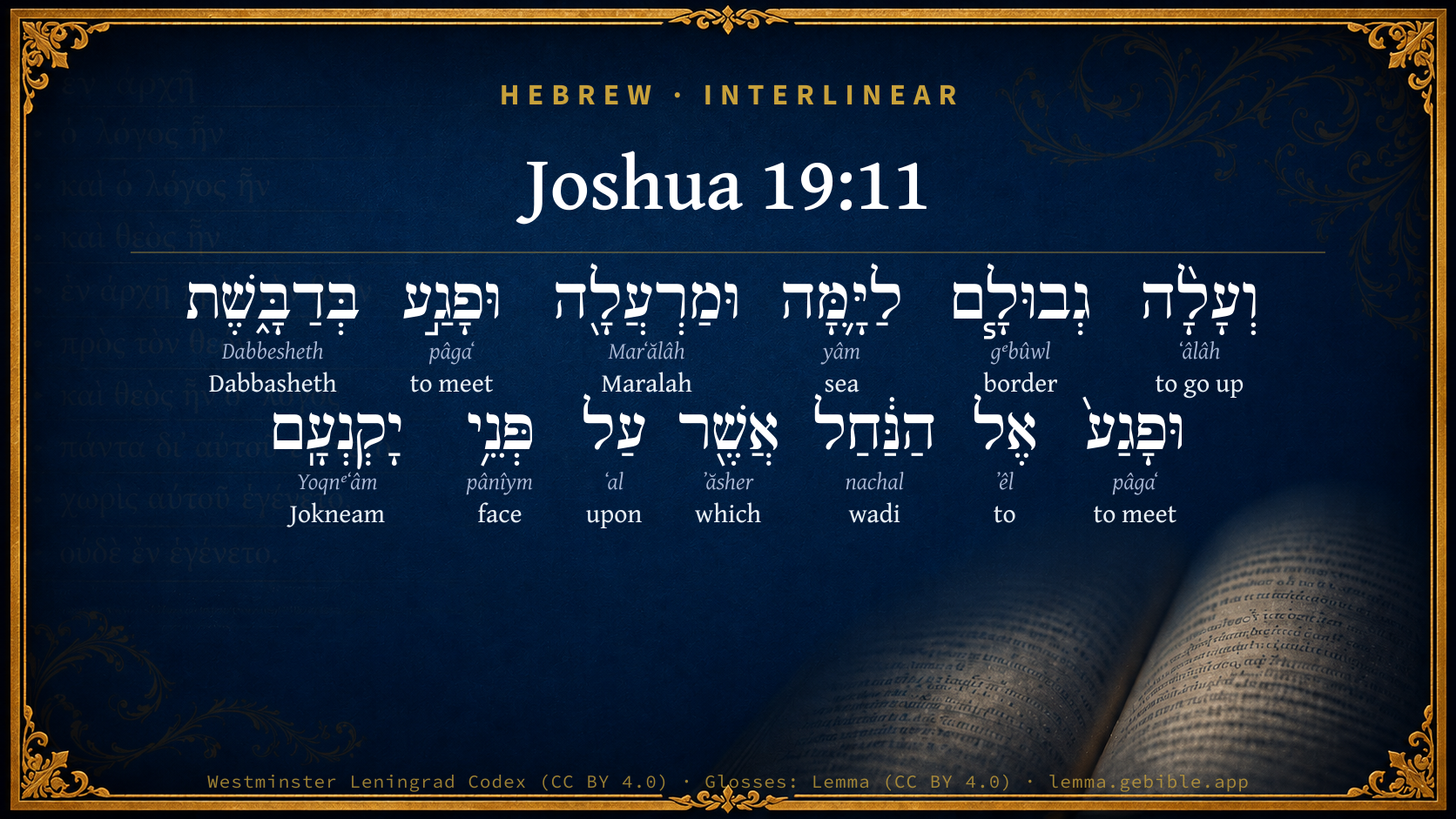
Hebrew (Westminster Leningrad Codex) Joshua 19:11 appears in the Hebrew Old Testament. The text above is from the Westminster Leningrad Codex. Each word links to its Strong’s number, a concise gloss, and parsing drawn from the Open Scriptures Hebrew Bible morphology. Click any word for its full Brown-Driver-Briggs (BDB) entry.
Download image
Cite this verse

Joshua 19:11 (World English Bible). Public Domain. Lemma interlinear Bible study tool, https://lemma.gebible.app/v/joshua/19/11.

Show BibTeX & RIS
BibTeX
RIS
English Translation
and their border went up westward, even to Maralah, and reached to Dabbesheth; and it reached to the brook that is before Jokneam;
World English Bible · Public Domain
Highlights
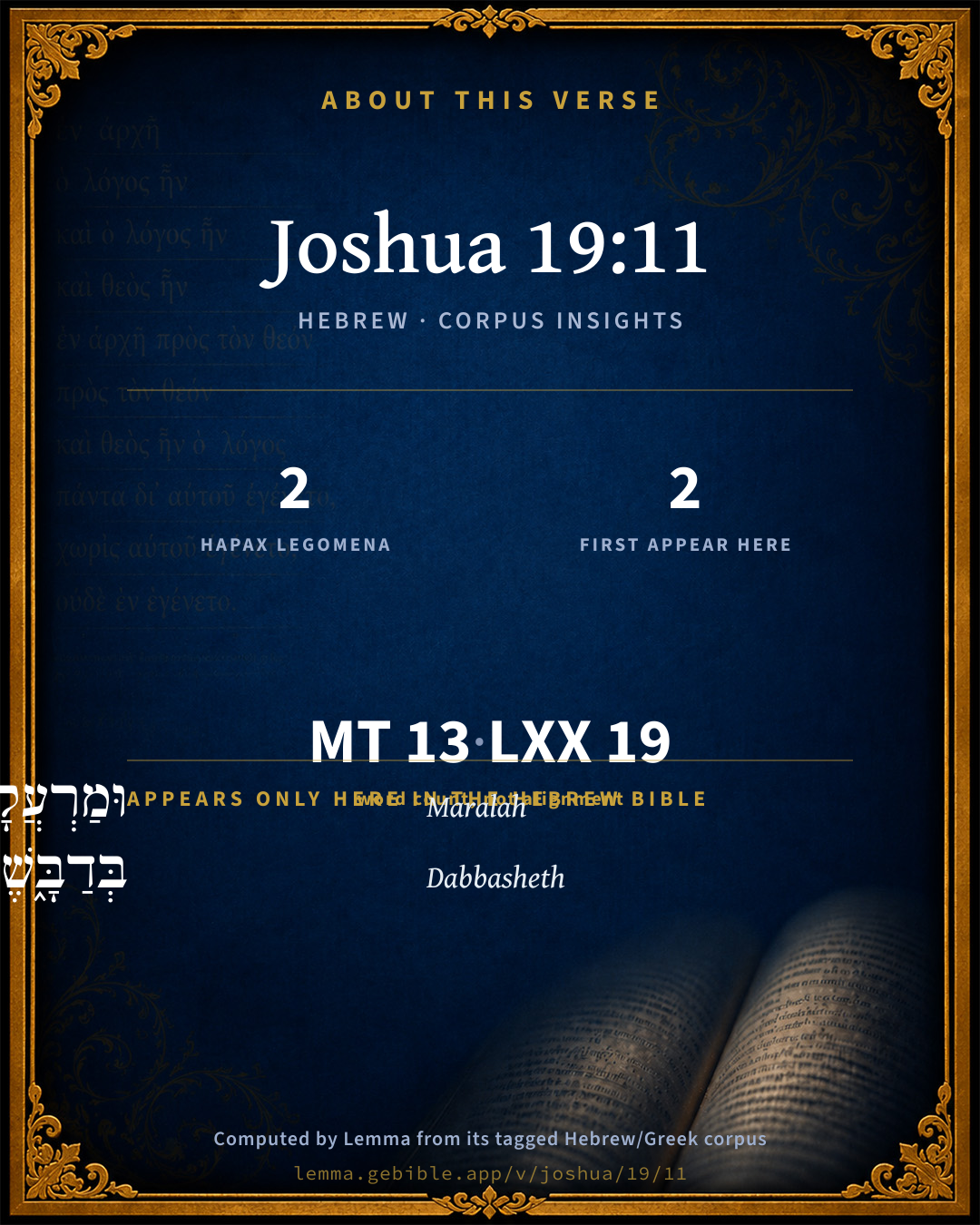
  • 2 hapax legomena — only here in the Hebrew Bible
  • 2 first appearances in the Hebrew Bible
Full analysis ↓
Download a study sheet

One document with this verse’s original text, its word-by-word gloss line, the meaning frame, cross-references with their text, attributed commentary, and full source and license credits — printable, and it pastes into notes with its structure intact.

This verse Autodidact and up

Study sheet (.html) Plain text (.txt)

A passage Seminary Student

Up to 50 verses in one chapter. A passage sheet keeps up to 6 commentary sources and 12 cross-references per verse, in the order this page ranks them, and says so on the sheet whenever that leaves anything out. Ask for a single verse and you get the Autodidact verse sheet above.

Everything on this page stays free to read, with no account — the sheet is a download of what is already on screen, not access to it.

Want to remove ads? Support Godless Engineer
Compare translations 3

The same verse in 3 English versions, stacked beneath the original-language interlinear above. Click any original word for its lexicon entry.

Each is an independent rendering of the whole verse — the interlinear is not word-aligned to these translations.

Highlighted words mark where these versions differ — a whole-verse word diff, not a word-by-word alignment.

  • World English Bible Public Domain
    and their border went up westward, even to Maralah, and reached to Dabbesheth; and it reached to the brook that is before Jokneam;
  • King James Version Public Domain
    And their border went up toward the sea, and Maralah, and reached to Dabbasheth, and reached to the river that is before Jokneam;
  • unfoldingWord Literal Text CC BY-SA 4.0
    And their border went up toward the sea and Maralah, and it met with Dabbesheth and met with the wadi that on the face of Jokneam.

unfoldingWord Literal Text — © unfoldingWord, licensed CC BY-SA 4.0. Word-aligned USFM3 via Door43 (git.door43.org/unfoldingWord/en_ult).

Versions to compare (up to 4)

3 of 4 selected

Show all 18 translations

Every available English version of this verse, each an independent rendering of the whole verse.

  • World English Bible Public Domain
    and their border went up westward, even to Maralah, and reached to Dabbesheth; and it reached to the brook that is before Jokneam;
  • Berean Standard Bible Public Domain
    It went up westward to Maralah, reached Dabbesheth, and met the brook east of Jokneam.
  • Majority Standard Bible Public Domain
    It went up westward to Maralah, reached Dabbesheth, and met the brook east of Jokneam.
  • King James Version Public Domain
    And their border went up toward the sea, and Maralah, and reached to Dabbasheth, and reached to the river that is before Jokneam;
  • American Standard Version (1901) Public Domain
    and their border went up westward, even to Maralah, and reached to Dabbesheth; and it reached to the brook that is before Jokneam;
  • Revised Version (1885) Public Domain
    and their border went up westward, even to Maralah, and reached to Dabbesheth; and it reached to the brook that is before Jokneam;
  • Geneva Bible (1599) Public Domain
    And their border goeth vp Westwarde, euen to Maralah, and reacheth to Dabbasheth, and meeteth with the riuer that lyeth before Iokneam,
  • Douay-Rheims (1899) Public Domain
    And it went up from the sea and from Merala, and came to Debbaseth: as far as the torrent, which is over against Jeconam.
  • Young's Literal Translation Public Domain
    and their border hath gone up towards the sea, and Maralah, and come against Dabbasheth, and come unto the brook which `is' on the front of Jokneam,
  • Literal Standard Version CC BY-SA 4.0
    and their border has gone up toward the sea, and Maralah, and come against Dabbasheth, and come to the brook which [is] on the front of Jokneam,
  • Unlocked Literal Bible CC BY-SA 4.0
    Their border went up westward toward Maralah and touched Dabbesheth; then it extended to the brook that was opposite Jokneam.
  • unfoldingWord Literal Text CC BY-SA 4.0
    And their border went up toward the sea and Maralah, and it met with Dabbesheth and met with the wadi that on the face of Jokneam.
  • Darby Bible Public Domain
    and their border went up westwards, and [to] Marealah, and reached to Dabbesheth, and reached to the torrent that is before Jokneam;
  • World Messianic Bible Public Domain
    Their border went up westward, even to Maralah, and reached to Dabbesheth. It reached to the brook that is before Jokneam.
  • Webster's Bible Public Domain
    And their border went up towards the sea, and Maralah, and reached to Dabbasheth, and reached to the river that is before Jokneam,
  • Free Bible Version CC BY-SA 4.0
    and then went west past Maralah, touched Dabbeshah, and then the brook near Jokneam.
  • Bible in Basic English Public Domain
    And their limit goes up to the west to Maralah, stretching to Dabbesheth, and to the stream in front of Jokneam;
  • JPS Tanakh (1917) Public Domain
    And their border went up westward, even to Maralah, and reached to Dabbesheth; and it reached to the brook that is before Jokneam.

Literal Standard Version (2020), Covenant Press — licensed CC BY-SA 4.0. Text via the HelloAO Bible API (eBible.org). Unlocked Literal Bible (unfoldingWord) — licensed CC BY-SA 4.0. Text via the HelloAO Bible API (eBible.org). unfoldingWord Literal Text — © unfoldingWord, licensed CC BY-SA 4.0. Word-aligned USFM3 via Door43 (git.door43.org/unfoldingWord/en_ult). Free Bible Version, Dr. Jonathan Gallagher — licensed CC BY-SA 4.0. Text via the HelloAO Bible API (eBible.org).

Word by word

More ways to search: Search by grammar → Find every occurrence → Compare this word →

Practice this passage: Drill this verse → Learn its vocabulary →

וּמַרְעֲלָ֖ה
Marʻălâh
H4831
“and · Maralah”
Conjunction + Noun, Proper
Part of Speech
Conjunction + Noun
Type
Proper
Full BDB Definition

Origin: from H7477

TWOT: None

Maralah = "trembling" - a town or landmark on the border of Zebulun
  1. וְעָלָ֨ה ʻâlâh H5927 “and · to go up” Conjunction + Verb, Qal, Perfect, 3rd Person, Masculine, Singular
  2. גְבוּלָ֧ם gᵉbûwl H1366 “border · their” Noun, Common, Masculine, Singular, Construct + Suffix, Personal, 3rd Person, Masculine, Plural
  3. לַיָּ֛מָּה yâm H3220 “to/for the · sea · toward” Preposition, Determined + Noun, Common, Masculine, Singular, Absolute + Suffix, Demonstrative
  4. וּפָגַ֣ע pâgaʻ H6293 “and · to meet” Conjunction + Verb, Qal, Perfect, 3rd Person, Masculine, Singular
  5. בְּדַבָּ֑שֶׁת Dabbesheth H1708 “in/at · Dabbasheth” Preposition + Noun, Proper
  6. וּפָגַע֙ pâgaʻ H6293 “and · to meet” Conjunction + Verb, Qal, Perfect, 3rd Person, Masculine, Singular
  7. אֶל ʼêl H413 “to” Preposition
  8. הַנַּ֔חַל nachal H5158 “the · wadi” Particle, Definite Article + Noun, Common, Masculine, Singular, Absolute
  9. אֲשֶׁ֖ר ʼăsher H834 “which” Particle, Relative
  10. עַל ʻal H5921 “upon” Preposition
  11. פְּנֵ֥י pânîym H6440 “face(s) of” Noun, Common, Both, Plural, Construct
  12. יָקְנְעָֽם Yoqnᵉʻâm H3362 “Jokneam” Noun, Proper

About this verse

These counts appear in no published source. They are computed here, from the morphology-tagged text and Lemma’s own curated glosses. What Lemma adds →

13
words
12
distinct lemmas
Historical
section

Notable vocabulary

2 hapax legomena — words that appear only here in the entire Hebrew Bible:

  • וּמַרְעֲלָ֖ה Maralah H4831
  • בְּדַבָּ֑שֶׁת Dabbasheth H1708

First appearance in Scripture

These words make their first canonical appearance in the Hebrew Bible here:

  • וּמַרְעֲלָ֖ה Maralah H4831
  • בְּדַבָּ֑שֶׁת Dabbasheth H1708

Shared distinctive vocabulary

יָקְנְעָֽם Jokneam H3362 occurs in 3 verses of the Hebrew Bible. Also found in:

Grammatical profile

  • 3 verbs
  • 7 nouns
  • 2 prepositions
  • 1 particle

Verb forms

  • וְעָלָ֨ה Qal · Perfect
  • וּפָגַ֣ע Qal · Perfect
  • וּפָגַע֙ Qal · Perfect

Repetition

A word recurs within this verse — often emphatic in Hebrew:

  • וּפָגַ֣ע to meet H6293 ×2

Hebrew & Septuagint length

In English translation the verse runs 23 words from the Hebrew and 17 from the Septuagint (LXX English) — closely comparable.

A rough comparison of the two English renderings, which tokenize alike — not a word-level alignment.

Word counts can differ between the Hebrew and the Greek without any difference in meaning — e.g. the Hebrew direct-object marker אֵת has no separate Greek word, and Greek often adds the article ὁ.

In the original languages it is 13 Hebrew tokens and 19 Greek tokens — but the two are counted differently (Hebrew bundles its prefixes and suffixes into one token; the Greek is in lemma form), so that isn’t a like-for-like length.

Cross-references

3

Topical passages linked to Joshua 19:11 in the Treasury of Scripture Knowledge — connected by theme and wording, ordered by reader-vote popularity; previews shown in the World English Bible.

  • Joshua 12:22 the king of Kedesh, one; the king of Jokneam in Carmel, one;
  • 1 Kings 4:12 Baana the son of Ahilud, in Taanach and Megiddo, and all Beth-shean which is beside Zarethan, beneath Jezreel, from Beth-shean to Abel Meholah, as far as beyond Jokmeam;
  • 1 Chronicles 6:68 and Jokmeam with its suburbs, and Beth Horon with its suburbs,

Cross-references courtesy of OpenBible.info (CC BY 4.0).

Hebrew and Greek witnesses Masoretic Hebrew ↔ Greek Septuagint

The same verse in the two great witnesses to the Old Testament, shown verse-for-verse.

These are two independent witnesses, not word-aligned to each other, and the Septuagint is shown in lemma (dictionary) form.

Hebrew Joshua 19:11 Masoretic · Westminster Leningrad Codex

וְעָלָ֨ה גְבוּלָ֧ם לַיָּ֛מָּה וּמַרְעֲלָ֖ה וּפָגַ֣ע בְּדַבָּ֑שֶׁת וּפָגַע֙ אֶל הַנַּ֔חַל אֲשֶׁ֖ר עַל פְּנֵ֥י יָקְנְעָֽם

and their border went up westward, even to Maralah, and reached to Dabbesheth; and it reached to the brook that is before Jokneam;

World English Bible · Public Domain

Greek LXX Joshua 19:11 Septuagint · lemma form

γωλα ὅριον αὐτός ὁ θάλασσα καί μαραγελλα καί συνἅπτω ἐπί βαιθαραβά εἰς ὁ φάραγξ ὅς εἰμί κατά πρόσωπον ιεκμαν

the sea and Magelda, and it shall reach to Baetharaba in the valley, which is opposite Jekman.

LXX2012 (modern English Septuagint) · Public Domain

Hebrew: Westminster Leningrad Codex (CC BY 4.0). Greek: Septuagint (public domain); English from LXX2012 (modern English Septuagint) (Public Domain). How the Septuagint differs from the Hebrew →

Targum (Aramaic paraphrase)

1

The Targum is the ancient Jewish Aramaic paraphrase of the Hebrew Scriptures — an interpretive translation, not the Hebrew text itself. Onkelos (literal) and Pseudo-Jonathan (expansive) render the Torah, and Jonathan the Prophets. Coverage is partial: where no permissively-licensed English translation exists for a verse, only the Aramaic is shown. This is verse-level text, not a word-by-word alignment to the Hebrew.

  1. Targum Jonathan Prophets (Joshua–Malachi)
    וּסְלִיק תְּחוּמְהוֹן לְיַמָא וּמַרְעֲלָא וּמְעָרַע בְּדַבָּשֶׁת וּמְעָרַע בְּנַחֲלָא דִי עַל אַפֵי יָקְנְעָם:

    (no public-domain English translation for this verse)

    Targum Jonathan — Aramaic: “Mikraot Gedolot” (public domain). English: “Sefaria Community Translation” (CC0 1.0 (public-domain dedication)); “London "Chaldee Paraphrase," 1871” (public domain). Text via Sefaria.

Commentary

Notes on Joshua 19:11 from classic Christian and Jewish commentators (each source and its license shown beneath its notes). The classic Christian expositions comment on the surrounding passage and are grouped to its opening verse, so a note may address several verses; the Jewish commentaries on the Tanakh (Rashi and others) are per-verse, so they appear only where the commentator wrote on this verse.

Lemma curates 59 commentaries, every one of them public domain or Creative Commons licensed, each selected and text-cleaned for this edition rather than reprinted as found. About our sources →

Joseph Benson's Commentary

Jos 19:11. Toward the sea — The lot of this tribe was washed by the midland sea on the west, and by the sea of Tiberias on the east, answering Jacob’s prophecy, Zebulun shall be a haven of ships; trading ships on the great sea, and fishing ships on the sea of Galilee. Before Jokneam — Supposed to be Kishon.

Joseph Benson's Commentary on the Old and New Testaments (1811–1818) — public domain. Text from a community e-Sword module.

Geneva Bible (1599)

Geneva Bible translators

Meaning, toward the great Sea.

Geneva Bible (1599) marginal notes — public domain. Text via Bolls.life.

The Cambridge Bible for Schools and Colleges

gen. ed. J. J. S. Perowne

11. and went up] From Sarid the southern border went up toward the sea in a westerly direction, and that as far as Maralah, somewhere on the mountains of Carmel, and touched upon Dabbasheth (= Camel’s hump), the site of which is unknown, the stream which is before Jokneam. In ch. Jos_12:22, Jokneam is said to have been by Carmel, and is identified with the modern Tell Kaimon, an eminence which stands just below the eastern end of Carmel. “The stream,” therefore, is in all probability the Kishon (= “twisted” or “winding”), famous (a) in the history of Deborah and Barak (Jdg_4:7; Jdg_4:13; Jdg_5:21), and (b) in that of Elijah and the prophets of Baal (1Ki_18:40). See Menke’s map in his Bibel-atlas.

The Cambridge Bible for Schools and Colleges (gen. ed. J. J. S. Perowne; Cambridge University Press, 1878–1918) — public domain. Text from a community e-Sword module.

John Gill's Exposition

And turned from Sarid eastward,.... This describes the southern border, going on from west to east:

towards the sunrising, unto the border of Chislothtabor; this Jerom places in the tribe of Issachar, it bordered on both tribes; and he says (l), that in his time there was a little village called Chaselus, eight miles from Diocaesarea, at the foot of Mount Tabor in the plains:

and then goeth out to Daberath; which also was a city in the tribe of Issachar, given to the Levites, Jos 21:28. Jerom (m) speaks of a little village of the Jews by Mount Tabor, of the country belonging to Diocaesarea, called Dabira; this place is still in being. Mr. Maundrell says (n), at the bottom of Tabor westward stands Debarah, supposed by some to take its name from Deborah, the famous judge and deliverer of Israel:

and goeth up to Japhia; this Jerom (o) says is the town called Sycamine, as you go from Caesarea to Ptolemais, above the sea, because of Mount Carmel, called Epha, thought by some to be the Jebba of Pliny (p). It seems, however, to be the Japha of Josephus (q), which he speaks of as being a strong fortified place both by nature and art.

(l) De loc. Heb. fol. 88. D. H. (m) lbid. fol. 90. I. (n) Journey from Aleppo, &c. p. 115. (o) De loc. Heb. fol. 92. K. (p) Nat. Hist. l. 5. c. 19. (q) De Bello Jud. l. 3. c. 6. sect. 31.

John Gill's Exposition of the Whole Bible (1746–1763) — public domain (CC PDM 1.0). Text via the HelloAO Bible API.

Haydock's Catholic Bible Commentary

From the sea. Hebrew, "towards the sea." Bonfrere asserts that Zabulon did not extend quite to the shore of the Mediterranean, chap. xvii. 10. (Calmet) --- Torrent, near Sidon, which some call the river Belus or Papis. (Pliny, [Natural History?] v. 19.

George Leo Haydock (1774–1849), Haydock's Catholic Family Bible and Commentary, 1859 edition — public domain. Excludes Psalms (Douay-Rheims chapter numbering differs from Protestant) and Deuterocanonical books (Catholic canon only).

Matthew Poole's English Annotations

The sea, i.e. the midland sea, as on the other side it reached to the sea of Galilee, and so those prophecies concerning him, Gen 49:13; Deu 33:18, were abundantly fulfilled.

Jokneam: supposed to be Kishon, Jdg 4:7, or Belus, or Pagis.

Matthew Poole's English Annotations on the Holy Bible (1683–1685) — public domain. Text from a community e-Sword/MySword module.

Whedon's Commentary on the Bible

Daniel D. Whedon

11. Toward the sea — The Mediterranean. But apparently not to the sea, for Asher reached to Carmel, (Jos_19:26,) and, according to Jos_17:10, touched Manasseh on the south. Maralah may, perhaps, be found in the little village Mahil, which occupies the top of a hill four miles southwest of Nazareth, and contains the ruins of a temple and other vestiges of antiquity. But this is not certain.

Jokneam — The modern Tell Kaimon, close to the base of Carmel and on the south bank of the Kishon. See on Jos_12:22. So the river here mentioned must be the ancient Kishon. See on Jdg_5:21.]

Daniel D. Whedon (gen. ed.), Commentary on the Old and New Testaments (1874–1909) — public domain. Text from a community e-Sword module.

The Pulpit Commentary

Toward the sea. Rather, westward. The original is touched or skirted (gp). River that is before Jokneam. This, with the assistance of Jos_12:22, which mentions Jokneam as near to Mount Carmel, enables us to identify this river (or rather, winter torrent), as "that ancient river, the river Kishon." Knobel, however, says that if the Kishon had been meant it would have been called by its name, and that we must therefore understand the Wady-el-Mil"h. But this is by no means a safe conclusion.

The Pulpit Commentary (1880–1919), ed. H.D.M. Spence-Jones & Joseph S. Exell — public domain. Text from a community e-Sword module.

John Wesley's Explanatory Notes

Toward the sea - The lot of this tribe was washed by the midland sea on the west, and by the sea of Tiberias on the east, answering Jacob's prophecy, Zebulun shall be an haven of ships; trading ships on the great sea, and fishing ships on the sea of Galilee. Before Jokneam - Supposed to be Kishon.

John Wesley, Explanatory Notes Upon the Whole Bible (1754–1765) — public domain. Text via the GEBible commentary corpus.

Lesson kit

Teaching starters — assembled from the data on this page, not authored interpretation. Every prompt links to the verse data it draws on. Edit before teaching.

Joshua, in the Historical, opens this verse with 13 words (12 distinct Hebrew lemmas). Its most distinctive word is Marʻălâh (“Maralah”). A historical commentator’s framing appears above. Read the whole chapter for the surrounding context.

Discussion questions

  1. What does “Maralah” (Marʻălâh) contribute to the verse as a whole?
  2. This verse holds 2 words here found nowhere else in the Hebrew Bible. What might the rare words draw attention to?
  3. 2 words here appear for the first time in Scripture. What is being introduced at this debut?
  4. Joshua 12:22 shares the word «Jokneam» with this verse. How do the two illuminate each other?
  5. “to meet” occurs 2× in this one verse. What is the effect of the repetition?
  6. These translations render this verse differently. What is at stake in choosing one wording over another?
  7. The verb «וְעָלָ֨ה» is Qal Perfect. How does its form color the action?
  8. Reading how Joseph Benson's Commentary and Geneva Bible (1599) read this verse, where do the two commentators agree and where do they part?

Things to notice

  • 2 words in this verse appear nowhere else in the Hebrew Bible.
  • 2 words make their first canonical appearance in Scripture here.
  • This verse counts 13 Hebrew ↔ 19 Greek words.
  • These translations choose different wording for 13 words in this verse.
  • “to meet” occurs 2× in this single verse.

Reading settings

Reading text

Shown beneath each verse's original-language words.

Old Testament
Old Testament edition

Read the OT as the Masoretic Hebrew (MT) or the Greek Septuagint (LXX).

English shown for the Greek Septuagint (in the Hebrew ↔ Greek comparison).

Comparing translations? Open the Compare panel on any verse page to stack up to four side by side.