1 Kings 9:26

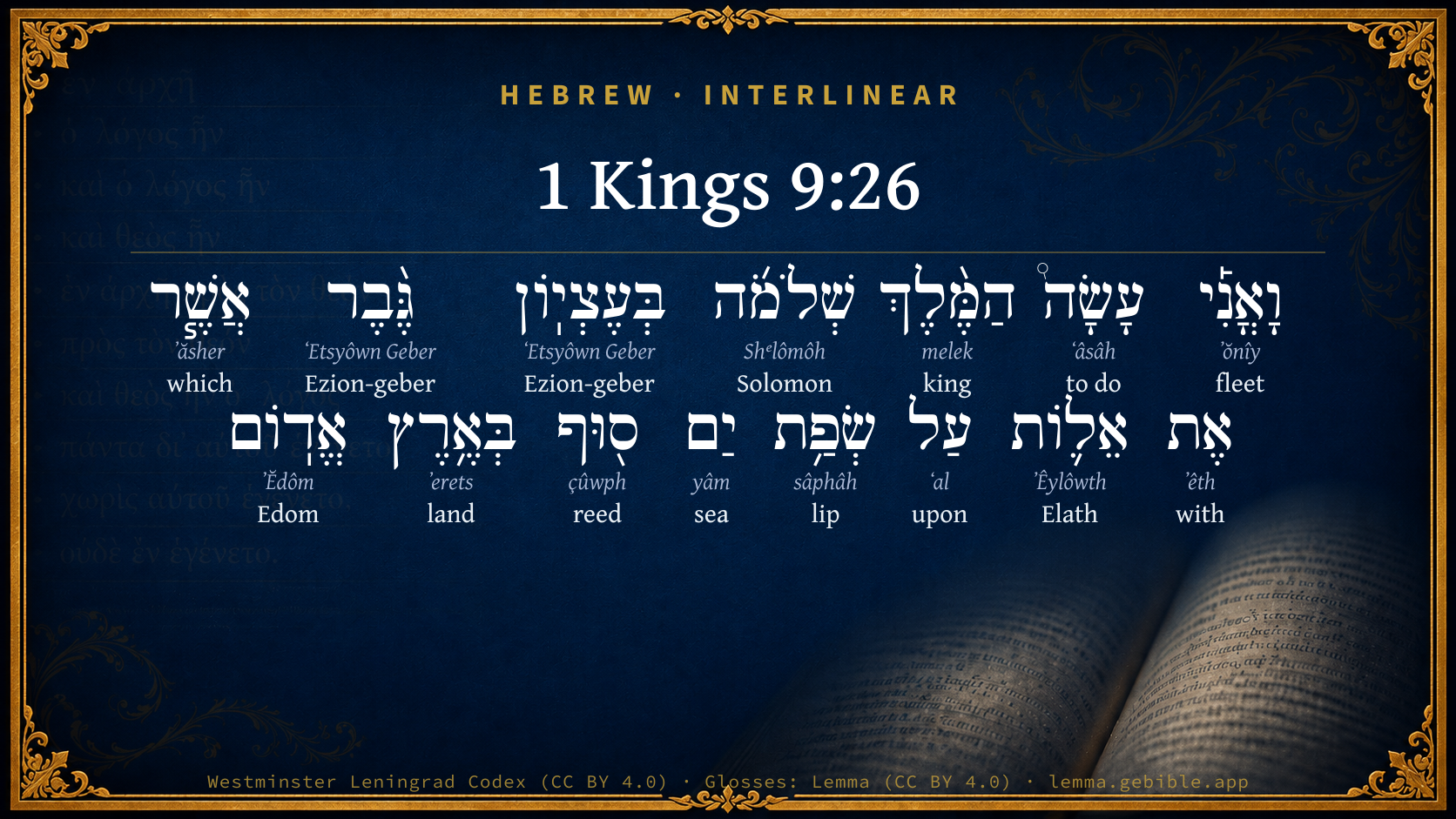
Hebrew (Westminster Leningrad Codex) 1 Kings 9:26 appears in the Hebrew Old Testament. The text above is from the Westminster Leningrad Codex. Each word links to its Strong’s number, a concise gloss, and parsing drawn from the Open Scriptures Hebrew Bible morphology. Click any word for its full Brown-Driver-Briggs (BDB) entry.
Download image
Cite this verse

1 Kings 9:26 (World English Bible). Public Domain. Lemma interlinear Bible study tool, https://lemma.gebible.app/v/1-kings/9/26.

Show BibTeX & RIS
BibTeX
RIS
English Translation
King Solomon made a navy of ships in Ezion Geber, which is beside Eloth, on the shore of the Red Sea, in the land of Edom.
World English Bible · Public Domain
Highlights
  • 1 first appearance in the Hebrew Bible
Full analysis ↓
Download a study sheet

One document with this verse’s original text, its word-by-word gloss line, the meaning frame, cross-references with their text, attributed commentary, and full source and license credits — printable, and it pastes into notes with its structure intact.

This verse Autodidact and up

Study sheet (.html) Plain text (.txt)

A passage Seminary Student

Up to 50 verses in one chapter. A passage sheet keeps up to 6 commentary sources and 12 cross-references per verse, in the order this page ranks them, and says so on the sheet whenever that leaves anything out. Ask for a single verse and you get the Autodidact verse sheet above.

Everything on this page stays free to read, with no account — the sheet is a download of what is already on screen, not access to it.

Want to remove ads? Support Godless Engineer
Compare translations 3

The same verse in 3 English versions, stacked beneath the original-language interlinear above. Click any original word for its lexicon entry.

Each is an independent rendering of the whole verse — the interlinear is not word-aligned to these translations.

Highlighted words mark where these versions differ — a whole-verse word diff, not a word-by-word alignment.

  • World English Bible Public Domain
    King Solomon made a navy of ships in Ezion Geber, which is beside Eloth, on the shore of the Red Sea, in the land of Edom.
  • King James Version Public Domain
    And king Solomon made a navy of ships in Eziongeber, which is beside Eloth, on the shore of the Red sea, in the land of Edom.
  • unfoldingWord Literal Text CC BY-SA 4.0
    And King Solomon made a fleet in Ezion Geber, which near Elath on the lip of the Sea of Reeds in the land of Edom.

unfoldingWord Literal Text — © unfoldingWord, licensed CC BY-SA 4.0. Word-aligned USFM3 via Door43 (git.door43.org/unfoldingWord/en_ult).

Versions to compare (up to 4)

3 of 4 selected

Show all 18 translations

Every available English version of this verse, each an independent rendering of the whole verse.

  • World English Bible Public Domain
    King Solomon made a navy of ships in Ezion Geber, which is beside Eloth, on the shore of the Red Sea, in the land of Edom.
  • Berean Standard Bible Public Domain
    King Solomon also assembled a fleet of ships at Ezion-geber, which is near Eloth in Edom, on the shore of the Red Sea.
  • Majority Standard Bible Public Domain
    King Solomon also assembled a fleet of ships at Ezion-geber, which is near Eloth in Edom, on the shore of the Red Sea.
  • King James Version Public Domain
    And king Solomon made a navy of ships in Eziongeber, which is beside Eloth, on the shore of the Red sea, in the land of Edom.
  • American Standard Version (1901) Public Domain
    And king Solomon made a navy of ships in Ezion-geber, which is beside Eloth, on the shore of the Red Sea, in the land of Edom.
  • Revised Version (1885) Public Domain
    And king Solomon made a navy of ships in Ezion-geber, which is beside Eloth, on the shore of the Red Sea, in the land of Edom.
  • Geneva Bible (1599) Public Domain
    Also King Salomon made a nauie of ships in Ezeon-geber, which is beside Eloth, and the brinke of the red Sea, in the land of Edom.
  • Douay-Rheims (1899) Public Domain
    And king Solomon made a fleet in Asiongaber, which is by Ailath on the shore of the Red Sea in the land of Edom.
  • Young's Literal Translation Public Domain
    And a navy hath king Solomon made in Ezion-Geber, that is beside Eloth, on the edge of the Sea of Suph, in the land of Edom.
  • Literal Standard Version CC BY-SA 4.0
    And King Solomon has made a navy in Ezion-Geber, that is beside Eloth, on the edge of the Sea of Suph, in the land of Edom.
  • Unlocked Literal Bible CC BY-SA 4.0
    King Solomon built a fleet of ships in Ezion Geber, which is near Elath on the shore of the Red Sea, in the land of Edom.
  • unfoldingWord Literal Text CC BY-SA 4.0
    And King Solomon made a fleet in Ezion Geber, which near Elath on the lip of the Sea of Reeds in the land of Edom.
  • Darby Bible Public Domain
    And king Solomon made a fleet of ships in Ezion-Geber, which is beside Eloth, on the shore of the Red Sea, in the land of Edom.
  • World Messianic Bible Public Domain
    King Solomon made a fleet of ships in Ezion Geber, which is beside Eloth, on the shore of the Sea of Suf, in the land of Edom.
  • Webster's Bible Public Domain
    And king Solomon made a navy of ships in Ezion-geber, which is beside Eloth, on the shore of the Red Sea, in the land of Edom.
  • Free Bible Version CC BY-SA 4.0
    King Solomon built a fleet of ships at Ezion-geber, which is near Eloth on the shore of the Red Sea, in the land of Edom.
  • Bible in Basic English Public Domain
    And King Solomon made a sea-force of ships in Ezion-geber, by Eloth, on the Red Sea, in the land of Edom.
  • JPS Tanakh (1917) Public Domain
    And king Solomon made a navy of ships in Ezion-geber, which is beside Eloth, on the shore of the Red Sea, in the land of Edom.

Literal Standard Version (2020), Covenant Press — licensed CC BY-SA 4.0. Text via the HelloAO Bible API (eBible.org). Unlocked Literal Bible (unfoldingWord) — licensed CC BY-SA 4.0. Text via the HelloAO Bible API (eBible.org). unfoldingWord Literal Text — © unfoldingWord, licensed CC BY-SA 4.0. Word-aligned USFM3 via Door43 (git.door43.org/unfoldingWord/en_ult). Free Bible Version, Dr. Jonathan Gallagher — licensed CC BY-SA 4.0. Text via the HelloAO Bible API (eBible.org).

Word by word

More ways to search: Search by grammar → Find every occurrence → Compare this word →

Practice this passage: Drill this verse → Learn its vocabulary →

וָאֳנִ֡י
ʼŏnîy
H590
“and · fleet”
Conjunction + Noun, Common, Both, Singular, Absolute
Part of Speech
Conjunction + Noun
Type
Common
Gender
Both
Number
Singular
State
Absolute
Full BDB Definition

Origin: probably from H579 (in the sense of conveyance)

TWOT: 125a , b

fleet, ships
  1. עָשָׂה֩ ʻâsâh H6213 “to do” Verb, Qal, Perfect, 3rd Person, Masculine, Singular
  2. הַמֶּ֨לֶךְ melek H4428 “the · king” Particle, Definite Article + Noun, Common, Masculine, Singular, Absolute
  3. שְׁלֹמֹ֜ה Shᵉlômôh H8010 “Solomon” Noun, Proper
  4. בְּעֶצְיֽוֹן ʻEtsyôwn Geber H6100 “in/at · Ezion-geber” Preposition + Noun, Proper
  5. גֶּ֨בֶר ʻEtsyôwn Geber H6100 “Ezion-geber” Noun, Proper
  6. אֲשֶׁ֧ר ʼăsher H834 “which” Particle, Relative
  7. אֶת ʼêth H854 “with” Preposition
  8. אֵל֛וֹת ʼÊylôwth H359 “Elath” Noun, Proper
  9. עַל ʻal H5921 “upon” Preposition
  10. שְׂפַ֥ת sâphâh H8193 “lip of” Noun, Common, Feminine, Singular, Construct
  11. יַם yâm H3220 “sea of” Noun, Common, Masculine, Singular, Construct
  12. ס֖וּף çûwph H5488 “reed” Noun, Common, Masculine, Singular, Absolute
  13. בְּאֶ֥רֶץ ʼerets H776 “in/at · land of” Preposition + Noun, Common, Both, Singular, Construct
  14. אֱדֽוֹם ʼĔdôm H123 “Edom” Noun, Proper

About this verse

These counts appear in no published source. They are computed here, from the morphology-tagged text and Lemma’s own curated glosses. What Lemma adds →

15
words
14
distinct lemmas
Historical
section

Notable vocabulary

The rarest word here is וָאֳנִ֡י fleet H590 — appearing just 7 times in the whole Hebrew Bible.

First appearance in Scripture

This word makes its first canonical appearance in the Hebrew Bible here:

  • וָאֳנִ֡י fleet H590

Shared distinctive vocabulary

וָאֳנִ֡י fleet H590 occurs in 5 verses of the Hebrew Bible. Also found in:

Grammatical profile

  • 1 verb
  • 11 nouns
  • 2 prepositions
  • 1 particle

Verb forms

  • עָשָׂה֩ Qal · Perfect

Repetition

A word recurs within this verse — often emphatic in Hebrew:

  • בְּעֶצְיֽוֹן Ezion-geber H6100 ×2

Hebrew & Septuagint length

In English translation the verse runs 26 words from the Hebrew and 28 from the Septuagint (LXX English) — closely comparable.

A rough comparison of the two English renderings, which tokenize alike — not a word-level alignment.

Word counts can differ between the Hebrew and the Greek without any difference in meaning — e.g. the Hebrew direct-object marker אֵת has no separate Greek word, and Greek often adds the article ὁ.

Cross-references

6

Topical passages linked to 1 Kings 9:26 in the Treasury of Scripture Knowledge — connected by theme and wording, ordered by reader-vote popularity; previews shown in the World English Bible.

  • 1 Kings 22:48 Jehoshaphat made ships of Tarshish to go to Ophir for gold: but they didn't go; for the ships were broken at Ezion Geber.
  • Numbers 33:35 They traveled from Abronah, and encamped in Ezion Geber.
  • Deuteronomy 2:8 So we passed by from our brothers the children of Esau, who dwell in Seir, from the way of the Arabah from Elath and from Ezion Geber. We turned and passed by the way of the wilderness of Moab.
  • 2 Kings 14:22 He built Elath, and restored it to Judah, after that the king slept with his fathers.
  • 2 Chronicles 8:11–12 Solomon brought up the daughter of Pharaoh out of the city of David to the house that he had built for her; for he said, My wife shall not dwell in the house of David king of Israel, because the places are holy, whereunto the ark of Yahweh has come.
  • 2 Chronicles 8:17–18 Then went Solomon to Ezion Geber, and to Eloth, on the seashore in the land of Edom.

Cross-references courtesy of OpenBible.info (CC BY 4.0).

Hebrew and Greek witnesses Masoretic Hebrew ↔ Greek Septuagint

The same verse in the two great witnesses to the Old Testament, shown verse-for-verse.

These are two independent witnesses, not word-aligned to each other, and the Septuagint is shown in lemma (dictionary) form.

Hebrew 1 Kings 9:26 Masoretic · Westminster Leningrad Codex

וָאֳנִ֡י עָשָׂה֩ הַמֶּ֨לֶךְ שְׁלֹמֹ֜ה בְּעֶצְיֽוֹן גֶּ֨בֶר אֲשֶׁ֧ר אֶת אֵל֛וֹת עַל שְׂפַ֥ת יַם ס֖וּף בְּאֶ֥רֶץ אֱדֽוֹם

King Solomon made a navy of ships in Ezion Geber, which is beside Eloth, on the shore of the Red Sea, in the land of Edom.

World English Bible · Public Domain

Greek LXX 1 Kings 9:26 Septuagint · lemma form
even that for which king Solomon built a ship in Gasion Gaber near Aelath on the shore of the extremity of the sea in the land of Edom.

LXX2012 (modern English Septuagint) · Public Domain

On this verse, The Pulpit Commentary discusses the Septuagint’s reading. Read the note in Commentary ↓

Hebrew: Westminster Leningrad Codex (CC BY 4.0). Greek: Septuagint (public domain); English from LXX2012 (modern English Septuagint) (Public Domain). How the Septuagint differs from the Hebrew →

Targum (Aramaic paraphrase)

1

The Targum is the ancient Jewish Aramaic paraphrase of the Hebrew Scriptures — an interpretive translation, not the Hebrew text itself. Onkelos (literal) and Pseudo-Jonathan (expansive) render the Torah, and Jonathan the Prophets. Coverage is partial: where no permissively-licensed English translation exists for a verse, only the Aramaic is shown. This is verse-level text, not a word-by-word alignment to the Hebrew.

  1. Targum Jonathan Prophets (Joshua–Malachi)
    וּסְפִינָתָא עֲבַד שְׁלֹמֹה מַלְכָּא בְּעֶצְיוֹן גֶּבֶר דְעִם אֵילוֹת עַל כֵּיף יַמָא דְסוּף בְּאַרְעָא דֶאֱדוֹם:

    (no public-domain English translation for this verse)

    Targum Jonathan — Aramaic: “Mikraot Gedolot” (public domain). English: “Sefaria Community Translation” (CC0 1.0 (public-domain dedication)); “London "Chaldee Paraphrase," 1871” (public domain). Text via Sefaria.

Commentary

Notes on 1 Kings 9:26 from classic Christian and Jewish commentators (each source and its license shown beneath its notes). The classic Christian expositions comment on the surrounding passage and are grouped to its opening verse, so a note may address several verses; the Jewish commentaries on the Tanakh (Rashi and others) are per-verse, so they appear only where the commentator wrote on this verse.

Lemma curates 59 commentaries, every one of them public domain or Creative Commons licensed, each selected and text-cleaned for this edition rather than reprinted as found. About our sources →

Trapp's Complete Commentary

John Trapp

1Ki 9:26 And king Solomon made a navy of ships in Eziongeber, which [is] beside Eloth, on the shore of the Red sea, in the land of Edom.

Ver. 26. And king Solomon made a navy of ships.] Not now first, but when he first began to build, or before. Neither out of covetousness, but for the ease of the people, and to defray his great charges. Fabrica enim opes etiam regias et maximas exhaurit. Building is very costly.

In Eziongeber.] Jehoshaphat did the like, but with unlike success; and why? see 1Ki 22:48.

John Trapp, A Commentary or Exposition upon All the Books of the Old and New Testament (1647–1656) — public domain. Text from a community e-Sword module.

Joseph Benson's Commentary

1Ki 9:26-27. King Solomon made a navy of ships — Not now, in the order in which it is placed in the history, but in the beginning of his reign; as appears from this consideration, that the almug-trees, used in the work of the Lord’s house, were brought in this navy from Ophir, (1Ki 10:11-12; 2Ch 9:10-11,) which was a three years voyage, 1Ki 9:22. And Hiram sent in the navy his servants — The navy was Solomon’s, who had servants of his own on board the ships, to manage the traffic; but as they had no skill in navigation, Hiram sent as many sailors as were necessary to man the ships, the Tyrians being in general bred at sea, and famous for their knowledge in maritime affairs.

Joseph Benson's Commentary on the Old and New Testaments (1811–1818) — public domain. Text from a community e-Sword module.

Tyndale Open Study Notes

Tyndale Open Resources

9:26-28 The seaport of Ezion-geber was situated on the Gulf of Aqaba, which opens onto the Red Sea. The location of Ophir is uncertain but may have been located in southwestern Arabia, eastern Africa, or India; the mention of gold and other precious commodities (see 10:11-12) indicates its strategic importance for trade.

Tyndale Open Study Notes — © Tyndale Open Resources, licensed CC BY-SA 4.0. Text via the HelloAO Bible API.

Jamieson, Fausset & Brown

Robert Jamieson, A. R. Fausset & David Brown

Ezion-geber, which is beside Eloth--These were neighboring ports at the head of the eastern or Elanitic branch of the Red Sea. Tyrian ship carpenters and sailors were sent there for Solomon's vessels (see on Ch2 8:17-18).

Ezion-geber--that is, "the giant's backbone"; so called from a reef of rocks at the entrance of the harbor.

Eloth--Elim or Elath; that is, "the trees"; a grove of terebinths still exists at the head of the gulf.

Jamieson, Fausset & Brown — Commentary Critical and Explanatory on the Whole Bible (1871) — public domain (CC PDM 1.0). Text via the HelloAO Bible API.

Adam Clarke's Commentary

Verse 26. A navy of ships] Literally, אני oni, a ship: in the parallel place, 2Ch 8:17, it is said that Hiram sent him אניות oniyoth, ships; but it does not appear that Solomon in this case built more than one ship, and this was manned principally by the Tyrians.

Adam Clarke's Commentary on the Bible (1810–1826) — public domain. Text from a community e-Sword/MySword module.

Ellicott's Commentary for English Readers

(26) Ezion-geber.—This place is first noticed in Num_33:35 and Deu_2:8 as a station in the wanderings of the Israelites, reached not long before their entrance into Canaan. It lies at the head of the Gulf of Akabah, the nearest point of the Red Sea, on the edge of the mountain country of Edom. Its very name (“the giant’s backbone”) indicates the nature of the country around it, which (it has been noted) could hardly have itself supplied timber for ship-building. But from 2Ch_8:18 it appears that the ships, or the materials from which they were built, were sent from Tyre.

A Bible Commentary for English Readers, edited by Charles John Ellicott (1878–1897) — public domain. Text from a community e-Sword module.

The Cambridge Bible for Schools and Colleges

gen. ed. J. J. S. Perowne

26–28. Solomon’s navy (2Ch_8:17-18)

26. in Ezion-geber] The name signifies ‘the Giant’s chine,’ and it was probably a promontory. Ezion-geber is mentioned first in the narrative of the journey of the Israelites from Egypt (Num_33:35). It was the last halting-place before they entered the wilderness of Zin. It lay at the top of the gulf of Akabah. Here was also Eloth (or Elath) of which we read (2Ki_14:22) that, though it is here said to be in the land of Edom, it was conquered for Judah at a later time, and still later (2Ki_16:6) came into the possession of Rezin king of Syria.

In reference to this navy, we are told (2Ch_8:18) that Hiram sent Solomon the ships. Putting that passage side by side with this, it can only mean that the wood for ship-building was brought from Tyre along the coast as far as was necessary, and then at the nearest point carried over land to the Gulf of Akabah, where the ships were built. The only other interpretation of the statement in 2 Chronicles would be that Hiram sent ships from Tyre round Africa and then by the Indian Ocean into the Red Sea, which cannot for a moment be supposed.

The Cambridge Bible for Schools and Colleges (gen. ed. J. J. S. Perowne; Cambridge University Press, 1878–1918) — public domain. Text from a community e-Sword module.

John Gill's Exposition

And they came to Ophir,.... About which place there are various opinions; some take it to be the little island of Zocatora, on the eastern coast of Africa, at a small distance from the straits of Babelmandel; others the island of Ceylon; others Sofala in Africa; some (k) Peru in America; Vatablus the island of Hispaniola in the West Indies, discovered by Columbus, and who thought (l) himself that he had found the land of Ophir, because of the quantity of gold in it; others the southern part of Arabia; but the most reasonable opinion is, says my author (m), that it is a rich country in Malacca, which is a peninsula in the true Red sea (that part of the ocean which divides Asia from Africa), known by the name of the "golden Chersonese", and which agrees with Josephus (n); and at twelve leagues from Malacca there is a very high mountain, which by the natives is called Ophir, and is reported to be, or to have been, very rich in gold, though at present only some tin mines are worked there; and Kircher (o) says the word Ophir is a Coptic or Egyptian word, by which the ancient Egyptians used to call that India which contains the kingdoms of Malabar, Zeilan, the golden Chersonese, and, the islands belonging to it, Sumatra, Molucca, Java, and other neighbouring golden islands. So Varrerius (p) thinks that all that coast in which are contained Pegu, Malaca, and Somatra, is Ophir; which places, besides gold, abound with elephants, apes, and parrots. In the island of Sumatra gold is now found, especially in Achin, in great plenty; in which is a mountain, called the "golden mountain", near the mines (q) Reland (r) takes Ophir to be the country round about a city called Oupara or Suphara, in the East Indies, where now stands Goa, the most famous mart in all India at this day for many of those things Solomon traded thither for. Though after all perhaps there was no such place originally as Ophir in India; only the gold brought from thence was like that of Ophir in Arabia, and therefore they called the place so from whence it was had; see Job 22:24.

and fetched from thence gold four hundred and twenty talents, and brought it to King Solomon; which according to Brerewood (s) amounted to 1,890,000 pounds of our money; and according to another writer (t) 5,132,400 ducats of gold. Abarbinel says a talent of gold was equal to 12,300 Venetian ducats; in Ch2 8:18 it is said, that four hundred and fifty talents of gold were brought to Solomon; perhaps thirty might be expended in the voyage, or paid to Hiram's servants for their wages, as some Jewish writers observe; or in the bulk or ore it might be four hundred and fifty talents, but when purified only four hundred and twenty, as Grotius remarks; either way removes the difficulty; though some think different voyages are respected here and there; of the gold of Ophir frequent mention is made in Scripture.

(k) Erasm. Schmid. de America, orat. ad Cale. Pindar. p. 261. So some Jewish writers say it is the new world, Ganz. Tzemach David, par. 1. fol. 10. 1. (l) P. Martyr Decad. 1. l. 1. (m) Harris's Voyages, ut supra. (vol. 1. B. 1. ch. 2. sect. 3. p. 377.) (n) Ut supra. (Antiqu. l. 8. c. 6. sect. 4.) (o) China Illustrat. cum Monument. p. 58. & Prodrom. Copt. c. 4. p. 119. (p) Comment. de Ophyra. (q) Dampier's Voyages, vol. 2. ch. 7. (r) Dissert. de Ophir, sect. 6, 7. (s) De Ponder. & Pret. c. 5. (t) Scheuchzer. Physic. Sacr. vol. 3. p. 572.

Next: 1 Kings Chapter 10

John Gill's Exposition of the Whole Bible (1746–1763) — public domain (CC PDM 1.0). Text via the HelloAO Bible API.

Albert Barnes' Notes on the Bible

On Ezion-geber and Eloth, see the notes to marginal references. As the entire tract about Elath (Akaba) is destitute of trees, it is conjectured that the wood of which Solomon built his fleet was cut in Lebanon, floated to Gaza by sea, and thence conveyed across to Ezion-geber, at the head of the E anitic Gulf, by land carriage. (Compare 2Ch 2:16.)

Albert Barnes' Notes on the Bible (1834–1885) — public domain. Text from a community e-Sword/MySword module.

Haydock's Catholic Bible Commentary

Fleet. Some ancient Latin editions have, (Haydock) "a name," or monument. (Worthington) --- Ailath, to the east. See Numbers xxxiii. 13.

George Leo Haydock (1774–1849), Haydock's Catholic Family Bible and Commentary, 1859 edition — public domain. Excludes Psalms (Douay-Rheims chapter numbering differs from Protestant) and Deuterocanonical books (Catholic canon only).

Matthew Poole's English Annotations

Solomon made a navy of ships; not now in the order in which it is placed in the history, but in the beginning of his reign; as appears, because the almug trees which he used in this work were brought in this navy from Ophir, 1Ki 10:11,12; 2Ch 9:10,11, which was a three years’ voyage & here, 1Ki 10:22; for Ophir and Tharshish were either the same place, or one near to another.

Eloth, or Elath, as it is called, 2Ki 14:22. See Deu 2:8. It is thought to be that famous port on the Red Sea which Ptolemy and Strabo call Elana.

In the land of Edom; which David brought under his dominion, and Solomon kept it.

Matthew Poole's English Annotations on the Holy Bible (1683–1685) — public domain. Text from a community e-Sword/MySword module.

Whedon's Commentary on the Bible

Daniel D. Whedon

26. A navy of ships — A fleet, of course, of less size, and ships of smaller dimensions than those with which we are familiar. The success and great importance of Phenician navigation probably suggested this enterprise to Solomon. The Hebrews were never a seafaring people, and Solomon’s sailors had to be taught by Hiram’s shipmen. See next verse.

Ezion-geber — An ancient city on the eastern arm of the Red Sea, at which the Israelites once or twice encamped during their wanderings in the desert. Num_33:35; Deu_2:8. In modern times no trace of it seems to be found.

Eloth — Written, also, Elath. This city seems to have been more ancient and more important than Ezion-geber, since it is mentioned for the purpose of showing the locality of other places. It, also, was one of the places where Israel halted in the desert journey. Deu_2:8. All that now remains of it are extensive mounds of rubbish which “present nothing of interest, except as indicating that a very ancient city has here utterly perished.” — Robinson.

On the shore of the Red Sea — That is, on the eastern arm of the Red Sea, which bounds the Peninsula of Sinai on the southeast. It is now commonly called the Elanitic Gulf, or Bahr Akabah.

Land of Edom — The mountainous tract of country lying to the south of Palestine, and, as here appears, extending to the Red Sea; the possession of the children of Esau. See at Gen_36:8.

Daniel D. Whedon (gen. ed.), Commentary on the Old and New Testaments (1874–1909) — public domain. Text from a community e-Sword module.

The Pulpit Commentary

And king Solomon made a navy of ships Heb. ynia, a collective noun, classis. The chronicler paraphrases by twOynia, plural. This fact finds a record here, probably because it was to the voyages of this fleet that the king was indebted for the gold which enabled him to erect and adorn the buildings recently described. (As to form, etc., of the ships, see Dict. Bib. 2. p. 1014). But no historian could pass over without notice an event of such profound importance to Israel as the construction of its first ships, which, next to the temple, was the great event of Solomon"s reign in Ezion-geber lit., the backbone of a man (or giant). Cf. Numbers Deu_2:8; 2Ki_4:22; 2Ch_8:17. The name is probably due, like Shechem (see note on 1Ki_12:25) to a real or fancied resemblance in the physical geography of the country to that part of the human body. Stanley (S. and P. p. 84) speaks of "the jagged ranges on each side of the gulf." Akaba, the modern name, also means back. 2 Chronicles l.c. says Solomon went to Ezion-geber, which it is highly probable he would do, which is beside Heb. tae = aloud (Gesen., Lex. s.v. ) Eloth lit., trees akin to Elim, where were palm trees. (Exo_15:27 Exo_16:1) The name is interesting as suggesting that Solomon may have found some of the timber for the construction of his fleet here. A grove of palm trees "still exists at the head of the gulf of Akaba" (Stanley S. and P. p. 20). Palms, it is true, are not adapted to shipbuilding, but other timber may have grown there in a past age. But see note on ver. 27. For Elath, see Porter, p. 40; Deu_2:8; ; 2Ki_8:20 2Ki_14:22 2Ki_16:6. It gave a name to the Elanitic Gulf, now the Gulf of Akaba on the shore Heb. lip of the Red sea Heb. Sea of Rushes.

LXX hJ ejruqralassa. The redness is due to subaqueous vegetation. "Fragments of red coral are forever being thrown up from the stores below, and it is these coral-line forests which form the true "weeds" of this fantastic sea" (Stanley, S. and P. p. 83). There is also apparently a bottom of red sandstone (ib. p. 6, note). It is divided by the Sinaitic peninsula into two arms or gulfs, the western being the Gulf of Suez, and the eastern the Gulf of Akabah. The former is 130 miles, (the latter 90 miles long) , in the land of Edom. The subjugation of Edom is mentioned 2Sa_8:14.

The Pulpit Commentary (1880–1919), ed. H.D.M. Spence-Jones & Joseph S. Exell — public domain. Text from a community e-Sword module.

John Wesley's Explanatory Notes

Made - Not now, but in the beginning of his reign.

John Wesley, Explanatory Notes Upon the Whole Bible (1754–1765) — public domain. Text via the GEBible commentary corpus.

unfoldingWord translationNotes

Door43 World Missions Community

King Solomon built

It might be best to translate so that the reader understands that other people helped Solomon do this. (See: Synecdoche)

a fleet of ships

"a large group of ships"

420 talents of gold

"four hundred and twenty talents of gold." A talent is a unit of weight equal to about 33 kilograms. AT: "about 14,000 kilograms of gold" (See: Numbers and Biblical Weight)

translationWords

king

Sea of Reeds

Edom

servant

unfoldingWord translationNotes — © Distant Shores Media and the Door43 World Missions Community, licensed CC BY-SA 4.0. Source: git.door43.org/Door43/en_tn.

Rashi

Rabbi Shlomo Yitzchaki (Rashi)

A ship. A ship.

Rashi on the Tanakh — English translations: “The Judaica Press complete Tanach with Rashi, translated by A. J. Rosenberg” (CC BY 4.0); “Pentateuch with Rashi's commentary by M. Rosenbaum and A.M. Silbermann, 1929-1934” (public domain); “The Metsudah Tanach series, Lakewood, N.J” (CC BY 4.0); and “The Book of Joshua, Metsudah Publications, 1997” (CC BY 4.0). Text via Sefaria.

Lesson kit

Teaching starters — assembled from the data on this page, not authored interpretation. Every prompt links to the verse data it draws on. Edit before teaching.

1 Kings, in the Historical, opens this verse with 15 words (14 distinct Hebrew lemmas). Its most distinctive word is ʼŏnîy (“fleet”). A historical commentator’s framing appears above. Read the whole chapter for the surrounding context.

Discussion questions

  1. The word ʼŏnîy carries the sense “fleet.” How does it shape the verse?
  2. The word “fleet” first appears here in Scripture. What is being introduced at this debut?
  3. 1 Kings 9:27 shares the word «fleet» with this verse. How do the two illuminate each other?
  4. “Ezion-geber” occurs 2× in this one verse. What is the effect of the repetition?
  5. These translations render this verse differently. What is at stake in choosing one wording over another?
  6. The verb «עָשָׂה֩» is Qal Perfect. How does its form color the action?
  7. Reading how Trapp's Complete Commentary and Joseph Benson's Commentary read this verse, where do the two commentators agree and where do they part?

Things to notice

  • 1 word makes its first canonical appearance in Scripture here.
  • These translations choose different wording for 14 words in this verse.
  • “Ezion-geber” occurs 2× in this single verse.
  • 14 distinct Hebrew lemmas span 15 words in this verse.

Reading settings

Reading text

Shown beneath each verse's original-language words.

Old Testament
Old Testament edition

Read the OT as the Masoretic Hebrew (MT) or the Greek Septuagint (LXX).

English shown for the Greek Septuagint (in the Hebrew ↔ Greek comparison).

Comparing translations? Open the Compare panel on any verse page to stack up to four side by side.