
Ezekiel 27:9

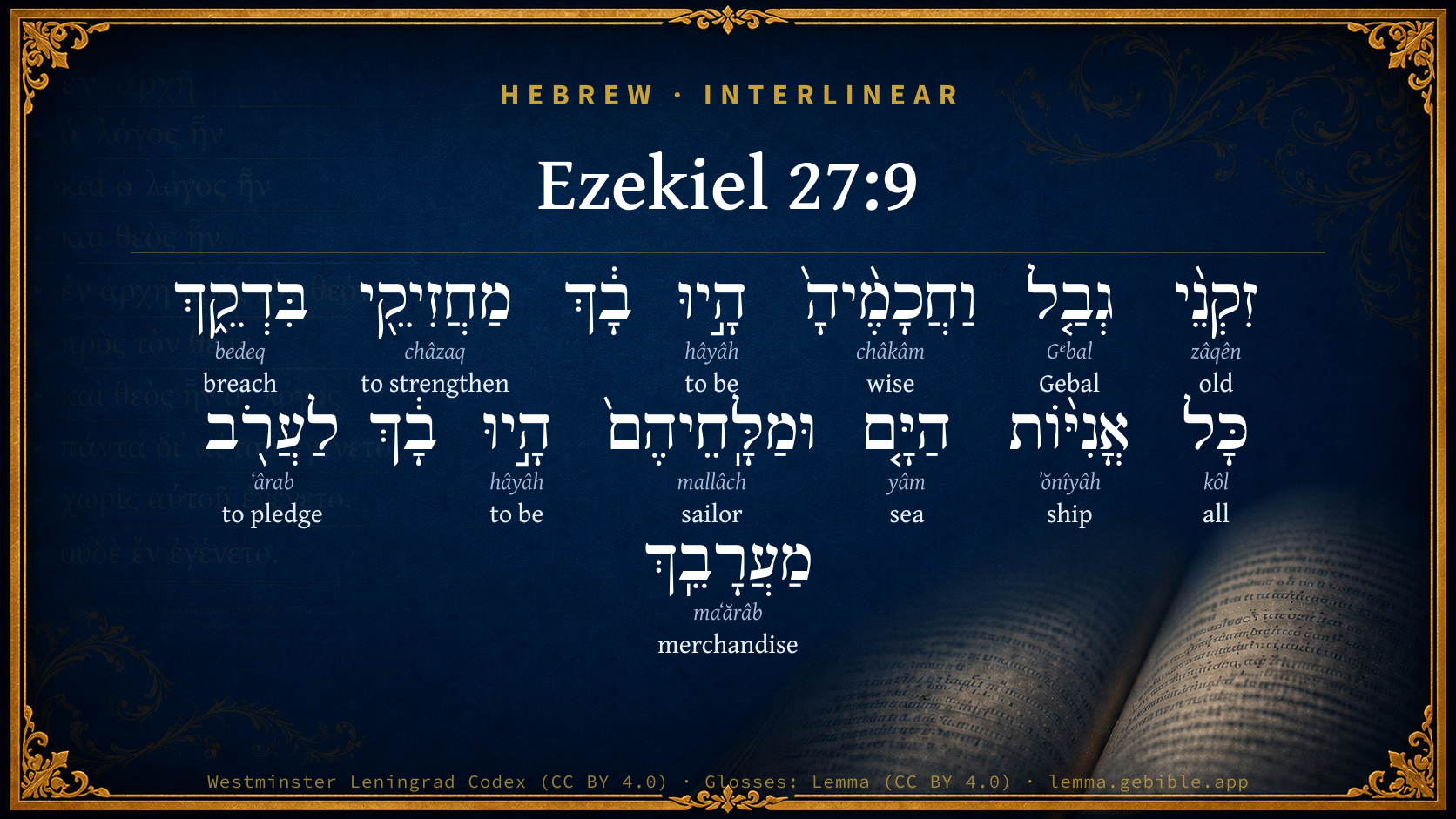
Hebrew (Westminster Leningrad Codex) Ezekiel 27:9 appears in the Hebrew Old Testament. The text above is from the Westminster Leningrad Codex. Each word links to its Strong’s number, a concise gloss, and parsing drawn from the Open Scriptures Hebrew Bible morphology. Click any word for its full Brown-Driver-Briggs (BDB) entry.
Download image
Cite this verse

Ezekiel 27:9 (World English Bible). Public Domain. Lemma interlinear Bible study tool, https://lemma.gebible.app/v/ezekiel/27/9.

Show BibTeX & RIS
BibTeX
RIS
English Translation
The old men of Gebal and the wise men of it were in you your repairers of ship seams: all the ships of the sea with their mariners were in you to deal in your merchandise.
World English Bible · Public Domain
Highlights
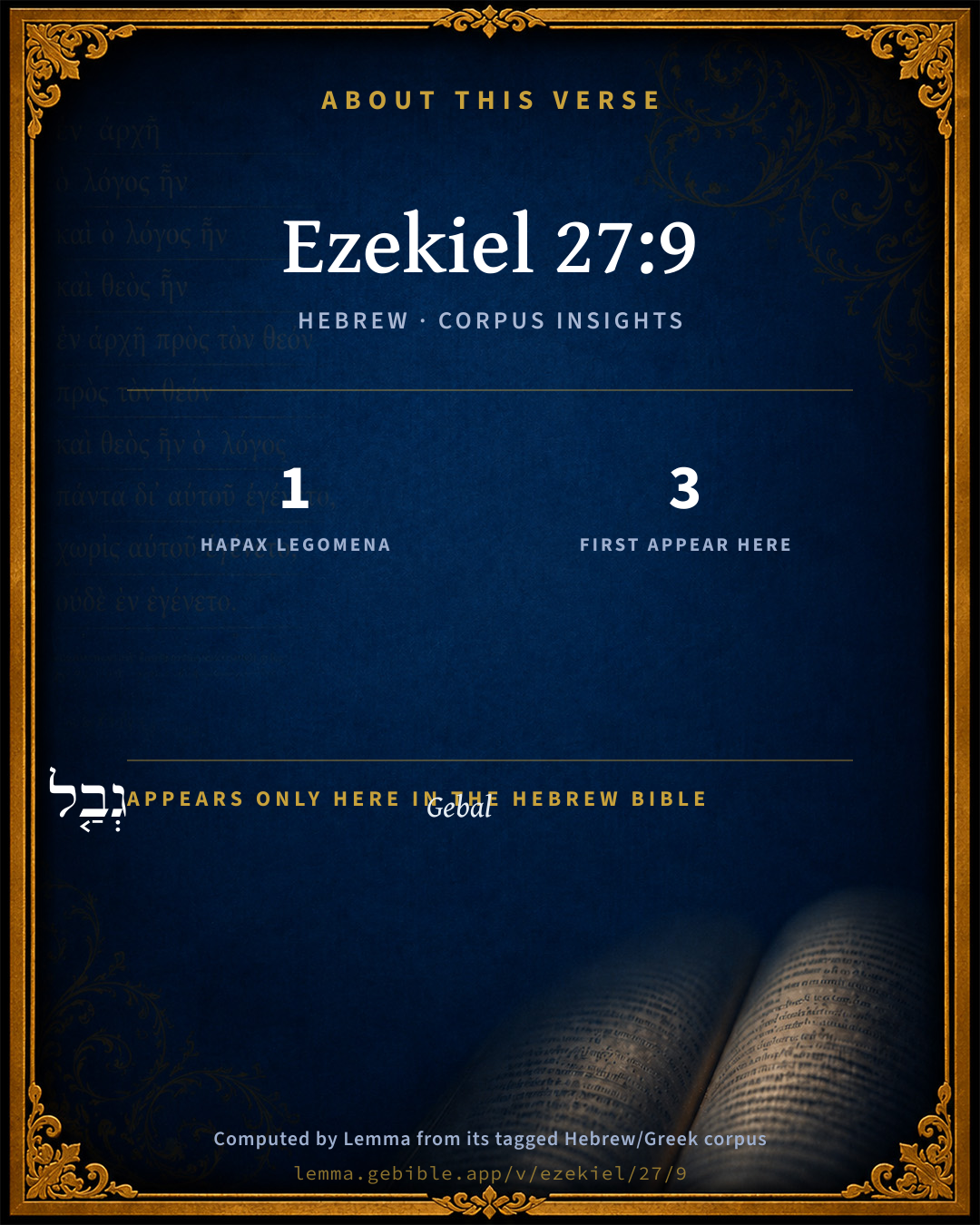
  • 1 hapax legomenon — only here in the Hebrew Bible
  • 3 first appearances in the Hebrew Bible
Full analysis ↓
Download a study sheet

One document with this verse’s original text, its word-by-word gloss line, the meaning frame, cross-references with their text, attributed commentary, and full source and license credits — printable, and it pastes into notes with its structure intact.

This verse Autodidact and up

Study sheet (.html) Plain text (.txt)

A passage Seminary Student

Up to 50 verses in one chapter. A passage sheet keeps up to 6 commentary sources and 12 cross-references per verse, in the order this page ranks them, and says so on the sheet whenever that leaves anything out. Ask for a single verse and you get the Autodidact verse sheet above.

Everything on this page stays free to read, with no account — the sheet is a download of what is already on screen, not access to it.

Want to remove ads? Support Godless Engineer
Compare translations 3

The same verse in 3 English versions, stacked beneath the original-language interlinear above. Click any original word for its lexicon entry.

Each is an independent rendering of the whole verse — the interlinear is not word-aligned to these translations.

Highlighted words mark where these versions differ — a whole-verse word diff, not a word-by-word alignment.

  • World English Bible Public Domain
    The old men of Gebal and the wise men of it were in you your repairers of ship seams: all the ships of the sea with their mariners were in you to deal in your merchandise.
  • King James Version Public Domain
    The ancients of Gebal and the wise men thereof were in thee thy calkers: all the ships of the sea with their mariners were in thee to occupy thy merchandise.
  • unfoldingWord Literal Text CC BY-SA 4.0
    Highly experienced craftsmen from Byblos filled your seams; all the ships of the sea and their sailors among you were carrying your merchandise for trade.

unfoldingWord Literal Text — © unfoldingWord, licensed CC BY-SA 4.0. Word-aligned USFM3 via Door43 (git.door43.org/unfoldingWord/en_ult).

Versions to compare (up to 4)

3 of 4 selected

Show all 18 translations

Every available English version of this verse, each an independent rendering of the whole verse.

  • World English Bible Public Domain
    The old men of Gebal and the wise men of it were in you your repairers of ship seams: all the ships of the sea with their mariners were in you to deal in your merchandise.
  • Berean Standard Bible Public Domain
    The elders of Gebal were aboard as shipwrights, repairing your leaks. All the ships of the sea and their sailors came alongside to barter for your merchandise.
  • Majority Standard Bible Public Domain
    The elders of Gebal were aboard as shipwrights, repairing your leaks. All the ships of the sea and their sailors came alongside to barter for your merchandise.
  • King James Version Public Domain
    The ancients of Gebal and the wise men thereof were in thee thy calkers: all the ships of the sea with their mariners were in thee to occupy thy merchandise.
  • American Standard Version (1901) Public Domain
    The old men of Gebal and the wise men thereof were in thee thy calkers: all the ships of the sea with their mariners were in thee to deal in thy merchandise.
  • Revised Version (1885) Public Domain
    The ancients of Gebal and the wise men thereof were in thee thy calkers: all the ships of the sea with their mariners were in thee to occupy thy merchandise.
  • Geneva Bible (1599) Public Domain
    The ancients of Gebal, and the wise men thereof were in thee thy calkers, all the shippes of the sea with their mariners were in thee to occupie thy marchandise.
  • Douay-Rheims (1899) Public Domain
    The ancients of Gebal, and the wise men thereof furnished mariners for the service of thy various furniture: all the ships of the sea, and their mariners were thy factors.
  • Young's Literal Translation Public Domain
    Elders of Gebal and its wise men have been in thee, Strengthening thy breach; All ships of the sea and their mariners, Have been in thee, to trade `with' thy merchandise.
  • Literal Standard Version CC BY-SA 4.0
    The elderly of Gebal and its wise men have been in you, || Strengthening your breach; All ships of the sea and their mariners, || Have been in you, to trade your merchandise.
  • Unlocked Literal Bible CC BY-SA 4.0
    Highly experienced craftsmen from Byblos filled your seams; all the ships of the sea and their sailors among you were carrying your merchandise for trade.
  • unfoldingWord Literal Text CC BY-SA 4.0
    Highly experienced craftsmen from Byblos filled your seams; all the ships of the sea and their sailors among you were carrying your merchandise for trade.
  • Darby Bible Public Domain
    The elders of Gebal and the wise men thereof were in thee repairing thy leaks; all the ships of the sea with their mariners were in thee, to barter with thee.
  • World Messianic Bible Public Domain
    The old men of Gebal and its wise men were your repairers of ship seams in you. All the ships of the sea with their mariners were in you to deal in your merchandise.
  • Webster's Bible Public Domain
    The ancients of Gebal and its wise men were in thee thy calkers: all the ships of the sea with their mariners were in thee to occupy thy merchandise.
  • Free Bible Version CC BY-SA 4.0
    Expert craftsmen from Gebal were onboard to repair any leaks. All the other ships at sea came to trade with you and their sailors bartered for your goods.
  • Bible in Basic English Public Domain
    The responsible men of Gebal and its wise men were in you, making your boards watertight: all the ships of the sea with their seamen were in you trading in your goods.
  • JPS Tanakh (1917) Public Domain
    The elders of Gebal and the wise men thereof were in thee thy calkers; all the ships of the sea with their mariners were in thee to exchange thy merchandise.

Literal Standard Version (2020), Covenant Press — licensed CC BY-SA 4.0. Text via the HelloAO Bible API (eBible.org). Unlocked Literal Bible (unfoldingWord) — licensed CC BY-SA 4.0. Text via the HelloAO Bible API (eBible.org). unfoldingWord Literal Text — © unfoldingWord, licensed CC BY-SA 4.0. Word-aligned USFM3 via Door43 (git.door43.org/unfoldingWord/en_ult). Free Bible Version, Dr. Jonathan Gallagher — licensed CC BY-SA 4.0. Text via the HelloAO Bible API (eBible.org).

Word by word

More ways to search: Search by grammar → Find every occurrence → Compare this word →

Practice this passage: Drill this verse → Learn its vocabulary →

גְבַ֤ל
Gᵉbal
H1380
“Gebal”
Noun, Proper
Part of Speech
Noun
Type
Proper
Full BDB Definition

Origin: from H1379 (in the sense of a chain of hills)

TWOT: None

Gebal = "mountain" - a maritime town of Phoenicia near Tyre (modern 'Jebeil') known to the Greeks as 'Byblus'
  1. זִקְנֵ֨י zâqên H2205 “old of” Adjective, Adjective, Masculine, Plural, Construct
  2. וַחֲכָמֶ֨יהָ֙ châkâm H2450 “and · wise · her” Conjunction + Adjective, Adjective, Masculine, Plural, Construct + Suffix, Personal, 3rd Person, Feminine, Singular
  3. הָ֣יוּ hâyâh H1961 “to be” Verb, Qal, Perfect, 3rd Person, Common, Plural
  4. מַחֲזִיקֵ֖י châzaq H2388 “strengthening” Verb, Hiphil, Participle Active, Masculine, Plural, Construct
  5. בִּדְקֵ֑ךְ bedeq H919 “breach · your” Noun, Common, Masculine, Singular, Construct + Suffix, Personal, 2nd Person, Feminine, Singular
  6. כָּל kôl H3605 “all of” Noun, Common, Masculine, Singular, Construct
  7. אֳנִיּ֨וֹת ʼŏnîyâh H591 “ships of” Noun, Common, Feminine, Plural, Construct
  8. הַיָּ֤ם yâm H3220 “the · sea” Particle, Definite Article + Noun, Common, Masculine, Singular, Absolute
  9. וּמַלָּֽחֵיהֶם֙ mallâch H4419 “and · sailors · their” Conjunction + Noun, Common, Masculine, Plural, Construct + Suffix, Personal, 3rd Person, Masculine, Plural
  10. הָ֣יוּ hâyâh H1961 “to be” Verb, Qal, Perfect, 3rd Person, Common, Plural
  11. לַעֲרֹ֖ב ʻârab H6148 “to pledge” Preposition + Verb, Qal, Infinitive Construct
  12. מַעֲרָבֵֽךְ maʻărâb H4627 “merchandise · your” Noun, Common, Masculine, Singular, Construct + Suffix, Personal, 2nd Person, Feminine, Singular

About this verse

These counts appear in no published source. They are computed here, from the morphology-tagged text and Lemma’s own curated glosses. What Lemma adds →

15
words
12
distinct lemmas
Prophets
section

Notable vocabulary

1 hapax legomenon — a word that appears only here in the entire Hebrew Bible:

  • גְבַ֤ל Gebal H1380

First appearance in Scripture

These words make their first canonical appearance in the Hebrew Bible here:

  • גְבַ֤ל Gebal H1380
  • וּמַלָּֽחֵיהֶם֙ sailor H4419
  • מַעֲרָבֵֽךְ merchandise H4627

Shared distinctive vocabulary

וּמַלָּֽחֵיהֶם֙ sailor H4419 occurs in 4 verses of the Hebrew Bible. Also found in:

Grammatical profile

  • 4 verbs
  • 7 nouns
  • 2 adjectives
  • 2 prepositions

Verb forms

  • הָ֣יוּ Qal · Perfect
  • מַחֲזִיקֵ֖י Hiphil · Participle Active
  • הָ֣יוּ Qal · Perfect
  • לַעֲרֹ֖ב Qal · Infinitive Construct

Repetition

A word recurs within this verse — often emphatic in Hebrew:

  • הָ֣יוּ to be H1961 ×2

Hebrew & Septuagint length

In English translation the verse runs 36 words from the Hebrew and 34 from the Septuagint (LXX English) — closely comparable.

A rough comparison of the two English renderings, which tokenize alike — not a word-level alignment.

Word counts can differ between the Hebrew and the Greek without any difference in meaning — e.g. the Hebrew direct-object marker אֵת has no separate Greek word, and Greek often adds the article ὁ.

Cross-references

3

Topical passages linked to Ezekiel 27:9 in the Treasury of Scripture Knowledge — connected by theme and wording, ordered by reader-vote popularity; previews shown in the World English Bible.

  • 1 Kings 5:18 Solomon's builders and Hiram's builders and the Gebalites did fashion them, and prepared the timber and the stones to build the house.
  • Joshua 13:5 and the land of the Gebalites, and all Lebanon, toward the sunrise, from Baal Gad under Mount Hermon to the entrance of Hamath;
  • Psalms 83:7 Gebal, Ammon, and Amalek; Philistia with the inhabitants of Tyre;

Cross-references courtesy of OpenBible.info (CC BY 4.0).

Hebrew and Greek witnesses Masoretic Hebrew ↔ Greek Septuagint

The same verse in the two great witnesses to the Old Testament, shown verse-for-verse.

These are two independent witnesses, not word-aligned to each other, and the Septuagint is shown in lemma (dictionary) form.

Hebrew Ezekiel 27:9 Masoretic · Westminster Leningrad Codex

זִקְנֵ֨י גְבַ֤ל וַחֲכָמֶ֨יהָ֙ הָ֣יוּ בָ֔ךְ מַחֲזִיקֵ֖י בִּדְקֵ֑ךְ כָּל אֳנִיּ֨וֹת הַיָּ֤ם וּמַלָּֽחֵיהֶם֙ הָ֣יוּ בָ֔ךְ לַעֲרֹ֖ב מַעֲרָבֵֽךְ

The old men of Gebal and the wise men of it were in you your repairers of ship seams: all the ships of the sea with their mariners were in you to deal in your merchandise.

World English Bible · Public Domain

Greek LXX Ezekiel 27:9 Septuagint · lemma form

ὁ πρεσβύτερος βύβλιοι καί ὁ σοφός αὐτός εἰμί ἐν σύ οὗτος ἐνἰσχύω ὁ βουλή σύ καί πᾶς ὁ πλοῖον ὁ θάλασσα καί ὁ κωπηλάτης αὐτός γίγνομαι σύ ἐπί δυσμή δυσμή

The elders of the Biblians, and their wise men, who were in you, these helped your counsel: and all the ships of the sea and their rowers traded for you to the utmost west.

LXX2012 (modern English Septuagint) · Public Domain

On this verse, Ellicott's Commentary for English Readers discusses the Septuagint’s reading. Read the note in Commentary ↓

Hebrew: Westminster Leningrad Codex (CC BY 4.0). Greek: Septuagint (public domain); English from LXX2012 (modern English Septuagint) (Public Domain). How the Septuagint differs from the Hebrew →

Targum (Aramaic paraphrase)

1

The Targum is the ancient Jewish Aramaic paraphrase of the Hebrew Scriptures — an interpretive translation, not the Hebrew text itself. Onkelos (literal) and Pseudo-Jonathan (expansive) render the Torah, and Jonathan the Prophets. Coverage is partial: where no permissively-licensed English translation exists for a verse, only the Aramaic is shown. This is verse-level text, not a word-by-word alignment to the Hebrew.

  1. Targum Jonathan Prophets (Joshua–Malachi)
    סָבֵי גְבַל וְחַכִּימָהָא הֲווֹ בִיךְ מַתְקְפֵי צוֹרְבִיךְ כָּל נַחֲתֵי יַמָא וְסַפָנֵיהוֹן הֲווֹ שָׁיְטִין וְמַיְתָן סְחוֹרָא לְגַוִיךְ:

    (no public-domain English translation for this verse)

    Targum Jonathan — Aramaic: “Mikraot Gedolot” (public domain). English: “Sefaria Community Translation” (CC0 1.0 (public-domain dedication)); “London "Chaldee Paraphrase," 1871” (public domain). Text via Sefaria.

Commentary

Notes on Ezekiel 27:9 from classic Christian and Jewish commentators (each source and its license shown beneath its notes). The classic Christian expositions comment on the surrounding passage and are grouped to its opening verse, so a note may address several verses; the Jewish commentaries on the Tanakh (Rashi and others) are per-verse, so they appear only where the commentator wrote on this verse.

Lemma curates 59 commentaries, every one of them public domain or Creative Commons licensed, each selected and text-cleaned for this edition rather than reprinted as found. About our sources →

Trapp's Complete Commentary

John Trapp

Eze 27:9 The ancients of Gebal and the wise [men] thereof were in thee thy calkers: all the ships of the sea with their mariners were in thee to occupy thy merchandise.

Ver. 9. The ancients of Gebal.] Great architects, {1Ki 5:18} but persecutors of the Church. {Psa 83:7}

Thy calkers.] Or, Stoppers of chinks, stuppa, pice, aliaque materia, when the ship springeth a leak.

John Trapp, A Commentary or Exposition upon All the Books of the Old and New Testament (1647–1656) — public domain. Text from a community e-Sword module.

Geneva Bible (1599)

Geneva Bible translators

Meaning, that they built the walls of the city, which is here meant by the ship: and of these were the builders of Solomon’s Temple, 1 Kings 5:18.

Geneva Bible (1599) marginal notes — public domain. Text via Bolls.life.

Jamieson, Fausset & Brown

Robert Jamieson, A. R. Fausset & David Brown

Gebal--a Phœnician city and region between Beirut and Tripoils, famed for skilled workmen (Kg1 5:18, Margin; Psa 83:7).

calkers--stoppers of chinks in a vessel: carrying on the metaphor as to Tyre.

occupy thy merchandise--that is, to exchange merchandise with thee.

Jamieson, Fausset & Brown — Commentary Critical and Explanatory on the Whole Bible (1871) — public domain (CC PDM 1.0). Text via the HelloAO Bible API.

Adam Clarke's Commentary

Verse 9. The ancients of Gebal] This was a city of Phoenicia, near Mount Libanus, Jos 13:5. It was called Biblos by the Greeks.

Thy calkers] Those who repaired their vessels; paying, as it is termed, pitched hemp into the seams, to prevent the water from oozing through.

To occupy thy merchandise.] That is, to be thy agents or factors.

Adam Clarke's Commentary on the Bible (1810–1826) — public domain. Text from a community e-Sword/MySword module.

Ellicott's Commentary for English Readers

(9) The ancients of Gebal.—“The ancients” is a thoroughly Semitic expression for the prominent men of a city. Gebal, the ancient Byblos, the modern Gébeil, and the Gu-ba-lu of the Assyrian inscriptions, was a famous Phœnician town just north of Beirût. Its site is still rich in ruins. Its people were famous builders, and according to the margin of 1Ki_5:18 (so also the Septuagint and Vulgate) were employed by Solomon on the work of the Temple. The representation is that the whole widely-dispersed Phœnician race were tributary to the works of Tyre. At this point the figure of the ship gives place for a time to plain language, the better to set forth the military resources and power of this great city.

A Bible Commentary for English Readers, edited by Charles John Ellicott (1878–1897) — public domain. Text from a community e-Sword module.

The Cambridge Bible for Schools and Colleges

gen. ed. J. J. S. Perowne

9. ancients of Gebal] The elders, a title of honour or office, the magistrates. Probably also the “wise men thereof” is a semi-official title (cf. Eze_27:8). The power of Tyre was exerted over all her dependencies (Eze_26:17), in which men of the highest position entered all ranks of her service. Gebal (the classical Byblos, now Jubeil) is situated not far from the river Adonis (Ibrahim) somewhat over 20 miles N. of Beirut (Jos_13:5; 1Ki_5:18, R.V.). The town was devoted to the worship of Beltis (Astarte) and Adonis, cf. on ch. Eze_8:14. The name appears in the Assyrian inscriptions, Del., Parad. p. 283.

thy calkers] Marg. stoppers of chinks, carpenters.

to occupy thy merchandise] to handle thy wares. The representation is that the great ship was attended on by all the ships of the sea with their sailors, who served her and delivered her wares to her, or were occupied about them (Eze_27:27).

The Cambridge Bible for Schools and Colleges (gen. ed. J. J. S. Perowne; Cambridge University Press, 1878–1918) — public domain. Text from a community e-Sword module.

John Gill's Exposition

They of Persia, and of Lud, and of Phut, were in thine army, thy men of war,.... As the Tryrians were a trading people, they hired foreign troops into their service, to fill their garrisons, defend their city, and fight for them in time of war; and these were of various nations, and the most famous for military skill and valour; as the Persians, a people well known, and famous for war in the times of Cyrus, and before, and well skilled in shooting arrows; and they of Lud, or the Lydians, a people in Greece, renowned for war before the times of Croesus their king, as well as in his time; and they of Phut, the Lybians, a people in Africa, skilful in drawing the bow, Isa 66:19,

they hanged the shield and helmet in thee; in their garrisons and towers, or places of armoury; which were defensive weapons, the one for the body, the other for the head; this they did in times of peace, when there was no occasion to use them, or when they were off their guard, and not on duty; see Sol 4:4,

they set forth thy comeliness; it being an honour to the Tyrians to have such soldiers in their service. The Targum is,

"they increased thy splendour;''

added to their glory.

John Gill's Exposition of the Whole Bible (1746–1763) — public domain (CC PDM 1.0). Text via the HelloAO Bible API.

Albert Barnes' Notes on the Bible

Gebal - i. e., Byblos (modern Gebeil) in Phoenicia, the chief seat of the worship of Adonis, and situated on an eminence over-looking the river Adonis, north of Beirut, not far from the Mediterranean sea. The “ancients” is a term for the council that presided over maritime cities.

Albert Barnes' Notes on the Bible (1834–1885) — public domain. Text from a community e-Sword/MySword module.

Haydock's Catholic Bible Commentary

Gebal. Septuagint, "Biblos," which is the same, 3 Kings v. 18. --- Furnished. Hebrew, "were in thee to repair thy breaches." Septuagint, "strengthened thy designs."

George Leo Haydock (1774–1849), Haydock's Catholic Family Bible and Commentary, 1859 edition — public domain. Excludes Psalms (Douay-Rheims chapter numbering differs from Protestant) and Deuterocanonical books (Catholic canon only).

Matthew Poole's English Annotations

The ancients; old experienced workmen.

Of Gebal; a town of Phoenicia near the sea, one of the four principal towns, to which belonged a jurisdiction over a fourth part of Phoenicia, mentioned Psa 83:7, among the conspirators against Israel and the Giblites, 1Ki 5:18. Natives of Gebal are called stone-squarers, people fitted for hard and servile works.

The wise men; skilful in their trades.

Were in thee; hired and dwelt in Tyre for gain’s sake, that they might be still employed.

Calkers; shipwrights, to build no doubt, as well as repair and strengthen, their ships.

All the ships of the sea; ships from all parts of the sea, full of mariners, not only to manage the ships at sea, but to offer their service to the Tyrians for bringing in or carrying out of their wares, so that they might reap the profit, whilst others did undergo trouble and danger of trafficking by sea; factors, and warehouse-keepers, and brokers.

Matthew Poole's English Annotations on the Holy Bible (1683–1685) — public domain. Text from a community e-Sword/MySword module.

Whedon's Commentary on the Bible

Daniel D. Whedon

9. Gebal (Gu-ub-li) — or, Byblos (Psa_83:7; Jos_13:5; 1Ki_5:18) — A celebrated city lying a little to the south of Arvad but north of Tyre and Sidon, constantly mentioned in the campaigns of the Assyrian kings from the ninth to the seventh centuries B.C. It is also supposed to be prominent in the Tel-el-Amarna letters, cir. 1400 B.C., under the form Gubla — though this may refer to another coast city, Gabula (Petrie, History, ii, p. 314). It was celebrated throughout the whole world for its worship of the goddess Ishtar (Ashteroth). The prophet represents the wisest men and officers (ancients, that is, elders) of this distinguished city serving on the great ship Tyre in inferior positions.

All the ships of the sea… were in thee — The bold figure of Tyre as a ship gives place to a more realistic description of the harbor and city, especially of the city bazaars.

Occupy thy merchandise — Carry on thy trade. — Kautzsch.

Daniel D. Whedon (gen. ed.), Commentary on the Old and New Testaments (1874–1909) — public domain. Text from a community e-Sword module.

The Pulpit Commentary

The ancients of Gebal. The word is used in the sense of "elders" or "senators," the governing body. Gebal, for which the LXX gives Biblii, is identified with the Greek Byblus. The name appears in Psa_83:7 in connection, among other nations, with Tyre and Asshur, as allied with them against Israel; in Jos_13:5 as near Lebanon andHermon; in 1Ki_5:18 (margin Revised Version) as among the stonemasons who worked with Hiram"s builders. Byblus was situated on an eminence overlooking the river Adonis between Beirut and Tripoli. Its modern name, Gebail, retains the old Semitic form, and its ruins abound in marble and granite columns of Phoenician and Egyptian workmanship. The work of the caulkers was to stop the chinks of the ship, and the men of Gebal appear to have been especially skilful in this. We note that the metaphor of the ship falls into the background in the latter clause of the verse, and does not appear again.

The Pulpit Commentary (1880–1919), ed. H.D.M. Spence-Jones & Joseph S. Exell — public domain. Text from a community e-Sword module.

John Wesley's Explanatory Notes

The ancients - Old experienced workmen. Gebal - A town of Phoenicia near the sea. The wise men - Skilful in their trades. Were in thee - Who dwelt in Tyre for gain. All the ships - Ships from all parts of the sea, full of mariners, not only to manage the ships at sea, but to offer their service to the Tyrians for bringing in, or carrying out their wares.

John Wesley, Explanatory Notes Upon the Whole Bible (1754–1765) — public domain. Text via the GEBible commentary corpus.

Rashi

Rabbi Shlomo Yitzchaki (Rashi)

The elders of Gebal [who were] skillful builders, as it is said (I Kings 5:32): “and Hiram’s builders and the Gebalites.”

who repaired your cracks [Heb. מַחַזִיקִי, lit. strengthen,] repaired your cracks so that no water should enter them, apiye[ce] tans ta crevaze in Old French, repairing your crack.

all the ships of the sea and their mariners [Heb. וּמַלָחֵיהֶם,] their sailors.

were within you They were around you to sail to the distant countries to bring the merchandise into your midst.

to guarantee your necessities [Heb. לַעֲרֹב מַעֲרָבֵךּ,] an expression of guaranteeing. These are all a person’s necessities, by which he lives; and his money is his guarantee and his salvation for his lifetime, garantie in French.

Rashi on the Tanakh — English translations: “The Judaica Press complete Tanach with Rashi, translated by A. J. Rosenberg” (CC BY 4.0); “Pentateuch with Rashi's commentary by M. Rosenbaum and A.M. Silbermann, 1929-1934” (public domain); “The Metsudah Tanach series, Lakewood, N.J” (CC BY 4.0); and “The Book of Joshua, Metsudah Publications, 1997” (CC BY 4.0). Text via Sefaria.

Lesson kit

Teaching starters — assembled from the data on this page, not authored interpretation. Every prompt links to the verse data it draws on. Edit before teaching.

Ezekiel, in the Prophets, opens this verse with 15 words (12 distinct Hebrew lemmas). Its most distinctive word is Gᵉbal (“Gebal”). A historical commentator’s framing appears above. Read the whole chapter for the surrounding context.

Discussion questions

  1. How does “Gebal” (Gᵉbal) shape what this verse is saying?
  2. 1 word here appears nowhere else in the Hebrew Bible. Why might the author reach for such rare wording?
  3. 3 words make their first appearance in Scripture here. What does this debut establish?
  4. How does Ezekiel 27:27, which shares the word «sailor», read alongside this verse?
  5. What does the repetition of “to be” (2× in this one verse) do in this verse?
  6. These translations render this verse differently. What is at stake in choosing one wording over another?
  7. «הָ֣יוּ» is a Qal Perfect verb. How does that grammatical form shape the action described?
  8. Compare how Trapp's Complete Commentary and Geneva Bible (1599) read this verse. Where do they agree or differ?

Things to notice

  • 1 word in this verse appears nowhere else in the Hebrew Bible.
  • 3 words make their first canonical appearance in Scripture here.
  • These translations choose different wording for 23 words in this verse.
  • “to be” occurs 2× in this single verse.
  • 12 distinct Hebrew lemmas span 15 words in this verse.

Reading settings

Reading text

Shown beneath each verse's original-language words.

Old Testament
Old Testament edition

Read the OT as the Masoretic Hebrew (MT) or the Greek Septuagint (LXX).

English shown for the Greek Septuagint (in the Hebrew ↔ Greek comparison).

Comparing translations? Open the Compare panel on any verse page to stack up to four side by side.