
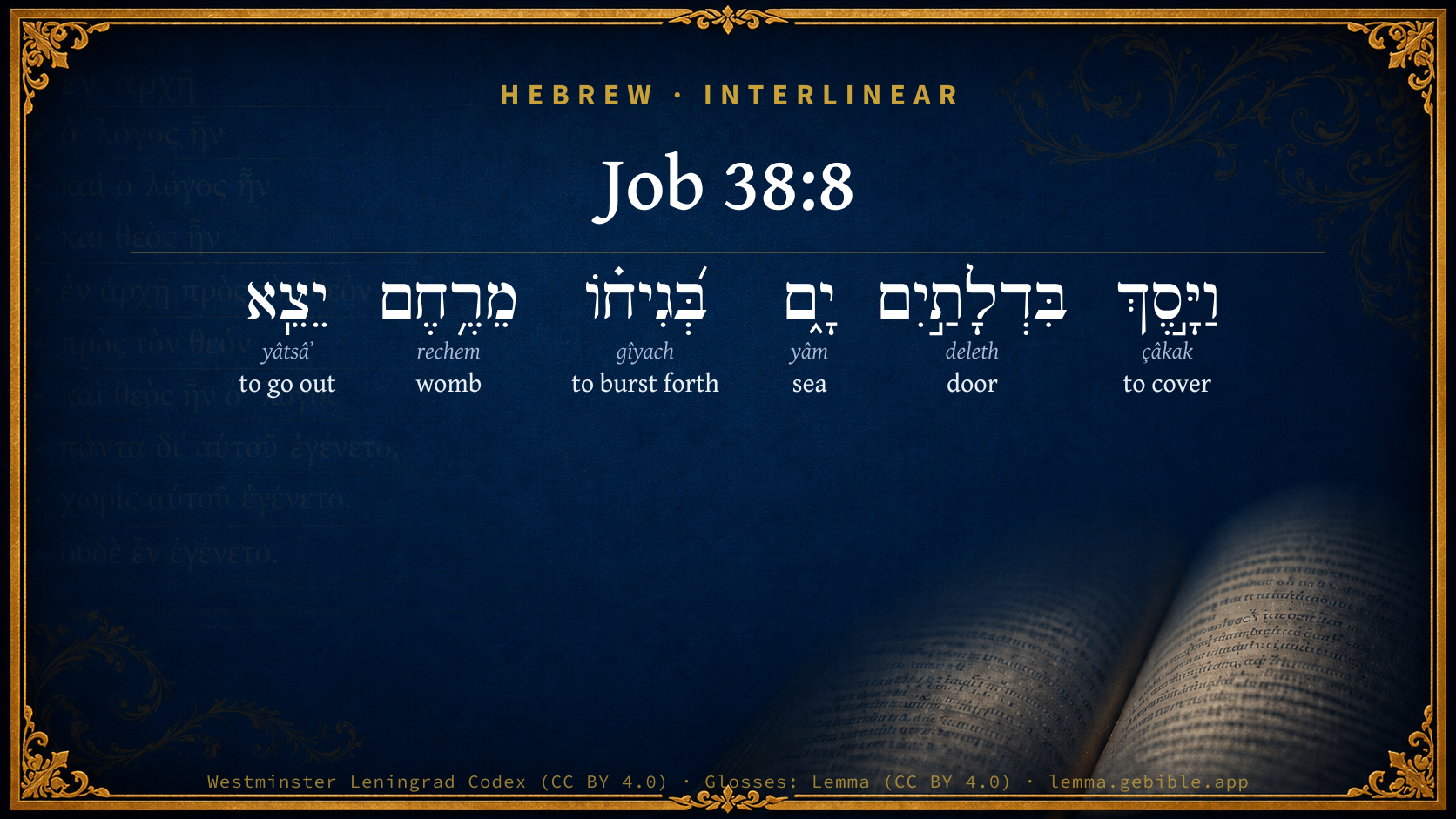
Job 38:8

Hebrew (Westminster Leningrad Codex) Job 38:8 appears in the Hebrew Old Testament. The text above is from the Westminster Leningrad Codex. Each word links to its Strong’s number, a concise gloss, and parsing drawn from the Open Scriptures Hebrew Bible morphology. Click any word for its full Brown-Driver-Briggs (BDB) entry.
Download image
Cite this verse

Job 38:8 (World English Bible). Public Domain. Lemma interlinear Bible study tool, https://lemma.gebible.app/v/job/38/8.

Show BibTeX & RIS
BibTeX
RIS
English Translation
"Or who shut up the sea with doors, When it broke forth from the womb,
World English Bible · Public Domain
Download a study sheet

One document with this verse’s original text, its word-by-word gloss line, the meaning frame, cross-references with their text, attributed commentary, and full source and license credits — printable, and it pastes into notes with its structure intact.

This verse Autodidact and up

Study sheet (.html) Plain text (.txt)

A passage Seminary Student

Up to 50 verses in one chapter. A passage sheet keeps up to 6 commentary sources and 12 cross-references per verse, in the order this page ranks them, and says so on the sheet whenever that leaves anything out. Ask for a single verse and you get the Autodidact verse sheet above.

Everything on this page stays free to read, with no account — the sheet is a download of what is already on screen, not access to it.

Want to remove ads? Support Godless Engineer
Compare translations 3

The same verse in 3 English versions, stacked beneath the original-language interlinear above. Click any original word for its lexicon entry.

Each is an independent rendering of the whole verse — the interlinear is not word-aligned to these translations.

Highlighted words mark where these versions differ — a whole-verse word diff, not a word-by-word alignment.

  • World English Bible Public Domain
    "Or who shut up the sea with doors, When it broke forth from the womb,
  • King James Version Public Domain
    Or who shut up the sea with doors, when it brake forth, as if it had issued out of the womb?
  • unfoldingWord Literal Text CC BY-SA 4.0
    And enclosed the sea with doors in its issuing from the womb, it came out,

unfoldingWord Literal Text — © unfoldingWord, licensed CC BY-SA 4.0. Word-aligned USFM3 via Door43 (git.door43.org/unfoldingWord/en_ult).

Versions to compare (up to 4)

3 of 4 selected

Show all 18 translations

Every available English version of this verse, each an independent rendering of the whole verse.

  • World English Bible Public Domain
    "Or who shut up the sea with doors, When it broke forth from the womb,
  • Berean Standard Bible Public Domain
    Who enclosed the sea behind doors when it burst forth from the womb,
  • Majority Standard Bible Public Domain
    Who enclosed the sea behind doors when it burst forth from the womb,
  • King James Version Public Domain
    Or who shut up the sea with doors, when it brake forth, as if it had issued out of the womb?
  • American Standard Version (1901) Public Domain
    Or `who' shut up the sea with doors, When it brake forth, `as if' it had issued out of the womb;
  • Revised Version (1885) Public Domain
    Or who shut up the sea with doors, when it brake forth, as if it had issued out of the womb;
  • Geneva Bible (1599) Public Domain
    Or who hath shut vp the Sea with doores, when it yssued and came foorth as out of the wombe:
  • Douay-Rheims (1899) Public Domain
    Who shut up the sea with doors, when it broke forth as issuing out of the womb:
  • Young's Literal Translation Public Domain
    And He shutteth up with doors the sea, In its coming forth, from the womb it goeth out.
  • Literal Standard Version CC BY-SA 4.0
    And He shuts up the sea with doors, || In its coming forth, it goes out from the womb.
  • Unlocked Literal Bible CC BY-SA 4.0
    Who shut up the sea with doors when it burst out, as if it had come out of the womb—
  • unfoldingWord Literal Text CC BY-SA 4.0
    And enclosed the sea with doors in its issuing from the womb, it came out,
  • Darby Bible Public Domain
    And who shut up the sea with doors, when it burst forth, issuing out of the womb?
  • World Messianic Bible Public Domain
    “Or who shut up the sea with doors, when it broke out of the womb,
  • Webster's Bible Public Domain
    Or who shut up the sea with doors, when it broke forth, as if it had issued out of the womb?
  • Free Bible Version CC BY-SA 4.0
    Who laid down the boundaries of the sea when it was born?
  • Bible in Basic English Public Domain
    Or where were you when the sea came to birth, pushing out from its secret place;
  • JPS Tanakh (1917) Public Domain
    Or who shut up the sea with doors, when it broke forth, and issued out of the womb;

Literal Standard Version (2020), Covenant Press — licensed CC BY-SA 4.0. Text via the HelloAO Bible API (eBible.org). Unlocked Literal Bible (unfoldingWord) — licensed CC BY-SA 4.0. Text via the HelloAO Bible API (eBible.org). unfoldingWord Literal Text — © unfoldingWord, licensed CC BY-SA 4.0. Word-aligned USFM3 via Door43 (git.door43.org/unfoldingWord/en_ult). Free Bible Version, Dr. Jonathan Gallagher — licensed CC BY-SA 4.0. Text via the HelloAO Bible API (eBible.org).

Word by word

More ways to search: Search by grammar → Find every occurrence → Compare this word →

Practice this passage: Drill this verse → Learn its vocabulary →

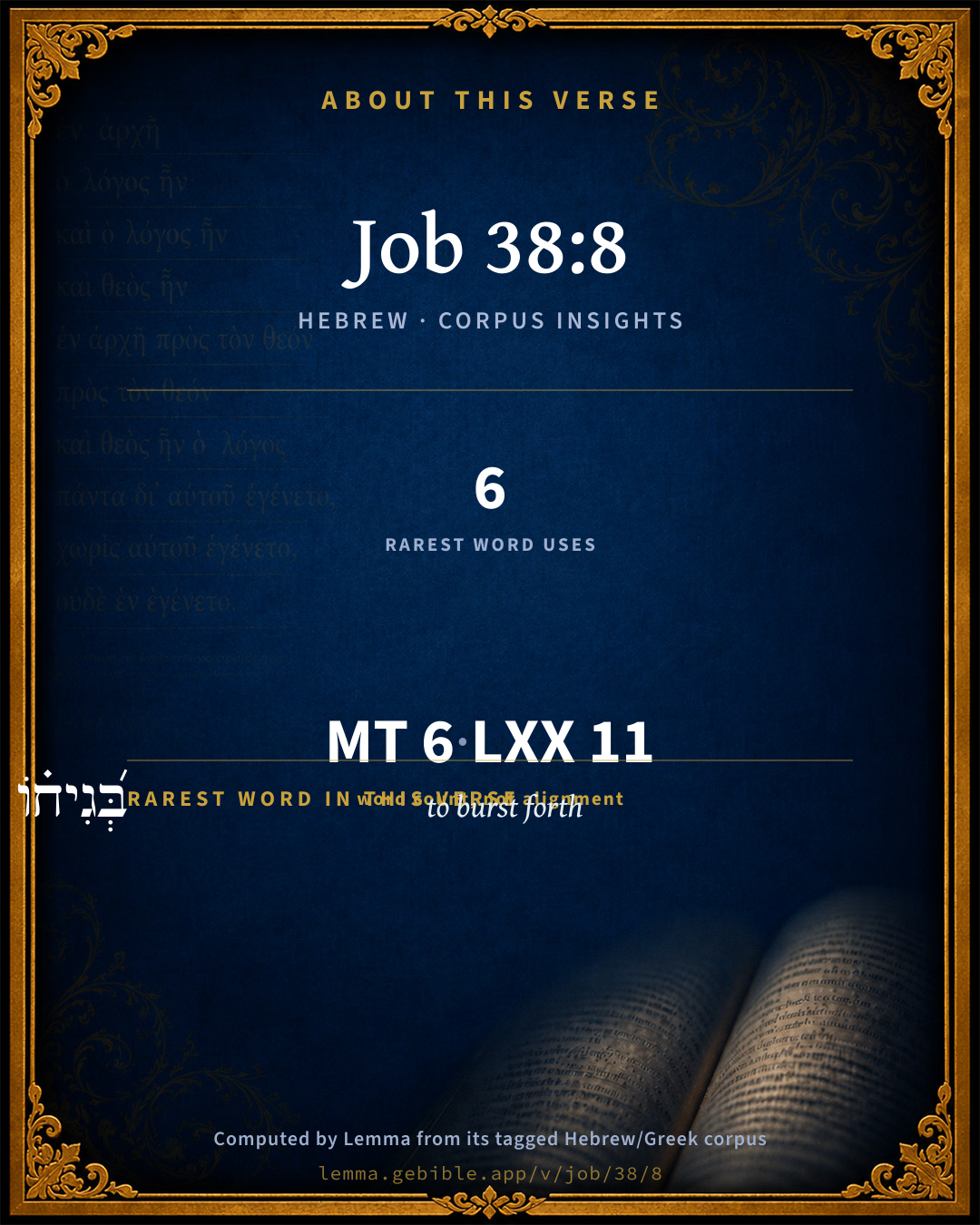
About this verse

These counts appear in no published source. They are computed here, from the morphology-tagged text and Lemma’s own curated glosses. What Lemma adds →

6
words
6
distinct lemmas
Wisdom
section

Notable vocabulary

The rarest word here is בְּ֝גִיח֗וֹ to burst forth H1518 — appearing just 6 times in the whole Hebrew Bible.

Shared distinctive vocabulary

בְּ֝גִיח֗וֹ to burst forth H1518 occurs in 6 verses of the Hebrew Bible. Also found in:

Grammatical profile

  • 3 verbs
  • 3 nouns

Verb forms

  • וַיָּ֣סֶךְ Hiphil · Sequential Imperfect
  • בְּ֝גִיח֗וֹ Qal · Infinitive Construct
  • יֵצֵֽא Qal · Imperfect

Hebrew & Septuagint length

In English translation the verse runs 15 words from the Hebrew and 18 from the Septuagint (LXX English) — closely comparable.

A rough comparison of the two English renderings, which tokenize alike — not a word-level alignment.

Word counts can differ between the Hebrew and the Greek without any difference in meaning — e.g. the Hebrew direct-object marker אֵת has no separate Greek word, and Greek often adds the article ὁ.

In the original languages it is 6 Hebrew tokens and 11 Greek tokens — but the two are counted differently (Hebrew bundles its prefixes and suffixes into one token; the Greek is in lemma form), so that isn’t a like-for-like length.

Cross-references

6

Topical passages linked to Job 38:8 in the Treasury of Scripture Knowledge — connected by theme and wording, ordered by reader-vote popularity; previews shown in the World English Bible.

  • Genesis 1:9 God said, "Let the waters under the sky be gathered together to one place, and let the dry land appear," and it was so.
  • Proverbs 8:29 When he gave to the sea its boundary, That the waters should not violate his commandment, When he marked out the foundations of the earth;
  • Jeremiah 5:22 Don't you fear me? says Yahweh: won't you tremble at my presence, who have placed the sand for the bound of the sea, by a perpetual decree, that it can't pass it? and though the waves of it toss themselves, yet they can't prevail; though they roar, yet they can't pass over it.
  • Psalms 104:8–9 The mountains rose, The valleys sank down, To the place which you had assigned to them.
  • Psalms 33:7 He gathers the waters of the sea together as a heap. He lays up the deeps in storehouses.
  • Job 38:10 Marked out for it my bound, Set bars and doors,

Cross-references courtesy of OpenBible.info (CC BY 4.0).

Hebrew and Greek witnesses Masoretic Hebrew ↔ Greek Septuagint

The same verse in the two great witnesses to the Old Testament, shown verse-for-verse.

These are two independent witnesses, not word-aligned to each other, and the Septuagint is shown in lemma (dictionary) form.

Hebrew Job 38:8 Masoretic · Westminster Leningrad Codex

וַיָּ֣סֶךְ בִּדְלָתַ֣יִם יָ֑ם בְּ֝גִיח֗וֹ מֵרֶ֥חֶם יֵצֵֽא

"Or who shut up the sea with doors, When it broke forth from the womb,

World English Bible · Public Domain

Greek LXX Job 38:8 Septuagint · lemma form

φράσσω δέ θάλασσα πύλη ὅτε μαιμάσσω ἐκ κοιλία μήτηρ αὐτός ἐκπορεύομαι

And I shut up the sea with gates, when it rushed out, coming forth out its mother's womb.

LXX2012 (modern English Septuagint) · Public Domain

On this verse, Haydock's Catholic Bible Commentary discusses the Septuagint’s reading. Read the note in Commentary ↓

Hebrew: Westminster Leningrad Codex (CC BY 4.0). Greek: Septuagint (public domain); English from LXX2012 (modern English Septuagint) (Public Domain). How the Septuagint differs from the Hebrew →

Commentary

Notes on Job 38:8 from classic Christian and Jewish commentators (each source and its license shown beneath its notes). The classic Christian expositions comment on the surrounding passage and are grouped to its opening verse, so a note may address several verses; the Jewish commentaries on the Tanakh (Rashi and others) are per-verse, so they appear only where the commentator wrote on this verse.

Lemma curates 59 commentaries, every one of them public domain or Creative Commons licensed, each selected and text-cleaned for this edition rather than reprinted as found. About our sources →

Jamieson, Fausset & Brown

Robert Jamieson, A. R. Fausset & David Brown

doors--floodgates; these when opened caused the flood (Gen 8:2); or else, the shores.

womb--of chaos. The bowels of the earth. Image from childbirth (Job 38:8-9; Eze 32:2; Mic 4:10). Ocean at its birth was wrapped in clouds as its swaddling bands.

Jamieson, Fausset & Brown — Commentary Critical and Explanatory on the Whole Bible (1871) — public domain (CC PDM 1.0). Text via the HelloAO Bible API.

Trapp's Complete Commentary

John Trapp

Job 38:8 Or [who] shut up the sea with doors, when it brake forth, [as if] it had issued out of the womb?

Ver. 8. Or who shut up the sea with doors] i.e. With bounds and banks. The sea God shut up in the hollow parts of the earth, as in a great house, that the dry land, naturally overwhelmed thereby, might appear, and become fit, both to bear grain, grass, plants, &c., and to yield a habitation for men and beasts. Piscator thinks it is a metaphor from flood gates at mill ponds.

When it brake forth as if it had issued out of the womb?] The sea is here set forth in lively colours, as an imcomprehensible work of God’s wisdom. Out of nothing God produced it at first, as an infant out of the mother’s womb. How great is God, then, to whom the great sea is but as a little infant? It brake out of the womb, when it was severed from the abyss; which lay covered with darkness, till the waters below were separated from those above, Gen 1:10.

John Trapp, A Commentary or Exposition upon All the Books of the Old and New Testament (1647–1656) — public domain. Text from a community e-Sword module.

Joseph Benson's Commentary

Job 38:8-10. Who shut up the sea with doors? — Who was it that set bounds to the vast and raging ocean, and shut it up, as it were, with doors within its proper place, that it might not overflow the earth? When it brake forth, &c. — From the womb or bowels of the earth, within which the waters were for the most part contained, and out of which they were by God’s command brought forth into the channel which God had appointed for them. When I made the cloud the garment thereof — When I covered it with vapours and clouds which rise out of the sea, and hover above it, and cover it like a garment. And thick darkness — Black and dark clouds; a swaddling-band for it — Having compared the sea to a new-born infant, he continues the metaphor, and makes the clouds as swaddling-bands, to keep it within its bounds; though indeed neither clouds, nor air, nor sands, nor shores, can bound the sea, but God alone. And brake up for it my decreed place — Made those hollow places in the earth, which might serve for a cradle to receive and hold this great and goodly infant when it came out of the womb. And set bars and doors — Fixed its bounds as strongly as if they were fortified with bars and doors.

Joseph Benson's Commentary on the Old and New Testaments (1811–1818) — public domain. Text from a community e-Sword module.

Whedon's Commentary on the Bible

Daniel D. Whedon

b. Job may, perhaps, tell who separated the sea from the womb of primeval chaos, and restrained its violence and rage within doors and bars, and made it docile and pliant as an infant in the hands of God, and subjected it to the dominion of eternal law, Job_38:8-11.

8. As if it had issued — When it issued, or burst forth. The figure is one of incomparable grandeur. At the command of God the sea comes forth from the chaos in which, as in a womb, it had lain concealed. The same verb, גיח, “burst forth,” is used in Psa_22:9 of the issuing of the fetus from the womb.

Daniel D. Whedon (gen. ed.), Commentary on the Old and New Testaments (1874–1909) — public domain. Text from a community e-Sword module.

Adam Clarke's Commentary

Verse 8. Who shut up the sea with doors] Who gathered the waters together into one place, and fixed the sea its limits, so that it cannot overpass them to inundate the earth?

When it brake forth, as if it had issued out of the womb?] This is a very fine metaphor. The sea is represented as a newly born infant issuing from the womb of the void and formless chaos; and the delicate circumstance of the liquor amnii, which bursts out previously to the birth of the foetus, alluded to. The allusion to the birth of a child is carried on in the next verse.

Adam Clarke's Commentary on the Bible (1810–1826) — public domain. Text from a community e-Sword/MySword module.

The Cambridge Bible for Schools and Colleges

gen. ed. J. J. S. Perowne

8. as if it had issued] Rather, and issued out of the womb.

8–10. The sea.

The Cambridge Bible for Schools and Colleges (gen. ed. J. J. S. Perowne; Cambridge University Press, 1878–1918) — public domain. Text from a community e-Sword module.

John Gill's Exposition

Or who shut up the sea with doors,.... From the earth the transition is to the sea, according to the order of the creation; and this refers not to the state and case of the sea as at the flood, of which some interpret it, but as at its first creation; and it is throughout this account represented as an infant, and here first as in embryo, shut up in the bowels of the earth, where it was when first created with it, as an infant shut up in its mother's womb, and with the doors of it; see Job 3:10; the bowels of the earth being the storehouses where God first laid up the deep waters, Psa 33:7; and when the chaos, the misshapen earth, was like a woman big with child;

when it brake forth out of the abyss, as the Targum, with force and violence, as Pharez broke out of his mother's womb; for which reason he had his name given, which signifies a breach, Gen 38:29; so it follows,

as if it had issued out of the womb; as a child out of its mother's womb; so the sea burst forth and issued out of the bowels of the earth, and covered it all around, as in Psa 104:6; and now it was that the Spirit of God moved upon the face of the waters, before they were drained off the earth; this was the first open visible production of the sea, and nay be called the birth of it; see Gen 1:2. Something like this the Heathen philosopher Archelaus had a notion of, who says (g), the sea was shut up in hollow places, and was as it were strained through the earth.

(g) Laert. Vit. Philosoph. l. 2. p. 99.

John Gill's Exposition of the Whole Bible (1746–1763) — public domain (CC PDM 1.0). Text via the HelloAO Bible API.

Albert Barnes' Notes on the Bible

Or who shut up the sea with doors - This refers also to the act of the creation, and to the fact that God fixed limits to the raging of the ocean. The word “doors” is used here rather to denote gates, such as are made to shut up water in a dam. The Hebrew word properly refers, in the dual form which is used here דלתים delethiym), to “double doors,” or to folding doors, and is also applied to the gates of a city; Deu 3:5; 1Sa 23:7; Isa 45:1. The idea is, that the floods were bursting forth from the abyss or the center of the earth, and were checked by placing gates or doors which restrained them. Whether this is designed to be a poetic or a real description of what took place at the creation, it is not easy to determine. Nothing forbids the idea that something like this may have occurred when the waters in the earth were pouring forth tumultuously, and when they were restrained by obstructions placed there by the hand of God, as if he had made gates through which they could pass only when he should open them. This supposition also would accord well with the account of the flood in Gen 7:11, where it is said that “the fountains of the great deep were broken up,” as if those flood-gates had been opened, or the obstructions which God had placed there had been suffered to be broken through, and the waters of their own accord flowed over the world. We know as yet too little of the interior of the earth, to ascertain whether this is to be understood as a literal description of what actually occurred.

When it brake forth, as if it had issued out of the womb - All the images here are taken from child-birth. The ocean is represented as being born, and then as invested with clouds and darkness as its covering and its swaddling-bands. The image is a bold one, and I do not know that it is any where else applied to the formation of the ocean.

Albert Barnes' Notes on the Bible (1834–1885) — public domain. Text from a community e-Sword/MySword module.

Haydock's Catholic Bible Commentary

Shut. Hebrew also, (Haydock) "facilitated the birth of the sea," as a midwife. (Grotius) (Calmet) --- Forth. Septuagint, "raged." (Haydock) --- God represents the waters ready to overwhelm all when first produced out of nothing, if he had not shut them up in the abyss, like a child in a cradle, or a wild beast in its den, ver. 10. (Calmet)

George Leo Haydock (1774–1849), Haydock's Catholic Family Bible and Commentary, 1859 edition — public domain. Excludes Psalms (Douay-Rheims chapter numbering differs from Protestant) and Deuterocanonical books (Catholic canon only).

Matthew Poole's English Annotations

Who was it, thou or I, that did set bounds to the vast and raging ocean, and shut it up as it were with doors within its proper place and storehouse, that it might not overflow the earth; which without God’s powerful restraint it would do? See Psa 33:7; 104:9. This sense seems most proper, and to be confirmed by the following verses.

When it brake forth, or, after it had broken forth, to wit, from the womb or bowels of the earth, within which the waters were for the most part contained, Gen 1:2; compare 2Pe 3:5; and out of which they were by God’s command brought forth into the proper place or channel which God had appointed for them.

Matthew Poole's English Annotations on the Holy Bible (1683–1685) — public domain. Text from a community e-Sword/MySword module.

The Pulpit Commentary

Or who shut up the sea with doors? From the earth a transition is made to the sea, as the second great wonder in creation. (comp. Gen_1:9, 10 Exo_20:11 Psa_104:24, Psa_104:25) God"s might is especially shown in his power to control and confine the sea, which rages so terribly and seems so utterly uncontrollable. God has blocked it in "with doors i.e. with "bounds that it cannot pass, neither turn again to cover the earth". (Psa_145:9) Sometimes the barrier is one of lofty and solid rock, which seems well suited to confine and restrain; but sometimes it is no more than a thin streak of sliver sand or a bank of loose, shifting pebbles. Yet, in both eases alike, the restraint suffices. "The sand is placed for the bound of the sea by a perpetual decree, that it cannot pass it"; (Jer_5:22) the beach of shifting pebbles remains as firm as the rock itself, and never recedes or advances more than a few feet. When it brake forth, as if it had issued out of the womb; i.e. at its birth, when it was first formed, by the gathering together of the waters into one place. (see Gen_1:9)

Vers. 8-11. Jehovah to Job: the first answer the examination: 2. Concerning the sea.

I THE PRODUCTION OF THE SEA.

1. The place whence it issued. The sea, by a bold metaphor, is represented as a child proceeding from its mother"s womb. The allusion apparently is to the third day"s creative work, when the terrestrial waters were collected into seas by "the upheaval of the land through the action of subterranean fires, or the subsidence of the earth"s crust in consequence of the cooling and shrinking of the interior mass" ("Pulpit Commentary: Genesis," 1:9). The hitherto quiet surface of the deep being thrown into violent commotion, on the one hand the upward rush of waters occasioned by the sinking of the solid particles would seem like an irruption from the interior of the earth, while on the other hand the backward sweep produced by the sudden upheaval of mountain-peaks would appear as if effected by the superior restraint of some mighty hand. Hence, the whole is depicted as the birth of a young giant, who is no sooner ushered into life than he requires to be restrained and confined.

2. The violence of its irruption. The word employed by Jehovah to describe its evolution from the still chaotic mass of the globe is the same which Scripture writers use to represent the bursting forth of a river from its source, (Job_40:23) the emerging of a child from its mother"s womb, (Psa_22:10) the rushing of a soldier into battle, (Eze_32:2) the springing of a warrior from ambush. (Jud_1:20:33) The language conveys a vivid picture of the vehement and sudden manner in which the land and water of our globe were separated, which, according to both revelation (Psa_104:7) and science, was most probably effected by volcanic agency.

3. The appearance it presented. Still adhering to the metaphor of a newborn infant, which the nurse wraps in swaddling-bands and baby-clothes, Jehovah tells the patriarch that he too had provided suitable apparel for the new-born sea, giving it clouds for a garment and darkness for a band, meaning that at its first separation from the solid earth it was overhung by heavy vapours and thick mists which served to enshroud it like a pall.

II THE DISPOSITION OF THE SEA.

1. The preparation of its place. The received translation, which is clearly inspired by Gen_1:9 and Psa_104:8, understands God to say that the newly formed sea was not left to roll its waters at will across the surface of the globe, but was withdrawn into the ocean beds in which at the present time it rests, and that these beds, besides being constructed by Divine agency, acting, no doubt, through natural means, had also been definitely prearranged by Divine wisdom, which had "broken up for it my decreed place" and were permanently fixed by Divine power, which had "strictly measured its boundary" (Umbreit), or broken over it a Divine decree (Delitzsch), i.e. imposing upon it a statute of limitation.

2. The restraining of its waters. This again is represented as the imprisoning within strongly built walls and firmly barred doors of the aforesaid young and vigorous giant, who cannot be permitted unchecked liberty, but must be kept within bounds, being afforded so much freedom and no more freedom, that is to say, within the precincts of his prison, but not beyond. In the case of the sea, the imprisoning walls and doors are the rocks and sands and beaches which line the coasts of the great ocean waters. And yet it is not these that repel the sea from overflowing its banks, but the voice of God who says, "Hitherto shalt thou come, but no further: and here shall thy proud waves be stayed;" as it is not the prison walls that really confine the young giant, but the sovereign will of him, the Parent or Nurse, by whom they have been constructed and the infant monster has been immured.

Learn:

1. That God is the Maker of the sea as well as of the dry land.

2. That God can control the sea even in its fiercest moods.

3. That the sea, no less than other creatures, cannot overstep the bounds assigned it by its Maker.

4. That God"s hand upon the sea" and God"s voice to the sea, are all that keep its waters from overflowing the earth.

Vers. 8-11. Lessons of the sea.

Passing from the thought of the joy of creation, when the morning stars sang together, we find our thoughts directed to the sea in its power and pride, first formed by the hand of God, and ever reined in by his commanding voice.

I GOD"S POWER OVER WHAT IS MOST GREAT. The sea strikes our imagination chiefly because of its vastness. It only consists of water, which, when we see it in the trickling rill or hold it in the cup, is one of the most simple and seemingly harmless things in nature. But in gathering volume it gains strength. The little rill swells into the roaring torrent. The water of the sea grows into a tumult of awful forces before which the strongest man is helpless. To the ocean Byron says"Man marks the earth with ruin his control Stops with the shore; upon the watery plain The wrecks are all thy deed, nor cloth remain A shadow of man"s ravage, save his own, When, for a moment, like a drop of rain, He sinks into thy depths with bubbling groan, Without a grave, unknell"d, uncoffin"d, and unknown. Yet the sea is under God"s complete control Nothing is too strong for God. No might can escape his authority. Kings and emperors, men of genius and men of vast resources, are all subject to the present rule, and must all answer to the final call of God.

II GOD"S ORDER IN WHAT IS MOST TURBULENT. Nothing looks so wild and lawless as the sea in a storm. In the mixing of the elements, when the wind shrieks among the waves, and the waters leap up madly to the sky, we seem to be back in the confusion of Old Chaos. Yet we know that the raging sea is as truly under the laws of nature as the fields with their growing crops. Every drop of water is as absolutely obedient to law as the stars in their orderly courses. God rides upon the storm. He rules over the unruly. Wild tempests of human passion, the fury of the despot and the rage of the people, are all watched and controlled by God. When black clouds gather and angry waves rise on the sea of human life, let us remember that there is One who rules over nations and cities as well as over the wild forces of nature.

III GOD"S RESTRAINT OF WHAT IS MOST CHANGEFUL. The waters threaten to invade the land. But there is a limit to their progress. Each wave that tries most eagerly to outrun its predecessor is compelled to break and fall back in confusion, hissing with vexation as it is dragged down among the pebbles. The tide rises, higher and yet higher; but it has its limit. God gives man a certain scope for freedom. He can rise and fall like the wave, and ebb and flow like the tide. Sometimes he seems to have a very long leash. But it is not endless, and God has hold of it. At the right moment he will draw it in, and then all man"s pride will be of no use. Our life is like the shifting tide, like the restless wave. We are wearied with its incessant changefulness. It is like the sea crawling up on the beach, and creeping back again, moaning on the shore night and day without intermission. There is monotony even in the changes. That is just the point to be noted. They are all limited and under restraint. So is it with those of life; they are limited and restrained by the providential care of our Father. W.F.A.

The Pulpit Commentary (1880–1919), ed. H.D.M. Spence-Jones & Joseph S. Exell — public domain. Text from a community e-Sword module.

John Wesley's Explanatory Notes

Doors - Who was it, that set bounds to the vast and raging ocean, and shut it up, as it were with doors within its proper place, that it might not overflow the earth? Break forth - From the womb or bowels of the earth, within which the waters were for the most part contained, and out of which they were by God's command brought forth into the channel which God had appointed for them.

John Wesley, Explanatory Notes Upon the Whole Bible (1754–1765) — public domain. Text via the GEBible commentary corpus.

Keil & Delitzsch

C. F. Keil & F. Delitzsch

8 And who shut up the sea with doors,

When it broke through, issued from the womb,

9 When I put clouds round it as a garment,

And thick mist as its swaddling clothes,

10 And I broke for it my bound,

And set bars and doors,

11 And said: Hitherto come, and no further,

And here be thy proud waves stayed!?

The state of תהו ובהו was the first half, and the state of תהום the second half of the primeval condition of the forming earth. The question does not, however, refer to the תהום, in which the waters of the sky and the waters of the earth were as yet not separated, but, passing over this intermediate condition of the forming earth, to the sea, the waters of which God shut up as by means of a door and bolt, when, first enshrouded in thick mist (which has remained from that time one of its natural peculiarities), and again and again manifesting its individuality, it broke forth (גּיח of the foetus, as Psa 22:10) from the bowels of the, as yet, chaotic earth. That the sea, in spite of the flatness of its banks, does not flow over the land, is a work of omnipotence which broke over it, i.e., restraining it, a fixed bound (חק as Job 26:10; Pro 8:29; Jer 5:22, = גּבוּל, Psa 104:9), viz., the steep and rugged walls of the basin of the sea, and which thereby established a firm barrier behind which it should be kept. Instead of וּפה, Jos 18:8, Job 38:11 has the Chethib וּפא. חק is to be understood with ישׁית, and "one set" is equivalent to the passive (Ges. 137*): let a bound be set (comp. שׁת, Hos 6:11, which is used directly so) against the proud rising of thy waves.

Keil & Delitzsch — Biblical Commentary on the Old Testament (1861–1891) — public domain (CC PDM 1.0). Text via the HelloAO Bible API. (Old Testament only.)

unfoldingWord translationNotes

Door43 World Missions Community

Connecting Statement:

Yahweh continues to challenge Job.

General Information:

Yahweh uses another question to emphasize that he created the earth and Job did not. (See: Rhetorical Question)

Who shut up the sea with doors ... and thick darkness its swaddling bands?

This can be translated as a statement. AT: "Tell me who shut up the sea with doors ... and thick darkness its swaddling bands." (See: Rhetorical Question)

shut up the sea with doors

Yahweh compares the way that he prevented the sea from covering all of the earth to holding it back with doors. AT: "prevented the water from flooding over the land" (See: Metaphor)

as if it had come out of the womb

Yahweh compares his creation of the sea to childbirth. (See: Simile)

its clothing

"as clothes for the sea"

thick darkness its swaddling bands

The abstract noun "darkness" can be translated as the adjective "dark." AT: "made dark clouds its swaddling bands" (See: Abstract Nouns)

swaddling bands

long pieces of cloth that people use to wrap a baby in after it is born

translationWords

womb

darkness

unfoldingWord translationNotes — © Distant Shores Media and the Door43 World Missions Community, licensed CC BY-SA 4.0. Source: git.door43.org/Door43/en_tn.

Rashi

Rabbi Shlomo Yitzchaki (Rashi)

the sea with doors The sand, which is its boundary.

when it broke forth Heb. בגיחו, when it broke forth from the deep, like (Ps. 22:10), “that You drew me (גחי) forth from the womb”; drew me forth.

Rashi on the Tanakh — English translations: “The Judaica Press complete Tanach with Rashi, translated by A. J. Rosenberg” (CC BY 4.0); “Pentateuch with Rashi's commentary by M. Rosenbaum and A.M. Silbermann, 1929-1934” (public domain); “The Metsudah Tanach series, Lakewood, N.J” (CC BY 4.0); and “The Book of Joshua, Metsudah Publications, 1997” (CC BY 4.0). Text via Sefaria.

Lesson kit

Teaching starters — assembled from the data on this page, not authored interpretation. Every prompt links to the verse data it draws on. Edit before teaching.

Job, in the Wisdom, opens this verse with 6 words (6 distinct Hebrew lemmas). Its most distinctive word is gîyach (“to burst forth”). A historical commentator’s framing appears above. Read the whole chapter for the surrounding context.

Discussion questions

  1. The word gîyach carries the sense “to burst forth.” How does it shape the verse?
  2. Judges 20:33 shares the word «to burst forth» with this verse. How do the two illuminate each other?
  3. The translations on this page render this verse differently — a whole-verse word diff, not a word-by-word alignment. What might account for the different wordings?
  4. The verb «וַיָּ֣סֶךְ» is Hiphil Sequential Imperfect. How does its form color the action?
  5. Reading how Jamieson, Fausset & Brown and Trapp's Complete Commentary read this verse, where do the two commentators agree and where do they part?

Things to notice

Reading settings

Reading text

Shown beneath each verse's original-language words.

Old Testament
Old Testament edition

Read the OT as the Masoretic Hebrew (MT) or the Greek Septuagint (LXX).

English shown for the Greek Septuagint (in the Hebrew ↔ Greek comparison).

Comparing translations? Open the Compare panel on any verse page to stack up to four side by side.