
Ezekiel 47:8

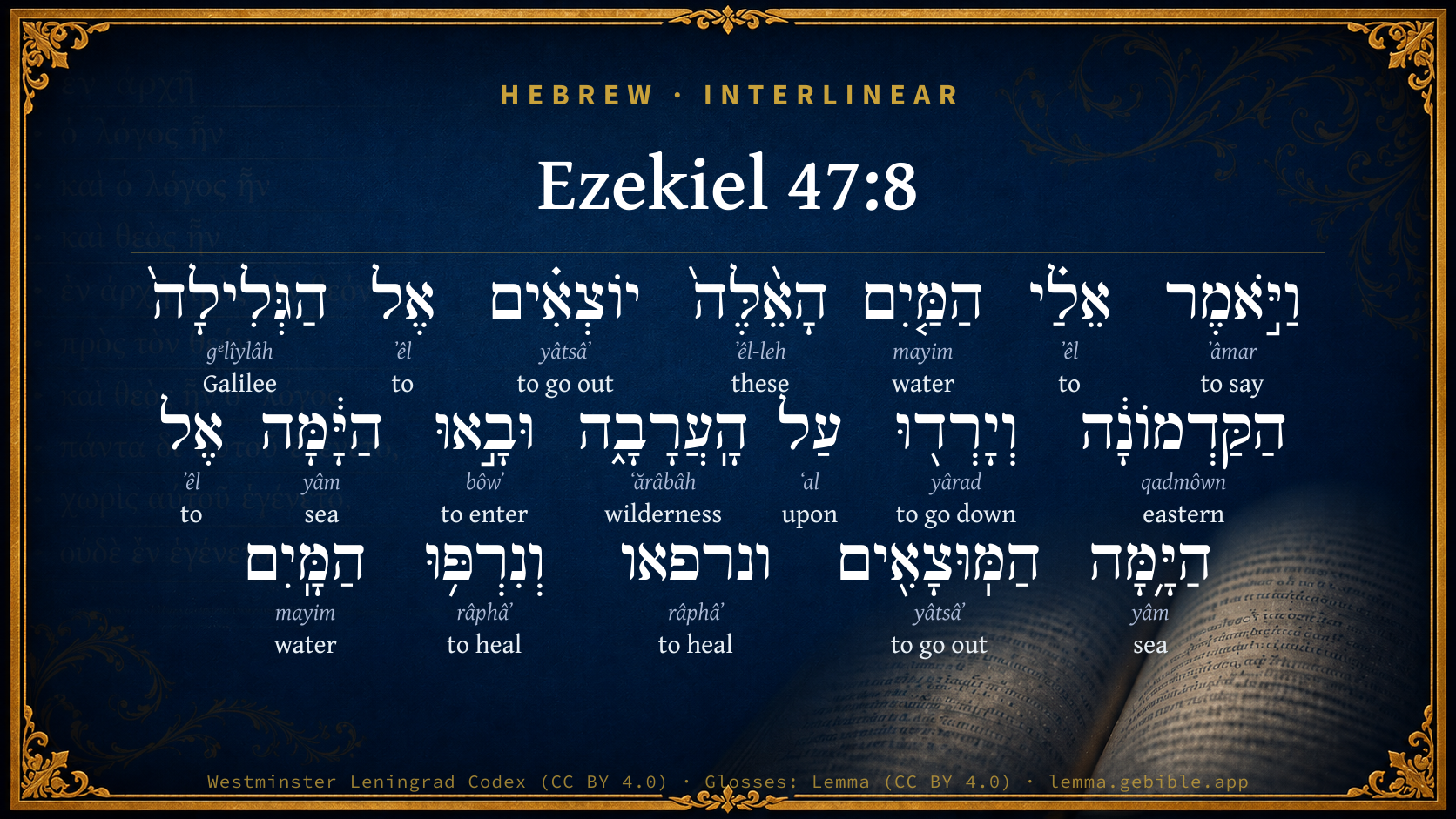
Hebrew (Westminster Leningrad Codex) Ezekiel 47:8 appears in the Hebrew Old Testament. The text above is from the Westminster Leningrad Codex. Each word links to its Strong’s number, a concise gloss, and parsing drawn from the Open Scriptures Hebrew Bible morphology. Click any word for its full Brown-Driver-Briggs (BDB) entry.
Download image
Cite this verse

Ezekiel 47:8 (World English Bible). Public Domain. Lemma interlinear Bible study tool, https://lemma.gebible.app/v/ezekiel/47/8.

Show BibTeX & RIS
BibTeX
RIS
English Translation
Then said he to me, These waters issue forth toward the eastern region, and shall go down into the Arabah; and they shall go toward the sea; into the sea [shall the waters go] which were made to issue forth; and the waters shall be healed.
World English Bible · Public Domain
Highlights
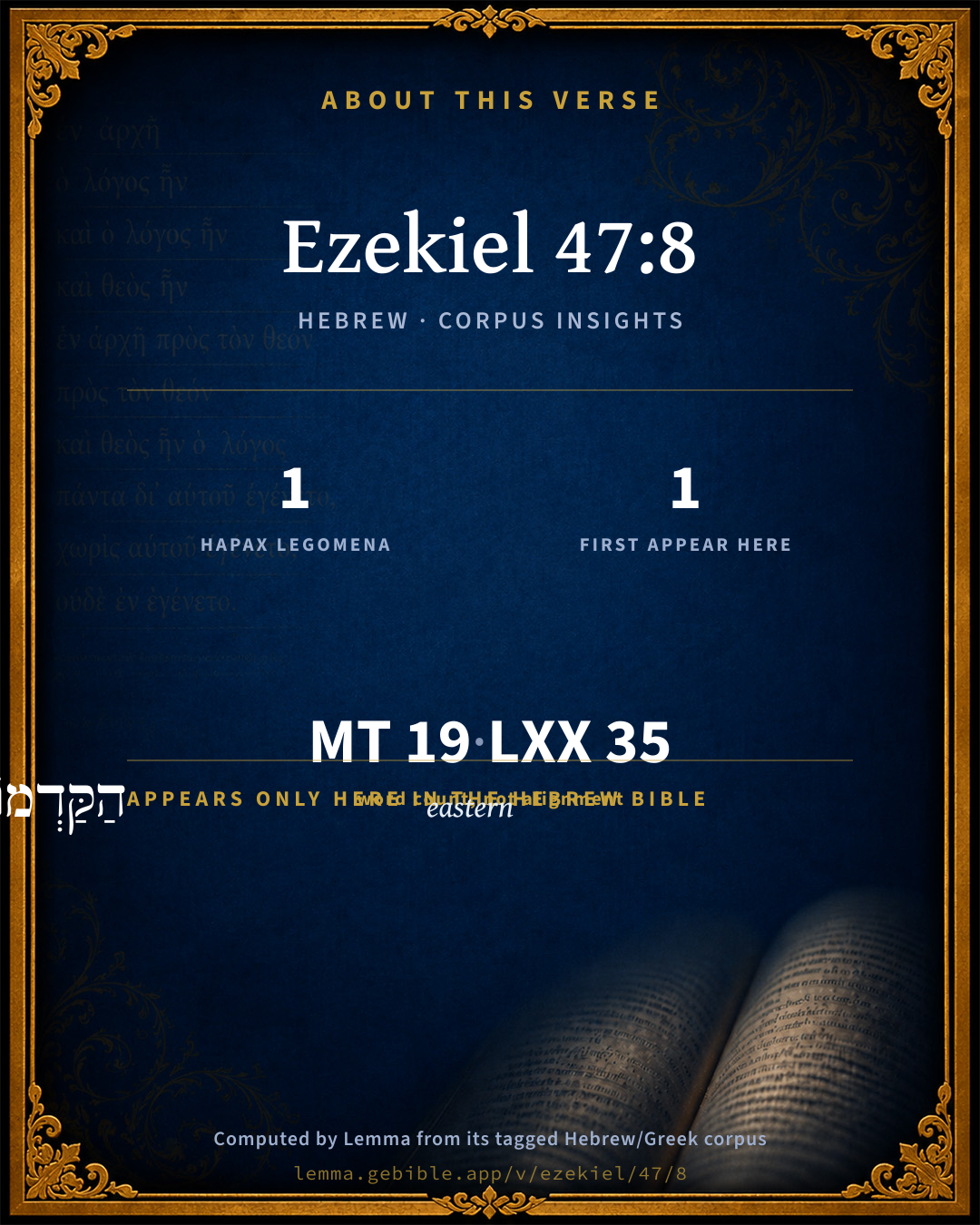
  • 1 hapax legomenon — only here in the Hebrew Bible
  • 1 first appearance in the Hebrew Bible
Full analysis ↓
Download a study sheet

One document with this verse’s original text, its word-by-word gloss line, the meaning frame, cross-references with their text, attributed commentary, and full source and license credits — printable, and it pastes into notes with its structure intact.

This verse Autodidact and up

Study sheet (.html) Plain text (.txt)

A passage Seminary Student

Up to 50 verses in one chapter. A passage sheet keeps up to 6 commentary sources and 12 cross-references per verse, in the order this page ranks them, and says so on the sheet whenever that leaves anything out. Ask for a single verse and you get the Autodidact verse sheet above.

Everything on this page stays free to read, with no account — the sheet is a download of what is already on screen, not access to it.

Want to remove ads? Support Godless Engineer
Compare translations 3

The same verse in 3 English versions, stacked beneath the original-language interlinear above. Click any original word for its lexicon entry.

Each is an independent rendering of the whole verse — the interlinear is not word-aligned to these translations.

Highlighted words mark where these versions differ — a whole-verse word diff, not a word-by-word alignment.

  • World English Bible Public Domain
    Then said he to me, These waters issue forth toward the eastern region, and shall go down into the Arabah; and they shall go toward the sea; into the sea [shall the waters go] which were made to issue forth; and the waters shall be healed.
  • King James Version Public Domain
    Then said he unto me, These waters issue out toward the east country, and go down into the desert, and go into the sea: which being brought forth into the sea, the waters shall be healed.
  • unfoldingWord Literal Text CC BY-SA 4.0
    The man said to me, “This water is going out to the eastern territory and down to the Arabah; this water flows into the Salt Sea and will make it fresh.

unfoldingWord Literal Text — © unfoldingWord, licensed CC BY-SA 4.0. Word-aligned USFM3 via Door43 (git.door43.org/unfoldingWord/en_ult).

Versions to compare (up to 4)

3 of 4 selected

Show all 18 translations

Every available English version of this verse, each an independent rendering of the whole verse.

  • World English Bible Public Domain
    Then said he to me, These waters issue forth toward the eastern region, and shall go down into the Arabah; and they shall go toward the sea; into the sea [shall the waters go] which were made to issue forth; and the waters shall be healed.
  • Berean Standard Bible Public Domain
    And he said to me, “This water flows out to the eastern region and goes down into the Arabah. When it empties into the Sea, the water there becomes fresh.
  • Majority Standard Bible Public Domain
    And he said to me, “This water flows out to the eastern region and goes down into the Arabah. When it empties into the Dead Sea, the water there becomes fresh.
  • King James Version Public Domain
    Then said he unto me, These waters issue out toward the east country, and go down into the desert, and go into the sea: which being brought forth into the sea, the waters shall be healed.
  • American Standard Version (1901) Public Domain
    Then said he unto me, These waters issue forth toward the eastern region, and shall go down into the Arabah; and they shall go toward the sea; into the sea `shall the waters go' which were made to issue forth; and the waters shall be healed.
  • Revised Version (1885) Public Domain
    Then said he unto me, These waters issue forth toward the eastern region, and shall go down into the Arabah: and they shall go toward the sea; into the sea shall the waters go which were made to issue forth; and the waters shall be healed.
  • Geneva Bible (1599) Public Domain
    Then saide he vnto me, These waters issue out towarde the East countrey, and runne downe into the plaine, and shall goe into one sea: they shall runne into another sea, and the waters shalbe wholesome.
  • Douay-Rheims (1899) Public Domain
    And he said to me: These waters that issue forth toward the hillocks of sand to the east, and go down to the plains of the desert, shall go into the sea, and shall go out, and the waters shall be healed.
  • Young's Literal Translation Public Domain
    And he saith unto me, `These waters are going forth unto the east circuit, and have gone down unto the desert, and have entered the sea; unto the sea they are brought forth, and the waters have been healed.
  • Literal Standard Version CC BY-SA 4.0
    And he says to me, “These waters are going forth to the east circuit, and have gone down to the desert, and have entered the sea; they are brought forth to the sea, and the waters have been healed.
  • Unlocked Literal Bible CC BY-SA 4.0
    The man said to me, “This water is going out to the eastern territory and down to the Arabah; this water flows into the Salt Sea and will make it fresh.
  • unfoldingWord Literal Text CC BY-SA 4.0
    The man said to me, “This water is going out to the eastern territory and down to the Arabah; this water flows into the Salt Sea and will make it fresh.
  • Darby Bible Public Domain
    And he said unto me, These waters issue out toward the east district, and go down into the plain, and go into the sea; when they are brought forth into the sea, the waters [thereof] shall be healed.
  • World Messianic Bible Public Domain
    Then he said to me, “These waters flow out toward the eastern region and will go down into the Arabah. Then they will go toward the sea and flow into the sea which will be made to flow out; and the waters will be healed.
  • Webster's Bible Public Domain
    Then said he to me, These waters issue out towards the east country, and go down into the desert, and go into the sea: which being brought forth into the sea, the waters shall be healed.
  • Free Bible Version CC BY-SA 4.0
    He told me, “This water flows out into the land to the east and into the Arabah. When it arrives at the Dead Sea, it turns the saltwater fresh.
  • Bible in Basic English Public Domain
    And he said to me, These waters are flowing out to the east part of the land and down into the Arabah; and they will go to the sea, and the waters will be made sweet.
  • JPS Tanakh (1917) Public Domain
    Then said he unto me: 'These waters issue forth toward the eastern region, and shall go down into the Arabah; and when they shall enter into the sea, into the sea of the putrid waters, the waters shall be healed.

Literal Standard Version (2020), Covenant Press — licensed CC BY-SA 4.0. Text via the HelloAO Bible API (eBible.org). Unlocked Literal Bible (unfoldingWord) — licensed CC BY-SA 4.0. Text via the HelloAO Bible API (eBible.org). unfoldingWord Literal Text — © unfoldingWord, licensed CC BY-SA 4.0. Word-aligned USFM3 via Door43 (git.door43.org/unfoldingWord/en_ult). Free Bible Version, Dr. Jonathan Gallagher — licensed CC BY-SA 4.0. Text via the HelloAO Bible API (eBible.org).

Word by word

More ways to search: Search by grammar → Find every occurrence → Compare this word →

Practice this passage: Drill this verse → Learn its vocabulary →

הַקַּדְמוֹנָ֔ה
qadmôwn
H6930
“the · eastern”
Particle, Definite Article + Adjective, Adjective, Feminine, Singular, Absolute
Part of Speech
Particle + Adjective
Type
Adjective
Gender
Feminine
Number
Singular
State
Absolute
Full BDB Definition

Origin: from H6923

TWOT: 1988e

eastern
  1. וַיֹּ֣אמֶר ʼâmar H559 “and · to say” Conjunction + Verb, Qal, Sequential Imperfect, 3rd Person, Masculine, Singular
  2. אֵלַ֗י ʼêl H413 “to · me” Preposition + Suffix, Personal, 1st Person, Common, Singular
  3. הַמַּ֤יִם mayim H4325 “the · water(s)” Particle, Definite Article + Noun, Common, Masculine, Plural, Absolute
  4. הָאֵ֨לֶּה֙ ʼêl-leh H428 “the · these” Particle, Definite Article + Pronoun, Demonstrative, Common, Plural
  5. יוֹצְאִ֗ים yâtsâʼ H3318 “going out” Verb, Qal, Participle Active, Masculine, Plural, Absolute
  6. אֶל ʼêl H413 “to” Preposition
  7. הַגְּלִילָה֙ gᵉlîylâh H1552 “the · Galilee” Particle, Definite Article + Noun, Common, Feminine, Singular, Absolute
  8. וְיָרְד֖וּ yârad H3381 “and · to go down” Conjunction + Verb, Qal, Sequential Perfect, 3rd Person, Common, Plural
  9. עַל ʻal H5921 “upon” Preposition
  10. הָֽעֲרָבָ֑ה ʻărâbâh H6160 “the · wilderness” Particle, Definite Article + Noun, Common, Feminine, Singular, Absolute
  11. וּבָ֣אוּ bôwʼ H935 “and · to enter” Conjunction + Verb, Qal, Sequential Perfect, 3rd Person, Common, Plural
  12. הַיָּ֔מָּה yâm H3220 “the · sea · toward” Particle, Definite Article + Noun, Common, Masculine, Singular, Absolute + Suffix, Demonstrative
  13. אֶל ʼêl H413 “to” Preposition
  14. הַיָּ֥מָּה yâm H3220 “the · sea · toward” Particle, Definite Article + Noun, Common, Masculine, Singular, Absolute + Suffix, Demonstrative
  15. הַמּֽוּצָאִ֖ים yâtsâʼ H3318 “the · gone out” Particle, Definite Article + Verb, Hophal, Participle Passive, Masculine, Plural, Absolute
  16. ונרפאו râphâʼ H7495 “and · to heal” Conjunction + Verb, Niphal, Sequential Perfect, 3rd Person, Common, Plural
  17. וְנִרְפּ֥וּ râphâʼ H7495 “and · to heal” Conjunction + Verb, Niphal, Sequential Perfect, 3rd Person, Common, Plural
  18. הַמָּֽיִם mayim H4325 “the · water(s)” Particle, Definite Article + Noun, Common, Masculine, Plural, Absolute

About this verse

These counts appear in no published source. They are computed here, from the morphology-tagged text and Lemma’s own curated glosses. What Lemma adds →

19
words
13
distinct lemmas
Prophets
section

Notable vocabulary

1 hapax legomenon — a word that appears only here in the entire Hebrew Bible:

  • הַקַּדְמוֹנָ֔ה eastern H6930

First appearance in Scripture

This word makes its first canonical appearance in the Hebrew Bible here:

  • הַקַּדְמוֹנָ֔ה eastern H6930

Shared distinctive vocabulary

הַגְּלִילָה֙ Galilee H1552 occurs in 5 verses of the Hebrew Bible. Also found in:

Grammatical profile

  • 7 verbs
  • 6 nouns
  • 1 adjective
  • 1 pronoun
  • 4 prepositions

Verb forms

  • וַיֹּ֣אמֶר Qal · Sequential Imperfect
  • יוֹצְאִ֗ים Qal · Participle Active
  • וְיָרְד֖וּ Qal · Sequential Perfect
  • וּבָ֣אוּ Qal · Sequential Perfect
  • הַמּֽוּצָאִ֖ים Hophal · Participle Passive
  • ונרפאו Niphal · Sequential Perfect
  • וְנִרְפּ֥וּ Niphal · Sequential Perfect

Repetition

Words recur within this verse — often emphatic in Hebrew:

  • הַמַּ֤יִם water H4325 ×2
  • יוֹצְאִ֗ים to go out H3318 ×2
  • הַיָּ֔מָּה sea H3220 ×2
  • ונרפאו to heal H7495 ×2
  • אֵלַ֗י to H413 ×3

Hebrew & Septuagint length

In English translation the verse runs 46 words from the Hebrew and 45 from the Septuagint (LXX English) — closely comparable.

A rough comparison of the two English renderings, which tokenize alike — not a word-level alignment.

Word counts can differ between the Hebrew and the Greek without any difference in meaning — e.g. the Hebrew direct-object marker אֵת has no separate Greek word, and Greek often adds the article ὁ.

In the original languages it is 19 Hebrew tokens and 35 Greek tokens — but the two are counted differently (Hebrew bundles its prefixes and suffixes into one token; the Greek is in lemma form), so that isn’t a like-for-like length.

Cross-references

14

Topical passages linked to Ezekiel 47:8 in the Treasury of Scripture Knowledge — connected by theme and wording, ordered by reader-vote popularity; previews shown in the World English Bible.

  • Joshua 3:16 that the waters which came down from above stood, and rose up in one heap, a great way off, at Adam, the city that is beside Zarethan; and those that went down toward the sea of the Arabah, even the Salt Sea, were wholly cut off: and the people passed over right against Jericho.
  • Deuteronomy 3:17 the Arabah also, and the Jordan and the border [of it], from Chinnereth even to the sea of the Arabah, the Salt Sea, under the slopes of Pisgah eastward.
  • Deuteronomy 4:49 and all the Arabah beyond the Jordan eastward, even to the sea of the Arabah, under the slopes of Pisgah.
  • 2 Kings 2:19–22 The men of the city said to Elisha, Behold, we pray you, the situation of this city is pleasant, as my lord sees: but the water is bad, and the land miscarries.
  • Isaiah 44:3–5 For I will pour water on him who is thirsty, and streams on the dry ground; I will pour my Spirit on your seed, and my blessing on your offspring:
  • Isaiah 35:7 The glowing sand shall become a pool, and the thirsty ground springs of water: in the habitation of jackals, where they lay, shall be grass with reeds and rushes.
  • Isaiah 41:17–19 The poor and needy seek water, and there is none, and their tongue fails for thirst; I, Yahweh, will answer them, I, the God of Israel, will not forsake them.
  • Isaiah 43:20 The animals of the field shall honor me, the jackals and the ostriches; because I give waters in the wilderness, and rivers in the desert, to give drink to my people, my chosen,
  • Isaiah 35:1 The wilderness and the dry land shall be glad; and the desert shall rejoice, and blossom as the rose.
  • Jeremiah 31:9 They shall come with weeping; and with petitions will I lead them: I will cause them to walk by rivers of waters, in a straight way in which they shall not stumble; for I am a father to Israel, and Ephraim is my firstborn.
  • Malachi 1:11 For from the rising of the sun even to the going down of the same, my name is great among the nations, and in every place incense will be offered to my name, and a pure offering: for my name is great among the nations," says Yahweh of Hosts.
  • Isaiah 11:6–9 The wolf shall dwell with the lamb, and the leopard shall lie down with the kid; and the calf and the young lion and the fattened calf together; and a little child shall lead them.
  • Isaiah 49:9 saying to those who are bound, Go forth; to those who are in darkness, Show yourselves. They shall feed in the ways, and on all bare heights shall be their pasture.
  • Matthew 13:15 For this people's heart has grown callous, Their ears are dull of hearing, They have closed their eyes; Or else perhaps they might perceive with their eyes, Hear with their ears, Understand with their heart, And should turn again; And I would heal them.'

Cross-references courtesy of OpenBible.info (CC BY 4.0).

Hebrew and Greek witnesses Masoretic Hebrew ↔ Greek Septuagint

The same verse in the two great witnesses to the Old Testament, shown verse-for-verse.

These are two independent witnesses, not word-aligned to each other, and the Septuagint is shown in lemma (dictionary) form.

Hebrew Ezekiel 47:8 Masoretic · Westminster Leningrad Codex

וַיֹּ֣אמֶר אֵלַ֗י הַמַּ֤יִם הָאֵ֨לֶּה֙ יוֹצְאִ֗ים אֶל הַגְּלִילָה֙ הַקַּדְמוֹנָ֔ה וְיָרְד֖וּ עַל הָֽעֲרָבָ֑ה וּבָ֣אוּ הַיָּ֔מָּה אֶל הַיָּ֥מָּה הַמּֽוּצָאִ֖ים ונרפאו וְנִרְפּ֥וּ הַמָּֽיִם

Then said he to me, These waters issue forth toward the eastern region, and shall go down into the Arabah; and they shall go toward the sea; into the sea [shall the waters go] which were made to issue forth; and the waters shall be healed.

World English Bible · Public Domain

Greek LXX Ezekiel 47:8 Septuagint · lemma form

καί εἶπον πρός ἐγώ ὁ ὕδωρ οὗτος ὁ ἐκπορεύομαι εἰς ὁ γαλιλαία ὁ πρός ἀνατολή καί καταβαίνω ἐπί ὁ ἀραβία καί ἄρχω ἕως ἐπί ὁ θάλασσα ἐπί ὁ ὕδωρ ὁ διεκβολή καί ὑγιάζω ὁ ὕδωρ

And he said to me, This is the water that goes forth to Galilee that lies eastward, and it is gone down to Arabia, and has reached as far as to the sea to the outlet of the water: and it shall heal the waters.

LXX2012 (modern English Septuagint) · Public Domain

On this verse, The Cambridge Bible for Schools and Colleges discusses the Septuagint’s reading. Read the note in Commentary ↓

Hebrew: Westminster Leningrad Codex (CC BY 4.0). Greek: Septuagint (public domain); English from LXX2012 (modern English Septuagint) (Public Domain). How the Septuagint differs from the Hebrew →

Targum (Aramaic paraphrase)

1

The Targum is the ancient Jewish Aramaic paraphrase of the Hebrew Scriptures — an interpretive translation, not the Hebrew text itself. Onkelos (literal) and Pseudo-Jonathan (expansive) render the Torah, and Jonathan the Prophets. Coverage is partial: where no permissively-licensed English translation exists for a verse, only the Aramaic is shown. This is verse-level text, not a word-by-word alignment to the Hebrew.

  1. Targum Jonathan Prophets (Joshua–Malachi)
    וַאֲמַר לִי מַיָא הָאִלֵין נַפְקִין בְּגָלִילָא מִמַדִינְחָא וְנָחֲתִין בְּמֵישְׁרָא וְעָלִין בְּיַמָא לְיַמָא רַבָּא מִתַּפְקִין וּמִתַּסָן מַיָא:

    (no public-domain English translation for this verse)

    Targum Jonathan — Aramaic: “Mikraot Gedolot” (public domain). English: “Sefaria Community Translation” (CC0 1.0 (public-domain dedication)); “London "Chaldee Paraphrase," 1871” (public domain). Text via Sefaria.

Commentary

Notes on Ezekiel 47:8 from classic Christian and Jewish commentators (each source and its license shown beneath its notes). The classic Christian expositions comment on the surrounding passage and are grouped to its opening verse, so a note may address several verses; the Jewish commentaries on the Tanakh (Rashi and others) are per-verse, so they appear only where the commentator wrote on this verse.

Lemma curates 59 commentaries, every one of them public domain or Creative Commons licensed, each selected and text-cleaned for this edition rather than reprinted as found. About our sources →

Trapp's Complete Commentary

John Trapp

Eze 47:8 Then said he unto me, These waters issue out toward the east country, and go down into the desert, and go into the sea: [which being] brought forth into the sea, the waters shall be healed.

Ver. 8. These waters issue out toward the east country.] In Galilaeam anteriorem. {a} See Act 9:31 - the churches in Galilee, "walking in the fear of the Lord and comforts of the Holy Ghost, were multiplied."

And go down into the desert.] Or, Plain; i.e., into the plains of Moab. {Num 22:1} The gospel worketh upon the worst, even to a transmentation.

And go into the sea.] The Dead Sea. The law of the Spirit of life which is in Christ Jesus, freeth men from the law of sin and of death. {Rom 8:2}

The waters shall be healed,] i.e., Made wholesome and useful; so great a cure is done upon corrupt nature by the grace of the gospel. He who was before vitiorum vorago, lacus libidinum, mare sceleribus amarum ac mortuum, a lake of lusts, a guzzle of vices, a dead sea of wickedness and wretchedness, shall by a strange change become a pleasant river, pure, clear, sweet, and savoury; beset not with such mock fruit as the banks of the Dead Sea are said to be, but with trees richly laden with the choicest fruits; as was to be seen in the penitent thief, who, as soon as gospelised and converted, bestirred him and bore abundance of fruit in a very little space.

{a} Piscat.

John Trapp, A Commentary or Exposition upon All the Books of the Old and New Testament (1647–1656) — public domain. Text from a community e-Sword module.

The Biblical Illustrator

Joseph S. Exell

Eze_47:8

These waters . . . go down into the desert.

Christ as a river in the desert

Though manhood seems to be a dry place, a salt and barren land, yet in the case of this Man it yields rivers of water,--numberless streams, abounding with refreshment.

I. Natures drought does not hinder Christs coming to men.

1. He came into the dry place of a fallen, ruined, rebellious world.

2. He comes to men personally, notwithstanding their being without strength, without righteousness, without desire, without life.

3. He flows within us in rivers of grace, though the old nature continues to be a dry and parched land.

4. He continues the inflowing of His grace till He perfects us, and this He does though decay of nature, failure, and fickleness prove us to be as a dry place.

III. Natures drought enhances the preciousness of Christ.

1. He is the more quickly discovered; as rivers would be in a desert.

2. He is the more highly valued; as water in a torrid climate.

3. He is the more largely used; as streams in a burning wilderness.

4. He is the more surely known to be the gift of Gods grace. How else came He to be in so dry a place? Those who are most devoid of merit are the more clear as to Gods grace.

5. He is the more gratefully extolled. Men sing of rivers which flow through dreary wastes.

III. Natures drought is most effectually removed by Christ. Rivers change the appearance and character of a dry place. By our Lord Jesus appearing in our manhood as Emmanuel, God with us,--

1. Our despair is cheered away.

2. Our sinfulness is purged.

3. Our nature is renewed.

4. Our barrenness is removed.

5. Our trials are overcome.

6. Our fallen condition is changed to glory.

IV. Our own sense of drought should lead us the more hopefully to apply to Christ. He is rivers of water in a dry place. The dry place is His sphere of action. Natures want is the platform for the display of grace.

1. This is implied in our Lords offices. A Saviour for sinners. A Priest who can have compassion on the ignorant, etc.

2. This is remembered in His great qualifications. Rivers, because the place is so dry. Full of grace and truth, because we are so sinful and false. Mighty to save, because we are so lost, etc.

3. This is manifested by the persons to whom He comes. Not many great or mighty are chosen. I came not to call the righteous, but sinners to repentance. He calls the chief of sinners. In every case the rivers of love flow into a dry place.

4. This is clear from the object which He aimed at, namely, the glory of God, and the making known of the riches of His grace. This can be best accomplished by working salvation where there is no apparent likelihood of it, or, in other words, causing rivers to water dry places. (C. H. Spurgeon.)

The purifying and transforming power of the Gospel

What a mercy it is that the Gospel does go into the desert. Think of what this island used to be, when our sires wandered about in their nakedness among its oak groves. Think of the times when the great wicker image was set up, and the Druids surrounded it, and that image was crammed full of hundreds of men and women, who were all to be consumed in one dread fire, while the people stood by to see their fellow creatures offered to their national Meloch. That is all over now. No longer is the mistletoe cut with the golden sickle, or the fierce deity appeased with blood of men. The missionary came and preached the Gospel; and the Druids ceased out of the land. They were both the legislature and the hierarchy, but they could not stand before the Divine truth. They were everybody then, but they are nobody now. I do not know what may happen here yet,. But I do know this, that when the Gospel comes, the images, the idols, the filthy things, the cruel and horrible things must go. The river of life purified Britain once, and it will cleanse it yet again. The waters shall be healed. (C. H. Spurgeon.)

The waters shall be healed.

The modern Dead Sea, and the living waters

The remarkable vision, which lies open before us, is exceedingly reassuring to those who are troubled by reason of the dreadful condition of the times--and which of us is not? The prophet bids us think of those waters, drear and dreadful, known by the suggestive name of the Dead Sea! This was the Chamber of Horrors of the land of Canaan. The world is a veritable Dead Sea upon a gigantic scale. Such also is the city in which we live: must I call it modern Sodom? Every wave that breaks upon the shore of this human lake now seems to wash up remains of monstrous things, unearthly, inhuman, beastly, devilish. London is a simmering cauldron of vice and crime. O God! how long shall it be? In certain respects such is every mans natural heart until he is renewed by grace. The heart is deceitful above all things, and desperately wicked, and may be well typified by the Sea of Death. If we could but look into it with such eyes as God hath, what should we not set? Thus the world, the city, the heart are each symbolised by the Dead Sea. Can they ever be purged? Can these waters be healed? According to our text, the Lord saith expressly, the waters shall be healed. Let us believe His promise, and take heart of hope from this good hour. Here is room, my brethren, for the faith which, like charity, believeth all things, hopeth all things.

I. And, first, to encourage your faith, I bid you to consider the promise.

1. We feel sure that this word of prophecy shall be accomplished to the letter in due time, because He that made the promise is able to fulfil it. What can resist the thunder of His word? Who shall stay His hand, or frustrate His design?

2. The Lord will fulfil this word thoroughly. This promise shall not be kept to the ear only, but it shall be fulfilled in the largest conceivable sense. What hosts have washed their robes, and made them white in the blood of the Lamb!

3. He will fulfil this word in connection with the present dispensation. To my mind this is clear enough, from the fact that these waters flowed forth from Mount Zion. From this I gather that our God means to use His church for His purposes of grace. Out of Zion, the perfection of beauty, God hath shined. We believe that He means to win His ultimate triumphs by the preaching of the Gospel.

4. Note, carefully, that this Divine promise, the waters shall be healed, will not put aside instrumentality, but when it is fulfilled it will call forth more abundant agencies. The waters run into the Dead Sea, and purify its waters; then fish begin to multiply, and then mans part comes in: The fishers shall stand upon it from En-gedi even into En-eglaim. You, slothful Christian men and women, who have never gone to sea in this fishery, will then be moved to the work, and will say, like Peter, I go a-fishing.

II. I invite you, next, to consider the wonder of the healing waters, that we may be helped thereby to believe that healing will come even to the Dead Sea of this present evil world, this present sinful Babylon, this present deceitful heart.

1. The wonders of the waters which Ezekiel saw lay in many things. First, consider whence they came. The healing waters flow from the throne of God and of the Lamb. As God is God, He hath decreed and purposed to redeem His people; and in that decree and purpose is the fountain of good to men. These waters flowed in the vision hard by the altar of burnt offering. Learn hence that the one channel of mercy to the sons of men is by the sacrifice of Christ. These waters, though they flowed unseen across the temple area, presently bubbled up from under the threshold of the door of the house. You know who is the Door of the temple of God: by Him we enter in unto God, and by Him God cometh forth in blessing unto us.

2. Note next, as a wonder in connection with these waters, how they increased. You and I have waded into these waters, have we not? If so, we know how they have increased upon us. Do you not see that the God who has done all this for you can do as much for others? Can He not heal the waters of the Dead Sea of our day?

3. Notice what these waters produced. They began to flow, and very soon vegetation came into the wilderness. They flowed into the desert, and into the Acacia Vale, as Joel calls it; and soon, on both sides of the river, there were trees, and, on a sudden, the trees were bearing fruit. Wherever the Gospel goes it carries life, and growth, and fruit with it.

4. As a further wonder, note whither the stream flowed. These waters issue out toward the east country, and go down into the desert, and go into the sea: which, being brought forth into the sea, the waters shall be healed. What a mercy it is that the Gospel does go into the desert! Think of what this island used to be, when our sires wandered about in their nakedness among its oak groves.

III. Consider the efficacy of the waters. I will quit the figure in some measure in order to explain how the Gospel is adapted to heal the wickedness of men. What does the Gospel do? saith one. I answer, In the Gospel we set before men the horrible nature of sin, and thus we lead them to turn from it. The Gospel gives man a hope; and that is a grand thing for the degraded and self-condemned. To have a hope that you can be a better man is a great help in escaping from sin. The Gospel purifies men because it gives them Christ Himself to be their Saviour. It brings them the Son of God to be their salvation. Moreover, the Gospel does not merely tell men certain truths, but it gives life, and power, and grace to them. There comes with the Gospel a power almighty, which changes the nature of the man; touches his understanding, and enlightens it; touches his will, and changes it; touches his affections, and purifies them. This power is the Holy Ghost, equal and co-eternal with the Father and the Son--nothing less than very God of very God. The power of the Gospel to cleanse this horrible Lake of Gomorrah lies in this: that it touches the heart, it moves the affections, it changes the nature, it renews the entire man. Moreover, it binds men in a holy brotherhood, and leads them back to their Father, and their God.

IV. The lesson of the waters. God works in very unexpected ways. The Lord knows how to do His own work, and He does it by apparently slender means.

2. As the Dead Sea has to be cleansed by that stream of water, all that we can do is, first of all, to pray, Spring up, O Well!

3. When we have done that, what next have we to do? Why, begin fishing. Go and fish in the streets, fish in the street corners, fish in any little room you can open, fish in the great crowds if they will come to you. The stream is breeding swarms of life; be ye fishers of men. (C. H. Spurgeon.)

The Biblical Illustrator, edited by Joseph S. Exell (c. 1880s–1900s) — public domain. Text from a community e-Sword module.

Joseph Benson's Commentary

Eze 47:8-9. Then said he, These waters issue toward the east country — These waters are described as taking their course along the plain, or champaign country, (for that is the sense of the word here rendered desert,) toward the lake where Sodom formerly stood, called the Dead sea, and by Moses, the Salt sea: see Deu 3:17. Which being brought forth into the sea, the waters shall be healed — These living and salubrious streams, by mixing with the salt and brackish waters of the sea, shall render them wholesome and fit for use; finely representing the tendency of the gospel, and the healing virtue of divine grace, in curing the corruptions of human nature, and vices of mankind. And every thing that liveth, &c., whithersoever the river shall come, shall live — “Even in the Asphaltite lake, or Dead sea, which is so unfavourable to animal life. Josephus represents this lake as salt, and incapable of feeding fishes. Tacitus says, that it does not suffer fishes or water-fowl to live in it; yet Maundrell observed two or three shells of fishes on the shore. Bishop Pococke found its water very salt; and on tasting it, his mouth was constringed, as if it had been a strong alum water. The bishop observes, ‘It has been said by all authors, and is the common opinion, that there is no fish in this lake: the fresh water fish of the river Jordan probably would not live in it. After I left the Holy Land, it was positively affirmed to me, that a monk had seen fish caught in this water; and possibly there may be fish peculiar to this lake, for which this water may not be too salt: but this is a fact that deserves to be inquired into. The air about this lake has always been thought to be very bad.’ ‘The Dead sea,’ says Michaelis, ‘is more brackish than any known sea or salt-well in the world. It contains as much salt as water can dissolve, namely, the fourth part of the weight of the water: and this is the reason why neither men nor animals sink in the Dead sea. If you throw fishes into heavy water, they cannot swim, but fall immediately on their sides.’“ — Newcome. The reader who wishes to have farther information on this subject, may find it in Dr. Pococke and Dr. Shaw’s Travels, or the Encycl. Britan. on the word Asphaltites. Every thing shall live whither the river cometh — This signifies the wonderful and blessed efficacy of the gospel, when accompanied by the influence of the Holy Spirit, and received in faith and love: it communicates spiritual life to such as were before dead in trespasses and sins: it creates them anew in Christ Jesus unto all holy tempers, words, and works, such as God hath ordained that men should walk in them.

Joseph Benson's Commentary on the Old and New Testaments (1811–1818) — public domain. Text from a community e-Sword module.

Geneva Bible (1599)

Geneva Bible translators

Showing that the abundance of these graces should be so great, that all the world should be full thereof, which is here meant by the Persian sea, or Genezareth, and the sea called Mediterranean, Zech. 14:8.

Geneva Bible (1599) marginal notes — public domain. Text via Bolls.life.

Jamieson, Fausset & Brown

Robert Jamieson, A. R. Fausset & David Brown

the desert--or "plain," Hebrew, Arabah (Deu 3:17; Deu 4:49; Jos 3:16), which is the name still given to the valley of the Jordan and the plain south of the Dead Sea, and extending to the Elanitic gulf of the Red Sea.

the sea--the Dead Sea. "The sea" noted as covering with its waters the guilty cities of the plain, Sodom and Gomorrah. In its bituminous waters no vegetable or animal life is said to be found. But now death is to give place to life in Judea, and throughout the world, as symbolized by the healing of these death-pervaded waters covering the doomed cities. Compare as to "the sea" in general, regarded as a symbol of the troubled powers of nature, disordered by the fall, henceforth to rage no more, Rev 21:1.

Jamieson, Fausset & Brown — Commentary Critical and Explanatory on the Whole Bible (1871) — public domain (CC PDM 1.0). Text via the HelloAO Bible API.

Ellicott's Commentary for English Readers

(8) Go down into the desert.—The word for country is the same as is used in Jos_22:10-11, for the borders of the Jordan, and undoubtedly has the same meaning here: the valley of the Jordan, called the Ghor. The word desert is better translated in the margin, plain, and refers to that expansion of the Jordan valley just north of the Dead Sea in which the city of Jericho was situated. So far the course of the river has been due east; now, without any allusion to the Jordan, it apparently takes its place and flows into the sea. Both the situation and the description show that the Dead Sea is intended. By its entrance “the waters of the sea shall be healed,” that is, they shall be so changed that, from being incapable of supporting life, they shall become the home of life in all abundance and variety (Eze_47:9-10).

A Bible Commentary for English Readers, edited by Charles John Ellicott (1878–1897) — public domain. Text from a community e-Sword module.

The Cambridge Bible for Schools and Colleges

gen. ed. J. J. S. Perowne

8. The direction of the stream was eastward, towards the region which is desert, and towards the Dead Sea.

the east country] lit. circle, or, district, the same word as Galilee (Isa_9:1). Cf. Jos_22:10-11, “the circuits of the Jordan.”

unto the desert] the Arabah, what is now called the Ghor, the depression of the Jordan valley, the Dead Sea, and southward as far as the gulf of Akaba; Deu_1:1; Deu_3:17; Jos_18:18. The “sea” into which the waters flow is the Dead Sea.

brought forth into the sea] The construction is difficult. For “into the sea” LXX. read “the waters.” This would necessitate a further change: into the sea, unto the bitter waters, and the waters, &c.; so Corn. after Syr., putrid waters.

The Cambridge Bible for Schools and Colleges (gen. ed. J. J. S. Perowne; Cambridge University Press, 1878–1918) — public domain. Text from a community e-Sword module.

John Gill's Exposition

Then said he unto me,.... The man that measured the waters spoke to the prophet again, and showed him the course of the waters; the quickening and healing virtue of them, and the multitude of fish in them:

these waters issue out toward the east country; the Gospel was first preached in the eastern parts of the world; See Gill on Eze 47:3, or "towards the first, or east Galilee" (f); in Galilee Christ began to preach, and wrought his first miracle; here he called his disciples, and chiefly conversed; and here he had the greatest followers, and some of the first Christian churches were formed here after his ascension, Mat 4:12,

and go down into the desert; or wilderness, the wilderness of the people, the Gentiles; to whom the Gospel was carried when rejected by the Jews, and who before were like a desert, but now became as a fruitful field, Isa 35:1. The Jews (g) interpret this of the plain, or the sea of Galilee or Tiberius, at which Christ called his disciples; near to this he delivered his discourses concerning himself, the bread of life, and eating his flesh, and drinking his blood; here he met with his disciples after his resurrection, and enjoined Peter to feed his sheep and lambs; see Mat 4:18,

and go into the sea; the Dead sea, or sea of Sodom, the lake Asphaltites, where nothing is said to live; an emblem of dead sinners; and may represent the worst of sinners, as the Sodomites were; and to such the Gospel was sent, and became effectual to salvation: or it may rather design the great ocean, and may signify the whole world, and all the nations of it, to which the Gospel, by the commission of Christ, was to be preached; see Dan 7:2. The Targum is,

"and go through the sea into the great sea;''

it may be rendered, "and go toward the west" (h); the Mediterranean sea being to the west of Judea, it is often put for the west; and so the sense may be, that these waters should flow east and west, as the living waters in Zac 14:8, the same with those, are said to do; and all the Jewish writers think there is such a division of the waters intended, and that they had two streams or rivers; which may receive some confirmation from the next verse, where the word for rivers is of the dual number, and signifies two rivers. The sense of the whole is, that the Gospel should be first preached in Judea and Galilee; then among the Gentiles throughout the Roman empire; and in the latter day especially throughout the world, when it shall be covered with it as the waters cover the sea, Isa 11:9,

which being brought forth into the sea, the waters shall be healed; that is, which waters of the river being directed and brought into, either the Dead sea, or the great ocean, the waters of the one, or of the other, were healed; and of bituminous and bitter waters were made clear, sweet, and wholesome; and signify the change made in sinful men by means of the Gospel, who are thereby quickened, made partakers of the grace of God, and have their sins pardoned, which is often meant by healing in Scripture, Psa 103:2, pardon of sin flows from the love and grace of God; is the great doctrine of the Gospel, and by which the Lord speaks peace and pardon, and communicates healing of all spiritual diseases to sinners sensible of them; see Psa 107:20.

(f) "in Galileam prinam", Junius & Tremellius; "ad Galileam anteriorem", Cocceius, Piscator, Starckius; "Galileam orientalem", Munster; so some in Vatablus, Tigurine version; so the Targum. (g) Tosaphta Succa in Jarchi & Kimchi in loc.; so in Ben Melec. (h) .

John Gill's Exposition of the Whole Bible (1746–1763) — public domain (CC PDM 1.0). Text via the HelloAO Bible API.

Albert Barnes' Notes on the Bible

“The sea” is a term commonly applied to the Dead Sea. Compare Deu 3:17, “the sea of the plain (Arabah), even the salt sea.” The more literal rendering of the verse in this sense would be, “and go into the sea; into the sea go the waters that issue forth, and the waters shall be healed.”

Healed - Every living thing (of which there were none before) shall abound in the “healed” waters. The absence of living creatures in the Dead Sea has been remarked by ancient and modern writers. So the water which Jesus should give should bring life to the dead in trespasses and sins. Compare Joh 4:14; Rev 22:2-3.

Albert Barnes' Notes on the Bible (1834–1885) — public domain. Text from a community e-Sword/MySword module.

Haydock's Catholic Bible Commentary

The. Hebrew, "the east country," (Protestants; Haydock) or "the frontiers (Gelilah) eastward," by which some improperly suppose that one rivulet went to the sea of Galilee. --- And shall. Hebrew, "the sea of the going out," where the Jordan River empties itself into the Dead Sea; or, the second rivulet ran into the Mediterranean, Zacharias xiv. 8. But this passage relates to the Dead Sea alone, (ver. 18.) and Gelilah is a place near it, where the Israelites erected an altar of union, Josue xxii. 10. (Calmet) --- Healed. No fish can live in the sea of Sodom. (Solin xxxviii.) --- Yet, let the place be ever so noxious, this water shall cure it; (see 4 Kings ii. 19.; Calmet) which must be taken in a mystical sense. (Haydock)

George Leo Haydock (1774–1849), Haydock's Catholic Family Bible and Commentary, 1859 edition — public domain. Excludes Psalms (Douay-Rheims chapter numbering differs from Protestant) and Deuterocanonical books (Catholic canon only).

Matthew Poole's English Annotations

Then said he: see Eze 47:6.

The east country; some read it as a proper name, and so render it, they did run toward Galilee in the east, and the Hebrew bears it indeed, as to the sound of the word; but it cannot be the meaning of the place, for neither the Upper nor Lower Galilee were east, but north-west from Jerusalem toward Tyre: our translation doth therefore better render it the east country, or border, as the Hebrew properly.

Into the desert; to Arabia, say the Seventy in their Greek version: if this were the course of the waters, they-did run a course quite contrary to that of Galilee, which lay north and by west from Jerusalem, whereas Arabia lay south and by east from Jerusalem. It is then the champaign, plain country, or the desert, as we read it, and may literally be understood of the desert of Maon, or Kadesh, or Ziph, which lay on the Dead Sea; and this suits well enough with En-gedi, and En-eglaim, mentioned as bordering on these waters, Eze 47:10.

Into the sea; the sea of Tiberias, say some; others, the sea called the Dead Sea, or lake of Sodom, which needed healing.

Being brought forth: when they run into this sea, or fall it, to it, (which is our usual phrase,) the waters of the sea shall be healed, made wholesome. Where the grace of God from his temple and altar flows, as this water, it heals the corrupt, vicious nature of man, and renders barren, horrid, and terrible deserts as a land of waters and gardens; so represented here, and so promised by the Lord, Isa 35:1,2; 41:19; 43:19,20; 51:3. Once more, to this verse let me add, that as the Hebrew doctors do, so we may take it here, that these flowing waters do divide themselves, and that some flow toward one sea, i.e. the sea of Tiberias, toward Galilee, other parts flow toward Arabia the Desert, and so in their way take their course by En-gedi, the desert of Ziph, and into the Dead Sea.

Matthew Poole's English Annotations on the Holy Bible (1683–1685) — public domain. Text from a community e-Sword/MySword module.

The Pulpit Commentary

Toward the east country (hlyliGhAla, hn; wOmdQh); literally, the east circle, in this case probably "the region about Jordan", (Jos_22:10, Jos_22:11) above the Dead Sea, where the valley or ghor widens out into a bread basin, equivalent to Deryh dKKi. (Gen_13:10) The LXX render, or than, designing by this, however (presumably), only to Graecize the Hebrew word hl; yliG as they do with the term hbrh desert , or, plain, which they translate by than. The Arabah signified the low, sterile valley into which the Jordan runs near Jericho, in which are the Dead Sea (hence called "the sea of the Arabah,", (Deu_3:17 Deu_4:49) and the brook Kedron, or "river of the Arabah", (Amo_6:14) and which extends as far south as the head of the Elanitic gulf. The whole region is described by Robinson ("Bibl. Res.," 2:596) as one of extreme desolation a character which belonged to it in ancient times (Josephus, "Wars," 3:10. 7; 4:8. 2). The part of this Arabah into which the waters flowed was situated north of the sea, clearly not the Mediterranean, but the Dead Sea, "the sea of the Arabah," as above stated, and the "eastern sea" as afterwards named (ver. 18), into which they ultimately flowed. The clause, which being brought forth into the sea, may either be connected with the proceeding words or formed into an independent sentence. Among those who adopt the former construction a variety of renderings prevails. The LXX reads, "(And the water) comes to the sea (ejpi to udwr thv diekbolhv), to the sea of the pouring out," i.e. the Dead Sea, into which the river debouches. With this Havernick agrees, rendering, "to the sea of that outflow." Ewald reads, "into the sea of muddy waters," meaning the Dead Sea. Kimchi, "into the sea where the waters are brought forth," i.e. the ocean (the Mediterranean), whoso waters go forth to encompass the world. Hengstenberg, Kliefoth, Keil, and Currey, who adopt the latter construction, borrow Wab; from the antecedent clause, and translate, "To the sea (come or go) the waters that have been brought forth;" with which accords the Revised Version. The last words record the effect which should be produced by their entering into the sea. The waters shall be healed, i.e. rendered salubrious, from being hurtful. (comp. Exo_15:23, Exo_15:25; 2Ki_2:22) The translation of the LXX, uJgiasei ta udata, is inaccurate. The unwholesome character of the Dead Sea is described by Tacitus: "Lucius immenso ambitu, specie maris sapore corruptior, gravitate odoris accolis pestifer, neque vento impellitar neque pisces ant suetas aquis volucres patitur" ("Hist.," 5:6). Yon Raumer (p. 61) writes, "The sea is celled Dead, because there is in it no green plant, no water-fowl in it, no fish, no shell. If the Jordan carry fish into it, they die." "According to the testimony of all antiquity and of most modern travelers," says Robinson ("Bibl. Res.," 2:226), "there exists within the waters of the Dead Sea no living thing, no trace, indeed, of animal or vegetable life. Our own experience goes to confirm the truth of this testimony. We perceived no sign of life within the waters.

Vers. 8-11Life and healing.

The stream that bursts from the temple rock is to flow through the dry ravines of the eastern wilderness until it reaches the Dead Sea, the desolate waters of which are to be miraculously healed by the coming of the life-bearing flood. Then fish shall swarm in the purified sea, and everything shall live whither the river cometh." This is a parable of the course of the gospel of Christ.

I THE GRACE OF CHRIST FLOWS TO THE MOST DEAD AND DEGRADED PEOPLE. The Dead Sea may be taken to represent the world in its sin, or that portion of mankind that is most sunken and worthless. The temple waters were not confined to the bracing heights of Jerusalem. They could not contain themselves in those upland regions. Their quantity was so great that they could not but overflow and pour themselves down through the wilderness. Christ cannot keep his rich gifts for a few rare, saintly souls already safely gathered into the Church. They are for the world, chiefly for the world in its sin and desolation. The gathering flood cannot rest till it finds the low level of the Dead Sea. Christ can have no satisfaction till his gospel has reached the most sinful and fallen creatures in the world.

II THE GRACE OF CHRIST BRINGS PURIFICATION AND HEALING.

1. Purification The Dead Sea is charged with salts; the stream is represented as washing these away, or in some manner transforming them. Some great cleansing is needed to purge the earthy mixture out of the hearts and lives of man. Christ brings waters in which the foulest may wash and be clean.

2. Healing. The strong brine of the Dead Sea is fatal to all life. If fish come down in the Jordan they must perish as soon as they reach the fatal lake.

To the bather the waters are so pungent that they produce agonizing sensations in the eyes, and the taste of them is unendurable. Enclosed by the bluest of hills, steaming with tropical heat, the dull and heavy waters produce a scene of noxious beauty like the charm of the snake, like the fascination of sin. But the gospel brings healing to the poisoned sea of human life, as the temple flood was imagined to bring it to the Dead Sea.

III THE PURIFICATION AND HEALING OF THE GRACE OF CHRIST BEAR FRUIT IN LIFE. The purged sea is to team with fish, and fishermen are to spread their nets on its now neglected shores. Before Christ comes men are dead in trespasses and sins. He brings life for the dead, and wherever his gospel goes it introduces this life to the world. Even intellectual, social, and political life are energized by Christianity. The strongest, keenest, freshest life of the world is found in Christendom. Those lands which were once Christian, and have since lost the religion of the Christ, have sunk back to semi-barbarism; e.g. North Africa. The best nourishment for the highest life of man in all its branches is found in the New Testament. When Christ is received, life is strong, rich, and fruitful.

The Pulpit Commentary (1880–1919), ed. H.D.M. Spence-Jones & Joseph S. Exell — public domain. Text from a community e-Sword module.

John Wesley's Explanatory Notes

The sea - The Dead-sea, or lake of Sodom. Shall be healed - The waters of the sea shall be healed, made wholesome. So where the grace of God from his temple and altar flows, it heals the corrupt nature of man, and renders barren terrible deserts, as a land of waters and gardens.

John Wesley, Explanatory Notes Upon the Whole Bible (1754–1765) — public domain. Text via the GEBible commentary corpus.

Rashi

Rabbi Shlomo Yitzchaki (Rashi)

to the...frontier [Heb. הֳגְלִילָה,] la marche, frontier (province).

the eastern [Heb. הַקַּדְמוֹנָה,] the eastern. Our Rabbis taught in the Tosefta of Succah (3:3): Where do they flow? To the Sea of Tiberias (Kinnereth), the Sea of Sodom (Dead Sea), and to the Great Sea, to heal their salty waters and to sweeten them.

[“Will descend upon the plain”] this is the Sea of Tiberias.

[“And come to the sea”] this is the Sea of Sodom.

to the sea that is brought out This is the אוֹקיַינוּס ocean, which is brought out from civilization to encompass the world.

And [it will come] to heal the waters of their saltiness. The Midrash Aggadah [says] Yerushalmi Shekalim (6:2): Why does he call them הַמוּצָאִים (in the plural)? Because of the two times that they went out.

Rashi on the Tanakh — English translations: “The Judaica Press complete Tanach with Rashi, translated by A. J. Rosenberg” (CC BY 4.0); “Pentateuch with Rashi's commentary by M. Rosenbaum and A.M. Silbermann, 1929-1934” (public domain); “The Metsudah Tanach series, Lakewood, N.J” (CC BY 4.0); and “The Book of Joshua, Metsudah Publications, 1997” (CC BY 4.0). Text via Sefaria.

Lesson kit

Teaching starters — assembled from the data on this page, not authored interpretation. Every prompt links to the verse data it draws on. Edit before teaching.

Ezekiel, in the Prophets, opens this verse with 19 words (13 distinct Hebrew lemmas). Its most distinctive word is qadmôwn (“eastern”). A historical commentator’s framing appears above. Read the whole chapter for the surrounding context.

Discussion questions

  1. The word qadmôwn carries the sense “eastern.” How does it shape the verse?
  2. This verse holds 1 word here found nowhere else in the Hebrew Bible. What might the rare word draw attention to?
  3. The word “eastern” first appears here in Scripture. What is being introduced at this debut?
  4. Joshua 13:2 shares the word «Galilee» with this verse. How do the two illuminate each other?
  5. “water” occurs 2× in this one verse. What is the effect of the repetition?
  6. The translations on this page render this verse differently — a whole-verse word diff, not a word-by-word alignment. What might account for the different wordings?
  7. The verb «וַיֹּ֣אמֶר» is Qal Sequential Imperfect. How does its form color the action?
  8. Reading how Trapp's Complete Commentary and The Biblical Illustrator read this verse, where do the two commentators agree and where do they part?

Things to notice

  • 1 word in this verse appears nowhere else in the Hebrew Bible.
  • 1 word makes its first canonical appearance in Scripture here.
  • This verse counts 19 Hebrew ↔ 35 Greek words.
  • These translations choose different wording for 27 words in this verse.
  • “water” occurs 2× in this single verse.

Reading settings

Reading text

Shown beneath each verse's original-language words.

Old Testament
Old Testament edition

Read the OT as the Masoretic Hebrew (MT) or the Greek Septuagint (LXX).

English shown for the Greek Septuagint (in the Hebrew ↔ Greek comparison).

Comparing translations? Open the Compare panel on any verse page to stack up to four side by side.